

★★★★☆ 4.3/5 — start before the map exists.
Best for: people who already know the work and are still waiting to be picked
Reading time: ~2 hours (Domino hardcover, 96 pp) · this guide ~11 min
Difficulty to apply: Medium — the idea fits on a sticky note; starting without a map is the hard part
Poke the Box in one minute
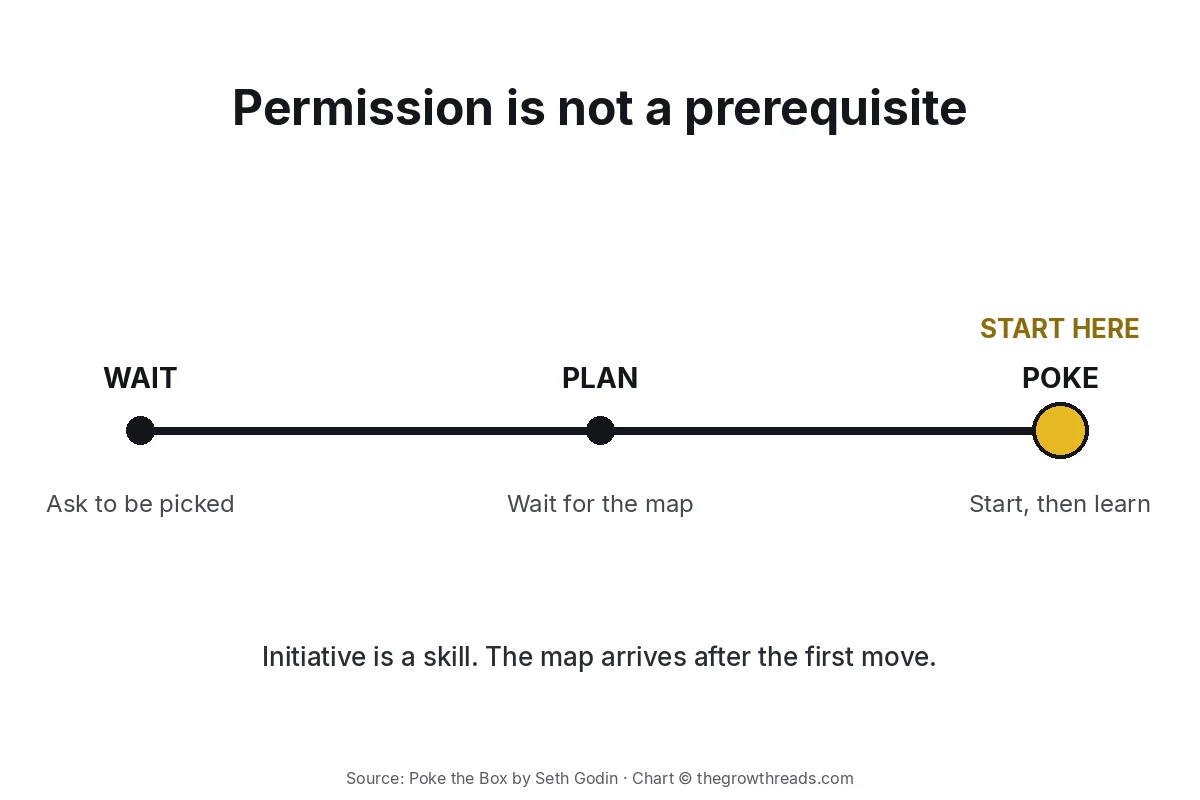
The scarce skill is not talent, taste, or a better plan. It is starting while the path is still ugly. Seth Godin’s 2011 manifesto is a short shove, not a system. Schools, jobs, and most “be professional” advice train you to wait: for the brief, the budget, the perfect week, the person with the clipboard. That training produced a surplus of pickers — people who will execute once someone else writes the map. It produced a shortage of initiators.
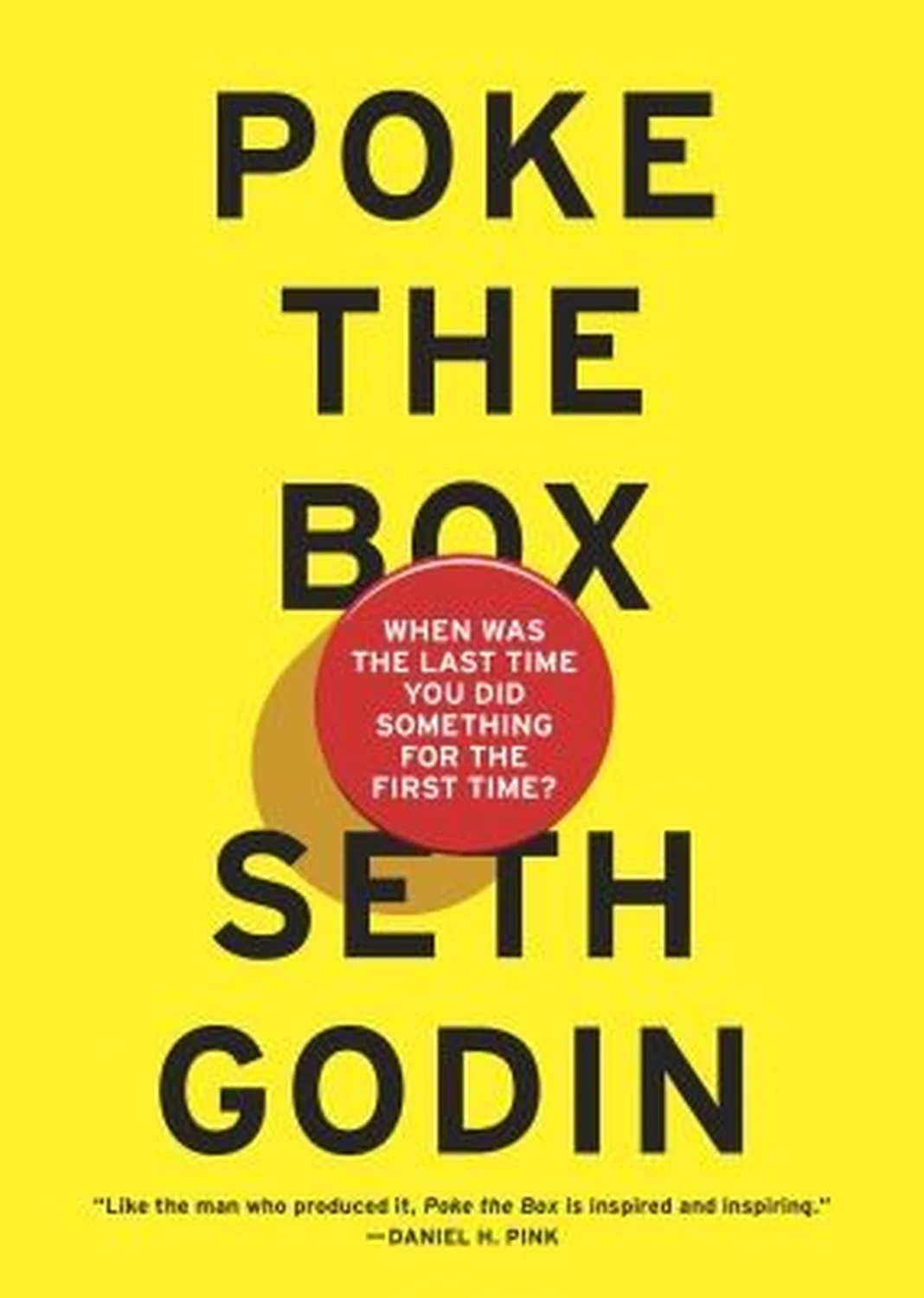
Poke the Box names the stall and gives it a physical image. The box is live. You do not know what it does until you touch it. A first pancake is supposed to be messy. Anxiety is just failure experienced in advance. The question that runs under every page is the one on the cover: when was the last time you did something for the first time? If the honest answer is last year, you do not need another framework. You need a poke with a date.
Key takeaways
- Initiative is the scarce hire. Plenty of people will run a play once it is drawn. Fewer will draw the first line.
- Pickers wait to be chosen. A missing spec feels like safety. It is usually a stall with better manners.
- Initiators start before the map exists. The path appears after contact with a live system, not before.
- The box talks back. A shipped draft, a live call, a public page — those return information a plan cannot.
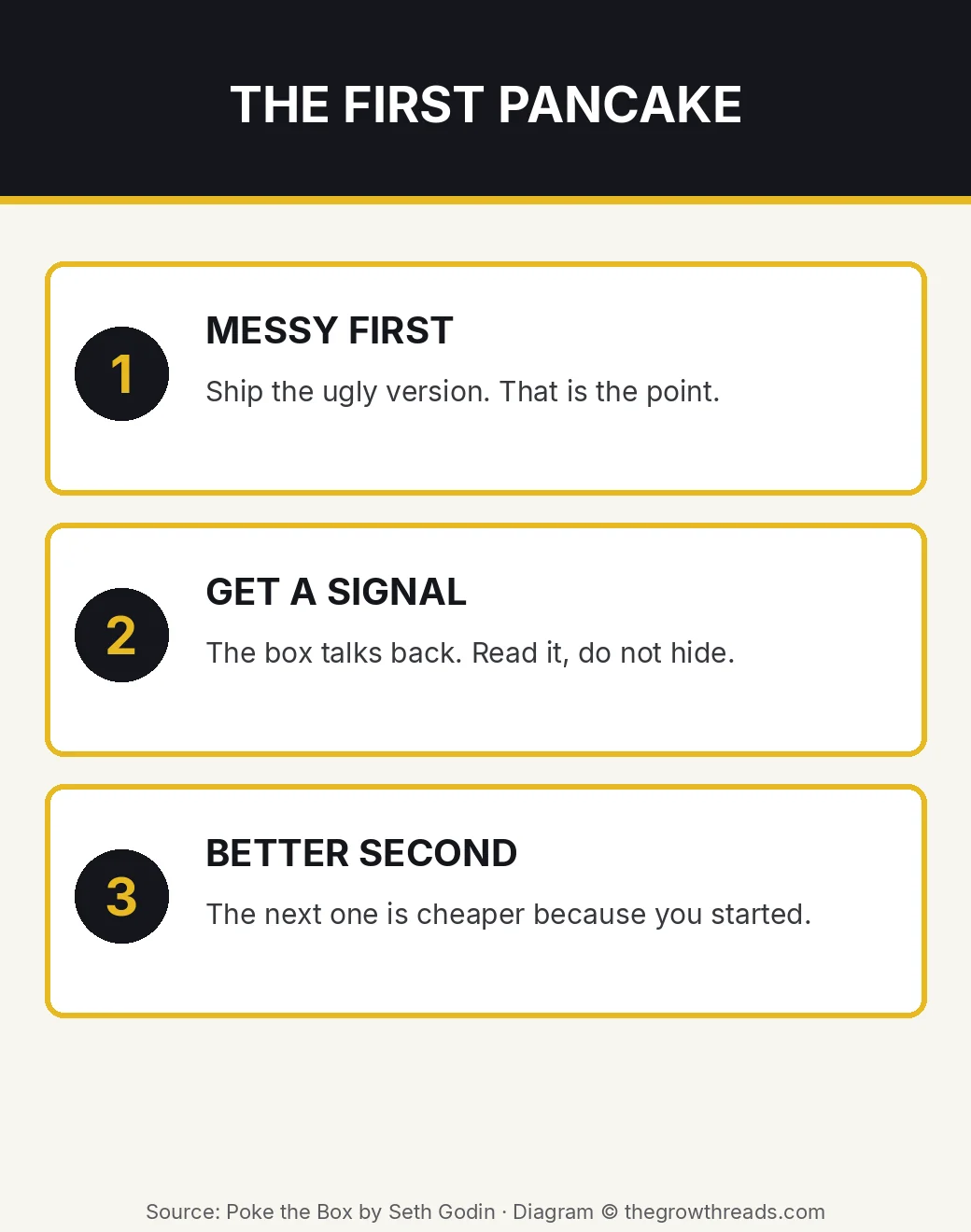
- The first pancake is supposed to be messy. Hiding until it is pretty is how the second pancake never happens.
- Anxiety is failure in advance. You are paying the cost of a miss you have not even run.
- Compliance is cheap. Following a complete map used to be a career. Now it is the easy part of the job.
- Soon is a hiding place. “After the reorg,” “after the course,” “after I feel ready” are the same sentence.
- Starting is a practice, not a mood. One poke a week beats a quarterly burst of courage you cannot schedule.
What is Poke the Box about?
Poke the Box is Seth Godin’s 96-page 2011 case that starting is now the scarce professional skill. In a culture that rewards waiting for permission, initiators poke a live system, read the signal, and go again — while pickers wait for a map that never arrives.
About the author
Seth Godin has spent two decades turning “ship it” into a public practice. He writes a daily blog, ran Yoyodyne (an early internet marketing firm later sold to Yahoo), and founded the altMBA and Akimbo workshops so people could learn by making, not by sitting. Purple Cow argued that very good is invisible. Linchpin argued that factory work is over. The Dip argued that quitting the wrong thing is a skill. Poke the Box sits earlier than those books: before you can be remarkable, indispensable, or strategically stubborn, you have to begin. The Practice, a decade later, is the calendar version of the same shove. Explore all Seth Godin book summaries →
Key concepts at a glance
| Concept | What it means | Use it when |
|---|---|---|
| Poke the box | Start a real interaction with a live system | You have been studying the work from the hallway |
| Initiator | The person who begins before the map is drawn | The team is waiting for a spec that will not come |
| Picker | The person who executes once chosen | You notice you only move after someone else decides |
| First pancake | The ugly first version that teaches the second | You are polishing a draft no one has seen |
| The live box | Any system that returns a signal when touched | A plan has replaced a customer, a page, or a ship date |
| Anxiety as advance failure | Paying for a miss you have not run | The fear is larger than the ninety-minute poke |
| Soon | A polite word for never | The calendar has a fog and no Friday |
Part 1: Starting is the scarce skill
Godin opens with a labor-market observation that still holds. Organizations can find people who will color inside the lines. They struggle to find people who will draw the first line when the page is blank. That is not a character flaw in the pickers. It is training. School rewards the complete answer. Most jobs punish the visible miss more than they punish the invisible delay. So adults get good at looking busy while the box sits unpoked.
Initiative used to be optional if you had a factory or a boss who handed you a route. Those maps thinned out. Most knowledge work now asks you to invent the next step, then defend it with evidence the step itself creates. Waiting for a complete brief is waiting for a job that is disappearing. The person who starts — even small — orients the room, because they gave everyone else something real to react to.
The book is thin because the argument is not complicated. You already know the project. You have the notes. You can describe the “someday” version in more detail than last week’s shipped work. The missing piece is contact. Godin is not asking you to bet the company. He is asking you to stop treating a blank calendar as professionalism.
TGR Note: If the stall is Resistance with a capital R — the voice that makes you clean the kitchen instead of open the file — The War of Art gives it a name and Do the Work gives it a short fight plan. Godin’s addition is labor, not myth: starting is the job now, not a personality type. Pair the poke with The Practice if you need a shipping calendar after the first move.
Part 2: Initiators, pickers, and a map that does not exist
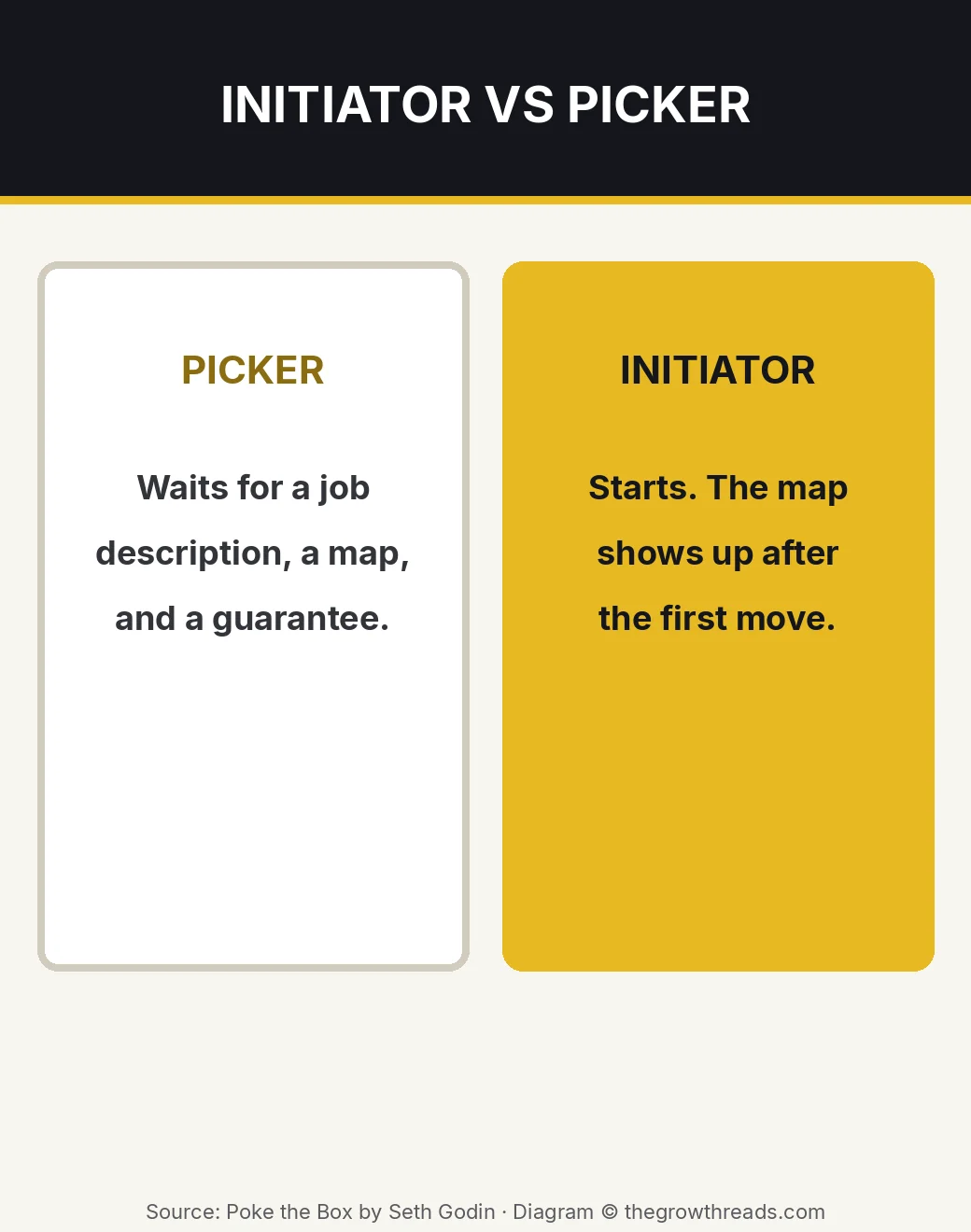
The book’s useful split is initiator versus picker. A picker waits to be selected. The selection can look official — a manager, a client, a budget — or private: a mood, a course, a guarantee that this time it will work. Pickers are not lazy. Many of them are excellent once the play is drawn. The trap is that fewer plays arrive pre-drawn. If your identity is “I execute well,” a missing map feels like the world failing you. Godin says the missing map is the assignment.
An initiator does not have more confidence. They have a different sequence: start, then learn. The map is a souvenir of motion, not a ticket you buy in the lobby. “I just need a better plan” is a stable stall because planning feels like work and never risks a no. Poking risks a no in ninety minutes. That is the feature. A no is a signal. A month of outlining is a mood.
Godin is careful not to crown chaos. Reckless people poke every box and call it bravery. Initiators pick one live system and accept the first messy return. They do not start seven companies before lunch. They start the thing that has been waiting, then they stay with the signal. If you need help choosing which hard thing to stay with, that is The Dip — written two years earlier, and the right sequel once you are in motion.
TGR Note: The Dip is the strategic-quitting companion, not a contradiction. Poke the Box gets you onto the field. The Dip decides whether the field is a cul-de-sac. If you skip the poke and only study quitting, you will quit things you never started. If you only poke and never quit, you will drown in first pancakes. Read them as a pair when the work has begun.
Part 3: The lizard brain and the first pancake
The fear in this book is not of hard work. It is of being seen while the work is still ugly. The first pancake sticks. You throw it out or you eat it standing up. Either way, the pan is now hot. People who refuse to cook until the first pancake looks like a magazine photo do not cook. They collect recipes.
Anxiety, in Godin’s line, is failure experienced in advance. You rehearse the email bouncing, the room going quiet, the metric staying flat — and you pay that cost today, with interest, without ever collecting the data. A poke is cheaper than that rehearsal. A ninety-minute draft sent to one person will usually hurt less than the week you spent imagining their face. The lizard brain wants you unseeable. Initiative makes you briefly visible. That is the whole conflict, and it does not need a personality test.
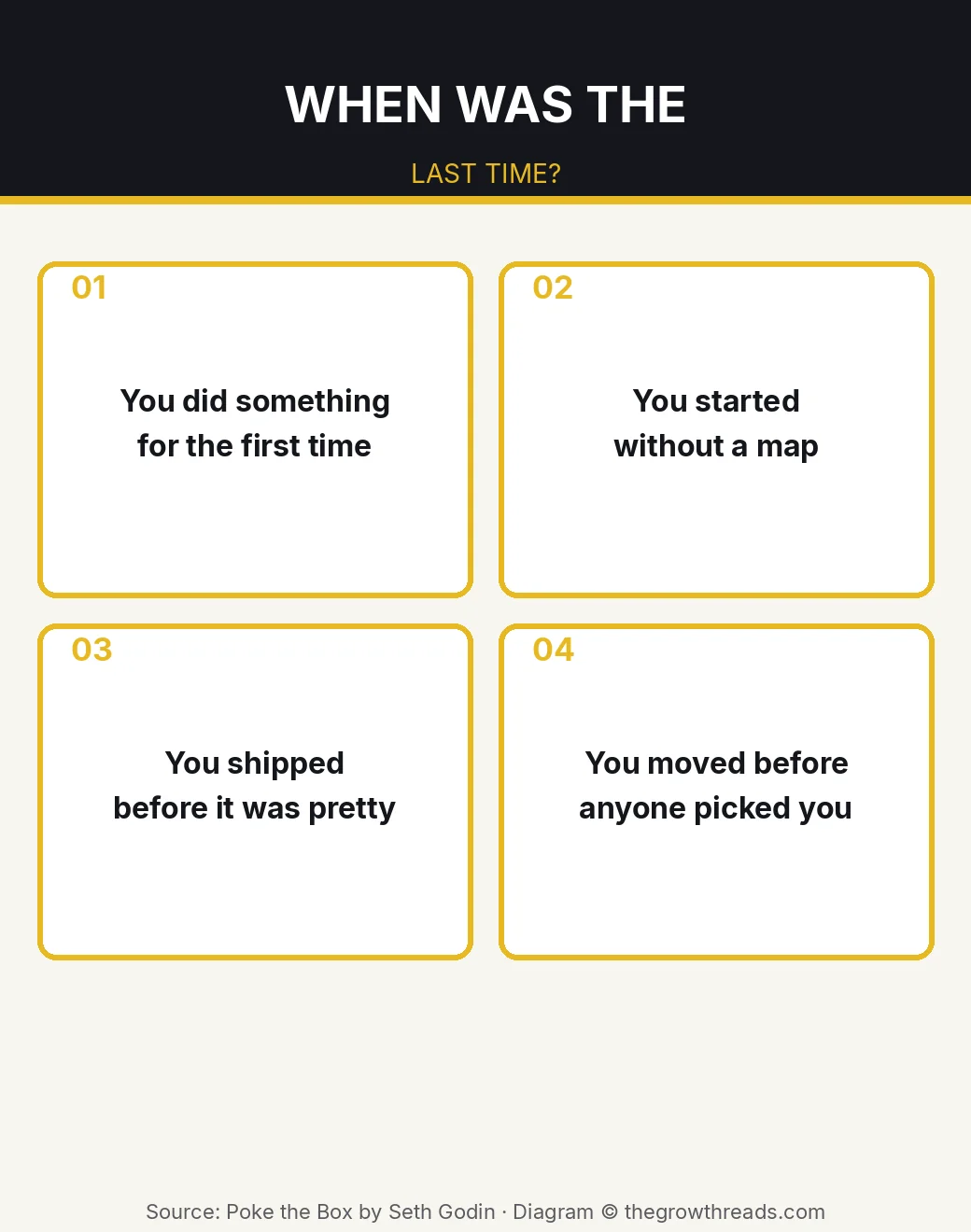
“When was the last time you did something for the first time?” is not a motivational poster. It is an audit. If the last first time was a new phone case, you have been picking. If the last first time was a page, a call, a product, a class you taught badly on purpose, you already know the feeling Godin wants back in the week. First times are supposed to be inefficient. That inefficiency is tuition, not evidence you should stop.
TGR Note: Linchpin is the longer argument that emotional labor and shipping are how you stop being interchangeable. Poke the Box is the first hour of that job. If you want the habit version of “small and shipped,” Atomic Habits will give you a cue and a two-minute start. Godin will not. He assumes you can find the box. He will not build you a streak tracker. Use Clear for the streak; use Godin for the shove.
Part 4: Make poking a habit
A single burst of courage is not the book. Initiators who poke once and then wait to be decorated become pickers again by Friday. Godin wants a stance: this is how I go to work. Not a personality rebrand. A calendar. The smallest honest version is one scheduled poke a week — a thing that leaves your desk and arrives in someone else’s day. Emails you send to yourself do not count. Notes in a private doc do not count. The box has to be live.
Soon is the enemy with good manners. It lets you keep the identity of someone who will start, without the risk of having started. Wrong-on-Tuesday produces a map. Impressive-in-November produces a folder. If you need a kinder on-ramp, Anything You Want makes the same point with a smaller company: start, serve, keep it tiny until it is real.
The close of the book is not a workbook. That is a feature and a limit. You will not find a 30-day challenge, a worksheet, or a diagnostic. You will find a question you can ask every Sunday night. If you cannot name a first time from the week that just ended, the next week needs a poke on Monday, not a new highlighter color. The 7-day plan below is TGR’s, not Godin’s. We added it because a shove without a date becomes a quote.
TGR Note: Today’s other Productivity summaries sit next to this one for a reason. Unfu*k Yourself is the self-talk that gets you out of the chair. Failing Forward is what to do with the miss after you poke. Godin is the missing middle: actually touch the box. If you only fix the inner monologue, or only study failure, you can still spend the week as a picker.
Who is Poke the Box best for — and who should read something else first?
Best for makers, freelancers, and operators who can already describe the work and still have not started. If your calendar is full of preparation and empty of shipped first versions, this is the book. It is also useful inside teams that have plenty of process and no one who will go first in the meeting.
Read something else first if you do not know what the work is. Godin will not choose your project. Use Essentialism or The One Thing to cut the pile, then come back. If you start constantly and never finish, you do not need another shove — you need Finish or The Dip. If you want a daily creative system rather than a manifesto, skip ahead to The Practice. If you want remarkability in the product itself, Purple Cow is the marketing sibling, not a substitute for starting.
Questions to reflect on
- When was the last time you did something for the first time — and was it work, or a purchase?
- Which project has the most notes and the fewest readers?
- Whose permission are you actually waiting for, and can they even give it?
- What would a ninety-minute first pancake look like for the thing you keep describing?
- If you shipped it ugly on Friday, who is the one real person who would see it?
🔥 Ready to poke one box this week?
Get Poke the Box, then use the 7-day plan to ship one first pancake to a real person.
How to apply Poke the Box (7-day plan)
- Day 1 — Name the box. Write one sentence: the live system you have been circling. One only.
- Day 2 — Define the poke. Cut it to ninety minutes. If it still needs a week, it is not a poke.
- Day 3 — Name the recipient. One real person. Not a Slack channel. Not future-you.
- Day 4 — Cook the first pancake. Make the ugly version. Do not open a second project.
- Day 5 — Ship it. Send it. The day it leaves your desk is the day the book starts working.
- Day 6 — Write the signal. Five lines: what came back, what surprised you, what you will change.
- Day 7 — Schedule the next poke. Put a first time on next week’s calendar before you reward yourself with a new plan.
Frequently asked questions
What is Poke the Box about in one paragraph?
Poke the Box is Seth Godin’s 2011 manifesto on initiative. In a world that still trains people to wait for a job description, a map, and a guarantee, the scarce skill is starting. Godin splits workers into pickers, who wait to be chosen, and initiators, who begin before the path is obvious. The “box” is any live system — a product, a team, a blank week. Poking it means shipping a first move, reading the signal, and going again. The book is short on purpose. The work it asks for is not.
What does “poke the box” mean?
To poke the box is to start a real interaction with a live system instead of studying it from the hallway. You send the draft. You launch the ugly version. You ask the customer. You publish the post. Godin’s image is physical: a box that might be connected to something. You do not know until you poke it. Waiting for a complete map is a way to never find out. The poke is small on purpose — the first pancake, not the banquet — so you can afford the information it returns.
How long does it take to read Poke the Box?
The Domino Project hardcover is 96 pages. Most readers finish it in about two hours, some in one sitting. That is the point: Godin did not write a course. He wrote a shove. Use the leftover week to run the 7-day plan in this summary — one start you have been narrating instead of shipping. If you treat the book as a weekend of highlighting and then return to waiting for permission, you read it as a picker. The value is the first move after the last page.
Is Poke the Box worth reading if I already read The Dip or Linchpin?
Yes, if starting is still the bottleneck. The Dip tells you which hard stretch to stay in and which cul-de-sac to leave. Linchpin tells you to become the person a factory cannot schedule. Poke the Box is earlier and smaller: begin before those books have a job. If you already ship on a calendar, go to The Practice instead — that is the daily system. If you are still waiting to be picked, this 96-page shove is the one that names the stall.
Who should read Poke the Box first?
People who already know what they want to make and still have not started. Freelancers waiting for a perfect brief. Employees who will not ship until the boss writes a spec that never arrives. Makers who research a week longer every time the work is about to be seen. If you need a habit architecture, start with Atomic Habits. If you need language for Resistance, start with The War of Art. If the only missing piece is the first poke, start here.
What is the difference between an initiator and a picker?
A picker waits to be selected — by a boss, a market, a mood, a complete plan. A picker treats a missing map as a reason to stay still. An initiator treats the missing map as the job. Initiators ship a first version, collect the signal, and let the path appear after contact with reality. Godin is not mocking caution. He is naming a labor market that already has enough people who will not move until someone else writes the script. Initiative is the scarce hire.
How do I apply Poke the Box at work this week?
Pick one live box you have been circling: a draft, a customer conversation, a messy internal tool, a page that has been “almost ready” for a month. Define a poke you can finish in ninety minutes — not the polished version. Ship it to a real person by Friday. Write down what the box said back. That note is the map. Do not add a second project until the first poke has a date and a recipient. Starting two things is how pickers fake momentum.
Related summaries
- The Dip — quit the cul-de-sac; stay in the hard stretch that is worth being best at.
- Linchpin — become the person a factory cannot schedule.
- The Practice — ship on a calendar instead of waiting to feel ready.
- Purple Cow — once you have started, make the thing worth a remark.
More in this silo: best productivity books.
How we analyze books: every book on The Growth Reads is read cover to cover, summarized in thousands of words of original analysis, and rated against our five-criteria rubric (lasting impact, evidence quality, practical application, writing & originality, external consensus). Read our full methodology.