

★★★★½ 4.5/5 — Busy is not the same as using your genius. Name the two types of work that fill you up, then redesign the rest.
Best for: ICs and managers who are competent, overloaded, and strangely tired.
Reading time: ~3 hrs (guide: 12 min)
Difficulty to apply: Easy to name your two geniuses. Harder to stop volunteering for the work that drains you.
The 6 Types of Working Genius in one minute
The week is full. The tank is not. Patrick Lencioni’s claim in The 6 Types of Working Genius is that the drain is often a type-of-work problem, not a grit problem. He names six activities every project needs: Wonder, Invention, Discernment, Galvanizing, Enablement, and Tenacity. You get joy and energy from two of them. You can do two more without filling up. The last two empty you even when you are “good at them.” Matt Holt published the book in 2022 (about 181 pages). You do not get another leadership pyramid. You get a filter for the next staff meeting: which types of work are on this plate, and whose genius actually matches them.
The book is a short fable plus the model, in the same family as The Five Dysfunctions of a Team. Some chapters retell the labels. The labels are the product. If the calendar looks well-rounded and Sunday still has dread, this is the map. If the team cannot tell the truth yet, start with Five Dysfunctions and come back.
Key takeaways
- Six types, not six personality costumes: Wonder, Invention, Discernment, Galvanizing, Enablement, Tenacity — activities inside the work, not vibes.
- Two geniuses per person: The types that give energy even when they are hard. Protect them on the calendar.
- Competency is not a virtue binge: You can do it. Too much of it still leaves you flat.
- Frustration is a design bug: Grinding the draining types to look well-rounded is how capable people burn out in place.
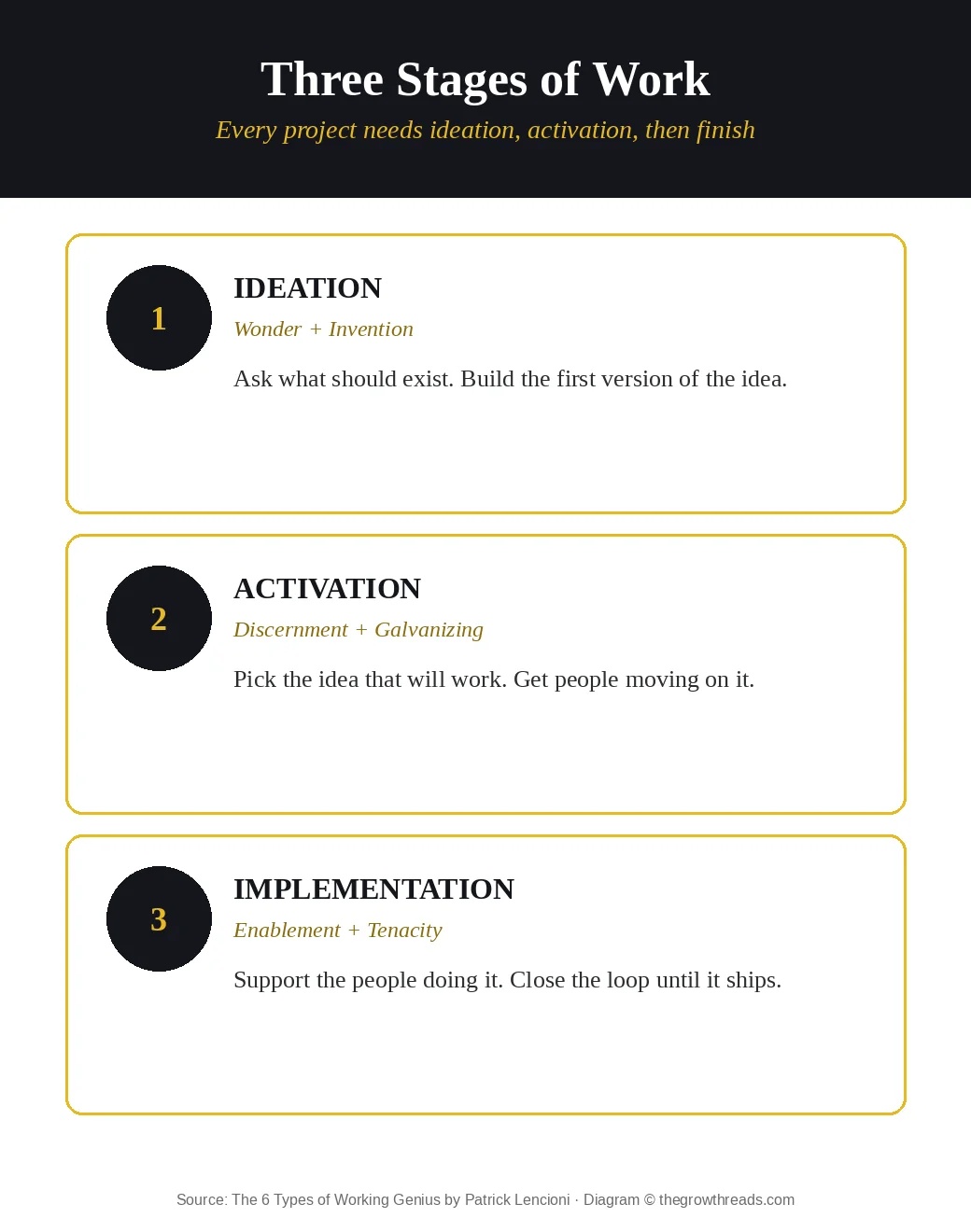
- Work has three stages: Ideation (Wonder + Invention), Activation (Discernment + Galvanizing), Implementation (Enablement + Tenacity).
- Teams stall on a missing stage: All ideas, no tenacity. All finish, no wonder. Hire for the gap.
- Pair people on purpose: Wonder needs Invention nearby. A Galvanizer without Discernment rallies the wrong thing.
- Energy after the task is the tell: Praise during the work can hide frustration.
- Redesign the mix: Move one recurring drain off your plate this week.
What is The 6 Types of Working Genius about?
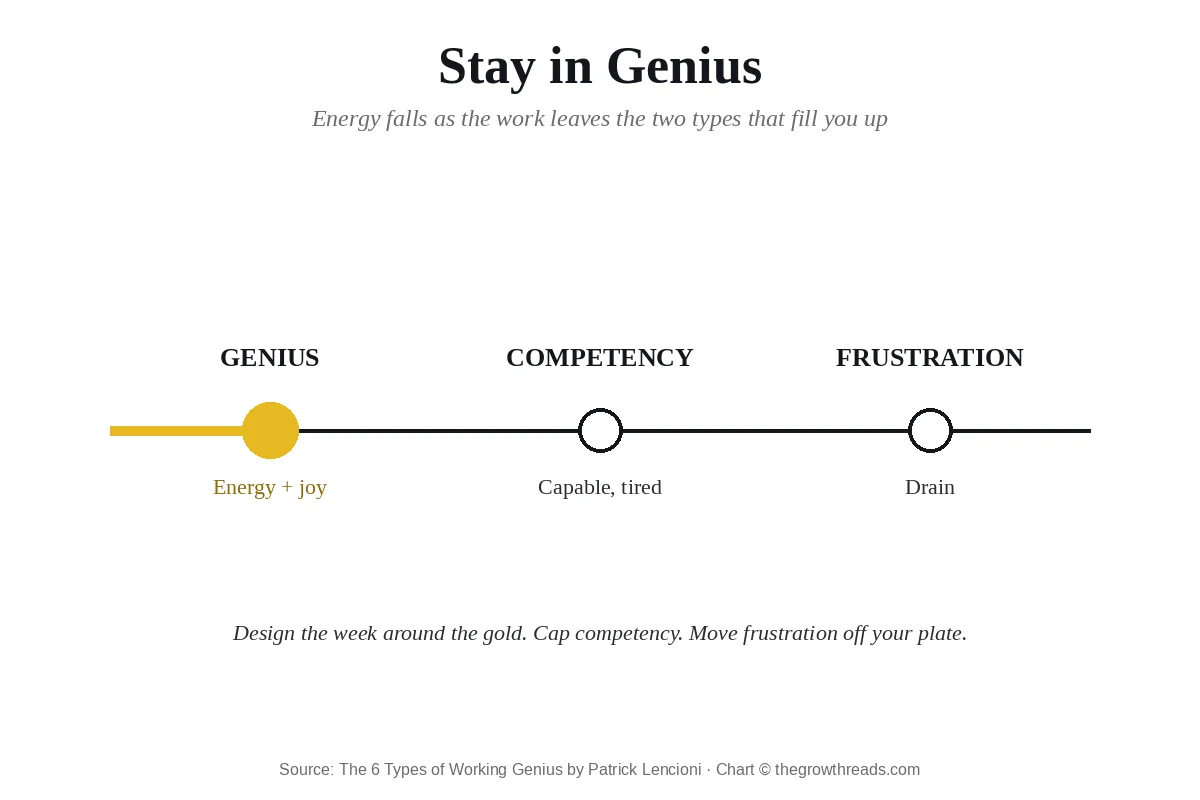
The 6 Types of Working Genius is Patrick Lencioni’s 2022 map of six types of work — Wonder, Invention, Discernment, Galvanizing, Enablement, and Tenacity. You get energy from two (genius), can do two more (competency), and drain on the last two (frustration). Use it to redesign the week around the types that fill you up.
About the author
Patrick Lencioni is a management consultant and founder of The Table Group, the firm behind The Five Dysfunctions of a Team, The Advantage, The Motive, and The Ideal Team Player. He writes business fables: a story, then a model you can put on a whiteboard before the next meeting. Working Genius (2022) is the work-type companion to those team books. The Table Group also runs a short assessment at workinggenius.com; the book stands on its own as the map. Lencioni’s through-line is organizational health over extra cleverness. Wikipedia has a page and no reliable author photo. Start with Five Dysfunctions if the room cannot tell the truth. Start here if the room is honest and still tired. Explore all Patrick Lencioni book summaries →
Key concepts at a glance
| Concept | What it means | Use it when |
|---|---|---|
| Working Genius | The two types of work that give joy and energy. | The calendar is full and you still feel unused. |
| Working Competency | Work you can do; it does not fill you up. | You are the reliable person on every extra task. |
| Working Frustration | Work that drains you even if you are skilled. | Sunday dread has a recurring meeting attached. |
| WIDGET | Wonder, Invention, Discernment, Galvanizing, Enablement, Tenacity. | You need a shared list for a project audit. |
| Ideation | Wonder + Invention — what should exist, then a first version. | The team only starts when a ticket already exists. |
| Activation | Discernment + Galvanizing — pick it, then rally people. | Ideas die in the parking lot, or every idea ships. |
| Implementation | Enablement + Tenacity — help people, then finish. | Demos look great and nothing closes. |
| Well-rounded myth | Hiring for all six types in one body. | The job post says “strategic doer who also loves details.” |
Part 1 — Busy is not the same as using your genius
Lencioni opens where most productivity books refuse to: the competent person who is not lazy, not confused, and still depleted. The fable’s team is shipping, attending, and smiling in stand-up. The private story is “I should be grateful.” That sentence is how frustration hides. The book’s first move is to separate volume of work from type of work. A week of meetings can be a Wonder week, a Tenacity week, or a mixed mess. Hours do not tell you. Energy after the hour does.
The practical reconstruction is an audit, not a destiny quiz. List the last ten tasks that ate real time. Mark each one: filled me up, fine, emptied me — before you name geniuses. People guess identity from the role they were hired into. The marks are better evidence. If eight of ten tasks are “fine” or “emptied me,” you have a mix problem. Moving one recurring drain beats a new planner.
Genius work can still be hard. The tell is whether the difficulty still has aliveness. Frustration can look easy from the outside and still cost the evening. Praise is a bad sensor — other people clap for competency because competency is useful to them.
TGR Note: If the drain is the job shape, not the next habit: Designing Your Work Life. If the drain is people-hours, not task types: Peopleware. Working Genius is the type-of-work filter inside those larger redesigns.
Part 2 — The six types (Wonder through Tenacity)
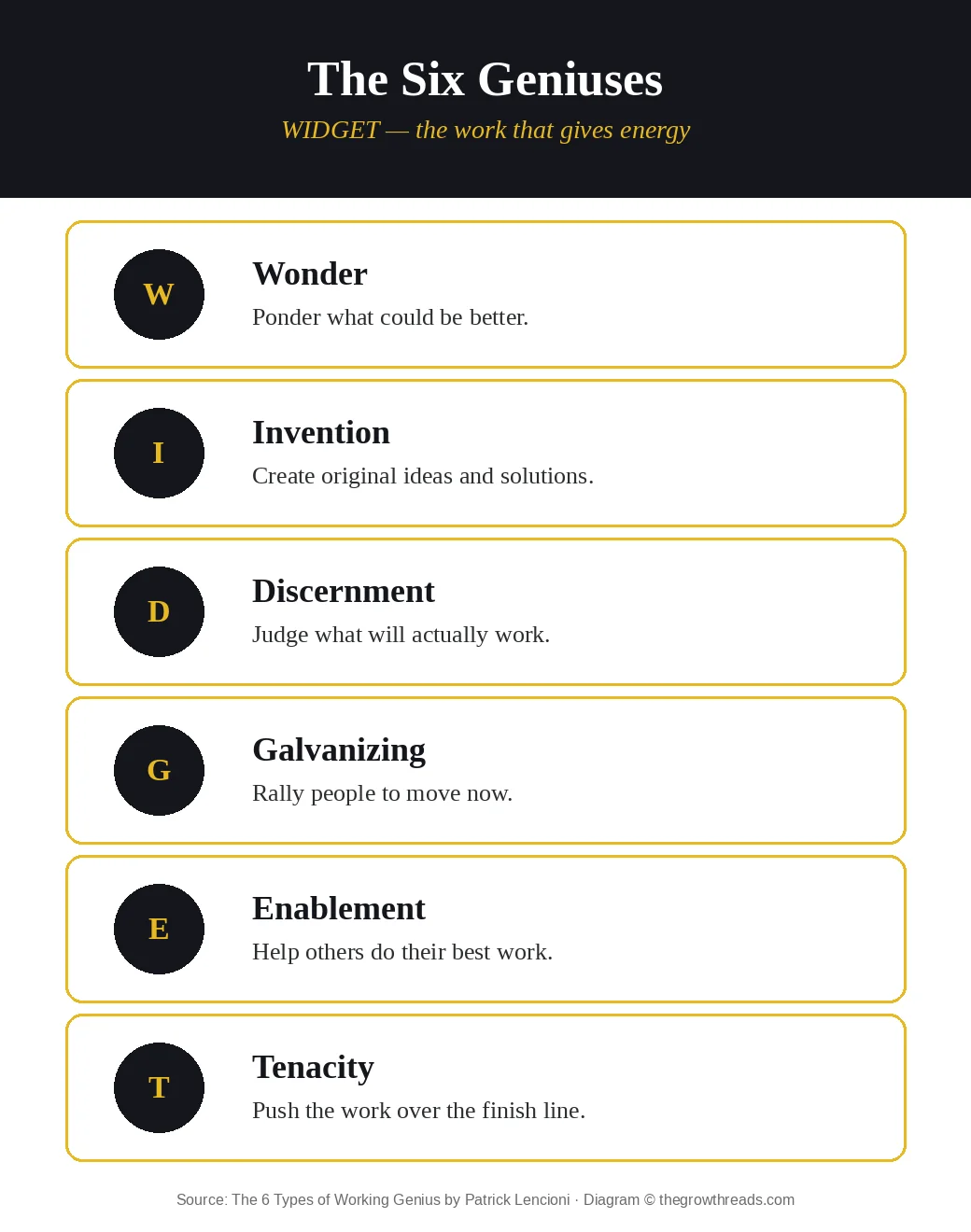
The six types are activities, not costumes. Wonder is the person who stares at a process and asks why it exists. Invention is the person who cannot leave the question as a question — they build a draft. Discernment is pattern-and-gut judgment: this version will work, that one is theater. Galvanizing is getting bodies and attention onto the thing. Enablement is the help that makes other people’s genius usable — unblocking, supporting, setting up. Tenacity is the push through the ugly middle until the work is actually done.
WIDGET is a memory aid, not a maturity ladder. Wonder is not “more strategic” than Tenacity. A company that only wonders never invoices. A company that only has tenacity becomes a factory for the last idea that got yelled. Lencioni’s fable keeps putting the same project in front of people with different geniuses so you can watch the stall: the Inventor who will not stop adding features, the Galvanizer who rallies the room before Discernment has voted, the Tenacity person asked to “just be more visionary” as if finishers were a character flaw.
You are looking for two geniuses, not a ranking of all six. The second genius is often the one you discount because it does not match the job title. A manager hired to “drive execution” may have Wonder and Discernment and be using Tenacity as a competency until they are empty. Saying that out loud is not a performance review. It is a mix diagnosis.
TGR Note: Talent language that is not task types: StrengthsFinder 2.0. Character in hiring: The Ideal Team Player. Use StrengthsFinder for how you think. Use Working Genius for which activities belong on this week’s plate.
Part 3 — Genius, competency, and frustration
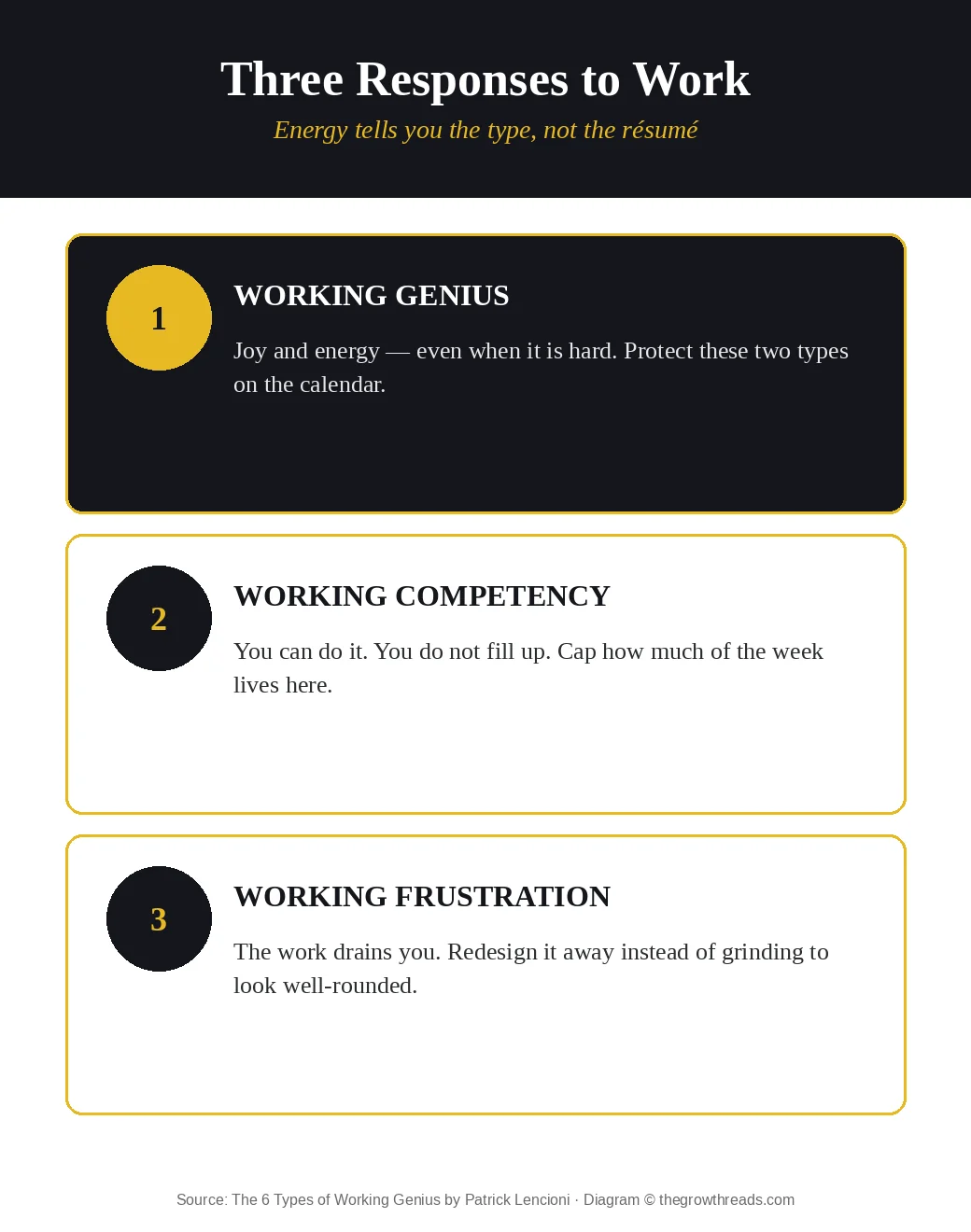
The three responses are the operational heart of the book. Genius: you would do this work even if the slide did not have your name on it. Competency: you can, you will, you should not live here. Frustration: the work costs more than it returns, including when you are praised for it. Lencioni’s warning about well-roundedness is aimed at job posts and at self-image. “Strategic doer who loves the details and also coaches the team” is six types wearing one salary. That person exists in the posting. They do not exist in the chair without a hidden frustration tax.
Competency is the trap because it is socially rewarded. Teams hand extra work to the person who will not drop it. Six months later that hero is the quiet resignation. Cap, rotate, or pair one recurring competency block. You do not need a reorg. You need one meeting that sits on the wrong genius moved to the right one.
Frustration is not a growth edge you have failed to grind through. People can get more skilled at a frustrating type. Skill does not turn it into genius. The book is gentle on this and still firm. If Enablement empties you, becoming a slightly better enabler is still a drain. Pair with someone whose genius is Enablement. Keep your name on the Wonder questions. That is not selfish. That is how the project gets both the question and the help.
TGR Note: Accountability for the next move, not the mix of tasks: QBQ!. Intrinsic drive when the type is already right: Drive. Working Genius does not replace either. It tells you whether the task you are owning is even in your two.
Part 4 — Map the team to the three stages of work
The six types collapse into three stages every piece of work has to pass. Ideation: Wonder plus Invention. Activation: Discernment plus Galvanizing. Implementation: Enablement plus Tenacity. Draw the three columns on a whiteboard. Put names, not wishes. Most stalls are a missing column. Product teams that live in ideation ship decks. Ops teams that live in implementation ship the previous idea forever. Activation is the quiet gap: someone has to pick, then someone has to get people moving. Without Discernment, Galvanizing becomes volume. Without Galvanizing, Discernment becomes a private opinion.
Pairing is the team-level practice. Wonder without Invention never becomes a draft. Invention without Discernment is a prototype factory. Galvanizing without Enablement burns people after the rally. You do not need every genius in every meeting. You need the stage on the agenda to be in the room.
Hiring rewrite: stop looking for a unicorn of all six. Hire the missing stage, then design the role so frustration is not the job. In 1:1s, ask what filled them up this week, not only what shipped. If the answer is always the fire drill, you are paying genius rates for frustration hours.
TGR Note: Team truth-telling first: The Five Dysfunctions of a Team. Owner time and system design: Clockwork. Working Genius is the work-mix layer. Use it after the room can tell the truth, before you automate a role that is already the wrong mix.
Who is The 6 Types of Working Genius best for — and who should read something else first?
Best for individual contributors and managers who are clearly competent and still tired in a way sleep does not fix. Best for team leads who keep writing “strategic executor” on job posts and then wonder why the new hire is empty by month four. Best for people who already like Lencioni’s fable-plus-model style and want the work-type companion to Five Dysfunctions.
Read something else first if the team cannot disagree in the room — start with The Five Dysfunctions of a Team. If the hiring problem is humility, hunger, and people smarts, start with The Ideal Team Player. If you want talent themes rather than task types, start with StrengthsFinder 2.0. If you need a full proactive operating system, start with The 7 Habits and come back. Working Genius is a filter for the mix of work. It is the wrong first book if the actual problem is trust, character, or a missing life OS.
Questions to reflect on
- Which two types of work from last week filled you up even when they were hard?
- Which recurring meeting or task empties you, and whose genius would it actually be?
- Where are you being praised for competency that you are treating as identity?
- Which of the three stages — ideation, activation, implementation — is missing on your current project?
- What is one drain you can move off your plate this week without asking for a new title?
🔥 Ready to work in your genius?
Name your two types this week, then move one draining task off your plate before Friday.
How to apply The 6 Types of Working Genius (7-day plan)
- Day 1 — Audit ten tasks. List the last ten that ate real time. Mark each filled / fine / emptied. No labels yet.
- Day 2 — Guess your two geniuses. From the “filled” marks, pick two WIDGET types. Write them at the top of the week.
- Day 3 — Name two frustrations. From the “emptied” marks. Circle one that recurs every week.
- Day 4 — Move one drain. Delegate, pair, or delete that circled task. One is enough.
- Day 5 — Map one teammate privately. What stage do they actually light up in? Do not diagnose them in public.
- Day 6 — Redesign one meeting. Invite the genius the agenda actually needs. Skip the well-rounded crowd.
- Day 7 — Protect two genius blocks. Put 90 minutes on next week’s calendar for your two types. Treat them like a customer meeting.
Frequently asked questions
What is The 6 Types of Working Genius about?
The 6 Types of Working Genius is Patrick Lencioni’s 2022 model of six types of work: Wonder, Invention, Discernment, Galvanizing, Enablement, and Tenacity. Each person has two types that give energy (Working Genius), two they can do without filling up (Working Competency), and two that drain them (Working Frustration). The book is a short fable plus the model, from Matt Holt, about 181 pages. Use it when you are busy, competent, and strangely tired. It is not a leadership pyramid. It is a map for redesigning the week around the two types that actually fill you up.
What are the 6 types of Working Genius?
Lencioni names six: Wonder (asking what could be better), Invention (creating original ideas), Discernment (judging what will work), Galvanizing (rallying people to act), Enablement (helping others do their best work), and Tenacity (pushing work over the finish line). The acronym is WIDGET. You are not supposed to be strong in all six. The claim is that every person has two geniuses. The other four split between competency and frustration. The practical move is to name your two, then stop volunteering for the two that empty you, even if you are good at them.
What is the difference between genius, competency, and frustration?
Working Genius is the work that gives joy and energy, even when it is hard. Working Competency is work you can do well enough; it does not fill you up, and too much of it leaves you flat. Working Frustration is work that drains you even if the résumé says you should be able to do it. Lencioni’s point is that well-roundedness is a hiring myth. A week full of competency looks productive from the outside and still produces the Sunday dread. Redesign frustration off your plate. Cap competency. Protect genius on the calendar as if it were a meeting with a customer.
Is Working Genius the same as StrengthsFinder?
No. StrengthsFinder names talent themes you bring to many kinds of work. Working Genius names types of work themselves — the activities inside a project. You can have Achiever or Strategic as a theme and still be in Working Frustration if the actual tasks are Tenacity when your genius is Wonder. Read StrengthsFinder when you want language for how you think. Read Working Genius when the calendar is full of tasks that should fit and do not. Plenty of people use both: themes for identity, genius types for the next staff meeting’s work design.
How do the three stages of work fit the six types?
Lencioni groups the six types into three stages every project needs. Ideation is Wonder plus Invention: what should exist, then the first version of the idea. Activation is Discernment plus Galvanizing: pick the idea that will work, then get people moving. Implementation is Enablement plus Tenacity: support the people doing it, then close the loop until it ships. A team that is all ideation never ships. A team that is all tenacity ships the wrong thing. Map the room against the three stages before you hire another “utility player.” The missing stage is usually the missing genius, not a missing motivational speech.
Can my Working Genius change?
Lencioni treats the two geniuses as relatively stable, not a mood. Competency can look like genius for a season because you are skilled and the work is on fire. The tell is energy after the work, not praise during it. If a type keeps emptying you across roles, it is likely frustration, not a growth edge you have failed to grind through. People do get better at competency with practice. That is not the same as it becoming a genius. Recheck after a role change. Do not recast yourself every quarter because a new tool is fashionable.
Who should read The 6 Types of Working Genius?
ICs and managers who are busy, capable, and tired in a way sleep does not fix. Team leads who keep hiring “well-rounded” people and still have the same stall. Skip it as a first book if the team cannot tell the truth yet — start with The Five Dysfunctions of a Team. If the problem is character in hiring, start with The Ideal Team Player. If you want a wider proactive map, start with the 7 Habits and come back. Working Genius is the work-type filter. Use it when the stall is the mix of tasks, not the absence of a goal.
Related summaries
- StrengthsFinder 2.0 Summary & Review — talent themes; Working Genius is the task types
- Clockwork Summary & Review — design the business so one body is not every type
- Peopleware Summary & Review — the drain is often the environment, not the person
- QBQ! Summary & Review — own the next move once the mix is right
- Best productivity books — the full Productivity silo
How we analyze books: we paraphrase arguments, add original application notes, and skip chapter-by-chapter reproduction. Read our full methodology.