

★★★★½ 4.5/5 — Personal accountability starts with the question you ask next. Stop Why and When. Ask what you can do.
Best for: ICs and managers who stall in blame or waiting, then call it alignment.
Reading time: ~2.5 hrs (guide: 12 min)
Difficulty to apply: Easy to understand. Hard to catch the question while the meeting is still live.
QBQ! in one minute
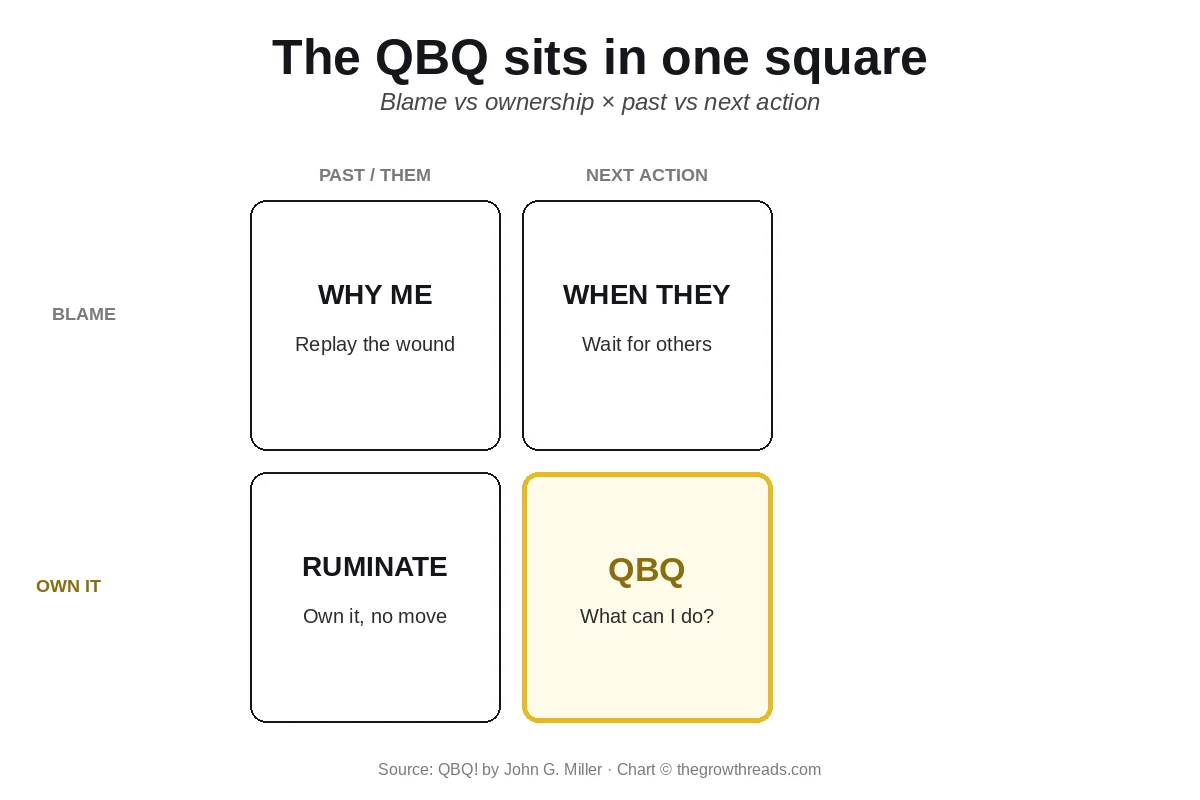
The question you ask next is the job. John G. Miller watched sales floors and staff meetings die on two kinds of sentence: Why is this happening to me, and When will they finally. Both sound like analysis. Both are a way not to move. QBQ! — The Question Behind the Question — is a short Putnam book (2004) that gives those sentences a name, then replaces them with a filter you can use before the meeting ends: start with What or How, put an I in it, aim at action. You do not get a personality type. You get a rewrite.
The book is small on purpose. Miller runs a training firm on this one idea. Some chapters repeat. The filter does not. If your week is full of waiting for the boss, the market, or a teammate who “should already know,” this is the practice. If you need a full life operating system, start with the 7 Habits and come back for the sentence-level tool.
Key takeaways
- Incorrect questions stall the room: Why and When point at them. They feel sharp and produce no next move.
- A QBQ has three tests: What or How, an I, and action. Fail one and you are still in the cover question.
- Victim thinking is a speech habit: Not a personality. You can catch it in the next sentence.
- Accountability is personal first: You cannot vote someone else into ownership from a Why slide.
- Waiting is a decision: When will they is a calendar you do not control. What can I do is one you do.
- I beats we in the question: We should is often nobody. I will is a name.
- Action, not autopsy: A better story about yesterday is not a QBQ.
- Service is owned questions: Outstanding work starts with How can I help this person now, not When will they appreciate me.
- Reps beat a speech: One rewrite in a live meeting is worth a poster about ownership.
- The question behind the question is the one you are avoiding because it would require you to move today.
What is QBQ! about?
QBQ! is a practice book on personal accountability. Miller’s claim is that the first question you ask is often a cover — Why are they like this, When will management decide — and the useful question is the one behind it: What can I do, How can I contribute. A QBQ starts with What or How, contains an I, and points at action. The Putnam 2004 edition is the one most readers have. Use it when the stall is a sentence, not a missing operating system.
About the author
John G. Miller founded QBQ, Inc. in Denver to teach personal accountability as a trainable habit, not a pep talk. He came through sales and organizational training, sitting in rooms that could describe the problem for forty minutes and still had no owner for the next hour. QBQ! is the short field book from that work; Flipping the Switch, Outstanding!, and Parenting the QBQ Way extend the same filter into follow-through, service, and home. There is no Wikipedia page that reliably identifies this Miller — skip random John Miller photos. For a full life OS, start with The 7 Habits. For the sentence you can use on a Tuesday, start here. Explore all John G. Miller book summaries →
Key concepts at a glance
| Concept | What it means | Use it when |
|---|---|---|
| QBQ | The Question Behind the Question — the owned rewrite. | The first question out of your mouth points at them. |
| Incorrect questions | Why and When, aimed at other people or fate. | The meeting is a complaint with a question mark. |
| Three tests | What/How + I + action. | You need a yes/no check on the sentence. |
| Victim thinking | A speech habit that outsources the next move. | The story is always they, never the hour you control. |
| Personal accountability | Owning your piece without waiting for the mood to change. | Alignment is code for waiting. |
| I vs we | We should often means nobody will. | The action item has a committee and no name. |
| Outstanding | Service as How can I help now, not When will they notice. | The team is keeping score of appreciation. |
| No more “I had no choice” | There is almost always a next owned question. | The excuse is the whole status update. |
Part 1 — Incorrect questions keep you stuck
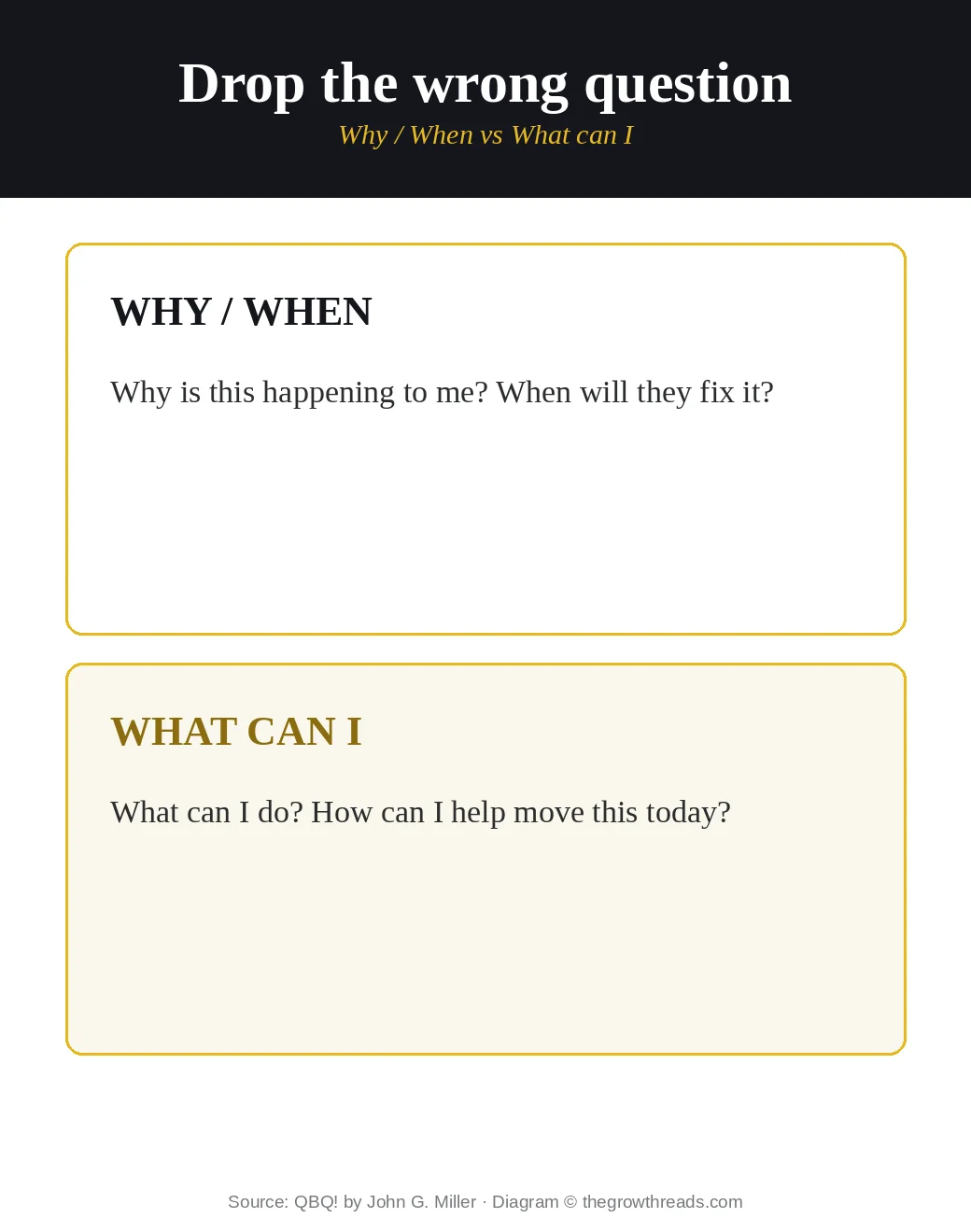
Miller’s opening move is linguistic, not motivational. He listens for two families of question that sound professional and produce no motion. Why is this happening to me, Why don’t they train us, Why is the process like this. When will they decide, When will the client get back, When will management finally. Why looks backward and assigns a villain. When looks forward and assigns a savior who is not in the room. Both let you stay in the chair. The room feels like it did analysis. Nothing has an owner.
He calls this victim thinking and he means a habit of speech, not a diagnosis. People who are competent at their craft still default to Why/When under load because those questions are socially cheap. You can say them in a standup and get nods. A QBQ is socially slightly more expensive: it names you. That is why teams that pride themselves on “candor” can still be unaccountable. Candor about them is not ownership of the next hour.
The productivity cousin is the blame loop. Failing Forward wants the miss to become a lesson instead of a prosecution. Miller wants the lesson to start with a different question, not a better villain. What Got You Here Won’t Get You There is the habit you cannot hear in yourself. Why/When is one of those habits. You already know the content of the complaint. The stall is the grammar.
TGR Note: Learn instead of prosecute: Failing Forward. Hear the habit: What Got You Here Won’t Get You There. QBQ is the sentence-level version — change Why/When before you change the org chart.
Part 2 — Build a QBQ: What, How, and I
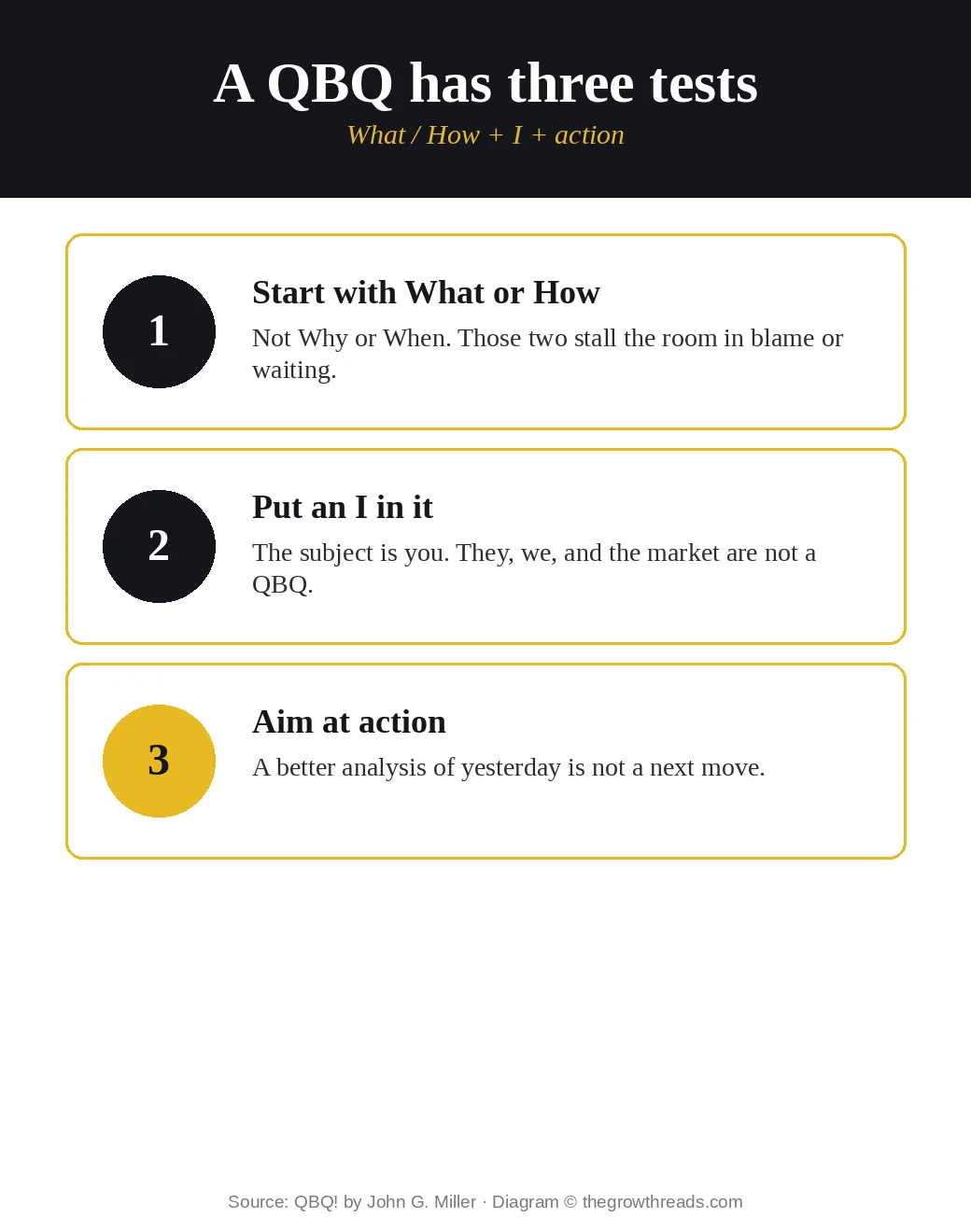
The construction rules are strict so you cannot cheat with tone. A QBQ begins with What or How. It contains an I. It focuses on action. Why don’t they communicate better fails all three. What can I do to make the next handoff clearer passes. How can we as an organization is a trap: we is often nobody, and organization is a way to delay until the offsite. Miller would rather you sound slightly awkward and named than fluent and unowned.
The “question behind the question” is the one you are avoiding. Why is this late is easy. What can I do in the next two hours to unstick the piece I own is the one that would require you to close the laptop and move. People hide in the first question because it is true enough. The client is slow. The spec is messy. The boss has not decided. All can be true. None of them are a QBQ. The QBQ does not deny the mess. It picks a lever you can pull without a vote.
This is narrower than a life philosophy, which is the point. The 7 Habits gives you Circle of Influence as a map. QBQ is the next sentence inside that circle. Managing Oneself wants you to know your strengths and take responsibility for how you work. Miller wants the responsibility to show up as grammar. If you cannot pass the three tests, you are still describing the weather.
TGR Note: Circle of Influence: The 7 Habits. Own how you work: Managing Oneself. QBQ is not a replacement OS. It is the filter you run on the next line in standup.
Part 3 — Accountability at work beats waiting
The workplace chapters are where the book earns its training-room fame. Miller’s examples are ordinary: a sales person waiting for marketing, a manager waiting for a budget, a teammate waiting for “clarity.” Each is a When will they. Translate: What can I do with the information I already have. How can I ship a smaller piece. How can I ask one specific person for one decision by Friday. The QBQ does not make you the CEO. It stops you from using the missing CEO as a blanket.
He is blunt about we. We should improve communication is a toast. I will send the three risks in writing today is a QBQ with a timestamp. Teams that live in we collect alignment and miss weeks. This is not a license to go rogue. A QBQ can be How can I escalate this cleanly. Escalation is still an I and an action. Silence dressed as patience is a When.
If the job is actually command of a unit, you will want a thicker doctrine. Extreme Ownership is the commander owning the result, including other people’s misses. Miller is the individual who does not run the unit and still needs a next move. No Excuses! is Tracy’s discipline hammer. QBQ is smaller and more linguistic. Use Tracy when the miss is follow-through you already agreed to. Use Miller when the miss is still hiding in the question.
TGR Note: Command of a unit: Extreme Ownership. Follow-through you already promised: No Excuses!. QBQ is for the hour before either of those books has a scene to work with — the sentence that would have kept you waiting.
Part 4 — Practice the question until it sticks
Miller’s later chapters are practice, not a new model. Outstanding service is How can I help this person now, not When will they notice. Parenting and home get the same filter: What can I do tonight, not Why are they like this. The risk in a short book is that you underline Outstanding and hang it on a wall. The work is catching the cover question in the meeting, rewriting it out loud, and doing one owned thing the same day. If the rewrite only happens in the car, you still waited.
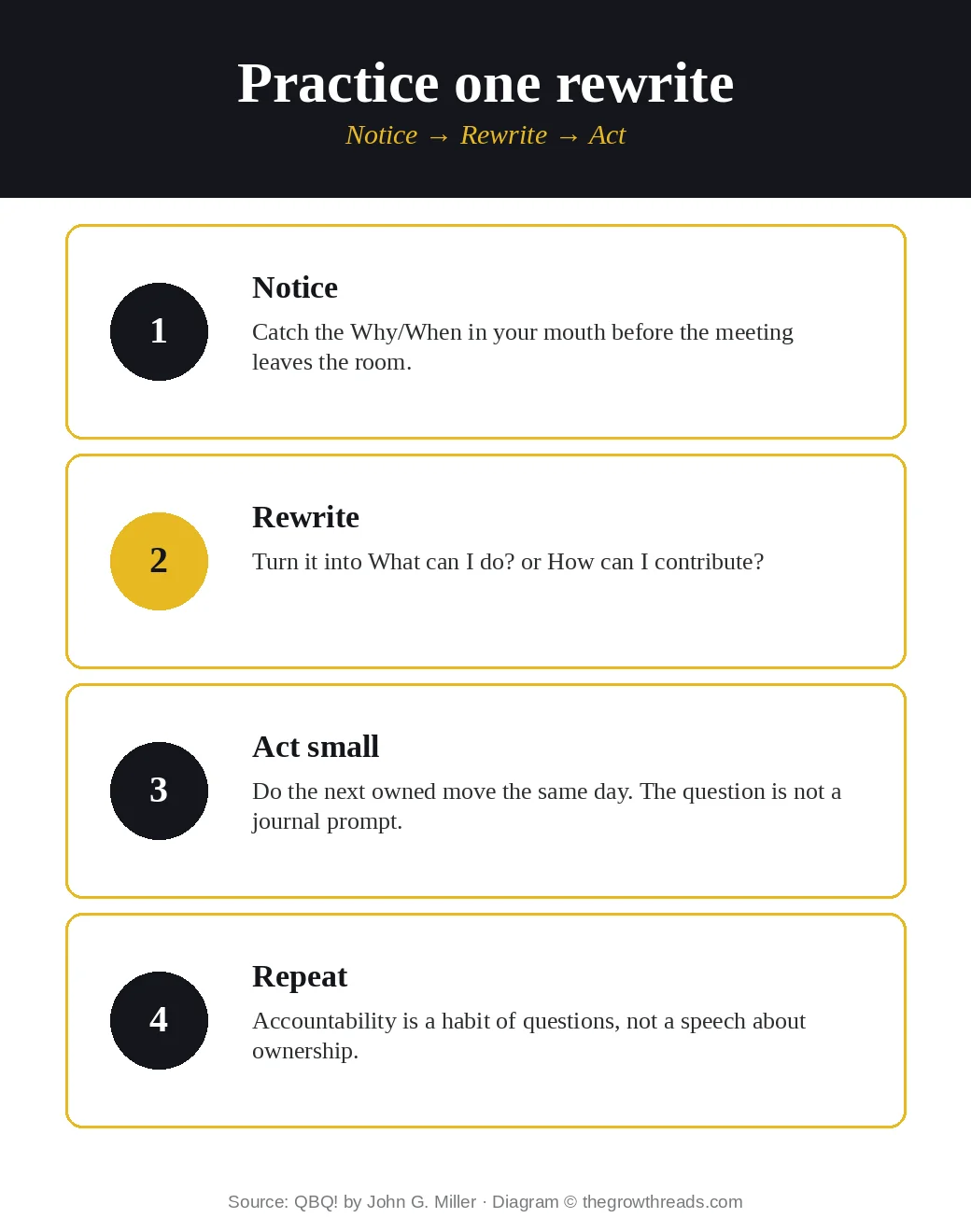
Repetition is the method. The chapters loop because the mistake loops. People learn the three tests on a workshop morning and fail them at 2 p.m. because Why is faster. The 7-day plan below is just reps: notice, rewrite, act, repeat in a harder room. High Performance Habits would call this a practice, not a mood. Atomic Habits would shrink the action until it is two minutes. Miller would still insist the question has an I in it. A tiny unowned task is still a When will they.
The book will feel thin if you wanted a system for strategy, hiring, or deep work. That is fair. It is a filter. Use it as a filter. When the strategy is actually missing, go get a strategy book. When the only missing piece is that everyone is waiting, you do not need another framework. You need a different first sentence.
TGR Note: Practice, not mood: High Performance Habits. Shrink the action: Atomic Habits. Keep Miller’s three tests on the tiny version. A two-minute task with no I is still a cover question.
Who is QBQ! best for — and who should read something else first?
Best for individual contributors and managers whose weeks disappear into Why/When loops: waiting on the boss, the client, the other team. It is also for the person who already believes in ownership and still hears those questions come out of their mouth in standup. If the stall is a sentence, this is the book.
Read something else first if you need a full operating system — start with The 7 Habits. If the job is leading a unit through a miss, start with Extreme Ownership. If the miss is a habit you cannot hear, What Got You Here Won’t Get You There. If you need a goal for the day more than a question filter, Today Matters. Come back to QBQ when the remaining bug is the first sentence in the room.
Questions to reflect on
- What Why or When did you say in the last meeting, and what QBQ was hiding behind it?
- Where is we should doing the work of I will?
- Who are you waiting on that you could make a smaller owned move without?
- Which of the three tests does your favorite complaint fail?
- If you rewrote today’s status as a QBQ, what would you actually do before lunch?
🔥 Ready to change the question?
Catch one Why/When today and turn it into a QBQ you can act on before the meeting ends.
How to apply QBQ! (7-day plan)
- Day 1 — Catch one Why/When. Write the exact sentence you said or thought. Do not fix it yet.
- Day 2 — Run the three tests. Rewrite it so it starts with What or How, contains I, and names an action.
- Day 3 — Do the owned piece. One move the rewrite pointed at, same day, before you explain the rest of the mess.
- Day 4 — Kill one we should. Replace it with I will plus a timestamp in a real thread.
- Day 5 — Live meeting. When Why/When appears, say the QBQ out loud once. Awkward counts.
- Day 6 — Service question. How can I help this person now — one customer, teammate, or report. Not When will they notice.
- Day 7 — Review the week. Count cover questions vs QBQs. Keep the one rewrite that actually moved work. Repeat it Monday.
Frequently asked questions
What is QBQ! about?
QBQ! is a short field book on personal accountability. John G. Miller argues that the question you ask next either keeps you in victim thinking or puts you back in the work. Incorrect questions start with Why or When and point at them. A QBQ starts with What or How, contains an I, and aims at action. Putnam published the widely sold edition in 2004. You do not get a personality model. You get a filter for the next sentence in a meeting. Read it when the room is waiting for someone else to move.
Who wrote QBQ!?
John G. Miller founded QBQ, Inc., a Denver training firm that teaches personal accountability at work and at home. He came through sales and organizational training, watching teams stall on Why is this happening and When will they. QBQ! is the short book from that practice. He later wrote Flipping the Switch, Outstanding!, and Parenting the QBQ Way. There is no useful Wikipedia page for this Miller — do not grab a photo of a different John Miller. Start here for the question filter. Pair it with Extreme Ownership if the job is leading a unit, not rewriting your own next line.
What does QBQ stand for?
QBQ stands for the Question Behind the Question. Miller’s claim is that the first question out of your mouth is often a cover: Why are they like this, When will management decide, Who dropped this. Behind it is a better question you are avoiding because it would require you to move. The QBQ is that second question: What can I do, How can I help, How can I improve the next hour. The acronym is the product. The practice is catching the cover question while you still have time to rewrite it.
What is a QBQ question?
A QBQ has three tests. It begins with What or How, not Why or When. It contains an I — the subject is you, not they, we, or the market. It focuses on action, not a better autopsy of yesterday. Why don’t they train us fails all three. What can I do to get the skill I need this month passes. The tests are strict on purpose. A clever Why that still points at the boss is not a QBQ with extra words. If you cannot do a piece of the answer today, you are still in the cover question.
How is QBQ different from Extreme Ownership?
Jocko Willink’s Extreme Ownership is a leadership doctrine: the commander owns the result, including the team’s misses. Miller’s QBQ is an individual speech habit: change the next question so you stop waiting. You can practice QBQ in a meeting where you have no rank. Extreme Ownership is the wrong first book if you are not running a unit and you need a sentence you can use on a Tuesday. Read Willink when the job is command. Read Miller when the stall is Why/When in your own mouth. Plenty of people need both.
Is QBQ just positive thinking?
No. Miller is not asking you to feel grateful about a bad process. He is asking you to stop using Why and When as a way not to act. A QBQ can be sharp: What can I do to surface the risk, How can I fix the piece I own. Positive thinking tries to change the weather in your head. QBQ changes the subject of the sentence. If the system is actually broken, the QBQ is still the next owned move — including escalation — not a smile. The book is short and repetitive. The filter is not optional just because the chapters are small.
How long does it take to apply QBQ?
You can use it the same day. The 7-day TGR plan is: catch one Why/When, rewrite it, take one owned action, then repeat in a live meeting. The habit is not a weekend retreat. It is interrupting the cover question before the meeting ends. Miller’s own training business is built on repetition, not on a personality type. If after a week you still only notice the question in the car ride home, the practice is still working — bring the rewrite forward by an hour. The book is a filter. The week is reps.
Related summaries
- Failing Forward Summary & Review — turn the miss into a lesson, not a prosecution
- The 7 Habits Summary & Review — the wider proactive map QBQ sits inside
- Managing Oneself Summary & Review — take responsibility for how you work
- What Got You Here Won’t Get You There Summary & Review — hear the habit others already hear
- Best productivity books — the full Productivity silo
How we analyze books: we paraphrase arguments, add original application notes, and skip chapter-by-chapter reproduction. Read our full methodology.