

★★★★½ 4.6/5 — The major problems of knowledge work are people problems. Stop buying tools to fix a room.
Best for: Engineering managers, tech leads, and founders running teams that need hours of unbroken thought.
Reading time: ~6 hrs (guide: 14 min)
Difficulty to apply: Easy to see. Hard to change the furniture, the calendar, and the overtime story.
Peopleware in one minute
Projects fail on people, not code. Tom DeMarco and Timothy Lister spent decades watching software groups buy tools, slogans, and extra hours while the actual work — thinking together — kept getting interrupted. The third edition of Peopleware is still the clearest argument that productivity in knowledge work is a sociology problem: flow, space, chemistry, and a deadline that is real. You cannot make a jelled team on a staffing spreadsheet. You can only stop killing the one you have.
Peopleware: Productive Projects and Teams (Addison-Wesley, 2013, third edition; first 1987) is a book of measured essays, not a framework with a canvas. The studies on noise and interrupted work still sting. Some office snapshots are dated. The overtime curve is not.
Key takeaways
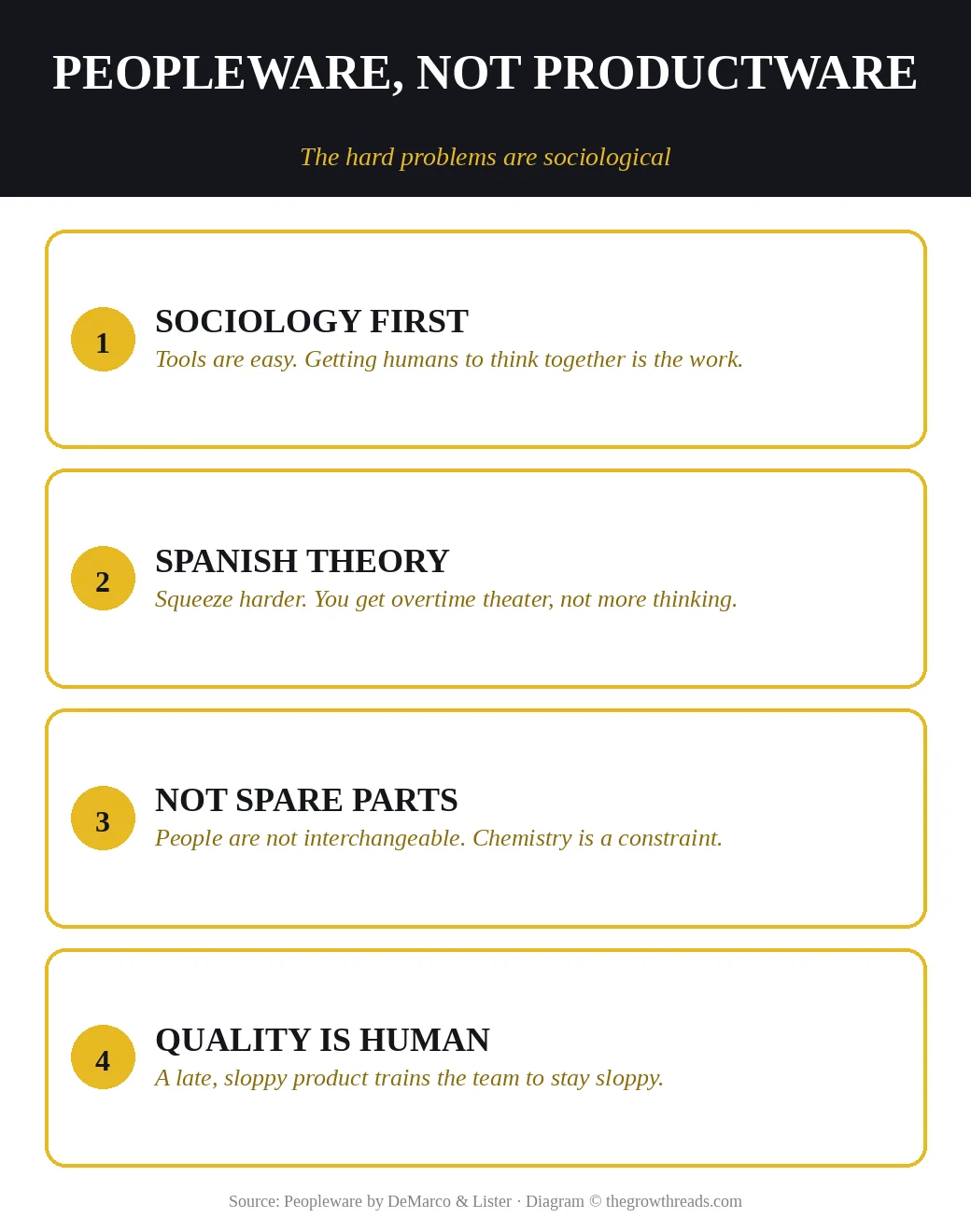
- Sociology before technology: The hard failures are people, space, and policy. New tools rarely fix an un-jelled team.
- Spanish Theory fails here: Squeezing harder gets overtime theater, not more design.
- People are not spare parts: Chemistry is a constraint. Interchangeable staffing is a fantasy.
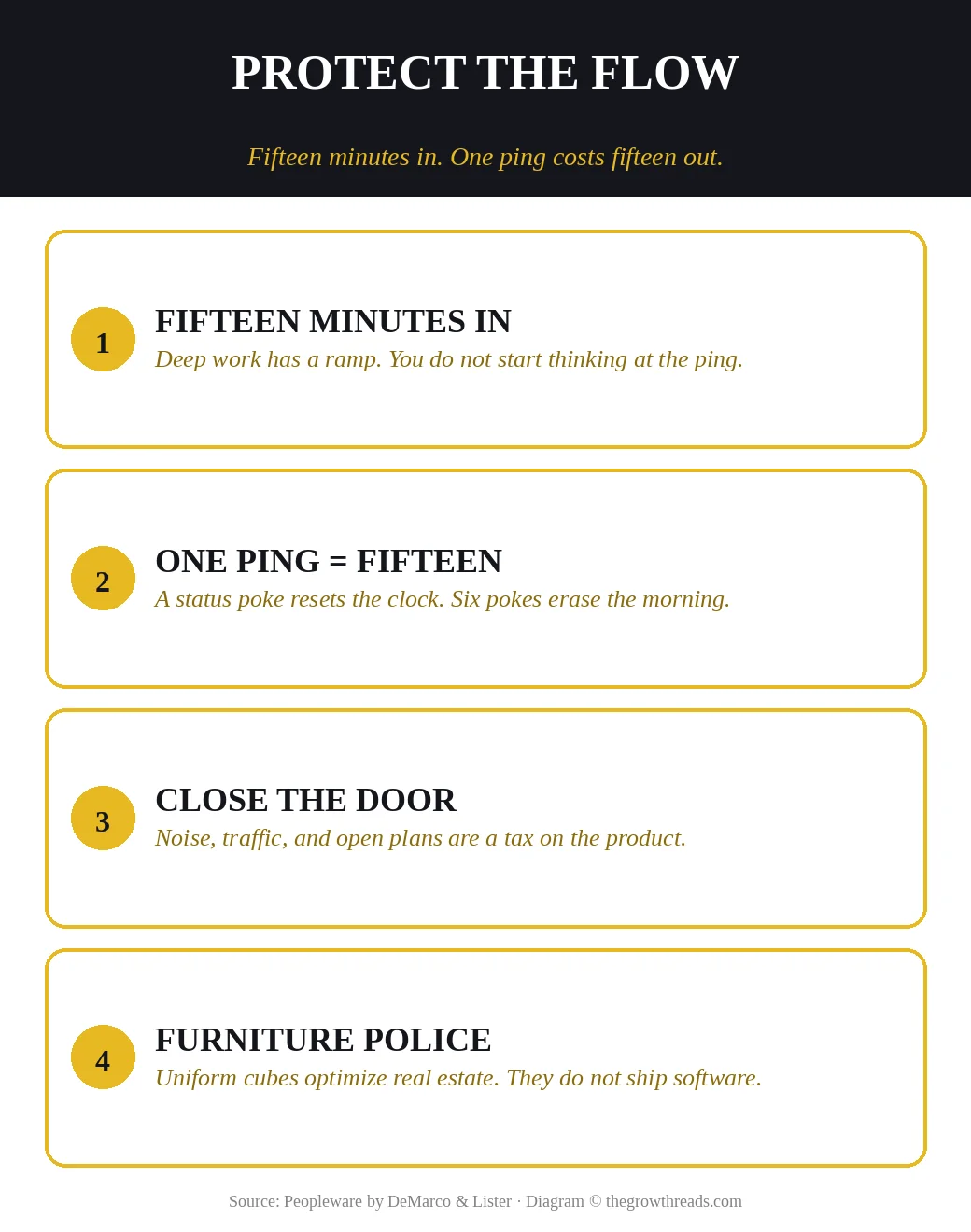
- Flow has a ramp: About fifteen minutes in. One ping costs fifteen out.
- The room is part of the product: Noise, traffic, and the Furniture Police are a tax on thinking.
- Jell is slow and fragile: You cannot schedule it. You can teamicide it in a week.
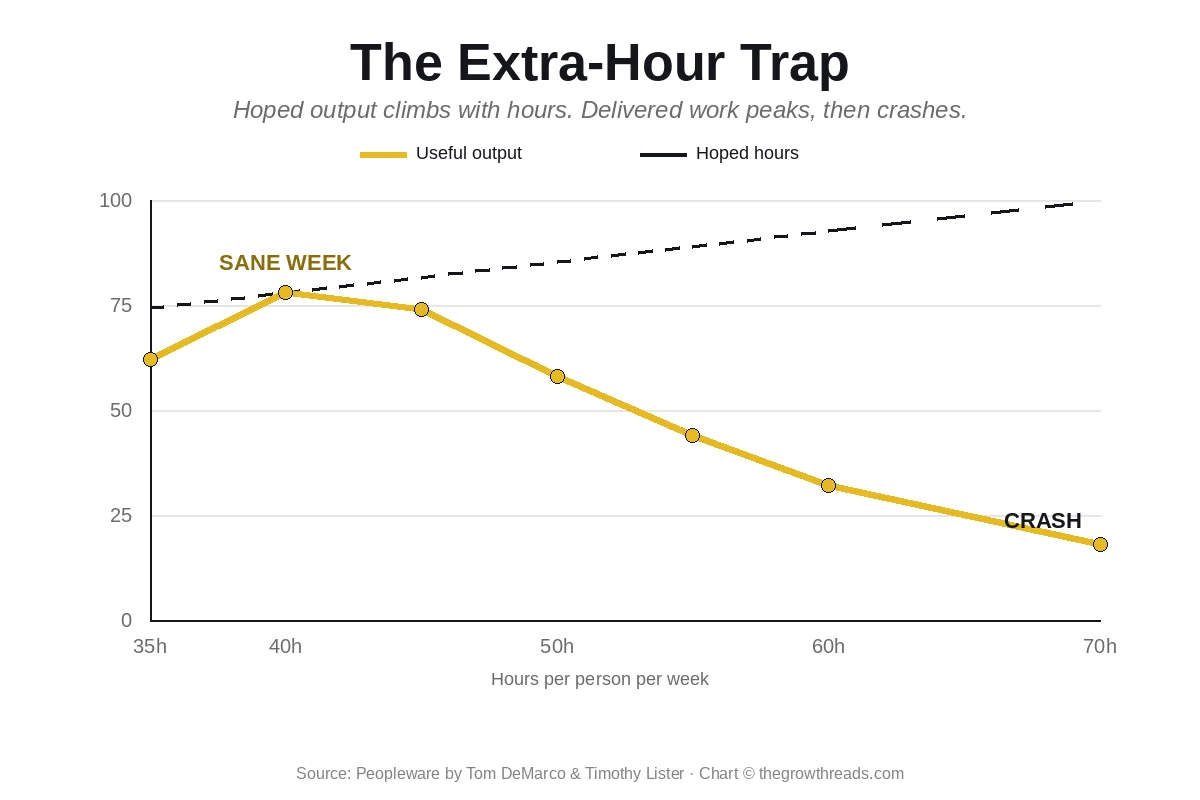
- Overtime is not a plan: Hoped hours climb. Useful output peaks, then crashes.
- Quality is a people act: Ship sloppy and you train the team to stay sloppy.
- Phony deadlines teach shrug: One fake date makes every later date optional.
- Leave a jelled team together: The cheapest next project is the group that already thinks as one.
What is Peopleware about?
Peopleware is a field book on making knowledge-work teams productive. DeMarco and Lister show that most process pain is interruption, space, staffing, and overtime culture. Protect flow, let a team jell, and stop treating humans as spare parts. It is for managers who keep buying tools when the room is the bug.
About the author
Tom DeMarco and Timothy Lister work as consultants in the Atlantic Systems Guild. DeMarco came through Bell Labs and the structured-analysis wave, then spent the rest of his career arguing that software’s expensive failures were rarely compilers. Lister ran the quieter measurements — noise, floor plans, error rates after interrupted days — that give Peopleware its stubborn specifics. Together they walked rooms that were supposed to be thinking and were actually recovering from the last status poke. DeMarco also wrote Slack and the novel The Deadline. There is a Wikipedia page for him and none that helps for Lister. Do not mix Tom with MJ DeMarco of the Fastlane books. For scheduling arithmetic, start with The Mythical Man-Month. For the human system that makes Brooks’s math explode, start here. Explore all Timothy Lister book summaries →
Key concepts at a glance
| Concept | What it means | Use it when |
|---|---|---|
| Peopleware | The human system around the work, not the stack. | Every fix so far has been a tool or a slogan. |
| Spanish Theory | Squeeze people harder and value appears. | Overtime is the plan, not a last burst. |
| Flow | Unbroken concentration with a ~15-minute ramp. | Chat, pokes, and walk-bys own the morning. |
| E-factor | Environment tax on thinking time. | The room is loud, open, and “collaborative.” |
| Jelled team | A group that is more than its roster. | You keep restaffing a project that already had a pulse. |
| Teamicide | Policies that kill chemistry on purpose-by-accident. | Split rooms, fragments, fake dates, poster “motivation.” |
| Furniture Police | Uniform space optimized for real estate, not thought. | Nobody can close a door or pin a wall. |
| Overtime trap | Extra hours buy errors after a short burst. | The chart of hoped hours is the status slide. |
Part 1 — The major problems are people problems
The opening move of Peopleware is a reframe managers still resist. If the product is late, the instinct is a new tracker, a new language, a new vendor. DeMarco and Lister keep pointing at the humans: who is interrupted, who is scared of the date, who was pulled off a jelled group to “help” a red project. They call the squeeze instinct the Spanish Theory of Value — press harder, juice appears. It is a decent theory of grapes. It is a ruinous theory of design. Knowledge work does not scale with visible strain. It scales with people who are allowed to think.
They are not anti-method. They are anti the fantasy that method substitutes for sociology. A team of interchangeable “resources” on a beautiful chart will still ship like strangers. Parkinson’s Law gets misused here too: if work expands to fill time, the cure must be less time. The book’s answer is ruder. Fake scarcity makes people hurry in ways that create rework, which then justifies the next fake date. Quality is not a phase you add. It is a habit the group either keeps or is trained out of. Ship a quality-reduced product to hit a slide and you have taught the team that the standard was optional.
That is why this sits next to Brooks, not instead of him. The Mythical Man-Month is the communication-path explosion when you add people to a late baby. Peopleware is why you thought adding people was the move: the room was already failing as a human system. The Practice of Management wants a customer before an internal dashboard. DeMarco and Lister want a thinking team before a tooling offsite.
TGR Note: Staffing a slip: The Mythical Man-Month. Customer before dashboard: The Practice of Management. Peopleware is the room in between — the humans who have to think before either math works.
Part 2 — Protect flow, then fix the room
The most stolen finding in the book is also the simplest. Getting into flow takes on the order of fifteen minutes. A knock, a ping, a “got a second” does not cost a second. It costs the ramp. Six of those and the morning was a performance of work. DeMarco and Lister measured error rates and self-reports around noisy, high-traffic space and got the unfashionable result: people need a door, a wall, and stretches of quiet that nobody is allowed to “use.” Collaboration is real. Unbounded collaboration is how you make sure nobody composes anything hard.
They have fun — and they are not joking — with the Furniture Police: the force that standardizes cubes, bans personal walls, and optimizes square feet while the product waits. Uniform space looks fair in a facilities deck. It is hostile to the actual variation of thinking. Some work needs a war-room wall. Some needs a closed door. A policy that forbids both is not neutral. It is a productivity choice dressed as interior design.
Later books made the same tax digital. A World Without Email is the hive-mind cousin: the interruption moved from the aisle to the badge. Rework cuts the work until a small team can finish it without a hero week. Peopleware is the physical layer those two still assume. If the room and the calendar are a slot machine of pokes, no personal-productivity trick will save the project. You are measuring the wrong unit. The unit is hours of intact thought, not hours of presence.
TGR Note: Digital hive: A World Without Email. Cut the surface area: Rework. DeMarco and Lister still start with the door. If nobody can close it, the rest is coping.
Part 3 — Hire for chemistry, then let a team jell
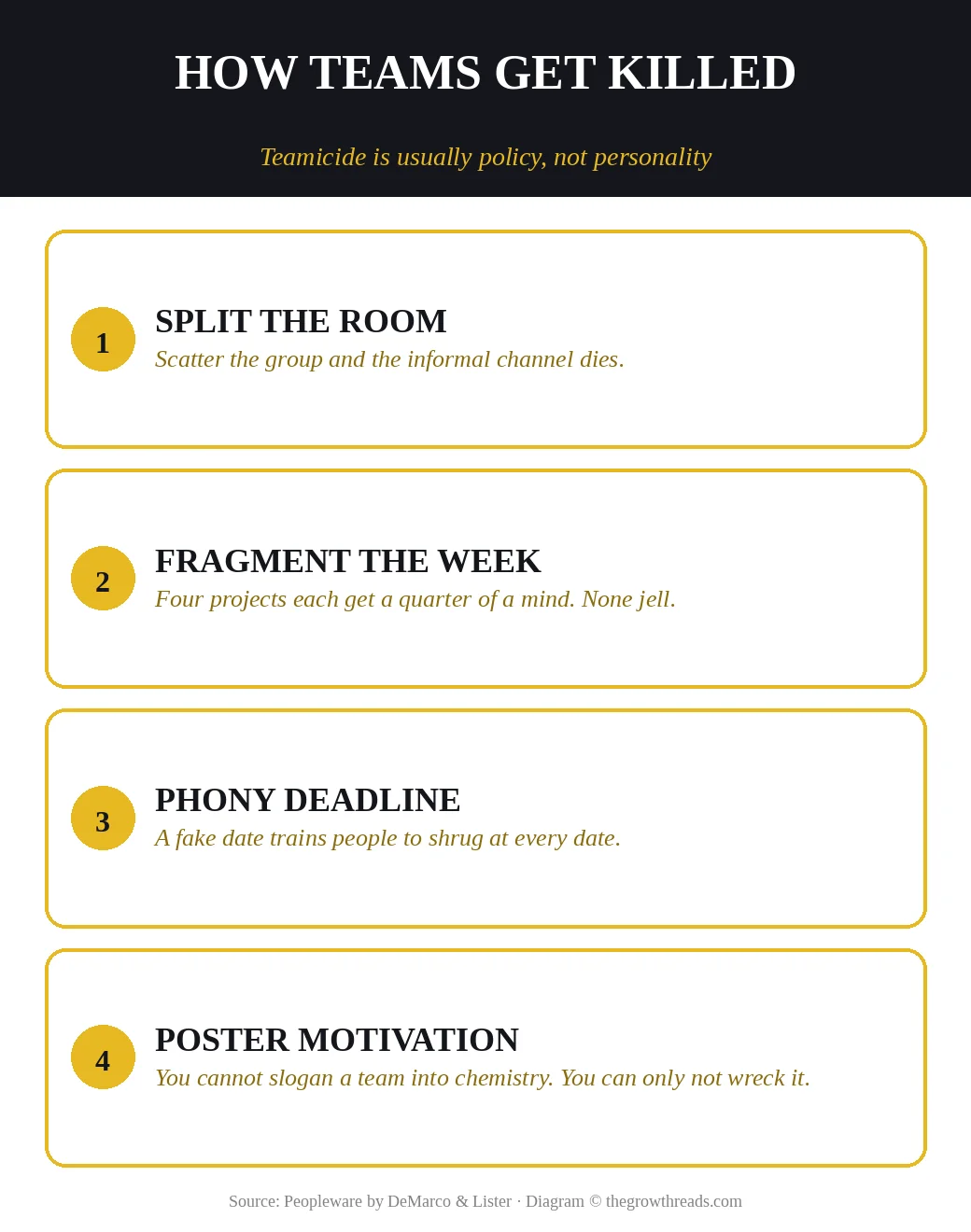
The middle of the book is hiring and team formation without the usual talent-mythology. You are not collecting unicorns. You are collecting people who can stand each other long enough to build a standard. Jell is what happens when a group starts covering, teasing, and defending quality without a memo. It is slow. It is obvious when it is gone. Managers kill it with ordinary policy: split the group across floors, assign everyone to four projects “just this quarter,” pull the best person onto a fire, hang a poster about excellence. DeMarco and Lister call the pattern teamicide. Nobody votes for it. The org chart does it anyway.
Chemistry is a constraint the same way a compiler version is a constraint. You would not swap compilers mid-build for fun. You swap people constantly and then wonder why the build is a social fiction. The right-people chapters are blunt about interviews that only test solo cleverness, and about the fantasy of the interchangeable engineer. A jelled team is an asset. Treating it as a drawer of spare parts is how you pay for the same ramp on every project.
Shipping cadence without this layer is just a prettier Gantt. Shape Up gives you six weeks and a cool-down so a bet can end. Getting Real tells you to build less so a small group can finish. Both assume there is a group. Peopleware is how that group stays a group: same room when it matters, same people on the hard thing, no fake date that trains everyone to stop believing dates. If you restaff every bet, you do not have a team. You have a temp agency with snacks.
TGR Note: Six-week bets: Shape Up. Build less: Getting Real. Neither cadence survives teamicide. Keep the people together or you are shipping a roster, not a team.
Part 4 — Overtime theater and the spaghetti dinner
The overtime chapter is the one managers underline and then ignore. A short, chosen burst can close a known gap. A culture of extra hours is a productivity-reduction technique. People get tired, then sloppy, then sick, then cynical. Hoped output is a straight line up the clock. Useful output is a curve that peaks near a sane week and then falls. The extra-hour trap looks like commitment on a dashboard. It is usually a way not to change the sociology: still too many fragments, still a phony date, still a room that cannot think. Visible strain is easier to praise than invisible flow.
The book’s warmer chapters are easy to skip and should not be. Work is supposed to be able to be fun in the narrow sense that a jelled group likes being in the work. The spaghetti dinner — cooking together, no agenda — is not a culture-deck item. It is unstructured time in which chemistry has a chance. You cannot mandate fun. You can stop filling every hour with status so that the only leftover emotion is fatigue. Entropy in a team is the slow slide toward process for its own sake. A catalyst manager removes obstacles and protects the group. A nervous manager adds ceremonies because ceremonies are visible.
When the whole company is on fire, you need a different map first. The Phoenix Project is the plant that cannot finish change because every day is an outage. The Unicorn Project is the local path inside that mess. Come back to Peopleware when the quiet project is still late because nobody can think. Make a cheeseburger, sell a cheeseburger. Do not build a sandwich platform while the team works nights to look busy.
Who is Peopleware best for — and who should read something else first?
Best for engineering managers, tech leads, and founders whose product requires hours of unbroken thought. It is also for the exec who keeps approving tools and headcount while the room gets louder. If your teams are “busy” and the work is still late, this is the book.
Read something else first if the org is still in incident-mode — start with The Phoenix Project. If the slip is a staffing reflex, start with The Mythical Man-Month. If you need a ship cadence more than a sociology, start with Shape Up. If the product is too big, Rework or Getting Real. Come back when the remaining bug is humans, space, and overtime theater.
Questions to reflect on
- How many times yesterday did someone in flow get reset by a “quick” poke?
- Which policy of yours would DeMarco and Lister file under teamicide?
- Is this week’s deadline a date you would still defend if nobody were watching?
- Where are you using overtime because the sociological fix felt political?
- Which jelled group did you last break apart to “help” a red project?
🔥 Ready to protect the thinking?
Fix the room and the week so a sane team can actually compose the work.
How to apply Peopleware (7-day plan)
- Day 1 — Count the pokes. Tally interruptions for one person you manage. Include chat. Put the number on a card.
- Day 2 — One closed block. Two hours with a door or a status of actually-off. No “got a second.”
- Day 3 — Kill one fragment. Take one person off a fourth project or a recurring status that resets the morning.
- Day 4 — Walk the room. Noise, traffic, walls. One physical change you can make without a renovation.
- Day 5 — Name the date. Is this week’s deadline real? If not, say so. Stop performing a fake one.
- Day 6 — Overtime test. If someone is in a hero week, ask what sociological fix you are avoiding.
- Day 7 — Leave them together. Pick one jelled pair or trio and do not restaff them next week. Unstructured time counts.
Frequently asked questions
What is Peopleware about?
Peopleware is a field book about the sociology of knowledge work. Tom DeMarco and Timothy Lister argue that most project failures are people problems dressed up as tool problems: noisy rooms, fragmented weeks, phony deadlines, and overtime theater. The third edition (Addison-Wesley, 2013) keeps the 1987 thesis and adds later essays on change, risk, and meeting culture. You do not get a process diagram. You get a set of tests: is this team allowed to jell, is anyone in flow, and is the deadline real. Read it when the board keeps buying software and the humans keep slipping.
Who wrote Peopleware?
Tom DeMarco and Timothy Lister are consultants in the Atlantic Systems Guild. DeMarco came through Bell Labs; Lister ran the quieter studies on space, noise, and interrupted work. They spent decades walking rooms that were supposed to be thinking and were recovering from the last ping. DeMarco also wrote Slack and The Deadline. Wikipedia covers DeMarco, not Lister. Do not confuse Tom with MJ DeMarco of The Millionaire Fastlane. Start here for teams. Pair it with The Mythical Man-Month for the scheduling math.
What is a jelled team in Peopleware?
A jelled team is a group that has become more than a list of names on a staffing sheet. People cover for each other, finish each other’s sentences about the work, and defend a standard without being asked. You cannot schedule jell on a Gantt chart. You can only stop doing the things that kill it: splitting the room, fragmenting people across four projects, shipping a quality-reduced product, hanging motivational posters, and declaring a date everyone knows is fake. Chemistry is a constraint, not a mood. Once a team has jelled, the cheapest move is to leave it together for the next hard thing.
What is flow, and why do interruptions cost so much?
Flow is the stretch where a knowledge worker is composing, not ramping up. DeMarco and Lister clocked the ramp at about fifteen minutes. One status ping does not cost thirty seconds. It costs the re-entry, and six pokes erase a morning. That is why open plans and always-on chat feel busy and ship little. Protecting flow is a room and a calendar: a door that closes, a block that is not a meeting, interruption treated as scarce. A World Without Email is the later cousin of the same tax.
Does overtime actually save a late project?
Peopleware’s ugly chart is that extra hours do not buy extra thinking for long. A short burst can close a known gap. A month of sixty-hour weeks buys errors, sick days, and a team that learned the date was never real. Hoped output climbs with the clock. Useful output peaks near a sane week, then falls. Overtime is visible; flow is not. Spanish Theory — squeeze harder — works on grapes, not design. If the project is late, adding hours usually avoids the real fix: fewer fragments, a real date, a room that can think.
Is Peopleware only for software teams?
The lab is software because that is where DeMarco and Lister measured noise, space, and error rates. The move is not. Any group that needs hours of unbroken attention — research, writing, design, analysis — will recognize the Furniture Police, the phony deadline, and the overtime hero. If the work is truly a queue or a shift, this is the wrong book. If it looks like status plus a product that requires thought, it is the right one. Shape Up is the later shipping cadence. Peopleware is why that cadence still has anyone left to ship.
How is Peopleware different from The Mythical Man-Month?
Brooks is the arithmetic of adding people to a late project: communication paths explode, and the baby still takes nine months. DeMarco and Lister grant that math and then walk the room: why extra people, why no flow, why the last date trained a shrug. Mythical Man-Month is what happens when you staff a slip. Peopleware is what happens when humans are spare parts, noise is free, and overtime is a plan. Read Brooks if the org throws bodies. Read this if it buys furniture and slogans while the team un-jells. You probably want both.
Related summaries
- The Mythical Man-Month Summary & Review — why extra people make late work later
- Shape Up Summary & Review — ship in six weeks without melting the team
- Rework Summary & Review — cut the work until a small group can finish
- The Phoenix Project Summary & Review — stop the firefighting first
- Best productivity books — the full Productivity silo
How we analyze books: we paraphrase arguments, add original application notes, and skip chapter-by-chapter reproduction. Read our full methodology.