

★★★★½ 4.5/5 — A fast color code for meetings, email, and feedback. The sharp title retires itself: most “difficult” people are a different pace and a different kind of proof.
Best for: Managers and teammates who keep talking past each other even when the goal is clear.
Reading time: ~6 hrs (guide: 15 min) · Difficulty to apply: Easy to spot in one meeting, daily to practice.
Surrounded by Idiots in one minute
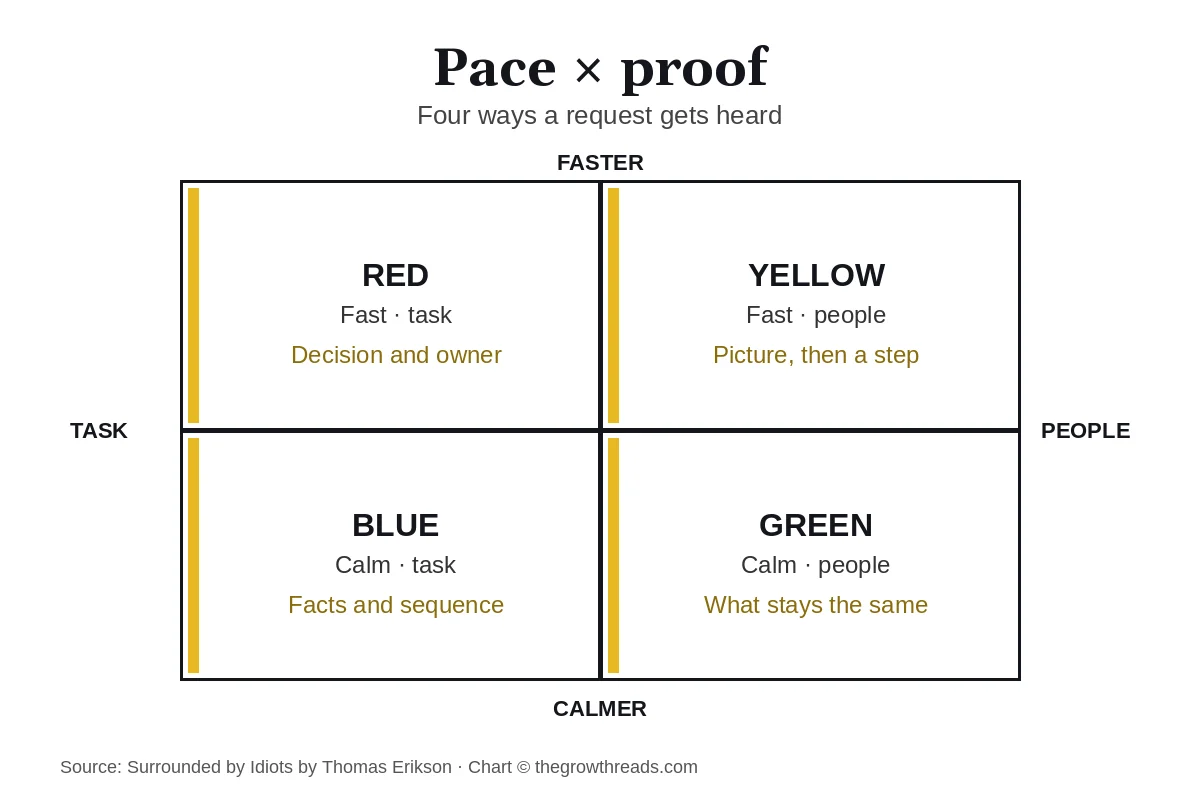
The person you call difficult is often just waiting for a different first sentence. Thomas Erikson sorts everyday work behavior into four colors. Red wants the result now. Yellow wants the picture and the people. Green wants to know the group is safe. Blue wants the facts before the vote.
The book’s rule is simple enough to use before lunch: communication happens on the listener’s terms. You do not need a new personality. You need a better opening, the right amount of detail, and a pace the other person can actually follow. The color is a working guess you check against the next conversation, not a badge you pin on a colleague.
Use it when people already agree on the goal and still miss each other. If the goal is fuzzy, fix that first.
Key takeaways
- Listener’s terms: The message that matters is the one they can use, not the one that felt natural to say.
- Four colors, not four destinies: Red, Yellow, Green, and Blue are habits of pace and proof. People mix them, and stress turns the volume up.
- Two questions: Are they fast or calm right now? Are they reaching for the task or for the people?
- Red: Lead with the decision, the owner, and the time. Warm-up sounds like delay.
- Yellow: Give the vision and the human point, then write one next step so the idea survives the conversation.
- Green: Name what will not change. Do not spring a new plan in front of the group and expect a smile.
- Blue: Send the brief first. Precision is care, not resistance.
- Adapt on purpose: Flexing your opener costs energy. Do it for the conversation that matters, then return to your own voice.
- Stress is information: Sharper, louder, quieter, or pickier usually means the color is tired, not that the person has changed species.
- Write the preferences down: A mixed team moves faster when everyone can see how each person wants a request and a disagreement.
What is Surrounded by Idiots about?
Surrounded by Idiots is Thomas Erikson’s practical guide to four everyday behavior styles: Red, Yellow, Green, and Blue. He argues that most difficult people are simply a different pace and a different kind of proof. Learn the pattern, change the ask, and work gets clearer.
About the author
Thomas Erikson is a Swedish author, lecturer, and communication trainer. For years he sat with managers who were sure another department was the problem. In 2014 he published the Swedish book Omgiven av idioter. The English edition from St. Martin’s Essentials arrived on July 30, 2019, and the cover’s “million copies” line matches the international run of that idea. The sharp title is a setup. Erikson’s point is that the so-called idiot is often someone whose speed and evidence do not match yours, and that you look just as confusing inside their style. He has spent his training career showing leaders how to speak so the listener can use the message the same day. Explore all Thomas Erikson book summaries →
Key concepts at a glance
| Concept | What it means | Use it when |
|---|---|---|
| Listener’s terms | A point lands only in the pace and proof the other person trusts. | You are about to repeat yourself for the third time. |
| Red | Fast, direct, competitive, impatient with preamble. | You need a decision and an owner today. |
| Yellow | Fast, social, optimistic, full of ideas, light on sequence. | You need energy in the room and one written next step. |
| Green | Steady, loyal, conflict-averse, slow to abandon the current plan. | A change will touch how people work together. |
| Blue | Precise, skeptical, quality-first, wants the brief before the vote. | The cost of a sloppy definition is high. |
| Adaptation | You edit the opener for one conversation. You do not fake a whole personality. | The relationship is worth more than the comfort of your default style. |
| Stress color | Pressure exaggerates the style: harsher, louder, quieter, or pickier. | A usually useful teammate is suddenly hard to read. |
Communication Happens on the Listener’s Terms
Erikson opens on a feeling almost every team knows. You explained the plan clearly. You used the words that make sense to you. And the other person still did the wrong next thing, or did nothing, or came back with a question you thought you had already answered. The book’s first move is to take that personally in a useful way: the explanation was clear for your color, not for theirs.
He treats behavior as something you can see in a meeting, not as a hidden essence. Who talks first. Who wants a story. Who wants a number. Who goes quiet when the plan changes. Those are the clues. The Swedish edition grew out of training rooms, not a lab, and the English edition keeps that trainer’s pace. You are meant to leave a chapter and try one sentence, not to file a diagnosis.
The colors sit in a long line of four-style tools. Workplaces have used DISC language for decades to talk about pace and focus. Erikson is not asking you to believe that four words explain a person. He is asking you to stop treating your own habit as the definition of professional. The practical question is narrow: what proof does this person need before the ask feels real?
Red, Yellow, Green, and Blue
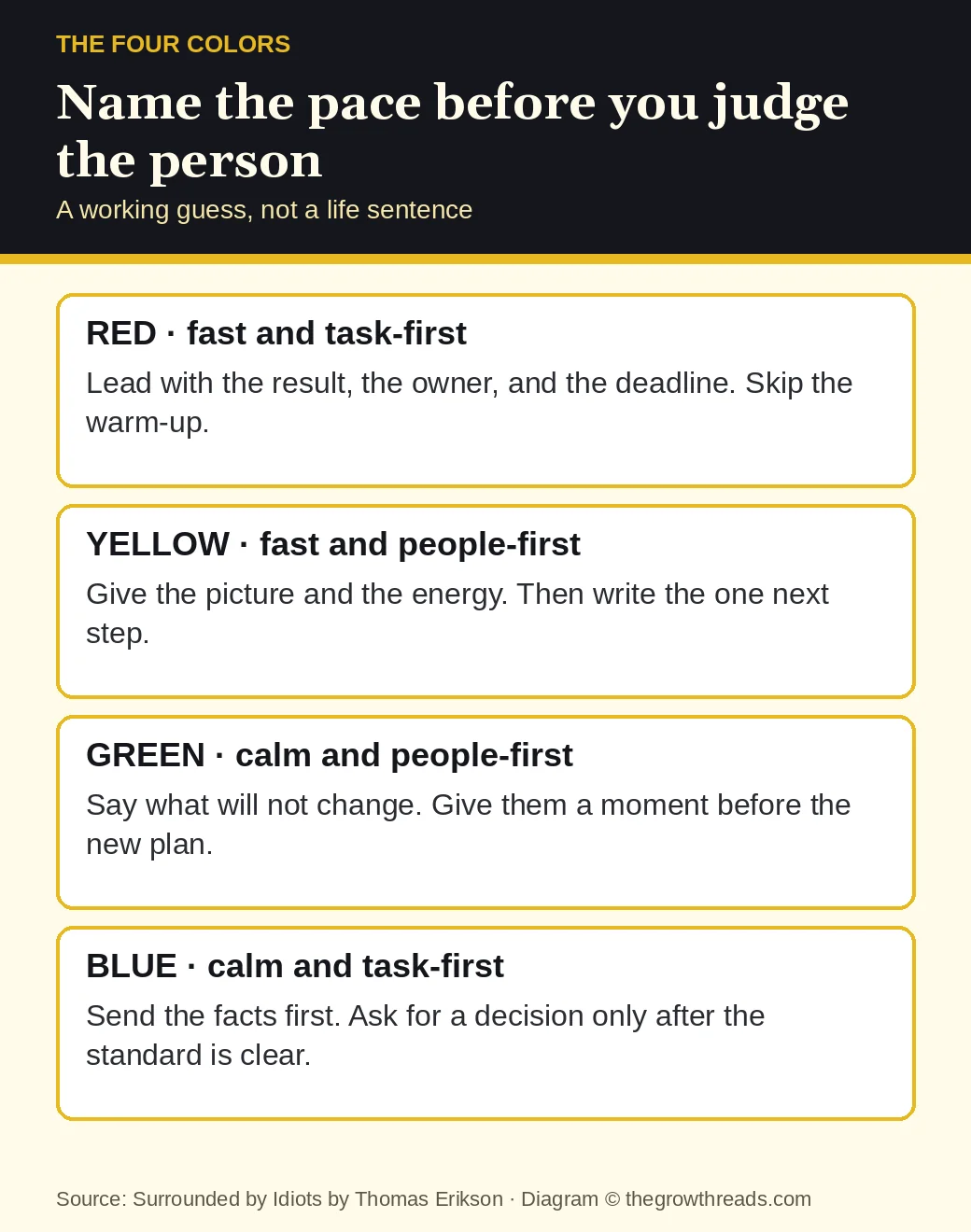
Red behavior is fast and pointed at the task. Reds decide quickly and get restless when a meeting circles. If you open with feelings and three caveats, they experience you as slow. Give them the outcome, the owner, and the date.
Yellow behavior is fast and pointed at people. Yellows bring energy and a stack of ideas, and they can leave without a sequence because the conversation felt like the work. Meet their pace, paint the picture, then write one next step before the hallway erases it.
Green behavior is calm and pointed at the group. Greens keep promises and need the current plan to make sense before they will trade it. A surprise pivot in public feels like a threat. Tell them what will stay true, and give them a beat before you ask for the new plan.
Blue behavior is calm and pointed at the standard. Blues want definitions and time to think, and they will not nod at a blurry plan. Send the brief before the meeting. Do not ask them to skip the facts when the cost of being wrong is real.
Almost nobody is one pure color. A person can look different at home than in a status meeting, and stress turns the volume up. The skill is a good-enough guess for the opener, dropped the moment the person does not match the card.
Adaptation: Change the Ask, Not the Person
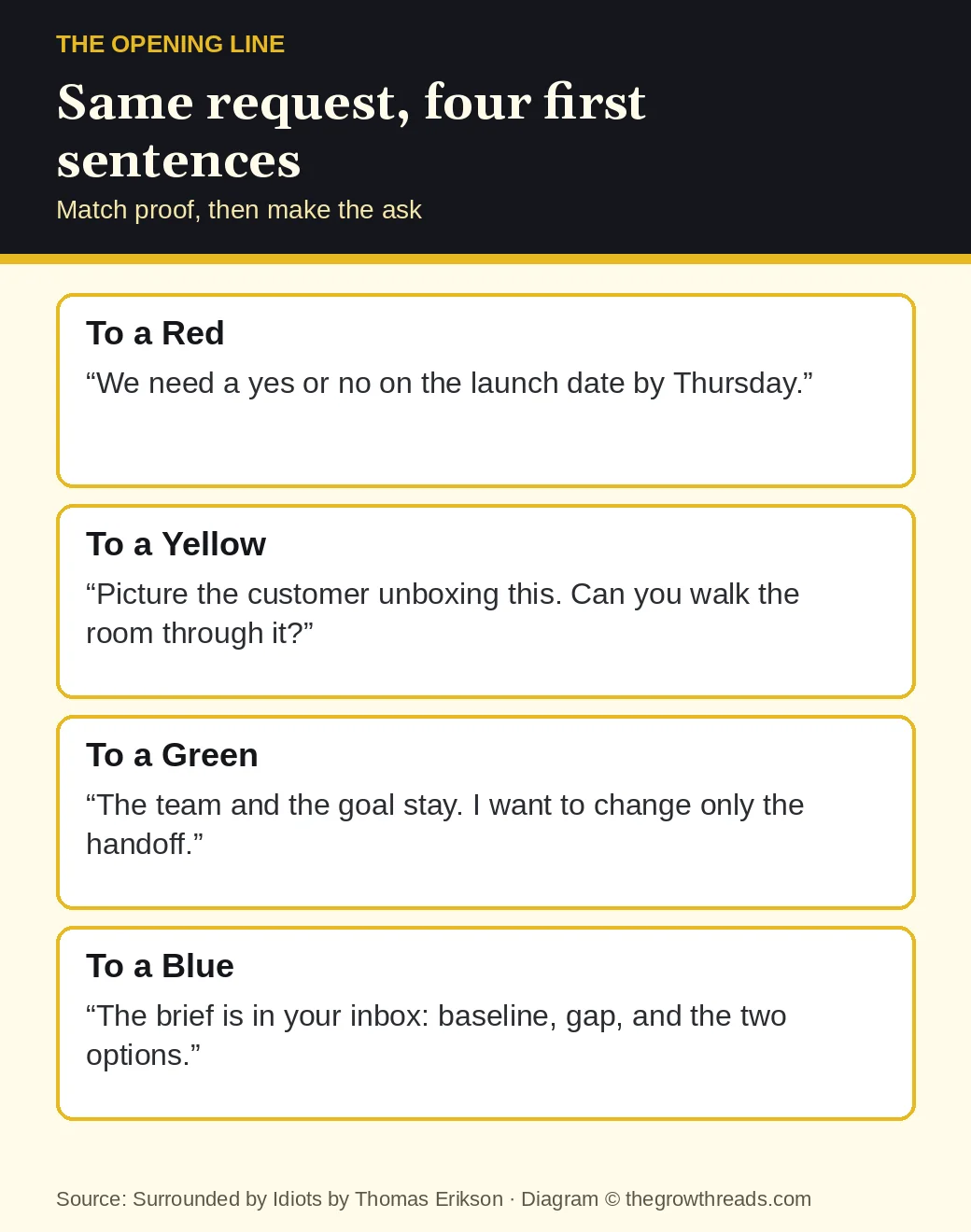
The middle of the book turns from recognition to practice. Adaptation is a short, deliberate edit. You change the first sentences, the amount of story, and the speed of the close. You do not perform a false personality for eight hours, and you do not ask the other person to become you before they are allowed to help.
Try it on one recurring ask. In a standup, the Red wants the decision and the name, the Yellow wants the customer picture, the Green wants to hear that the team is not being thrown out, and the Blue wants the metric defined before the vote. The same facts can serve all four if each person gets a small door.
Feedback follows the same doors. Tell a Red what changed in the result. Tell a Yellow how people experienced the work, then the one behavior to repeat. Tell a Green what you value before you name the change, and do it privately if the point is sharp. Tell a Blue the specific gap against the standard they already agreed to. Praise works the same way. Generic “great job” is noise. Specific proof in their currency is fuel.
Stress, Email, and the Team
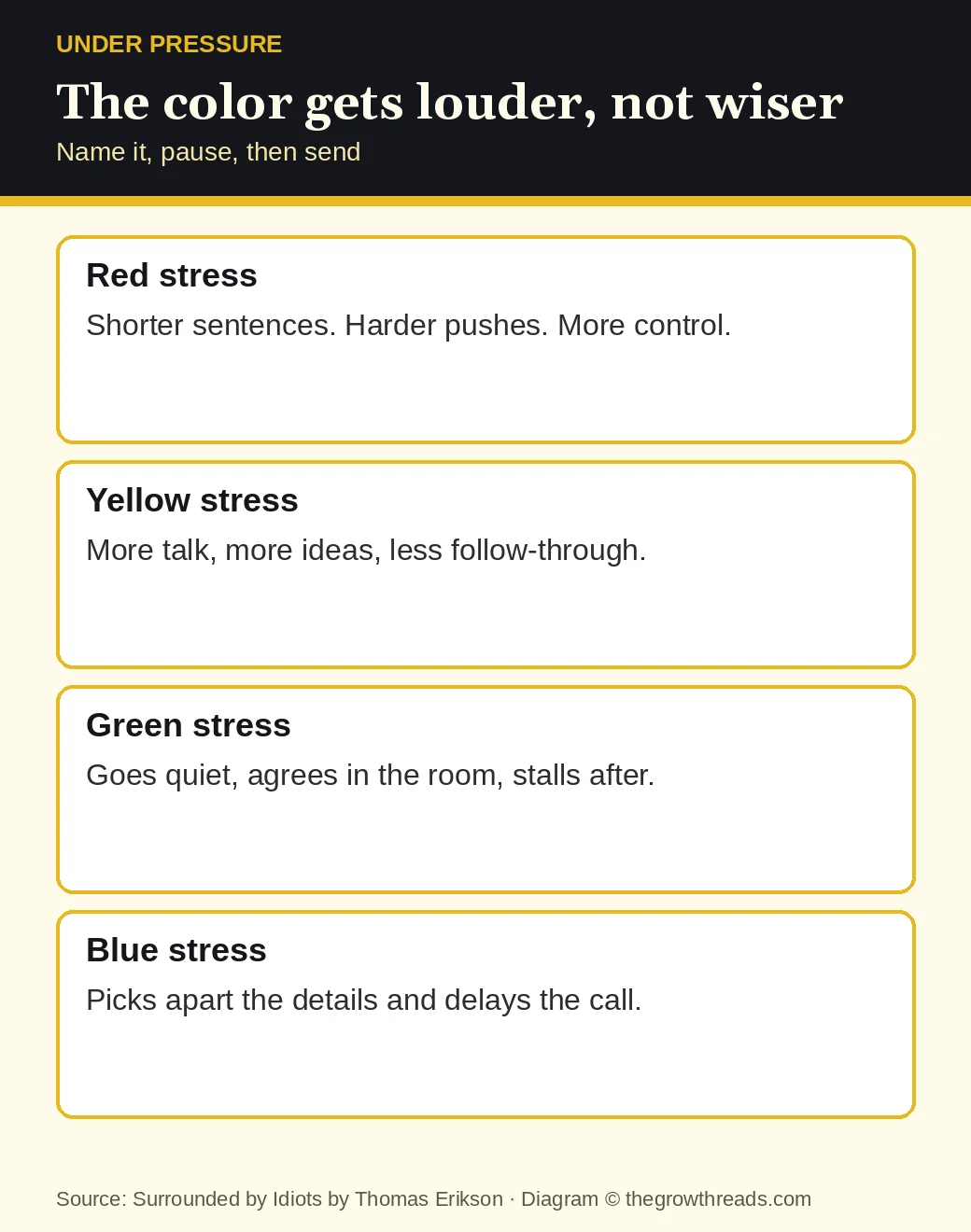
Under pressure the color gets louder. Reds get sharper and more controlling. Yellows talk more and finish less. Greens go quiet, agree in public, and stall in private. Blues nitpick and delay the call until the document feels safe. Erikson’s useful warning is that stress behavior is a worse version of a strength, not a new person who walked into the building. Name it, take ten minutes, then send the message you would have sent calm.
Writing is where remote teams win or lose this book. A Red reads a long preamble as disrespect. A Yellow reads a bare ticket as a cold shoulder. A Green reads a surprise change in a channel as a threat to the group. A Blue reads “any thoughts?” with no attachment as a setup. Keep one shared record of the decision so the lively idea and the quiet worry do not depend on who stayed on the call.
Reds and Yellows start things. Greens and Blues keep them honest. Red and Green often clash on speed. Yellow and Blue often clash on rigor. Neither pair is broken. Give the fast colors a decision and the calm colors a document.
Bad news fails when it arrives in the speaker’s favorite format. A Red can take a direct miss if the next move is attached. A Green often needs the relationship named first, and privately. A Blue needs the evidence. A Yellow needs to see that the people still matter. The standard stays. The entrance changes.
Who is Surrounded by Idiots best for — and who should read something else first?
Read this if you lead meetings, write the asks, or keep wondering why a clear plan still produces four different interpretations. It is especially useful for a new manager whose natural style is not the team’s style.
Read something else first if style is not the bottleneck. Start with The ONE Thing or Essentialism when everything is “priority one.” Start with Deep Work when the calendar is the villain. Start with Atomic Habits when the team cannot repeat a behavior long enough to see if the sentence even mattered. Come back to the colors when the work is clear and the people still miss each other.
Questions to reflect on
- When a deadline lands, which color do you become, and who pays for that version of you?
- Who on your team needs the point in one sentence, and who needs the brief the day before?
- Where are you calling someone difficult when you are only using your own pace?
- What would you stop doing if you treated their style as useful instead of wrong?
- Which relationship would move if the next message matched their proof, not your habit?
🔥 Ready to match the room before you speak?
Use the four colors on one real ask this week: a meeting, a piece of feedback, or a single email.
How to apply Surrounded by Idiots (7-day plan)
- Day 1 — Watch one meeting. Do not label anyone out loud. Note who wants a decision, a story, reassurance, or a document.
- Day 2 — Rewrite one ask four ways. Outcome and owner. Picture and next step. What stays the same. Facts sent ahead. Deliver only the version that matches the listener.
- Day 3 — Match the first minute. If they are brief, be brief. If they warm up slowly, do not jump to the close. Stop when the point has landed.
- Day 4 — Feedback in their currency. Give one piece of praise and one correction using the proof they trust. Keep it private if the color is Green and the note is sharp.
- Day 5 — Fix one email. Put their door in the first two lines. Keep the same facts underneath. Put the ask where that color will see it.
- Day 6 — Catch your stress color. When you get sharp, scattered, silent, or picky, wait ten minutes before the next message. Send the calm version.
- Day 7 — Make a tiny team card. Each person writes how they want a request and a disagreement. Post it where the work happens. Use it next week without a workshop.
Frequently asked questions
What is the Surrounded by Idiots method in one sitting?
The method is a four-color shorthand for how people prefer to take in a request. Red is fast and task-first. Yellow is fast and people-first. Green is steady and relationship-first. Blue is careful and detail-first. Thomas Erikson’s claim is practical: most friction at work is a mismatch of pace and proof, not a shortage of intelligence. You make a working guess, then you change the opening line, the amount of detail, and how fast you push for a decision. The color is a hypothesis you update after the conversation. It is not a label you announce in the meeting or write on a person’s file.
Is Surrounded by Idiots a personality test?
No. The book is a field guide for the next conversation, not a scored instrument and not a clinical assessment. Erikson writes in the tradition of DISC-style behavior tools that trainers have used for decades to talk about pace and focus. Those tools describe habits you can see in a meeting. They do not measure worth, morals, or IQ, and a color can shift when the stakes change. Use the chapter as a way to prepare one ask. If you need a hiring screen or a medical opinion, this is the wrong instrument. If you need a clearer status email by this afternoon, it is the right size.
How do you talk to a Red, Yellow, Green, or Blue coworker?
Match the first sentence to the proof they trust. With a Red, lead with the outcome, the owner, and the time. With a Yellow, offer the picture and the people effect, then pin one written next step so the energy survives the hallway. With a Green, say what will stay the same and do not ambush the change. With a Blue, send the facts before you ask for a vote, and do not call caution “blocking.” The rest of the message can be the same facts. Only the door changes. You are editing the entrance, not inventing four different projects.
What should you read if the real problem is not communication style?
Use a different book when the bottleneck is not the listener’s pace. If the team has too many priorities, start with The ONE Thing or Essentialism and cut the list before you color-code the room. If the work never gets a quiet hour, Deep Work will do more than a new vocabulary. If no one can keep a promise for two weeks, Atomic Habits or Getting Things Done will beat a color chart. Surrounded by Idiots earns its place when smart people already know the goal and still talk past each other. Style is the problem only after the goal is singular.
How long does it take to read Surrounded by Idiots?
The English edition runs about 304 pages, so a focused reader finishes it in roughly six hours. You do not need the whole afternoon to use it. The one-minute version is the four colors plus one rule: communication lands on the listener’s terms. A fifteen-minute pass over the color cards is enough to rewrite one email today. The rest of the book is repetition and workplace scenes that make the same move obvious in meetings, feedback, and writing. Treat the week plan on this page as the working edition. Return to a chapter when a specific color keeps stalling the work.
Can you use the four colors with a remote team?
Yes. Written work makes the colors louder, because you lose tone and you keep the pace. A Red reads a long preamble as delay. A Yellow reads a bare bullet list as cold. A Green reads a surprise change in chat as a threat to the group. A Blue reads a question with no document as a trap. Put the ask up front for Red, the human point for Yellow, the stable parts for Green, and the attachment for Blue. Keep one shared record so the lively idea and the quiet worry do not vanish after the call.
Does the sharp title mean the book looks down on people?
The title is a provocation the book spends its pages retiring. Erikson’s move is to notice that the person you call difficult is often using a different speed and a different kind of evidence, and that you look just as odd inside their style. The useful stance is curiosity plus a clearer sentence, not a pecking order. You still tell the truth, set a standard, and disagree. You simply stop spending the first five minutes in a format they cannot hear. If a culture uses color words to mock people, it has left the book behind. The tool is for designing the next message.
Related summaries
- The 6 Types of Working Genius Summary & Review — energy for the work, not just the sentence.
- StrengthsFinder 2.0 Summary & Review — talents you can staff against, week after week.
- The Charisma Myth Summary & Review — presence you can practice once the door is chosen.
- Exactly What to Say Summary & Review — phrases for the moment after you know the color.
- Best productivity books — the shelf this review sits on.