

★★★★☆ 4.4/5 — Pick a feasible offer. Take a first dollar in 27 days. Keep the day job.
Best for: people with a usable skill and a notebook of business ideas that have never met a customer.
Reading time: ~5.5 hours (272 pages) · this guide ~12 min
Difficulty to apply: Easy to start, medium to keep — the prompts are small; protecting evenings from “one more feature” is the work.
Side Hustle in one minute
You do not need a company. You need a calendar, a feasible offer, and a first dollar beside the job you already have. Chris Guillebeau’s Side Hustle (Currency, 2017) is a 27-day sprint for people who keep researching businesses and have not yet sold anything. Week one collects ideas from problems people already pay to solve. Week two scores them for wanted, doable, and fast cash. Week three writes who, result, and price — an offer, not an LLC. Weeks four and five launch messy, take money, and keep the project small enough that it does not eat the job. Originality is optional. Feasibility is not. Pick one idea that can pay this month, tell the people who already have the mess, and let the first sale — not the logo — decide whether it deserves another month.
Key takeaways
- A side hustle is a paid project, not a startup: the point is extra income beside work, not a pitch deck.
- Twenty-seven days is a forcing function: a calendar beats a vision board. Miss a day, pick up the next one.
- Collect many ideas before you marry one: frustrations, skills, and paid-for problems beat a muse.
- Feasibility beats originality: wanted, doable, and fast to a first dollar outrank clever.
- Sell an offer, not a company: who, result, price, and a first ask are enough to start.
- Existing skills and existing people win: strangers and new crafts slow the first dollar.
- Launch messy, then learn: the first customer teaches more than another week of branding.
- Keep it small enough to run at night: if it requires quitting, it is the wrong first hustle.
- Cash is the scoreboard: likes, logos, and “someday” pages do not count.
- Decide after revenue, not before: grow, maintain, or stop once money has spoken.
What is Side Hustle about?
Side Hustle is a 27-day plan for starting a small paid project beside your job. Guillebeau walks you from a list of ideas to a simple offer, a first launch, and a first dollar — without quitting work or building a company first. The test is cash this month, not a brand.
About the author
Chris Guillebeau is a writer and entrepreneur known for tiny businesses and long-haul travel. He ran the Art of Non-Conformity blog, visited every country in the world, and hosted the World Domination Summit, a gathering of people who wanted unconventional careers without waiting for permission. The $100 Startup (2012) is his field guide for one-person offers at the overlap of skill and demand. Side Hustle, five years later, is the shorter calendar: how to take a first dollar in 27 days while you still have a job. He later wrote Born for This and Time Anxiety. The through-line is smallness with a receipt — freedom funded by something someone will pay for, not by a motivational mood. Explore all Chris Guillebeau book summaries →
Key concepts at a glance
| Concept | What it means | Use it when |
|---|---|---|
| Side hustle | A profit-seeking project beside a job or studies, not a startup in costume. | You say “business” and mean a logo, an LLC, and a six-month build. |
| 27-day calendar | A forcing function that sequences idea, pick, offer, launch, improve. | You have been “researching” for a quarter and have no customer. |
| Idea arsenal | Many candidate problems before you marry one. | You are waiting for a perfect, original idea. |
| Feasibility score | Wanted + doable + fast to a first dollar. | The clever idea cannot ship this month. |
| Offer, not company | Who, result, price, first ask. No org chart. | You are designing a brand before a sentence of sale. |
| Existing circle | First buyers from people who already trust you. | You are hiding until ads feel professional. |
| First dollar | The only launch metric that counts in week four. | You are celebrating likes and a landing page. |
| Keep it small | The hustle must fit evenings so the job stays intact. | The project is quietly becoming a second employer. |
Part 1: Ideas before a muse
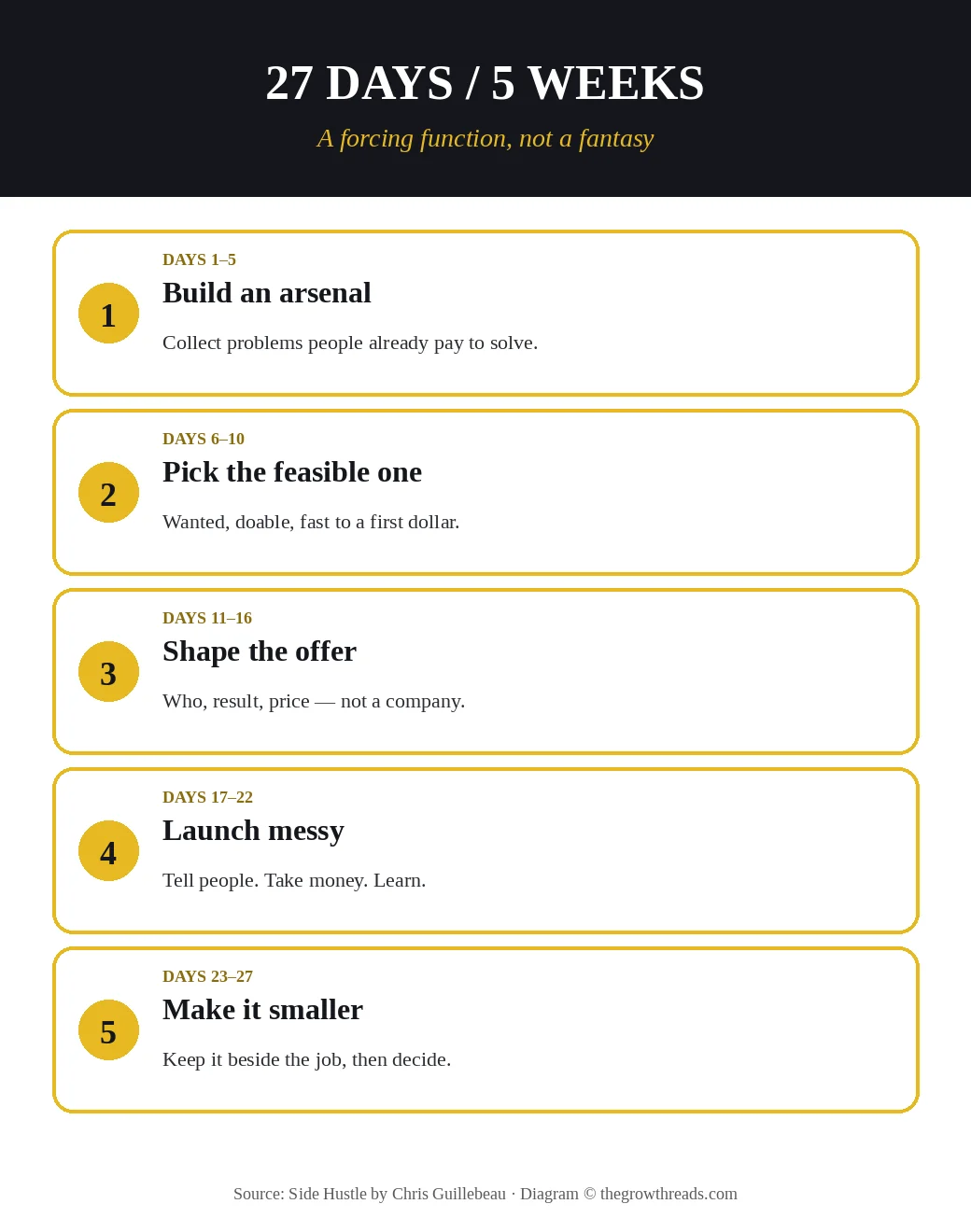
Week one (days 1–5) is an arsenal, not a revelation. Guillebeau wants volume: frustrations you keep hitting, skills you already get asked about, and problems people already pay someone — anyone — to fix. The muse is a stall. A list is a working file. Look at the last three times a colleague said “you’re good at that,” the last three purchases you made to get unstuck, and the last three complaints you heard at dinner. Each is a seed. None of them has to be a billion-dollar category. They have to be specific enough that a person would recognize themselves in a sentence.
The trap in week one is originality theater. You discard the tutoring offer because “everyone does that,” and you keep the app idea because nobody has quite combined those three buzzwords. Guillebeau would reverse the ranking. If people already spend money on the tutoring pain, you have demand. The app with no buyer is a hobby with a pitch. Write the ideas down without scoring them yet. Scoring too early is how you talk yourself back into research. Ten messy candidates beat one polished fantasy. The calendar’s job is to stop you from living in week one forever.
TGR Note: If you want the longer case for a one-person offer — sweet spot, customers, enough proof that you do not need a warehouse — start with The $100 Startup. Side Hustle assumes you already buy that model and need a month on the calendar. Anything You Want is the even smaller version: serve a few people well and stop there.
Part 2: Feasibility over originality
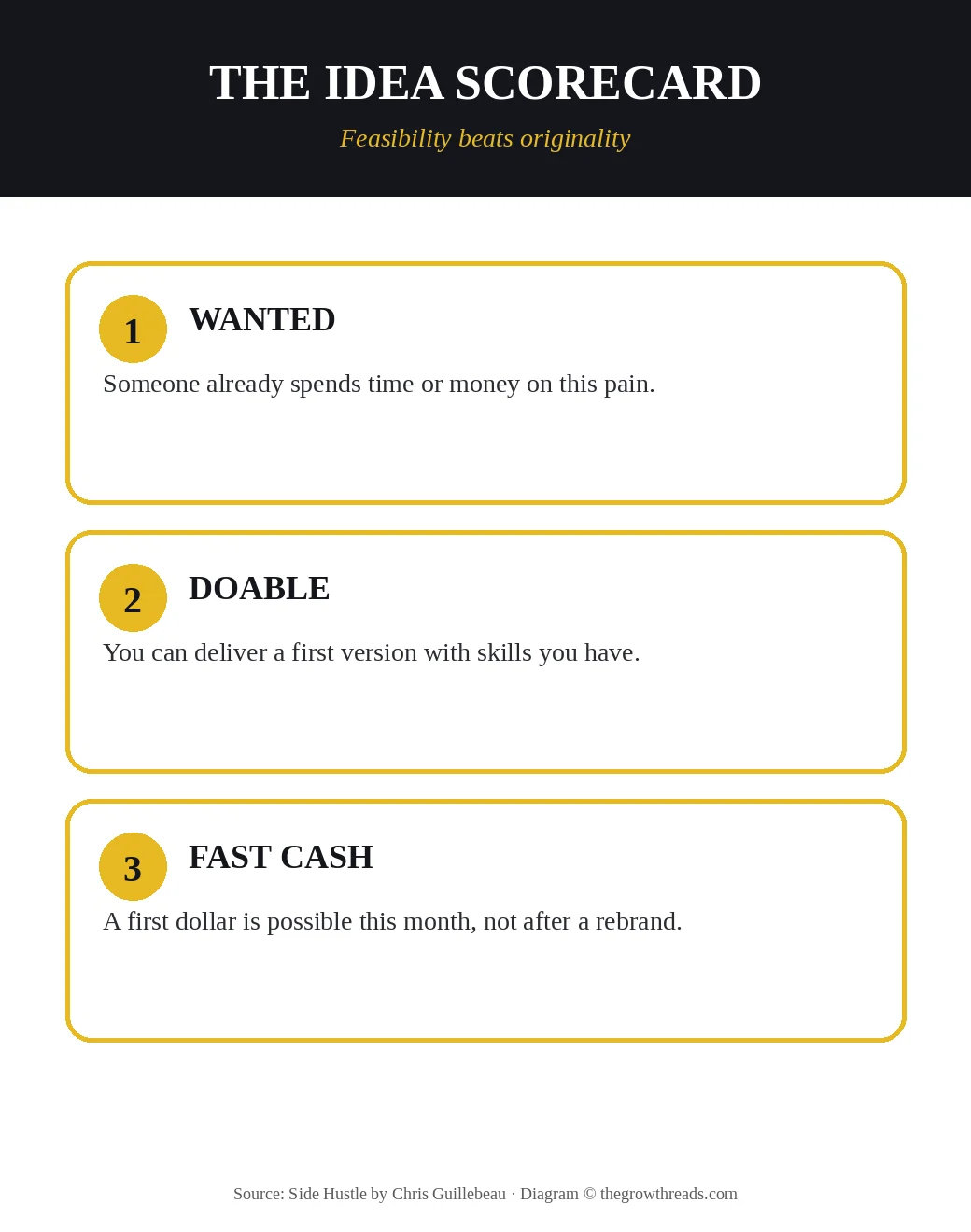
Week two (days 6–10) is a scorecard, not a personality test. Three questions, asked of every idea on the list. Is it wanted — does someone already spend time or money on this pain? Is it doable — can you deliver a first version with skills you have, not skills you will learn after a course? Is it fast to cash — could a first dollar happen this month, not after a rebrand, a warehouse, or a co-founder? The idea that wins is the one that clears all three, even if it is boring on paper. Boring plus a receipt beats clever plus a mood board.
Guillebeau is not anti-creativity. He is anti-delay dressed as creativity. Originality can come later, once you have a customer who will tell you what to improve. In week two you bench the rest of the arsenal instead of deleting it. That matters psychologically: you are not killing your “real” idea, you are picking the one that can pay while you still have a job. If two ideas tie, pick the one you can explain in one spoken sentence to a specific person. If you cannot say who pays and what they get, it is not ready. It is still a hobby with a name.
TGR Note: Before you fall in love with a solution, talk to the person who has the pain. The Mom Test is the companion skill: ask about their life, not whether they like your idea. Guillebeau’s scorecard tells you what to pick. Fitzpatrick tells you how to hear whether the pain is real.
Part 3: An offer, not a company
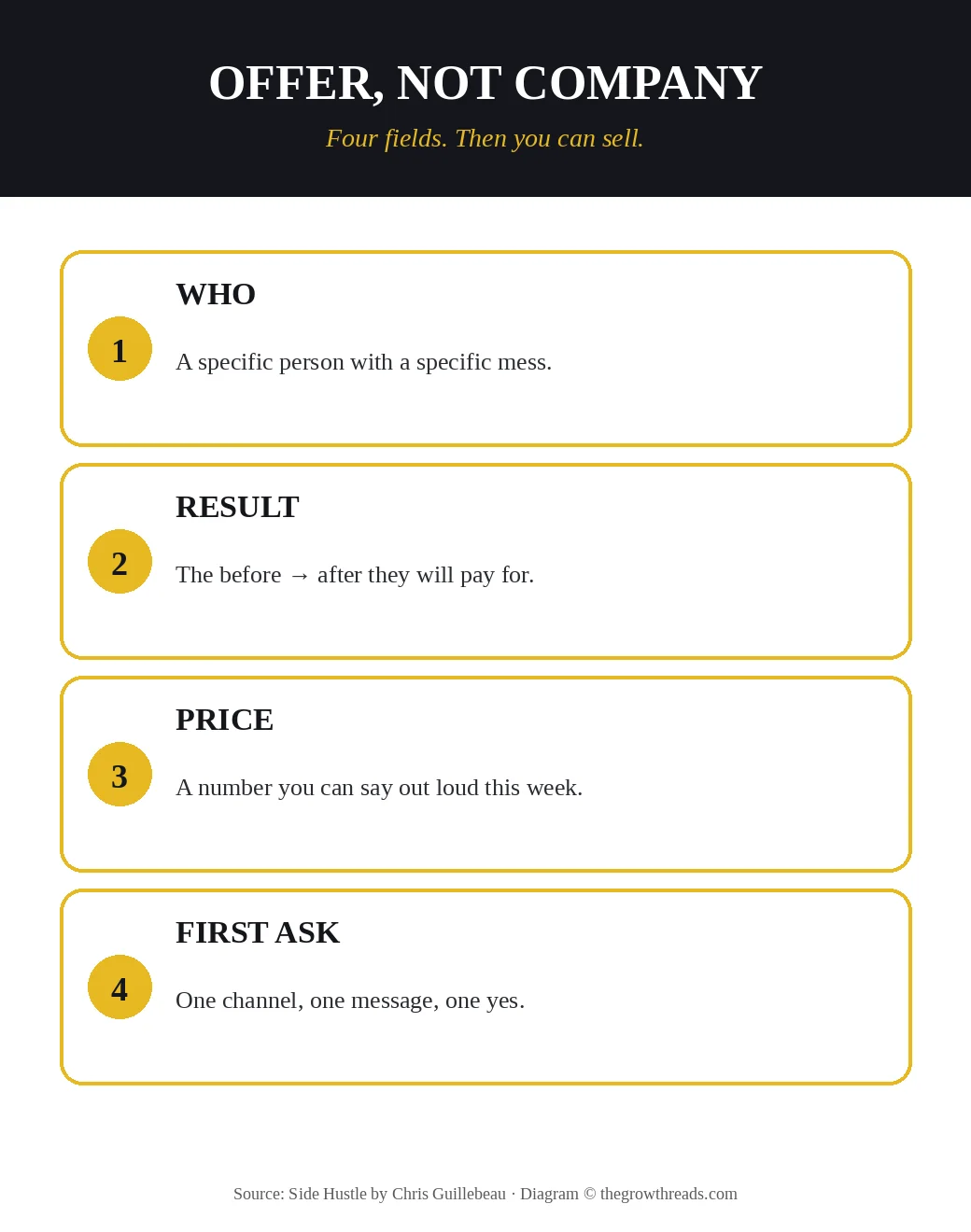
Week three (days 11–16) is four fields. Who is this for — a specific person with a specific mess, not “busy professionals.” What result do they buy — the before and after, not your process. What is the price — a number you can say out loud this week, even if it is smaller than your fantasy rate. What is the first ask — one channel, one message, one yes. That is an offer. It is not a company. You do not need a logo suite, an LLC, a Shopify theme, or a content calendar to take a first dollar. Those can wait until money has voted.
Delivery should match the skill you already have. If you teach, the first version can be a paid call or a short workshop, not a 40-module academy. If you design, it can be one landing page for one local shop, not a productized agency. If you write, it can be a paid brief, not a media brand. Guillebeau keeps returning to speed: every extra asset you invent in week three is a day you are not in week four. Write the offer in plain sentences a customer could repeat. Then pick how they pay — a simple invoice, a checkout link, even a transfer — and how you will actually do the work without blowing up your job’s evenings.
TGR Note: If week three keeps turning into org charts and mission statements, switch books. Rework is the operating system for staying small after you have something to sell. The E-Myth Revisited is for the later moment when the hustle is real and you need a system so it does not depend on your heroic evenings. Neither replaces the first offer.
Part 4: Launch, then make it smaller
Weeks four and five (days 17–27) are where most notebooks die. Guillebeau’s instruction is unromantic: tell people, take money, learn. Start with the circle that already trusts you — colleagues, former clients, a tiny list, a community you actually show up in. A polished ad to strangers is slower than an honest sentence to five people who have the problem. The launch is a series of small asks, not a Super Bowl spot. One “here is what I can do this month, here is the price” message beats a 12-email sequence you never send.
When the first dollar arrives, week five is not a victory lap. It is a size check. What broke? What did the customer actually need? What can you strip so this still fits beside the job? The hustle should produce profit and stay small enough to run at night. If it only works by skipping sleep, it is a second employer, not a side project. After 27 days you decide: grow a little, maintain as a quiet extra, or stop. Stopping a hustle that paid and taught you something is a success. Restarting week one because launch felt awkward is how the calendar becomes another unread system. One short attributed line from the book’s stance: a side hustle is a moneymaking project you start in addition to regular work — not a personality, and not a resignation letter.
Two evening blocks and one weekend hour will carry most first offers. Put them on the same days each week. If a task needs a website, a course platform, or a hire, ask whether a first dollar still depends on it. If the answer is no, it is next month’s problem. Poke the Box is the startle if you have the offer and still will not send it.
Who is Side Hustle best for — and who should read something else first?
Best for people with a job, a usable skill, and a stack of untested ideas. Teachers, designers, operators, and specialists who already solve a problem at work and could sell a slice of that help in the evening. Also for the person who romanticizes startups and needs a smaller first game with a receipt.
Read something else first if you have no skill worth paying for yet — start with So Good They Can’t Ignore You and get paid for craft before you productize it. If you already know the offer and cannot start, use Poke the Box or The War of Art. If you want a company, not a hustle, The E-Myth Revisited is the next book, not this one. If you already sell and the work is eating your calendar, Clockwork or Rework will help more than another 27-day idea sprint.
Questions to reflect on
- What problem have three different people already paid someone to fix in the last year?
- Which of my current skills can deliver a first version this month without a new certification?
- Who, specifically, would I text an offer sentence to this week — name them?
- What am I calling “branding” that is actually delay?
- If this had to fit two evenings and one weekend hour, what would I cut from the plan?
🔥 Ready to take a first dollar in 27 days?
Pick one feasible offer. Tell five people who already have the problem.
How to apply Side Hustle (7-day plan)
- Day 1 — Arsenal. Write ten idea seeds: frustrations, asked-for skills, paid-for problems. No scoring.
- Day 2 — Score. Mark each wanted / doable / fast cash. Circle the one that clears all three.
- Day 3 — Who and result. One sentence: who it is for, what before → after they buy.
- Day 4 — Price and delivery. Say a number out loud. Write how you will do the work in two evening blocks.
- Day 5 — First ask list. Name five people who already have the mess. Draft one message. Do not send a funnel.
- Day 6 — Send. Ship the message to all five before noon. Take the first yes, even if the offer is ugly.
- Day 7 — Size check. If someone paid, write what to strip so it still fits the job. If nobody paid, send five more asks, do not rebuild the brand.
Frequently asked questions
What is Side Hustle about in one paragraph?
Side Hustle is Chris Guillebeau’s 27-day calendar for starting a small paid project beside a job. You collect ideas from problems people already pay to solve, pick the one that is wanted, doable, and fast to a first dollar, write a simple offer, tell people, and take money before you build a company. The book is a sprint, not a manifesto. The scoreboard is cash in 27 days, not a logo, an LLC, or a five-year plan. Read it when you keep researching businesses and have not yet sold anything.
How long does it take to read Side Hustle?
The Currency edition runs 272 pages. Most readers finish it in about five to six hours. The 27-day plan is the real clock: Guillebeau wants you working the next prompt the same week, not collecting another unread business title. This summary is a twelve-minute pass through the five weeks, the idea scorecard, and a seven-day TGR plan that compresses the first moves. If you only have a lunch break, read the one-minute section, score three ideas, and send one offer sentence to a person who already has the problem.
Is Side Hustle worth reading if I already read The $100 Startup?
Yes, if The $100 Startup left you convinced and still unlaunched. That book is the philosophy of a tiny, useful offer at the intersection of skill and demand. Side Hustle is the calendar that forces a first dollar in 27 days. You will hear the same bias toward smallness and existing skills. You will not get a second manifesto. Use Startup when you need to believe a one-person business is allowed. Use Side Hustle when you need tomorrow’s prompt. If you already ship small offers, skip ahead to Rework or Clockwork instead of rereading the sprint.
Do I need to quit my job to use Side Hustle?
No. The whole point is a project that fits beside paid work. If the idea requires you to resign, lease an office, or spend six months building before a customer appears, Guillebeau would call it the wrong first hustle, not a brave one. Keep the job. Keep the health insurance. Sell a narrow result to a few people who already want it. If the hustle later earns enough to replace the job, that is a later decision, not a day-one requirement. The 27-day plan is designed so evenings and a weekend can carry the first launch.
What is the 27-day plan in Side Hustle?
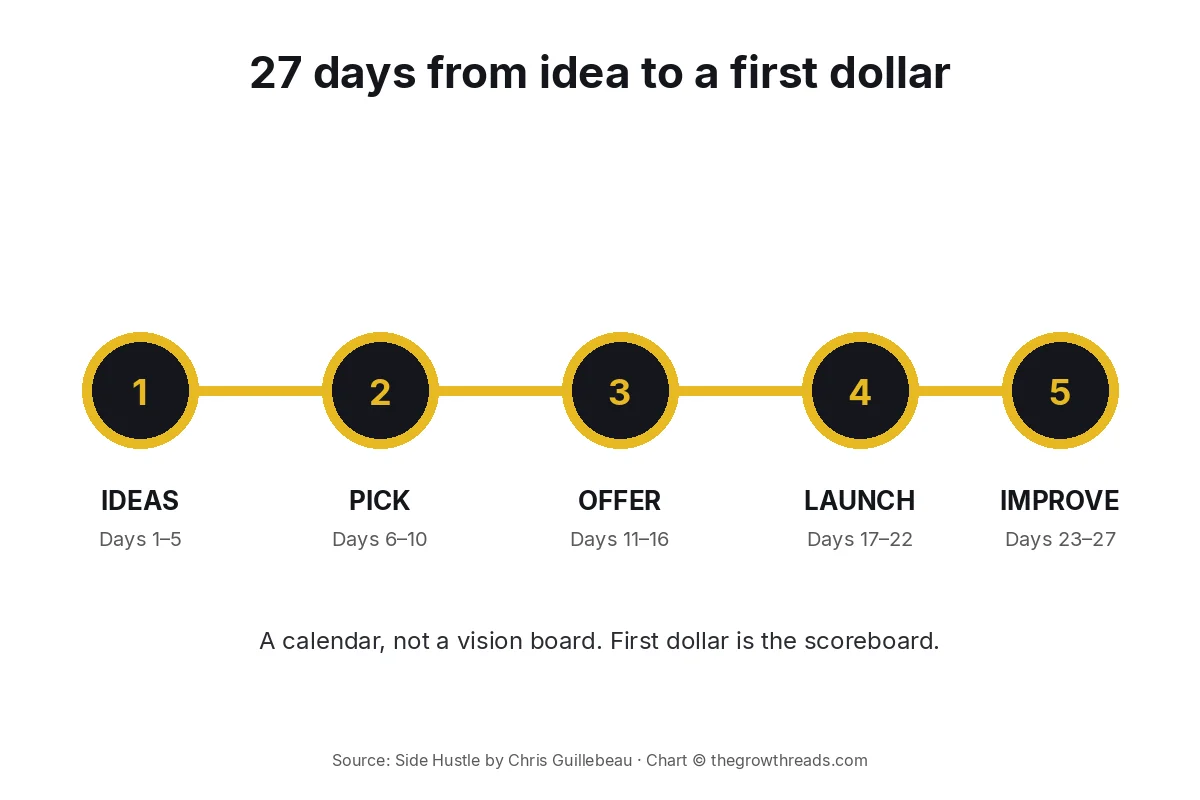
Five weeks on a calendar. Days 1–5: collect many ideas from frustrations, skills, and problems people already pay to fix. Days 6–10: score those ideas for wanted, doable, and fast cash, then pick one. Days 11–16: write who it is for, what result you sell, how they pay, and how you deliver — an offer, not a company. Days 17–22: tell people and take the first money. Days 23–27: improve from those sales and keep the work small enough that it does not eat the job. The plan is a forcing function. Miss a day, pick up the next one. Do not restart the month.
Who is Side Hustle best for?
People with a job, a usable skill, and a notebook full of business ideas that have never met a customer. Teachers, designers, accountants, nurses, and operators who already solve a problem at work and could sell a slice of that help in the evening. It is also for the person who romanticizes startups and needs a smaller first game. It is less useful if you have no skill worth paying for yet — go to So Good They Can’t Ignore You first — or if you already run a one-person firm and need systems. Then Clockwork or The E-Myth Revisited will help more than another idea sprint.
Side Hustle vs The $100 Startup vs Rework?
The $100 Startup is Guillebeau’s case that a tiny, useful business can fund a life — sweet-spot, customers, and enough proof that you do not need a warehouse. Side Hustle is the 27-day drill that gets a first dollar beside a job. Rework, by Jason Fried and David Heinemeier Hansson, is the operating system for staying small after you have something to sell: ignore the growth theater, ship less, and keep the calendar calm. Read Startup to believe the model, Side Hustle to start this month, Rework to stop turning the hustle into a fake company. Link them; do not stack all three in one week.
Related summaries
- The $100 Startup — the longer case for a tiny, useful offer.
- Anything You Want — serve a few people well and stop there.
- The Mom Test — hear the pain before you marry the idea.
- Rework — stay small after the first dollar.
- Best productivity books — the full Productivity pillar.
How we analyze books: every book on The Growth Reads is read cover to cover, summarized in thousands of words of original analysis, and rated against our five-criteria rubric (lasting impact, evidence quality, practical application, writing & originality, external consensus). Read our full methodology.