

★★★★½ 4.5/5 — A miss is information. It is not a verdict on you. Take the lesson and put the next attempt on the calendar.
Best for: people who already start, already miss, and then spend the week turning that miss into a story about who they are.
Reading time: ~4 hours (224 pages) · this guide ~12 min
Difficulty to apply: Easy to start, medium to keep — the stance is simple; using it in the hour after a no is the work.
Failing Forward in one minute
The difference between a stall and a next attempt is not talent. It is what you do with the miss. John C. Maxwell’s Failing Forward (Thomas Nelson, 2000) is a short book about that hour. Average people treat a short landing as a verdict. Achieving people treat it as a step they can still use. Get the “you” out of it: name it, own the next move, extract one lesson, and get up. The work is a calendar block after the no, not a nicer story in the same chair.
Key takeaways
- The gap is the response: average and achieving people both miss. They do not both stay down.
- Redefine the miss: you have not failed forward until you quit on the lesson or on the next try.
- Get the “you” out: a short attempt is an event. It is not a biography.
- Responsibility is not shame: own the next move without putting the miss on your name tag.
- Action shrinks fear: waiting to feel brave is how yesterday keeps the chair.
- Do not import the miss: an outside no does not have to become an inside verdict.
- Yesterday is not a workspace: replay is not review. Write the lesson, then leave the tape.
- Find one benefit: not a silver lining speech — one reusable fact, then train the weak point it named.
- Get up, get going: the stance only counts if a retry is on the calendar.
What is Failing Forward about?
Failing Forward argues that success is not the absence of misses. It is a trained response: keep the miss off your identity, own the next move, and put another try on the calendar. Maxwell writes for the afternoon after the no — when blame, of the room or of yourself, has replaced a retry.
About the author
John C. Maxwell is an American pastor, speaker, and leadership author whose 21 Irrefutable Laws of Leadership made him one of the most widely read writers in the field. He later turned the same teaching voice toward personal growth in The 15 Invaluable Laws of Growth. Failing Forward sits between those two: not a law list for running a team, and not a full growth plan, but a stance for the hour after your own work lands short. He founded EQUIP and the John Maxwell Company. This book is the quieter sibling — whether you will still take your own next attempt after a miss. He writes as a teacher, not a lab. The claim to test is simple: if you change the response, the miss stops being a life sentence. Explore all John C. Maxwell book summaries →
Key concepts at a glance
| Concept | What it means | Use it when |
|---|---|---|
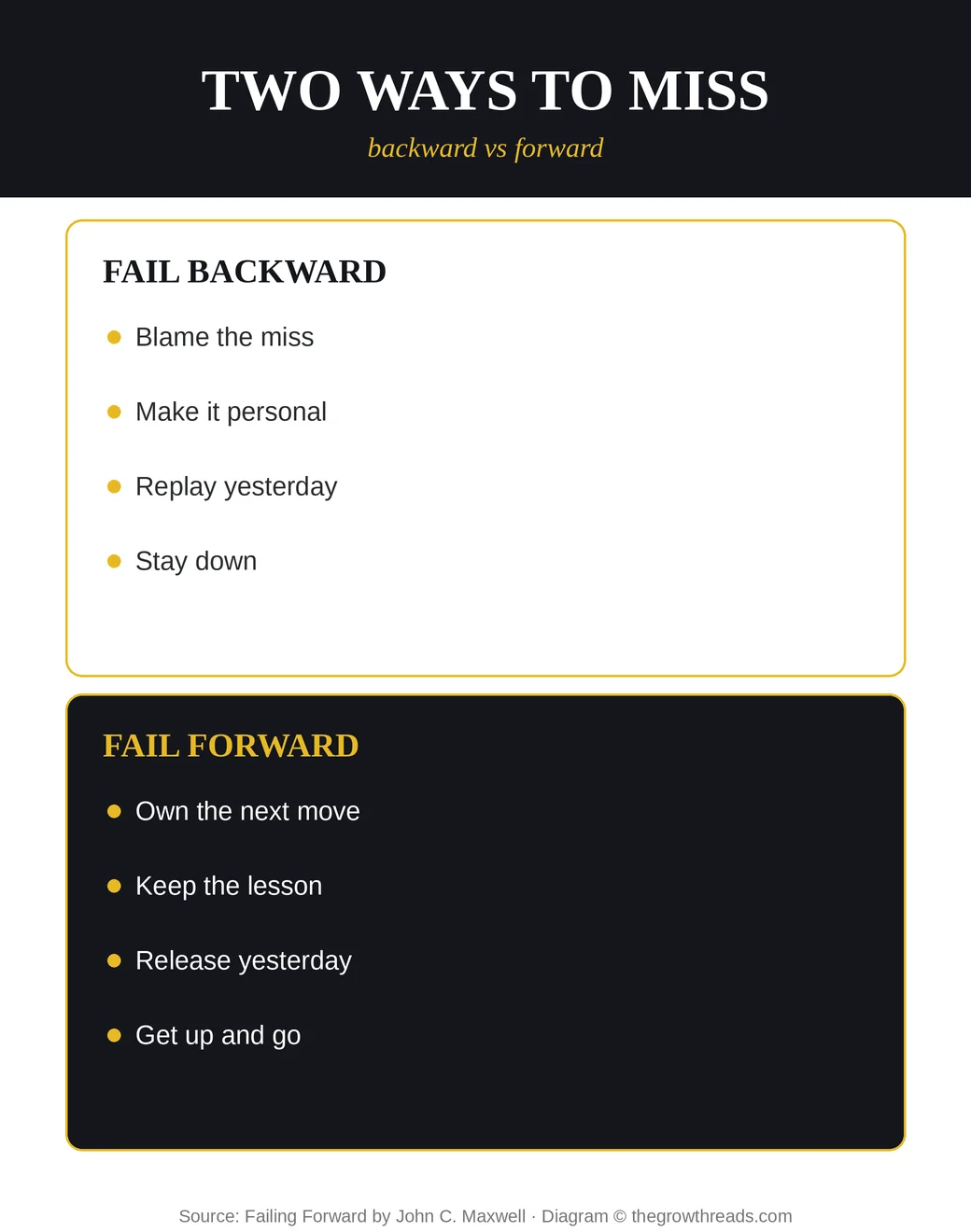
| Fail backward | Personalize the miss, replay it, stay down. | A no has become a week of brief-writing against yourself. |
| Fail forward | Own it, keep the lesson, schedule the retry. | You can name the miss and still have no next attempt on the calendar. |
| New definition of failure | You have not failed until you quit on the lesson or the try. | You are treating a short landing as a final score. |
| Get the “you” out | The miss is an event, not a self. | You hear “I am a failure” instead of “that attempt missed.” |
| Responsibility | The next move is yours. Shame is optional and unhelpful. | You are waiting for the room to apologize before you retry. |
| Benefit in the bad | Leave with one reusable fact, not a speech. | You keep telling the story and never write the lesson. |
| Get up, get going | The stance is a calendar block, not a feeling. | Insight has been sitting in the chair since Tuesday. |
Part 1: Average vs achieving — it is how you see the miss
Maxwell opens with a distinction that sounds too clean until you watch a real week. Average people and achieving people both miss. The split is not a talent gap in the first attempt. It is the story that starts in the next hour. Fail backward and the miss becomes a verdict. Fail forward and the miss stays a miss: that attempt landed short, here is what I can see, here is when I try again.
He wants a new definition. In the old one, failure is any result that is not the picture you wanted. That definition turns every ambitious week into a threat, so you start protecting the picture instead of running the attempt. In Maxwell’s definition, you have not failed until you have refused the lesson or refused the next try. A short landing is expensive. It is not yet a closed case. That is not permission to be sloppy. It is permission to keep the identity off the scoreboard so you can still look at the film.
Fear lives in that old definition. If a miss means you are the miss, of course you delay the attempt. Action is how he shrinks the fear: a smaller next try while the story is still loud, not a speech about courage.
TGR Note: If the problem is how a whole team hides errors, start with Black Box Thinking. If the problem is talent-as-practice, Bounce and Talent Is Overrated are the cousins. Maxwell is the personal stance in the hour after your miss, before any of those systems get a second run.
Part 2: Get the “you” out of failure
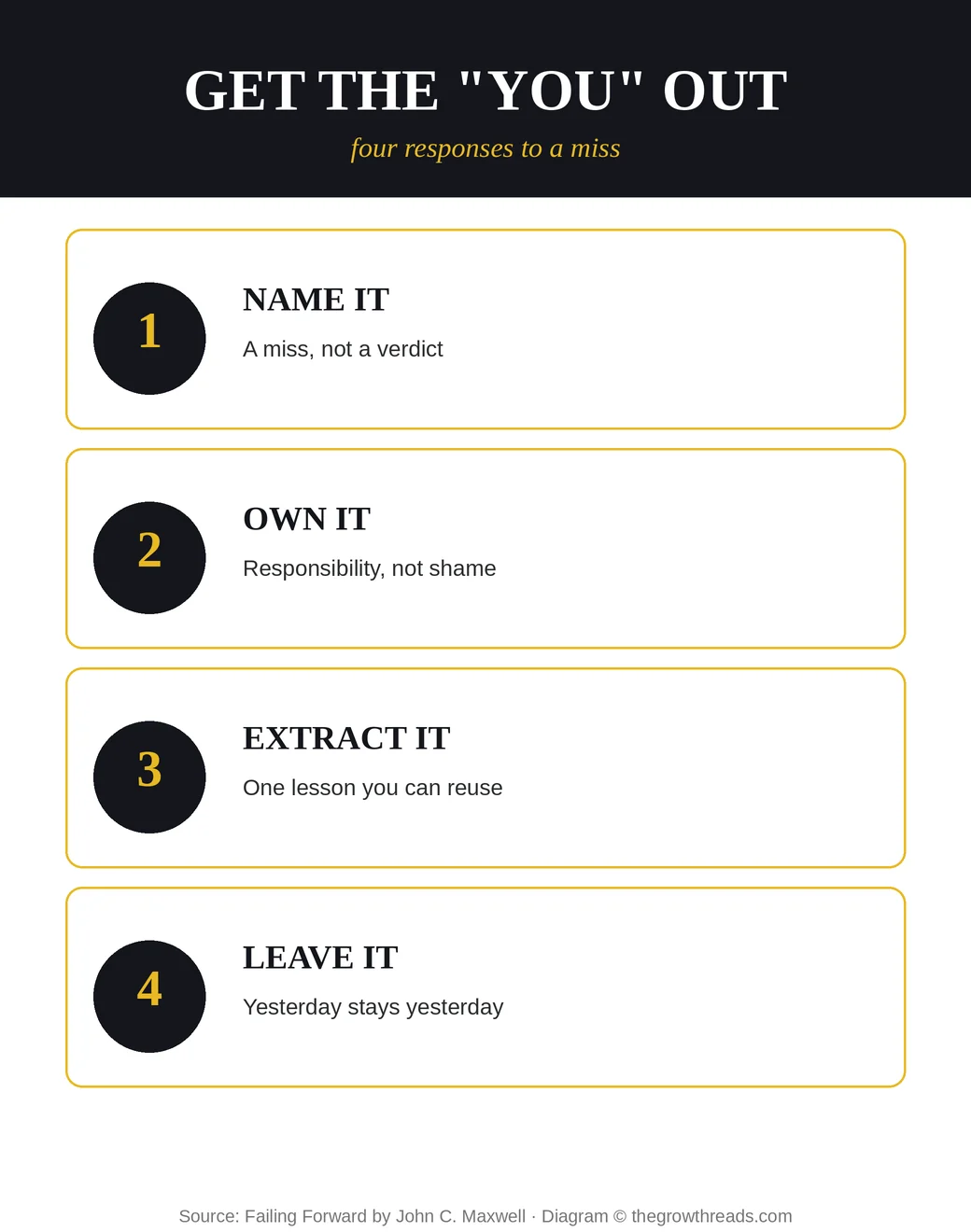
The most useful move in the book is grammatical. Maxwell wants the word you off the miss. “The launch failed” is a report. “I am a failure” is a costume. Reports can be used. Costumes get worn to the next meeting. Getting the you out is not a trick to avoid responsibility. It is how responsibility stays usable. Shame says you are the problem, so the only logical next step is hiding. Responsibility says the next move is still yours, so the next step is a retry with a sharper aim.
He is blunt about blame. Outsourcing the miss to the client, the algorithm, the teacher, or the market feels like self-protection. It also donates your next move. If they caused it, they have to fix the conditions before you are allowed to try. That is a long wait. Owning the next move does not mean pretending the room was fair. It means you will not sit still until the room writes you an apology. The outside no can stay outside. The inside verdict is the part you actually control.
Yesterday is the other trap. Replay feels like review and is usually rumination with better lighting. Review writes one sentence you can reuse, then leaves the tape. Maxwell’s instruction is pastoral: say goodbye to yesterday, not because the miss did not matter, but because it cannot teach you from a chair you refuse to leave.
TGR Note: If the stall is a loud inner brief rather than a story about a miss, Unfu*k Yourself is the interrupt: say a line, then move for ten minutes. If you need Maxwell’s broader growth system — written plan, stretching environment, weekly review — go to The 15 Invaluable Laws of Growth. Failing Forward is the hour between those two books.
Part 3: Turn a bad experience into a teacher
Maxwell’s “find the benefit” chapter is easy to mishear as forced cheer. He is not asking you to be glad it went badly. He is asking you to leave the scene with one reusable fact. Maybe the pitch was too wide. Maybe you under-practiced the close. Maybe you needed a smaller room first. One fact is a teacher. A ten-minute speech about “everything happens for a reason” is a way to skip the fact. Write the lesson in a sentence a stranger could use. If you cannot, you are still in the story, not in the debrief.
The weak-point chapter is the unsentimental twin. A miss often points at a skill you keep walking around: the follow-up, the numbers, the uncomfortable conversation, the last ten percent of polish. Achieving people treat that pointer as a training assignment. Failing backward treats it as proof you should stay in the lanes that already feel safe. Maxwell’s line that there is not much difference between people, but that the little difference makes a big difference, is pointing at this. The little difference is rarely genius. It is whether you will train the thing the miss named.
If at first you succeed, try something harder is the other side of the same coin. A clean week can stall you if it never asks more. Maxwell wants one lesson, then a slightly harder try — stretch without a debrief is chaos; a debrief without a stretch is a tidy notebook.
TGR Note: Hidden Potential is Grant’s longer argument that improvement is a designed path, not a gift. Do Hard Things is Magness on noticing, choosing, and lasting through discomfort. Maxwell is shorter and more pastoral: take the miss off your name tag, then train the weak point it revealed. Use Grant and Magness when you need the training plan. Use this when you still will not start the plan because last Tuesday still has the chair.
Part 4: Get up, get over it, get going
The last move is the one people skip because it is not a quote. Get up. Get over it. Get going. Maxwell stacks those three because insight loves to stop at get over it — a private, dignified peace with the miss that never returns to the field. Peace that does not retry is still failing backward in nicer clothes. Getting going is a scheduled attempt: same week if you can, next week if the work is heavy, never “when I feel like myself again.” Yourself is who shows up for the retry.
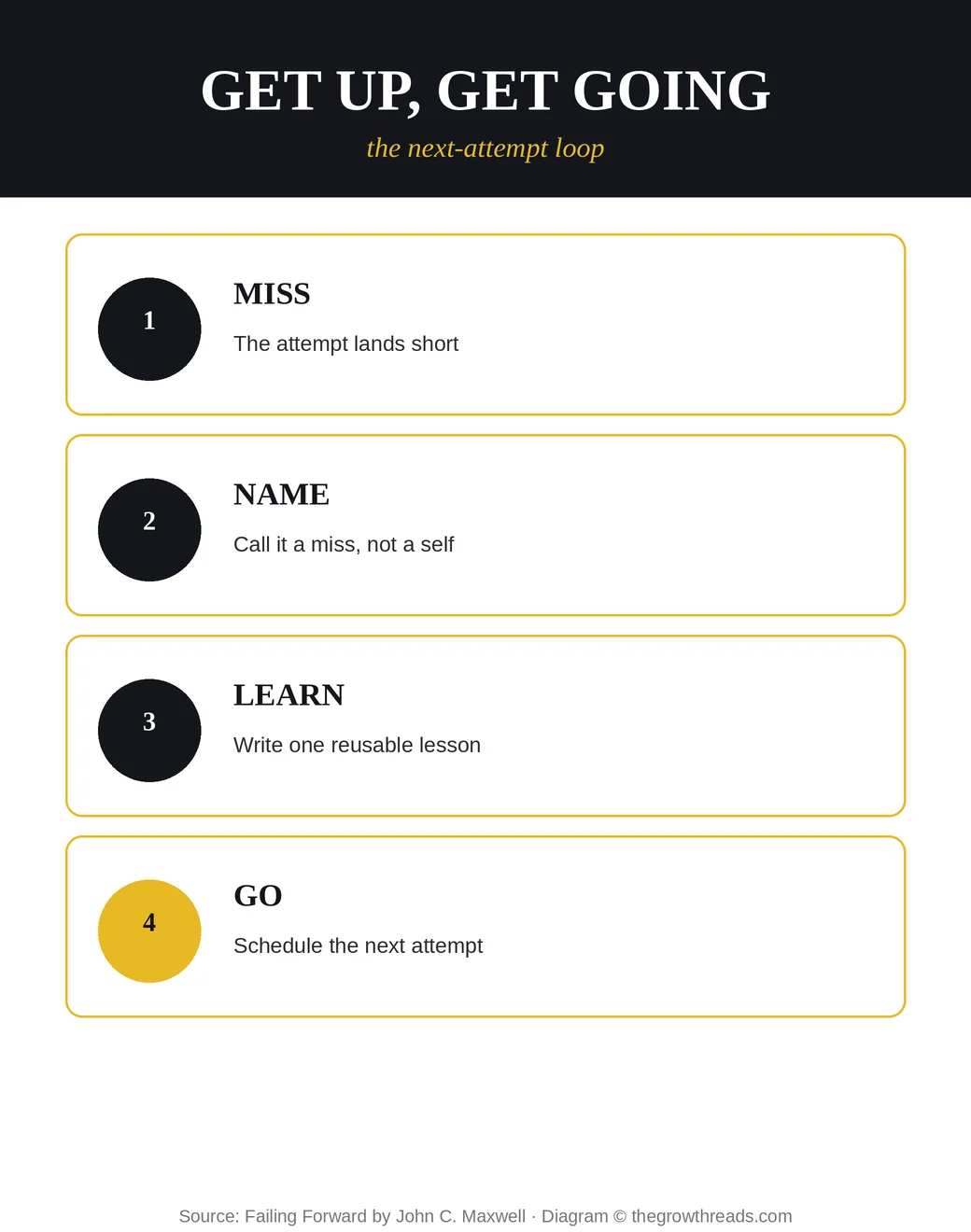
You do not need his biography to use the loop. Miss. Name it as a miss. Own the next move. Extract one lesson. Put the retry on the calendar before you close the laptop. That is the whole machine. It is almost insultingly small, which is why it survives a loud week.
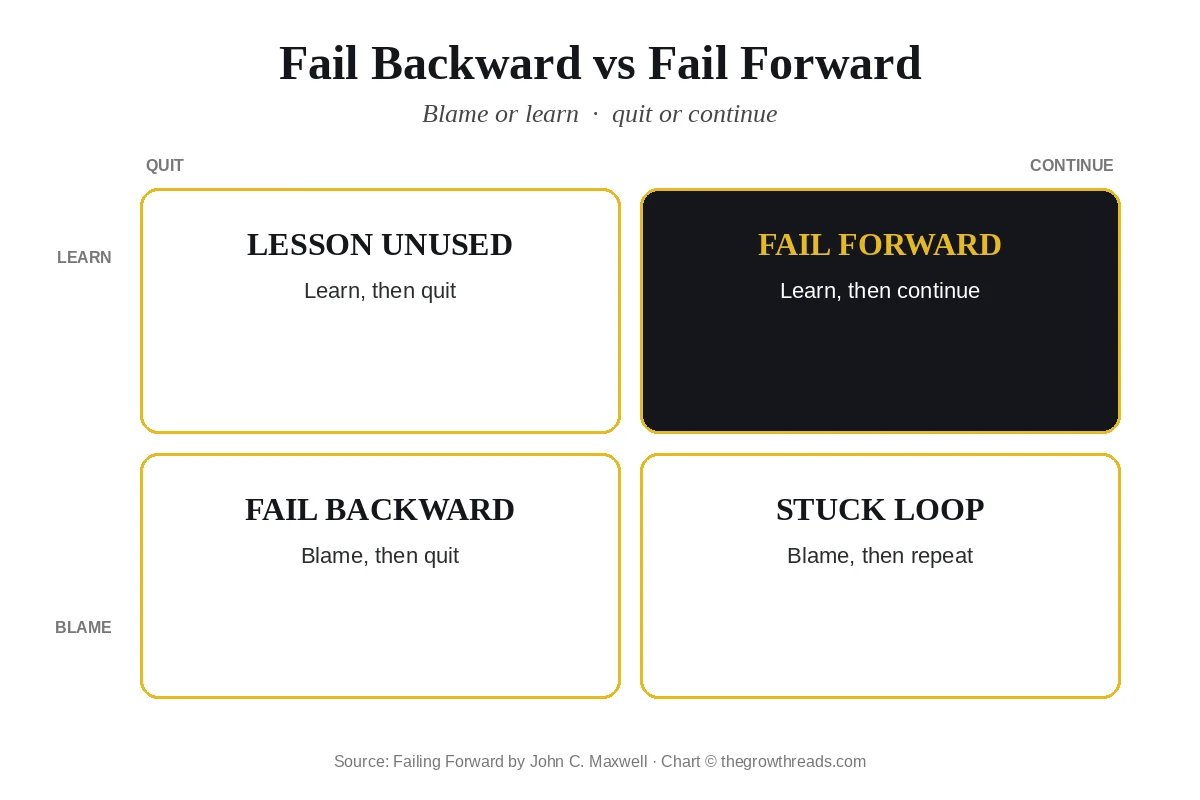
Put the 2×2 on a card if you want: blame or learn, quit or continue. The gold square is learn and continue. Everything else is a costume. Blame and quit is fail backward. Blame and continue is a stuck loop — you keep trying, but you keep trying as a defendant. Learn and quit is a lesson you will not cash. The book’s job is to walk you into the gold square once this week, then again. Maxwell will not build your habit stack. He will get you off the floor so a stack can run.
Who is Failing Forward best for — and who should read something else first?
Read this if you already start, you already miss, and you turn that miss into a story about who you are — after a launch, a grade, a pitch, or a week that landed short. The tone is pastoral Maxwell: lists, stories, a stance you can teach a room.
Read something else first if you cannot get into the chair at all — go to Atomic Habits or Mini Habits. If you need a team’s error culture, start with Black Box Thinking. If you need the science of practice, start with Talent Is Overrated or Bounce. If the stall is a loud narrator rather than a story about a miss, start with Unfu*k Yourself. Maxwell will not replace a cue, a lab, or a coach. He will change what you do in the hour after the attempt lands short.
Questions to reflect on
- Where did last week’s miss become a sentence about you instead of a sentence about the attempt?
- What would “own the next move” look like in one calendar block, without waiting for the room to apologize?
- If you had to write one reusable lesson a stranger could use, what is it — in one line?
- Are you in replay or in review? What would leaving the tape actually require this afternoon?
- When is the next attempt, and what weak point will that attempt train on purpose?
🔥 Ready to fail forward this week?
Name one miss. Write one lesson. Put the retry on the calendar before the story takes the chair.
How to apply Failing Forward (7-day plan)
- Day 1 — Write one miss from the last two weeks as an event, not a self. No “I am.” One sentence.
- Day 2 — Add one line of responsibility: the next move that is yours, even if the room was unfair.
- Day 3 — Extract one reusable lesson a stranger could use. If you cannot, you are still in the story.
- Day 4 — Put a retry on the calendar this week. Name the weak point that attempt will train.
- Day 5 — When replay starts, label it replay. Close the tape. Open the next attempt’s first five minutes.
- Day 6 — Do the retry ugly. Stop at the block you scheduled. Do not expand it into a personality project.
- Day 7 — Score the week: did you fail backward (stay down) or forward (lesson + attempt)? Keep the one move that produced a retry.
Frequently asked questions
What is Failing Forward about in one paragraph?
Failing Forward is John C. Maxwell’s case that the gap between average weeks and achieving weeks is not talent. It is how you see a miss and what you do in the hour after it. He asks you to stop treating failure as a verdict on you, take responsibility without shame, extract one reusable lesson, and schedule the next attempt. The book is pastoral and practical rather than a lab study. Read it as a stance you can use on Tuesday, not as a personality transplant.
What does it mean to fail forward?
Failing forward means the miss stays a miss: you own it, you keep the lesson, and you get moving again. Failing backward means you personalize it, replay yesterday, and stay down. Maxwell’s line is that achieving people are not people who never miss. They are people whose response does not turn one short attempt into an identity. The test is behavioral. If the next calendar block is a retry, you are failing forward. If the next week is a brief against yourself, you are still on the floor.
Is Failing Forward just positive thinking?
No. Positive thinking tries to paper a nicer story over the same stall. Maxwell wants a new definition of the miss and a next action. Responsibility is not a pep talk. It is refusing to outsource the next move to luck, other people, or a mood that might arrive on Thursday. The benefit-finding chapter is not a demand that you enjoy the miss. It is a demand that you leave with one thing you can reuse. If nothing on your calendar changes, you reread the slogan and skipped the work.
How is this different from Black Box Thinking or Bounce?
Black Box Thinking is how a team or a craft treats errors as data. Bounce is how talent is built through practice that includes misses. Failing Forward is the personal stance in the hour after your own short attempt: identity, responsibility, yesterday, next try. Use Syed when the culture around you hides mistakes. Use Maxwell when the culture is fine and you are the one turning a miss into a self. They nest. A clean debrief still dies if you make the miss personal and never schedule the retry.
Who is John C. Maxwell and should I trust the book?
Maxwell is an American pastor-turned-leadership author whose 21 Irrefutable Laws of Leadership and later growth books made him one of the most widely read writers in the field. Thomas Nelson published Failing Forward in 2000; the trade paperback linked here is the 2007 reprint. He writes as a teacher of stance, not as a lab. Treat the book as applied response-to-failure, not as a randomized trial. The useful claim does not need a white coat: a miss that becomes identity will stall the next attempt. If you want the science of practice after the stance, stack Talent Is Overrated or Bounce.
How long does Failing Forward take to apply?
The paperback is 224 pages, roughly four hours of reading. Application is shorter on purpose. Day one is naming one miss without a verdict. Day two is one sentence of responsibility. By the end of the week you should have a written lesson and a scheduled retry, not a new personality. Most people who bounce off the book underline the slogans and never put a next attempt on the calendar. A week is enough to learn whether you fail backward (replay, blame, stay down) or forward (own, extract, go). Ninety days is enough to see whether retries actually happen.
Should I read The 15 Invaluable Laws of Growth or Mini Habits instead?
Read The 15 Invaluable Laws of Growth if you need Maxwell’s broader growth system — written plan, stretching environment, weekly review. Read Mini Habits if the stall is getting started at all, not recovering from a miss. Read Failing Forward if you already start, you already miss, and you turn that miss into a story about who you are. The growth book is the plan. Mini Habits is the first two minutes. This book is the hour after the attempt lands short. If you already own a Maxwell title and still freeze after a no, start here, then return to the plan with one completed retry.
Related summaries
- The 15 Invaluable Laws of Growth — Maxwell’s broader growth plan after the stance is in place.
- Black Box Thinking — treat errors as data when the miss is a system, not only a self.
- Bounce — talent as practice that includes misses, without making them identity.
- Unfu*k Yourself — the inner-brief interrupt if the stall is narration rather than a story about a miss.
- Best productivity books — the full Productivity pillar.
How we analyze books: every book on The Growth Reads is read cover to cover, summarized in thousands of words of original analysis, and rated against our five-criteria rubric (lasting impact, evidence quality, practical application, writing & originality, external consensus). Read our full methodology.