

★★★★☆ 4.5/5 — Decide when the fact is in the room, not when the diagram looks finished.
Best for: a solo founder or a new manager who is building a system for a problem that has not arrived. This review’s deep read is the introduction and chapter 3. Difficulty to apply: moderate. The rule is short. Knowing when the last responsible moment has arrived is the work.
Lean Software Development in one minute
Stop building the system for a problem you do not have yet. Mary Poppendieck and Tom Poppendieck argue that a decision made on speculation is the expensive one, and that a better decision waits until the fact is in hand.
Their 2003 toolkit sets seven lean principles. The third is to decide as late as possible. Chapter 3, read in full here, calls the cutoff the last responsible moment: the time when failing to decide would remove an alternative. Until then, build only what the current need requires.
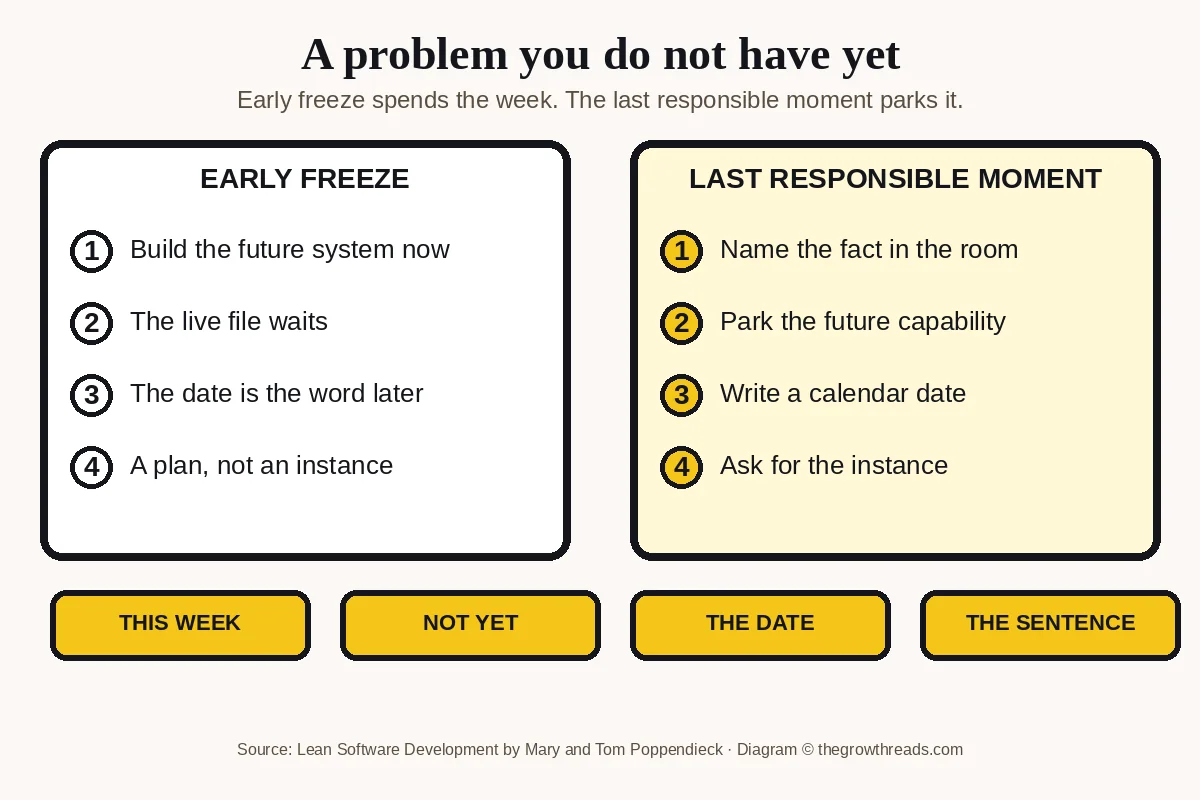
For a solo founder or a new manager the move is four lines: this week’s job, the future problem, the date you will look again, and the sentence you send when someone asks you to build the future one now. Those lines are this review’s application. The book supplies the rule.
Key takeaways
- Fact before the freeze: a better decision is based on fact, not speculation. An open option beats a locked design while the situation is still moving.
- Translate the principle: principles can travel. Copying another field’s practice is where the metaphor breaks.
- Early freeze is depth-first: low-level decisions get made before anyone has felt the high-level ones.
- A head start is not concurrent work: starting earlier still needs domain knowledge and contact with the people who have the problem.
- The last responsible moment is a time: it is when failing to decide would remove an alternative. Past it, the decision happens by default.
- Parking without a date is procrastinating: the authors say delaying a real decision is hard work.
- Defer the capability you are sure you will need: build the simplest thing the current need requires.
- Do not defer a constraint that is already true: security, response time, and failsafe operation belong at the start if they matter in the domain.
What is Lean Software Development about?
Lean Software Development is a toolkit that turns seven lean principles into thinking tools for people who lead software work. The third principle tells you to decide as late as possible, when the fact is available, instead of freezing a design for a problem that has not arrived.
The introduction is written for software development managers, project managers, and technical leaders. It says the book is not a cookbook of practices. It is for people who have to design the practices that fit their own domain. That distinction matters for a solo founder who is not running a software group, and for a new manager with one person reporting to them. You take the principle. You do not copy a die-making shop or a twenty-person engineering team.
About the author
Mary Poppendieck and Tom Poppendieck wrote the book together. Addison-Wesley’s author page, checked on 17 November 2026, says Mary has led work from enterprise supply chain management to digital media and is president of Poppendieck LLC. Tom is an enterprise analyst, architect, and agile process mentor. The publisher credits this book with the 2004 Jolt Software Development Productivity Award. In chapter 3 they describe their own split: Tom keeps options open, Mary is quicker to move, and she waits for his wider look on important decisions while he relies on her sense of when a decision is due. Neither has a Wikipedia page this review could use for a portrait. Explore all Mary Poppendieck book summaries →
Key concepts at a glance
| Concept | What it means | Use it when |
|---|---|---|
| Decide as late as possible | Decide from fact, not speculation. | The diagram is ready and the fact is not. |
| Last responsible moment | When failing to decide removes an alternative. | You need a date, not later. |
| Options thinking | The right, not the duty, to act later. | The choice would be irreversible and still a guess. |
| Defer future capabilities | Build only what the current need requires. | You are sure you will need a system you do not need yet. |
| Simple rules | A short list the nearest person can use. | The decision is waiting on someone outside the room. |
Do not freeze a design you have not lived with
Chapter 3 opens on car dies. Cutting the die is half the capital of a new-car program. In the 1980s, the book reports, design changes after the specs were released cost 30 to 50 percent of die cost in the United States and 10 to 20 percent in Japan. The obvious reading is that Japanese makers stopped the change. The chapter says they did not.
The U.S. pattern froze the design, then cut the steel. The book says about two years passed from the order to the die. In Japan the toolmakers rough-cut the steel while the car was still being designed, stayed in contact with the body engineer, and left material where a late change was likely. They did not freeze until late. The chapter says they spent perhaps a third as much on changes, and that a typical Japanese panel in 1990 took five stamping shots against seven in the United States.
Programming, they write, is a lot like die cutting. Freezing requirements first forces depth-first design: low-level decisions before anyone has felt the high-level ones. The costly miss is the thing forgotten at the start. When a big mistake is possible, survey the landscape and delay the detail.
Concurrent software work, in their account, means you start the highest-value features once a high-level design exists, while the details are still being investigated. It fails if you only start earlier. You need enough domain knowledge to see where the design is going, and direct contact with the people who know the problem. A founder who opens a billing-tool file, with no customer who cannot pay, has the head start and neither condition.
TGR note. The morning article, A Problem You Do Not Have Yet, uses Getting Real for the same order. Getting Real is already reviewed here. Use the last responsible moment for the date, and the morning note’s four lines for the page you fill in on Tuesday.
An option is the right to decide later
Tool 7 calls an option the right, but not the obligation, to do something later. A hotel reservation is their everyday picture. Cancel, and you lose the fee, not the stay. People resist an irrevocable choice while they are still uncertain, and most business decisions are written as if that option did not exist.
Hewlett-Packard’s printers are the worked example. The book says forecasts of how many printers each country would take were always a bit off, so one country had extras and another ran short. HP began fitting the electrical cord in the warehouse after the order. That cost more per unit than fitting it at the factory. The book reports that the option still paid, and that HP saved $3 million a month by matching supply to demand.
They use Enrico Zaninotto’s point that just-in-time controls complexity by minimizing irreversible actions. Delaying the plug until an order existed made the system simpler. A plan is still useful. The chapter says it clarifies tradeoffs and lets you move quickly. It should not lock detailed actions that came from speculation. Options are not free, and it takes expertise to know which ones to hold. A permissions system for a hire you have not made is an option with the wrong price. The cheaper option is a named file, a date, and the hours left on this week’s job.
The last responsible moment
Tool 8 names the cutoff. The last responsible moment is the moment at which failing to decide eliminates an important alternative. The authors credit the Lean Construction Institute. Wait past it and the decision is made by default, which they do not recommend. Their line is exact: procrastinating is not the same as making decisions at the last responsible moment, and delaying decisions is hard work.
Two tactics land on this week. Defer the capability you are sure you will need, and build only the simplest thing the current need requires. Refuse the extra feature you are adding just in case. Extra work adds complexity, not flexibility. The chapter points to Kent Beck’s YAGNI. This review did not read Beck. The Poppendiecks’ instruction is the one used here.
Two limits sit beside it. If security, response time, or failsafe operation is critical, consider it from the start. An early freeze is more likely to miss those features, because it narrows the view. A bias toward waiting must not become a bias toward never deciding. They picture Dell, which could assemble a computer in less than a week and so could decide less than a week before shipping. A slower studio has an earlier cutoff. Get faster at the live job. Do not build the two-year system now.
TGR note. Shape Up puts a number of days on a problem you have already chosen. This chapter refuses a capability you do not need yet. If you already picked the job and the week is disappearing into it, use the appetite. If you are designing a system for a hire, a scale, or a failure that is not in the room, use the last responsible moment and leave that file closed.
Breadth first, then a rule a person can use
Tool 9 contrasts a funnel with a tunnel. Breadth-first delays the commitment. Depth-first makes it early. Most people, the chapter says, take the tunnel on a new problem because it shrinks the problem fast. The risk is narrowing too soon, especially if the person choosing is not an expert. Depth-first works only if that early selection was right and nothing later will overturn it. Otherwise breadth-first does better, including when the domain will change.
The authors use themselves as the pair. Tom keeps looking. Mary starts, and she waits for his wider look on an important decision while he uses her sense of when it is due. A new manager can copy that: one person looks wide, one person calls the time.
They reject replacing that judgment with a process that thinks for people. Simple rules are the substitute they do accept. From David Freedman’s Corps Business, the chapter says Marines plan and do not predict, settle on an approach with a 70 percent chance of success, and manage by end state and intent: say what and why, and leave the details. Of the seven short rules in the chapter, the third is this problem: decide as late as possible, and keep options open as long as practical, but no longer. A permissions scheme for people you have not hired fails it. Try This asks you to list the decisions in front of you and name the fact that would make a tough one easy.
TGR note. A pile of live work needs a cut, not a park. Making Work Visible is that review. Park only the item that is not live yet.
Who is Lean Software Development best for — and who should read something else first?
Read this if the week is going to a system for a scale, a hire, or a failure that has not happened, while a live job waits. The book names the date. The four-line note is the application.
Read something else first if the problem is already in the room. A price that no longer matches the work is Breaking the Time Barrier. A build you already chose, with no number of days on it, is Shape Up. If security, response time, failsafe operation, or money you are already holding is the issue, chapter 3 says consider it from the start. The book is written for software leaders. The introduction says to translate the principle. The die-shop percentages, HP’s monthly saving, and the Marines’ 70 percent stay inside those accounts. They are not a target for a one-person company.
Questions to reflect on
- What file is open this week for a person, a scale, or a failure that is not in the room?
- What live job got none of those hours, and who would notice within seven days?
- What fact, if it arrived, would make the future system the right work? Do you have that fact, or a hope?
- What calendar date will you look again? If the answer is later, you have not delayed the decision. You have skipped it.
- Which constraint is already true, so that parking it would be the expensive mistake the chapter warns about?
🔥 Ready to decide when the fact is here?
Use the last responsible moment on the system you were about to build for a problem you do not have yet.
How to apply Lean Software Development (7-day plan)
- Day 1 — This week. One sentence. Name the person or the file that is already stuck.
- Day 2 — Not yet. Name the future capability and the fact you do not have. A billing tool for a product that does not bill is not yet. An unpaid invoice you already sent is this week.
- Day 3 — The date. Put a calendar day on the not-yet line. Later does not count.
- Day 4 — The sentence. Send it before you open the file. Name this week’s problem, the future one, and the date. Ask for the instance, not the plan.
- Day 5 — One tough decision. Name the fact that would make it easy. If you do not have that fact, you are not at the last responsible moment.
- Day 6 — The critical list. If the parked item is security, response time, failsafe operation, or money you are already holding, move it onto this week.
- Day 7 — Close or shrink. Close the future file. If one real instance arrived, solve only the smallest version that instance supports.
Frequently asked questions
What is Lean Software Development?
Lean Software Development is a 2003 Addison-Wesley book by Mary Poppendieck and Tom Poppendieck. The introduction calls it a set of thinking tools for software leaders, built on seven lean principles. This review uses the third: decide as late as possible. Open Library records xxviii plus 203 pages. The Amazon listing checked on 17 November 2026 gives a print length of 230 pages, a publication date of 8 May 2003, and ISBN-13 978-0321150783. The sample’s copyright page is dated 2003 and notes a seventeenth printing in May 2013.
What does decide as late as possible mean?
The introduction says a better decision is based on fact, not speculation, and that keeping a design option open beats an early commitment while the situation is still moving. Chapter 3, which starts on page 47 of the sample, applies that to software: do not freeze the detail while the high-level shape is still changing. The rule is not to avoid the decision. Make it when the information that would change it is in the room. Until then, spend the hours on the problem that already requires care.
What is the last responsible moment?
Chapter 3 defines it as the moment at which failing to decide eliminates an important alternative. The authors credit the phrase to the Lean Construction Institute. They say procrastinating is not the same thing, and that delaying a decision is hard work. Wait past the moment and the decision happens by default, which they do not recommend. For a solo founder or a new manager the practical form is a calendar date. Later is not a date. The future file stays closed until that date, or until one real instance arrives.
Is parking a future problem the same as ignoring it?
No. The chapter says a bias toward late commitment must not become a bias toward no commitment, and that you need a sense of when the decision is due. It also says that if security, response time, or failsafe operation is critical in the domain, consider it from the start. A system for a hire you have not made can be parked. A control that already protects a person, or money you are holding, cannot. Parking means you name the future problem, put a date on it, and leave the file closed.
What should you do when someone asks you to build the future system now?
Send one sentence and stop opening the file. That problem is not in front of us this week. This week’s problem is the live one. You will look at the future one on the date you wrote. If it shows up sooner, they should send the instance, not the plan. That sentence is this review’s application. It is not printed in the book. If they accept the date, do this week’s work. If they send one real case, solve the smallest version that case supports. If they want the plan anyway, repeat the date.
When should a small team refuse to delay?
Delay the future capability. Do not delay a constraint that is already true. Chapter 3 says a few decisions fix a system’s constraints for its life, such as language, architectural layering, or a commitment to a database other applications already use. Take a breadth-first look at those, rather than a rush into detail. The same pages say that ignoring security, response time, or failsafe operation until too late is costly, and that an early freeze is more likely to miss them because it narrows the view. A hope about next year’s scale is not on that list.
What did this review actually read?
On 17 November 2026 the Pearson sample for ISBN 9780321150783 was read through the end of chapter 3, including the introduction and the Try This exercises. Chapters 1, 2, and 4 through 8 were not read beyond the contents list and the introduction’s short account of each principle. No page number is cited from an unread chapter. The InformIT author page, the Open Library record, and the Amazon listing for ISBN-10 0321150783 were checked the same day. The four-line note and the sentence you send are this review’s application. They are not a form in the book.
Related summaries
- Getting Real summary — decide when the real information is in front of you.
- Shape Up summary — put days on a problem you have already chosen.
- Making Work Visible summary — cut a pile of live work, not a future system.
- Breaking the Time Barrier summary — name what moved after the price.
- Best productivity books — the silo this review sits in.