

★★★★☆ 4/5 — Use it when everything is marked urgent and you still start the pile. Say yes to one thing, show it, and tell people there is no capacity for the rest.
Best for: a solo founder or a new manager whose week arrives already stamped urgent.
Reading time: the second edition is 240 pages. The introduction and the WIP chapter are the sitting that matches this week.
Difficulty to apply: moderate. The yes is simple. Leaving the other notes visible, and unstarted, is the work.
Making Work Visible in one minute
When every note says urgent, say yes only to the most important thing, put that yes where people can see it, and use a limit to say there is no capacity for the rest. Dominica DeGrandis’s second edition names five thieves that keep a week unfinished. The one that matches this morning is conflicting priorities: projects and tasks that compete, made worse when you are uncertain what the most important thing is. The remedy she states is a shift from saying yes to everything to saying yes to only the most important thing at that time, and doing it visually. A work-in-progress limit is what lets you say there is no capacity to take on more right now.
Key takeaways
- The stamp is not a ranking: competing tasks get worse when you cannot name the most important thing.
- One yes: stop saying yes to everything. Say yes only to the most important thing right now.
- Show it: put that yes on a board people can look at, not in your head.
- The limit is the no: it is what lets you say there is no capacity for more right now.
- A limit liberates: reducing work in progress is how the unfinished pile stops running you.
- The long list is the trap: the most talented people have the longest lists.
- What slips stays visible: the other urgent notes wait, named, where someone can see they are not the yes.
- A real break moves the yes: do the break, put the yes back the same day, and do not add a second one.
What is Making Work Visible about?
Making Work Visible is Dominica DeGrandis’s book on five thieves that keep a week unfinished, and on a board that shows the work. When everything is marked urgent, say yes only to the most important thing, show that yes, and use a limit to tell people there is no capacity for the rest.
About the author
Dominica DeGrandis wrote Making Work Visible after years of putting invisible IT work on a board. In the second-edition introduction she describes eight years at Corbis, a layoff in September 2008, program-management work at AT&T Mobile, and July 2010, when she says she fired herself. In January 2011 David J. Anderson asked her to research and teach a course called Kanban for IT Operations. That research started in England, Sweden, and Germany in February 2011, and the first beta workshop ran in Boston that March. The book began as notes for people designing boards in those workshops. The second-edition preface is signed from Woodinville, Washington, in December 2021. IT Revolution Press published the edition on 15 March 2022, ISBN 9781950508495, 240 pages. We quote lines from the publisher’s excerpt of that edition that also appear in her 8 March 2022 article adapted from it. We do not add page numbers. Explore all Dominica DeGrandis book summaries →
Key concepts at a glance
| Concept | What it means | Use it when |
|---|---|---|
| Conflicting priorities | Tasks that compete, worse when you cannot name the most important thing. | Every note arrived stamped urgent. |
| The most important thing | The one yes for this moment. Not the loudest note. | You are about to start whichever file is open. |
| Make work visible | Put the yes, and the waiting work, where another person can see them. | The ranking still lives in your head. |
| Work in progress | Work started and not finished. Too much of it is demand past capacity. | The week is full and nothing is done. |
| The limit | The line that lets you say there is no capacity right now. | Someone wants a second yes. |
| Unplanned work | An interruption that stops you finishing. | A new stamp lands after you have chosen. |
| Neglected work | Half-done work that sits idle. | Old items stay open because new stamps felt hotter. |
| The sentence | Our application: the yes, the day, and the names of what waits. | You have to tell someone what slips. |
The urgent stamp is a conflicting priority
DeGrandis opens with five thieves of time. Too much work in progress has started and is not finished. Unknown dependencies are things you did not know had to happen first. Unplanned work is the interruption that stops you finishing. Conflicting priorities are projects and tasks that compete, worse when you are uncertain what the most important thing is. Neglected work sits idle, half done. The morning problem is the fourth thief, fed by the first. Everything is marked urgent because nothing has been chosen, so every request wears the same label and you start all of them.
The most talented have the longest lists. A solo founder hears that as clients, cash, and the work only they can finish. A new manager hears the boss, the team, and the old job they still do. Talent is how demand got past capacity. It is not a reason to keep saying yes. Too much work in progress, in her terms, is when demand exceeds capacity. A week of identical stamps is that sentence with the stamps still on.
Say yes to one thing, and show it
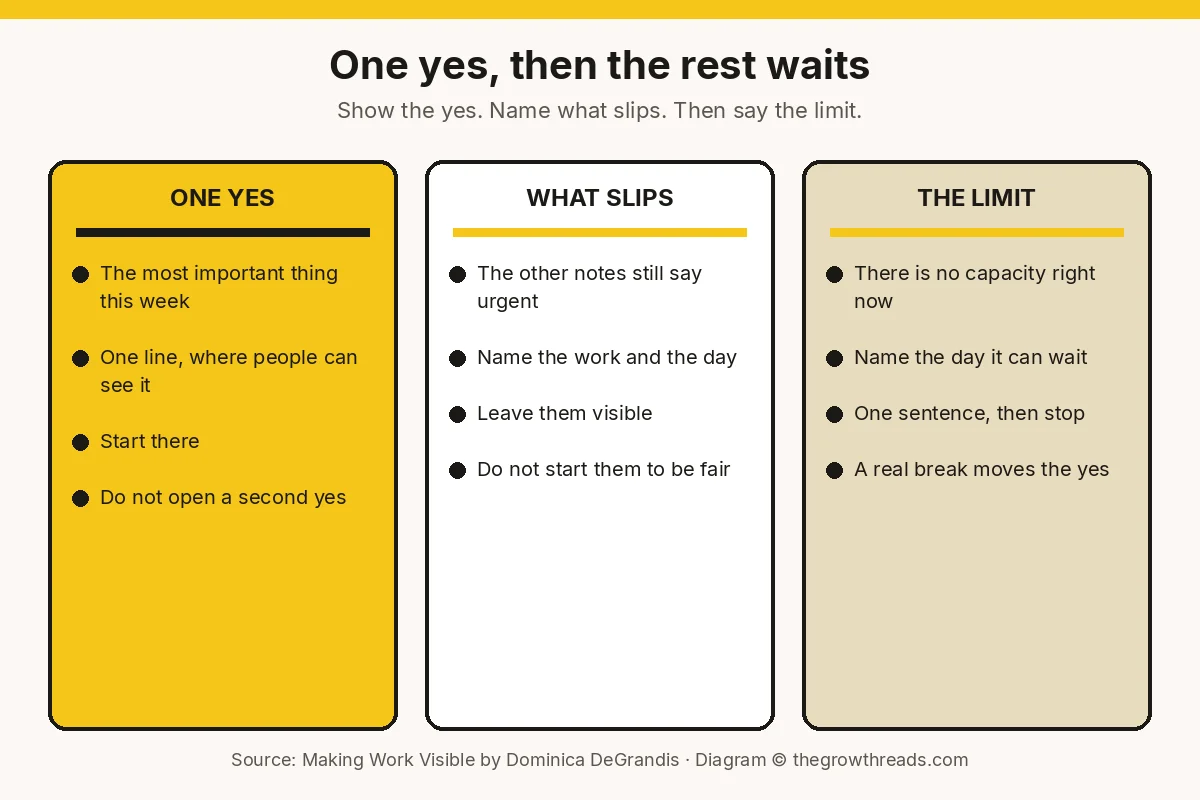
The line is short enough to keep. All it takes is a shift from haphazardly saying yes to everything to deliberately saying yes to only the most important thing at that time. And to do it visually. That is the ranking step. Not a new app, and not a longer day. One yes, where someone else can see it, instead of a private feeling that you will get to all of it.
Around that yes she names a system. Make the work visible. Limit work in progress. Measure the flow. Prioritize, which she flags as the hard one. Adjust from what you learn. This week you do not need the metrics chapter. You need the yes on a board, with the other urgent notes waiting, because the stamps will not rank themselves. If the yes is a sentence you have not shown anyone, you have not done the thing she asked for.
The morning article already asks for one commitment this week. Use that line as the yes. Three yeses is the pile with better stationery. Her phrase is “the most important thing,” singular, at that time. She does not count your cards and declare that every team must hold one. The application for this week is one.
The limit is how you tell people
A yes that nobody hears will be overrun by the next stamp. The mechanism is the work-in-progress limit. It is what allows you to say, “No, there is no capacity to take on more work right now.” She adds that reducing work in progress is liberating, not limiting. The right amount lets you keep a healthy amount of work. She does not hand you a universal number, and this review will not invent one. The liberation is the sentence you were avoiding: there is no room, so the other thing waits.
That sentence is the book’s. The note you send on Monday is our application of it, for the week the morning article already described. It is not a quotation. Replace the brackets. Leave the shape.
When you name the week: This week’s yes is [the line], done by [day]. [Named work] waits until [later day]. There is no capacity to start the other urgent notes until that yes is done.
When a new stamp arrives: There is no capacity to take that on right now. I can start it on [a day]. This week’s yes stays [the line] until [day].
Then stop typing. A second paragraph that adds “and I’ll try to fit the others in” puts the pile back on the table. If you are a new manager, you send this note. A report can list the stamps in the sender’s words. They do not pick a second yes, and they do not quietly start the waiting work so the board looks fair.
What slips stays on the board
Saying yes to one thing does not delete the other notes. Unplanned work is the interruption that stops you finishing, or stops you at a worse point. A new stamp after you have chosen is that thief. Neglected work is the half-done card that sits idle because a hotter stamp arrived. Leave those cards visible. Hidden work is how the week lies to you.
A real break is not a new stamp. Payroll, a client who is down, a safety or legal clock: do that, and put the yes back the same day. Only the clock moves. A message that says urgent, from someone anxious, waits with a date. If you erase the yes and do not replace it, the long list starts growing again.
The introduction is written for teams that deliver work, with an IT bent and a few examples from outside it. A solo founder can still use the yes, the board, and the capacity sentence without a kanban rollout. A new manager can put those three things where the team can see them before anyone starts the pile to be helpful. The metrics and the workshop come after the sentence has been sent once.
Who is Making Work Visible best for — and who should read something else first?
Read this if the week arrives pre-stamped and you start too much of it. The introduction and the chapter on too much work in progress match that problem. The rest is a workshop for boards, dependencies, meetings, and metrics. You do not need the workshop to send Monday’s sentence.
Read The ONE Thing alongside it if you still cannot name the yes. That review is already live, and it is a different book. Read Essentialism first if the trouble is a life of good options rather than a week of competing requests. Read First Things First if urgent and important still mean different things. Read Eat That Frog if you know the yes and keep starting something easier. This book will not pick the line. It shows where to put it, and the sentence that protects it.
Questions to reflect on
- Which note did you start this week only because it was stamped urgent?
- What is the one yes, written so a stranger could check it on a board?
- Which pieces of work will wait, with a name and a day, if that yes is real?
- Who has not heard that there is no capacity, and is about to start the rest?
- If a real break erases the block today, what time does the yes go back on?
🔥 Ready to put one yes where people can see it?
The second edition is the one this review checked. The yes, the board, and the capacity line are the part to use on this week.
How to apply Making Work Visible (7-day plan)
- Day 1 — List every item marked urgent, in the sender’s nouns. Do not start them.
- Day 2 — Write the one yes you can finish this week. Put it where someone else can open it. Three lines means you skipped it.
- Day 3 — Name what slips: the work, the person, and the day it moves to. Leave the names next to the yes.
- Day 4 — Send the sentence. The yes, the day, and what waits. Say there is no capacity for the rest. Then stop.
- Day 5 — Work the yes. A new stamp gets the second sentence and a date. Do not open that file.
- Day 6 — If a real break erases the block, do it and put the yes back the same day. Do not add a second one.
- Day 7 — Finish the yes, or say in one line what is still true. Leave the waiting notes on the board.
Frequently asked questions
What do you do when everything is marked urgent?
Write the items in the words people used, then pick the most important thing you can finish this week and put that yes where someone else can see it. DeGrandis calls the pile conflicting priorities: tasks that compete, worse when you cannot say what matters most. Her shift is to stop saying yes to everything and to say yes only to the most important thing at that time, visually. Name what waits, and say there is no capacity to start it until the yes is done. A louder stamp does not change the yes. If you cannot point at the line, you are not ready to open the pile.
What does Making Work Visible say to do first?
Say yes to only the most important thing at that time, and do it visually. That sentence is in the second-edition introduction, and the same words are in her 8 March 2022 article adapted from the book. Around it she asks for a system that makes work visible, limits work in progress, manages flow, prioritizes, and adjusts. For a week that is already stamped, the yes and the limit are enough. You do not need a metrics program before you send the sentence. The book will not choose the line. You still name the thing, in words a stranger could check.
How do you tell people what is going to slip?
Use the limit out loud. DeGrandis writes that a work-in-progress limit is what allows you to say there is no capacity to take on more work right now. For this week, add the yes, the day it will be done, and the name of what waits, including the day it moves to. Then stop. Do not add that you will try to fit the rest in. The fuller note is this review’s application, not a script printed in the book. The people who will feel the wait are the ones who need the date. If they never hear it, they will send the stamp again, and they are right to.
What if a real emergency shows up after you have chosen?
Do the emergency, and put the yes back on the board the same day. Unplanned work, in her list, is an interruption that stops you finishing or stops you at a worse point. Payroll, a client who is actually down, and a safety or legal clock qualify. A message that only says urgent does not. When you move the block, say you are doing the break now and that the yes is back on a named block this week. It does not drop off. You do not add a second yes to compensate. Anxious urgency is a competing task with a date, not a reason to erase the line.
Is a work-in-progress limit the same as doing less forever?
She says to think of reducing work in progress not as limiting but as liberating. The right amount is what lets you keep a healthy amount of work. The limit refuses a second start while the first is unfinished. It is not a vow that the waiting notes never get done. They stay visible so they are not neglected in secret. This review does not invent a card count. The book illustrates boards. It does not measure your week. One yes is the application when the list is stamped. A later board can set a limit that fits capacity.
Which edition is this review based on?
The second edition, IT Revolution Press, 15 March 2022, paperback ISBN 9781950508495, 240 pages. The publisher’s excerpt includes the copyright page, the introduction, and the opening of the work-in-progress chapter. The lines in quotation marks are sentences in that excerpt that also appear in her 8 March 2022 article, which she says is adapted from the second edition. We do not cite page numbers. The 2017 first edition is not the text described here. The two reply notes are our application for a solo founder or a new manager. A sample board in a figure is not your limit.
What if you manage people who want to start every stamp?
You send the sentence, and you put the yes where they can see it. They can list every labelled request in the sender’s nouns, and they can draft the reply beside you. They do not pick a second yes, and they do not start the waiting work so the week looks fair. Fair, when everything is marked urgent, is how the stamp wins. Give them the line before they are in the inbox alone. Your boss gets the same sentence, with a date they can answer. If they override you, do the new item and put the original yes back the same day. You do not keep both clocks.
Related summaries
- The ONE Thing summary — the focusing question, already on the shelf
- Essentialism summary — when the trouble is too many good options
- First Things First summary — when urgent and important still mean different things
- Eat That Frog summary — when you know the yes and start something easier
- Best productivity books