

★★★★☆ 4/5 — Use it when the work changed after you named the price. Name the gap the fee bought, then keep the new thing inside that fee, cut it, or price a different result.
Best for: a solo founder with the file already open, or a new manager whose client or boss just widened a job that already has a number.
Reading time: the authors say one hour. The official PDF is 70 pages. The café scene is the part that matches this week.
Difficulty to apply: moderate. The sort is one mark. Sending one reply, and waiting when the result itself moved, is the work.
Breaking the Time Barrier in one minute
Name the outcome the price bought, name the thing that just moved, and send one reply. Mike McDerment and Donald Cowper’s 2013 fable puts a designer across a café table from a mentor who prices the gap between where a client is and where that client wants to go. She calls those two spots Point A and Point B. She will not haggle: less money means the client chooses less delivered. When a fixed month runs long, she does the work inside the fee. The email you send this week is this review’s application. The fable does not print it.
Key takeaways
- The price is the gap: Point A is where the client is now. Point B is where the client wants to go. The value is closing that gap.
- An hour is the wrong unit once you can already create that impact: selling hours puts you and the client on opposite sides of the table.
- A long month stays inside the fee: the mentor says she does what it takes, that it has happened, and that she still tracks her costs.
- Less money means less delivered: she will not haggle the number. The client chooses a smaller option.
- Options carry different depth: the proposal is a menu. Each option has its own value and its own price.
- The clothing-company scene is before the proposal: she redefines the job, then writes the options. That is not the open file.
- The dollar figures are the story: a $500 month and a $20,000 site. They are examples in the fable, not a fee to copy.
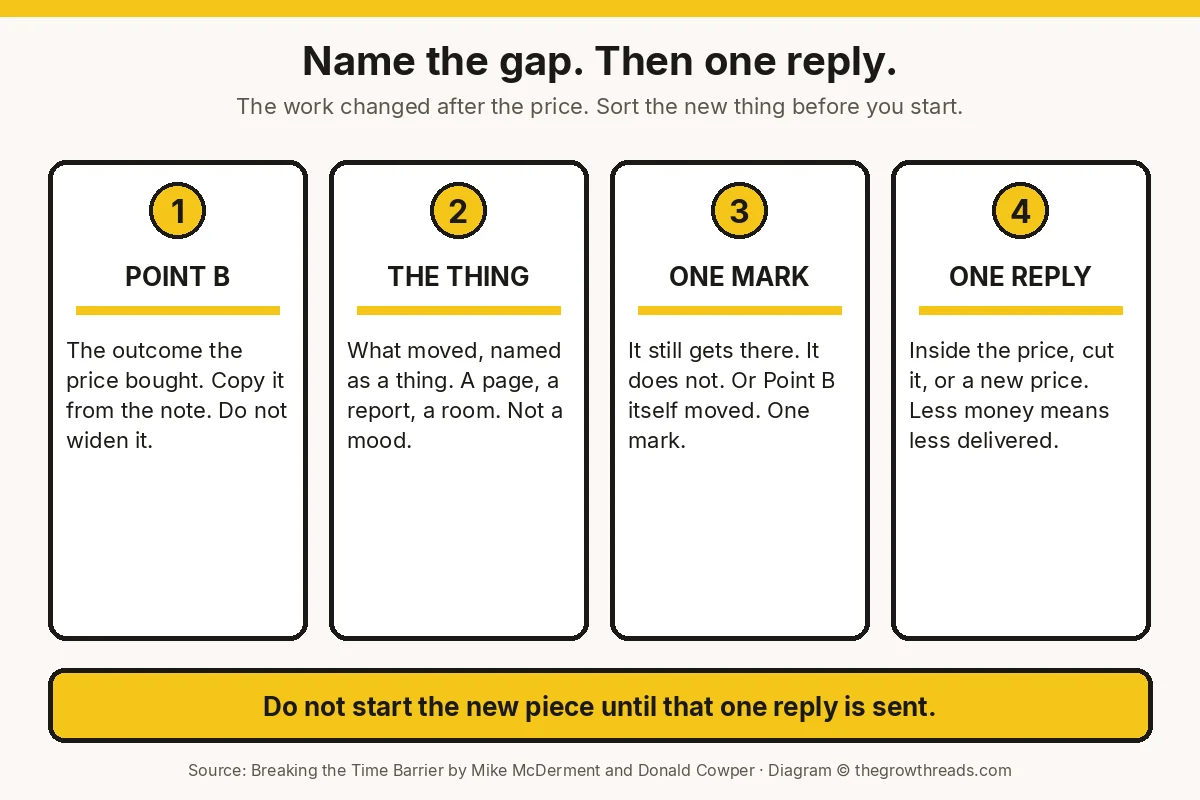
- The open file still needs one reply: write Point B, write the thing, mark one case, and send the matching sentence.
What is Breaking the Time Barrier about?
Breaking the Time Barrier is the 2013 FreshBooks fable by Mike McDerment and Donald Cowper. A designer learns to price the gap between where a client is and where that client wants to go. A long month stays inside the fee. Less money means the client chooses less delivered.
About the author
Mike McDerment and Donald Cowper wrote Breaking the Time Barrier. The title page says Copyright 2013 FreshBooks, Toronto. McDerment’s preface says that in January 2003 he saved over a Word invoice, built his own billing tool, and spent 3.5 years in his parents’ basement. He writes that one year he worked 19 days and generated over $200,000 for that project. That is his account, not a target. He names Cowper as the best-selling author who joined FreshBooks as its small business writer. The PDF we read is 70 pages. Amazon paperback ASIN B071VPJRV3 lists the same authors and 1 January 2013, showed no ISBN on 15 November 2026, and was unavailable. Explore all Donald Cowper book summaries →
Key concepts at a glance
| Concept | What it means | Use it when |
|---|---|---|
| Point A and Point B | Where the client is now, and where the client wants to go. The fee is for closing that gap. | The note that named the price never wrote the result down. |
| Impact | The mentor prices the effect on the client’s business. A website, in her line, is not what the client came to buy. | The new ask is “another page” and nobody has said what that page is for. |
| Conflict of interest | Hours reward a longer job. The client wants the result sooner. | You are about to invoice the extra hours on a result you already priced. |
| Do what it takes | A month that runs long, with the same result, stays inside the fee. She still knows her costs. | The outcome held and the week got heavier. |
| Less delivered | She will not haggle. A lower number is a smaller option, and the client chooses it. | They want the same result for less. |
| Options | The proposal is a menu. Each line has its own depth and its own price. | You are about to send one number and hope. |
| The open file | This review’s cut for a job that has already started. Write the thing. Mark one case. Send one reply. | Someone added a piece after the yes. |
The hour is the wrong unit
Steve prices from an hourly rate, ships a start-up site that hits its targets, and still feels underpaid. Maintenance is a couple of hours a week, so he takes low-paying referrals to keep the clock running.
Karen meets him at a café and names the stall in one word: pricing. He sells web design and charges from an hourly rate. She asks whether he is selling hours. Her price is the impact on the client’s business. In the story a client believed a site could add $100,000 of profit a year, and she asked for $20,000. She says his hourly model would have landed near $2,000 to $2,500 for that same client. Those numbers are the scene.
He asks what happens if one month takes 25 hours on a client she charges $500. She says she does what it takes, that it has happened, and that she still tracks costs. In the story she needs almost $100,000 a year to run her shop. A heavy month on the result you already priced stays inside the fee.
Selling hours, she says, puts you and the client on opposite sides. A longer job pays you more. The client wants the result sooner. Quicker work shrinks an hourly bill, while a sooner result is often worth more. Covering her costs remains her job.
The morning piece on the work that changed after the price uses this scene when the result held. A new invoice for a thing that still reaches it is the mistake.
Point A, Point B, and the thing that moved
Karen rarely names a price in the first meeting. She writes the proposal later, with options at different prices. Point A is where the client is now. Point B is the goal. The value is closing that gap.
On an open file, the price you named already bought a Point B. The new message is a thing: a page, a report, a room, a second audience. Write both lines. If the thing still closes the same gap, the fee covers it. If it does not help, leave it out. If the goal is a different Point B, the old fee was for a different result.
The fable sets those points before the work. A heavier week on the original Point B stays inside the fee. A different Point B is a new proposal. She does not start the new depth in the room.
If the file is still closed, that is a different morning. The Win Without Pitching Manifesto covers the ask before the work starts.
Less delivered, not a lower number
She will not haggle. If a client wants to pay less, they choose less delivered. A menu of options makes that trade-off visible. A single number that then gets cut is, in her account, more likely to become a no.
In the clothing-company story, told before the proposal goes out, one option is $100,000, which she calls 10 percent of the value the client could expect. She says her fee will often sit between 10 and 20 percent of expected value, usually because of risk. The client picks $125,000. Those figures are one scene, not a percentage for your open file.
A smaller result is a smaller option, chosen in the open.
If two people think they own the task, settle the name first. The One Minute Manager Meets the Monkey is that cut.
The file is already open
Steve wavers on the first value-based prices and makes discount exceptions, including when faster payment is the reason. He feels underpaid when he gives in, then holds the number. He keeps hourly maintenance for a while and still tracks hours so he can scope the work. The story’s $30,000 proposal and $15,000 deposit are the ending, not a number to send. After that project he drops hourly billing.
Your file is earlier than that ending. The price has a name. Someone added a thing. Do this before you touch it.
- Find the note where the price was named. Copy Point B in one line. If that note was only a number, write the result you are actually finishing, and say so in the reply. Do not widen Point B so the new thing fits.
- Write what moved, as a thing. “They keep adding” is not yet a thing.
- Mark one case. The thing still closes that gap. It does not. Or Point B itself moved. Two marks means two things. Each thing gets its own mark.
- Send one sentence from the three below, and wait if Point B moved.
- If they want to pay less for the same Point B, offer less delivered. Do not cut the number and keep the result.
- If they do not reply, the original Point B is still the job. Silence is not a yes to a new result.
These three sentences are this review’s application. Fill the brackets from the price note, then stop.
If it still reaches Point B: The price we named was for [the outcome]. What moved is [the thing]. It still gets us there, so I will do it inside the price. I will not send a new invoice.
If it does not help: The price we named was for [the outcome]. What moved is [the thing]. It does not help that outcome, so I will leave it out and finish the original.
If Point B moved: The price we named was for [the original outcome]. What moved is the outcome. It is now [the new outcome]. I can do that for [the new price], or I can finish the original and stop. Which do you want? I will not start the new piece until you say.
A report can describe the thing. They do not spend the number. Give them Point B before they are on the thread alone. If they already said yes, send the sort the same day.
If the week stops when you stop, SYSTEMology is the hours cut. Send this reply first when a new thing is in the file.
Who is Breaking the Time Barrier best for — and who should read something else first?
Read this if a price already has a name and a new thing is on the table. You are a solo founder in the file, or a new manager whose team has started and whose client or boss just widened the job. The café scene gives you Point A, Point B, the refusal to haggle, and the heavy month that stays inside the fee. You add the one reply.
Read the morning article on the work that changed after the price for the same sort in a shorter note. Read The Win Without Pitching Manifesto if the file is still closed. Read The One Minute Manager Meets the Monkey if two people think they own the next move. Read Making Work Visible if the price is not the question.
Questions to reflect on
- What Point B did the original price buy, in one line, copied from the note?
- What moved, as a thing you can point at, rather than a feeling that they keep adding?
- Does that thing still close the same gap, miss it, or replace Point B?
- If they want to pay less, which smaller option will you offer instead of cutting the number?
- If the hours ran long and Point B held, what will you change on the next price, after you finish this one inside the fee?
🔥 Ready to name the gap and send one reply?
The text we read is the official 2013 FreshBooks PDF. The Amazon button is the paperback listing for the same book. It was unavailable when we checked, and the page showed no ISBN.
How to apply Breaking the Time Barrier (7-day plan)
- Day 1 — Copy Point B from the note where you named the price. If the note was only a number, write the result you are finishing.
- Day 2 — Name the new thing. A page, a report, a room. If you cannot point at it, wait.
- Day 3 — Mark one case. It still closes Point B, it does not, or Point B moved.
- Day 4 — Send the matching sentence. Do the helpful thing, leave the distraction out, or wait.
- Day 5 — If they want to pay less for the same Point B, offer a smaller option.
- Day 6 — If the hours ran long and Point B held, finish inside the fee and change the next price.
- Day 7 — If someone else is on the thread, they draft and you send. Silence keeps the original result.
Frequently asked questions
What do you do when the work changes after you named the price?
Write the outcome that price bought and the new thing beside it. The fable calls the outcome Point B, the place the client wants to go. If the thing still closes that gap, do it inside the price. In the café scene the mentor does a heavy month inside the fee and still tracks her costs. If the thing does not help, leave it out and finish the original. If Point B itself moved, name a new price or stop at the original, and wait. Those three replies are this review’s application. The fable does not print the email.
What are Point A and Point B?
Point A is where the client is now. Point B is where the client wants to go. Karen uses the pair so the price is for one agreed result. The fee closes that gap. On an open job, copy Point B from the note where you named the price. Test the new thing against that line. A thing that still gets you there stays inside the fee. A thing that replaces Point B needs its own price, or you stop at the original. Do not widen Point B so the new thing fits the old number.
Should you invoice a month that ran long?
Finish the result you priced. Steve asks what happens if a month takes 25 hours on a client she charges $500. She says she does what it takes, that it has happened, and that those months are offset because the work balances. She still knows her costs. In the story she needs almost $100,000 a year to run her shop. The dollar figures are the scene, not a fee schedule. Use the heavy week when you set the next price. A second bill for the same Point B repeats the conflict she names, because hours reward a longer job and the client wants the result sooner.
What if the client wants to pay less?
Offer less delivered. Karen says she will not haggle. If a client wants to pay less, they choose to have less delivered. The proposal is a menu, so the trade-off is visible. Steve later tries to follow that advice, with room for a discount tied to getting paid sooner, and he feels underpaid when he cuts the number anyway. Keep the original number on the original Point B. A smaller result is a smaller option. Wait for them to choose it. Do not start the smaller piece and the original piece on the same afternoon. A silence keeps the original result as the job you already sold.
Is 10 to 20 percent the fee you should charge?
Leave that range in the story. Karen prices one clothing-company option at $100,000 and calls it 10 percent of the value the client could expect. She says her fee will often sit between 10 and 20 percent of expected value, and that risk usually explains the difference. The client picks a $125,000 package. The scene is told before the proposal goes out. It is not a rate for an open file, and it is not a study. The book does not tell you to add a percentage to a job you already priced.
What if a report already told the client yes?
Send the sort the same day. A report, or a contractor, can describe what moved. They do not spend the price. Give them the one-line Point B before they sit on the thread alone. They can draft. You send. If their yes started a thing that still closes the gap, let it continue and say it stays inside the price. If it started a distraction, stop that piece and finish the original. If it started a different Point B, send the third sentence and wait. A yes that felt helpful still needs a mark.
Which text is this review based on?
We read the official 2013 FreshBooks PDF in full. It is 70 pages, copyright FreshBooks, Toronto, and the file date is 13 June 2013. It prints no ISBN. On 15 November 2026 the Amazon paperback for ASIN B071VPJRV3 showed the same title and authors, the date 1 January 2013, and no ISBN. The listing was marked unavailable. We did not invent a page number. Bookshop’s deep link returned a block, so that button uses the shop fallback. The three reply sentences are this review’s application. They match the morning article, and they are not printed in the fable. The preface’s income line is McDerment’s account of one year.
Related summaries
- The Win Without Pitching Manifesto summary — when the ask arrives before the file is open
- The One Minute Manager Meets the Monkey summary — when two people think they own the next move
- SYSTEMology summary — when the week still depends on your hours after the reply is sent
- Making Work Visible summary — when everything is marked urgent and the price is not the question
- Best productivity books