

★★★★½ 4.5/5 — A funny, blunt operating system for people who fail a lot and still want a way to get lucky on purpose.
Best for: generalists waiting on passion, motivation, or a single world-class skill before they start.
Reading time: ~5 hours (256 pages) · this guide ~12 min
Difficulty to apply: Easy. The work is converting one goal into a daily system and naming the skills you already have.
How to Fail at Almost Everything and Still Win Big in one minute
Stop living inside a goal you have not hit yet. Run a system today, stack a few good-enough skills, and give luck more doors to knock on. Scott Adams’s 2013 book is a memoir of public misses — restaurants, inventions, corporate jobs — used as evidence for three moves. First, goals keep you in a failing state until the finish line; a system is a thing you can complete before lunch. Second, passion is often a story you tell after you start winning; energy is the input you can actually manage. Third, you probably will not be the best in the world at one craft. You can be rare by combining four skills at the 75th percentile. Dilbert was that mix: drawing, office humour, business sense, and the willingness to ship strips every day.
Key takeaways
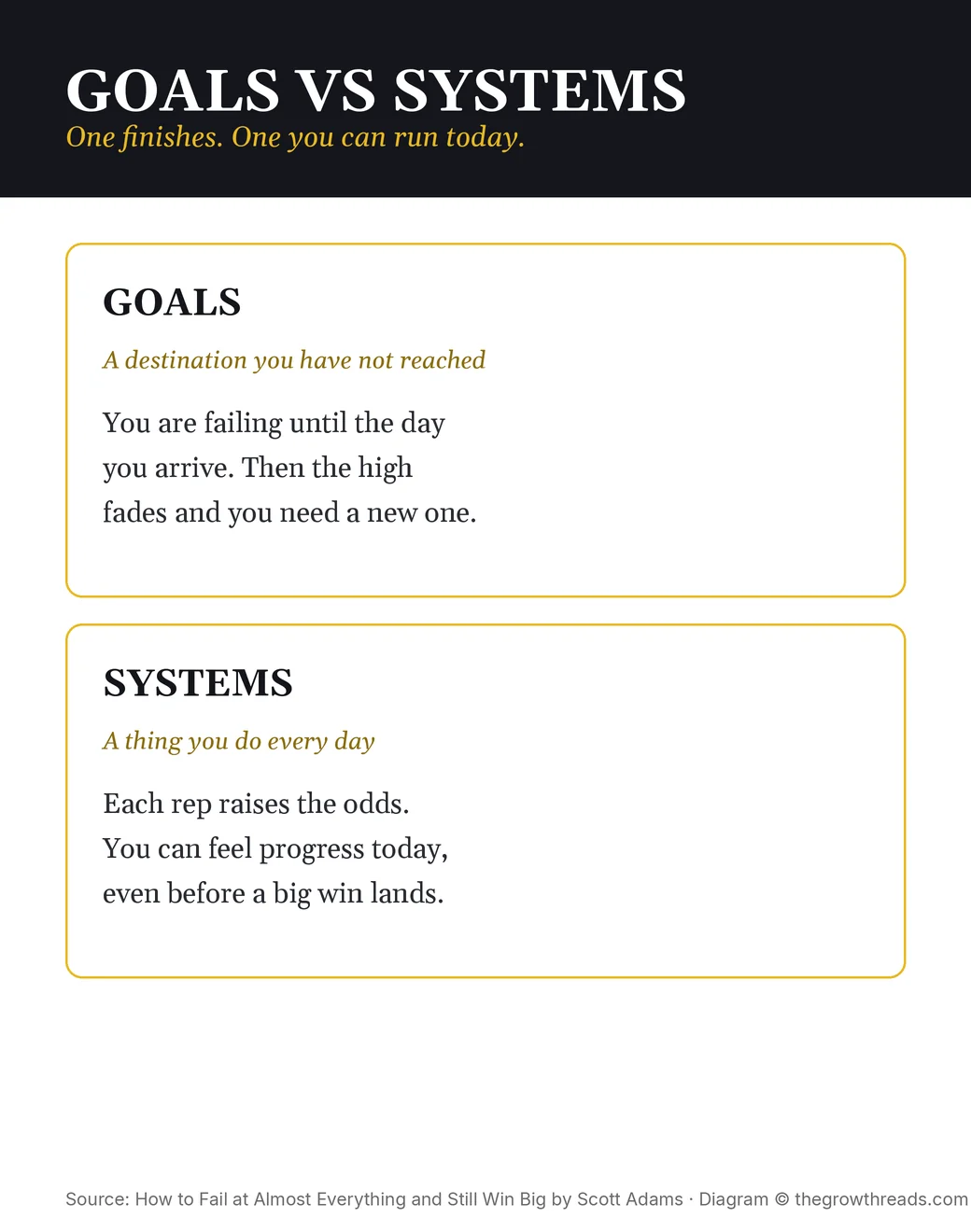
- Systems beat unfinished goals: A goal defines you as behind until you arrive. A system is a daily action that raises the odds whether or not this week’s outcome cooperates.
- Failure is tuition: Treat a miss as data about the next system, not a verdict on your identity. Adams collected embarrassing attempts on purpose.
- Passion lags success: People often feel lit up after they start winning, then rewrite history. Plan with energy, not with a spark you do not have yet.
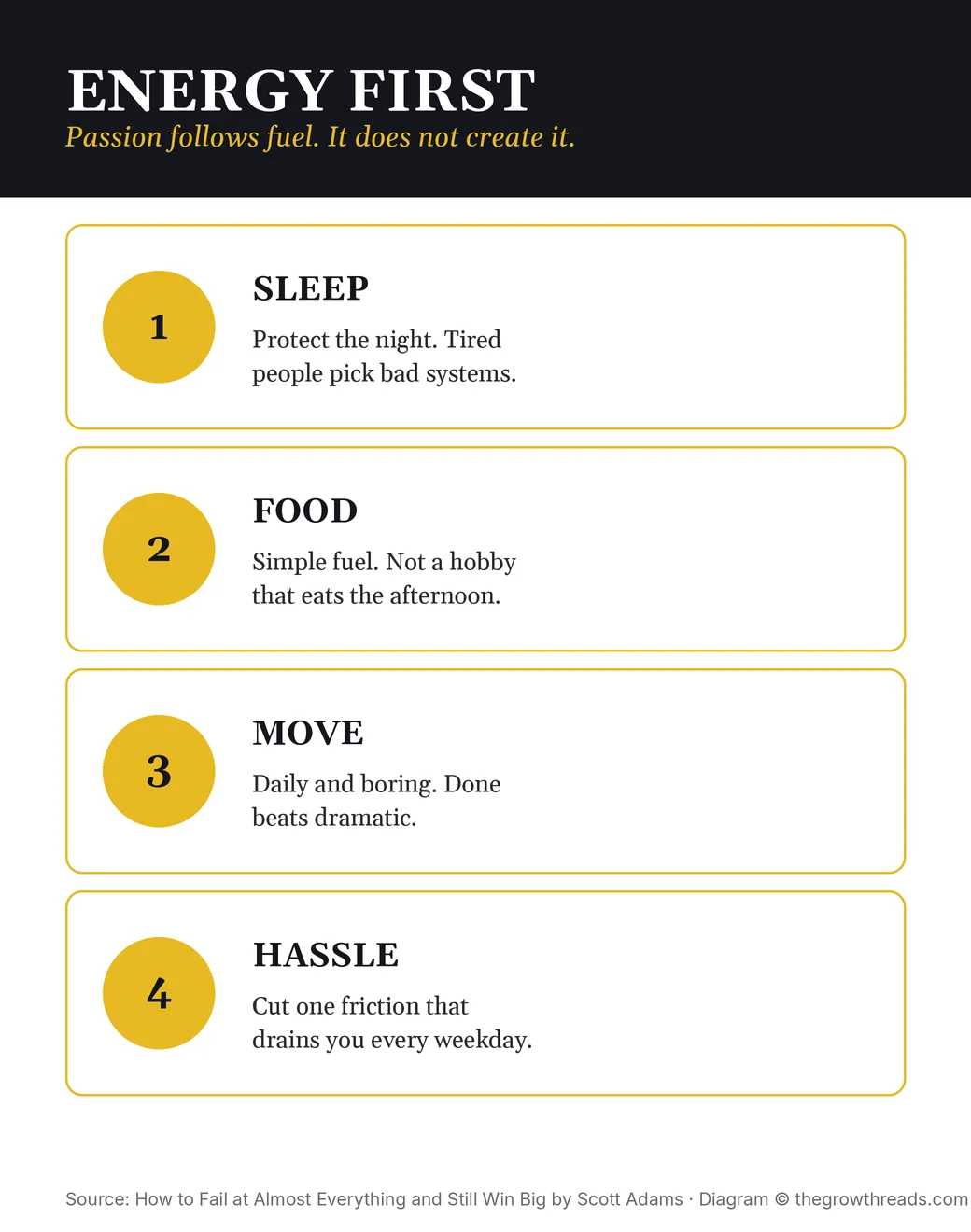
- Energy is the real constraint: Sleep, simple food, daily movement, and fewer hassles decide whether you can run the system tomorrow.
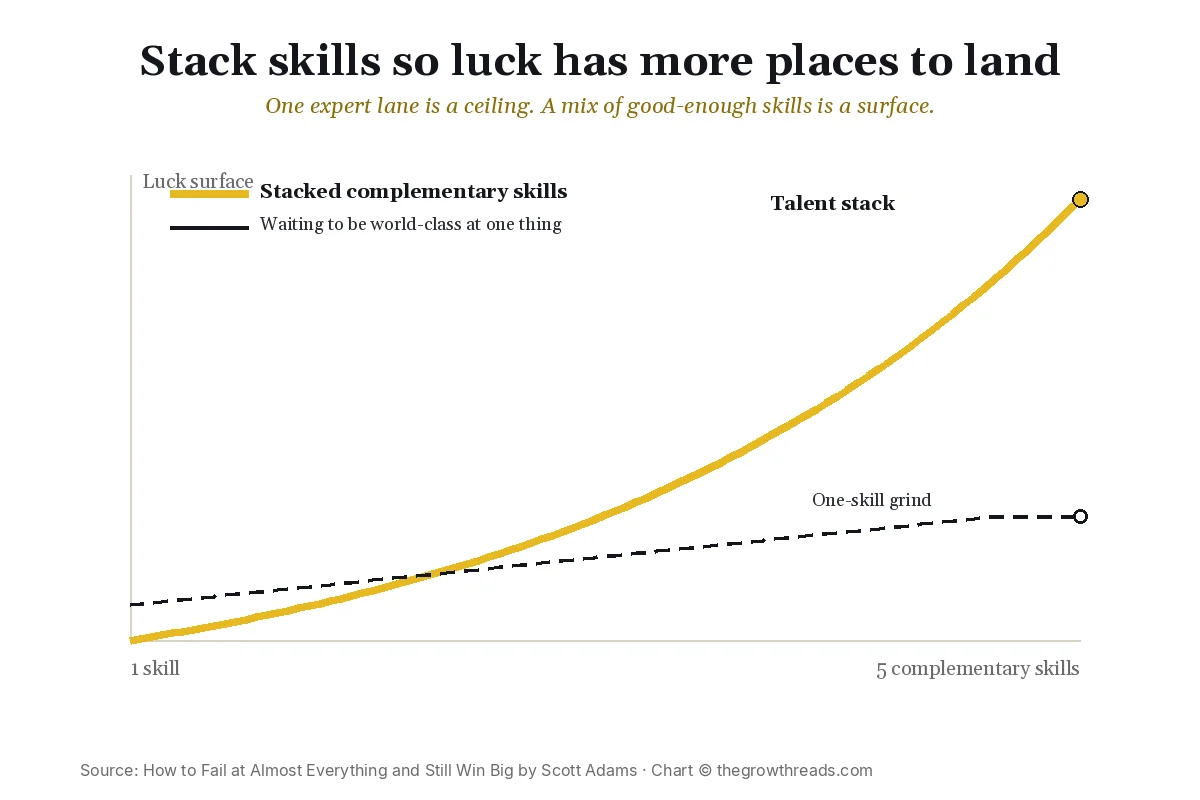
- Build a talent stack: Several complementary skills at “good enough” beat one lonely expert lane most of us will never occupy.
- Increase the luck surface: Ship work, meet people, and stay in motion so chance has somewhere to land. Luck is not a personality trait.
- Happiness is a system: Mood follows fuel and friction more than it follows a vision board. Cut one recurring hassle this week.
- Program the day, not the identity: Put the system on the hours when you actually have energy. Willpower at 10 p.m. is not a plan.
- Be rare, not perfect: The product is the overlap. You do not need museum-grade drawing if the other three skills in the stack are uncommon in the same person.
What is How to Fail at Almost Everything and Still Win Big about?
How to Fail at Almost Everything and Still Win Big is Scott Adams’s 2013 manual for getting luckier without waiting on passion. He replaces unfinished goals with daily systems, stacks good-enough skills, and treats sleep, food, and fewer hassles as the fuel.
About the author
Scott Adams (1957–2026) created Dilbert while he still had a cubicle. He studied economics, worked in banking and at Pacific Bell, and spent years sending cartoon submissions that did not land. Restaurants, inventions, and side projects failed in public. He treated those misses as tuition, then wrote this 2013 book as the field notes: systems over goals, a stack of good-enough skills, and energy as the real constraint. Dilbert became one of the most widely syndicated office strips of its era, which is the proof-of-work behind the advice. This summary stays with the 2013 productivity manual — the part still useful on a weekday. Explore all Scott Adams book summaries →
Key concepts at a glance
| Concept | What it means | Use it when |
|---|---|---|
| Goals vs systems | A goal is a finish line you have not crossed. A system is a daily action that raises the odds. | You only feel successful on the day a trophy arrives. |
| Failure as data | A miss is tuition. It tells you what to change in the system, not who you are. | One rejection has you rewriting your identity. |
| Talent stack | Four complementary skills at the 75th percentile can be rarer than one world-class skill. | You are waiting to be the best before you ship. |
| Luck surface | More shipped work and more mixed skills give chance more places to land. | You are grinding in private and calling it patience. |
| Energy first | Sleep, food, movement, and fewer hassles are the inputs. Passion is often the output. | You keep waiting to “feel like it.” |
| Passion as lagging | Interest often follows competence and small wins, then gets remembered as destiny. | You will not start until the spark shows up. |
| Happiness formula | Mood is closer to fuel and friction than to a five-year vision. | Your days are loud, tired, and full of tiny taxes. |
Part 1: Failure is data — and goals keep you failing
Adams’s useful provocation is not that ambition is stupid. It is that a goal is a terrible place to live. Until you hit it, the honest description of your status is “not there yet.” That is a long season of being a loser by your own scoreboard, and it trains you to wait. A system is smaller and kinder to the nervous system: it is a thing you can finish today that makes a good outcome more likely over a hundred days. “Become a famous cartoonist” is a goal. “Write and submit a strip before work” is a system. Only one of those can be true on a Wednesday in 1989.
He collected failures on purpose — two restaurants, inventions that went nowhere, corporate applications that did not convert — because each miss taught him something about customers, timing, or his own energy. The line people quote is blunt: goals are for losers; systems are for people who want to win. Read it as a scheduling rule. Keep a direction if you need one. Stop postponing your sense of progress until a committee applauds.
TGR Note: If you want the habit architecture that sits under a system, Atomic Habits is the cleaner install: identity, cues, environment. If you want the inner posture of staying with the work without needing a finish line, The Practicing Mind is the process companion. Adams is the decision to stop living in the unfinished goal.
Part 2: Energy first, passion later
The book’s second punch is that “follow your passion” is a story winners tell after the fact. Adams watched people get good, get paid, and then feel the spark, and he refused to use a feeling he did not have as the plan. What he could manage was personal energy. Sleep. Food that does not wreck the afternoon. Daily movement. One fewer recurring hassle. This is not a medical protocol — if you have a health condition, follow a clinician, not a cartoonist — and you can skip his personal diet experiments. The transferable claim is simpler: a tired person picks bad systems and then calls it a character flaw.
Schedule the system on the hours when you actually have fuel. Do not put the hardest skill at 10 p.m. and then diagnose yourself with a motivation problem. Cut one friction that taxes every weekday: a meeting, a decision you re-make each morning, a commute step you could delete. Passion is allowed. It is a poor planning input. Competence plus energy is a better bet, and interest often arrives after a few clean weeks.
TGR Note: If the real issue is the room, not the pep talk, Good Habits, Bad Habits shows how context runs behaviour. If you need a love of the boring rep, Chop Wood Carry Water is the process romance. Adams is blunter: fuel the body so the system has a chance.
Part 3: The talent stack
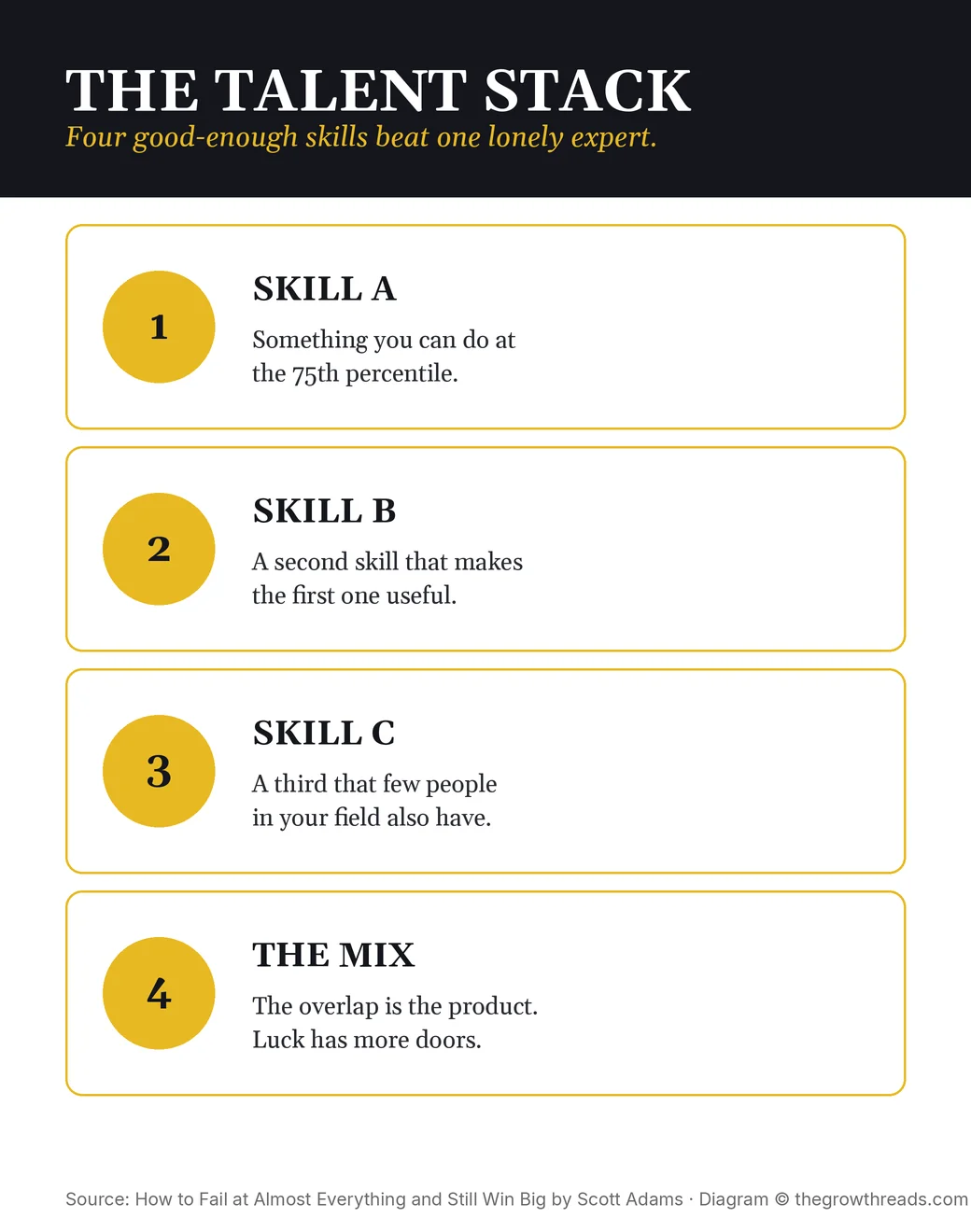
Most career advice secretly assumes you will become extraordinary at one thing. Adams wrote for the rest of us. A talent stack is a handful of skills at roughly the 75th percentile that almost nobody else holds together. Dilbert was not museum drawing. It was decent drawing plus office humour plus an insider’s feel for corporate incentives plus the writing habit to ship a strip. Each piece was common. The overlap was not.
That mix does two jobs. It makes you hard to replace, because hiring one person who can do the combination is cheaper than hiring four specialists. And it widens what Adams calls luck: more skills mean more rooms in which an opportunity can recognise you. A single expert lane is a ceiling for anyone who will not be the best pianist or the best programmer on earth. A stack is a surface. List the skills you are already in the top quarter at. Add one complementary skill that your field rarely pairs with them. Then ship something that uses the overlap, because a stack that never leaves the notebook cannot get lucky.
TGR Note: Once you have picked a craft worth getting excellent at, switch books. Talent Is Overrated is deliberate practice. The Little Book of Talent is 52 small drills for the sweet spot. Adams is the prior choice: what mix are you even practising?
Part 4: Happiness is a system you can run
The last move is to stop treating mood as a mystery. Adams’s happiness formula is almost insultingly practical: eat in a way that keeps energy steady, move, sleep, keep something pleasant in the near future, and reduce daily hassle. You will not meditate your way out of a life that is loud, tired, and full of tiny taxes. You will also not vision-board your way into a system you never run. Put the pleasant thing on the calendar (a walk, a person, a project you like) so the week is not only obligation. Then look at the hassles. Each one is an energy leak. Plug one.
He also writes about “programming” himself — repetition, simple cues, even affirmations he treated as a personal experiment. You can take the useful version without the magic: decide the system when you have energy, then make it the default for the tired hours. Over-prepare for the moments luck shows up. When someone asks if you can do the thing, the stack should already have a sample. Voice and persuasion sit in that stack for many knowledge jobs. They are skills, not a personality you either received or did not.
Who is How to Fail at Almost Everything and Still Win Big best for — and who should read something else first?
Best for people who are waiting — on passion, on a perfect plan, on becoming world-class at one skill — and who need permission to run a plain system with the skills they already have. It is especially useful for generalists, career switchers, and anyone who has a graveyard of unfinished goals. Read something else first if you already know the system and cannot install it: start with Atomic Habits. If attention is the bottleneck, Deep Work is the better first move. If you want process without the memoir, The Practicing Mind is leaner. If failure still feels like a verdict on the self, Black Box Thinking is the culture of treating misses as data.
Questions to reflect on
- Which goal am I living inside that I could convert into a daily system this week?
- What are four skills I am already in the top quarter at — and what product sits in the overlap?
- When during the day do I actually have energy, and where have I parked the hard system instead?
- What one recurring hassle is taxing me every weekday, and what would deleting it free?
- Where am I grinding in private and calling it patience, when luck needs a shipped sample?
🔥 Ready to stop waiting on a goal?
Pick a system you can run tomorrow. Stack one more skill this month. Give luck more doors.
How to apply How to Fail at Almost Everything and Still Win Big (7-day plan)
- Day 1 — Convert one goal. Write the goal you have been carrying. Under it, write a daily action that would still count as a win if the outcome stayed quiet this month. Example: “get promoted” becomes “ship one visible piece of work before lunch.”
- Day 2 — Energy audit. Score last night’s sleep, today’s food quality, and whether you moved. Change only the worst of the three for the next six days. Do not rebuild your whole lifestyle. Pick the leak.
- Day 3 — List the stack. Write six skills you are already in the top quarter at. Circle four that could sit in the same product, job, or offer. The mix is the point, not the single highest score.
- Day 4 — Add one complementary skill. Choose a 20-minute system that fills a hole in the stack — writing, numbers, a tool, a language of a neighbouring team. Put it on the calendar at the hour you actually have energy.
- Day 5 — Raise the luck surface. Ship something small into the world: a post, a sample, an introduction, an application. Luck cannot land on work that never leaves the folder.
- Day 6 — Cut one hassle. Remove one recurring friction (a meeting, a commute step, a decision you re-make every morning). Adams treats hassle as an energy tax. Pay less.
- Day 7 — Review the system, not the trophy. Ask only: Did I run the system on at least five days? Which skill in the stack got a rep? Keep the system for week two. Do not add a new goal yet.
Frequently asked questions
What is How to Fail at Almost Everything and Still Win Big about?
It is Scott Adams’s 2013 field manual for making luck more likely. He argues that goals keep you in a failing state until the finish line, while a daily system raises the odds every day you run it. He adds a talent stack — several good-enough skills in combination — and treats sleep, food, movement, and fewer daily hassles as the fuel. The stories come from failed restaurants, unused inventions, and the cartoon that finally stuck. The useful residue is a weekday operating system, not a pep talk about believing harder.
What does Adams mean by “goals are for losers”?
He is not attacking ambition. He is attacking the scoreboard. A goal defines you as behind until the day you hit it, and the high fades, so you need another finish line. A system is a thing you can do today — write the strip, make the call, practice the skill — that raises the odds whether or not this week’s outcome cooperates. You can still name a direction. You just stop waiting to feel successful until a trophy arrives. Atomic Habits later said the same idea in identity language: vote for the person who does the reps.
What is a talent stack?
A talent stack is a handful of skills at roughly the 75th percentile that almost nobody else holds in the same mix. Adams’s cartoon worked because he could draw well enough, write jokes about office life, and understand corporate incentives. None of those skills had to be world-class alone. The overlap was the product. Use it when you are not going to be the best pianist or the best coder on earth, but you can be rare by combining two or three adjacent skills. That mix is also a larger surface for luck to land on.
Is passion overrated in this book?
Adams treats passion as a lagging indicator. People often feel lit up after they start winning, then rewrite the story as “I followed my passion.” What you can manage on a Tuesday is energy: sleep, simple food, daily movement, and cutting one hassle that drains you. Passion is allowed. It is just a poor planning input. If you have no spark yet, run a system in a field where you have a skill stack and let interest catch up. If you already have a craft you love, keep it — and still build the energy system underneath it.
How long does it take to read How to Fail at Almost Everything and Still Win Big?
The Portfolio paperback is 256 pages. Most readers finish in four to five hours. This guide is built to be useful in about twelve minutes, then to send you into a seven-day application rather than another highlights file. If you only take one pass, convert one current goal into a daily system and list four complementary skills you already have at “good enough.” That is the book’s payload. The stories are there to make the systems feel less theoretical.
Who should read this book — and who should start elsewhere?
Read it if you are waiting on motivation, hunting a single world-class skill, or treating every miss as a verdict on your identity. Skip it as a first book if you need a habit architecture — start with Atomic Habits — or if attention is the actual bottleneck, in which case Deep Work is the better first move. If you want process without the cartoonist memoir, The Practicing Mind is leaner. This book is for generalists who will never be the best at one thing and still want a way to get lucky on purpose.
How does this compare with Atomic Habits or Talent Is Overrated?
Atomic Habits is the cleaner habit operating system: identity, cues, environment. Talent Is Overrated and The Little Book of Talent are about designed practice once you have picked a craft. Adams sits beside them. He tells you to stop living inside unfinished goals, to stack skills instead of chasing one peak, and to treat energy as the constraint. Use Clear to install the daily loop. Use Colvin or Coyle when the loop exists and the skill needs a better drill. Use Adams when you are choosing what to even be in the game for.
Related summaries
- Atomic Habits — the habit operating system under a daily system
- Talent Is Overrated — deliberate practice once you have picked a craft
- The Practicing Mind — staying with the process without a finish-line high
- Hidden Potential — character skills and the conditions that grow them
- Best Productivity Books — the full Productivity pillar
How we analyze books: every book on The Growth Reads is read cover to cover, summarized in thousands of words of original analysis, and rated against our five-criteria rubric (lasting impact, evidence quality, practical application, writing & originality, external consensus). Read our full methodology.