

★★★★½ 4.6/5 — a field manual for treating the miss as data, not a personality.
Best for: People who keep repeating the same stall, launch, or post-mortem without changing the system
Reading time: ~7 hours (350 pages) if you binge · this guide ~12 min
Difficulty to apply: Easy to see — aviation vs blame. Hard to keep — you have to log the miss while it still stings
Black Box Thinking in one minute
Failure is not a verdict. It is a black box you refused to open. Matthew Syed’s Black Box Thinking (John Murray / Portfolio, 2015) is a long argument with a short job: high performers get better because they record the miss, extract the data, and change the system. Aviation does this. Elite sport does this. Science does this. Most offices, hospitals, and personal weeks do the opposite — hide, blame, narrate, repeat. Syed’s usable move is not “be humble.” It is close the loop on one real failure this week: write what happened, what you expected, what you will change, and fly the next attempt with that change in place. This summary is the application layer — one logged miss, one system tweak, a 7-day plan — not a speech about other people’s crashes.
Key takeaways
- Progress needs failure: A miss is a violated expectation. That gap is information. Hide it and you freeze.
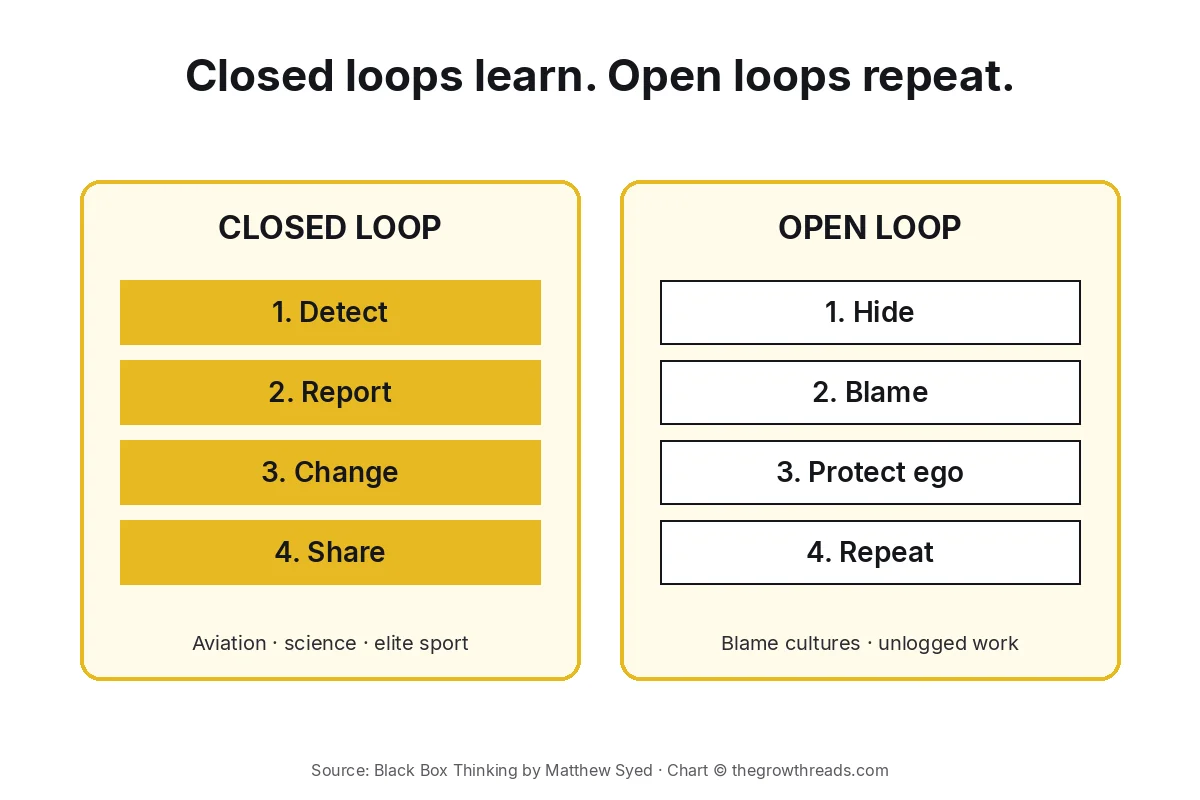
- Closed loop vs open loop: Detect, report, change, share — or hide, blame, protect ego, repeat. Culture is which loop you actually run.
- Cognitive dissonance edits the tape: The mind rewrites the story so you were not wrong. Write the facts before the story hardens.
- Scapegoats keep the system: Firing a person feels like action. The procedure that produced the miss stays.
- Complexity has no single villain: When many small errors stack, nobody logs them. That is when a checklist or a black box matters.
- Success narratives lie: Straight-line stories skip the crashes. Steal the process, not the highlight reel.
- Marginal gains compound: Many 1% changes, closed every time, beat one heroic overhaul you never inspect.
- Blame and learning cannot share the room: If the cost of telling the truth is a career, you will not get the data.
- Test small, then share: A private insight that never changes the next attempt is still an open loop.
- Log while it stings: The useful notes are written in the hour of the miss, not in next quarter’s offsite.
What is Black Box Thinking about?
Black Box Thinking is Matthew Syed’s 2015 case for treating failure as data. Closed-loop cultures record the miss, change the system, and share the lesson. Open-loop cultures hide, blame, and repeat. The point is one logged failure that actually alters the next attempt — not a new personality.
About the author
Matthew Syed is a British journalist and a former table-tennis Olympian who turned a career in elite sport into a second career explaining how people actually get better. He writes for The Times, presents on high performance, and sits in the awkward middle of locker rooms and boardrooms. Bounce made the practice argument. Black Box Thinking is the failure argument: talent talk is cheap if you cannot look at a miss without flinching. He is not a lab scientist publishing original trials. He is a translator who pulls aviation investigations, healthcare disasters, cycling’s marginal gains, and cognitive-dissonance research into stories you can steal. The through-line is practical: the teams that improve are the teams that built a way to hear bad news while it is still useful. Explore all Matthew Syed book summaries →
Key concepts at a glance
| Concept | What it means | Use it when |
|---|---|---|
| Black box | A record of what happened, protected from ego | The miss is already being narrated |
| Closed loop | Detect, report, change, share | The same failure returned |
| Open loop | Hide, blame, protect, repeat | Post-mortems end in a person |
| Cognitive dissonance | The story rewrites so you were not wrong | You feel certain before the facts |
| Scapegoat | Punish a person, keep the system | Someone must “own it” by Friday |
| Narrative fallacy | Success looks like a straight line | You are copying a winner’s myth |
| Marginal gains | Many small closed loops | You are waiting for a transformation |
| Growth culture | Truth is cheaper than looking good | People hide the near-miss |
Part 1: Closed loops vs open loops
Syed opens where most productivity books never go: a routine hospital procedure that should have been boring. Elaine Bromiley went in for sinus surgery in 2005. Oxygen failed. The team froze on a familiar script. She died. Her husband, Martin Bromiley, was an airline pilot. He did not want a villain. He wanted an investigation with the same seriousness aviation gives a near-miss. That contrast is the book’s engine. Planes carry two ugly orange boxes because crashes are treated as data. Healthcare, courts, and a lot of knowledge work treat crashes as shame. The difference is not intelligence. It is whether the system is allowed to learn.
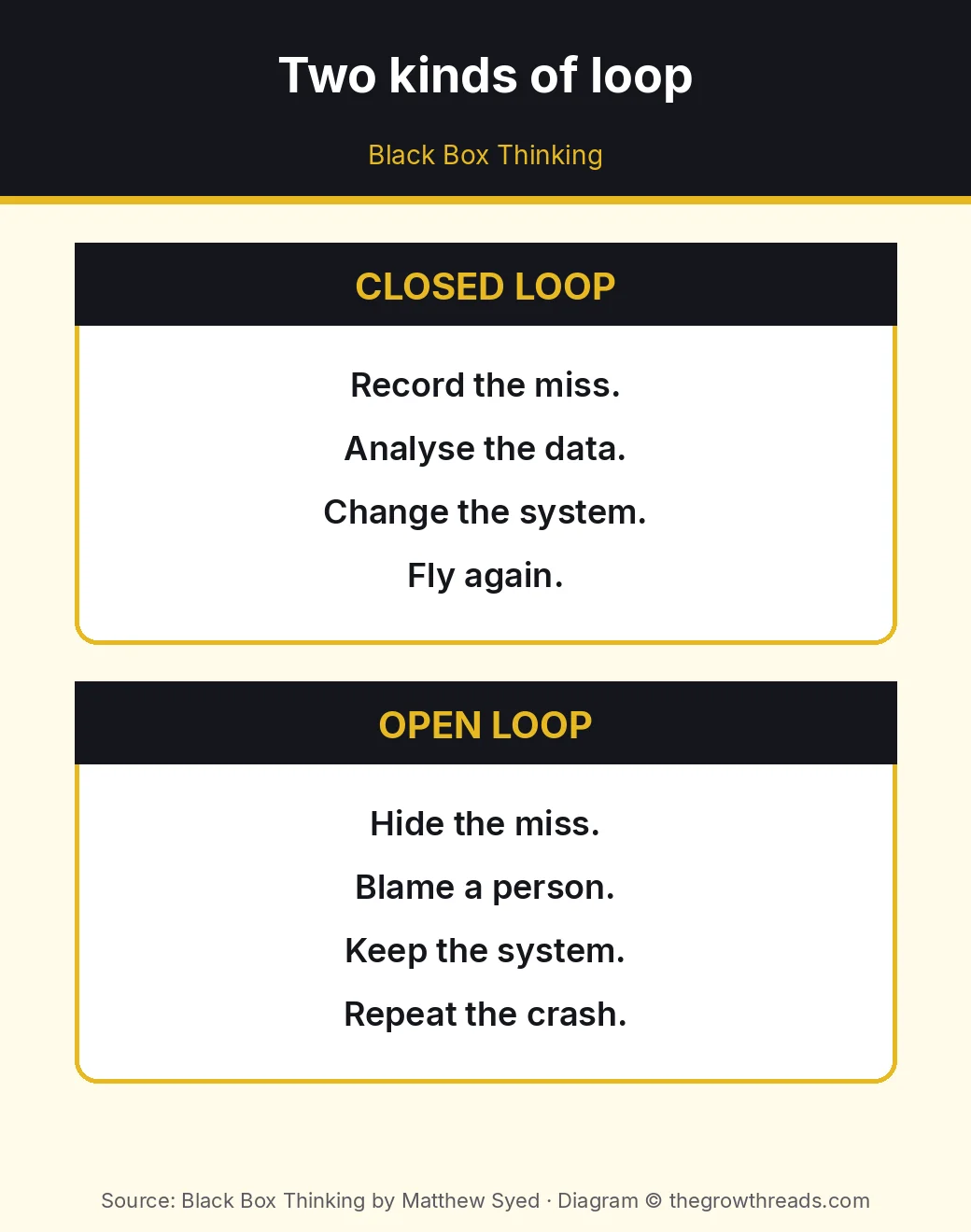
A closed loop is simple on paper. Something goes wrong. You record it. You analyse the sequence, not the character. You change a procedure, a checklist, a default. You share the lesson so the next crew does not pay tuition again. An open loop looks busy and learns nothing. The miss is hidden, softened, or pinned on whoever had the bad shift. The procedure stays. Next Tuesday rhymes. Syed’s claim is not that aviation is morally superior. Aviation was forced into closed loops by physics: a wreck is public. Your stalled product launch is private. That is why you need a black box on purpose — a note, a recording, a timestamped “what I expected vs what happened” — before the story gets comfortable.
“Progress in fact depends on failure, provided we are good at learning from it,” Syed writes. The TGR translation: if you cannot point at last week’s miss in writing, you are still in an open loop. The chart after the takeaways is that fork. Left column gold. Right column empty boxes. Pick one actual failure and put it on the left.
TGR Note: If the failure is a skipped step in a known sequence, our Checklist Manifesto summary is the sibling — Gawande wants the steps visible. If the miss is a system with delays and feedback you cannot see, Thinking in Systems is the map. Syed supplies the culture that lets either tool actually get used.
Part 2: Why we hide the miss
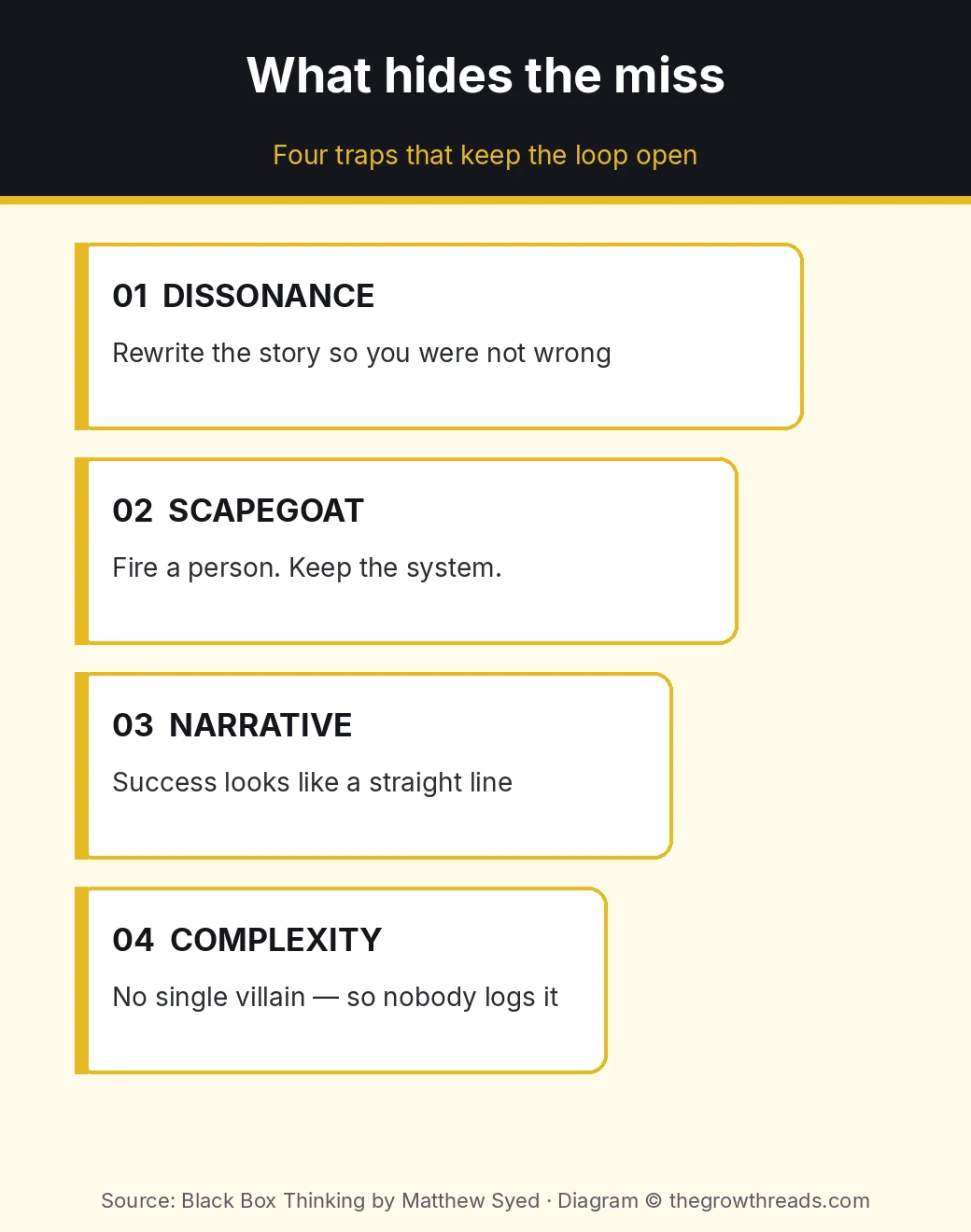
The second movement is psychological, not procedural. You can buy the orange box and still lie to it. Cognitive dissonance — Festinger’s old finding, told here as a performance problem — is the mind’s talent for reducing the gap between “I am competent” and “I just failed.” We do not usually say “I was wrong.” We say the test was unfair, the client was impossible, the timing was unlucky. The story is soothing. It is also how the same bug ships twice. Syed’s practical counter is boring: write the sequence before you write the meaning. Times, actions, what you expected. Meaning can wait an hour. Facts cannot.
Scapegoating is dissonance with a job title. Someone must be blamed so the rest of the room can stay innocent. Fire the nurse, the intern, the PM. Keep the understaffed protocol. Complexity makes this worse. Real failures are often Swiss-cheese — several small holes lining up. There is no satisfying villain, so nobody logs the near-miss. Narrative fallacy does the same job for success. We tell straight-line stories about winners and skip the ugly iterations. Then we copy the myth and wonder why the 1% never shows up. The stacked bars in this part are those four traps. They all do one thing: keep the loop open while looking like an explanation.
TGR Note: If the hidden miss is an identity threat — “I am the kind of person who doesn’t fail” — start with Mindset. If the trap is a first-frame you will not re-examine, Clear Thinking is the pairing. Syed is the logging layer those books still need when the week gets loud.
Part 3: Marginal gains and actionable failure
Once the loop can close, Syed wants volume. British Cycling’s marginal-gains folklore is the picture: many 1% changes — pillows, hand-washing, bike fits — stacked until a nation that won little started winning a lot. You do not need a velodrome. You need a bias for small, testable changes you will actually inspect. A heroic overhaul you never measure is an open loop in gym clothes. A 1% tweak you record — subject line, standup length, the first ten minutes of deep work — is a closed loop you can run on a Tuesday.
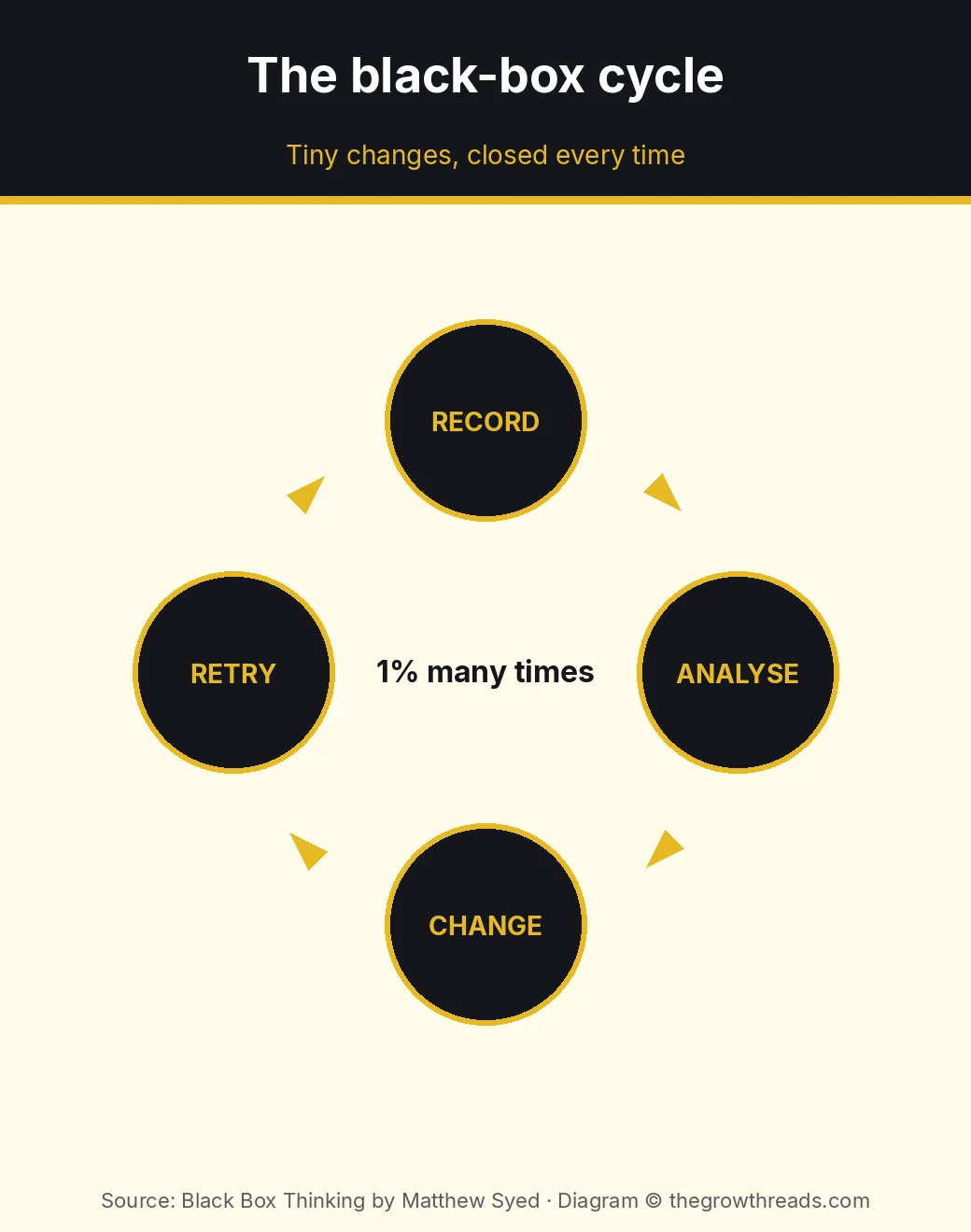
Not every failure is equally useful. Syed draws on the distinction between failures you can learn from and failures that only punish. A sloppy skipped checklist is not “growth.” A well-logged experiment that missed is. The job is to design attempts so the miss is informative: one variable, a prediction, a time-box, a note. Then retry. The cycle infographic is that loop: record, analyse, change, retry. The centre line is the point. One percent, many times. Pair it with the practice shelf — Peak, Talent Is Overrated, Make It Stick — if the loop is a skill you are trying to grow, not a plane you are trying not to crash.
TGR Note: Tiny closed loops are also the plot of Atomic Habits — 1% better is a habit claim as much as a cycling claim. If the miss is quitting in the hard middle, The Dip asks whether to persist. Syed asks whether you have any data to decide.
Part 4: A culture that can hear bad news
The last movement is the room. A black box in a blame culture becomes a prosecution file. People stop writing. Syed’s growth culture is not posters. It is a cheaper cost of telling the truth than of looking good. Leaders go first: they narrate their own misses in public, with the change attached. Teams separate “what happened” from “who is in trouble.” Near-misses get the same respect as wrecks, because near-misses are cheaper teachers. If you manage anyone, your job this week is one sentence in a meeting: here is what I got wrong, here is the procedure that changes, here is how we will know in seven days.
For a solo week the culture is still a design. Who sees your miss? A private notes app that never alters the next calendar block is a diary, not a loop. Share one failure with one person who will ask “what changes?” not “whose fault?” Put the retry on the calendar with the change already in the environment — checklist, blocker, script. That is the same spirit as The Lean Startup’s build-measure-learn, pointed at a life rather than a company. Hidden Potential is the sibling on getting better after the first plateau. The book only works if Tuesday still has a logged miss. Unlogged inspiration is an open loop with nicer lighting.
TGR Note: If the stall is remaining in process without a post-mortem, today’s The Practicing Mind is the attention layer. Syed is the data layer. You need both: stay with the work, then actually look at the miss.
Who is Black Box Thinking best for — and who should read something else first?
Best for people who already work hard and still repeat the same stall, launch, meeting, or post-mortem. Run the 7-day plan on one real miss, not on other people’s plane crashes.
Read something else first if no small daily act sticks: Atomic Habits. If the problem is a missing checklist for a known sequence: The Checklist Manifesto. If you need the growth-mindset language before you can look at a grade: Mindset. If you start well and quit in the middle: The Dip or Grit. If you want practice design more than failure culture: Peak and Make It Stick. If the work is a product experiment: The Lean Startup.
Questions to reflect on
- What miss from the last two weeks have you already rewritten into a story?
- When a project failed, did you change a person or a procedure?
- Where would a 1% closed loop fit this week — a script, a checklist, a ten-minute review?
- Who in your room makes telling the truth expensive?
- What would you write in a black box for yesterday if nobody would punish you?
🔥 Ready to log the miss instead of narrating it?
Get Black Box Thinking, then run the 7-day plan on one real failure — not on a highlight reel of other people’s crashes.
How to apply Black Box Thinking (7-day plan)
- Day 1 — Name one miss. One sentence: the failure you keep repeating. If you cannot point at it, you are still in a story.
- Day 2 — Write the black box. Time, actions, what you expected, what happened. No meaning yet. Facts only, same day as the sting.
- Day 3 — Separate person from procedure. Circle the step that would still fail if a different human ran it. That is the system.
- Day 4 — One 1% change. Alter one variable (checklist item, default, script). Write the prediction. Put the retry on the calendar.
- Day 5 — Share the miss. Tell one person who will ask “what changes?” not “whose fault?” If you manage people, narrate one of yours first.
- Day 6 — Retry with the change in. Run the attempt. Log again. Compare to Day 2. Keep or revert on evidence, not mood.
- Day 7 — Make the loop boring. Schedule a 15-minute weekly black-box review. The book only works if next Tuesday still has a job.
Frequently asked questions
What is Black Box Thinking about in one paragraph?
Black Box Thinking is Matthew Syed’s 2015 case that progress depends on how you treat failure. Closed-loop cultures — aviation, elite sport, good science — record the miss, extract the data, change the system, and share the lesson. Open-loop cultures hide, blame, protect ego, and repeat. The book is a stack of investigations and cognitive-science stories, not a lab paper. This summary is the application layer: one logged miss, one 1% change, and a 7-day plan. You do not need a plane. You need a note written while the miss still stings.
What is a closed loop versus an open loop?
A closed loop detects a miss, reports it without theatre, changes a procedure, and shares the lesson so the next attempt is different. An open loop hides the miss, blames a person, protects the story, and repeats the crash in nicer language. Syed’s aviation contrast is the picture: black boxes exist so the wreck teaches. Most personal weeks are open loops with a to-do app. Day 2 and Day 4 of the plan are how you close one loop: facts first, then one change you will actually retry. If the same failure returns, you did not close it.
Who was Elaine Bromiley and why does Syed start there?
Elaine Bromiley died after a routine sinus surgery in 2005 when oxygen failed and the team stayed inside a familiar script. Her husband, Martin Bromiley, was an airline pilot. He asked for an aviation-style investigation rather than a hunt for a villain. Syed uses that case because it makes the closed-loop idea concrete: the miss was systemic, the culture was not built to learn, and a pilot’s instinct — record, analyse, change — was the missing instrument. You will not run an operating theatre this week. You can still refuse to turn one ugly hour into a character judgment.
How is Black Box Thinking different from Mindset or Grit?
Mindset is the belief layer: ability can grow if you treat a grade as information. Grit is the perseverance layer: stay with the long goal. Black Box Thinking is the logging layer those books still need. A growth mindset without a record becomes a pep talk. Grit without a post-mortem becomes stubbornness. Read Mindset first if you cannot look at a miss without collapsing. Read Grit or The Dip if the issue is quitting, not learning. Read Syed if you already persist and still repeat. The 7-day plan is a black box, not a motivational speech.
Are the healthcare statistics in the book still solid?
The direction is solid. Some of the famous mortality numbers Syed cites — the older “To Err Is Human” range — have been debated, re-estimated, and argued over in the years since 2015. He wrote a performance book, not a systematic review. Keep the application: preventable error is real, blame cultures hide it, closed loops reduce it. Drop the claim that one exact death count is the last word. FAQ is the right place for that caveat. The 7-day plan still runs without a perfect epidemiology paper. Log your own miss. Change one procedure. Measure the next attempt.
Should I read this or The Checklist Manifesto first?
Read The Checklist Manifesto if the work is a known sequence that skilled people still skip under pressure — surgery, launches, live ops. Gawande’s tool is the list. Read Black Box Thinking if the deeper problem is that nobody will admit the miss, so no list ever gets written. Many readers need both. Start here if post-mortems end in a person. Start with Gawande if everyone already agrees what went wrong and still forgets a step. You do not need Syed’s whole shelf before Day 1. You need one named miss and a timestamped note.
Is Black Box Thinking still useful in 2026?
The loop aged well. Tools got better; the habit of hiding the miss did not expire. Dashboards can still be open loops if they punish the person who files the ticket. AI can still be an open loop if you never record where it failed. Syed’s claim is still the useful one: progress depends on failure you are willing to inspect. Ignore the quote-graphic version that makes “embrace failure” a poster. Keep the black box, the 1% change, and one weekly review. Day 1 should still be a real miss you can point at in the week you actually work — not a speech about airplanes.
Related summaries
- Make It Stick Summary & Review
- Peak Summary & Review
- The Checklist Manifesto Summary & Review
- Talent Is Overrated Summary & Review
- Best Productivity Books
How we analyze books: every book on The Growth Reads is read cover to cover, summarized in thousands of words of original analysis, and rated against our five-criteria rubric (lasting impact, evidence quality, practical application, writing & originality, external consensus). Read our full methodology.