

★★★★½ 4.6/5 — Treat thinking as a skill you can train this week, not a mood you wait to feel.
Best for: Knowledge workers whose calendars are full and whose choices are still made with leftover attention.
Reading time: ~3.5 hrs (guide: 12 min)
Difficulty to apply: Low on the drills; honest on repeating them when the inbox shouts.
How Successful People Think in one minute
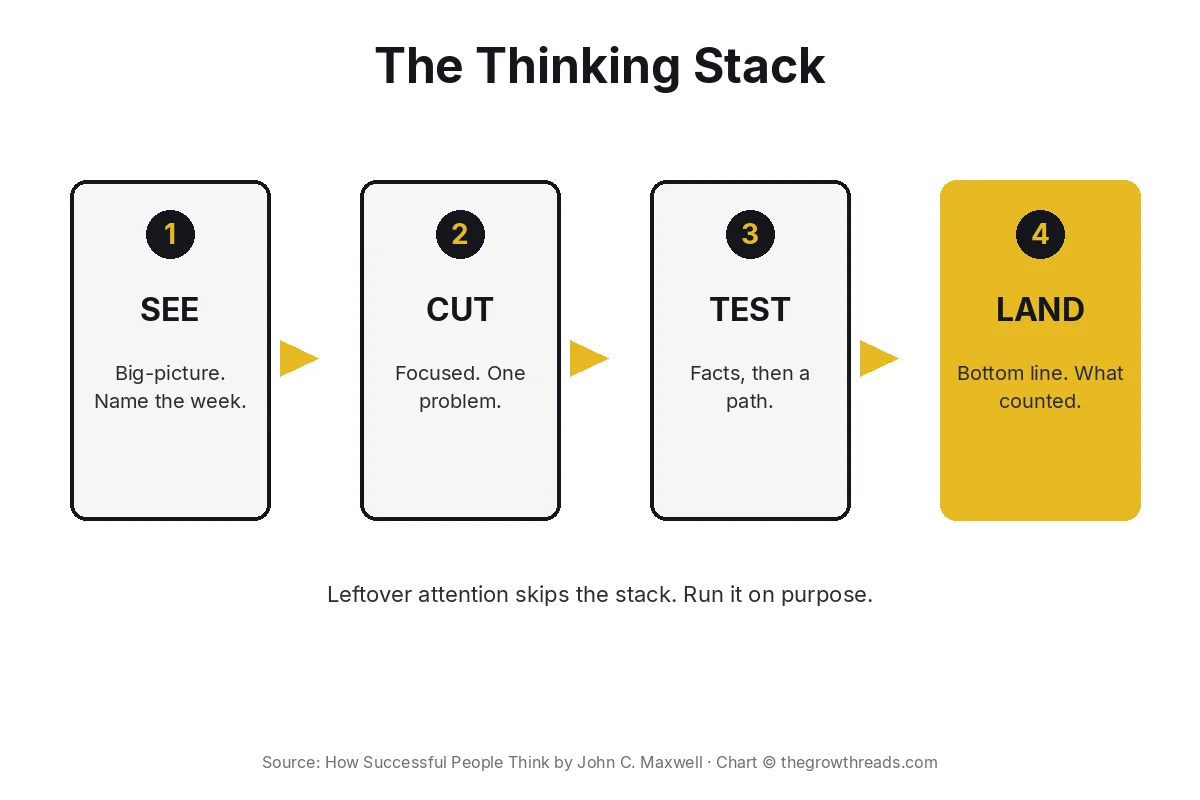
Successful people are not using a different clock. They are using a different quality of thought. How Successful People Think (2009) is John C. Maxwell’s shortest usable argument that thinking is eleven skills, not a gift: see the week, cut the noise, test the facts, invent a path, borrow other heads, and land on what actually counted. Popular advice fills the gap when you skip a skill. If you take one move from this How Successful People Think summary, pick the skill you did not use yesterday and run it on one live problem before lunch.
Key takeaways
- Thinking is trained: Talent and circumstances matter. Leftover attention still makes most weeks.
- Eleven skills, one stack: You do not pick a favourite. You notice the missing one.
- Big-picture first: Context before tasks, or the tasks become the context.
- Focus is a cut: One problem. Remove what is only noise wearing a badge.
- Creative is a new move: Not a prettier version of the plan that already failed.
- Realistic before hopeful: Facts are not pessimism. They are the floor.
- Strategy is a next step: A slogan is not a path.
- Possibility is a test: “What would have to be true?” then check it.
- Shared thinking compounds: The hole in your view is often another person.
- Bottom line is a landing: Name what will still matter when Friday arrives.
What is How Successful People Think about?
How Successful People Think is Maxwell’s method for upgrading the hour before the work: eleven named thinking skills you practise on a live problem so the week is aimed, not inherited from leftover attention, popular advice, and meetings that never land.
About the author
John C. Maxwell is an American leadership teacher and writer whose books have sold tens of millions of copies and whose organisations — EQUIP and the John Maxwell Company — turned classroom drills into a global practice. He pastored first, then spent decades teaching that influence is a learnable skill, not a title. How Successful People Think arrived in 2009 as a compact sibling to the larger Maxwell shelf: less origin story, more checklist. The authority is volume plus repetition. He has watched operators confuse motion with thought for a long time, and he wrote a short book so they could stop doing it this week. Explore all John C. Maxwell book summaries →
Key concepts at a glance
| Concept | What it means | Use it when |
|---|---|---|
| Thinking as skill | Eleven practises, not a personality | You wait to “feel strategic” |
| Big-picture | See the week beyond this inbox | Tasks have become the whole map |
| Focused | One problem; cut leftover attention | Everything is equally loud |
| Creative | A new move, not a prettier old one | The plan already failed once |
| Realistic | Facts before hope | The story is nicer than the numbers |
| Strategic | A path with a next step | You have a slogan and no Tuesday |
| Shared | Borrow other heads on purpose | You are the only reviewer of the thought |
| Bottom-line | Name what will still matter | The meeting ended and nothing landed |
Part 1 — See farther, then cut
Maxwell’s opening claim is unfashionable in a culture that treats thinking as a vibe. Good thinking is several skills. People who look “naturally strategic” are usually practising a mix you can name. The first three are how you look: big-picture, focused, creative. Skip one and the week tilts.
Big-picture thinking is not vision-board language. It is the refusal to let this inbox become the map. Before you touch the loudest task, you write the week in one sentence: what this stretch of days is actually for. Focused thinking is the cut that follows. One problem. The rest is noise wearing a calendar invite. Creative thinking is the third look: a move you have not tried, not a restyling of the plan that already failed. The order matters. Inventing before you see the week produces theatre. Cutting without a picture produces a smaller pile of the same mistake.
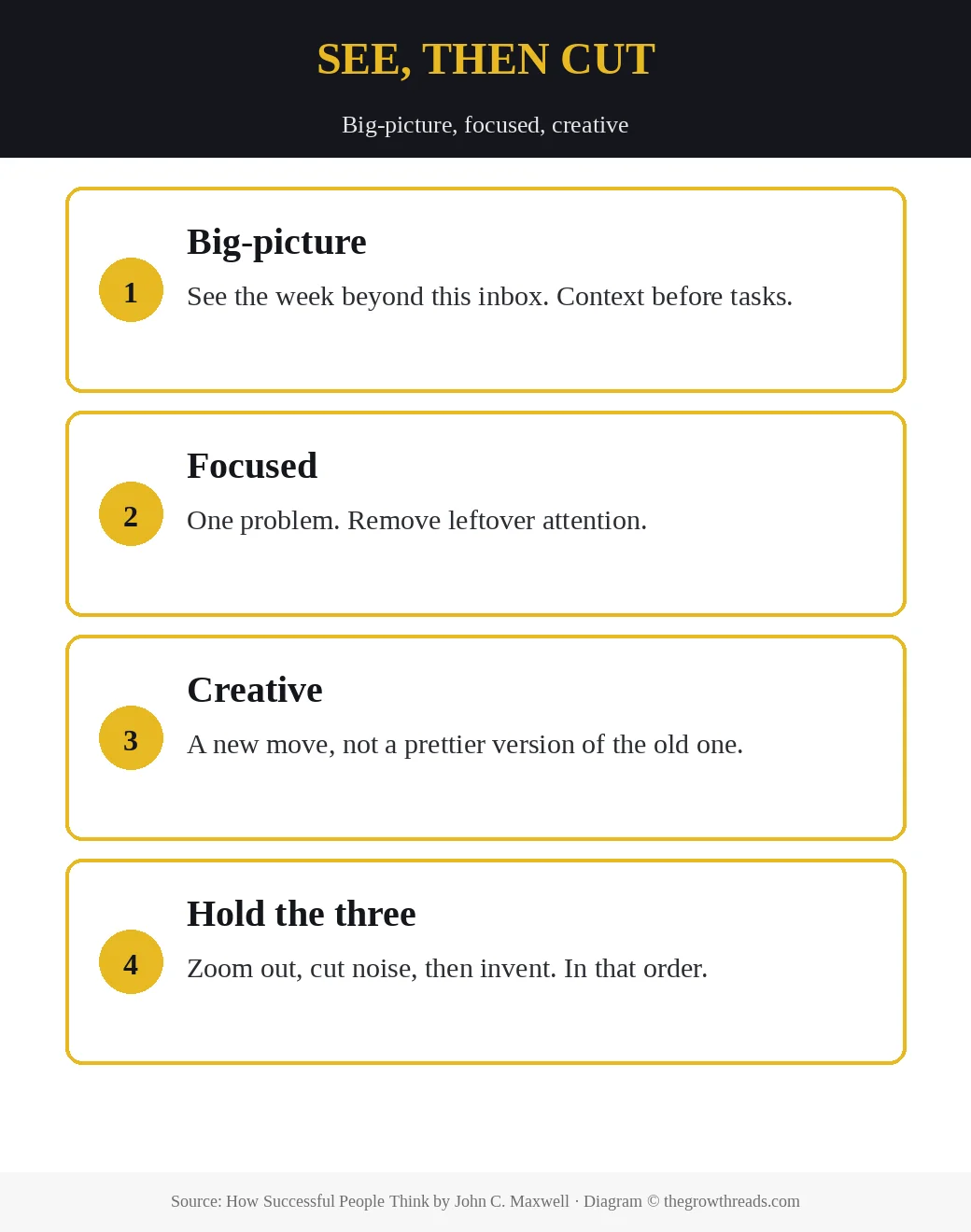
Most knowledge workers reverse the order. They open the laptop, inherit leftover attention, and call the first fire “priority.” Maxwell’s drill is slower for ten minutes and faster for the day. Write the picture. Cut to one question. Only then ask what a new move would look like. The feeling of being behind is often a missing picture, not a missing hour.
TGR Note: The cut is cousin to The One Thing and Essentialism: one problem, designed exclusion. Focus is the science of why leftover attention is expensive. Use Maxwell when you need names for the skills. Use those three when the stall is the calendar or the hijack. Do not collect all four as a way to delay the one-sentence picture.
Part 2 — Facts, a path, and a possible
The next three skills stop hope from posing as a plan. Realistic thinking is not pessimism. It is the floor: what is true about the numbers, the time, the other people. Strategic thinking turns that floor into a path with a next step you could take before lunch. Possibility thinking asks what would have to be true for a better path — then tests it, instead of using “possible” as a mood.
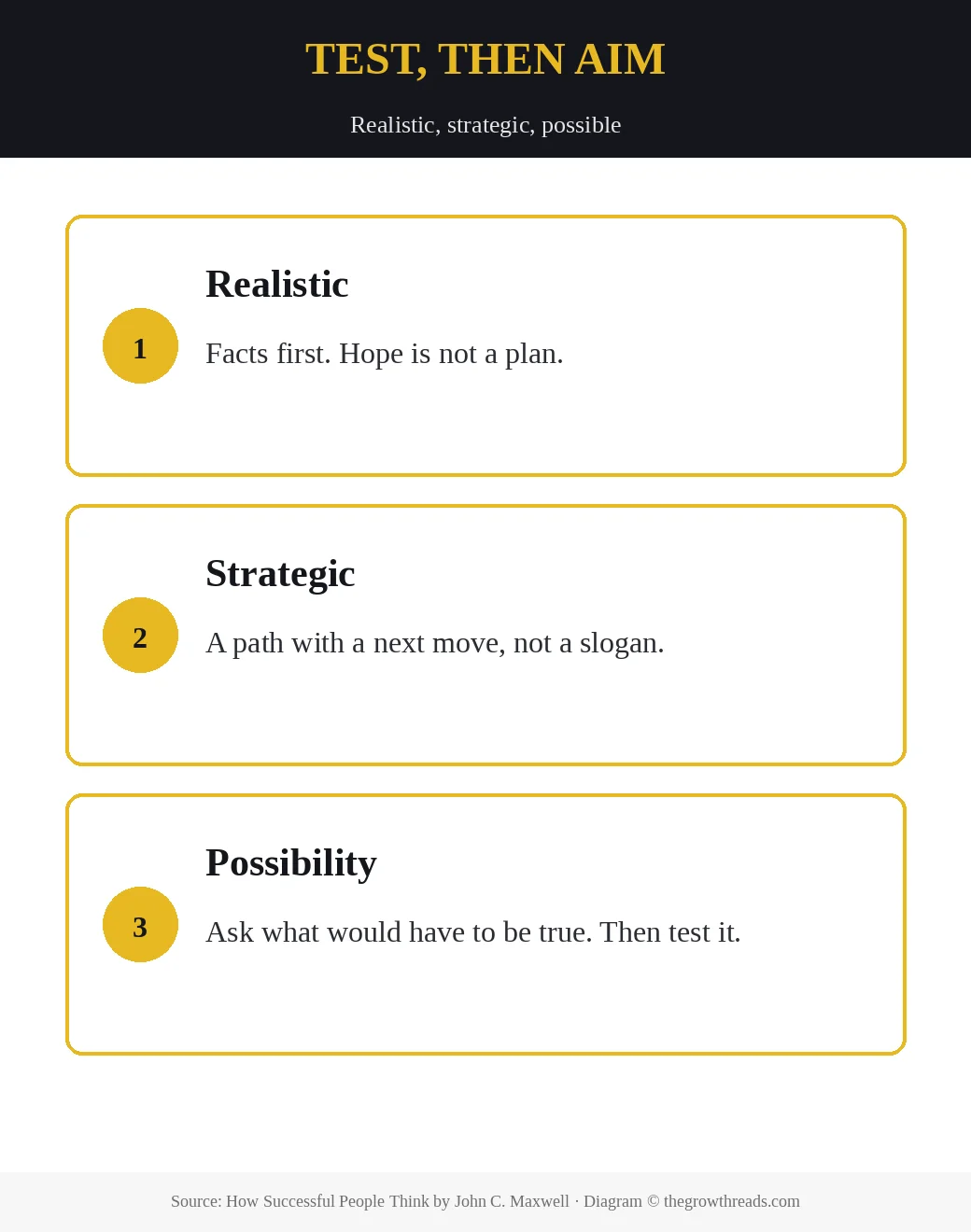
Teams skip realistic because it feels disloyal to the dream. Individuals skip it because the story is nicer. Maxwell’s point is practical. A path built on a false floor collapses on Wednesday and then you spend Thursday recovering identity. Write three facts that would still be true if you were not in the room. Then write the next step those facts allow. Possibility sits after that, not before. “What would have to be true?” is a research question. It is not a permission slip to ignore the floor. Hidden Potential would call the possible a bet on capacity. Maxwell wants the bet priced.
TGR Note: Clear Thinking is the longer operating system for judgment under default. Maxwell is the shorter checklist: facts, path, possible. If the decision is high-stakes and biased, start with Parrish. If the week is ordinary and still fuzzy, run Maxwell’s three on a single live problem this afternoon. Talent Is Overrated is the reminder that the skill improves with deliberate reps, not with a better personality story.
Part 3 — Look back, question the default, borrow heads
Reflective thinking is the pause that turns a week into material. What actually happened. What you told yourself happened. The gap is the lesson. Questioning popular thinking is the sibling skill: default advice is a starting point, not a verdict. Shared thinking is how you stop being the only reviewer of your own mind. Maxwell is blunt that the hole in your view is often another person, and that “I’ll think about it” without a named other is usually a delay.
Popular thinking shows up as the phrase everyone in your industry repeats. It is efficient. It is also how whole teams walk off the same cliff. The drill is small. Write the default in one line. Write one fact that would have to change for the default to be wrong. Then ask one person who does not share your incentives. Shared thinking is not a brainstorm with ten sticky notes. It is one other head, on one question, with the picture and the facts already on the table so they are not guessing.
Reflection without sharing becomes rumination. Sharing without reflection becomes noise. Maxwell wants both, on a timer. Ten minutes to write what happened. One conversation that is not a status update. The point is not to feel collaborative. The point is to catch the skill you skipped while there is still week left.
TGR Note: Designing Your Life prototypes a life the way Maxwell wants you to prototype a thought: small, tested, not a five-year novel. Good Habits, Bad Habits is why leftover attention keeps winning — the cue is the inbox, the routine is reaction. Change the cue (picture first) and the routine has a chance. Do not add a fourth app. Add one named person to the thought before you ship it.
Part 4 — Give it away, then land it
The last two skills are how thinking becomes useful to someone besides you. Unselfish thinking asks who else gets better if this thought is true. It is not sainthood. It is a quality check. Selfish thinking hides in smart rooms as “protecting the work.” Often it is protecting a status. Bottom-line thinking is the landing: what will still matter when the meeting ends, the week ends, the launch ships. If you cannot name it, you did not think it through. You performed thinking.
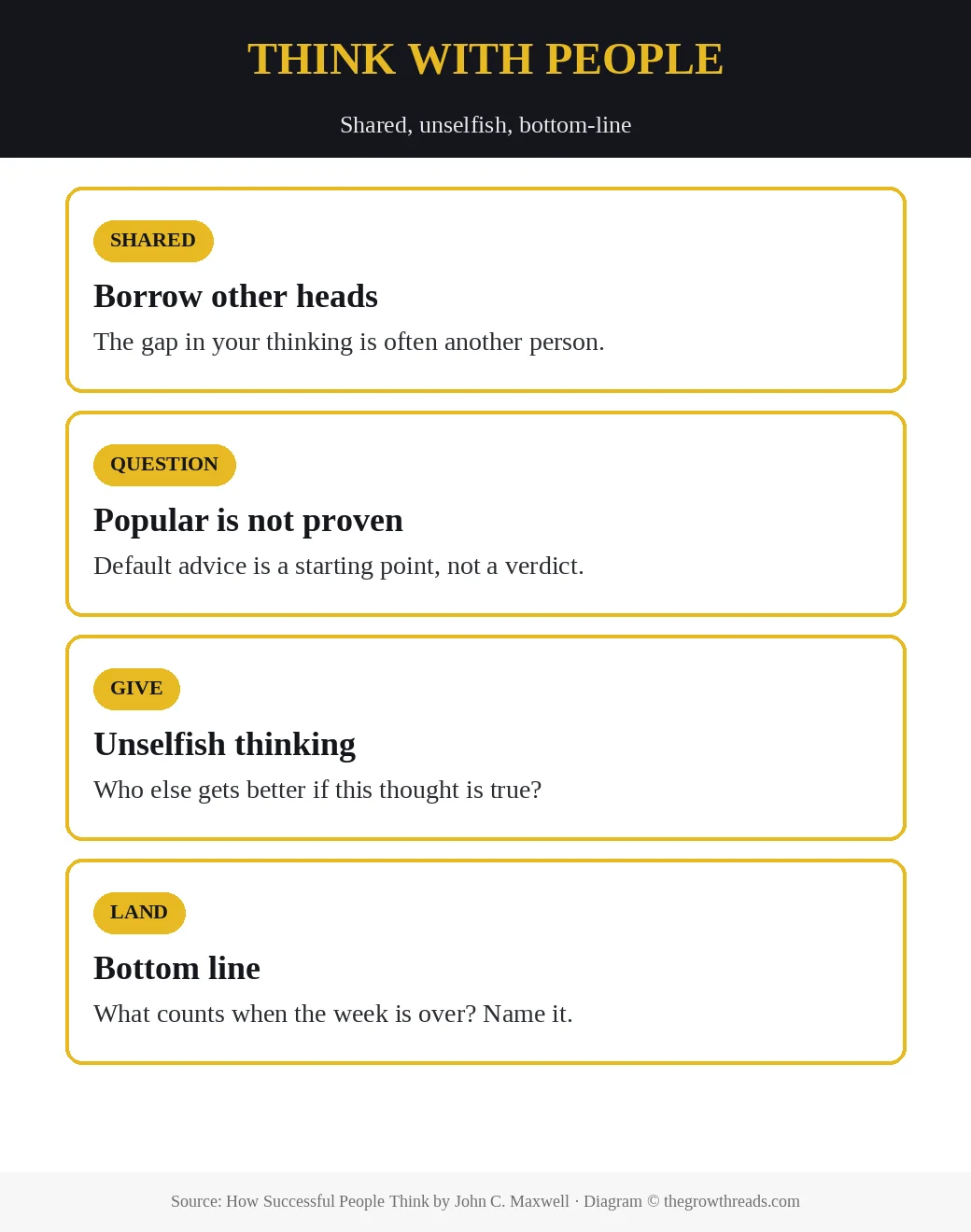
Maxwell’s classroom is full of people who can talk for forty minutes and not land. The bottom line is a sentence a tired colleague could repeat. Unselfish thinking is the test of whether that sentence helps anyone besides the speaker. Together they stop the stack from being a private hobby. You see, you cut, you test, you share — and then you say what counted. Publication, promotion, and praise are weather. The landing is the work. If you sat down to be seen as strategic, the sitting will feel empty after the meeting, because meetings end. If you sat down to land a sentence other people can use, the skill survives a quiet week.
Make it physical. Maxwell’s books work when they become a card, not a mood. One index card: picture, cut, facts, next step, who you asked, bottom line. That is the whole stack for one problem. Tomorrow, another card. Eat That Frog would put the ugly job first. Maxwell would put the missing skill first. They rhyme. The refusal to think on purpose is the same as the refusal to start.
TGR Note: The 15 Invaluable Laws of Growth is the longer Maxwell on becoming a person who can carry more; Failing Forward is the companion for staying in after a miss. Use this book for the hour before the work. Use those two for the year around the work. Do not reread all three as a way to skip the card. Pick the skill you skipped yesterday. Land it by Friday.
Who is How Successful People Think best for — and who should read something else first?
Best for people whose job includes a week of decisions and who still think with leftover attention: operators, founders, managers, specialists, independent knowledge workers. Especially if you already work hard and keep repeating the same class of miss — no picture, no facts, no landing.
Read something else first if you cannot yet start a twenty-minute sitting — Good Habits, Bad Habits or Eat That Frog, then come back. If the enemy is a hijacked hour, start with Focus. If the enemy is bias on a high-stakes call, start with Clear Thinking. If you need a life-design prototype rather than a thinking stack, Designing Your Life fits that job. Come to Maxwell when the bottleneck is the quality of the thought, not the size of the calendar.
Questions to reflect on
- Which of the eleven skills did you skip yesterday, named in one word?
- What is this week for, in one sentence a tired colleague could repeat?
- What three facts would still be true if you were not in the room?
- Who is the one other head you will put on this thought before you ship it?
- What will still matter on Friday, and what is only noise wearing a badge?
🔥 Ready to think on purpose this week?
Pick the skill you skipped yesterday, run it on one live problem, and land a bottom line by Friday.
How to apply How Successful People Think (7-day plan)
- Day 1 — Name the missing skill. Write yesterday’s worst decision in one line. Circle the skill you skipped. That is this week’s drill, not all eleven.
- Day 2 — Big picture on a card. One sentence: what this week is for. Put it where you open the laptop.
- Day 3 — Cut. List seven loud tasks. Keep one. The rest wait. Work the one for twenty-five minutes.
- Day 4 — Facts then a path. Three facts that survive without you. One next step those facts allow. Take the step.
- Day 5 — Ask what would have to be true. Write one possible. Test it with a message, a number, or a twenty-minute prototype. Not a mood.
- Day 6 — Shared thinking. Put one other head on the thought. Send the picture and the facts. Ask one question. Do not send a novel.
- Day 7 — Land it. What counted. Who is better if it is true. One sentence a tired colleague could repeat. Tomorrow, a new card.
Frequently asked questions
What is How Successful People Think about?
How Successful People Think is John C. Maxwell’s compact field manual for treating thinking as a skill you can train, not a personality you wait to feel. He names eleven kinds of thinking — big-picture, focused, creative, realistic, strategic, possibility, reflective, questioning popular defaults, shared, unselfish, and bottom-line — and argues that success tracks the mix, not one heroic insight. The book is short on purpose. Each chapter is a drill: see farther, cut noise, test facts, invent a path, think with other people, and land on what actually counted. It is a practice book for knowledge work, not a biography of famous minds.
What are the 11 types of thinking in How Successful People Think?
Maxwell’s eleven are big-picture, focused, creative, realistic, strategic, possibility, reflective, questioning popular thinking, shared, unselfish, and bottom-line. You do not pick a favourite and ignore the rest. Big-picture without focus is tourism. Focus without facts is stubbornness. Strategy without possibility is a smaller cage. Shared thinking without a bottom line is a pleasant meeting. The usable picture is a stack you run on a real problem: see the week, cut to one question, test it against evidence, aim a next move, borrow another head, and name what will count when Friday arrives. That sequence is the book.
Is How Successful People Think worth reading if I already read Maxwell?
Yes if you want a thinking checklist you can run on Tuesday, not another leadership origin story. The 15 Invaluable Laws of Growth is about becoming a person who can carry more. Failing Forward is about staying in the work after a miss. This book is narrower: the hour before the work, when leftover attention is making your choices. If those two already changed how you recover and grow, this one changes how you aim. Skip it as a first Maxwell if you still cannot start a two-minute action — get a mechanics book first, then come back with a real problem in hand.
How is How Successful People Think different from Clear Thinking or Focus?
Shane Parrish’s Clear Thinking is about protecting judgment from defaults and building an operating system around high-stakes calls. Daniel Goleman’s Focus is attention science: inner, other, and outer focus as a scarce resource. Maxwell is neither lab nor lattice. He hands you eleven named skills and asks you to practise the missing one this week. Use Parrish when the problem is a decision under bias. Use Goleman when the problem is a hijacked hour. Use Maxwell when you can start, you can attend, and you still think in leftovers — popular advice, no bottom line, no other heads in the room.
Who should read How Successful People Think?
Operators, founders, managers, and independent knowledge workers whose weeks are full and whose thinking is still accidental: the person who answers email with leftover attention and calls it strategy. It is especially useful if you already work hard and still repeat the same class of mistake. Skip it as a first book if you cannot yet sit down for twenty focused minutes — go to a start-small habit book, then return. If the stall is sharing the work, not aiming it, a shipping book will help more. Come here when the bottleneck is the quality of the thought, not the size of the calendar.
How long is How Successful People Think and how should I read it?
The Center Street edition is about 160 pages. Most readers finish it in three to four hours. Do not study it like a textbook. Read one chapter, then run that skill on a live problem the same day: a one-sentence big picture, a cut list, a fact check, a shared question. The book is short so the drills can be long. A useful rule is one skill, one problem, same afternoon. If you highlight all eleven and never pick one, you have bought a poster. If you land a bottom line by Friday, you have used the book.
Is How Successful People Think only for leaders?
No. The stories lean on teams and organisations because that is Maxwell’s classroom, but the method is for anyone whose work includes a decision and a week. A researcher choosing a question, a specialist writing a spec, a founder picking a product, a teacher designing a term — each of those stalls the same way a manager stalls. Leftover attention fills the gap. Maxwell’s move is the same. Name the skill you skipped. Practise it on one problem. Bottom-line thinking is not a title. It is the habit of asking what will still matter when the meeting ends, whether or not anyone reports to you.
Related summaries
- The 15 Invaluable Laws of Growth — the longer Maxwell on becoming someone who can carry more
- Failing Forward — staying in the work after the miss
- Clear Thinking — an operating system for judgment when defaults pull
- Focus — attention as a scarce resource, not a mood
- More on the best productivity books pillar
How we analyze books: we read for application, not for a takedown — then we add a plan you can run this week. Read our full methodology.