

★★★★½ 4.5/5 — Attention is a muscle. Train inner, other, and outer focus or the day trains you.
Best for: knowledge workers who can sit at the desk and still cannot hold a thought, plus managers who confuse being busy with being aware.
Reading time: ~8 hours (320 pages) · this guide ~12 min
Difficulty to apply: Medium — the ideas are simple; protecting the reps is the work.
Focus in one minute
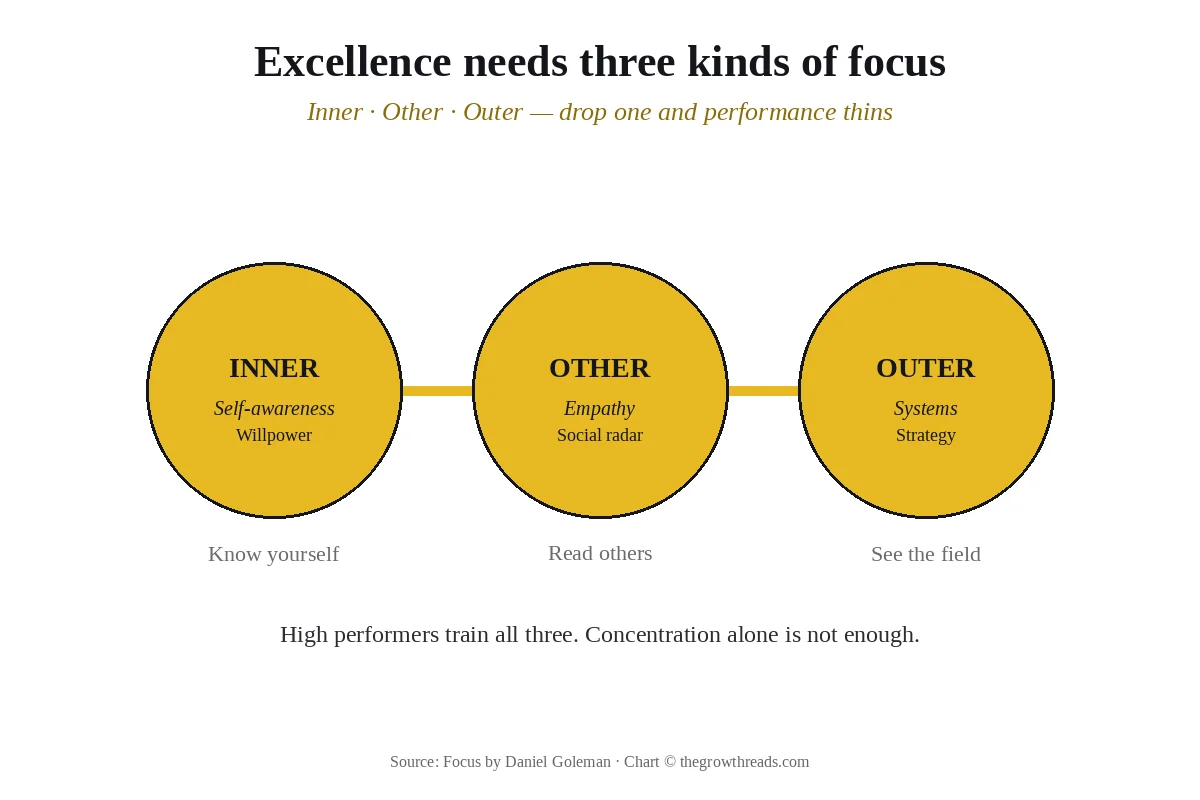
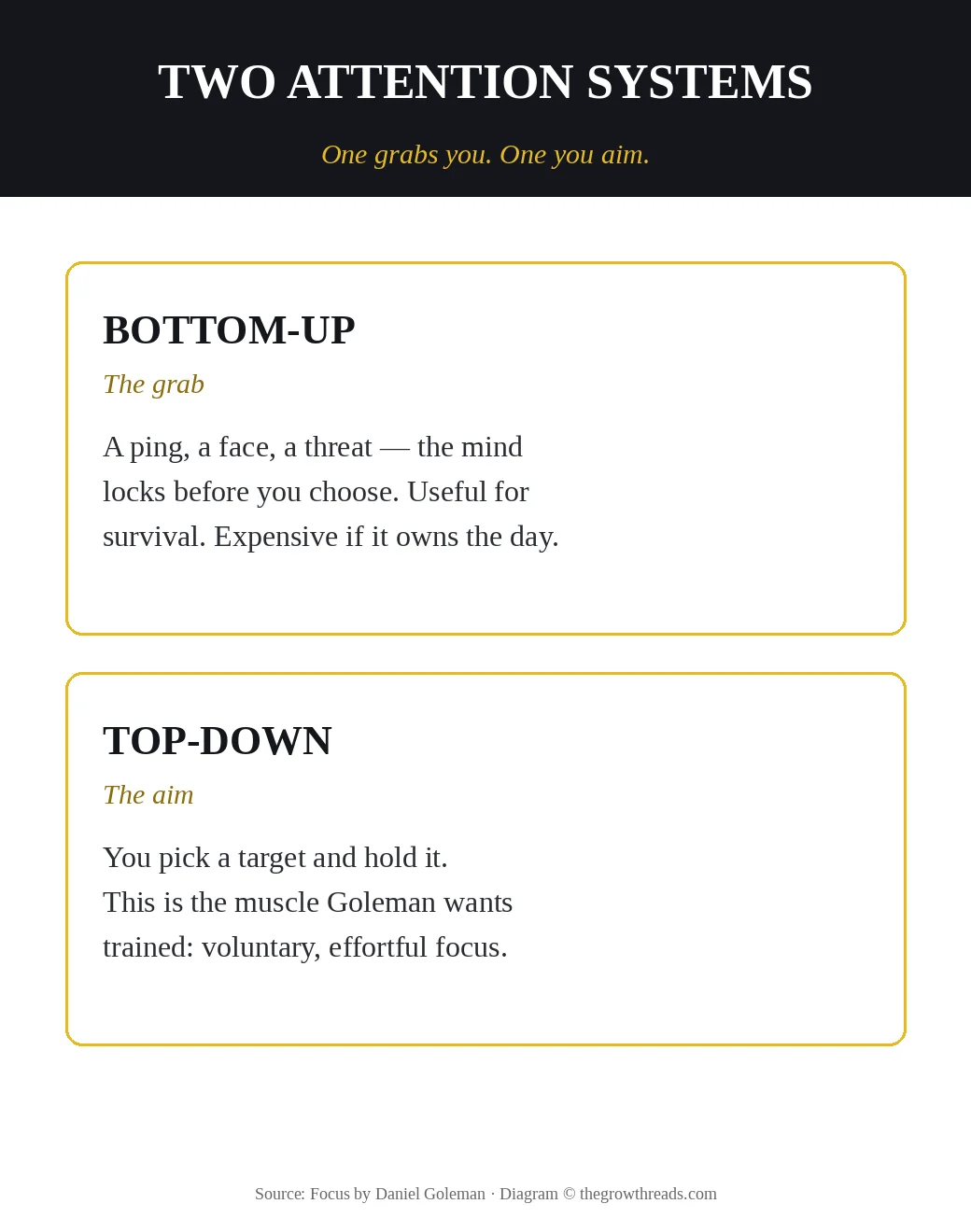
The scarce resource is not time. It is attention — and it behaves like a muscle. Daniel Goleman, the psychologist who put emotional intelligence on the map, argues that what you can hold in mind, ignore, and sense in other people is the hidden driver of excellence. Inner focus is self-awareness and willpower. Other focus is empathy. Outer focus is systems awareness: the field, not the ping. Bottom-up attention grabs you; top-down is the one you aim. High performers live in the second. The practical move is not a new app. It is reps: notice the wander, return, restore the muscle. Concentration without empathy and systems sense is a thin kind of excellence.
Key takeaways
- Attention is trainable: use it poorly and it withers; work it and it grows, the way a muscle does.
- Two systems run the show: bottom-up grabs; top-down aims. Excellence lives in the second.
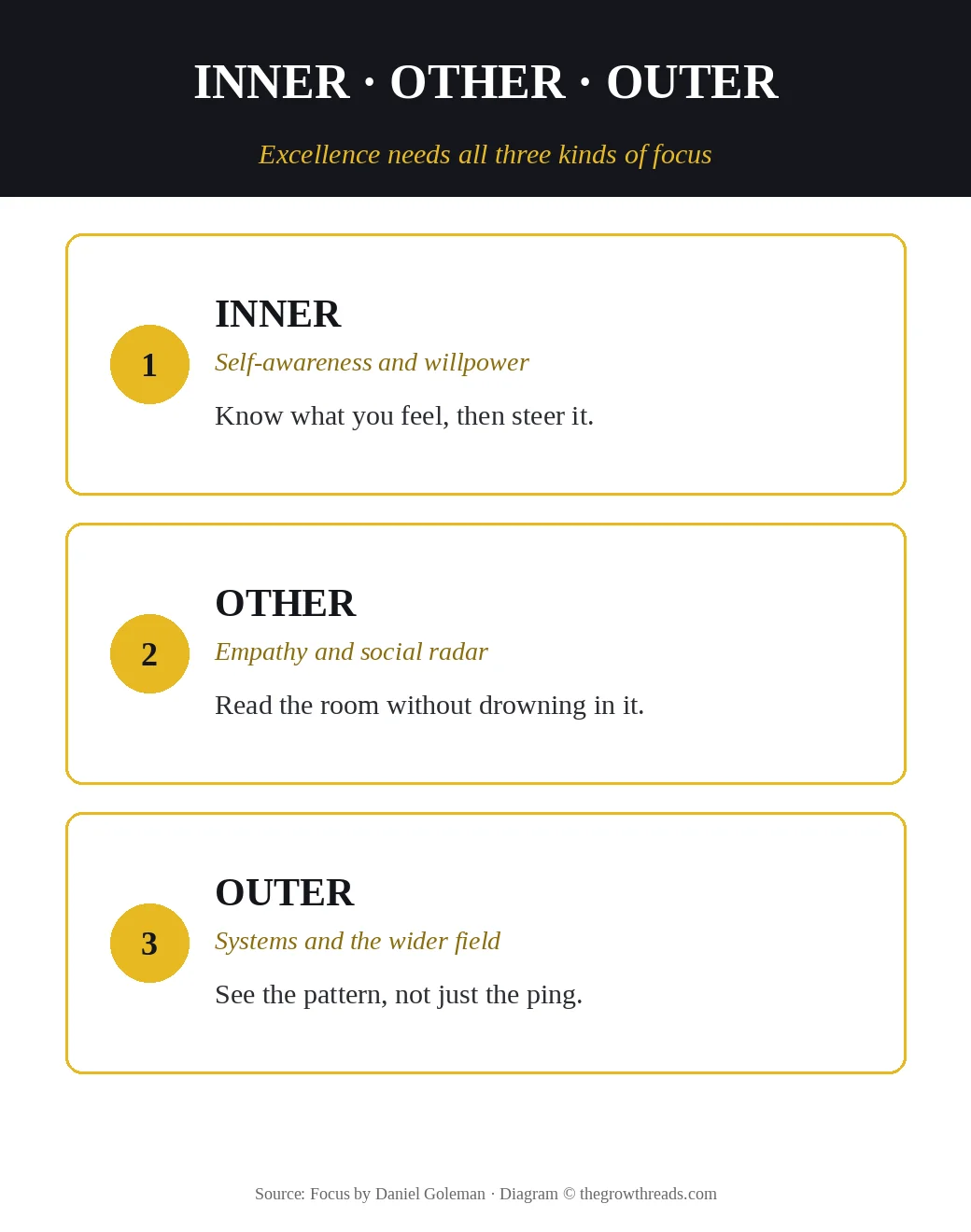
- Three directions matter: inner, other, and outer focus. Drop one and performance thins.
- Self-awareness is not journaling for its own sake: it is the dashboard that lets willpower steer.
- Empathy is a performance skill: cognitive, emotional, and concern — three different moves.
- Systems sense beats busy: leaders who only zoom in miss the pattern that will eat the plan.
- Smart practice needs attention: hours without full mind are occupancy, not training.
- Wander is the rep, not the failure: catching it and returning is how the muscle is built.
- Restoration is part of the gym: sleep, nature, and unfilled time refill what the day spends.
What is Focus about?
Focus argues that attention — not raw talent or more hours — is the hidden driver of excellence. Goleman maps how attention works, then shows why high performers need three kinds: inner (self-awareness and willpower), other (empathy), and outer (systems). The rest is how to train that muscle in a world built to steal it.
About the author
Daniel Goleman is a psychologist and former New York Times science journalist whose 1995 book Emotional Intelligence made EQ a public idea: self-awareness, self-regulation, empathy, and social skill often predict results better than IQ. Focus (Harper, 2013; Harper Paperbacks 2015) is the attention chapter of that project. After two decades of translating labs for civilians, he treats focus as the skill underneath learning, relationships, and leadership — not a personality type you either received or missed. He co-founded CASEL, lectures widely, and writes as a reporter of other people’s experiments. That is the book’s useful bias. You do not get a productivity system. You get a map of the muscle those systems quietly depend on. Explore all Daniel Goleman book summaries →
Key concepts at a glance
| Concept | What it means | Use it when |
|---|---|---|
| Attention as muscle | Focus strengthens with designed use and withers with constant hijack. | Your week is full and your mind still will not stay. |
| Bottom-up attention | Automatic grab: threat, novelty, ping, emotion. | You keep starting the hard thing and somehow opening mail. |
| Top-down attention | Voluntary aim: you choose a target and hold it. | You can name the one outcome that would make the morning count. |
| Inner focus | Self-awareness plus the willpower to steer what you notice. | You cannot tell urgency from importance in your own body. |
| Other focus | Cognitive empathy, emotional empathy, and empathic concern. | You are technically right and still losing the room. |
| Outer focus | Systems awareness — the wider field, not the next alert. | You are winning the hour and losing the quarter. |
| Smart practice | Deliberate, attended drills beat mindless volume. | You have years in the role and a flat skill curve. |
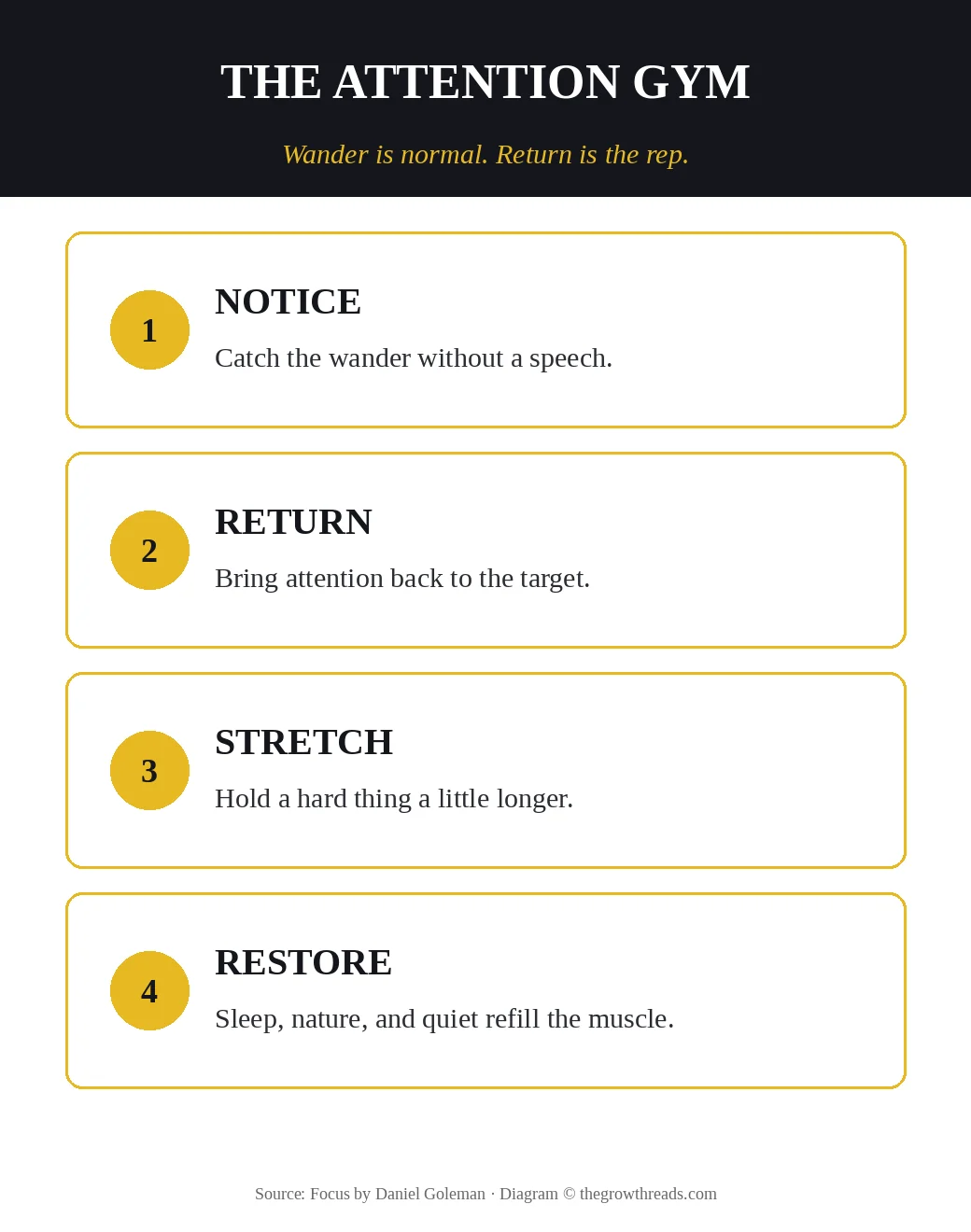
| Attention gym | Notice wander → return → stretch → restore. | You treat distraction as a moral failing instead of a rep. |
Part 1: Attention is the hidden muscle
Goleman opens where most productivity books refuse to linger: the mechanism. Time is the calendar. Attention is what actually occupies the hour. You can block four hours for “deep work” and still spend them in a light trance of tabs, half-conversations, and the body’s startle at every badge. The book’s first gift is a cleaner name for that failure. It is not laziness. It is an untrained muscle in an economy that profits when the muscle stays weak.
He borrows William James’s old line and makes it operational. The faculty of bringing a wandering attention back, again and again, is not a mood. It is the root of judgment and will. Wander is not the scandal. Never noticing the wander is. That single distinction changes the week. If you treat every drift as proof you are broken, you quit the gym. If you treat every return as a rep, you have a practice.
The neuroscience is a reporter’s tour. Bottom-up circuitry evolved to keep you alive: a rustle in the grass mattered more than a five-year plan. Top-down circuitry — the aim — is slower, costlier, and the one modern work pays for. Phones, feeds, and open offices are a bottom-up casino. The answer is not to hate tools. It is to stop volunteering your top-down budget to them before noon. Excellence is not clenched tunnel vision all day. Select, then open, then select again — on purpose. Switching because something twitched is still a hijack, even if you call it hustle.
TGR Note: If you want the calendar architecture around this muscle, Deep Work is the sister book. Goleman explains why the mind slips; Newport designs the day so it has fewer chances to. Hyperfocus is Chris Bailey’s tighter attention-budget version of the same fight.
Part 2: Inner focus — self-awareness and willpower
Inner focus is Goleman’s first of the three. It is not spa language. It is whether you can detect your own signal in time to use it. Self-awareness here is closer to a dashboard than a diary: What am I actually feeling? Is this urgency, or is this fear wearing urgency’s jacket? Where did my attention go in the last three minutes? People who cannot answer those questions still work. They just work as passengers.
Willpower here is not a mystical store of grit. It is cognitive control on the next impulse — the pause between grab and reply. Every unexamined ping spends the same budget you needed for the memo. You did not “lack discipline this morning.” You spent it on junk. Inner focus is also not a clenched jaw that never notices the body. Athletes use it to feel enough to adjust. A tight chest at 10:14 a.m. is data about the meeting you are about to fake. Ignoring it is flying without instruments. The drill is small: name a 25-minute target, wander, return without a speech. People who wait to “feel focused” never start the set.
TGR Note: Inner focus is the attention version of Goleman’s own Emotional Intelligence — self-awareness first, then regulation. If the stall is starting at all, Atomic Habits gets you in the chair; Focus tells you what the chair is for. Indistractable is the trigger-design companion: inner focus plus an honest look at why you reached for the phone.
Part 3: Other focus — empathy as a performance skill
The second direction is the one productivity culture likes to skip. Other focus is empathy, and Goleman will not let it stay a soft extra. He splits it into three moves that get lazily bundled as “being nice.” Cognitive empathy is understanding how someone thinks — their map. Emotional empathy is feeling a version of what they feel. Empathic concern is the care that makes you useful rather than flooded. High performers need all three, in the right dose, at the right time.
A founder with only cognitive empathy can out-argue a team and still not move them. Emotional empathy alone absorbs every mood and then cannot decide. Concern without understanding becomes nagging. Technical skill without other-focus looks impressive in a spreadsheet and fails in the human system that has to carry it. The meeting you “won” on logic and lost on tone returns as rework. Other-focus is not a break from the work. It is how the work ships. In the next conversation, pick one move: map their argument, name the feeling without fixing it, or ask what would actually help. Empathy without a target is another form of wander.
TGR Note: If your week is technically full and socially expensive, pair this chapter with Give and Take — Grant’s research on how other-focus either compounds or drains. For the leadership cousin, Goleman’s Primal Leadership is the emotional-tone version of outer plus other focus.
Part 4: Outer focus, smart practice, and leading the field
Outer focus is systems awareness. It is the ability to zoom out from the ping to the pattern: the market, the org chart, the ecology of a team, the second-order effects of a “quick” yes. Goleman is at his most useful here for people who are already good at concentrating. Tunnel vision is not the same as excellence. A brilliant specialist who cannot see the system will solve the wrong problem with great intensity. That is a productivity bug with a gold star on it.
Leaders he admires are not merely intense. They cycle: inner (what is my state doing to this room?), other (what is the room feeling?), outer (what system are we inside?). Drop the cycle and you get the visionary who cannot read a face, the empath who cannot see a P&L, the operator who never looks up. Triple focus is a rotation, not sainthood: ten minutes of outer before you drown in inner; an other-check before the “quick” blast. Smart practice sits here because hours with a wandering mind are occupancy, not training. Restoration — sleep, a walk, unfilled time — restocks the muscle. The 7-day plan is that gym in miniature.
TGR Note: Outer focus is the systems lens Thinking in Systems trains at book length. For the practice engine under “smart practice,” Peak and Talent Is Overrated are the how-to. If the enemy is the hijack itself, Stolen Focus is the cultural diagnosis Goleman assumes you already feel.
Who is Focus best for — and who should read something else first?
Read this if you can already sit down, you already have a task system, and you still cannot hold a thought. It is especially sharp for managers whose teams are “busy” and strangely unaware — of themselves, of customers, of the system they are inside. If you liked Emotional Intelligence and wanted the attention chapter, this is it.
Read something else first if you cannot start at all — go to Atomic Habits or Mini Habits. If you need a daily architecture for uninterrupted blocks, start with Deep Work or Make Time. If the problem is phones as a designed trap, start with Indistractable or Digital Minimalism. Goleman will not build your calendar. He will tell you which mental muscle the calendar is supposed to protect.
Questions to reflect on
- In the last hour of real work, how many times did you notice a wander — and how many times did you only notice the wreckage later?
- Which of the three is thinnest for you right now: inner, other, or outer?
- What bottom-up grab do you still treat as an emergency that is actually just a well-designed itch?
- Where are you putting in hours with only half your attention and calling it practice?
- What restoration have you been spending as if it were optional — sleep, a walk, unfilled time?
🔥 Ready to train the muscle?
Protect one aimed hour. What you ignore is as trained as what you stare at.
How to apply Focus (7-day plan)
- Day 1 — Name the one target for tomorrow’s first 25 minutes. Write it on paper, not in an app that also holds mail.
- Day 2 — Run the set. When you wander, mark a tally and return. No speech. The tally is the score.
- Day 3 — Audit bottom-up grabs. List the three pings that stole yesterday. Mute or delay two of them for one morning.
- Day 4 — Other-focus drill: in one conversation, map their argument before you add yours. Do not skip to your point.
- Day 5 — Outer-focus drill: before you open the queue, write the system you are actually in — project, team, quarter — in two sentences.
- Day 6 — Restore on purpose. A 20-minute walk without a podcast. Treat it as training, not a break you have to earn.
- Day 7 — Review the tallies. Keep the one drill that moved the muscle. Block four aimed sessions for next week now.
Frequently asked questions
What is Focus by Daniel Goleman about in one paragraph?
Focus is Goleman’s case that attention is the hidden driver of excellence — a mental muscle that withers if you spend it on junk and grows if you train it. He maps two systems (bottom-up grab versus top-down aim) and three directions (inner self-awareness, other-focus empathy, and outer systems sense). High performers need all three, plus the smart-practice habit of actually being present for the hours they already work. The book is a science-journalist’s tour, then a gym: notice the wander, return, restore.
How is Focus different from Deep Work or Hyperfocus?
Deep Work is an architecture book: block the calendar, ritualize intensity, drain the shallow. Hyperfocus is an attention-budget book: choose a target, protect the window, then scatter on purpose. Focus is the underlying user manual for the mind those books assume you still have. Goleman spends more time on empathy and systems awareness than Newport or Bailey do. If your blocks exist and your mind still leaves the room, start here. If you have no blocks, start with Deep Work, then come back so the blocks have a muscle inside them.
What are the three kinds of focus?
Inner focus is self-awareness and willpower — detecting your own state and steering it. Other focus is empathy, split into understanding someone’s map, feeling a version of their state, and caring enough to be useful. Outer focus is systems awareness: the field around the task, not just the next alert. Goleman’s claim is that excellence is not maxing one of these. A specialist with no outer focus solves the wrong problem brilliantly. A kind person with no inner focus drowns. Train the thin one this month, not your favorite.
Does Goleman say mindfulness is required?
He treats mindfulness as one proven way to train the return — noticing a wander without a courtroom in your head, then coming back. He does not require a cushion, an app, or a new identity. The same rep exists in a 25-minute writing block: leave, notice, return. Sleep and time in nature show up as restoration, not as branding. If a formal sit helps you feel the wander earlier, use it. If a walk without headphones does the same job, that counts. The muscle is the return, not the costume around it.
Is this the same idea as Emotional Intelligence?
It is the same author extending the same spine. Emotional Intelligence made self-awareness, regulation, empathy, and social skill public ideas. Focus zooms in on the attention those skills run on. You cannot regulate a feeling you never noticed. You cannot read a room you are not in. You cannot lead a system you never look at. If you already know the EQ map, this book is the attention chapter. If you have not read EQ, you can still use Focus as a standalone gym. The vocabulary overlaps on purpose.
Can I apply this if my job is full of meetings and Slack?
Yes, with an honest scope. Goleman is not pretending you can vanish into a cabin. Outer and other focus are built for rooms full of people. The application is to stop spending the last of your top-down budget on junk between the meetings that actually require it. Mute two grabs for one morning. Aim 25 minutes at one artifact before the first stand-up. In the meeting, pick one empathy move instead of performing all three. Restoration still counts — especially when the job is a casino. You will not get a monastery. You can still get reps.
Should I read Stolen Focus or Indistractable instead?
Read Stolen Focus if you want the cultural diagnosis — why it is so hard, at population scale, to hold a thought. Read Indistractable if you want a trigger-by-trigger design for phones, timeboxes, and internal itches. Read Focus if you want the mind’s user manual underneath both: two systems, three directions, and a gym. They nest. Hari explains the weather. Eyal redesigns the house. Goleman trains the person who has to live in it. None of them replace sleep or a closed door for the hour that matters.
Related summaries
- Deep Work — the calendar architecture that protects this muscle.
- Hyperfocus — attention as a budget you spend on purpose.
- Indistractable — designing triggers so the grab system has fewer votes.
- Emotional Intelligence — Goleman’s EQ map, the spine this book extends.
- Best productivity books — the full Productivity pillar.
How we analyze books: every book on The Growth Reads is read cover to cover, summarized in thousands of words of original analysis, and rated against our five-criteria rubric (lasting impact, evidence quality, practical application, writing & originality, external consensus). Read our full methodology.