

★★★★★ 4.6/5 — The clearest case yet that carbs and insulin, not gluttony or laziness, drive fat storage.
Best for: Anyone who has “eaten less, moved more” and wants the biology behind why it stalls.
Reading time: ~6 hrs to read the full book · ~35 min for this guide.
Difficulty to apply: Moderate — it asks you to rethink what to eat, not to count anything.
Why We Get Fat in one minute
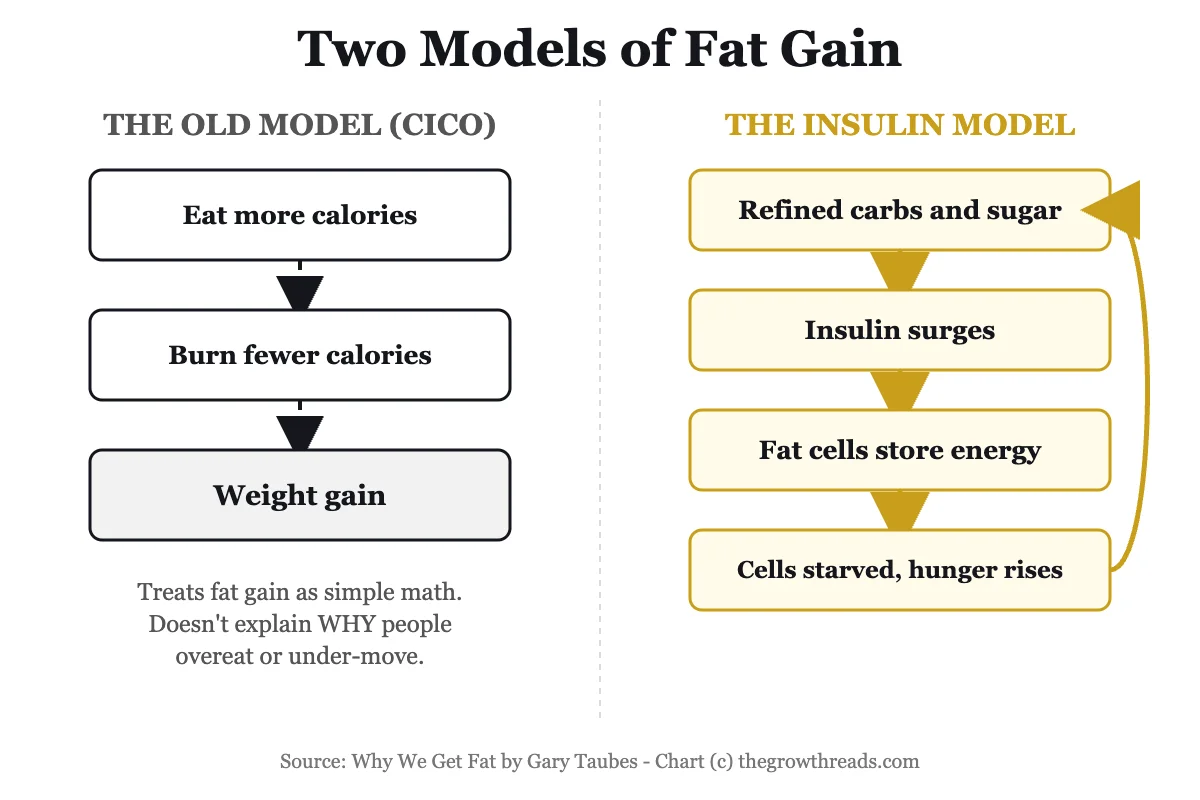
You are not fat because you lack willpower — you are fat because your hormones, not your math, decide where your food energy goes. Gary Taubes spends Why We Get Fat dismantling the “calories in, calories out” (CICO) model of weight gain and replacing it with a hormonal one: refined carbohydrates and sugar spike insulin, insulin tells fat cells to store fuel instead of release it, and the resulting cellular hunger drives you to eat more of exactly the foods that started the cycle. It is a shorter, more accessible distillation of the argument Taubes first made in Good Calories, Bad Calories, built for readers who want the case for cutting refined carbs without wading through 600 pages of citations.
Key takeaways
- CICO is a tautology, not a cause: “eat less than you burn” is true by definition but never explains why some people overeat or under-move in the first place.
- Fat tissue is hormonally regulated: insulin is the primary signal that tells fat cells to store energy rather than release it.
- Refined carbs and sugar trigger the most insulin: which makes them the most fattening foods per calorie, not dietary fat.
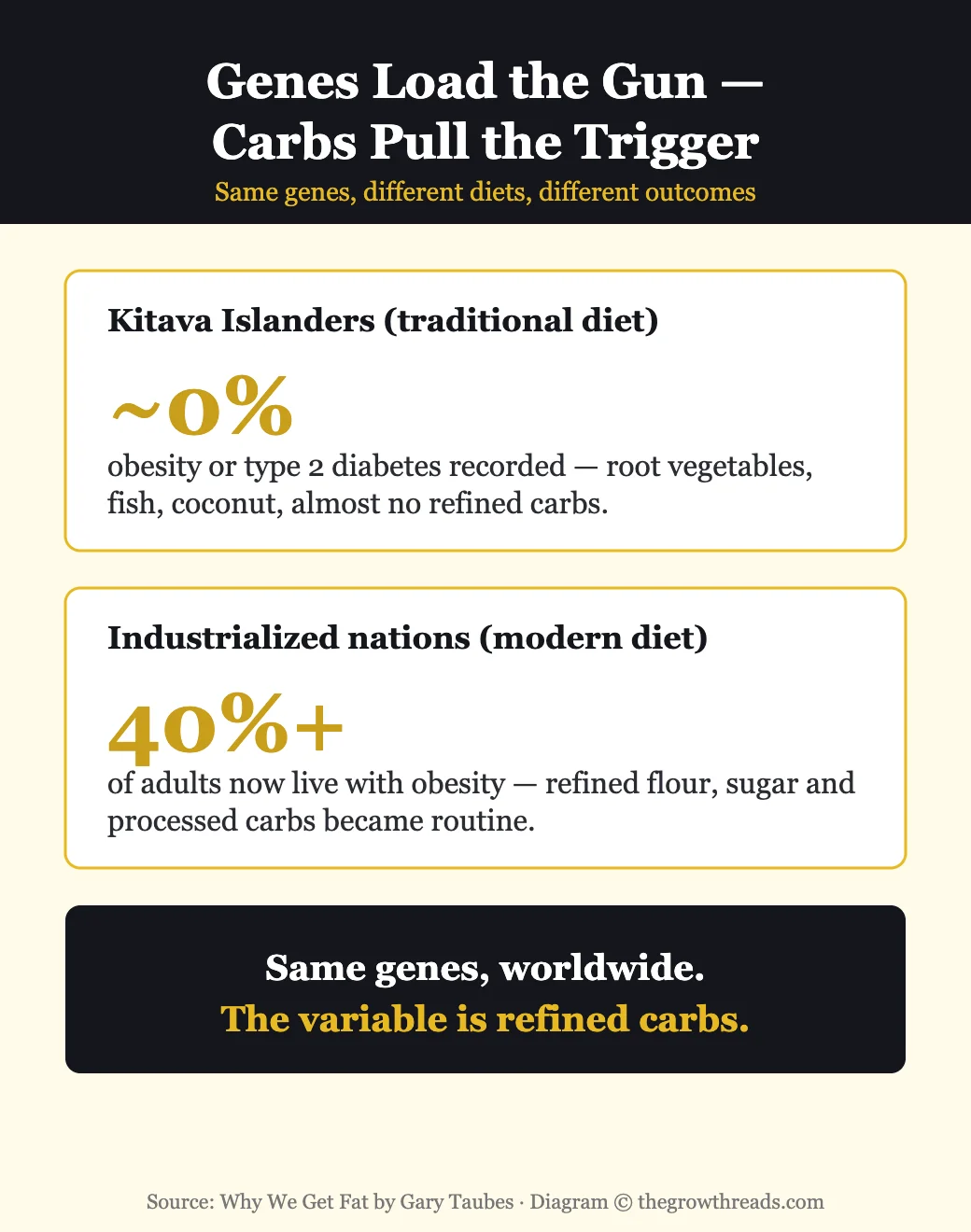
- Genes load the gun, carbohydrate quality pulls the trigger: genetics explain who is prone to gain fat, not why entire populations got fatter after 1980.
- Exercise burns surprisingly few net calories: and it often increases hunger, which is why it is an unreliable weight-loss lever on its own.
- “Just eat less” fails long-term: because hunger is hormonally driven, and the body actively defends its fat stores against conscious restriction.
- Traditional low-carb populations stayed lean: Kitava islanders and pre-war Pima Indians ate plenty of food and some fat, but almost no refined carbohydrate — and had negligible obesity.
- Insulin resistance builds for years before weight gain is visible: making early carbohydrate quality a bigger lever than late-stage calorie cutting.
- Obesity behaves like a growth disorder, not a math problem: fat accumulates the way a tumor or edema does — driven by regulation, not intention.
- The practical fix is simple to state: cut sugar and refined starch, stop fearing dietary fat, and stop counting calories.
What is Why We Get Fat about?
Why We Get Fat argues that obesity is caused by hormonal fat regulation, not overeating or laziness. Refined carbohydrates and sugar spike insulin, which directs fat cells to store energy rather than release it, driving both fat gain and the hunger that keeps the cycle going.
About the author
Gary Taubes is an award-winning science and health journalist and cofounder of the Nutrition Science Initiative (NuSI), a nonprofit that funds rigorous obesity and metabolism research. A former staff writer for Discover and correspondent for the journal Science, he has written for The New York Times Magazine, The Atlantic, and Esquire, and has received three Science in Society Journalism Awards from the National Association of Science Writers. Why We Get Fat (2010) distills the argument he first built at length in Good Calories, Bad Calories (2007); he later expanded the sugar-specific case in The Case Against Sugar (2016). He lives in Oakland, California. Explore all Gary Taubes book summaries →
Key concepts at a glance
| Concept | What it means | Use it when |
|---|---|---|
| Calories-in, calories-out (CICO) | The idea that weight change is simply energy intake minus energy expenditure. | Explaining why plain calorie math doesn’t predict who gains or loses fat. |
| Insulin | The hormone that signals fat cells to store or release fuel. | Deciding which foods are most likely to trigger fat storage. |
| Carbohydrate-insulin hypothesis | Refined carbs → insulin surge → fat accumulation, ahead of any calorie count. | Framing a diet strategy around food quality, not quantity. |
| Adipose tissue regulation | Fat cells actively store and release energy under hormonal control, not passively. | Understanding why hunger and satiety don’t respond to willpower alone. |
| Insulin resistance | Cells stop responding normally to insulin, worsening fat storage over time. | Recognizing early metabolic risk factors, years before visible weight gain. |
| Kitava and Pima populations | Traditional, low-refined-carb diets that produced negligible obesity despite adequate food and fat intake. | Citing real-world evidence for the hypothesis. |
| Energy expenditure compensation | The body offsets exercise calories by cutting other activity or raising hunger. | Understanding why exercise alone rarely produces large weight loss. |
| Macronutrient partitioning | Hormones route nutrients to fat versus muscle tissue — “a calorie isn’t a calorie.” | Understanding why food quality changes outcomes at equal calorie counts. |
Part 1: The calories-in-calories-out myth
The conventional wisdom is thermodynamically true and practically useless: yes, weight change equals energy in minus energy out, in the same way that “you’re in debt because you spent more than you earned” is true of anyone in debt. Taubes’ complaint isn’t with the arithmetic — it’s that CICO never explains the mechanism. Why do some people unconsciously eat more or move less than others at the same body weight? Conventional advice answers with willpower and gluttony. Taubes answers with hormones.
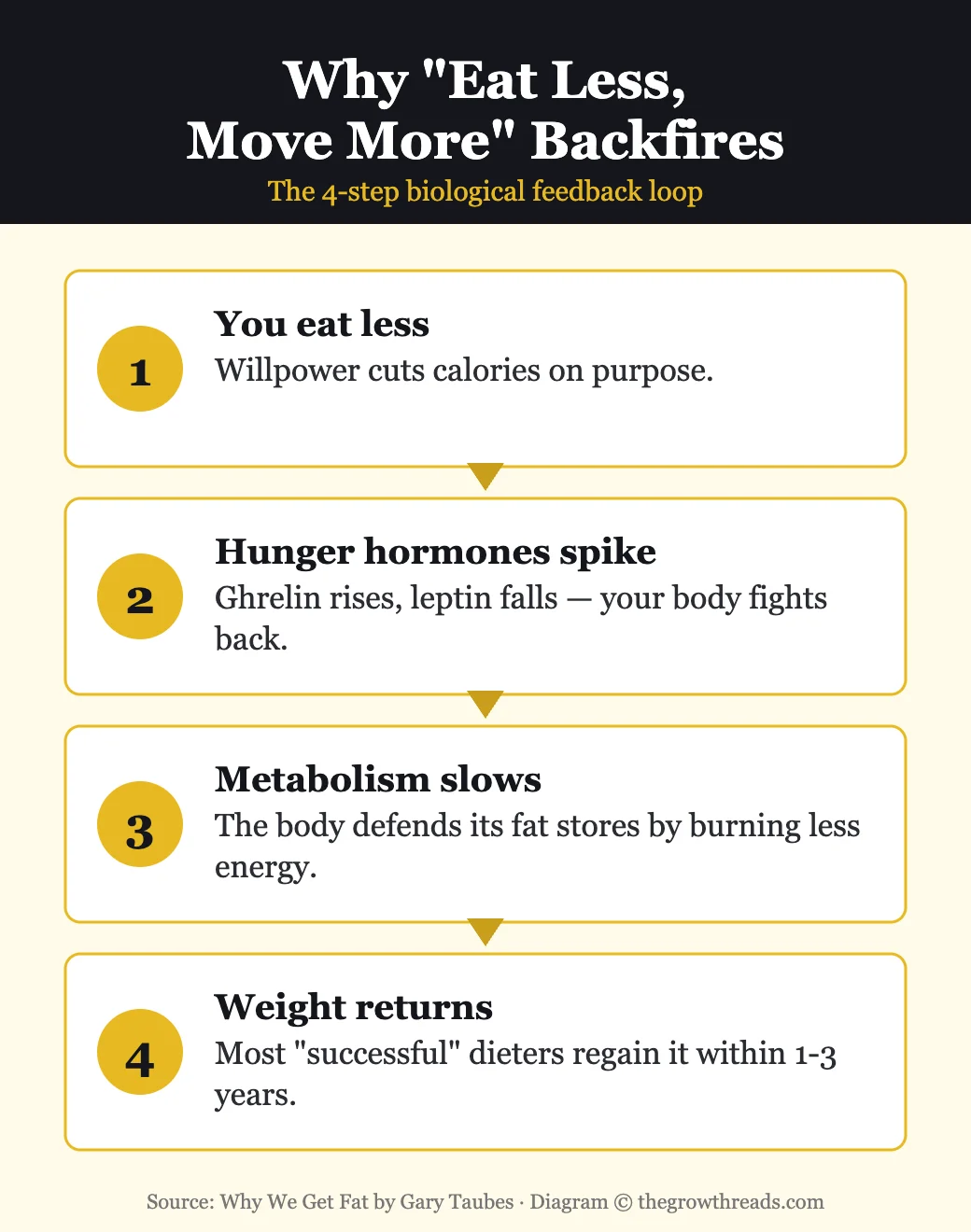
He walks through decades of controlled feeding studies and clinical trials showing that “eat less, move more” advice produces short-term loss and long-term regain in the overwhelming majority of dieters — not because people quietly cheat, but because the body actively resists the deficit. Hunger hormones like ghrelin rise, satiety hormones like leptin fall, and resting metabolic rate drops to defend the fat mass the body is used to carrying. The failure isn’t a character flaw; it’s a predictable physiological response that conventional weight-loss advice rarely accounts for.
TGR Note: Jason Fung reaches the same hormonal conclusion from a clinical, fasting-focused angle in our The Obesity Code summary — read the two together and the “insulin drives storage” thesis stops looking like a fringe idea and starts looking like a consensus among metabolism-focused physicians.
Part 2: The carbohydrate-insulin hypothesis
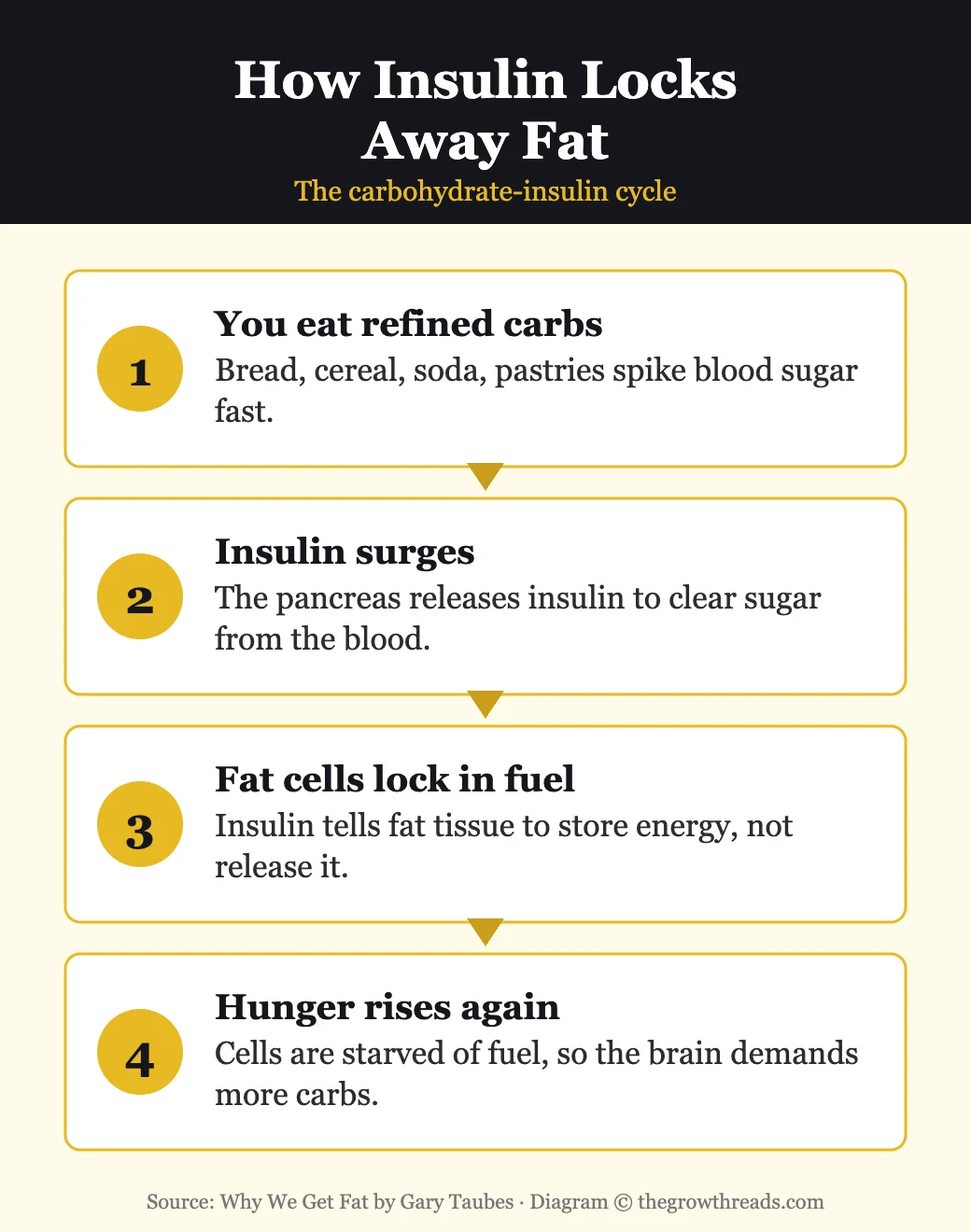
Here is the alternative model. Adipose (fat) tissue is not a passive storage bin — it is an actively regulated organ, and insulin is its primary control signal. When insulin is high, fat cells are instructed to pull in and lock away fatty acids; when insulin is low, they release fuel for the body to burn. Refined carbohydrates and sugars produce, by far, the largest and fastest insulin response of any macronutrient category, which is why Taubes singles them out rather than blaming “overeating” in general.
The cycle compounds: chronically elevated insulin keeps shuttling fuel into fat cells, starving muscle and other tissues of usable energy even as the body is, by any objective measure, over-fed. That cellular starvation signal is what registers in the brain as hunger — not a failure of discipline, but a hormonally accurate (if unhelpful) report that your cells aren’t getting the fuel that’s sitting, locked away, in your fat tissue.
TGR Note: If the biology here feels abstract, our Glucose Revolution summary is the practical companion — simple sequencing tricks (fiber first, vinegar before carbs, a walk after meals) that blunt the exact insulin spikes Taubes is describing, without requiring you to overhaul your whole diet at once.
Part 3: Debunking exercise, genetics, and willpower myths
Taubes takes aim at three sacred cows. First, exercise: controlled studies repeatedly show that increased physical activity produces far smaller weight loss than the “calories burned” number on a treadmill display implies, largely because the body compensates by moving less elsewhere in the day and by increasing appetite. Exercise has real benefits — cardiovascular health, mood, longevity — but reliable fat loss on its own isn’t reliably one of them.
Second, genetics: twin and adoption studies confirm that some people are more prone to fat gain than others at identical calorie intakes. But genetic predisposition can’t explain why obesity rates roughly tripled in most industrialized countries after 1980 — human genomes don’t change that fast. Genes decide who is most vulnerable; the environment (specifically, the flood of refined carbohydrates into the food supply) decides how often that vulnerability gets triggered.
Third, willpower: framing weight as a discipline problem blames people for a hormonal response they don’t consciously control, and it sets up the same failure loop covered in Part 1. Taubes’ point isn’t that effort is irrelevant — it’s that effort aimed at the wrong lever (calorie counting) will keep failing regardless of how much willpower is applied.
TGR Note: For the flip side of the exercise argument — what movement is actually good for, if not weight loss — see our Spark summary. Taubes would agree with its core claim: exercise is worth doing for your brain and mood, just don’t expect it to substitute for fixing what’s on your plate.
Part 4: What to do about it
The second half of the book turns practical. Taubes’ prescription is unglamorous but specific: eliminate sugar and refined grains (white bread, white rice, most breakfast cereal, anything with added sugar), stop treating dietary fat as the enemy, eat protein and vegetables to satiety, and — this is the part that surprises calorie-counting veterans — stop counting calories entirely. If insulin, not arithmetic, is the fat-storage switch, then obsessing over calorie totals distracts from the one variable that actually moves the needle: carbohydrate quality.
He’s careful to note this isn’t a call to eat unlimited food. Removing the insulin trigger tends to normalize appetite on its own, so most readers find satiety arrives sooner without deliberate restriction — the opposite of the willpower-depleting deficit CICO advice demands.
TGR Note: For a broader whole-foods framework that complements Taubes’ carb-focused rule of thumb, our In Defense of Food summary distills Michael Pollan’s “eat food, not too much, mostly plants” into the same kind of simple, sustainable heuristic — useful once you’ve cut the refined carbs and want a plan for what to eat instead.
Who is Why We Get Fat best for — and who should read something else first?
Why We Get Fat is best for readers who have already tried calorie counting or “eat less, move more” and want the physiological explanation for why it stalled — plus a low-carb-curious starting point that doesn’t require tracking a single number. It’s also a good fit if you want the condensed, 288-page version of an argument before committing to the denser Good Calories, Bad Calories.
If you want a gentler, more clinically-framed entry point to the same hormonal model, start with The Obesity Code instead. If you’re not ready for a carb-focused framework at all and just want a sane, whole-foods baseline, In Defense of Food is the calmer starting point.
Questions to reflect on
- Where do refined carbs and added sugars show up in your current diet without you really noticing them?
- Have you tried “eat less, move more” before — what happened to your weight and hunger in the months after?
- What would change about how you talk to yourself if you treated hunger as a hormonal signal rather than a willpower failure?
- Which traditional low-carb population’s story — Kitava, the pre-war Pima — resonates most with your own eating patterns or family history?
- What’s one refined-carb swap you could make this week without overhauling your entire diet at once?
🔥 Ready to stop fighting your hunger hormones?
Get Why We Get Fat and see exactly which foods are spiking your insulin — and what to eat instead.
How to apply Why We Get Fat (7-day plan)
- Day 1 — Audit: Walk your kitchen and fridge and flag every refined carb hiding in your routine: bread, cereal, soda, pastries, sauces with added sugar.
- Day 2 — One swap: Replace one refined-carb meal with a plate built around protein, vegetables, and a healthy fat.
- Day 3 — Cut liquid sugar first: Drop soda, juice, and sweetened coffee drinks — the fastest, largest insulin spikes come from sugar you drink, not eat.
- Day 4 — Read the genetics chapter: Revisit Part 3 above and note your own family’s weight and diet patterns against the “genes load the gun” framing.
- Day 5 — Skip the calorie count: Eat to satiety on lower-refined-carb meals for one full day without tracking a single number.
- Day 6 — Decouple movement from guilt: Take a walk or do light activity purely because it feels good, not to “earn” or “burn off” food.
- Day 7 — Review and commit: Note which refined-carb swap was easiest to sustain, and make that one change permanent before adding another.
Frequently asked questions
What is the main argument of Why We Get Fat?
Taubes argues that obesity is caused by a hormonal disorder of fat regulation, not by eating too much or moving too little. Refined carbohydrates and sugar trigger large insulin responses, and insulin signals fat cells to store energy rather than release it. That storage, in turn, starves other tissues of usable fuel and drives the hunger that keeps people eating the same carbohydrate-heavy foods. The practical implication is that cutting refined carbs — not counting calories — is the more effective lever for most people trying to lose fat.
Is the carbohydrate-insulin hypothesis scientifically accepted?
It’s a genuinely debated hypothesis rather than settled consensus. Some controlled feeding studies have supported reduced insulin secretion improving fat loss outcomes on low-carb diets, while others find similar weight loss across diets matched for calories and protein regardless of carb content. Taubes’ broader framework is more accepted among low-carb-focused clinicians than among mainstream dietetics bodies. The practical advice — reduce refined carbs and sugar — is uncontroversial even among critics of the strong version of his hypothesis.
Does Gary Taubes say all carbs are bad?
No. The book’s target is specifically refined carbohydrates and sugar — white bread, white rice, breakfast cereal, pastries, and sweetened drinks — because these produce the sharpest insulin spikes per calorie. Taubes doesn’t build his case around fibrous vegetables, legumes, or whole fruit, which digest more slowly and provoke a smaller insulin response. The distinction is refinement and speed of digestion, not “carbohydrate” as a single blanket category.
How is this different from a typical low-carb diet book?
Most low-carb diet books lead with a meal plan or recipes. Why We Get Fat leads with the physiology — why CICO fails, how insulin regulates fat tissue, what twin studies actually show about genetics — and only turns practical in the final chapters. It reads more like an argument you’d make to a skeptical friend than a cookbook, which is exactly the audience it’s aimed at: people who want to understand the “why” before changing what’s on their plate.
Does exercise matter at all according to Taubes?
Yes, but not primarily as a weight-loss tool. Taubes cites research showing the body often compensates for exercise-related calorie burn by moving less at other points in the day or by increasing appetite, which blunts net fat loss. He doesn’t argue against exercise — its cardiovascular, mood, and longevity benefits stand on their own — he argues against relying on it as the primary lever for shedding fat.
Is Why We Get Fat based on Good Calories, Bad Calories?
Yes. Good Calories, Bad Calories (2007) is Taubes’ dense, heavily-cited 600-page case for the same carbohydrate-insulin hypothesis, aimed at researchers and serious nonfiction readers. Why We Get Fat (2010) is his own shorter, more accessible distillation of that argument for a general audience, with a practical “what to do about it” section the earlier book didn’t include. Readers who want the full scientific case should go to the 2007 book; readers who want the readable version should start here.
What should I eat after reading this book?
Taubes’ practical suggestion is straightforward: cut sugar and refined starches (white bread, white rice, cereal, pastries, sweetened drinks), don’t restrict dietary fat, eat adequate protein and non-starchy vegetables, and eat to satiety rather than counting calories. This isn’t medical advice — if you have diabetes, are on medication affected by diet, or have another health condition, check with a doctor or dietitian before making a major dietary change.
Related summaries
- The Obesity Code Summary & Review — Jason Fung’s clinical case for the same hormonal-obesity model, with a fasting-focused protocol.
- The Diabetes Code Summary & Review — how insulin resistance progresses toward type 2 diabetes, and how to reverse it.
- Glucose Revolution Summary & Review — simple, practical sequencing hacks to blunt the exact insulin spikes this book describes.
- In Defense of Food Summary & Review — a calmer, whole-foods framework for what to eat once the refined carbs are gone.
See our full best health books list for more titles in this silo.
How we analyze books: We read the full text, cross-check key claims and statistics against the author’s cited sources and subsequent research, and build practical application plans rather than critiques. Read our full methodology.