

⭐⭐⭐⭐✦ 4.5 / 5 — A masterclass in people-first leadership from the coach behind Apple, Google, and Intuit.
Best for: Managers and senior leaders who want to become better coaches and build high-trust teams.
Reading time: ~4 hours (240 pages)
Difficulty to apply: Medium — the principles are simple but require sustained daily practice.
Trillion Dollar Coach in one minute
The best leaders don’t just manage — they coach. Trillion Dollar Coach tells the story of Bill Campbell, an unassuming former football coach who became the behind-the-scenes advisor to Steve Jobs, Larry Page, Eric Schmidt, and dozens of other Silicon Valley titans. His secret was deceptively simple: build trust, put the team first, care about people as human beings, and create a culture where honest feedback flows freely. Campbell never wrote a line of code or built a product, yet his coaching shaped companies worth over a trillion dollars combined. This book distills his principles into a playbook any leader can use — whether you run a startup or manage a team of three.
Key takeaways
- Only coach the coachable: The people who benefit most from coaching are honest, humble, and willing to put the team first. Don’t waste energy on those who refuse feedback.
- Trust is the foundation of everything: Bill built deep trust with every person he coached. Without psychological safety, no amount of strategy will save a team.
- Work the team, not the problem: When facing a tough decision, most leaders focus on the problem. Bill focused on getting the right people aligned first — the answer follows.
- Practice free-form listening: Great coaches listen with full attention, ask the right question at the right moment, and resist the urge to jump in with solutions.
- Run crisp meetings: Bill believed operational excellence starts with well-run staff meetings — trip reports, metrics reviews, and tackling the top one or two issues head-on.
- Peer relationships matter more than hierarchy: Bill championed peer feedback and cross-functional pairing, knowing that lateral trust is what holds organizations together.
- Fill the gaps between people: A coach’s job is to spot the tensions and misunderstandings that fester between teammates and resolve them before they become toxic.
- Lead with love: Bill hugged people. He remembered birthdays. He showed up at hospitals. Caring about people beyond their work performance is not soft — it is the hardest and most important part of leadership.
- Build community deliberately: Campbell organized team trips, social events, and rituals that turned coworkers into a community. High-performing teams need shared identity.
- Your title makes you a manager; your people make you a leader: Authority comes from influence, not position. Earn it daily by supporting the people around you.
What is Trillion Dollar Coach about?
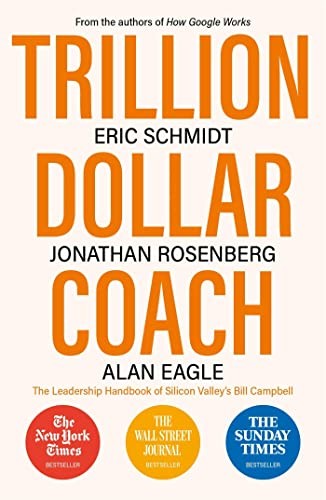
Trillion Dollar Coach chronicles the coaching philosophy and practical methods of Bill Campbell, a former Columbia University football coach who became the most influential executive advisor in Silicon Valley. Written by three people he coached — Eric Schmidt, Jonathan Rosenberg, and Alan Eagle — the book distills Campbell’s approach to building trust, running teams, and leading with genuine care for people into an actionable leadership playbook.
About the author
Eric Schmidt served as CEO and executive chairman of Google. Jonathan Rosenberg was SVP of Products at Google. Alan Eagle has worked at Google since 2007 as a director of executive communications. The three wrote this book as a tribute to their mentor, Bill Campbell, who passed away in 2016. They conducted over 80 interviews with Campbell’s friends, colleagues, and mentees — including Tim Cook, Sundar Pichai, Sheryl Sandberg, and Ben Horowitz — to reconstruct his coaching methods. The result is part biography, part leadership manual, and entirely rooted in firsthand experience. Explore all Eric Schmidt book summaries →
Key concepts at a glance
| Concept | What it means | Use it when |
|---|---|---|
| Only coach the coachable | Focus coaching on people who are honest, humble, and team-first | Deciding where to invest your mentoring time |
| Work the team, not the problem | Get the right people aligned before trying to solve the issue | Facing a complex cross-functional challenge |
| Free-form listening | Listen fully without an agenda, then ask the one right question | 1:1 meetings and coaching conversations |
| Trip reports | Start meetings with personal stories to build human connection | Running staff meetings or team check-ins |
| Fill the gaps | Spot and repair tensions between team members proactively | Noticing friction or silos forming |
| Peer feedback loops | Encourage honest lateral feedback rather than top-down reviews only | Building a high-trust team culture |
| The envelope of trust | Create safety so people can take risks and speak openly | Onboarding new team members or rebuilding morale |
| Decisive leadership | When the team cannot reach consensus, the leader must decide | Debates are going in circles |
Part 1 — The Caddie and the CEO
Bill Campbell grew up in Homestead, Pennsylvania, a steel town south of Pittsburgh. He played football at Columbia University and later coached the team, compiling a modest record but earning a reputation for inspiring fierce loyalty from his players. When he moved to Silicon Valley in the 1980s, first at Apple under John Sculley and then as CEO of Intuit, he brought the same coaching mindset to business.
The authors describe how Campbell’s football background shaped his management philosophy. He saw every company as a team, every executive as a player who needed clear expectations and honest feedback, and every meeting as a chance to build cohesion. His coaching wasn’t about Xs and Os — it was about understanding what motivated each person and removing the barriers in their way.
Campbell’s first principle was deceptively demanding: only coach the coachable. He looked for people who were honest about their weaknesses, humble enough to accept help, and willing to put the team above their ego. If someone lacked those traits, Campbell wouldn’t waste time trying to change them. He would invest his energy where it could compound.
This selectivity is counterintuitive for most leaders, who feel obligated to develop everyone equally. But Campbell understood a deep truth about coaching: it only works when the person being coached is an active participant. You cannot push someone uphill if they are determined to sit down.
Part 2 — Your title makes you a manager; your people make you a leader
Campbell believed that management was a distinct and noble craft — not a stepping stone to something more glamorous. He often reminded the executives he coached that their most important job was to help their people grow, succeed, and feel supported. “Your title makes you a manager,” he would say. “Your people make you a leader.”
The practical expression of this belief was Campbell’s approach to 1:1 meetings. He had a consistent framework: start by asking about life outside work. Then talk about performance — not in vague terms, but against specific goals. Address peer relationships: who is the person working well with, and where is friction building? Finally, discuss leadership development and stretch opportunities.
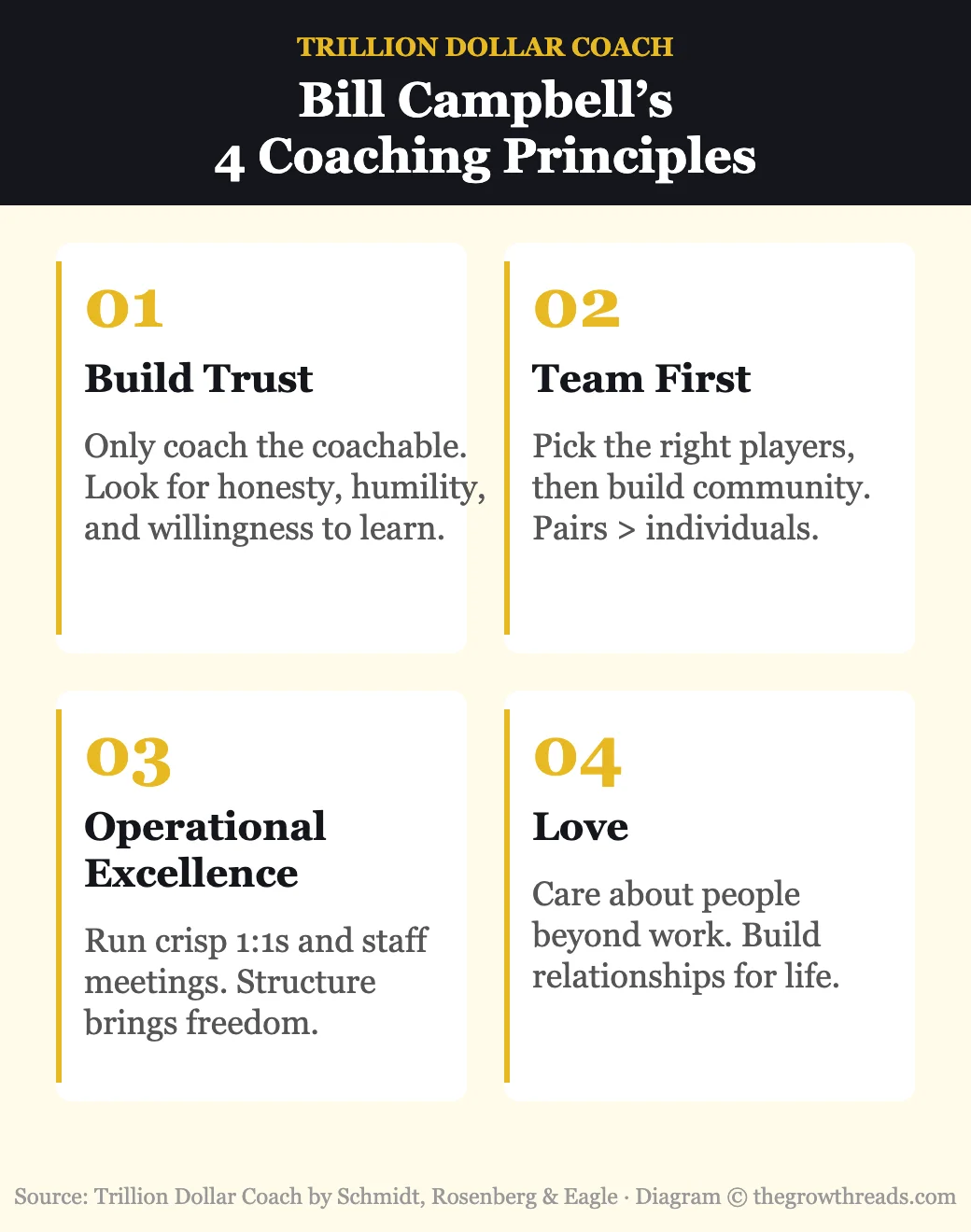
Campbell’s 1:1 format was not a template he imposed — it was a philosophy. The point was to show that you cared about the whole person, not just their output. He believed that when people felt genuinely supported, they brought their best work. When they felt like replaceable cogs, they protected themselves instead of taking risks.
He also championed what the authors call free-form listening — the discipline of listening without an agenda, letting the other person talk until the real issue surfaces, and then asking one sharp question that reframes the conversation. Most managers listen while composing their response. Campbell listened to understand.
Part 3 — Build an envelope of trust
Trust was the single word Campbell returned to more than any other. He called it “the envelope of trust” — a container of psychological safety that allows people to be vulnerable, take risks, and speak honestly without fear of punishment.
Building that trust was not abstract. Campbell did it through consistent, concrete behaviors. He kept confidences absolutely — if you told Bill something in private, it stayed private. He gave feedback that was brutally honest but delivered with genuine care. He showed up reliably: if he said he would be at your product review, he was there. And he demonstrated vulnerability himself, admitting his own mistakes and uncertainties.
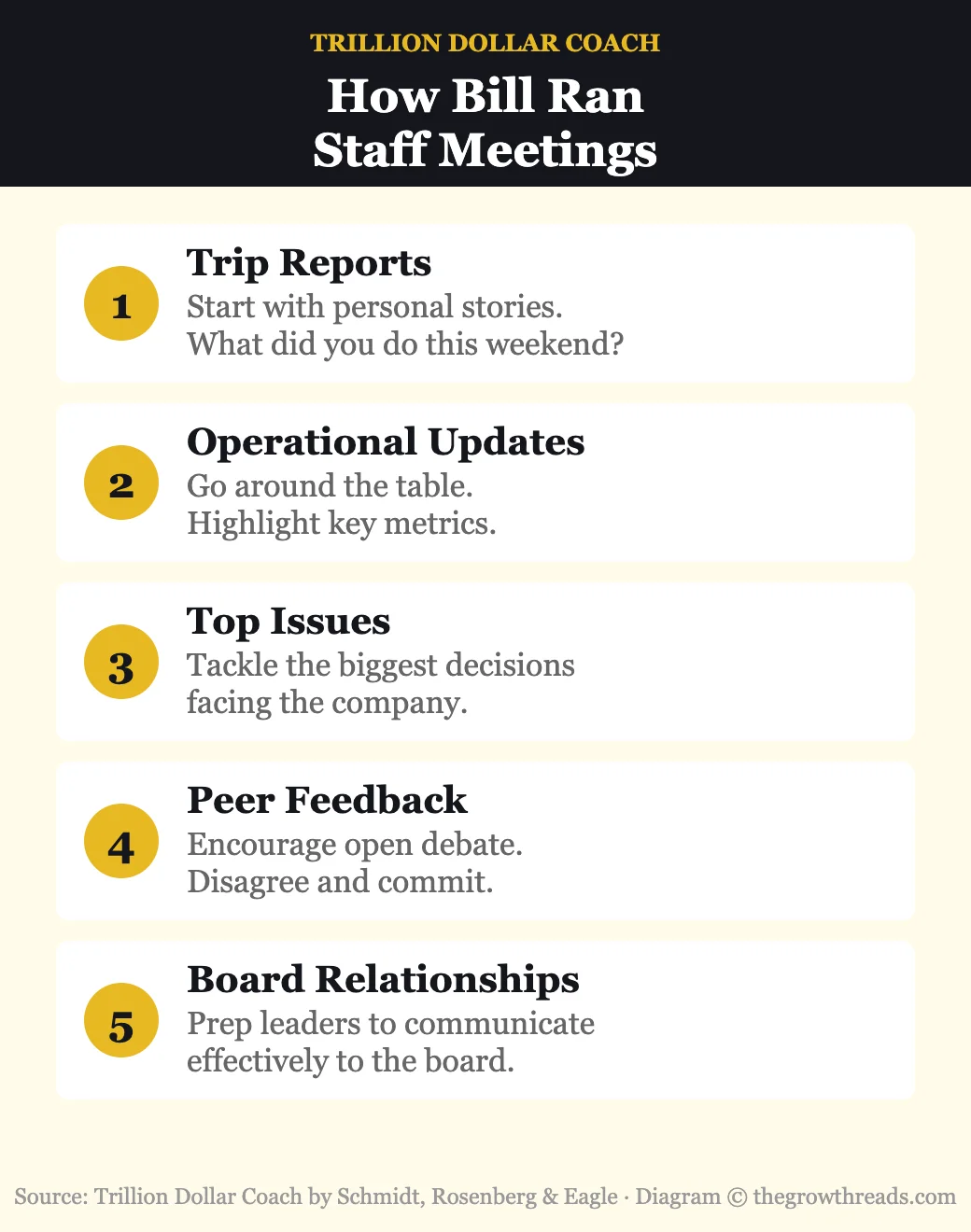
The authors describe Campbell’s approach to staff meetings as a masterclass in operational trust. He insisted on trip reports — brief personal updates at the start of every meeting. What did you do this weekend? How are your kids? The purpose was not small talk. It was a deliberate ritual to remind everyone that they were people first and colleagues second.
After trip reports came operational updates from each function, then the real work: identifying the top one or two issues facing the company and debating them openly. Campbell’s role was to ensure the debate stayed productive. He would let tensions surface, encourage dissenting views, and then — when the room could not reach consensus — step in and say, “Here is what we’re going to do.” Decisive leadership, in his view, was not about being right. It was about preventing paralysis.
Part 4 — Team first, love always
The final section of the book addresses Campbell’s most distinctive — and most frequently underestimated — leadership trait: love. Not sentimental love, but active, practical love expressed through daily actions. He hugged people. He remembered the names of their children. When someone was sick, he visited the hospital. When someone was struggling, he called every day until things improved.
Campbell believed that building community was a core leadership responsibility, not a nice-to-have. He organized team dinners, off-sites, and informal gatherings with the same seriousness that most executives reserve for board meetings. These weren’t optional social events — they were deliberate investments in team cohesion.
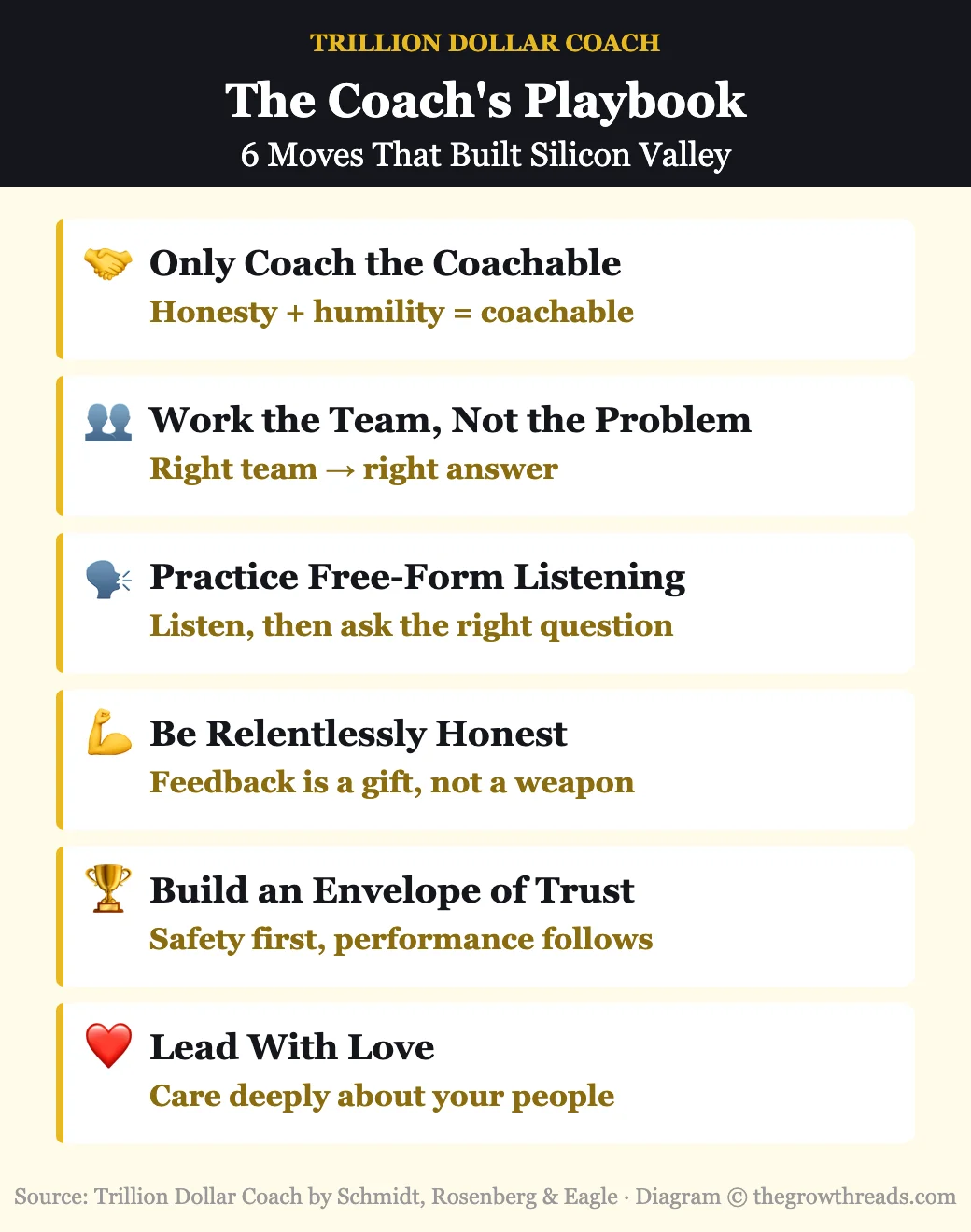
His approach to team dynamics was captured in a phrase the authors repeat throughout the book: work the team, not the problem. When a difficult issue arose, most leaders would dive straight into the substance — analyzing data, debating options, seeking the optimal solution. Campbell would step back and ask: Do we have the right people in the room? Are they aligned? Is there unresolved tension between any of them? He believed that if you got the team dynamics right, the team would find the right answer.
One of Campbell’s most powerful practices was what the authors call filling the gaps — proactively spotting the tensions, misunderstandings, and resentments that build up between team members and addressing them before they became toxic. He would walk the halls, have quiet conversations, and then bring the two parties together for a direct discussion. Most organizations let these gaps fester until they explode. Campbell treated them as routine maintenance.
Who is Trillion Dollar Coach best for — and who should read something else first?
Trillion Dollar Coach is ideal for managers who already understand the basics of leadership and want to see what extraordinary coaching looks like in practice. It is especially valuable for leaders who are technically strong but struggle with the people side — the 1:1s that feel awkward, the team dynamics they ignore, the feedback they avoid giving.
If you are brand new to management and want a structured framework to start with, read The Making of a Manager by Julie Zhuo first. If you want a deeper dive into feedback specifically, start with Radical Candor. Then come back to Trillion Dollar Coach to see these principles embodied in one person’s life.
Questions to reflect on
- Are you investing your coaching energy in people who are genuinely coachable — or trying to change people who have already decided not to listen?
- When was the last time you asked a direct report about their life outside work with genuine curiosity?
- Do your staff meetings start with human connection or jump straight into metrics?
- Where are the gaps in your team right now — the unspoken tensions you have been avoiding?
- If you were fired tomorrow, would your team say you made them better? What would need to change for the answer to be yes?
🔥 Ready to coach like Bill Campbell?
Get the playbook that shaped Apple, Google, and Intuit.
How to apply Trillion Dollar Coach (7-day plan)
- Day 1 — Audit your coachables: List every person you manage. Rate each on honesty, humility, and willingness to put the team first. Identify where to invest more coaching energy and where to step back.
- Day 2 — Redesign your 1:1 template: Add four sections to your next 1:1: life outside work, performance against goals, peer relationships, and growth opportunities. Use this structure for every 1:1 going forward.
- Day 3 — Add trip reports to your team meeting: Start your next staff meeting with a two-minute personal check-in from each person. Model it by going first — share something real about your weekend.
- Day 4 — Practice free-form listening: In your next three conversations, resist the urge to respond immediately. Listen until the other person finishes completely, pause for three seconds, then ask one question that reframes the issue.
- Day 5 — Fill one gap: Identify one tension between two team members. Have a quiet conversation with each person individually, then bring them together to discuss it directly with you as the facilitator.
- Day 6 — Build community: Schedule one informal team event in the next two weeks — a lunch, a walk, or a coffee hour with no agenda. The goal is connection, not productivity.
- Day 7 — Lead with love: Write a short, specific note of appreciation to three people on your team. Mention exactly what they did and why it mattered. Send it before the day ends.
Frequently asked questions
Is Trillion Dollar Coach worth reading?
Yes — especially if you manage people or aspire to. The book is short, well-written, and packed with actionable coaching principles drawn from Bill Campbell’s work with some of the most successful companies in history. Even experienced leaders will find at least two or three practices they can adopt immediately. The anecdotes from Google, Apple, and Intuit make abstract leadership concepts concrete and memorable.
Who was Bill Campbell?
Bill Campbell was a former Columbia University football coach who became one of Silicon Valley’s most influential executive advisors. He served as CEO of Intuit and then spent over two decades coaching leaders at Google, Apple, and dozens of other companies. He was trusted by Steve Jobs, Larry Page, and Eric Schmidt as a confidential sounding board. Campbell passed away in 2016 at age 75, and this book was written to preserve his coaching legacy.
What does “only coach the coachable” mean?
It means directing your coaching energy toward people who demonstrate three traits: honesty about their weaknesses, humility to accept help, and willingness to prioritize the team over their ego. Campbell believed coaching only works when the recipient actively wants to grow. People who resist feedback or refuse to acknowledge blind spots will not benefit from coaching no matter how skilled the coach is.
How long does it take to read Trillion Dollar Coach?
The book is approximately 240 pages and most readers finish it in three to four hours. The writing style is conversational and anecdote-driven, which makes it a fast read. Each chapter ends with a summary of key coaching principles, so you can also read it in short sessions and retain the main ideas. An audiobook version is available at just over five hours.
What is the “work the team, not the problem” principle?
This is Campbell’s most counterintuitive insight. When facing a difficult business challenge, most leaders immediately analyze the problem and propose solutions. Campbell’s approach was different — he would first ensure the right people were in the room, that they were aligned, and that there was no unresolved friction between them. His belief was that a well-functioning team will naturally arrive at the right answer if interpersonal dynamics are healthy.
How is Trillion Dollar Coach different from other leadership books?
Most leadership books are written by researchers or consultants presenting frameworks. This one is written by three people who were personally coached by Campbell for years, drawing on over 80 interviews with his mentees. The result reads more like a biography interleaved with practical lessons than a typical business book. The principles are grounded in specific, named situations at real companies rather than anonymous case studies or lab experiments.
Can I apply these coaching principles if I am not a CEO?
Absolutely. Campbell’s principles apply at every level of management. Starting 1:1s with personal check-ins, practicing free-form listening, filling gaps between team members, and leading with genuine care require no title or authority. First-time managers may actually find these habits easier to build because they have fewer ingrained patterns to unlearn. The 7-day application plan in this review is designed for any level.
Related summaries
If you enjoyed this summary, you might also find these helpful:
- Radical Candor Summary — Kim Scott’s framework for honest feedback, directly influenced by Bill Campbell.
- Leaders Eat Last Summary — Simon Sinek on why great leaders create safety for their teams.
- The Five Dysfunctions of a Team Summary — Patrick Lencioni’s model for building trust and healthy conflict.
- The Making of a Manager Summary — Julie Zhuo’s practical guide for first-time managers.
📚 Explore all Leadership summaries
This book is part of our best leadership books collection. Browse the full list for more actionable summaries on leading teams, building culture, and developing your management practice.
How we analyze books at The Growth Reads: We read every book cover to cover, cross-reference key claims with primary sources and peer-reviewed research, and distill each into an actionable summary you can apply in under 7 days. Our 5-criteria rating evaluates practical applicability, evidence quality, writing clarity, depth of insight, and lasting impact. Read our full methodology.