

⭐⭐⭐⭐ 4.1 / 5
One-liner: A passionate manifesto for leading movements by challenging the status quo and connecting like-minded people.
Best for: Entrepreneurs, change agents, and anyone who wants to lead without waiting for permission.
Reading time: ~3 hours (160 pages)
Difficulty to apply: Medium — the concepts are simple but require courage to act on.
Tribes in One Minute
You don’t need permission to lead. Seth Godin argues that a tribe is simply a group of people connected by a shared idea and a way to communicate — and that every one of us has the opportunity to lead one. The internet has removed the barriers that once made leadership the province of the powerful few: now anyone with a passion and a willingness to challenge the status quo can build a movement. The catch is that most people choose not to. They are what Godin calls “sheepwalkers” — people who do what they’re told and follow the factory model because it feels safe. Tribes is a call to become a heretic instead: someone who questions the accepted way, connects believers, and leads without waiting for a title or a mandate.
Key Takeaways
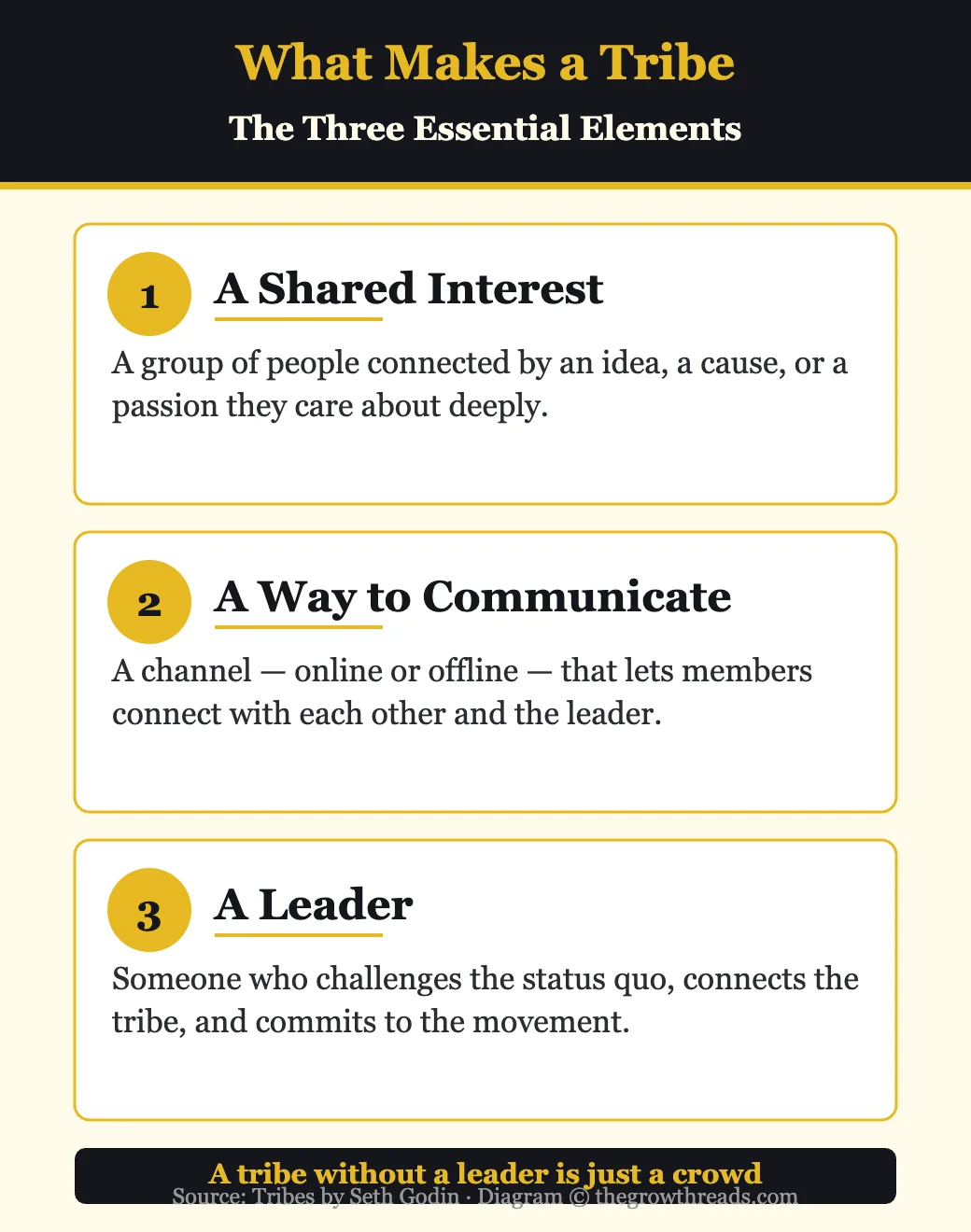
- A tribe needs only three things: A shared interest, a way to communicate, and a leader willing to connect and challenge.
- Leadership is not management: Managers maintain the status quo. Leaders challenge it and create movements.
- You don’t need permission: The biggest obstacle to leading is the belief that someone else has to give you authority first.
- Heretics drive progress: Every meaningful change begins with someone willing to say “this isn’t working” and offer a different path.
- Sheepwalking is the real risk: Following the crowd feels safe, but it guarantees mediocrity. The greater risk is never leading at all.
- The internet is your leverage: Technology has made it possible to find, connect, and lead tribes of any size — for free.
- Tight beats big: A small, passionate tribe is more powerful than a large, indifferent audience. Depth of connection matters more than reach.
- Leaders create culture: Shared language, rituals, values, and stories transform a loose group into a committed tribe.
- Fear is the gatekeeper: The resistance you feel before leading — fear of criticism, failure, or standing out — is the signal that you are about to do something that matters.
- Movements are everywhere: Every organization, community, and cause is a potential tribe waiting for someone brave enough to lead it.
What Is Tribes About?
Tribes argues that leadership is about creating and connecting movements — not managing people or processes. Seth Godin shows that anyone can build a tribe by finding like-minded people, challenging the status quo, and committing to a cause. The book is a short, passionate manifesto for leading without permission in the age of the internet.
About the Author
Seth Godin is one of the most influential marketing and leadership thinkers of the modern era. He has written over twenty bestselling books including Purple Cow, Linchpin, and This Is Marketing. He founded the altMBA (now Akimbo), launched Squidoo (later merged with HubPages), and was inducted into the Direct Marketing Hall of Fame. His daily blog — one of the most popular in the world — has been running for over two decades. Godin’s signature style combines big ideas with short, punchy prose designed to provoke action rather than passive agreement. Explore all Seth Godin book summaries →
Key Concepts at a Glance
| Concept | What It Means | Use It When |
|---|---|---|
| Tribe | A group connected by a shared idea, a communication channel, and a leader | You want to build a community around a cause or product |
| Heretic | Someone who challenges the accepted way and offers a different path | You see something broken and want to change it |
| Sheepwalker | Someone who follows the factory model — does what they are told because it feels safe | You notice you are complying out of fear rather than conviction |
| The factory | The industrial-age system that rewards compliance, predictability, and fitting in | You feel trapped by institutional norms that no longer serve their purpose |
| Movement | A tribe in motion — when shared passion becomes coordinated action for change | You want to go beyond community to create real impact |
| Status quo | The current state of things, maintained by inertia, fear, and the factory model | You need to name what you are challenging before people will follow |
Part 1: The End of the Factory — Why Tribes Matter Now
Godin opens by contrasting two models of work and leadership. The factory model — the dominant paradigm of the 20th century — rewards compliance, predictability, and fitting in. Workers are interchangeable parts in a machine, and managers exist to keep the machine running smoothly. In this model, leadership is unnecessary and even unwelcome because it disrupts the system.
The internet, Godin argues, has broken this model. Tools for communication, organization, and distribution are now essentially free. Anyone with a laptop and a passion can reach thousands of people who share their interest. The barriers to leading a tribe — which once included access to media, capital, and institutional power — have collapsed. What remains is the only barrier that ever truly mattered: the willingness to lead.
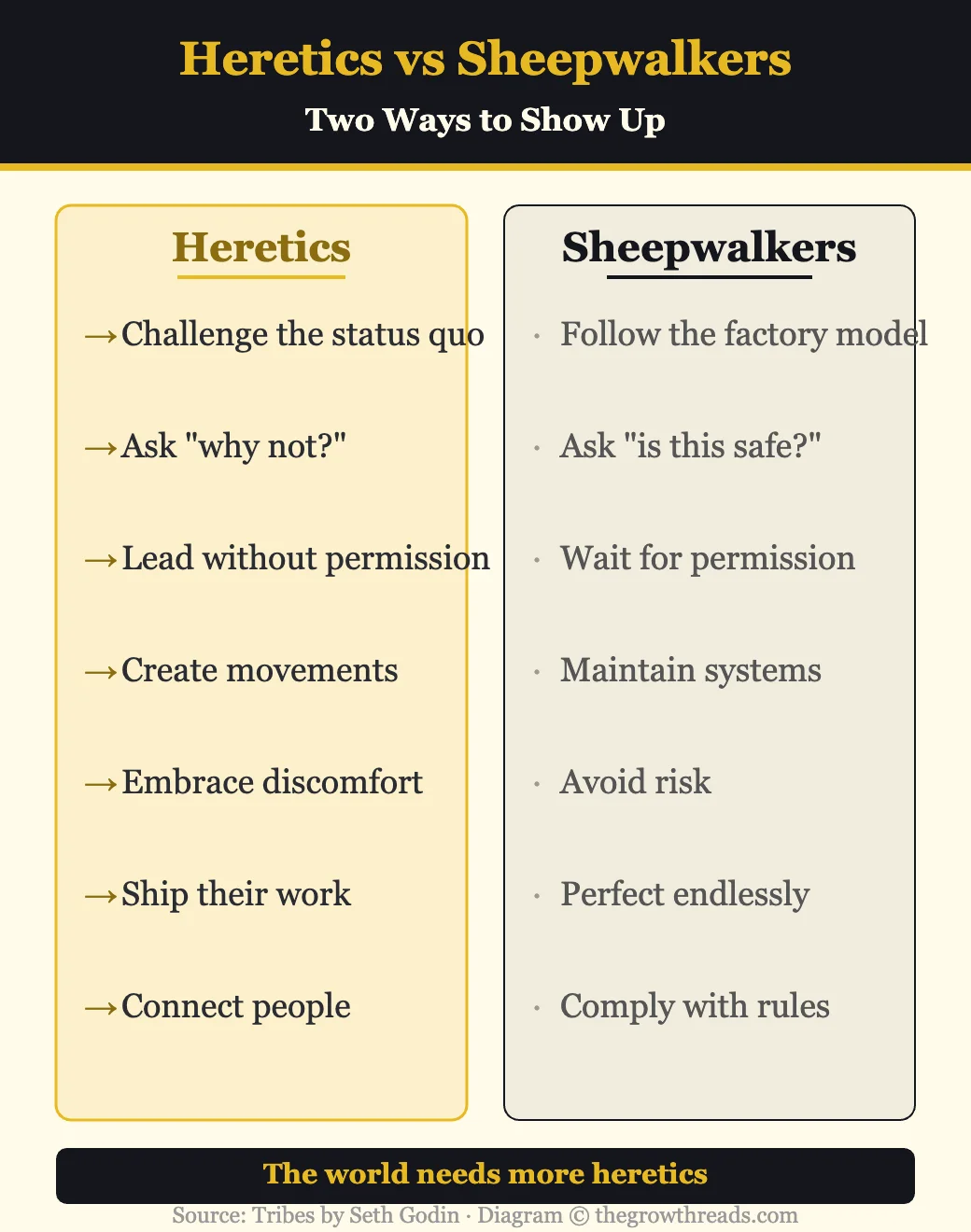
Godin introduces the concept of “sheepwalking” — going through the motions at work, following the rules, and avoiding any action that might attract attention or criticism. He argues that sheepwalking is not a personality type but a choice, reinforced by a system that punishes deviation. The first step toward leading a tribe is recognizing that you are sheepwalking — and deciding to stop.
Part 2: Heretics, Leaders, and the Courage to Stand Out
The heart of Tribes is Godin’s argument that heretics — not managers — are the people who change the world. A heretic is anyone who looks at the accepted way of doing things and says, “This isn’t working. Here’s a better way.” Every major movement, from civil rights to open-source software to organic food, was started by heretics who were willing to endure criticism, rejection, and ridicule.
Godin distinguishes between two types of leadership. Institutional leadership comes with a title, a budget, and the authority to give orders. Tribal leadership requires none of these. It comes from caring about something enough to stand up and say so — and then doing the work to connect others who care about the same thing.
The resistance to tribal leadership is almost entirely internal. Fear of failure, fear of criticism, fear of standing out — these are the forces that keep potential leaders sheepwalking through their careers. Godin argues that this fear is not a sign that you should stop; it is a sign that you are about to do something that matters. The discomfort is the compass.
Part 3: Building and Leading Your Tribe
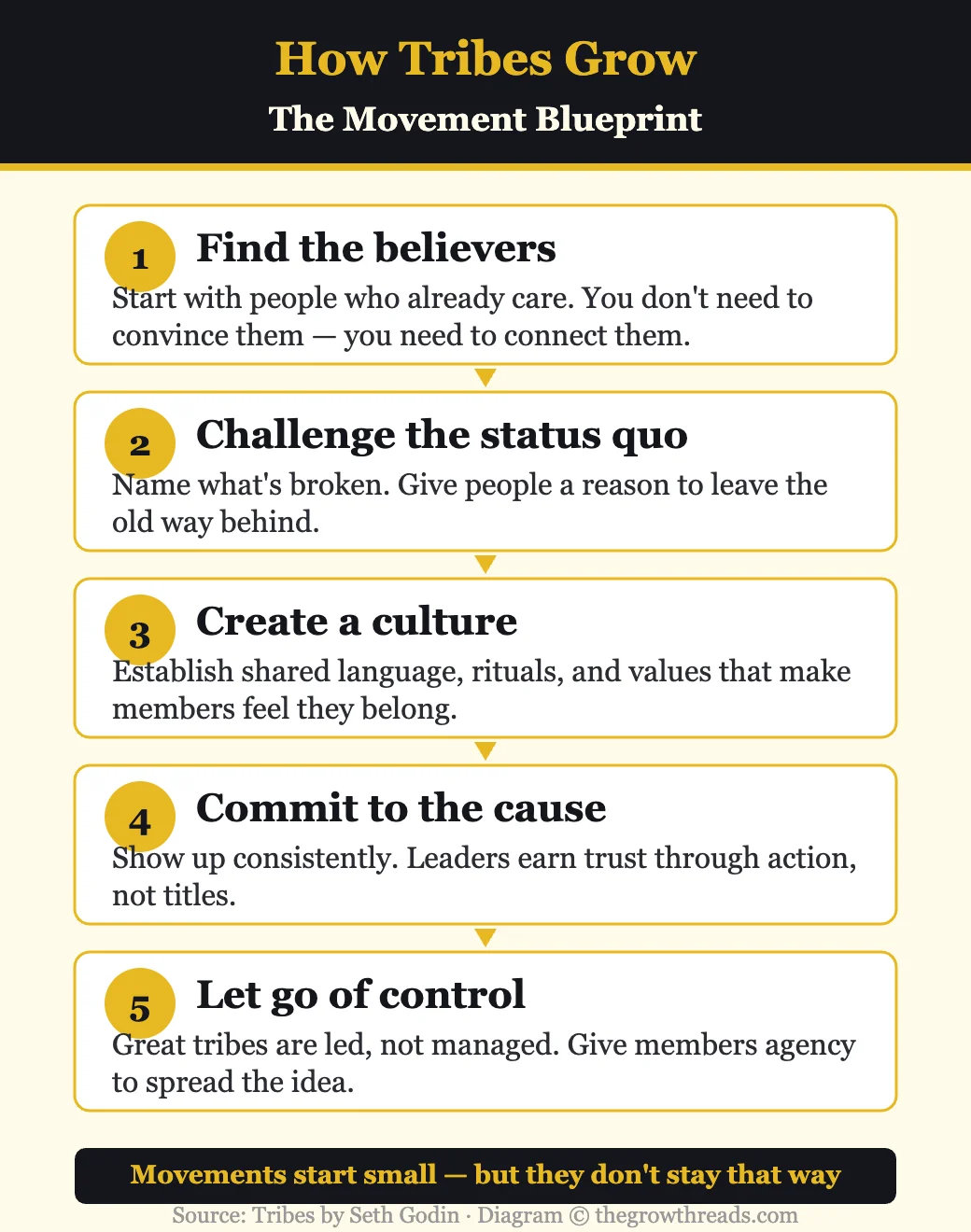
In the final section, Godin offers practical (if characteristically broad) guidance on building a tribe. The process begins not with recruitment but with finding people who already care. You do not need to create demand — you need to find it and connect it.
A tribe grows through five actions: challenge the status quo (name what’s broken), create a culture (shared language, rituals, and values), commit to the cause (show up consistently), curiosity (keep learning and evolving), and connection (bring members together and give them agency).
Godin emphasizes that tight beats big. A tribe of 1,000 passionate believers is more powerful than a mailing list of 100,000 passive subscribers. The goal is not reach — it is connection. And connection requires a leader willing to be generous, vulnerable, and persistent.
The book ends with a call to action that is essentially Godin’s career in miniature: the world is full of tribes waiting to be led. The only thing missing is you.
Who Is Tribes Best For — and Who Should Read Something Else First?
Tribes is perfect for entrepreneurs, community builders, nonprofit leaders, and anyone who feels the urge to lead but is held back by the belief that they need permission or a title. It is a short, energizing read that works best as a catalyst for action.
If you want more practical frameworks for building group culture, start with The Culture Code. If you are looking for a step-by-step guide to marketing your tribe, Godin’s own This Is Marketing is the natural follow-up. For the personal discipline required to ship your work, pair Tribes with The War of Art.
Questions to Reflect On
- Where in your life are you sheepwalking — going through the motions instead of leading?
- What cause, idea, or change do you care about enough to build a tribe around?
- What is the status quo you would challenge if you were not afraid of the consequences?
- Who are the people who already share your passion — and how could you connect them?
- What would you do today if you did not need anyone’s permission?
🔥 Ready to lead your tribe?
Discover why leadership is about movements — not management — and why you don’t need permission to start.
How to Apply Tribes (7-Day Plan)
- Day 1 — Name your tribe: Write down one idea, cause, or change you care deeply about. Define in one sentence who your tribe would be.
- Day 2 — Find the believers: Identify 5–10 people who already share this passion — friends, colleagues, online connections. Reach out to three of them today.
- Day 3 — Challenge the status quo: Write a short statement (3–5 sentences) explaining what is broken about the current way and what could be different.
- Day 4 — Create a channel: Set up one communication channel for your tribe: a group chat, newsletter, social account, or simple email list.
- Day 5 — Share your manifesto: Post or send your “what’s broken / what’s possible” statement to your tribe members. Invite responses.
- Day 6 — Lead by example: Take one visible action that embodies the change you are advocating. Show your tribe what commitment looks like.
- Day 7 — Let go and empower: Ask one tribe member to contribute — a post, an idea, an introduction. Begin shifting from solo leader to movement enabler.
Frequently Asked Questions
What is a tribe according to Seth Godin?
A tribe is a group of people connected to one another, connected to a leader, and connected to an idea. It requires only three things: a shared interest, a way to communicate, and a leader willing to challenge the status quo. Tribes have existed for thousands of years — what has changed is that the internet now makes it possible for anyone to find, connect, and lead one, regardless of geography, budget, or institutional authority.
What is a sheepwalker?
A sheepwalker is Godin’s term for someone who goes through the motions — following instructions, fitting in, and avoiding any action that might attract attention or criticism. Sheepwalking is the product of the factory model, which rewards compliance and punishes deviation. Godin argues that sheepwalking is not a personality trait but a choice, reinforced by fear and institutional pressure. The first step toward leadership is recognizing when you are sheepwalking and deciding to stop.
How is a leader different from a manager?
Godin draws a sharp distinction: managers maintain the status quo, keep systems running, and ensure compliance. Leaders challenge the status quo, create new possibilities, and inspire people to follow them toward a better future. Managers need authority; leaders need only courage and commitment. You can be a leader without being a manager, and many managers are not leaders. The world has enough managers, Godin argues — what it needs is more leaders.
Do I need a large following to lead a tribe?
No. Godin emphasizes that tight beats big. A tribe of 1,000 passionate believers who share a cause and communicate regularly is far more powerful than a mailing list of 100,000 passive subscribers. The goal is not reach — it is connection, commitment, and shared action. Many of the most impactful movements in history started with tiny groups of dedicated people. What matters is the intensity of the connection, not the size of the audience.
What does Godin mean by “heretic”?
A heretic, in Godin’s usage, is someone who looks at the accepted way of doing things and says “this isn’t working — here’s a better way.” It is not about being contrarian for its own sake; it is about caring enough about an outcome to challenge the systems and assumptions that prevent progress. Every major movement — civil rights, open-source software, renewable energy — was started by heretics. Godin argues that the world needs more of them.
Is Tribes still relevant in 2026?
More than ever. The tools for tribe-building have only multiplied since the book’s 2008 publication: social media platforms, community tools like Discord and Circle, newsletters via Substack, and podcasts all make it easier than ever to find and connect like-minded people. Godin’s core thesis — that leadership is about movements, not management — has become the default playbook for creators, entrepreneurs, and community builders. The principles are timeless; the tools are better than ever.
What should I read after Tribes?
If you want more practical frameworks for building group culture, read The Culture Code by Daniel Coyle. For the marketing side of tribe-building, Godin’s own This Is Marketing is the natural sequel. For the personal discipline needed to ship your creative work, pair Tribes with The War of Art by Steven Pressfield. And for understanding how to become indispensable within an organization (or to a tribe), read Godin’s Linchpin.
Related Summaries
- The Culture Code by Daniel Coyle — the science of how great groups build belonging, vulnerability, and purpose.
- This Is Marketing by Seth Godin — how to find your tribe and serve them with empathy.
- The War of Art by Steven Pressfield — overcoming the Resistance that stops you from doing the work that matters.
- Linchpin by Seth Godin — how to become indispensable by doing emotional, creative labor.
📚 Explore more in our Best Leadership Books pillar page.