

★★★★★ 4.7/5 — The definitive Buffett biography: not just how he invests, but how he thinks.
Best for: Long-term investors, entrepreneurs, and anyone who wants the psychology behind the world’s greatest compounding record.
Reading time: ~20 hrs for the full book (976 pages) · ~24 min for this guide
Difficulty to apply: Moderate — the book is long, but its core habits are simple to start today.
The Snowball in one minute
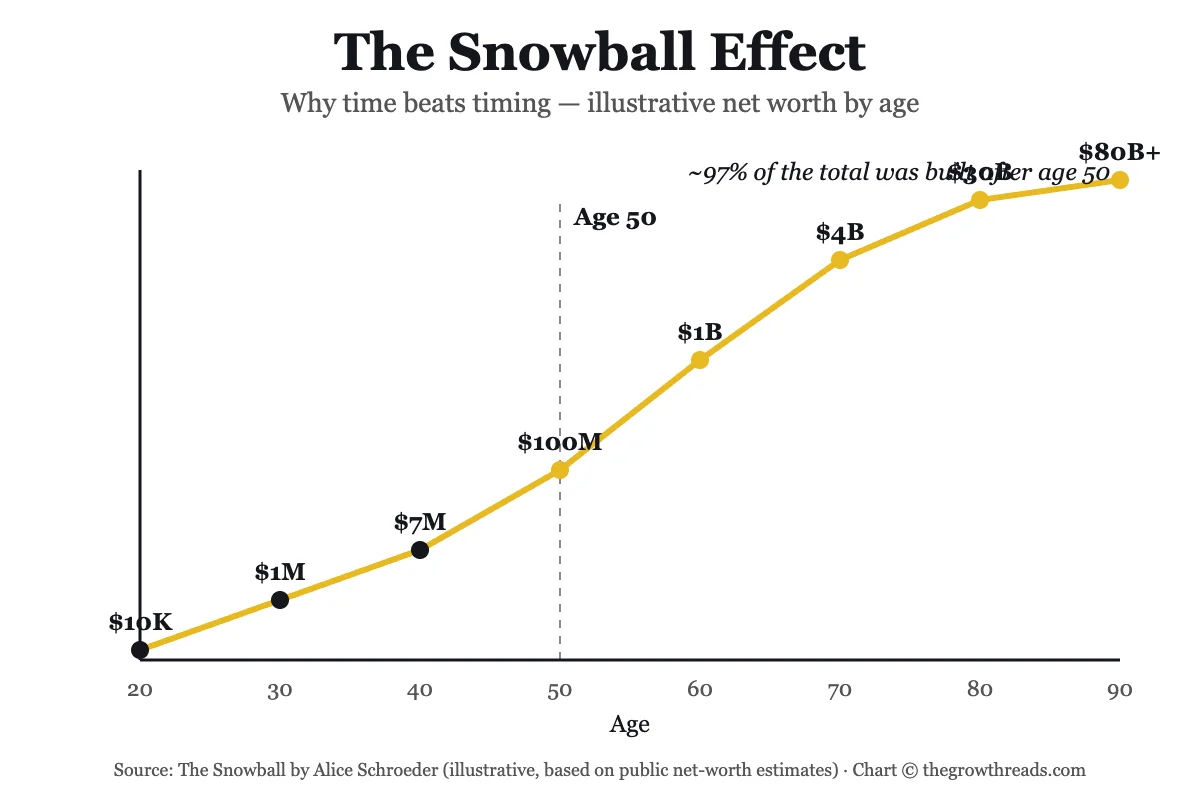
Nobody gets rich by accident — they get rich by starting a snowball early and never stepping off the hill. Alice Schroeder’s authorized biography of Warren Buffett spends nearly a thousand pages proving a simple point: the size of a fortune (or a reputation, or a body of knowledge) depends less on brilliance than on how early you start compounding it and how long you let it run. Buffett was investing at 11, filing taxes at 13, and running small businesses through his teens — not because he had a masterplan, but because he understood, decades before anyone gave it a name, that time is the one ingredient no one can buy back. The book follows him from Omaha paper routes through Columbia Business School, the founding of Berkshire Hathaway, the near-collapse of Salomon Brothers, and finally to the decision to give almost all of it away. Along the way, Schroeder pulls back the curtain on the parts most business books skip: the loneliness, the marriage that quietly fell apart while staying legally intact, and the internal compass — the “Inner Scorecard” — that let Buffett ignore Wall Street’s noise for seventy years.
Key takeaways
- Compounding is the whole game: money, knowledge, and reputation all behave like snow rolling downhill — the size of the snowball matters less than how long it rolls and how wet the snow is.
- Start absurdly early: Buffett bought his first stock at 11 and was filing tax returns at 13; every extra decade of compounding matters more than raw talent.
- Judge yourself by your Inner Scorecard, not the Outer one: measure decisions against your own standards, not the applause of a crowd.
- Circle of Competence beats broad knowledge: Buffett skipped entire industries — tech, for decades — simply because he couldn’t confidently price them.
- Margin of Safety is a habit of mind, not just a formula: build slack into every high-stakes decision, financial or otherwise.
- Mr. Market is a mood, not a verdict: the market’s daily price is an offer, never an order you’re obligated to accept.
- Reputation compounds too — in both directions: decades of trust can be undone by one bad decision, as the Salomon Brothers crisis nearly proved.
- Simplicity is a strategy: Buffett lived in the same modest Omaha house from 1958 onward, despite becoming one of the richest people alive.
- Luck deserves humility: Buffett calls his birth into mid-century America the “Ovarian Lottery,” and treats his fortune as something to steward, not just keep.
- Giving it away is also a decision that compounds: his 2006 pledge to give away nearly his entire fortune became the seed of The Giving Pledge.
What is The Snowball about?
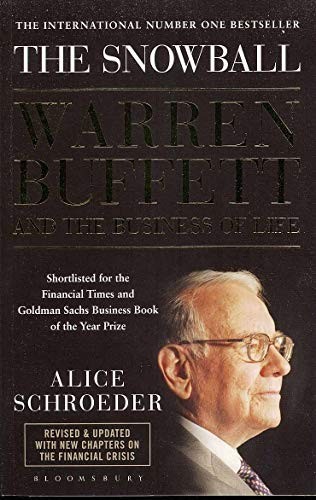
The Snowball is Alice Schroeder’s authorized biography of Warren Buffett, built on years of exclusive interviews and access to his private files. It traces how a paperboy from Omaha became the world’s most successful investor by treating money, knowledge, and reputation as compounding forces — and argues that patience, not genius, is the real engine of extraordinary wealth.
About the author
Alice Schroeder spent over a decade on Wall Street, rising to managing director at Morgan Stanley, where her research on Berkshire Hathaway’s insurance operations was so rigorous that Warren Buffett himself began calling her for feedback on her reports. In 2003, he offered her something he had refused every other writer: full access to his personal archives, his family, and hundreds of hours of his own time, and asked her to write his authorized biography. Schroeder, who trained as an accountant and once worked as an auditor, spent the next five years turning that access into The Snowball, drawing on hundreds of interviews and decades of private letters. The result reads less like a business manual than a life story — which is precisely why Buffett trusted her to tell it. She has since written and lectured internationally on Berkshire Hathaway, valuation, and long-term investing. Explore all Alice Schroeder book summaries →
Key concepts at a glance
| Concept | What it means | Use it when |
|---|---|---|
| The Snowball | Wealth, reputation, and knowledge all compound — size depends on time rolled and the quality of what it picks up along the way. | You’re deciding whether to start now or wait for a “better” moment. |
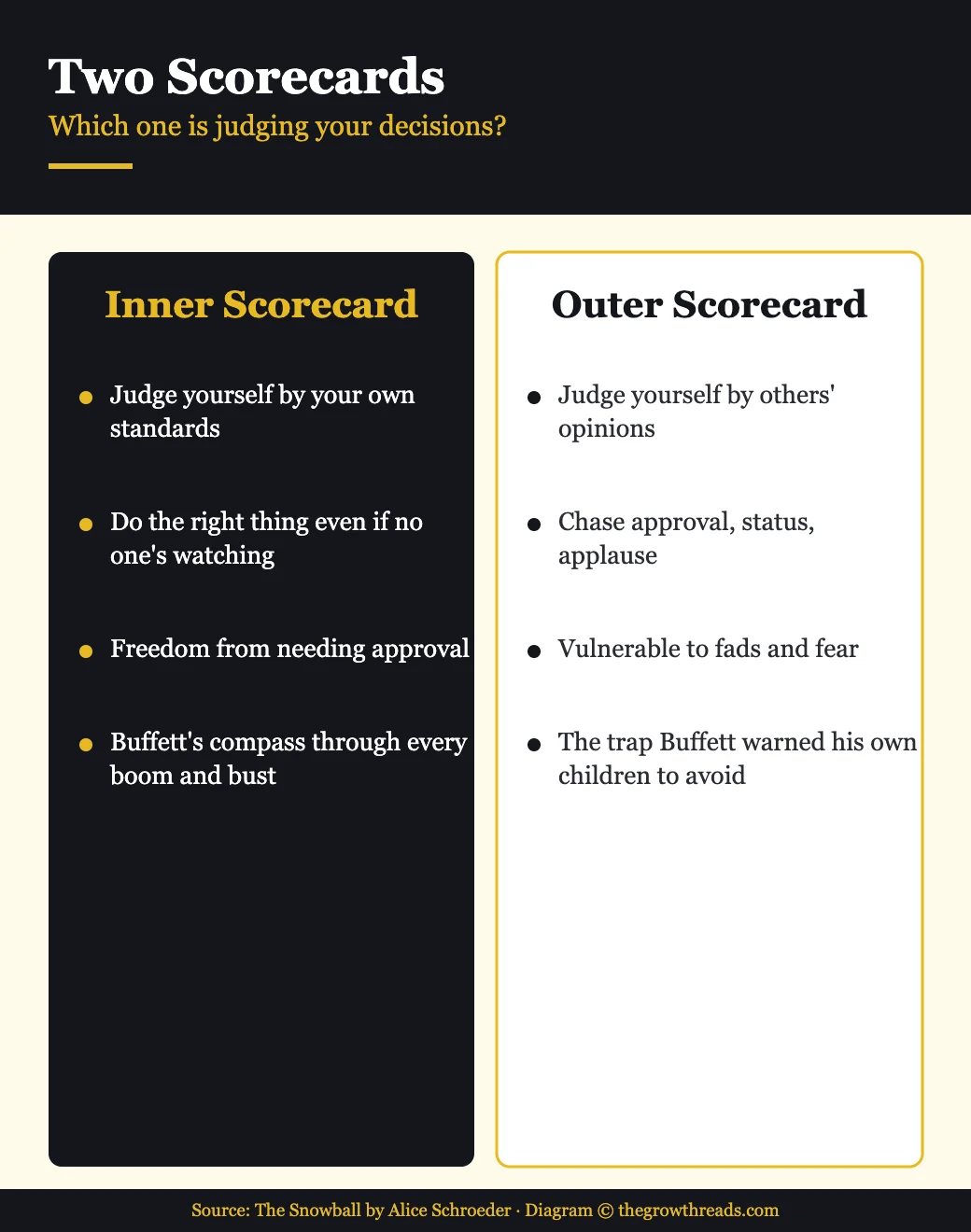
| Inner Scorecard | Judging yourself by your own standards instead of others’ approval. | You’re facing social pressure to make a decision you don’t believe in. |
| Circle of Competence | Sticking to what you deeply understand and skipping the rest, no matter how exciting. | You’re tempted by an opportunity you can’t confidently evaluate. |
| Margin of Safety | Building a buffer between what something costs and what it’s actually worth. | You’re making any high-stakes financial or life decision. |
| Mr. Market | Treating daily price swings as offers, not verdicts on your judgment. | Markets — or public opinion — are volatile and you feel pressure to react. |
| Float | Using money you hold but don’t yet owe as a low-cost source of investable capital. | You’re structuring a business, not just picking stocks. |
| Ovarian Lottery | Recognizing how much of success is the accident of when and where you were born. | You’re evaluating your own privilege, or your purpose for wealth. |
| Reputation Capital | Trust built over decades that can be destroyed in minutes. | You’re weighing a shortcut against your long-term credibility. |
Part 1: The Making of an Investor
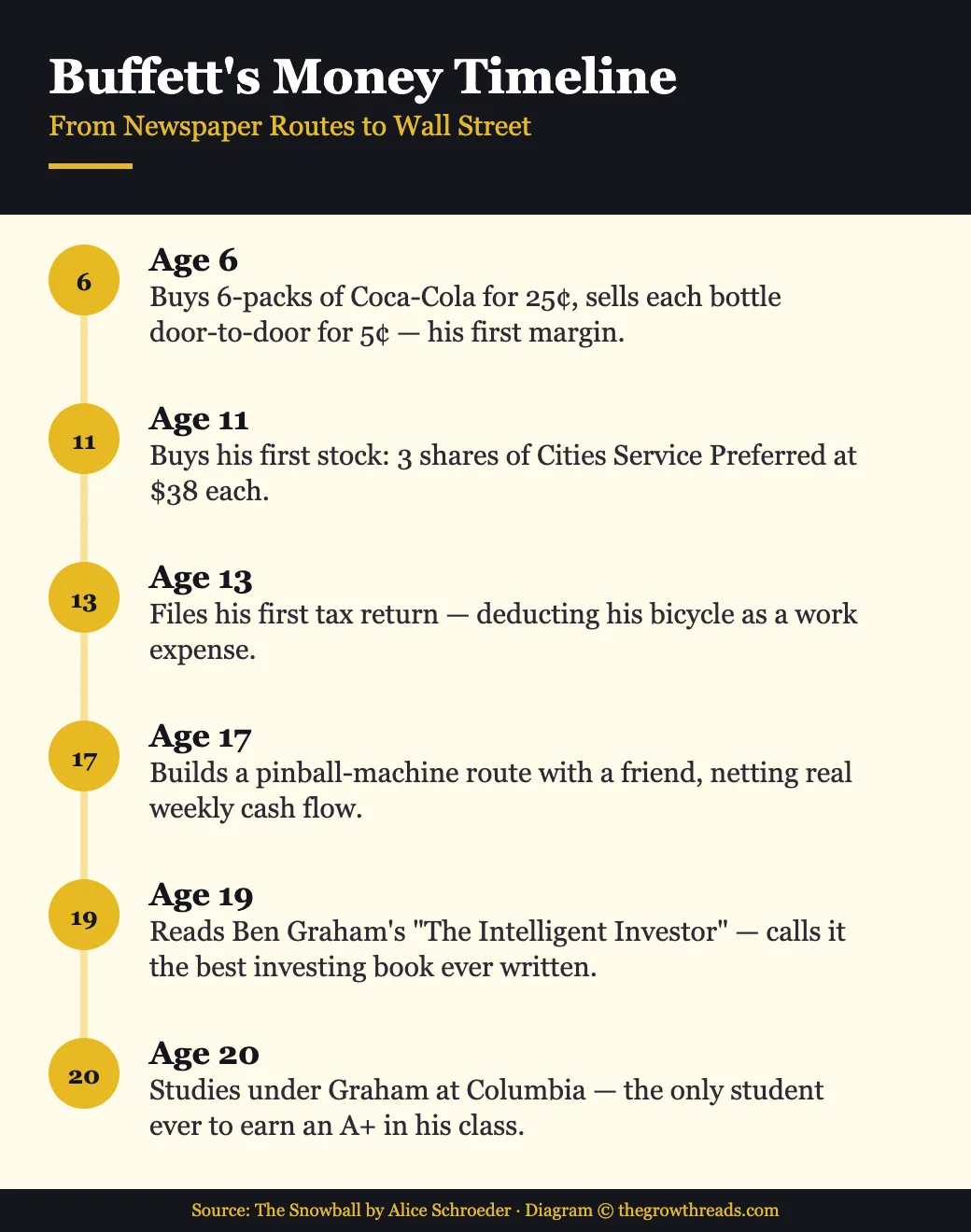
Buffett’s entrepreneurial instincts showed up before he could ride a bike unassisted. At six, he bought six-packs of Coca-Cola for a quarter and sold each bottle door-to-door for a nickel — a 20 percent margin he understood intuitively long before anyone taught him the word. By eleven, he had saved enough from paper routes, a pinball-machine business, and reselling golf balls to buy his first stock: three shares of Cities Service Preferred. He sold too early, watched the price triple afterward, and carried that lesson — about patience, not about picking — for the rest of his career. At thirteen he filed his own tax return and deducted his bicycle as a work expense, already treating his paper route less like a chore than a small business with a balance sheet.
The real turning point came at nineteen, at the University of Nebraska library, when he found Benjamin Graham’s The Intelligent Investor. Schroeder describes it less as a discovery than a conversion: Buffett would later call it simply the best book on investing ever written. He followed Graham to Columbia Business School, where he became the only student ever to earn an A+ in Graham’s class, then talked his way into a job at Graham’s firm, Graham-Newman, working directly under the man whose “margin of safety” principle would anchor every investment decision Buffett made for the next seven decades. What Schroeder makes clear is that none of this was a straight line to greatness — it was years of small, compounding bets on his own judgment, made long before anyone was paying attention.
TGR Note: The child who calculated margins on Coca-Cola bottles is the same behavioral pattern The Psychology of Money spends a whole book explaining: financial success is a behavior, not a body of knowledge. If Buffett’s early frugality and long time horizon sound familiar, they’re close cousins of the “stealth wealth” habits documented in The Millionaire Next Door — ordinary discipline, applied for an unreasonably long time.
Part 2: Building the Snowball
In 1956, at twenty-five, Buffett started Buffett Partnership Ltd. with $105,100 pooled from family and friends, running it out of his house with the same principles he’d absorbed from Graham: buy statistically cheap businesses, often below the value of their liquid assets, and wait. This approach — nicknamed “cigar-butt investing,” because it meant picking up unglamorous, half-smoked businesses for one last free puff of value — worked well enough to close the partnership with an extraordinary track record by 1969, when Buffett, uneasy with a market he no longer understood, returned his partners’ money rather than chase a bubble.
One of those cigar butts was Berkshire Hathaway itself, a failing New England textile mill Buffett began buying in 1962 and took control of in 1965 — a decision he later called, with unusual candor for a man rarely self-critical, the dumbest stock he ever bought, partly triggered by a personal slight from the mill’s owner rather than cold analysis. Schroeder traces how Berkshire’s textile operations quietly died over the following two decades while Buffett redirected its cash into better businesses, guided increasingly by his partner Charlie Munger’s blunt advice: it’s far better to buy a wonderful business at a fair price than a fair business at a wonderful price. The 1972 purchase of See’s Candies, at a price Graham would have rejected outright, marked the pivot from cigar butts to compounding machines. Layered on top of all of it was insurance: Buffett’s 1967 purchase of National Indemnity gave Berkshire access to float — premiums collected long before claims came due — turning an ordinary insurer into a permanent, low-cost source of investable capital.
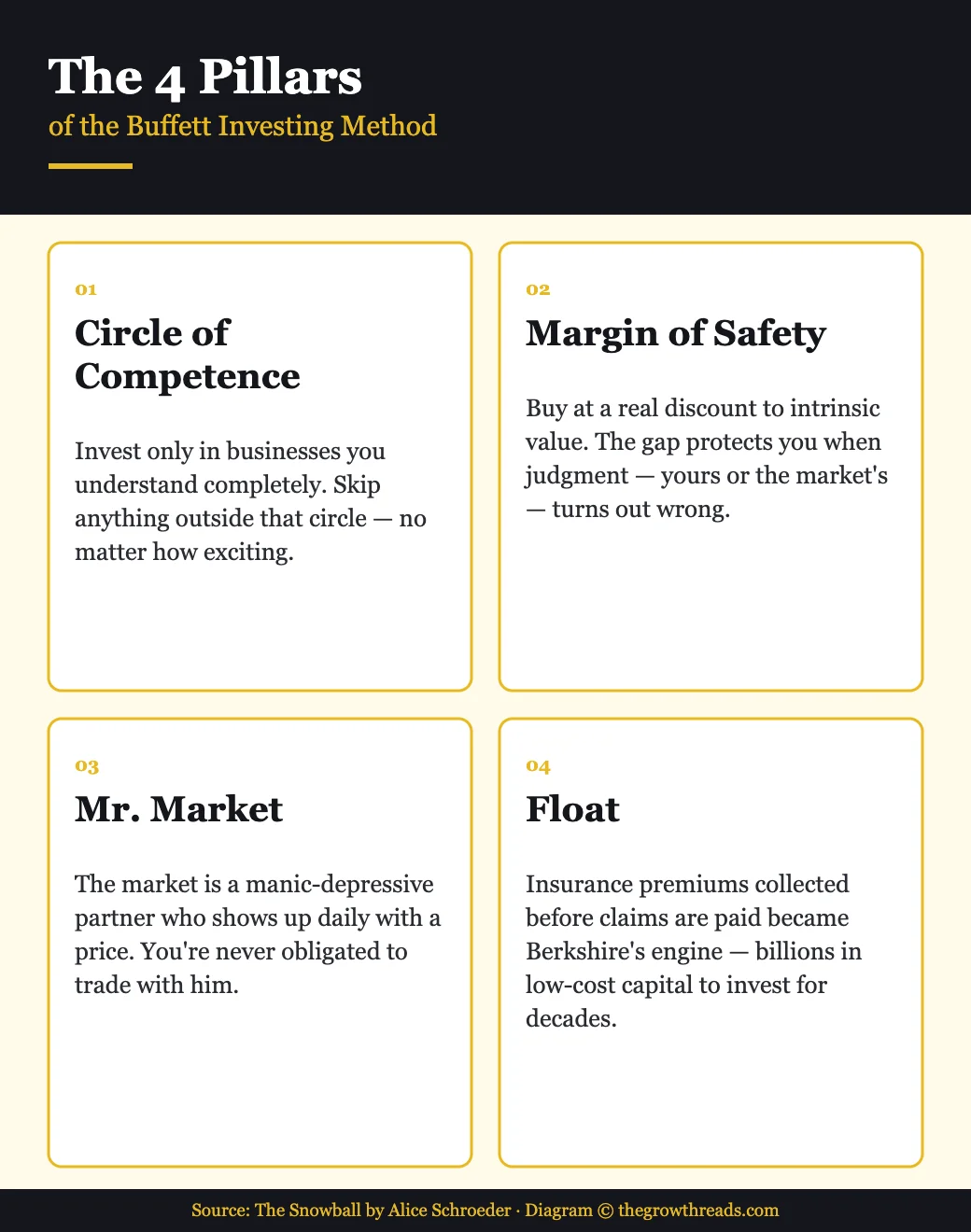
TGR Note: Graham’s Margin of Safety and Mr. Market show up here in their original form — for the source material, The Intelligent Investor is the natural next read. For a more checklist-driven walkthrough of how these principles apply to picking individual stocks today, The Warren Buffett Way covers similar ground with less biography and more spreadsheet.
Part 3: The Business of Life
The most quietly radical idea in The Snowball has nothing to do with stocks. Buffett’s father, Howard, taught him to separate the Inner Scorecard — judging yourself by your own standards — from the Outer Scorecard, judging yourself by what others think. Schroeder shows how consistently this framework insulated Buffett from Wall Street’s fashions: he sat out the dot-com bubble in the late 1990s, publicly mocked for being “over” as an investor, and was vindicated only after the crash. The Inner Scorecard also explains some of the book’s more uncomfortable material: Buffett’s marriage to Susan Buffett, who moved to San Francisco in 1977 while the couple remained legally married and effectively arranged for her friend Astrid Menks to look after him in Omaha — an arrangement Schroeder presents without judgment, as evidence of a man whose priorities rarely bent to convention.
Reputation gets its sharpest test in the book’s account of the 1991 Salomon Brothers scandal, when a rogue trader’s bond-bidding fraud nearly sank the firm and Buffett, its largest shareholder, stepped in as interim chairman. He testified before Congress with a line that became his signature: “Lose money for the firm, and I will be understanding. Lose a shred of reputation for the firm, and I will be ruthless.” Schroeder frames Salomon as proof that reputation compounds exactly like capital — slowly, invisibly, for decades — and can evaporate in a single news cycle if integrity slips even once.
TGR Note: Buffett’s business partner gets his own, denser treatment of judgment and integrity in Poor Charlie’s Almanack, which reads like the mental-models appendix to this book’s biography. If the Inner Scorecard resonates, The Almanack of Naval Ravikant covers similar ground on judgment and long-term thinking from a very different era of wealth-building.
Part 4: Giving It Away
Buffett calls the accident of his birth — American, male, mid-century, wired for capital allocation at the exact moment financial markets were about to reward that skill enormously — the “Ovarian Lottery.” Schroeder devotes the book’s final act to how seriously he took the implications: rather than build a Buffett Foundation bureaucracy, he decided in 2006 to give away the overwhelming majority of his fortune to the Bill and Melinda Gates Foundation and family-run foundations, reasoning that the Gates Foundation could already deploy capital more effectively than he could build a new machine to do it. That decision became the seed of The Giving Pledge, which Buffett co-founded with Bill and Melinda Gates in 2010 to persuade other billionaires to commit the majority of their wealth to philanthropy.
For his own children, Buffett settled on a phrase that captures the whole philosophy of the book: enough money that they could do anything, but not so much that they could do nothing. Schroeder’s closing argument is that giving is not a departure from the snowball metaphor but its final stage — the same patient, compounding logic applied to impact instead of principal.
TGR Note: The idea that money is a tool for a life, not a scoreboard, is the entire thesis of Your Money or Your Life, and shows up again in a more numbers-driven form in Rich Dad Poor Dad‘s distinction between assets and liabilities. Read together, all three make the same point from different angles: what you do with money matters more than how much of it you have.
Who is The Snowball best for — and who should read something else first?
The Snowball rewards readers who want the full human story behind the investing wisdom — the setbacks, contradictions, and slow decades, not just the highlight reel. It’s best for long-term investors, entrepreneurs building something that takes years to pay off, and anyone drawn to biography as a way of absorbing character rather than tactics.
If you want tactical, checklist-style investing guidance without the 900-page life story, start with The Warren Buffett Way or The Intelligent Investor instead. If your interest is behavioral money habits rather than biography, The Psychology of Money covers similar emotional ground in a fraction of the pages.
Questions to reflect on
- Where in your life are you optimizing for the Outer Scorecard instead of the Inner one?
- What is your actual Circle of Competence — and where have you strayed outside it recently?
- If you measured your reputation like a bank account, would this month’s decisions be a deposit or a withdrawal?
- What “float” — capital, time, or goodwill — do you have access to that you’re not using productively?
- If you knew that nearly all of your eventual success would come after age 50, what would you stop rushing today?
🔥 Ready to think in decades, not days?
Get the full story behind history’s greatest compounding record.
How to apply The Snowball (7-day plan)
- Day 1: Write down your Inner Scorecard — three decisions you’re proud of that nobody applauded, and three you made mainly for approval.
- Day 2: Define your Circle of Competence in one paragraph — what do you actually understand well enough to bet on?
- Day 3: Pick one recurring expense and calculate what it would be worth in 30 years if invested instead, using any compound-interest calculator.
- Day 4: Apply Margin of Safety to one upcoming decision — a job offer, purchase, or commitment — by building in a buffer before you commit.
- Day 5: Write your personal “reputation rule” — one line you’d want people to say about your integrity in a crisis.
- Day 6: Journal on your own Ovarian Lottery — one piece of unearned luck in your life, and one way you could redirect part of its upside.
- Day 7: Choose one asset — a skill, a habit, a relationship, or a fund — to compound consistently for the next 12 months, and set a monthly check-in.
Frequently asked questions
What is the main lesson of The Snowball?
The central lesson is that compounding — of money, knowledge, and reputation — rewards time far more than it rewards brilliance. Warren Buffett’s fortune wasn’t built through a handful of genius bets; it was built by starting early, staying in the game for over seventy years, and letting small, consistent advantages accumulate. The book argues that patience and character, more than intelligence, explain his results, and that the same logic applies to skills, relationships, and reputation, not just investment portfolios.
Is The Snowball a biography or an investing book?
It’s primarily a biography, not a how-to investing guide. Alice Schroeder spent five years with unprecedented access to Buffett’s personal life, family, and archives, and the book reads chronologically like a life story rather than a strategy manual. Investing concepts like Margin of Safety, Circle of Competence, and Mr. Market appear throughout, but always in the context of the decisions and relationships that shaped them, so readers looking for a step-by-step stock-picking system may prefer a more tactical title.
How long is The Snowball?
The hardcover runs to 976 pages, making it one of the longest books commonly recommended in the money and investing category. Most readers report it takes 18 to 24 hours to finish, depending on reading speed, though its chronological, story-driven structure makes it easier to sustain than a typical business book of similar length. Audiobook editions run over 35 hours. This guide summarizes the core arguments and stories in about 24 minutes.
What is the “Inner Scorecard” Buffett talks about?
The Inner Scorecard is a framework Buffett credits to his father, Howard: judging your own decisions by your own standards rather than by other people’s approval. Schroeder shows it protecting Buffett during periods when his strategy looked outdated to the outside world, including the dot-com bubble, when critics called him finished shortly before the crash proved his caution correct. The opposite, the Outer Scorecard, means measuring yourself by applause, status, or what other people think — a pattern the book treats as a long-term liability.
Did Warren Buffett personally endorse this book?
Buffett personally selected Alice Schroeder to write his authorized biography in 2003 and gave her access he had denied every previous writer, including his private letters, family, and years of his own time in interviews. That said, “authorized” means access, not editorial control — Schroeder has said Buffett did not review or approve the manuscript before publication, and the book includes candid, occasionally unflattering material about his marriage and personal choices that a purely approved account might have omitted.
Is The Snowball worth reading if I’m not interested in investing?
Yes — many readers come away saying the investing content is almost secondary to the character study. The book’s real subject is decision-making under social pressure, the cost and value of reputation, the tension between family life and an all-consuming career, and what “enough” means once money is no longer scarce. Readers interested in biography, psychology, or philanthropy tend to find as much value in it as dedicated investors do.
How is The Snowball different from Poor Charlie’s Almanack or The Warren Buffett Way?
The Snowball is a chronological life story; Poor Charlie’s Almanack is closer to a mental-models reference book built around Charlie Munger’s speeches and quotes; The Warren Buffett Way is a practical breakdown of his investment criteria and case studies for picking stocks. Readers often start with The Snowball for the full narrative context, then use Poor Charlie’s Almanack or The Warren Buffett Way as more tactical, reference-style follow-ups once the underlying philosophy makes sense.
Related summaries
- The Psychology of Money Summary & Review
- Poor Charlie’s Almanack Summary & Review
- The Warren Buffett Way Summary & Review
- The Intelligent Investor Summary & Review
- See all the best money books
How we analyze books: Every TGR summary blends the book’s original arguments with independent verification and cross-references to related research, so you get more than a rehash of the table of contents. Read our full methodology.