

★★★★☆ 4.4/5 — A short, rule-driven system built on one idea: structure creates freedom, not the other way around.
Best for: Readers who want a simple, repeatable daily template rather than a philosophy of productivity.
Reading time: ~2.5 hrs full book (this guide: ~8 min)
Difficulty to apply: Easy — most of the rules can be tried the same night and morning.
The Perfect Day Formula in one minute
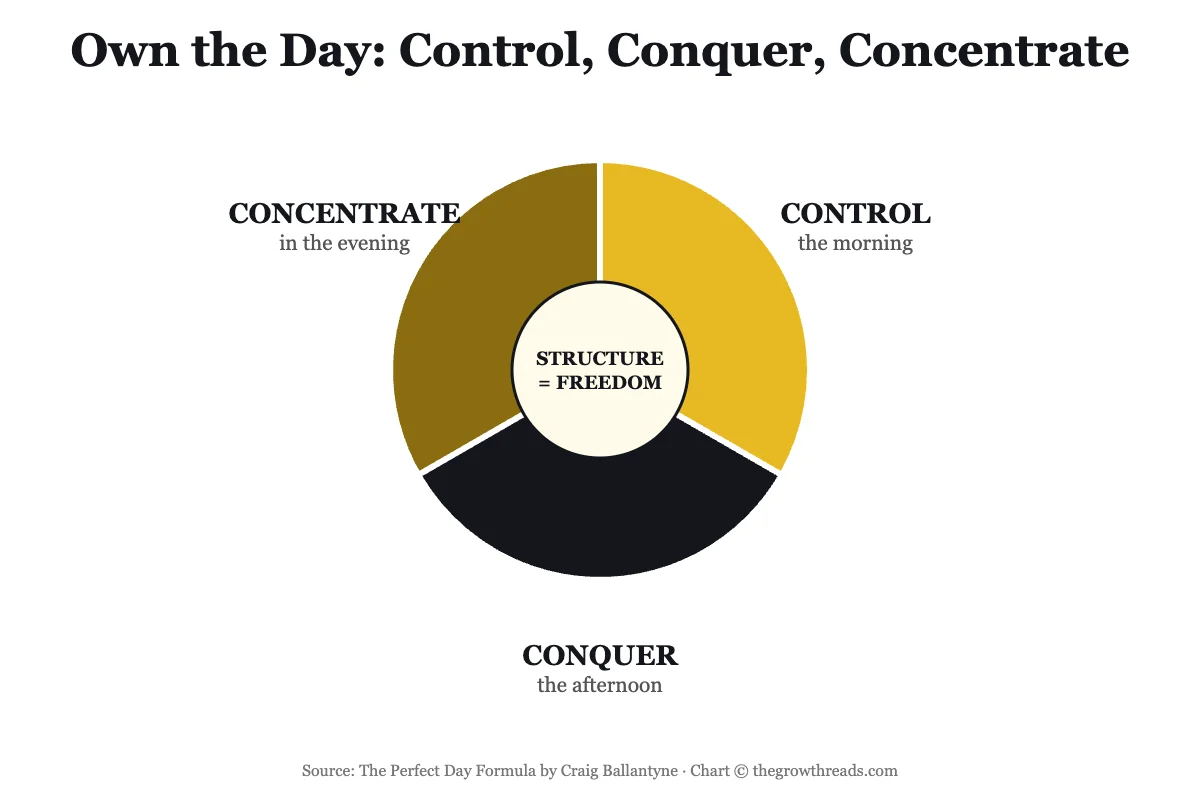
Freedom doesn’t come from having no rules — it comes from having the right ones. Craig Ballantyne’s The Perfect Day Formula makes the case that a tightly structured day, built around a small number of non-negotiable rules, actually produces more freedom than an open, unstructured one, because it removes the hundreds of small decisions that quietly drain willpower before the important work even starts. The book organizes a day into three phases — controlling the morning, conquering the afternoon, and concentrating in the evening — and backs each phase with concrete, specific rules rather than vague encouragement.
Key takeaways
- Structure equals freedom: the book’s central claim — a day built on clear rules removes decisions, and removing decisions is what actually creates mental space.
- Three phases, one day: control the morning, conquer the afternoon, and concentrate in the evening, each with its own rules and priorities.
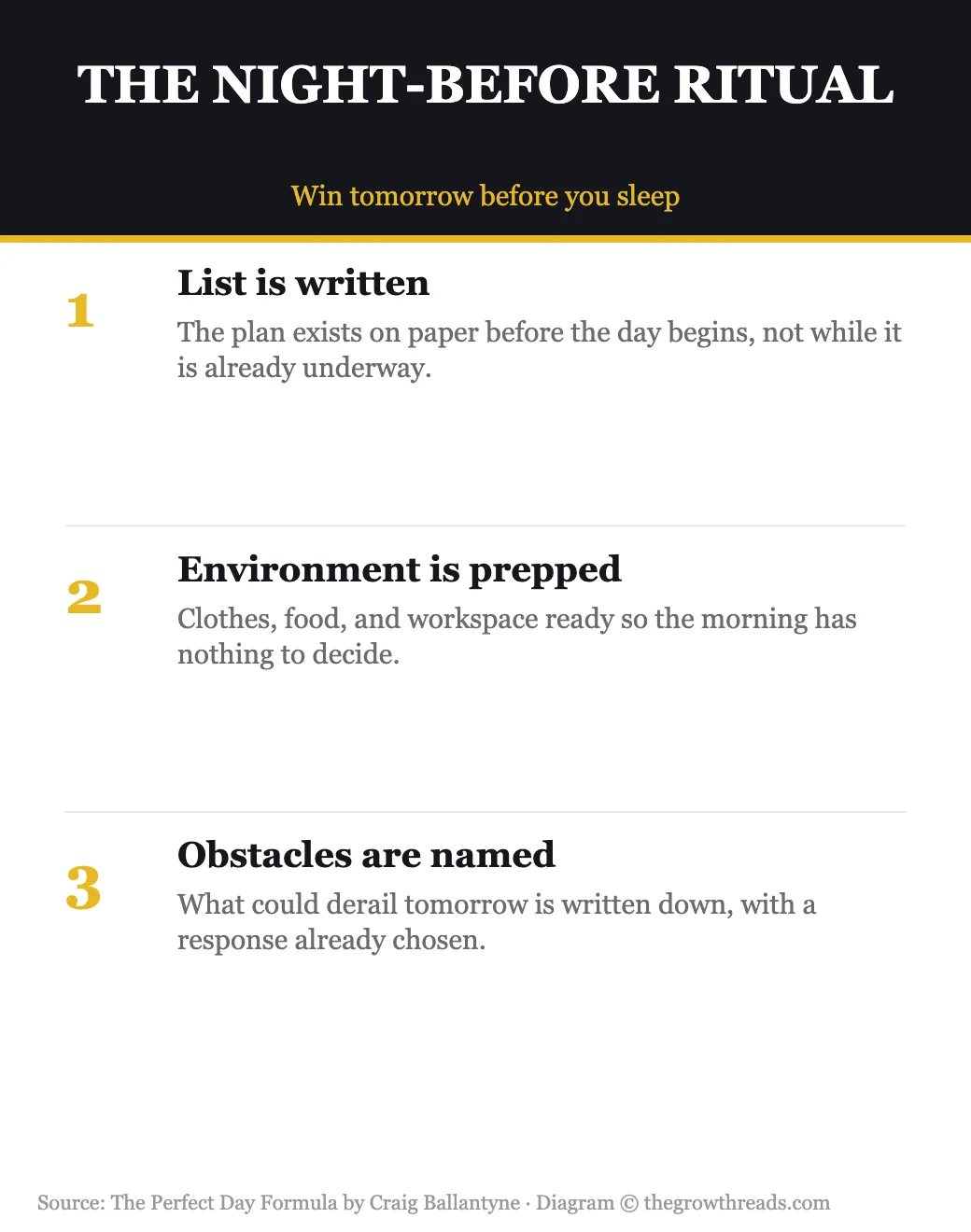
- The night before decides the morning: a day that starts well almost always started being planned the night before.
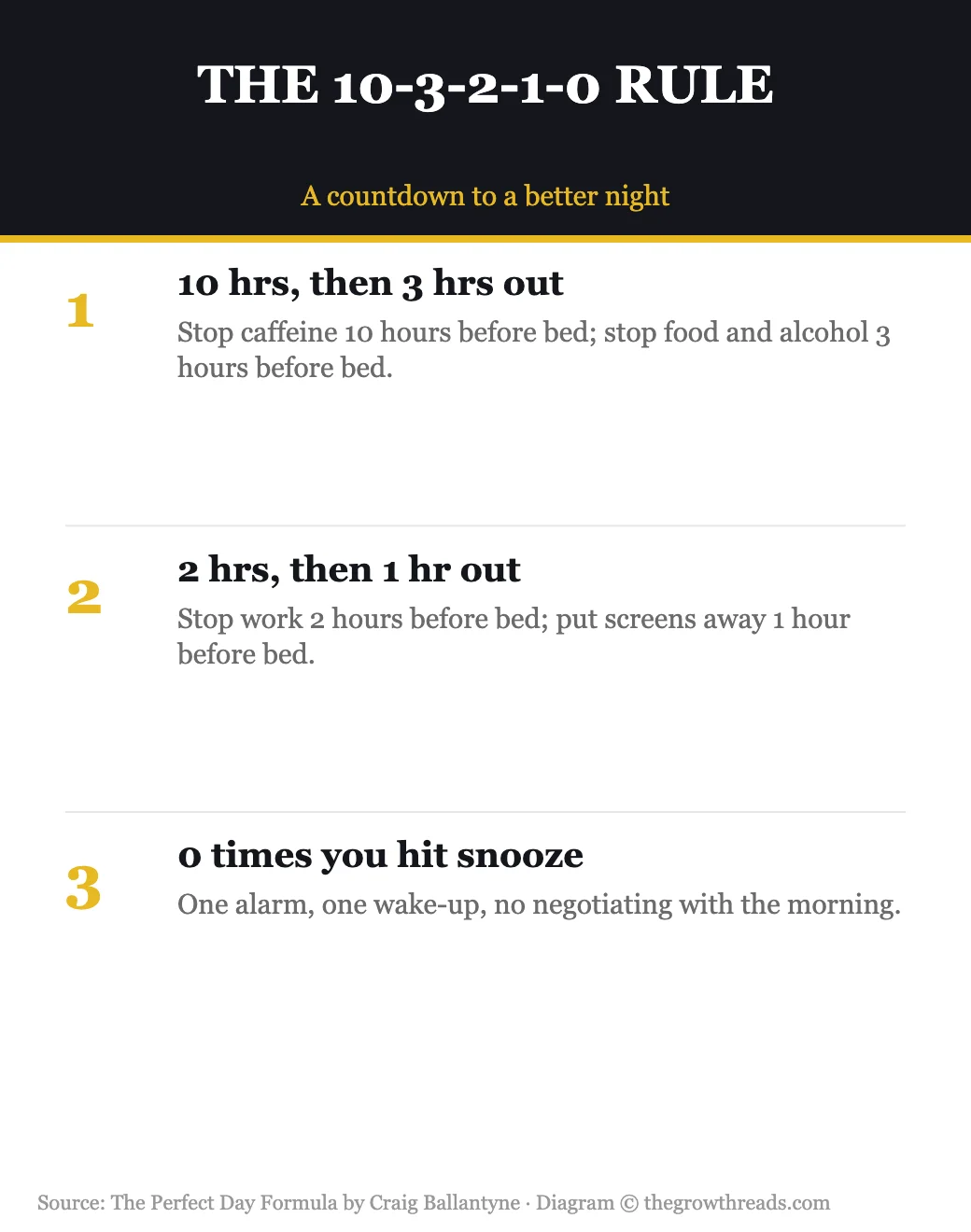
- The 10-3-2-1-0 rule: a countdown of specific cutoffs before bed — caffeine, food and alcohol, work, screens, and snooze presses — that protects sleep quality.
- Personal rules beat willpower: a short list of self-imposed, written rules (“I don’t check email before 9am”) removes the need to re-decide the same thing daily.
- Accountability multiplies follow-through: structure that only lives in your own head is easy to quietly abandon; structure someone else can see tends to survive.
- Deadlines create real pressure: a goal without a date rarely gets acted on with any urgency.
- Community sustains discipline: a support network of people pursuing similar structure makes the rules easier to keep on hard days.
- Incentives are allowed: rewarding yourself for keeping the structure isn’t a weakness in the system — it’s part of what makes it durable.
- Small rules compound fast: because the book’s rules are so specific, most readers can start applying several of them on the very first night.
What is The Perfect Day Formula about?
The Perfect Day Formula is Craig Ballantyne’s short, rule-based system for structuring an entire day into three phases — morning, afternoon, and evening — each governed by specific, non-negotiable personal rules. Its central argument is that structure creates freedom: removing small daily decisions through fixed rules frees up mental energy for the work that actually matters.
About the author
Craig Ballantyne built his career first in the fitness industry, creating the Turbulence Training workout system before moving into broader productivity and entrepreneurship content through the Early to Rise publishing brand. His writing style is direct and rule-based rather than theoretical — a natural extension of a training background where specific, repeatable protocols matter more than abstract motivation. Across his body of work, including titles like The Perfect Week Formula (a separate, later book focused specifically on structuring a business owner’s week), Ballantyne consistently returns to the same core belief: disciplined structure, not willpower or inspiration, is what actually produces consistent results. That consistency is part of what makes his catalog easy to navigate once you know the throughline: whichever specific book you pick up, the underlying premise stays the same — a life organized around a small number of firm, written rules tends to outperform one organized around good intentions renewed each morning. Explore all Craig Ballantyne book summaries →
Key concepts at a glance
| Concept | What it means | Use it when |
|---|---|---|
| Structure = freedom | The book’s central claim — fixed rules remove decisions and create mental space | Your days feel scattered despite good intentions |
| Control / Conquer / Concentrate | The three-phase daily structure — morning, afternoon, evening | You want one simple template to organize an entire day |
| 10-3-2-1-0 rule | A countdown of pre-bed cutoffs for caffeine, food, work, and screens | Sleep quality is inconsistent or mornings feel foggy |
| Personal rules | Short, specific, self-imposed rules that remove repeated daily decisions | The same decision keeps draining willpower every single day |
| Night-before prep | Planning tomorrow’s list and environment before today ends | Mornings consistently start slow or disorganized |
| Five pillars of structure | Planning, accountability, community, incentives, and deadlines | A routine keeps starting strong and then quietly fading |
Part 1: Structure is freedom, not its opposite
Ballantyne opens by challenging a common assumption: that structure and freedom sit on opposite ends of a spectrum, and that more rules always mean less room to breathe. He argues the reverse. Every decision you have to make in the moment — what to eat, when to start work, whether to check your phone — draws down a limited daily supply of willpower. A day with no fixed rules isn’t actually freer; it’s a day spent re-deciding the same small things over and over, with less energy left for what matters by the time it counts.
The fix, in his framing, is to convert as many of those recurring decisions as possible into fixed personal rules — decided once, in advance, and simply followed rather than re-litigated daily. A rule like “I don’t check email before 9am” isn’t a restriction on freedom; it’s a decision you only have to make one time, which then quietly protects your morning every single day afterward. Multiply that one rule across a handful of recurring daily decisions — what to eat for breakfast, when to start deep work, when the phone goes on airplane mode — and the cumulative effect is a morning that runs largely on autopilot, in the best sense: not because nothing matters, but because the things that matter most were already decided in advance, calmly, instead of negotiated in the moment under pressure.
Part 2: Control the morning, conquer the afternoon
The book’s three-phase structure gives each part of the day a distinct job. Mornings are for control — a protected block, free of email and other people’s demands, used for the highest-priority work while willpower is at its freshest. Afternoons are for conquering — the more reactive, meeting-heavy, energy-variable stretch of the day, where the goal shifts from deep focus to simply getting through the list without losing the gains made that morning.
Ballantyne is explicit that the three phases aren’t meant to be treated with equal intensity. The morning gets the most protection because willpower is a depleting resource across the day; asking the afternoon to match the morning’s focus is, in his view, asking for a fight you’ll usually lose. Instead, the afternoon leans more on the accountability and incentive structures covered later in the book to keep momentum going once focus naturally starts to fade.
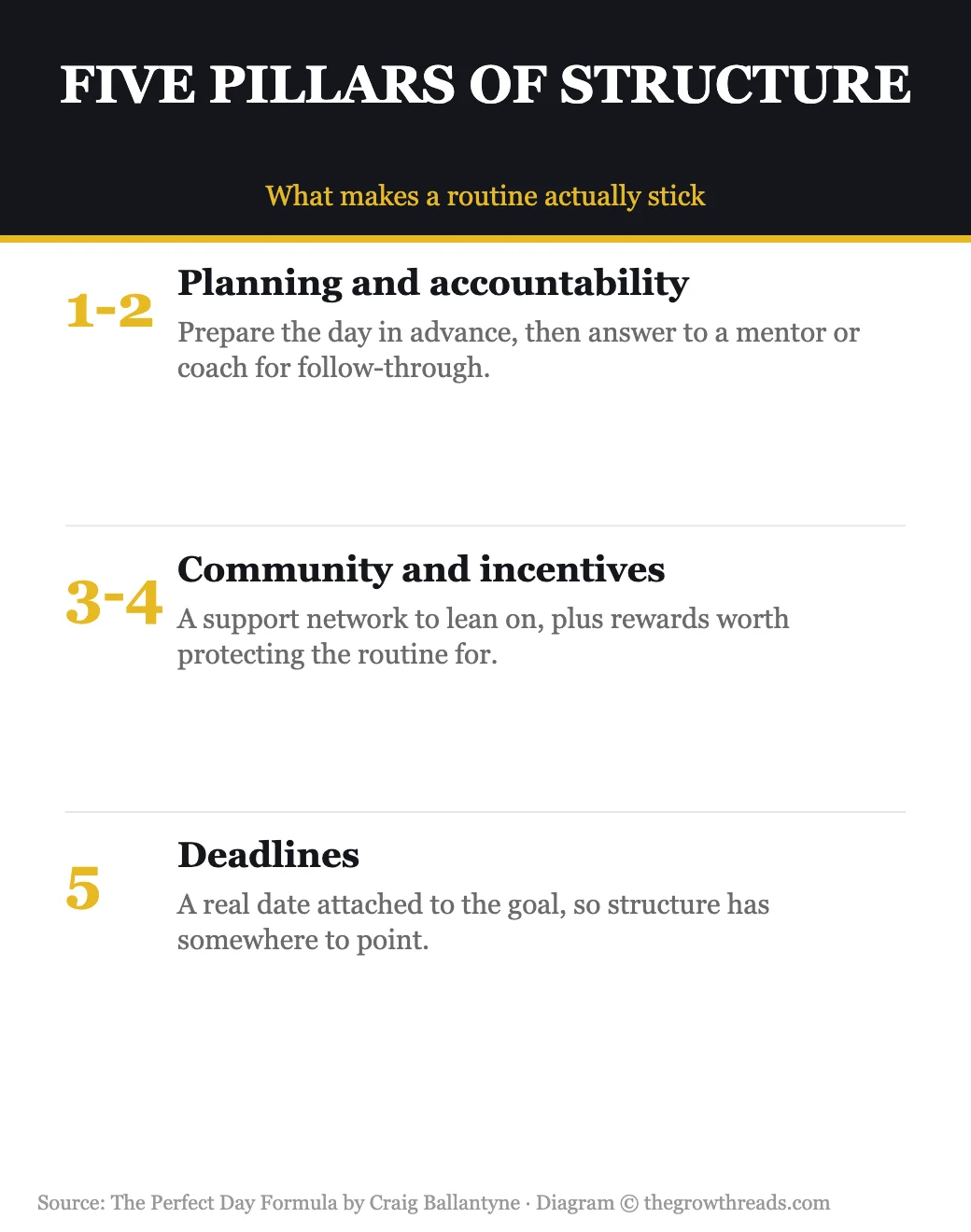
Those five pillars — planning, accountability, community, incentives, and deadlines — are what keep the afternoon’s structure from collapsing under its own weight. Planning sets the intention; accountability to a mentor, coach, or peer makes follow-through visible instead of private; community provides support on the days discipline alone isn’t enough; incentives make the structure worth protecting; and deadlines attach real urgency to goals that would otherwise drift.
Part 3: Concentrate in the evening, and win tomorrow tonight
The evening phase is where the book gets most specific. Rather than treating the evening as unstructured downtime, Ballantyne frames it as the setup for tomorrow’s morning — a short, deliberate ritual that determines whether the next day starts controlled or scrambling.
The centerpiece of the evening phase is the 10-3-2-1-0 rule, a countdown of concrete cutoffs in the hours before bed: no caffeine 10 hours out, no food or alcohol 3 hours out, no work 2 hours out, no screens 1 hour out, and zero snooze-button presses in the morning. Each cutoff is small on its own, but stacked together they protect the one resource the entire system depends on — a mind that’s actually rested enough to follow through on the rules the next day. None of the five individual cutoffs asks for much sacrifice on its own; skipping an afternoon coffee refill or plugging the phone in outside the bedroom are both minor adjustments. The design intent is cumulative rather than dramatic — a handful of small, boring changes stacked in the same direction, repeated nightly, rather than one sweeping overhaul that’s hard to sustain past the first enthusiastic week.
Who is The Perfect Day Formula best for — and who should read something else first?
This book is best for readers who want a short, concrete, rule-based system they can start applying the same night they finish reading — it’s less a philosophy of time management than a specific template. If you respond well to firm personal rules and clear cutoffs rather than open-ended principles, the format will feel refreshingly direct.
If you’re looking for a deeper exploration of why willpower and decision fatigue work the way they do, Willpower Doesn’t Work covers similar territory with more explanation behind the rules. And if your challenge is specifically structuring a business owner’s week rather than a single day, Ballantyne’s own later book, The Perfect Week Formula, addresses that directly — this title stays focused on the day, not the week.
Questions to reflect on
- Which daily decision do you re-make almost every day that could instead become a fixed personal rule?
- What does your current evening routine actually set you up for tomorrow morning?
- Which of the 10-3-2-1-0 cutoffs would be easiest for you to try tonight?
- Who could you make your morning or afternoon structure visible to, for real accountability?
- Which of the five pillars — planning, accountability, community, incentives, deadlines — is weakest in your current routine?
🔥 Ready to build your own perfect day?
Grab The Perfect Day Formula and start the 10-3-2-1-0 rule tonight.
How to apply The Perfect Day Formula (7-day plan)
- Day 1 — Pick one rule: Choose a single personal rule you’ll follow starting tonight, such as no screens one hour before bed.
- Day 2 — Start the countdown: Try the full 10-3-2-1-0 sequence for one night and notice how the next morning feels.
- Day 3 — Write tomorrow’s list tonight: Before bed, write out tomorrow’s top priorities instead of deciding them in the morning.
- Day 4 — Protect one morning block: Choose a fixed window with no email or messages, reserved only for your highest-priority task.
- Day 5 — Add one afternoon pillar: Pick one of the five pillars — likely accountability or a deadline — and apply it to something you’ve been putting off.
- Day 6 — Tell someone your structure: Share your new rules with one person who can notice, honestly, whether you’re keeping them.
- Day 7 — Review and lock in: Note which rules actually stuck, drop what didn’t fit, and commit to the ones that did for the week ahead.
Frequently asked questions
Is The Perfect Day Formula the same as Craig Ballantyne’s other books?
Not exactly, though they share a family resemblance. The Perfect Day Formula is focused specifically on structuring a single day into morning, afternoon, and evening phases. The Perfect Week Formula, a separate and later book, applies similar structural thinking to a business owner’s entire week rather than a single day. If you’ve read one, expect some overlap in tone and underlying philosophy, but the specific frameworks are built for different time horizons.
Do I have to follow every rule in the 10-3-2-1-0 sequence at once?
No. The book presents the full sequence as an ideal, but most readers get more traction adopting one or two cutoffs first — screens one hour before bed is a common starting point — and adding the rest gradually as they stick.
What if my schedule doesn’t allow a fixed morning block?
The specific hours matter less than the principle: a protected stretch of time, wherever it fits your schedule, used for your highest-priority work before reactive demands take over. Shift workers, parents of young children, and other non-standard schedules may need to adapt where the “morning” block falls rather than following the book’s timing literally.
Is the book more about productivity or about health and sleep?
Both, deliberately. The 10-3-2-1-0 rule ties sleep quality directly to next-day performance, on the premise that a rested mind is what actually makes the rest of the system’s rules sustainable. The book treats sleep as infrastructure for productivity, not a separate topic from it.
Is this book backed by research, or is it Ballantyne’s own system?
It’s presented as Ballantyne’s own practical system, built from his coaching and training background rather than as an academic or citation-heavy text. The underlying ideas — decision fatigue, the value of pre-committed rules, and sleep hygiene — align with broader, well-established findings in psychology and behavioral science, even where this specific packaging and the 10-3-2-1-0 rule itself are his own.
Is the book worth it if I’ve read a lot of productivity books already?
If you’re deeply familiar with decision-fatigue research and rule-based habit systems, some of the underlying ideas may feel familiar. Some readers also note the book is short relative to its price and that its final section reads as a pitch for Ballantyne’s coaching programs. That said, the specific 10-3-2-1-0 rule and the three-phase daily structure are concrete enough that most readers find at least one or two rules worth adopting immediately, even if the surrounding material feels lighter than expected.
Who should skip this book?
Readers who prefer a flexible, principles-first approach over firm personal rules may find the rule-heavy style too rigid. If open-ended frameworks suit you better than fixed cutoffs, a book like Willpower Doesn’t Work covers similar ground with more room for personal interpretation.
Related summaries
Continue exploring the Time Management collection: Willpower Doesn’t Work · Hell Yeah or No · Master Your Time, Master Your Life · What the Most Successful People Do Before Breakfast. For the full library, see our best productivity books pillar guide.