

★★★★☆ 4.2/5 — A Stanford professor’s blunt, research-backed case that toxic coworkers cost real money, and a practical playbook for screening them out or surviving them.
Best for: managers building hiring and culture standards, and anyone currently stuck with a demeaning boss or coworker · Reading time: ~4 hrs (this guide: ~11 min) · Difficulty to apply: Moderate — the diagnostic questions are simple, enforcing the rule against a talented offender takes real institutional will
The No Asshole Rule in one minute
Demeaning, belittling coworkers and bosses aren’t just unpleasant — they inflict measurable financial damage on organizations. Stanford professor Robert I. Sutton, expanding on a widely read 2004 Harvard Business Review article, argues that toxic people drive up turnover, absenteeism, legal risk, and the hidden cost of colleagues who spend energy avoiding or managing around them. His prescription is blunt: organizations should adopt an explicit, enforced “no asshole rule,” screening people out during hiring and firing them when necessary, even when they’re individually talented, because the systemic damage outweighs their output. First published in 2007 and translated into more than 20 languages, the book also offers a practical survival guide for people stuck working under someone they can’t fire or escape.
Key takeaways
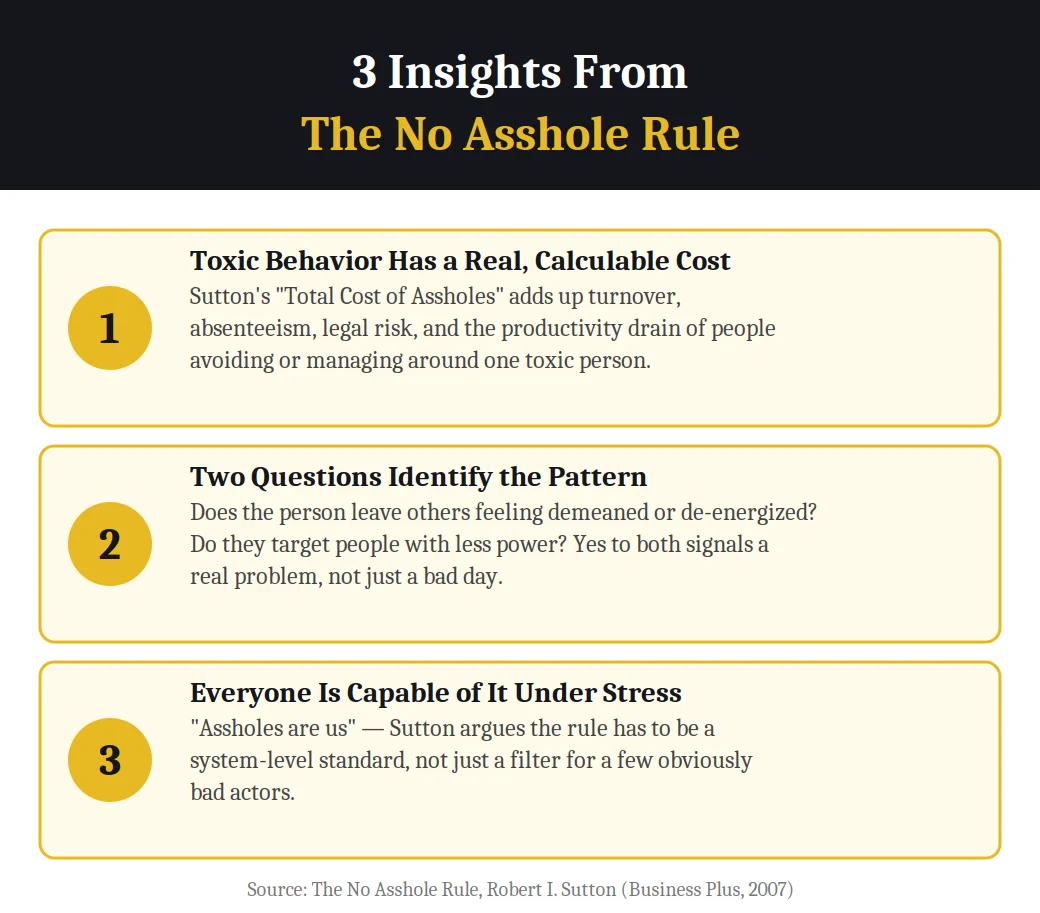
- Toxic behavior has a calculable cost: Sutton’s “Total Cost of Assholes” adds up turnover, absenteeism, legal exposure, and the productivity drain of coworkers who avoid or manage around one difficult person.
- Two questions identify the pattern: does the person leave others feeling demeaned or de-energized, and do they specifically target people with less power? Yes to both signals a real problem, not a bad day.
- “Assholes are us”: Sutton argues everyone is capable of this behavior under stress, which is why the rule has to be a system-level standard, not just a filter for a few obviously bad actors.
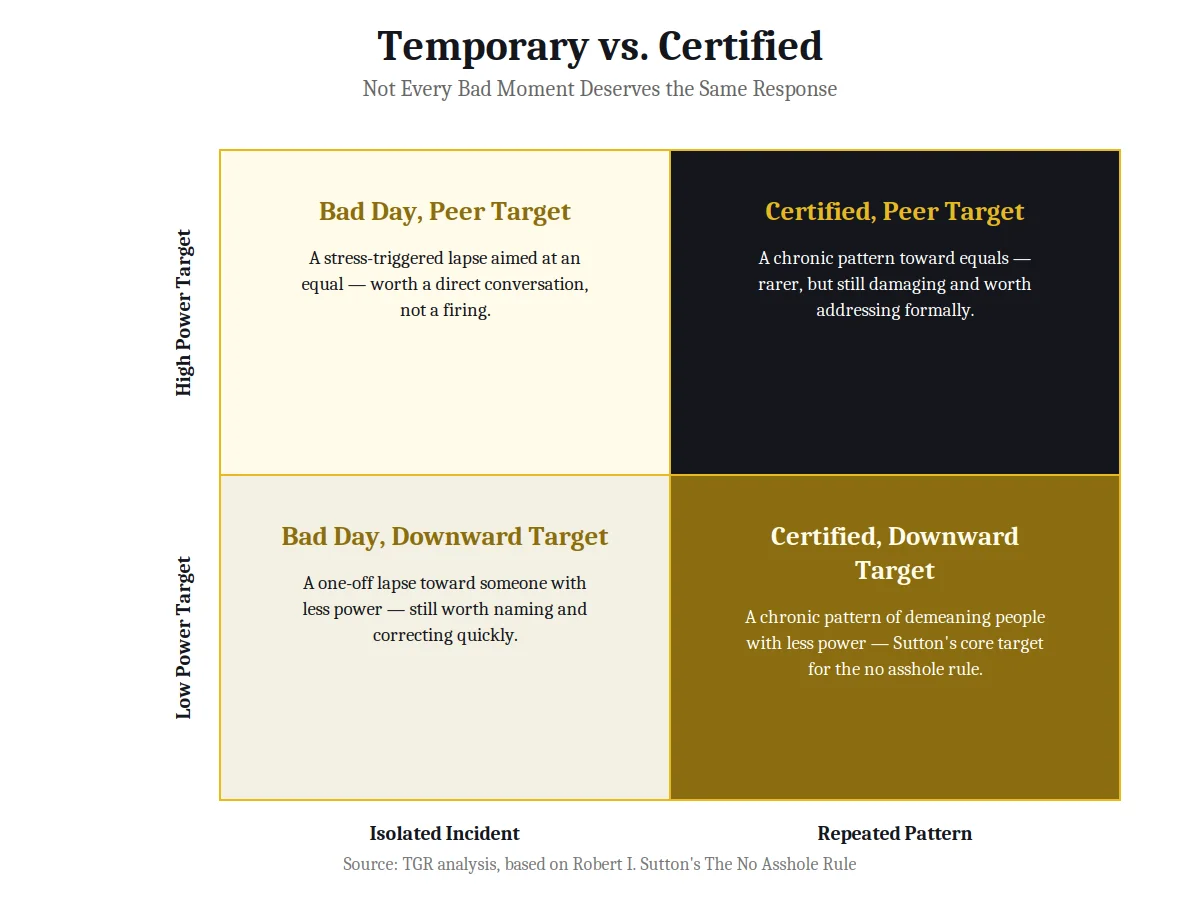
- There’s a difference between temporary and certified cases: a stress-triggered lapse is correctable; a chronic, patterned way of treating people across time and targets is what actually warrants exclusion.
- Downward nastiness is the real target: the large majority of demeaning behavior is aimed at people with less power, not at peers or superiors — which is exactly what makes it easy for leadership to miss.
- Talented offenders are the hardest test of the rule: Sutton cites companies like Men’s Wearhouse, which fired a top-performing but abusive salesman — and saw store sales rise afterward.
- Good companies screen for it explicitly: Southwest Airlines and IDEO both build civility checks directly into hiring, not just performance management after the fact.
- You can survive a toxic workplace you can’t leave: Sutton offers concrete tactics — limiting exposure, emotional detachment, small wins, and building quiet alliances — for people who can’t simply walk away.
- One publicly corrected offender can reinforce the norm for everyone: drawing on research into littering behavior, Sutton argues a visible rule-breaker who’s called out can function as a “reverse role model” — the exception, not the strategy.
What is The No Asshole Rule about?
The No Asshole Rule is Stanford professor Robert I. Sutton’s research-backed argument that demeaning, power-abusing coworkers and bosses inflict real, measurable costs on organizations — in turnover, absenteeism, legal risk, and the hidden productivity drain of people managing around them. Expanded from a widely read 2004 Harvard Business Review article, the book proposes a simple two-question test for identifying the pattern, distinguishes situational lapses from chronic “certified” cases, and argues organizations should build an explicit no-asshole standard into hiring, promotion, and firing decisions — even when the person in question is talented. It closes with a practical guide for surviving a toxic workplace when leaving isn’t an option.
About the author
Robert I. Sutton is Professor Emeritus of Management Science and Engineering at Stanford University, where he has been on the faculty since 1983. An organizational psychologist, he co-founded Stanford’s Center for Work, Technology and Organization, the Stanford Technology Ventures Program, and the Stanford d.school. His other books include Weird Ideas That Work, The Knowing-Doing Gap and Hard Facts, Dangerous Half-Truths, and Total Nonsense (both with Jeffrey Pfeffer), Good Boss, Bad Boss, The Asshole Survival Guide, and Scaling Up Excellence and The Friction Project (both with Huggy Rao). Explore all Robert I. Sutton book summaries →
Key concepts at a glance
| Concept | What it means | Use it when |
|---|---|---|
| Total Cost of Assholes (TCA) | The full financial toll of a toxic employee — turnover, absenteeism, legal risk, and lost productivity of people avoiding them | You’re weighing whether a “high performer’s” behavior is actually worth it |
| The Asshole Test | Two questions: does the person leave others feeling demeaned, and do they target people with less power? | You’re not sure if a complaint about someone is a personality clash or a real pattern |
| Temporary vs. Certified | A situational, stress-triggered lapse versus a chronic, patterned way of treating people across time and targets | You’re deciding how serious a response a specific incident actually warrants |
| Downward Nastiness | Demeaning behavior directed at people with less power, which makes up the large majority of real cases | A manager treats subordinates very differently than they treat peers or superiors |
| Small Wins | Incremental, achievable pushback against a toxic culture rather than trying to fix everything at once | You can’t change the whole culture, but you can change one meeting or one interaction |
Part 1: What toxic behavior actually costs
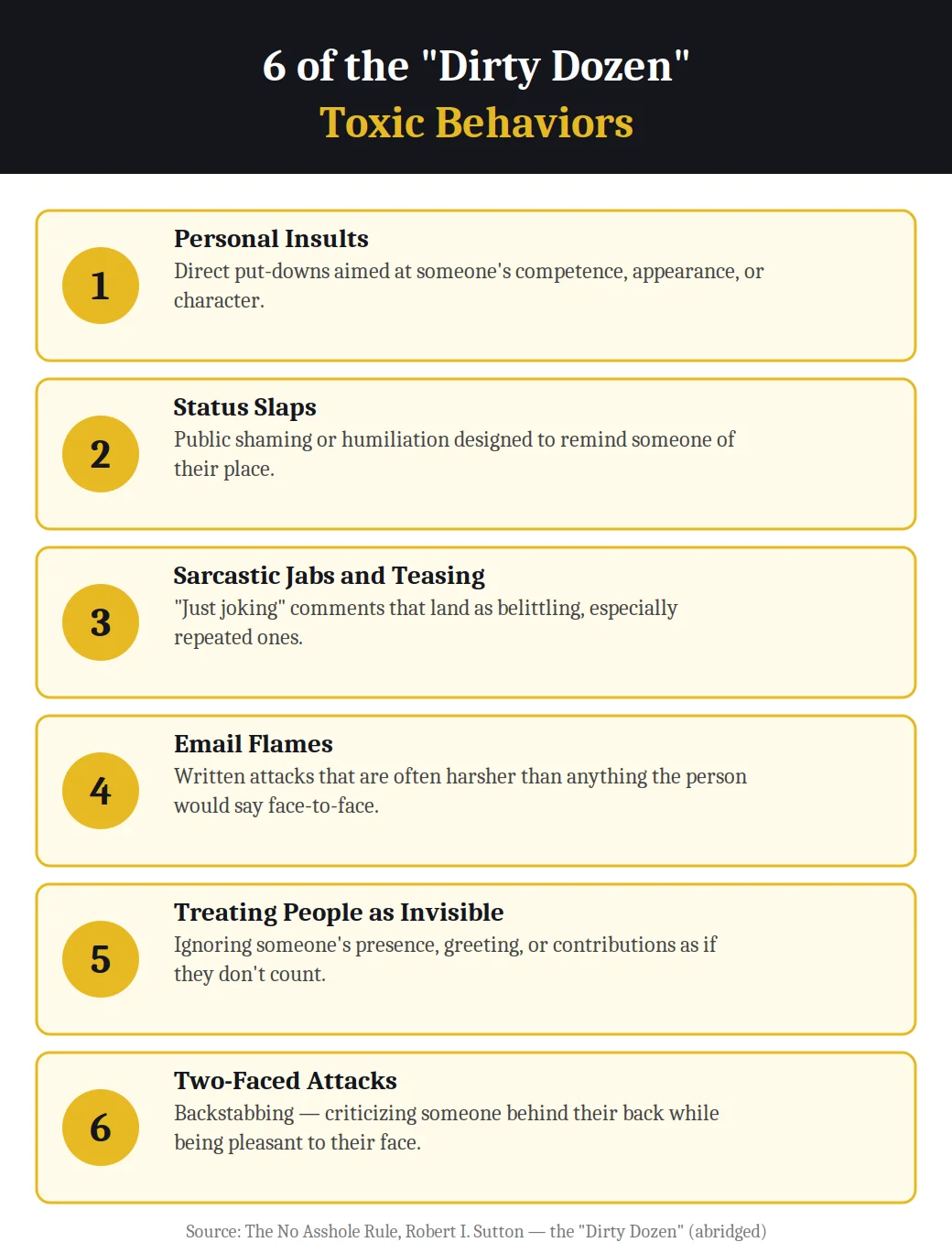
Sutton’s opening argument is deliberately unsentimental: this isn’t about niceness for its own sake, it’s about money. His “Total Cost of Assholes” framework adds up turnover among victims and witnesses, absenteeism, legal settlements, lost client relationships, and the less visible cost of colleagues who spend real time and energy avoiding, appeasing, or managing around one difficult person. He cites a case of a top-performing but abusive salesman whose behavior was estimated to cost his firm roughly $160,000 a year in turnover and lost productivity — despite his individual sales numbers looking excellent on paper.
TGR Note: This willingness to remove a high performer for behavior alone directly parallels Legacy‘s “no dickheads” selection policy — both books argue that unchecked toxicity is a competitive disadvantage, not a personnel footnote.
Part 2: Telling a bad day from a real pattern
Sutton is careful to distinguish a “temporary asshole” — someone having a stress-triggered bad moment, which he admits he’s guilty of himself — from a “certified” one, whose demeaning behavior is a consistent pattern across time, targets, and situations. The distinction matters because the response should differ: a direct conversation for the former, and a real institutional consequence for the latter. His two-question test cuts through ambiguity: does the person leave others feeling demeaned or de-energized, and do they specifically target people with less power than themselves? The second question is often the more revealing one, since downward nastiness toward subordinates makes up the large majority of real cases, and it’s exactly the kind of behavior that’s easiest for leadership to miss because it isn’t aimed at them.
TGR Note: This care in separating a stress lapse from a genuine pattern echoes Team of Rivals‘s account of Lincoln rarely holding grudges over isolated conflicts, while still recognizing chronic disloyalty, like Salmon Chase’s, when it actually mattered.
Part 3: Surviving what you can’t fix
Not everyone can quit or fire their way out of a toxic situation, and Sutton takes that seriously rather than treating it as a footnote. His survival tactics are concrete: limit your exposure by minimizing face time and batching interactions rather than staying open-ended and available; reframe the person’s behavior as data about them rather than a verdict on you; look for small wins — shortening a meeting, muting a disruptive voice — instead of trying to fix an entire culture at once; and quietly build alliances with other targets or witnesses, since isolation makes toxic dynamics far worse.
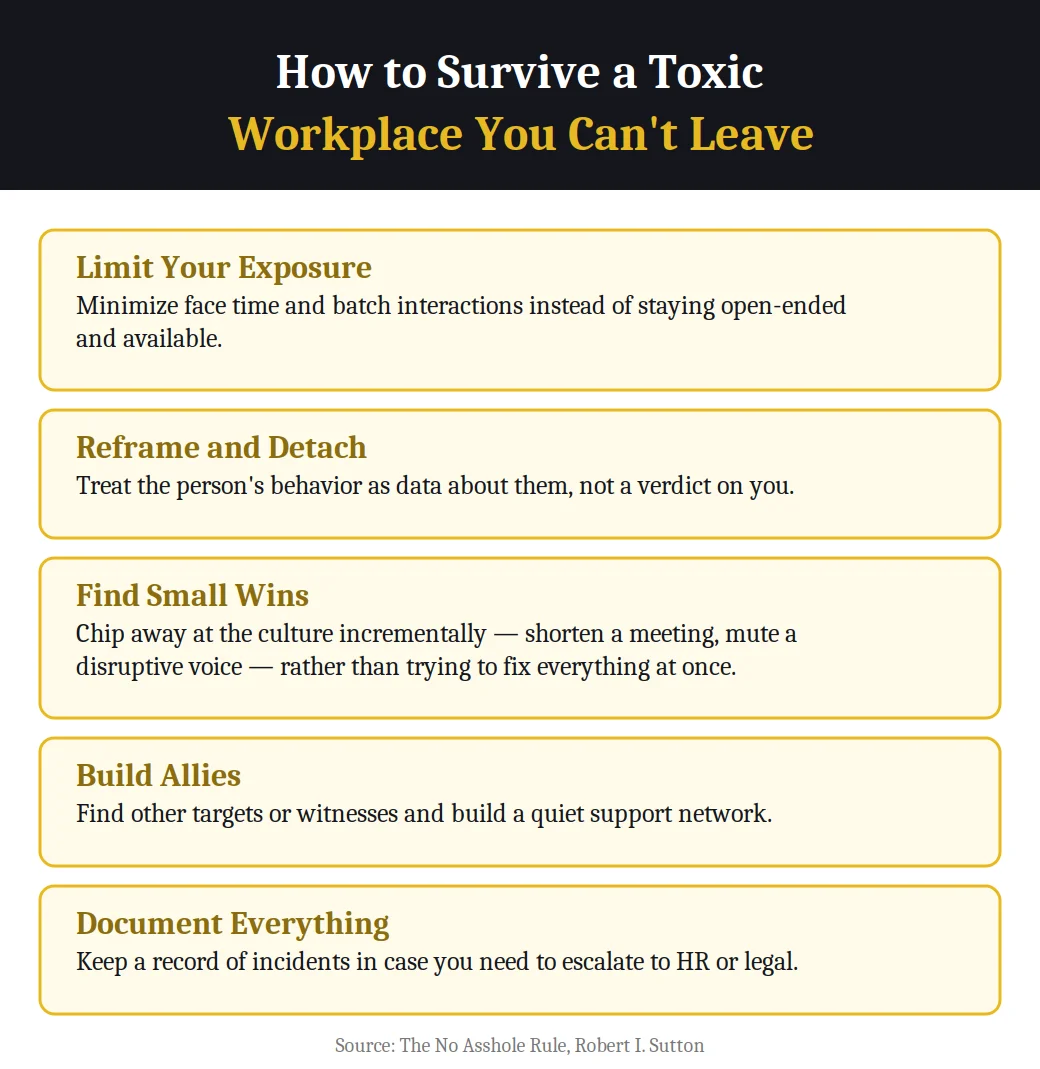
He also recommends documenting incidents as a matter of course, not paranoia, in case a pattern needs to be escalated formally later. The throughline across both the organizational and personal-survival halves of the book is the same: toxicity thrives on ambiguity and isolation, and both are reduced by naming the pattern clearly and refusing to normalize it.
Who is The No Asshole Rule best for — and who should read something else first?
This book is best for managers building hiring standards and culture policy, HR leaders deciding how to weigh a talented-but-difficult employee, and anyone currently working under a demeaning boss or coworker who needs concrete tactics, not just validation. Its short, direct chapters make it fast to read in a genuinely stressful moment.
If you want this same character-screening instinct applied to team culture more broadly, Legacy covers similar ground through the All Blacks’ “no dickheads” policy. If you’re focused on building organizational health at the leadership-team level rather than screening individuals, The Advantage offers a complementary framework. And if you want a historical case of tolerating genuine friction without tolerating demeaning behavior, Team of Rivals shows what that distinction looks like in practice.
Questions to reflect on
- Is there someone on your team whose talent you’ve been using to excuse a genuine pattern of demeaning behavior?
- Applying Sutton’s two-question test to yourself honestly — under stress, have you ever been the temporary asshole in the room?
- Does your hiring process actually screen for civility, or does it only measure skills and experience?
- If you’re dealing with a toxic boss or coworker right now, what’s one small win you could realistically pursue this week?
- Who could be a genuine ally for you in a difficult workplace situation — and have you actually reached out to them?
🔥 Ready to build — or survive — a more civilized workplace?
This guide covers the core framework — the book gives you Sutton’s full research, case studies, and detailed survival tactics.
How to apply The No Asshole Rule (7-day plan)
- Day 1: Apply the two-question test to one difficult relationship at work — is it a real pattern, or a bad day you’re overreacting to?
- Day 2: If you manage people, review your hiring process for whether it screens for civility at all, not just skills.
- Day 3: If you’re dealing with a difficult boss or coworker, identify one way to limit unnecessary exposure this week.
- Day 4: Practice reframing one demeaning interaction as data about the other person, not a verdict on you.
- Day 5: Identify one small, achievable win you can pursue instead of trying to fix the whole culture at once.
- Day 6: Reach out to one potential ally — someone else who’s noticed the same pattern you have.
- Day 7: Honestly self-assess: have you been a temporary asshole to someone with less power than you recently? Address it directly.
Frequently asked questions
What is the main idea of The No Asshole Rule?
That demeaning, power-abusing coworkers inflict measurable financial and organizational costs, and companies should enforce an explicit rule against them, even when they’re talented.
What is the “asshole test” in the book?
Two questions: does the person leave others feeling demeaned or de-energized, and do they specifically target people with less power? Yes to both signals a real problem.
What’s the difference between a temporary and a certified case?
A temporary case is a situational, stress-triggered lapse; a certified case is a chronic pattern of demeaning behavior across time, targets, and situations.
What is the “Total Cost of Assholes”?
Sutton’s framework for tallying the real financial impact of a toxic employee, including turnover, absenteeism, legal risk, and lost productivity of people managing around them.
What if I can’t leave a toxic workplace?
Sutton offers tactics including limiting exposure, emotionally detaching, pursuing small wins, building quiet alliances, and documenting incidents.
Which companies does the book cite as good examples?
Southwest Airlines and IDEO for screening candidates during hiring, and Men’s Wearhouse for firing a top-performing but abusive salesman.
How is this different from Legacy’s “no dickheads” policy?
They’re closely aligned in spirit — both argue toxic behavior should be screened out regardless of talent — though Sutton’s book is research-driven business writing, while Legacy applies the idea through one sports team’s culture.
Related summaries
If The No Asshole Rule resonated, these dig further into related territory: Legacy on the All Blacks’ “no dickheads” culture, The Advantage on building organizational health, and Team of Rivals on tolerating friction without tolerating toxicity. For more, see our best leadership books pillar page.
How we analyze books: We work from the full book — reconstructing its core arguments in our own words, adding commentary that connects it to related research and other books in our library, and pressure-testing the advice in a practical 7-day plan. Ratings weigh usefulness, readability, and evidence quality. Read our full methodology.