

TGR Verdict: ★★★★☆ 4.1/5
A practical, if pointedly gendered, guide that reframes marital conflict around five specific “losing strategies” and replaces them with a structured, teachable communication tool.
The New Rules of Marriage in one minute
Family therapist Terrence Real argues that lasting relationships depend less on who’s right and more on whether you can catch yourself running one of five destructive habits: needing to be right, controlling your partner, unbridled self-expression, retaliation, and withdrawal. Written primarily to help women get more of what they want from marriage by understanding these dynamics, the book replaces vague advice like “communicate better” with specific, teachable tools — most notably the four-step “Feedback Wheel” for raising a grievance without it turning into an accusation. Real’s central reframe: a good relationship isn’t something you have, it’s something you do, and objective reality — who’s technically correct — has no place in close personal relationships.
Key takeaways
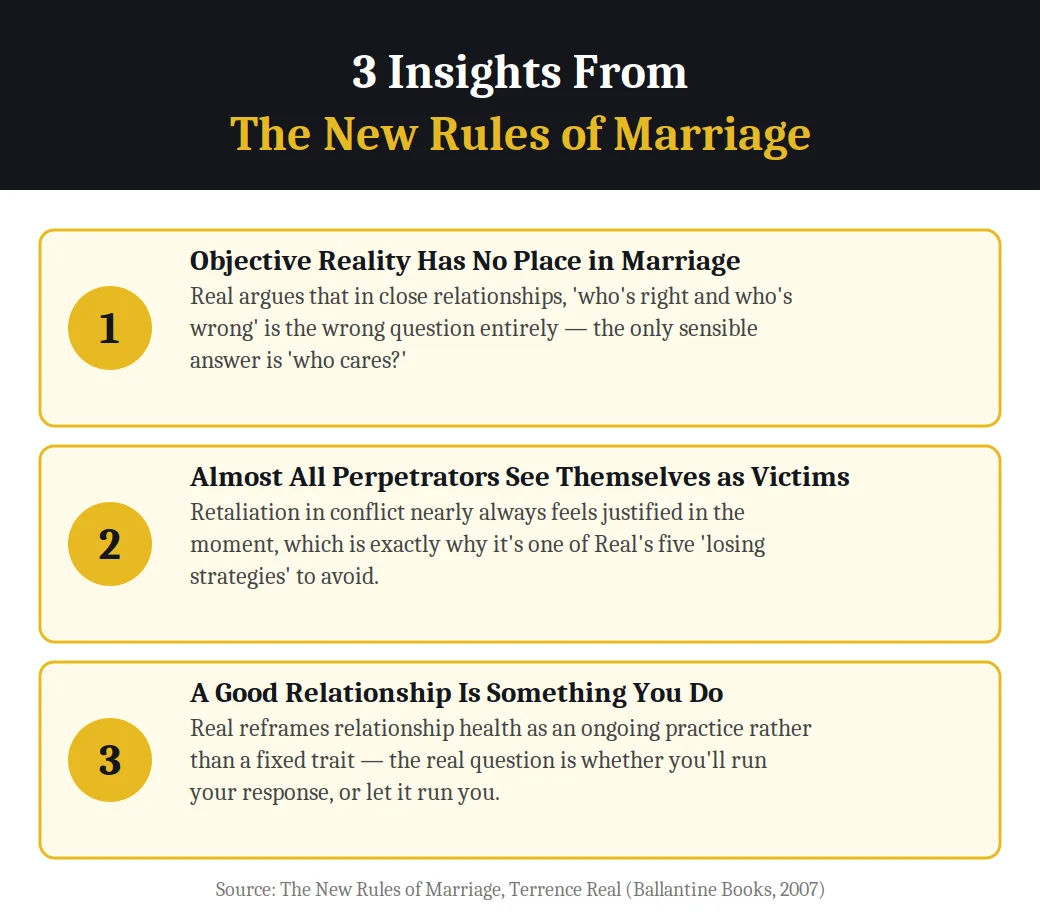
- Objective reality has no place in close personal relationships — the only sensible answer to “who’s right and who’s wrong” is “who cares?”
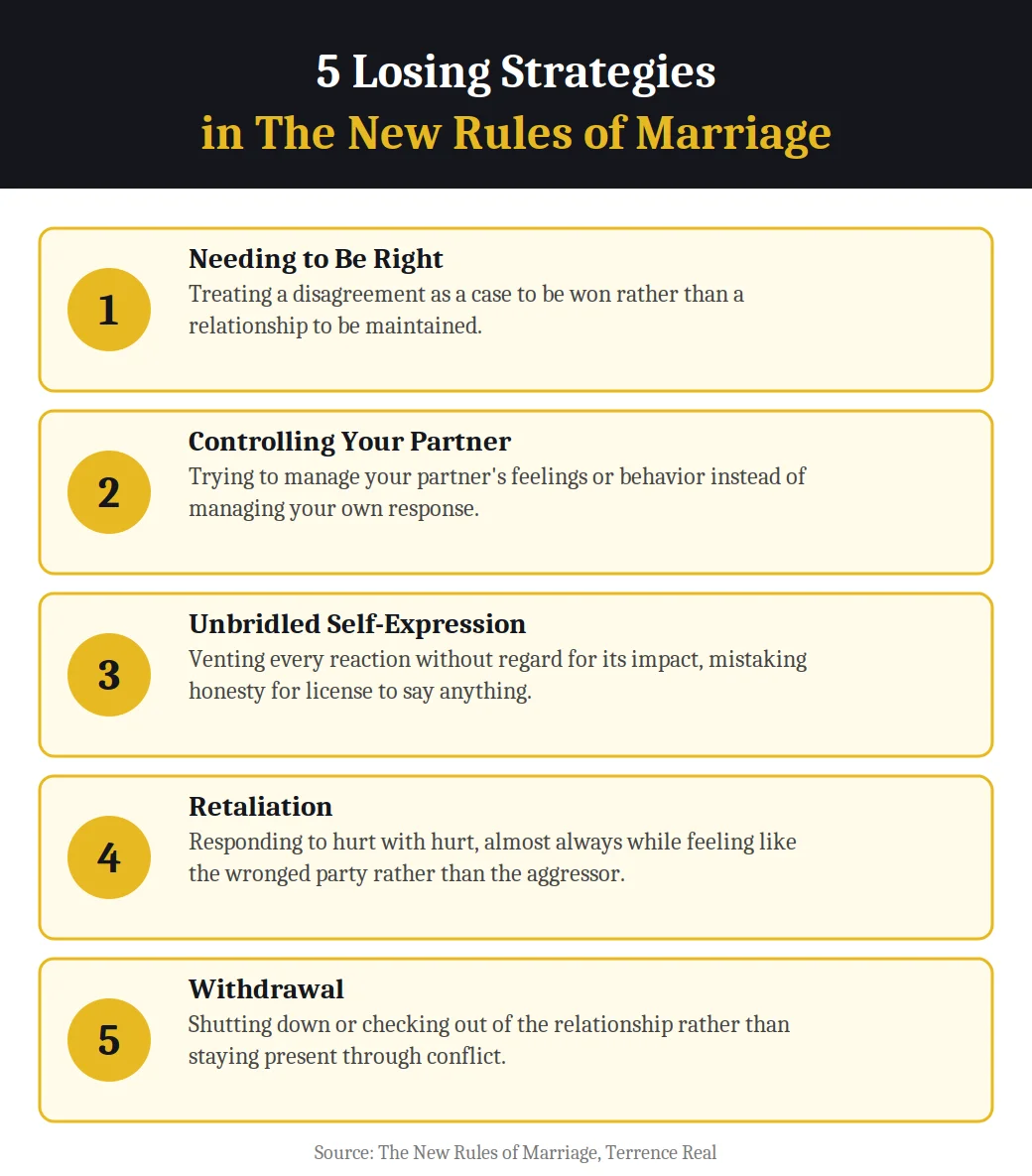
- There are five “losing strategies” that erode relationships: needing to be right, controlling your partner, unbridled self-expression, retaliation, and withdrawal.
- Almost all perpetrators of retaliation see themselves as victims in the moment, which is exactly why retaliation feels justified even when it’s destructive.
- A good relationship isn’t something you have but something you do — an ongoing practice rather than a fixed trait.
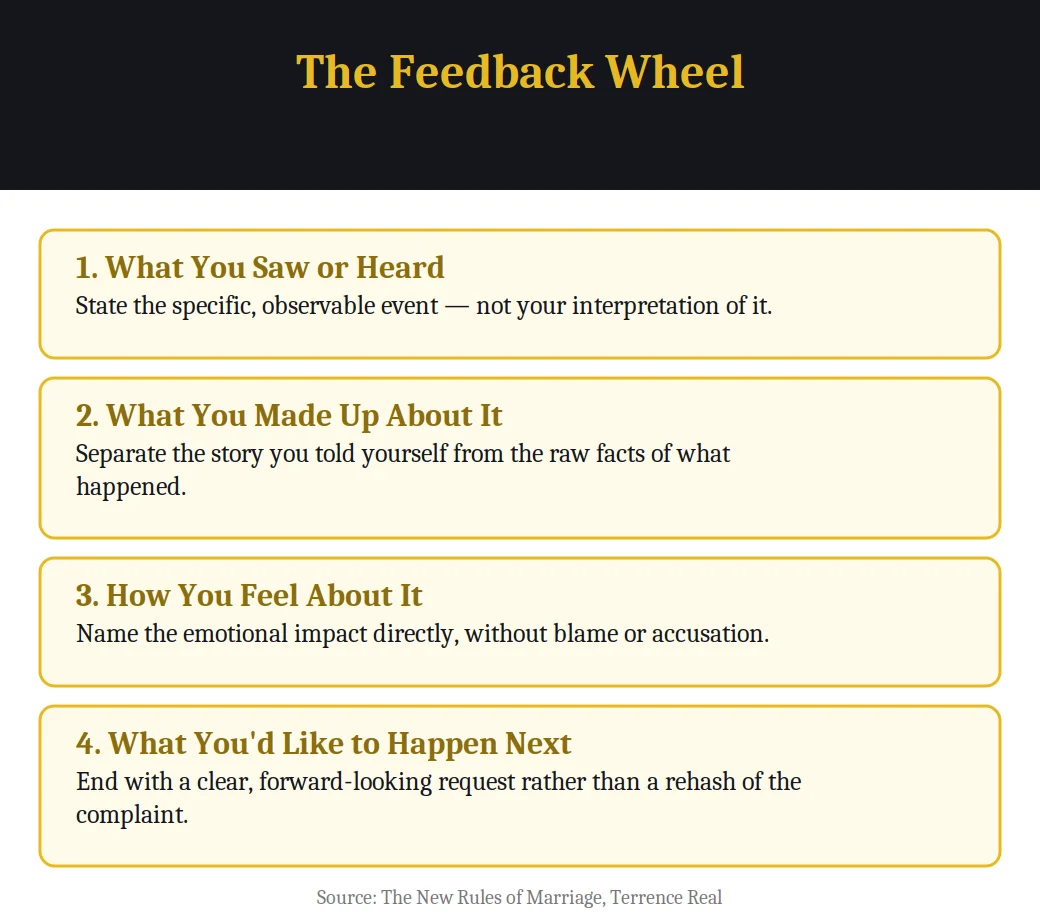
- The “Feedback Wheel” is a four-step structured way to raise a grievance: what you saw, what you made up about it, how you feel, and what you’d like to happen next.
- “Don’t criticize, ask” — shifting from a complaint about the past to a specific request for the future is one of the book’s core communication rules.
- Real challenges the “one-up/one-down” dynamic in relationships, arguing partners should relate from a position of “same-as” rather than dominance or submission.
- “Cherishing” your partner — actively appreciating what you have rather than only noticing what’s missing — is treated as a distinct, learnable skill.
- Real’s broader argument is that women have been socialized toward more relational skill over the past generation, while men often haven’t received equivalent training — creating a real skills gap couples need to name and address directly.
What is The New Rules of Marriage about?
The New Rules of Marriage is family therapist Terrence Real’s practical guide to marital conflict, built around a specific list of five “losing strategies” — needing to be right, controlling your partner, unbridled self-expression, retaliation, and withdrawal — that Real argues sabotage almost every relationship at some point. Rather than leaving readers with the vague instruction to “communicate better,” the book offers concrete replacements: asking instead of criticizing, cherishing what you have, and using a structured four-step tool called the Feedback Wheel to raise grievances without turning them into attacks. The book is explicitly framed around helping women navigate a generation-long gender gap in relational skill, while giving both partners a shared, teachable vocabulary for conflict.
About the author
Terrence Real is a family therapist who founded the Relational Life Institute in 2002 to train other therapists in his Relational Life Therapy model. He first became widely known for I Don’t Want to Talk About It (1997), a pioneering book on male depression, and later wrote How Can I Get Through to You? (2002), The New Rules of Marriage (2007), and Us (2022). His work has been featured on Today and Good Morning America and covered in The New York Times, Psychology Today, and Esquire. Explore all Terrence Real book summaries →
Key concepts at a glance
| Concept | What it means |
|---|---|
| The Five Losing Strategies | Needing to be right, controlling your partner, unbridled self-expression, retaliation, and withdrawal. |
| The Feedback Wheel | A four-step structured way to raise a grievance: what you saw, what you made up about it, how you feel, and what you’d like to happen next. |
| “Same-As” Positioning | Relating to a partner as an equal, rather than from a one-up (dominant) or one-down (submissive) position. |
| Cherishing | Actively appreciating what you have in a partner rather than only noticing what’s missing. |
| Objective Reality Has No Place in Marriage | Real’s rule that in close relationships, being technically right matters far less than staying connected. |
Part 1: The five losing strategies
Real opens by naming five specific habits that undermine relationships, arguing that couples rarely fail from a single dramatic betrayal — they erode gradually through these five patterns repeating over years. Needing to be right treats a disagreement as a case to win rather than a relationship to maintain. Controlling your partner substitutes managing someone else’s feelings for managing your own reaction. Unbridled self-expression mistakes venting for honesty, without regard for its impact. Retaliation responds to hurt with hurt, almost always while the retaliator feels like the wronged party rather than the aggressor. And withdrawal — shutting down rather than staying present through conflict — often looks like peace but is really just conflict deferred.
TGR Note: This idea that retaliation nearly always feels justified in the moment connects directly to the pursuer-distancer dynamics Harriet Lerner examines in The Dance of Anger, where anger is treated as information rather than simply something to vent or suppress.
Part 2: Replacing losing strategies with relational empowerment
Rather than leaving readers with just a list of what not to do, Real pairs each losing strategy with a specific replacement skill — what he terms relational empowerment. Instead of needing to be right, ask what your partner could do now or later that would feel right, rather than relitigating who was wrong. Instead of controlling, set clear limits on your own behavior. Instead of unbridled self-expression, discipline your reactions enough to say what’s true without the venom. And instead of withdrawal or retaliation, practice cherishing — actively noticing and voicing appreciation for what your partner already gives, rather than only cataloguing what’s missing.
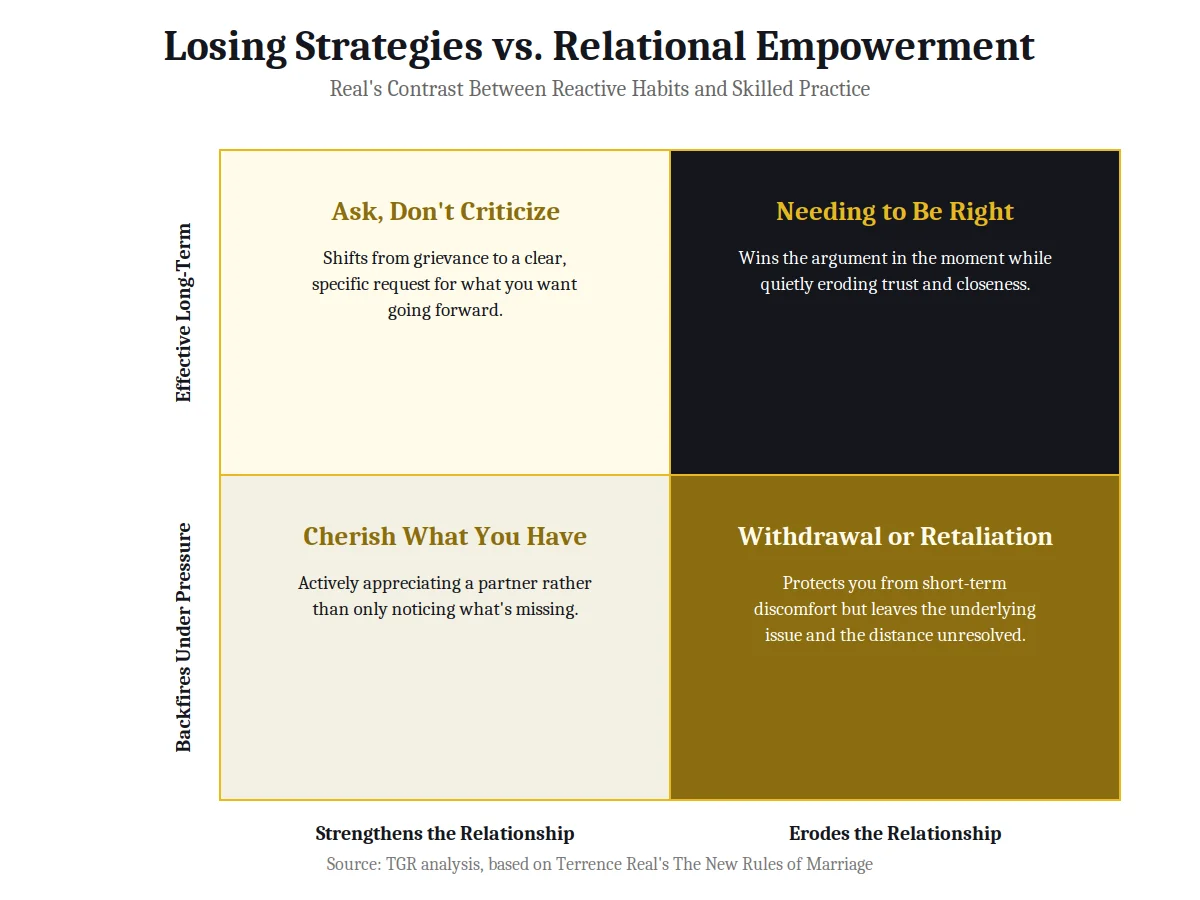
TGR Note: This shift from criticism to a clear, specific request echoes David Schnarch’s argument in our Passionate Marriage summary that conflict handled directly, rather than smoothed over or escalated, is what actually builds intimacy.
Part 3: The Feedback Wheel in practice
The book’s most concrete tool is the Feedback Wheel, a four-step structure for raising a grievance without it curdling into an attack: state what you saw or heard (the observable fact, not your interpretation), name what you made up about it (separating the story from the raw event), say how you feel about it without blame, and close with a specific request for what you’d like to happen going forward. Real presents this as a teachable skill rather than a personality trait — something either partner can practice regardless of how naturally “good at communication” they consider themselves.
Who is The New Rules of Marriage best for?
This book is best for couples who keep having the same unproductive fight and want specific, nameable habits to interrupt rather than another vague call to “communicate better.” Its explicit framing toward women navigating a gender gap in relational skill makes it especially resonant for readers in heterosexual marriages, though the underlying tools (the Feedback Wheel, the five losing strategies) apply to any relationship dynamic.
It pairs well with our Passionate Marriage summary for a more clinically oriented take on marital conflict, or our The Dance of Anger summary for more on the emotional roots of retaliation and withdrawal.
Questions to reflect on
- Which of the five losing strategies — needing to be right, controlling, unbridled self-expression, retaliation, or withdrawal — do you fall into most often?
- Can you recall a recent conflict where being “right” mattered more to you than staying connected to your partner?
- Do you tend to relate to your partner from a one-up, one-down, or same-as position?
- When was the last time you actively voiced appreciation for something your partner does, rather than only noting what’s missing?
- What would it look like to use the Feedback Wheel the next time a familiar grievance comes up?
How to apply The New Rules of Marriage (7-day plan)
- Day 1: Identify which of the five losing strategies you rely on most often in conflict.
- Day 2: Notice one moment where needing to be right mattered more to you than staying connected.
- Day 3: Practice the first two steps of the Feedback Wheel: state what you saw, then what you made up about it.
- Day 4: Add the final two steps: name how you feel, then make a specific request for what you’d like next.
- Day 5: Voice one genuine piece of appreciation for your partner, unprompted.
- Day 6: Notice a moment you want to withdraw or retaliate, and choose to stay present instead.
- Day 7: Reflect on whether you relate to your partner from a one-up, one-down, or same-as position, and what shifting it might look like.
Frequently asked questions
What are the five “losing strategies” in The New Rules of Marriage?
The five losing strategies are needing to be right, controlling your partner, unbridled self-expression, retaliation, and withdrawal — habits Terrence Real argues erode relationships over time.
What is the Feedback Wheel?
The Feedback Wheel is a four-step structured way to raise a grievance: state what you saw or heard, what you made up about it, how you feel, and what you’d like to happen next.
Is The New Rules of Marriage written mainly for women?
Yes — the book is explicitly framed around helping women navigate a generation-long gender gap in relational skill, though its core tools apply to either partner in any relationship.
What does Terrence Real mean by “same-as” positioning?
It’s his term for relating to a partner as an equal, rather than from a one-up (dominant) or one-down (submissive) position.
Who is Terrence Real?
Terrence Real is a family therapist who founded the Relational Life Institute in 2002 and is also known for I Don’t Want to Talk About It (1997), a pioneering book on male depression.
What does “cherishing” mean in this book?
Cherishing is Real’s term for actively noticing and voicing appreciation for what a partner already gives, rather than only cataloguing what’s missing.
Has The New Rules of Marriage received any criticism?
Some readers have noted the book’s framing can feel dated or one-sided, placing more of the burden of relational repair on women, even as most reviewers find its practical tools, like the Feedback Wheel, genuinely useful.
Related summaries
If you found The New Rules of Marriage valuable, read our Passionate Marriage summary for more on marital intimacy, or explore our full list of best relationship books.
Our methodology: TGR book summaries are researched using the original text, publisher materials, author interviews, and critical reception, then structured to give you the core arguments, practical applications, and an honest verdict on who the book is best for.