

★★★★★ 4.5/5 — A short, plain-language case that a simple, mechanical formula — buy good businesses at bargain prices — can beat the market, if you have the discipline to stick with it.
Best for: readers who want a jargon-free introduction to systematic value investing and the psychology required to actually follow it · Reading time: ~4 hrs (this guide: ~11 min) · Difficulty to apply: Moderate — the formula itself is simple, sticking with it through underperformance is genuinely hard
The Little Book That Still Beats the Market in one minute
Joel Greenblatt argues you can systematically beat the market by combining two simple ideas: buy good businesses, and buy them at bargain prices — and his “Magic Formula” turns that combination into a mechanical, repeatable process. The formula ranks stocks by earnings yield (EBIT divided by enterprise value, a cheapness measure that fairly accounts for debt and cash) and return on capital (a quality measure showing how efficiently a business turns capital into profit), then combines the two rankings to surface companies that are both well-run and inexpensive. Originally written for his own children using simple, jargon-free analogies — including a schoolyard gum-selling stand that teaches how a business’s worth relates to the money it generates — the book backtests the formula from 1988 through 2009, showing it substantially outperforming the S&P 500 over that period. The catch, and the book’s real subject, is that the formula underperforms the market in roughly 4 or 5 months out of every 12, and can lag for full multi-year stretches — which is exactly why Greenblatt argues most investors abandon systematic strategies before they pay off.
Key takeaways
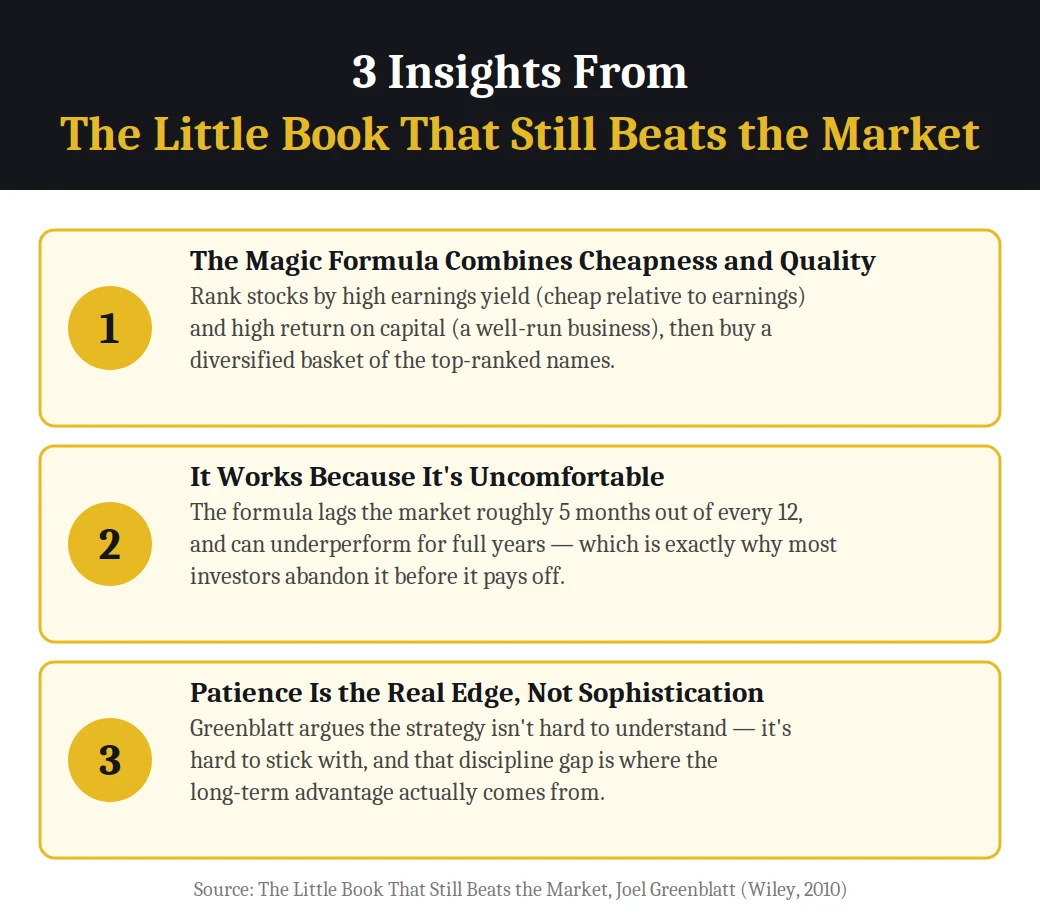
- The Magic Formula combines cheapness and quality: rank stocks by high earnings yield (cheap relative to earnings) and high return on capital (a well-run business), then buy a diversified basket of the top-ranked names.
- Earnings yield beats a simple P/E ratio: EBIT divided by enterprise value accounts for a company’s debt and cash, letting you compare businesses with very different capital structures fairly.
- Return on capital measures true business quality: a company that generates high profit per dollar of capital invested usually has some form of durable competitive advantage.
- The formula is Graham-and-Buffett value investing, systematized: “buy good businesses at bargain prices” is the same principle legendary value investors use by feel, mechanically replicated as a repeatable process.
- Backtested results were striking: from 1988 to 2009, the formula’s top-ranked stocks substantially outperformed the S&P 500 on an annualized basis, even after accounting for a $1 billion-plus market-cap universe.
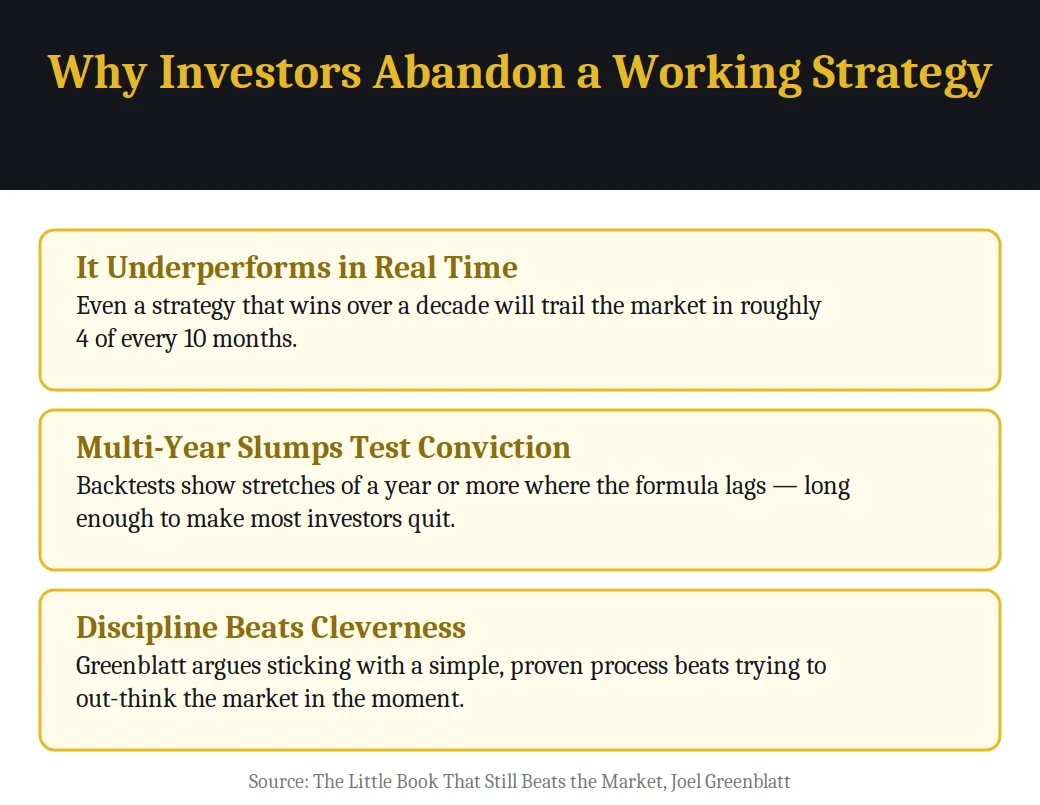
- It underperforms often — and that’s the point: the strategy lags the market roughly 4 to 5 months out of every 12, and can trail for full years, testing the conviction of anyone following it.
- Most investors abandon working strategies too early: Greenblatt argues that discomfort, not lack of knowledge, is what causes people to quit systematic approaches right before they’d pay off.
- Mr. Market should be exploited, not obeyed: borrowing Benjamin Graham’s metaphor, Greenblatt argues the market is irrational day to day but tends to “get it right” over a 2-3 year horizon.
- Patience is the real edge, not sophistication: the formula itself isn’t difficult to understand — sticking with it through uncomfortable stretches is the actual skill the book is teaching.
What is The Little Book That Still Beats the Market about?
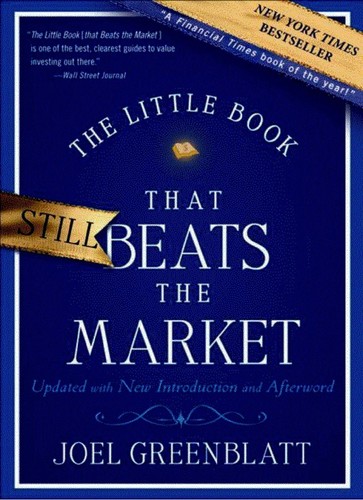
The Little Book That Still Beats the Market is Joel Greenblatt’s case that a simple, mechanical “Magic Formula” — ranking stocks by earnings yield and return on capital, then buying a diversified basket of the top-ranked companies — can systematically outperform the broader market over time. Originally written for his own children and built around plain-language analogies rather than financial jargon, the book explains value investing principles in a way accessible to a complete beginner, then backs the strategy with two decades of backtested performance data. First published in 2005 as The Little Book That Beats the Market and updated in 2010 with new performance data through the 2008 financial crisis, the book’s real argument isn’t just about the formula’s mechanics — it’s about the emotional discipline required to keep following a strategy through the periods when it doesn’t work.
About the author
Joel Greenblatt is an American investor, hedge fund manager, and academic best known as the founder of Gotham Capital, an investment partnership that reportedly returned over 40% annualized to investors during its first two decades. He is a professor at Columbia Business School, where he has taught value investing, and co-founder of Gotham Asset Management. Greenblatt developed the “Magic Formula” investing strategy at the center of this book — a systematic way of identifying good businesses trading at bargain prices — and originally wrote the book for his own children, explaining sophisticated value-investing principles through simple, jargon-free analogies like a schoolyard gum-selling stand. Explore all Joel Greenblatt book summaries →
Key concepts at a glance
| Concept | What it means | Use it when |
|---|---|---|
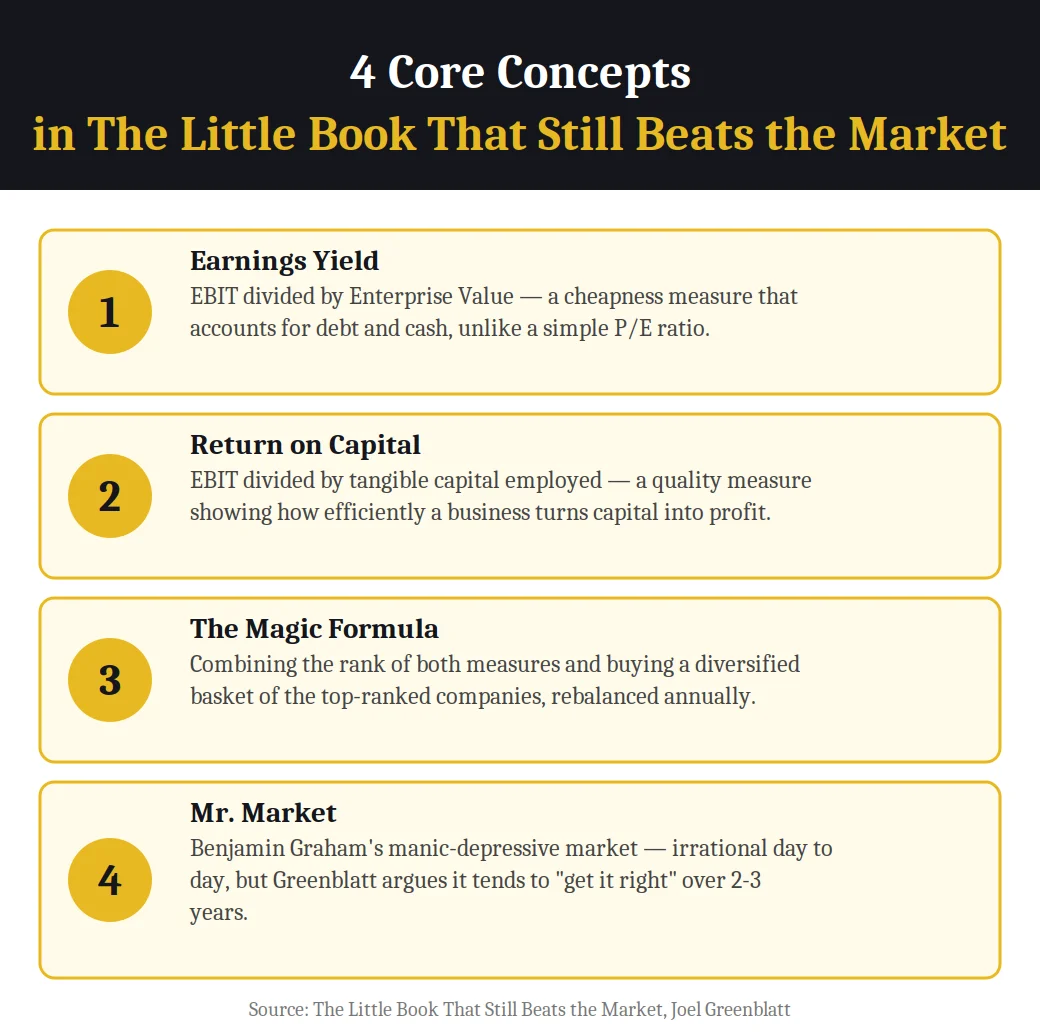
| Earnings Yield | EBIT divided by Enterprise Value — a cheapness measure that accounts for debt and cash | You’re comparing how “cheap” two companies with different capital structures really are |
| Return on Capital | EBIT divided by tangible capital employed — a measure of business quality | You’re assessing whether a company has a durable competitive advantage |
| The Magic Formula | Combining both rankings and buying a diversified basket of the top companies, rebalanced annually | You want a systematic, repeatable process instead of picking stocks by feel |
| Mr. Market | Benjamin Graham’s manic-depressive market, irrational short-term but rational over years | Market volatility is tempting you into an emotional, reactive decision |
| Discipline Over Sophistication | Sticking with a proven process through underperformance, rather than abandoning it | A strategy you believe in is going through a rough stretch |
Part 1: What the Magic Formula actually measures
Greenblatt builds the formula from two ideas any investor can understand. Earnings yield — EBIT divided by enterprise value — measures cheapness more fairly than a simple price-to-earnings ratio, because it accounts for a company’s debt and cash rather than comparing raw share prices. Return on capital measures quality: how efficiently a business turns the capital invested in it into profit, which usually signals some form of durable competitive advantage, whether that’s a strong brand, unique product, or structural cost edge. Greenblatt illustrates the underlying logic with a simple, kid-friendly example — a schoolyard gum-selling stand versus a branded gum-manufacturing company — showing that a business’s true worth is a multiple of the money it reliably generates, not just how much it costs to set up.
TGR Note: Greenblatt’s “buy good businesses at bargain prices” logic echoes Winning the Loser’s Game‘s emphasis on cost discipline and patience — both books argue the hardest part of investing well is behavioral, not analytical.
Part 2: Why cheap and quality have to go together
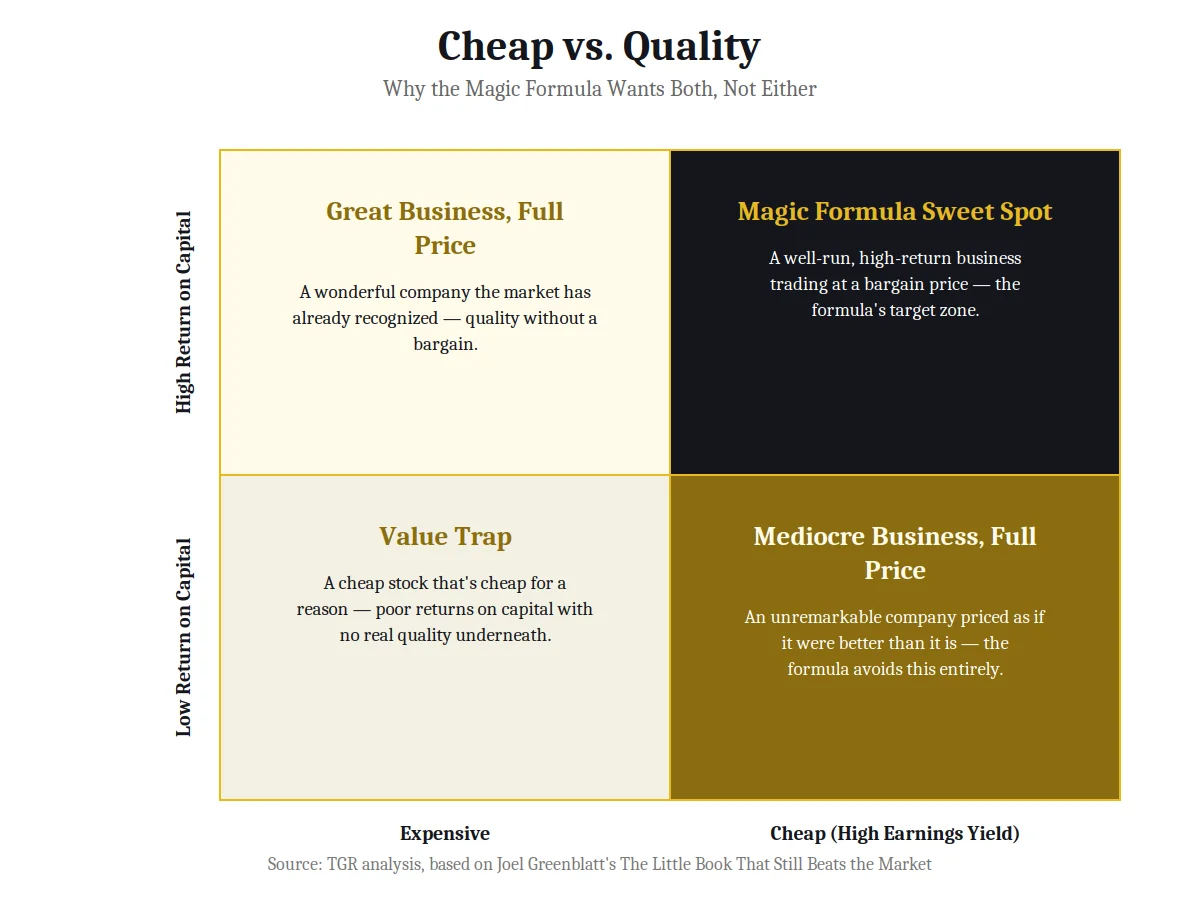
The formula’s real insight is that cheapness and quality alone are each dangerous in isolation. A cheap stock with poor returns on capital is often a “value trap” — cheap for a very good reason, with no underlying quality to reward patience. A high-quality business trading at a full price offers little margin of safety, since the market has already recognized its strengths. Greenblatt’s Magic Formula deliberately targets the intersection: well-run, high-return businesses that happen to be trading at a bargain, a combination the market periodically creates through short-term overreaction, neglect, or temporary bad news that doesn’t reflect the company’s long-term earning power.
Part 3: Why the formula works precisely because it’s uncomfortable
Greenblatt’s backtests, run from 1988 through 2009 across a universe of companies worth $1 billion or more, showed the Magic Formula substantially outperforming the S&P 500 on an annualized basis — but not smoothly. The strategy lagged the broader market in roughly 4 to 5 months out of every 12, and experienced full multi-year stretches of underperformance during the study period. This, Greenblatt argues, is precisely why the edge persists: a strategy that worked every single month would quickly get arbitraged away as everyone piled in, while a strategy that’s uncomfortable enough to trigger doubt keeps most investors from sticking with it long enough to capture its long-run advantage. He borrows Benjamin Graham’s “Mr. Market” metaphor to make the same point from a different angle — the market is a manic-depressive business partner, irrational day to day, but one that tends to “get it right” over a longer horizon if you have the patience to wait.
Who is The Little Book That Still Beats the Market best for — and who should read something else first?
This book is best for readers who want a short, plain-language introduction to systematic value investing — including complete beginners, since it was written for exactly that audience. Its brevity and simple analogies make it one of the fastest classic investing books to finish, though it rewards readers willing to sit with the discomfort the strategy describes rather than expecting an easy win.
If you want the deeper case for why patience and low costs matter more than cleverness in investing generally, Winning the Loser’s Game makes a complementary argument from the indexing side of the debate.
Questions to reflect on
- Have you ever abandoned a sound financial strategy simply because it underperformed for a while — and what did that decision actually cost you?
- Can you name a “value trap” you’ve been tempted by — something cheap that was cheap for a good reason?
- Do you currently have a systematic, repeatable process for evaluating investments, or are decisions made case by case, by feel?
- How would you react, honestly, if a strategy you believed in underperformed the market for a full year?
- Where else in your life — not just investing — do you abandon good processes too early because of short-term discomfort?
🔥 Ready to see whether you have the patience the Magic Formula demands?
This guide covers the core framework — the book gives you Greenblatt’s full backtested data, analogies, and step-by-step explanation.
How to apply The Little Book That Still Beats the Market (7-day plan)
- Day 1: Learn the two Magic Formula metrics — earnings yield and return on capital — well enough to explain them to someone else.
- Day 2: Look up one company you already know well and estimate whether it would rank as “cheap,” “quality,” both, or neither.
- Day 3: Identify a past investment decision where you abandoned a strategy right before or during a rough patch — what triggered the exit?
- Day 4: Write down what “sticking with it” would honestly feel like if a chosen strategy underperformed for six straight months.
- Day 5: Practice Greenblatt’s Mr. Market reframe: pick a recent market headline and describe it as an irrational mood swing, not new information.
- Day 6: Research how a simple systematic screen (value, quality, or both) has performed historically versus a broad index.
- Day 7: Decide, in writing, one investing rule you’ll commit to following even when it feels uncomfortable.
Frequently asked questions
What is the Magic Formula?
A systematic strategy that ranks stocks by earnings yield and return on capital, then buys a diversified basket of the top-ranked companies.
What is earnings yield?
EBIT divided by Enterprise Value — a cheapness measure that fairly accounts for a company’s debt and cash.
What is return on capital?
EBIT divided by tangible capital employed — a measure of how efficiently a business turns capital into profit.
Does the Magic Formula always beat the market?
No — it underperforms roughly 4 to 5 months out of every 12 and can lag for full multi-year stretches, which is central to the book’s argument.
Who is this book written for?
Greenblatt originally wrote it for his own children, so it uses plain-language analogies rather than financial jargon.
Who is Mr. Market?
Benjamin Graham’s metaphor for a manic-depressive market that’s irrational short-term but tends to “get it right” over years.
How is this different from Winning the Loser’s Game?
This book advocates a systematic stock-picking formula, while Winning the Loser’s Game makes the case for low-cost index investing instead.
Related summaries
If The Little Book That Still Beats the Market resonated, these dig further into related territory: Winning the Loser’s Game on disciplined, low-cost investing, The Undercover Economist on how markets price value, and other titles in our best money and economics books pillar page.
How we analyze books: We work from the full book — reconstructing its core arguments in our own words, adding commentary that connects it to related research and other books in our library, and pressure-testing the advice in a practical 7-day plan. Ratings weigh usefulness, readability, and evidence quality. Read our full methodology.