

★★★★☆ 4.3/5 — A sharp, uncomfortable case that self-deception is strategic, and that many of our most familiar institutions run on hidden status motives we’d rather not admit even to ourselves.
Best for: skeptics of stated motives, students of institutions, and anyone willing to question their own noble self-image · Reading time: ~8 hrs (this guide: ~15 min) · Difficulty to apply: Moderate — the framework is easy to grasp, applying it honestly to yourself is uncomfortable
The Elephant in the Brain in one minute
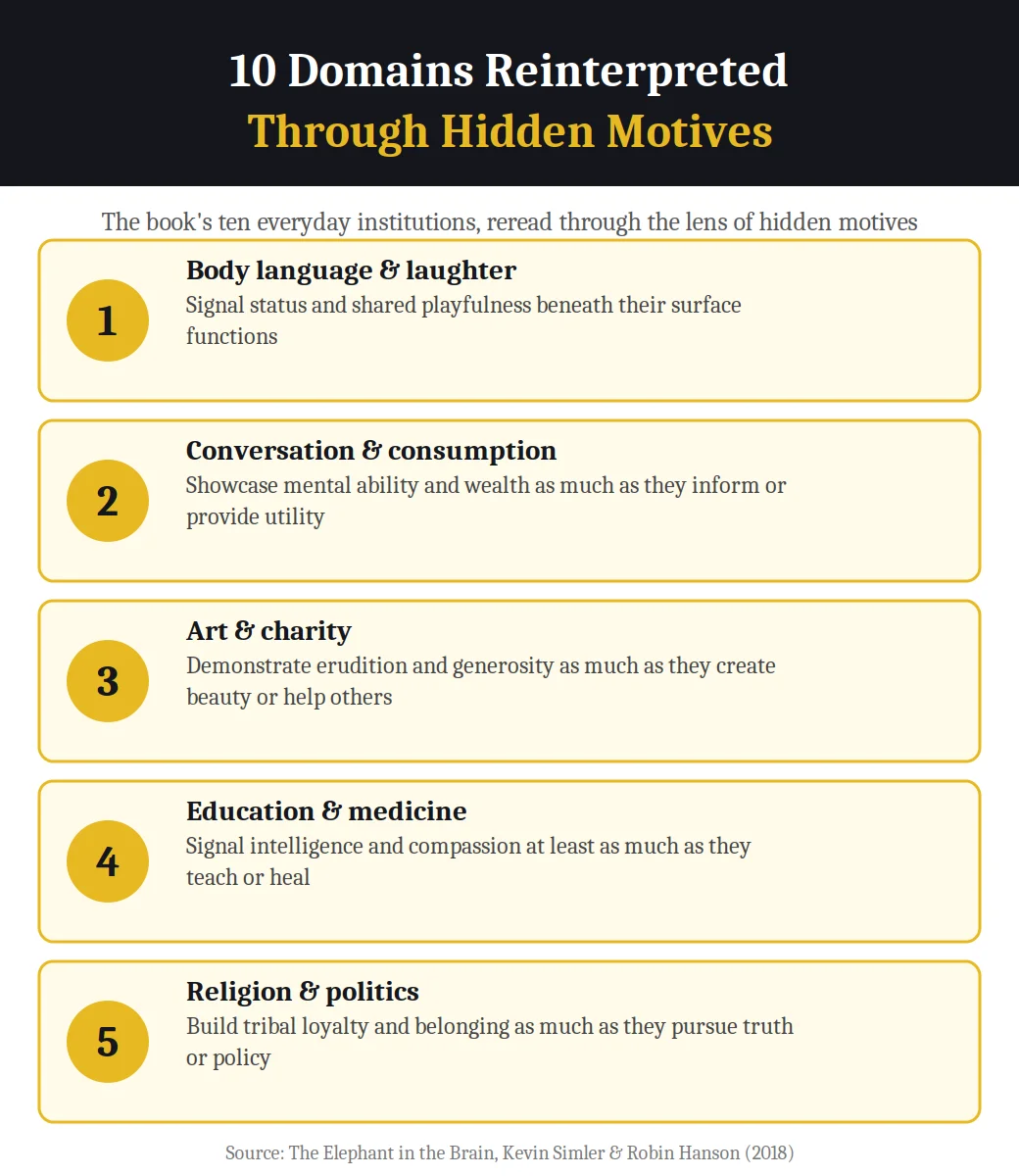
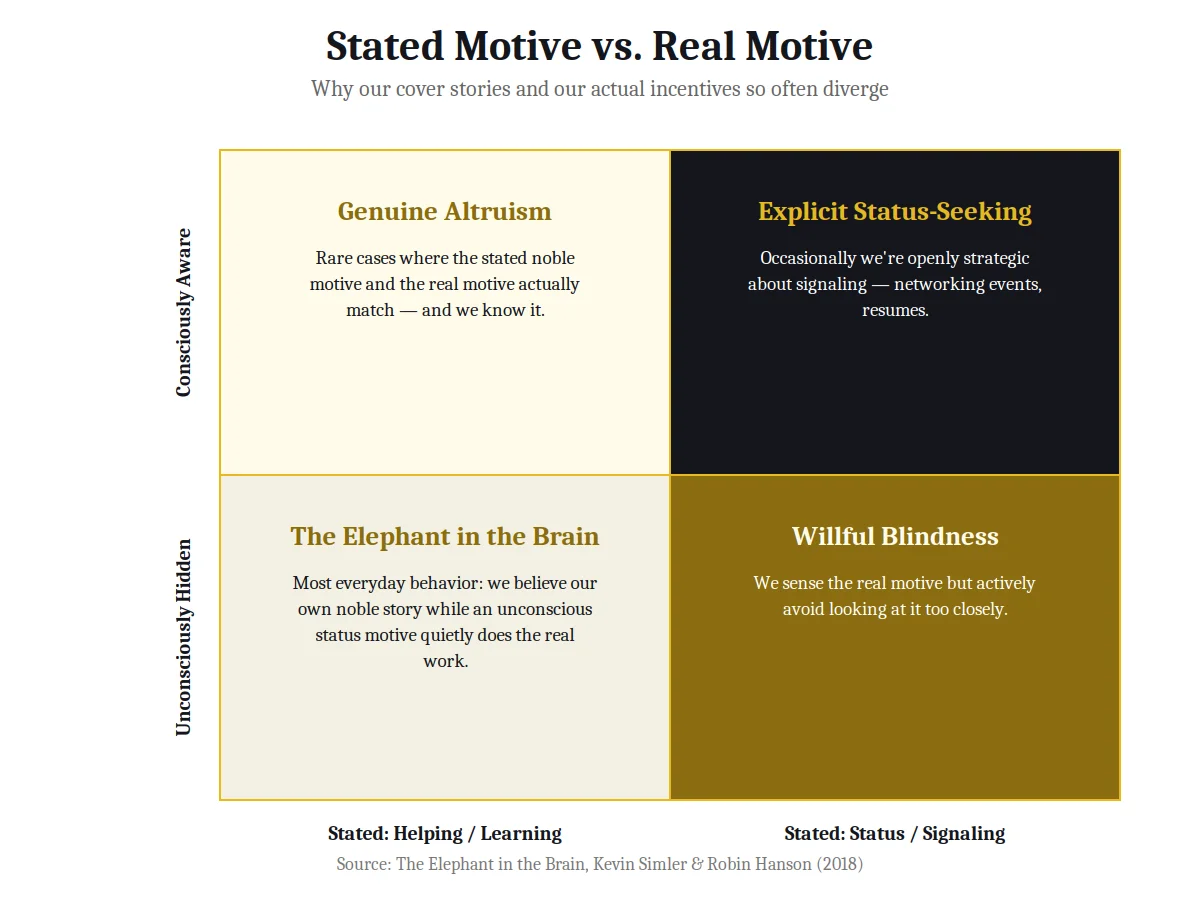
We’re not liars so much as we’re strategically self-deceived — the real reasons behind our behavior are hidden from other people, and from ourselves. Kevin Simler and Robin Hanson’s 2018 book argues that human self-deception isn’t an accident of imperfect self-knowledge; it’s an adaptive strategy. Because other people are constantly on the lookout for hidden, self-interested motives, the most convincing way to conceal a selfish motive is to genuinely not know you have it — you can’t leak a secret you’re unaware of keeping. Building on signaling theory and evolutionary psychology, Simler and Hanson apply this “hidden motives” lens to ten everyday domains — body language, laughter, conversation, consumption, art, charity, education, medicine, religion, and politics — arguing that in each case, the stated, noble-sounding purpose coexists with an unconscious, status-driven real purpose that does much of the actual work.
Key takeaways
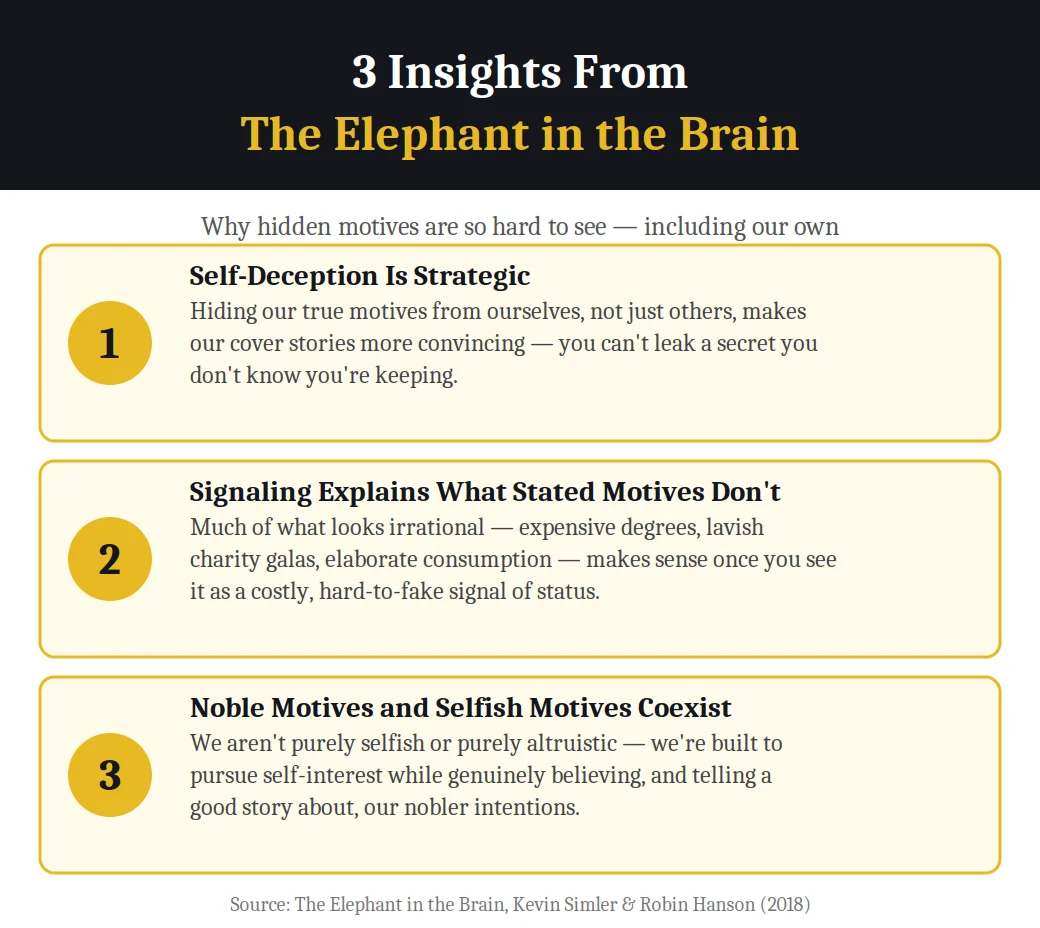
- Self-deception is a strategy, not a flaw: concealing your own motives from yourself makes your outward story more convincing, since you’re not consciously managing a lie.
- Signaling explains behavior that looks otherwise irrational: expensive degrees, lavish charity galas, and elaborate consumption make more sense once understood as costly, hard-to-fake signals of status rather than purely functional choices.
- Noble motives and selfish motives coexist: the authors argue we’re built to genuinely believe our own good intentions while an unconscious status motive quietly does much of the real work.
- Body language and laughter carry hidden signals: posture communicates status, and laughter functions partly as a shared signal of play and safety rather than a pure response to humor.
- Conversation and consumption showcase more than they inform: conversation displays mental agility and knowledge as much as it exchanges information, and consumption signals wealth as much as it satisfies need.
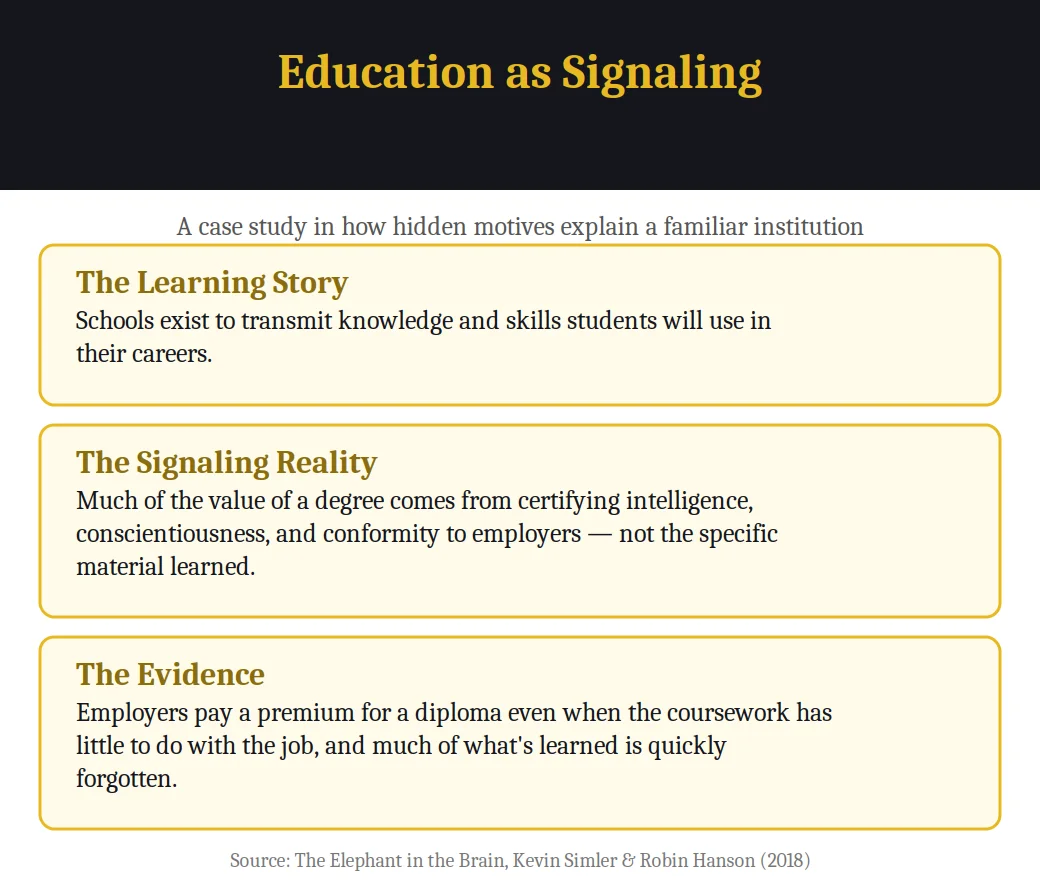
- Education is largely about signaling, not learning: much of a degree’s value comes from certifying intelligence, conscientiousness, and conformity to employers rather than the specific material studied.
- Medicine often signals caring more than it produces health: regions and individuals that spend more on healthcare don’t consistently show correspondingly better health outcomes.
- Charity signals generosity as much as it helps: donors rarely evaluate the cost-effectiveness of where their money goes, which is hard to explain if the primary goal were maximizing impact.
- Religion and politics build tribal loyalty: both function partly as loyalty and belonging rituals for a group, alongside their stated pursuit of truth or policy outcomes.
What is The Elephant in the Brain about?
The Elephant in the Brain is Kevin Simler and Robin Hanson’s argument that humans routinely hide selfish motives from themselves, not just from others, because self-deception makes those hidden motives more convincing and harder to detect. Drawing on signaling theory and evolutionary psychology, the authors argue this pattern isn’t limited to occasional white lies — it structures entire institutions. The book applies this “hidden motives” lens to ten everyday domains, from body language and laughter to education, medicine, charity, religion, and politics, arguing that in each case a noble stated purpose coexists with an unconscious, status-driven real purpose that does much of the actual work.
About the author
Kevin Simler is a writer and software engineer known for his blog Melting Asphalt, which explores human behavior through evolutionary psychology and hidden incentives. Robin Hanson is an economist and professor at George Mason University, known for his research on prediction markets, medical economics, and the self-interested motives people are reluctant to acknowledge even to themselves. Together they co-authored The Elephant in the Brain, published in 2018, applying signaling theory to reinterpret ten everyday institutions through the hidden motives that actually drive them. Explore all Kevin Simler & Robin Hanson book summaries →
Key concepts at a glance
| Concept | What it means | Use it when |
|---|---|---|
| Strategic self-deception | Hiding your own motives from yourself makes your outward story more convincing to others | Your stated reason for doing something doesn’t fully explain your behavior |
| Signaling theory | Costly, hard-to-fake behaviors and purchases communicate status, wealth, or virtue | A behavior seems economically wasteful but persists anyway |
| Education as signaling | Degrees certify intelligence, conscientiousness, and conformity more than they transmit specific job skills | You’re evaluating the real value of a credential versus the learning itself |
| Medicine as caring signal | Healthcare spending often signals compassion and attentiveness more reliably than it improves health outcomes | You’re assessing whether more spending or intervention actually helps |
| Charity as generosity signal | Donations often function as a signal of wealth and compassion more than as cost-effective altruism | You’re evaluating your own or others’ giving decisions |
Part 1: Why we deceive ourselves
Simler and Hanson open by establishing the core mechanism: self-deception as a strategy rather than a flaw. Because humans are highly attuned to detecting hidden, self-interested motives in others, someone who’s aware of their own selfish motive risks leaking it through body language, tone, or a slip of the tongue. But someone who’s genuinely unaware of their own hidden motive has nothing to leak — their sincerity is real, even though the underlying story is incomplete. This is why, the authors argue, we’re often the last to recognize our own status-seeking, self-interested behavior, even as we’re quite good at spotting it in others.
TGR Note: This connects directly to Thinking, Fast and Slow‘s account of how much mental processing happens outside conscious awareness — both books argue that the stories we tell ourselves about our own reasoning are often reconstructed after the fact rather than genuinely causal.
Part 2: Signaling in everyday behavior
The book’s first application of the framework covers everyday behaviors that seem simple on the surface: body language, laughter, and conversation. Posture and body language communicate relative status even when no words are exchanged. Laughter functions partly as a signal of shared play and safety, which is why people laugh more in groups and in the presence of higher-status individuals, independent of how funny something objectively is. Conversation, meanwhile, showcases mental agility, knowledge, and wit as much as it transmits useful information — much of ordinary conversation is a performance of competence rather than a pure information exchange.
TGR Note: The signaling lens on everyday consumption pairs well with Predictably Irrational‘s account of how much of consumer behavior is driven by relative comparison and social context rather than pure utility.
Part 3: Stated motives versus real motives in institutions
The book’s most provocative section applies the framework to major institutions people rarely think to question. Education, the authors argue, is substantially about signaling rather than learning: much of a degree’s value to employers comes from certifying intelligence, conscientiousness, and conformity, not the specific material studied, which helps explain why employers pay a premium for a diploma even when coursework has little direct relevance to the job, and why so much of what’s learned is quickly forgotten.
Medicine, similarly, is reinterpreted as substantially about signaling caring rather than reliably producing health — regions and individuals that spend considerably more on healthcare don’t consistently show correspondingly better health outcomes, which is hard to explain if health improvement were the sole goal. Charity gets the same treatment: donors rarely evaluate the cost-effectiveness of where their money actually goes, which suggests that giving functions partly as a signal of wealth, generosity, and compassion rather than purely as optimized altruism. Religion and politics round out the list, both framed as building tribal loyalty and belonging alongside their stated pursuit of truth or policy outcomes.
TGR Note: This institutional reinterpretation echoes The Righteous Mind‘s argument that moral reasoning is often a post-hoc justification for intuitions and group loyalties formed for other reasons entirely — both books push back on taking stated motives at face value.
Part 4: What to do with an uncomfortable truth
The book closes without offering a tidy self-help fix, which is itself part of its argument: if hidden motives are adaptive and largely unconscious, there’s no simple trick to eliminate them. Simler and Hanson instead argue that the practical value of the framework is diagnostic — once you can recognize the signaling function beneath a stated purpose, you can evaluate institutions and decisions more clearly, whether that means choosing a degree program with clearer eyes about its signaling value, evaluating a charity by its actual impact rather than its emotional appeal, or simply being more forgiving of your own and others’ mixed motives rather than expecting anyone to be purely altruistic.
Who is The Elephant in the Brain best for — and who should read something else first?
This book is best for skeptics of official stated motives, students of institutions and public policy, and anyone willing to question their own self-flattering account of their own behavior. It rewards readers who enjoy provocative, evidence-based arguments over comforting self-help conclusions.
If your interest is more specifically in the cognitive biases behind flawed everyday reasoning, Thinking, Fast and Slow provides the deeper psychological foundation. If you want a classic account of the specific persuasion techniques that exploit these same social instincts, Influence is the natural companion. And if you’re curious how these same dynamics play out specifically in moral and political reasoning, The Righteous Mind covers that adjacent territory in depth.
Questions to reflect on
- Think of a recent decision you framed as purely altruistic or purely practical — is there a plausible status motive hiding underneath it?
- Where in your own life has a “noble” stated purpose (learning, helping, caring) coexisted with a status motive you hadn’t fully acknowledged?
- Have you ever chosen a degree, job, or purchase substantially for what it signals to others, while telling yourself a different story about why?
- When you last gave to charity, did you evaluate its actual cost-effectiveness, or did the emotional appeal of the ask matter more?
- Which of the ten domains — body language, laughter, conversation, consumption, art, charity, education, medicine, religion, or politics — surprised you the most once reframed through hidden motives?
🔥 Ready to see your own hidden motives more clearly?
This guide covers the core framework — the book gives you Simler and Hanson’s full research and case studies across all ten domains.
How to apply The Elephant in the Brain (7-day plan)
- Day 1: Pick one everyday behavior of yours (a purchase, a social media post) and identify a plausible signaling motive behind it.
- Day 2: Reflect on a degree, credential, or course you’ve pursued and separate its signaling value from its actual learning value.
- Day 3: Look at a recent charitable donation and honestly assess whether you evaluated its cost-effectiveness or its emotional appeal.
- Day 4: Notice one conversation today where you’re showcasing knowledge or wit rather than purely exchanging information.
- Day 5: Identify a group (political, religious, professional) you belong to, and separate its stated purpose from its loyalty-building function.
- Day 6: Practice being more forgiving of a mixed motive in someone else, rather than assuming pure altruism or pure selfishness.
- Day 7: Reflect on one institution you interact with regularly, and reconsider a decision within it now that you can see its signaling function more clearly.
Frequently asked questions
What is the main idea of The Elephant in the Brain?
Humans routinely hide selfish, status-driven motives from themselves, not just from others, and this self-deception structures major institutions like education, medicine, and charity alongside their stated noble purposes.
Why do the authors say self-deception is strategic?
Because others are good at detecting hidden motives, genuinely not knowing your own selfish motive makes your outward story more convincing and harder to catch as insincere.
Is education really just about signaling?
The authors argue much of a degree’s value comes from certifying intelligence, conscientiousness, and conformity to employers, not the specific material learned, though the book doesn’t claim learning has zero value.
Does the book say charity is bad?
No — it argues that giving often functions partly as a signal of generosity and wealth rather than purely optimized altruism, which explains why donors rarely evaluate cost-effectiveness, not that giving itself is wrong.
What are the ten domains covered in the book?
Body language, laughter, conversation, consumption, art, charity, education, medicine, religion, and politics.
Is medicine really about signaling rather than health?
The authors cite evidence that higher healthcare spending doesn’t consistently produce correspondingly better health outcomes, suggesting medicine partly signals compassion and attentiveness alongside its health function.
How is this book different from Thinking, Fast and Slow?
Thinking, Fast and Slow covers general cognitive biases in reasoning, while The Elephant in the Brain focuses specifically on hidden, status-driven motives behind everyday behavior and institutions.
Related summaries
If The Elephant in the Brain resonated, these dig further into related territory: Thinking, Fast and Slow on the cognitive biases behind flawed reasoning, Influence on the persuasion techniques that exploit social instincts, and The Righteous Mind on hidden motives in moral and political reasoning. For more, see our best psychology books pillar page.
How we analyze books: We work from the full book — reconstructing its core arguments in our own words, adding commentary that connects it to related research and other books in our library, and pressure-testing the advice in a practical 7-day plan. Ratings weigh usefulness, readability, and evidence quality. Read our full methodology.