

★★★★☆ 4.2/5 — Harris applies Acceptance and Commitment Therapy directly to fear and self-doubt, arguing confidence is built through action, not felt in advance of it.
Best for: anyone stuck waiting to “feel ready” before public speaking, changing careers, or taking a meaningful risk · Reading time: ~6 hrs (this guide: ~14 min) · Difficulty to apply: Moderate — the ideas are simple, acting despite fear takes repeated practice
The Confidence Gap in one minute
Confidence isn’t a feeling you wait for before acting — it’s a byproduct of taking action again and again, fear and all. Russ Harris, a physician and Acceptance and Commitment Therapy (ACT) trainer, argues in this 2011 book that most people have the relationship between confidence and action backward: they assume they need to feel confident before they can perform, speak up, or take a risk, when in reality confidence is built through repeated practice, not summoned in advance of it. Drawing on ACT’s core framework, Harris teaches readers to defuse from unhelpful, fear-driven thoughts rather than argue with or suppress them, accept self-doubt and anxiety as normal companions to anything meaningful, and commit to values-guided action regardless of what their mind is telling them in the moment.
Key takeaways
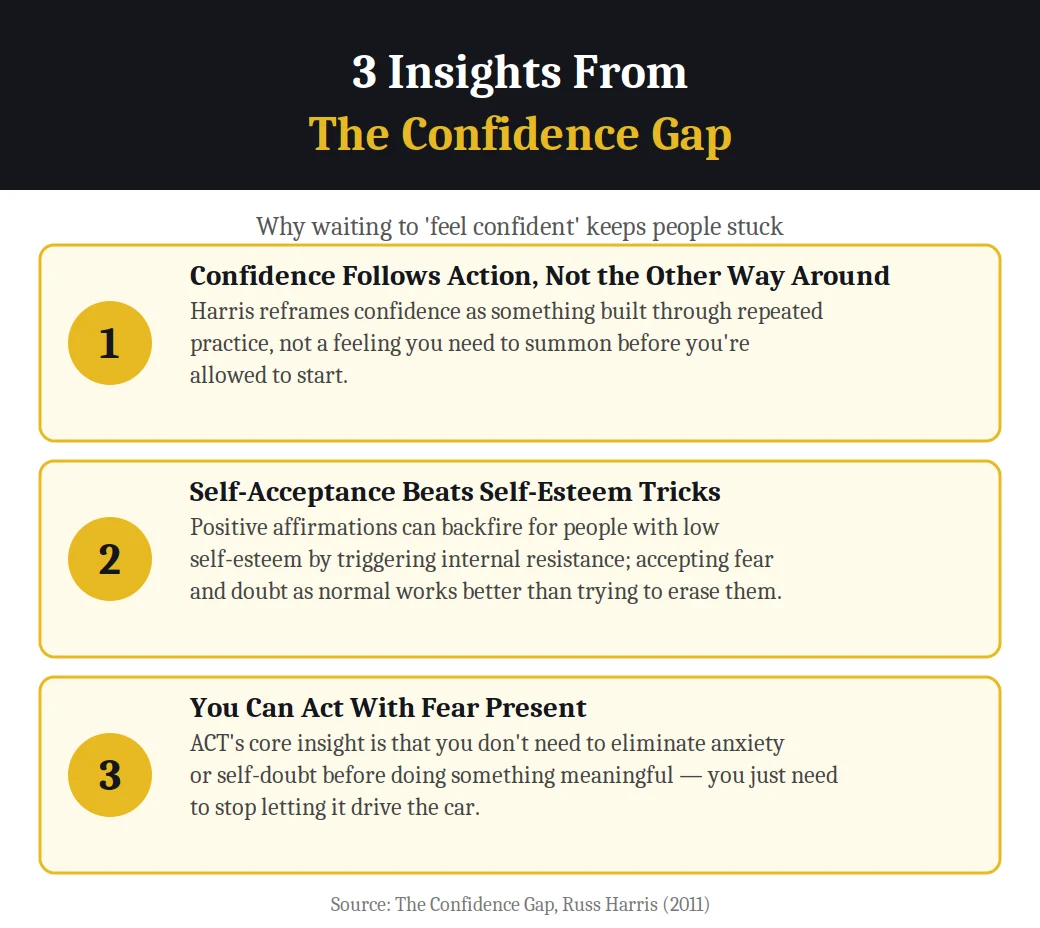
- Confidence follows action, not the other way around: Harris reframes confidence as something built through a repeated cycle of practice, not a prerequisite feeling you need before you’re allowed to start.
- Real confidence still includes fear: even highly skilled, experienced people continue to feel fear and self-doubt before high-stakes moments — confidence doesn’t mean the fear disappears, it means you act anyway.
- Positive affirmations can backfire: research shows that forcing statements like “I am confident” can actually increase distress in people with low self-esteem by triggering internal resistance.
- Self-acceptance works better than self-esteem tricks: acknowledging fear and self-doubt as normal human experience, rather than trying to talk yourself out of it, reduces its grip.
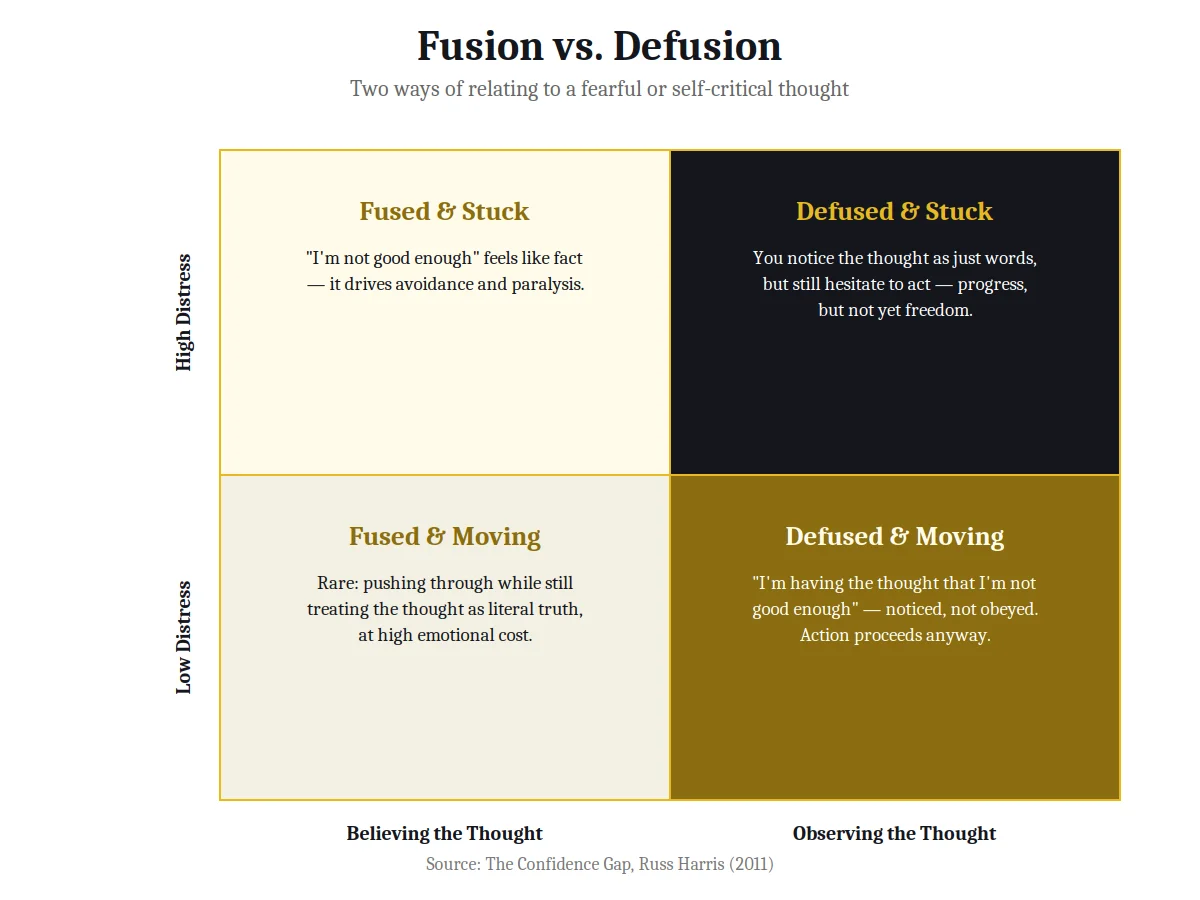
- Defusion separates you from your thoughts: noticing “I’m having the thought that I’m not good enough” instead of simply believing “I’m not good enough” creates enough distance to act despite the thought.
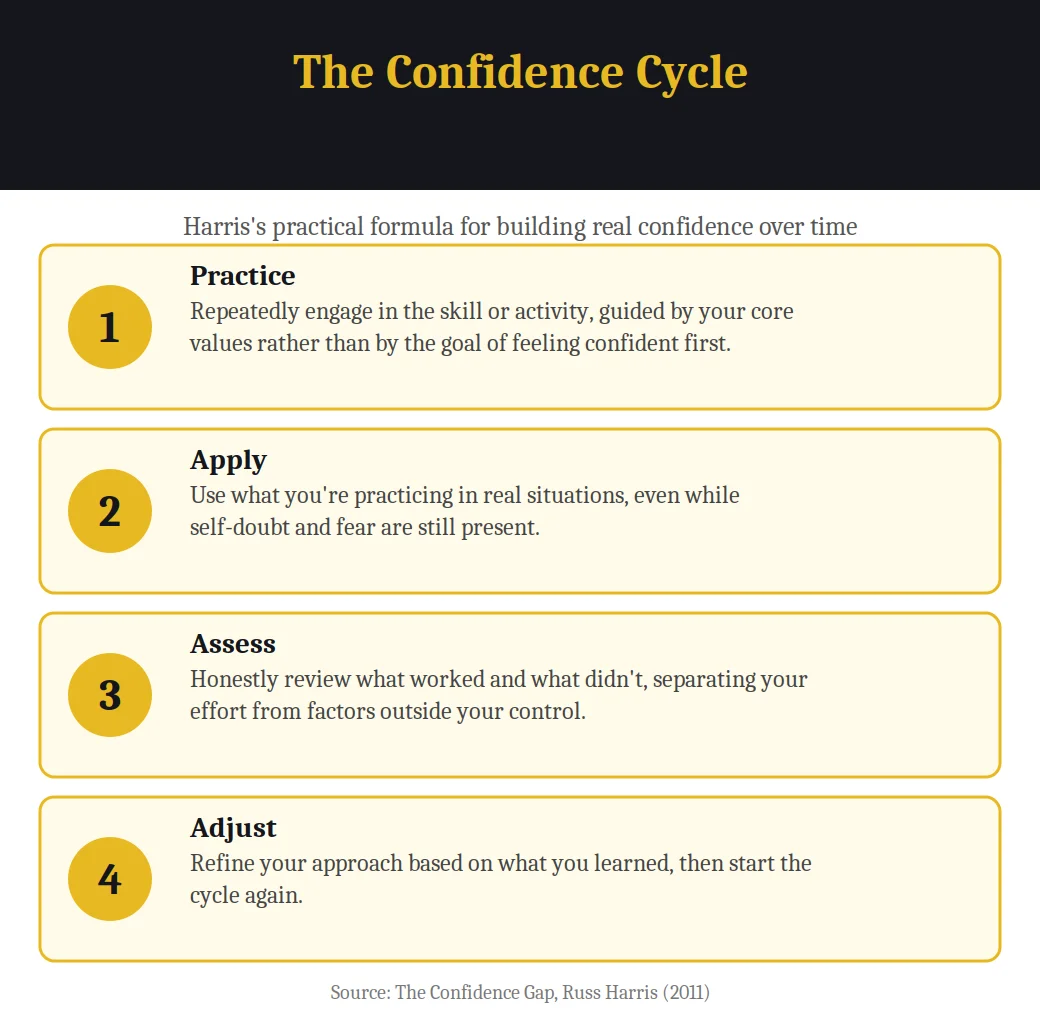
- The Confidence Cycle has four steps: practice, apply, assess, and adjust — repeating this cycle, guided by your values, is what actually builds skill and confidence over time.
- Values matter more than outcomes: anchoring action in what you care about, rather than in guaranteed success, keeps you moving even when a specific attempt doesn’t go well.
- Being present beats getting lost in your head: anxious anticipation and post-mortem self-criticism both pull you out of the moment where actual performance happens.
- Assessment should separate effort from outcome: honestly reviewing what you controlled versus what you didn’t prevents both false confidence and unfair self-blame.
What is The Confidence Gap about?
The Confidence Gap is Russ Harris’s application of Acceptance and Commitment Therapy specifically to fear, self-doubt, and the pursuit of confidence. Harris argues that most people have the sequence backward, waiting to feel confident before they act, when confidence is actually a byproduct of repeated practice. The book teaches readers to defuse from unhelpful, fear-driven thoughts instead of arguing with them, accept anxiety and self-doubt as a normal part of doing anything that matters, and commit to values-guided action regardless of what their mind says in the moment — building genuine confidence through a repeatable cycle of practice, application, and honest assessment.
About the author
Russ Harris is a physician and trainer in Acceptance and Commitment Therapy (ACT), and the author of The Happiness Trap, which challenges the cultural assumption that happiness means constantly feeling good and eliminating negative emotion. In The Confidence Gap, he applies that same ACT framework specifically to the problem of fear and self-doubt, arguing that confidence is built through committed action rather than felt in advance of it. Both books share Harris’s central approach: accepting difficult thoughts and feelings rather than fighting them, and taking values-driven action even when uncomfortable emotions are present. Explore all Russ Harris book summaries →
Key concepts at a glance
| Concept | What it means | Use it when |
|---|---|---|
| The Confidence Cycle | Practice, apply, assess, adjust — a repeatable loop that builds skill and confidence over time | You’re trying to develop confidence in a new skill or situation |
| Fusion vs. defusion | Fusion means believing a thought as literal fact; defusion means noticing it as just words passing through your mind | A fearful or self-critical thought is stopping you from acting |
| Self-acceptance vs. self-esteem tricks | Accepting fear and doubt as normal works better than forcing positive affirmations, which can backfire | Traditional confidence-boosting techniques feel hollow or increase resistance |
| Values-guided action | Anchoring your actions in what you care about rather than in guaranteed outcomes | Fear of failure is making it hard to start or continue |
| Being present | Staying grounded in the current moment instead of anxious anticipation or post-event self-criticism | Anxiety before or after a performance is pulling your attention away from what’s actually happening |
Part 1: Why the confidence-first model is backward
Harris opens by naming the trap in the book’s title: most people believe they need to feel confident before they can speak in public, change careers, or take a meaningful risk — as if confidence were a precondition rather than a result. He argues this belief keeps people stuck indefinitely, since confidence in a new domain almost never arrives before you’ve actually practiced it. Instead, Harris reframes confidence as something built through a repeatable cycle: practice a skill guided by your values, apply it in real situations even while self-doubt is present, honestly assess what worked and what didn’t, and adjust before starting the cycle again.
TGR Note: This mirrors Mindset‘s argument that ability grows through deliberate effort rather than existing as a fixed trait — both books treat competence, and the confidence that comes with it, as something built rather than discovered.
Part 2: Fusion, defusion, and the myths about confidence
Harris introduces ACT’s concept of cognitive fusion — believing a thought like “I’m not good enough” as literal, objective fact — and contrasts it with defusion, which means noticing the same thought as just a string of words passing through your mind, with no inherent authority over your behavior. Adding the phrase “I’m having the thought that…” in front of a fearful thought is a simple technique that creates just enough psychological distance to act despite it, rather than being controlled by it.
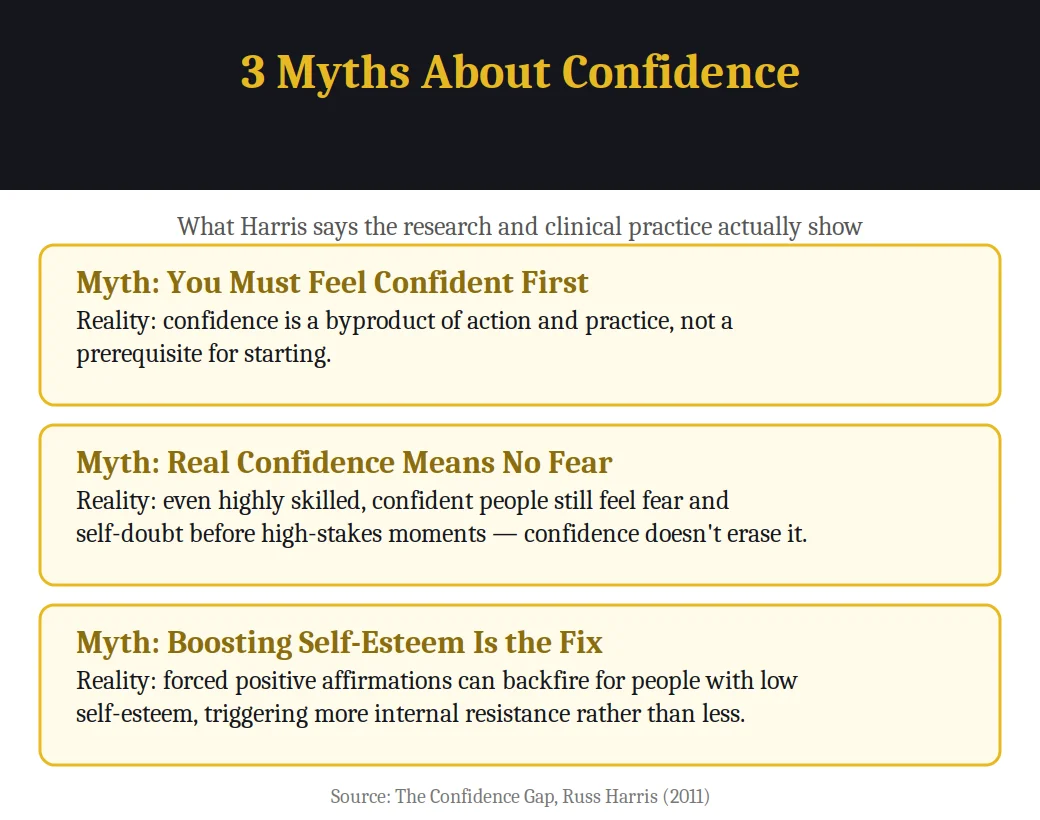
Harris also directly challenges three common myths: that real confidence means the absence of fear, that boosting self-esteem through positive affirmations is the fix, and that you must feel ready before starting. On the second point, he cites research showing that forced affirmations like “I am confident” can actually increase distress for people with low self-esteem, since the mind immediately generates counter-evidence, making the exercise backfire. Self-acceptance — acknowledging fear and doubt as normal rather than trying to argue them away — proves more effective and more durable.
TGR Note: The idea that accepting difficult feelings works better than trying to eliminate them connects directly to Self-Compassion‘s case that self-kindness, not harsh self-criticism, is what actually builds resilience under pressure.
Part 3: Values, presence, and honest assessment
The final piece of Harris’s framework is anchoring action in personal values rather than in guaranteed outcomes. Because outcomes are never fully within your control, tying your motivation to a specific result — winning, being liked, performing perfectly — sets you up for the action to feel pointless the moment things don’t go as planned. Anchoring instead in what you actually care about (being someone who shows up, who contributes, who tries) keeps you moving forward through inevitable setbacks. Harris pairs this with an emphasis on staying present during the action itself, since both anxious anticipation beforehand and harsh self-criticism afterward pull attention away from what’s actually happening in the moment.
Finally, Harris stresses that assessment after taking action should separate what you actually controlled — your preparation, your effort, your choices — from factors genuinely outside your control, like other people’s reactions or unpredictable circumstances. This honest separation prevents both inflated overconfidence after a lucky win and unfair self-blame after a loss that wasn’t really your fault, keeping the entire Confidence Cycle grounded in reality rather than distorted self-judgment.
Who is The Confidence Gap best for — and who should read something else first?
This book is best for anyone stuck waiting to “feel ready” before public speaking, changing careers, dating, or taking any meaningful risk, especially those who’ve tried traditional positive-thinking approaches without lasting success. It rewards readers open to a practical, exercise-based approach grounded in ACT rather than pure motivational language.
If your struggle is less about confidence specifically and more about a broader relationship with difficult emotions, Harris’s own The Happiness Trap lays out the full ACT framework this book draws from. If harsh self-criticism itself is the bigger obstacle, Self-Compassion offers a complementary, kindness-centered approach to the same underlying problem.
Questions to reflect on
- What’s something you’ve been putting off because you don’t feel confident enough yet — and what would it look like to practice toward it instead of waiting?
- Think of a recent fearful or self-critical thought: could you notice it as “I’m having the thought that…” rather than treating it as fact?
- Have you ever tried forcing yourself to feel confident through positive affirmations — and did it actually help, or did it create more internal resistance?
- What value, rather than what guaranteed outcome, could you anchor your next attempt at something difficult in?
- After your last setback, did you honestly separate what was in your control from what wasn’t — or did you default to blanket self-blame?
🔥 Ready to stop waiting to feel confident?
This guide covers the core framework — the book gives you Harris’s full ACT-based exercises and case studies.
How to apply The Confidence Gap (7-day plan)
- Day 1: Identify one thing you’ve been avoiding because you don’t feel confident enough yet.
- Day 2: Notice the specific fearful or self-critical thought behind that avoidance, and practice restating it as “I’m having the thought that…”
- Day 3: Take one small action toward that avoided thing anyway, with the fear or doubt still present.
- Day 4: Identify the value behind why this matters to you, separate from any guaranteed outcome.
- Day 5: Practice staying present during one difficult moment instead of anticipating it anxiously or replaying it afterward.
- Day 6: Honestly assess your last attempt at something hard, separating what you controlled from what you didn’t.
- Day 7: Plan your next round of the Confidence Cycle — practice, apply, assess, adjust — for the thing you’re building toward.
Frequently asked questions
What is the main idea of The Confidence Gap?
Confidence is a byproduct of repeated action and practice, not a feeling you need to have before you’re allowed to start — and accepting fear and self-doubt works better than trying to eliminate them first.
What is the Confidence Cycle?
A four-step loop Harris outlines: practice a skill guided by your values, apply it in real situations, honestly assess what worked, and adjust before repeating the cycle.
What is defusion in The Confidence Gap?
Defusion means noticing a fearful or self-critical thought as just words passing through your mind rather than believing it as literal fact, which creates enough distance to act despite it.
Do positive affirmations help build confidence?
Not necessarily — research cited in the book shows forced affirmations like “I am confident” can increase distress in people with low self-esteem by triggering internal resistance.
Does confidence mean you stop feeling fear?
No — Harris argues even highly skilled, confident people continue to feel fear and self-doubt before high-stakes moments; confidence means acting despite it, not eliminating it.
What is ACT and how does it relate to this book?
Acceptance and Commitment Therapy (ACT) is the psychological framework the book applies to confidence and fear, emphasizing acceptance of difficult thoughts and feelings alongside values-guided action.
How is The Confidence Gap different from The Happiness Trap?
The Happiness Trap lays out Harris’s general ACT framework for wellbeing, while The Confidence Gap applies that same framework specifically to fear, self-doubt, and building confidence.
Related summaries
If The Confidence Gap resonated, these dig further into related territory: The Happiness Trap on Harris’s full ACT framework, Self-Compassion on responding to self-doubt with kindness, and Mindset on building ability through deliberate effort. For more, see our best psychology books pillar page.
How we analyze books: We work from the full book — reconstructing its core arguments in our own words, adding commentary that connects it to related research and other books in our library, and pressure-testing the advice in a practical 7-day plan. Ratings weigh usefulness, readability, and evidence quality. Read our full methodology.