

★★★★☆ 4.0/5 — A compelling case that simple checklists can prevent catastrophic failures in any complex field.
Best for: Professionals in high-stakes environments, managers, and anyone who wants to reduce errors in complex workflows.
Reading time: ~4 hours (209 pages)
Difficulty to apply: Low — building a basic checklist takes 30 minutes. The harder part is the discipline to use it consistently.
Evidence quality: Exceptional — Gawande draws from aviation, surgery, construction, and finance with rigorous real-world data.
The Checklist Manifesto in one minute
The modern world has become too complex for any single person to manage from memory alone. Surgeon and writer Atul Gawande makes the case that even the most skilled professionals make avoidable errors — not because they lack knowledge, but because they have too much of it to reliably apply under pressure. His solution is deceptively simple: checklists. Drawing from aviation’s safety revolution, construction’s coordination systems, and his own WHO surgical safety checklist (which reduced deaths by 47% across eight countries), Gawande shows that a well-designed checklist is not an insult to expertise — it is the tool that makes expertise reliable.
Key takeaways
- Errors of ignorance vs. errors of ineptitude: We fail not because we don’t know enough, but because we fail to apply what we already know. Checklists close the gap.
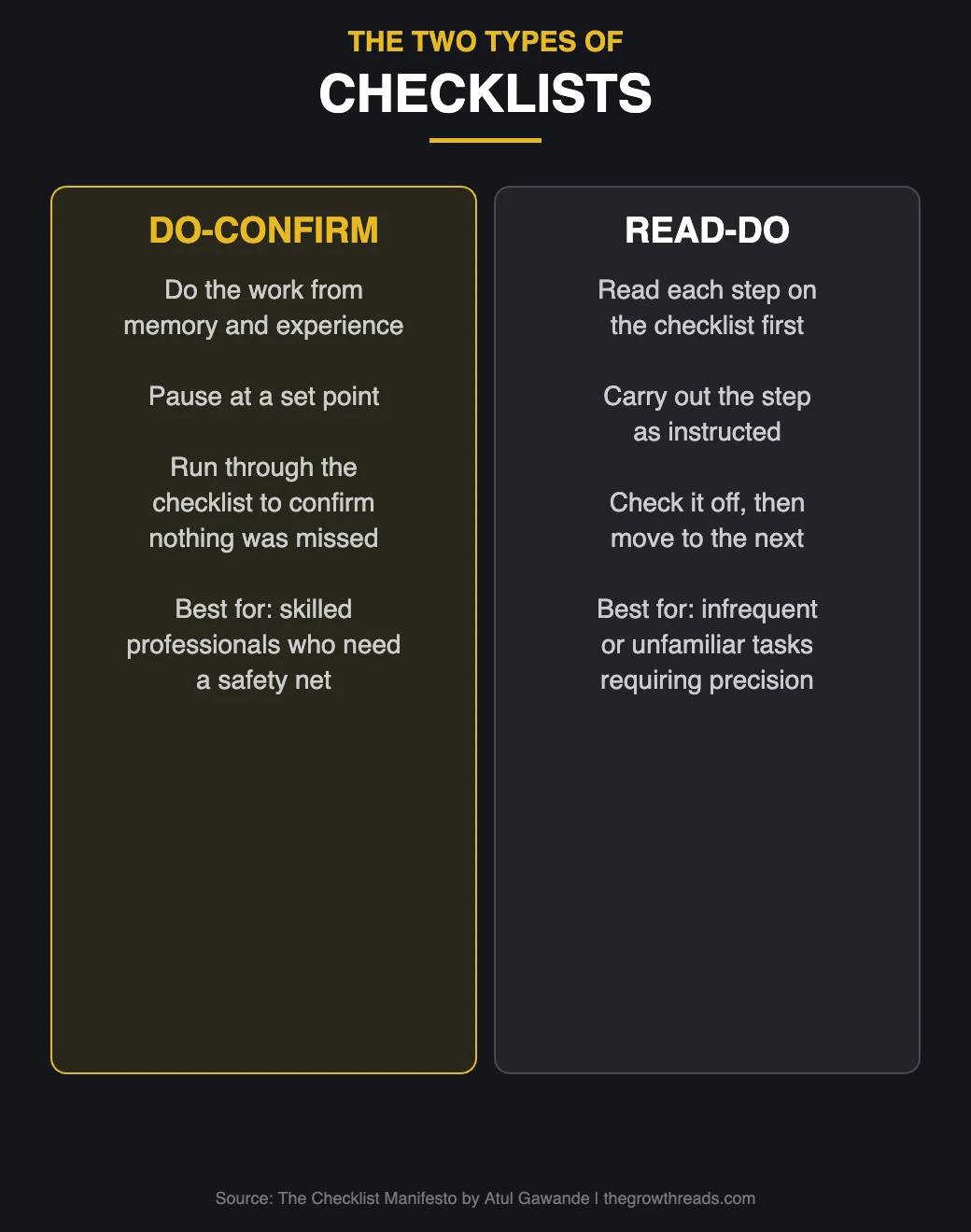
- Two types of checklists exist: DO-CONFIRM (do the work, then confirm) and READ-DO (read each step, then execute). Choose based on the task’s nature.
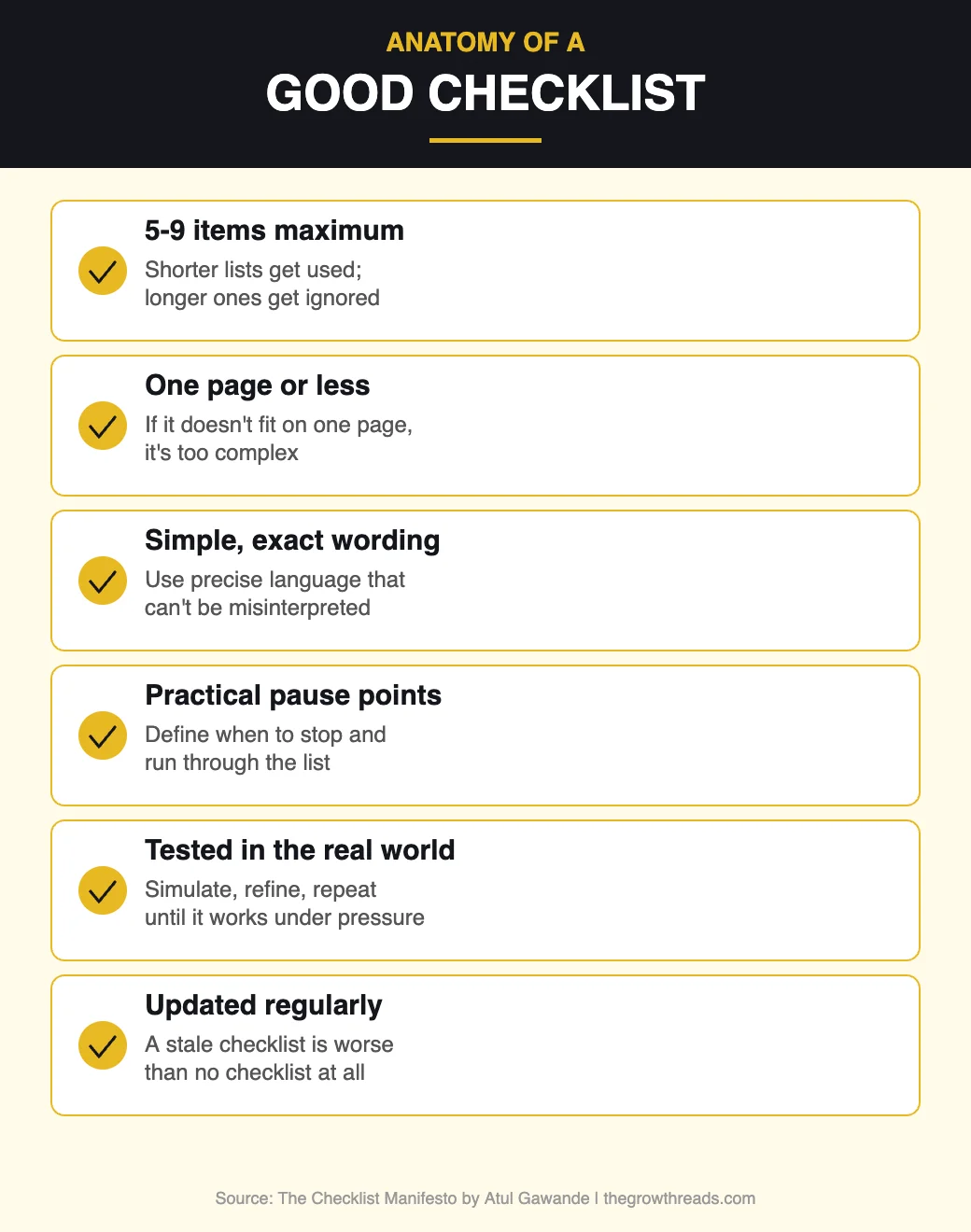
- Keep it short: A good checklist has 5–9 items, fits on one page, uses simple language, and targets only the critical “killer items” that are most dangerous to skip.
- Checklists are not instruction manuals: They assume competence. They are safety nets for skilled professionals, not substitutes for training.
- Communication failures kill: In complex environments, the biggest risk is not technical failure but communication failure between team members.
- Forced functions work: Requiring people to stop, talk, and confirm creates a pause that catches errors before they become disasters.
- Test in the real world: No checklist works on the first draft. You must simulate, refine, and iterate until it performs under actual conditions.
- Discipline matters more than design: The best checklist is useless if people skip it. Culture and leadership determine adoption.
- Checklists free up mental bandwidth: By handling routine items automatically, they allow experts to focus their attention on the genuinely complex problems.
- The WHO checklist saved over 150,000 lives: Gawande’s surgical safety checklist has been adopted in over 4,000 hospitals worldwide since 2009.
What is The Checklist Manifesto about?
The Checklist Manifesto argues that simple checklists can prevent catastrophic failures in complex fields. Atul Gawande shows how aviation, construction, surgery, and investing all benefit from structured checklists that catch avoidable errors, improve team communication, and make expert knowledge reliably actionable under pressure.
About the author
Atul Gawande is a surgeon at Brigham and Women’s Hospital, a professor at Harvard Medical School and the Harvard T.H. Chan School of Public Health, and a staff writer for The New Yorker. He led the World Health Organization’s Safe Surgery Saves Lives initiative, which developed the surgical safety checklist now used in thousands of hospitals worldwide. Gawande has been named one of the most influential people in the world by Time magazine and has received a MacArthur Fellowship. His books — including Complications, Better, and Being Mortal — have shaped how millions think about medicine, performance, and systems design. He served as CEO of Haven, the Amazon–Berkshire Hathaway–JPMorgan health venture. Explore all Atul Gawande book summaries →
Key concepts at a glance
| Concept | What it means | Use it when |
|---|---|---|
| Errors of ineptitude | Failures from not correctly applying known knowledge | You notice mistakes happening despite sufficient training |
| DO-CONFIRM checklist | Work from memory, then pause and confirm with the list | The task is familiar and the team is experienced |
| READ-DO checklist | Read each item and perform it step-by-step | The task is infrequent, high-stakes, or unfamiliar |
| Killer items | The critical steps most likely to be skipped or forgotten | You are deciding what to include on your checklist |
| Pause point | A defined moment to stop and run through the list | You need to build checklist use into a workflow |
| Forced function | A mandatory communication or confirmation step | Team members need to share information before proceeding |
| Master schedule | Construction-style coordination checklist across teams | Multiple specialists must sequence their work correctly |
Part 1: The problem of complexity
Gawande opens with a paradox of modern expertise: we have more knowledge than ever, yet we still make devastating, avoidable mistakes. He distinguishes between two types of failure. Errors of ignorance happen when we don’t have the knowledge. Errors of ineptitude happen when we have the knowledge but fail to apply it correctly. In the modern world, ineptitude has overtaken ignorance as the primary source of failure.
He illustrates with medicine. The average ICU patient requires 178 individual actions per day from their care team. At a 1% error rate — impressive by most standards — that is nearly two errors per patient per day. Multiply across a hospital, and the scale of avoidable harm becomes staggering. This is not a training problem. These are skilled professionals doing the best they can in systems that have outgrown any individual’s capacity to manage from memory.
The same pattern appears in every complex field. Financial advisors forget to ask about risk tolerance. Lawyers skip key clauses in contracts. Software engineers ship code without running critical tests. The root cause is the same: the volume of knowledge required to perform correctly exceeds what human memory and attention can reliably deliver.
Part 2: The checklist solution — lessons from aviation and construction
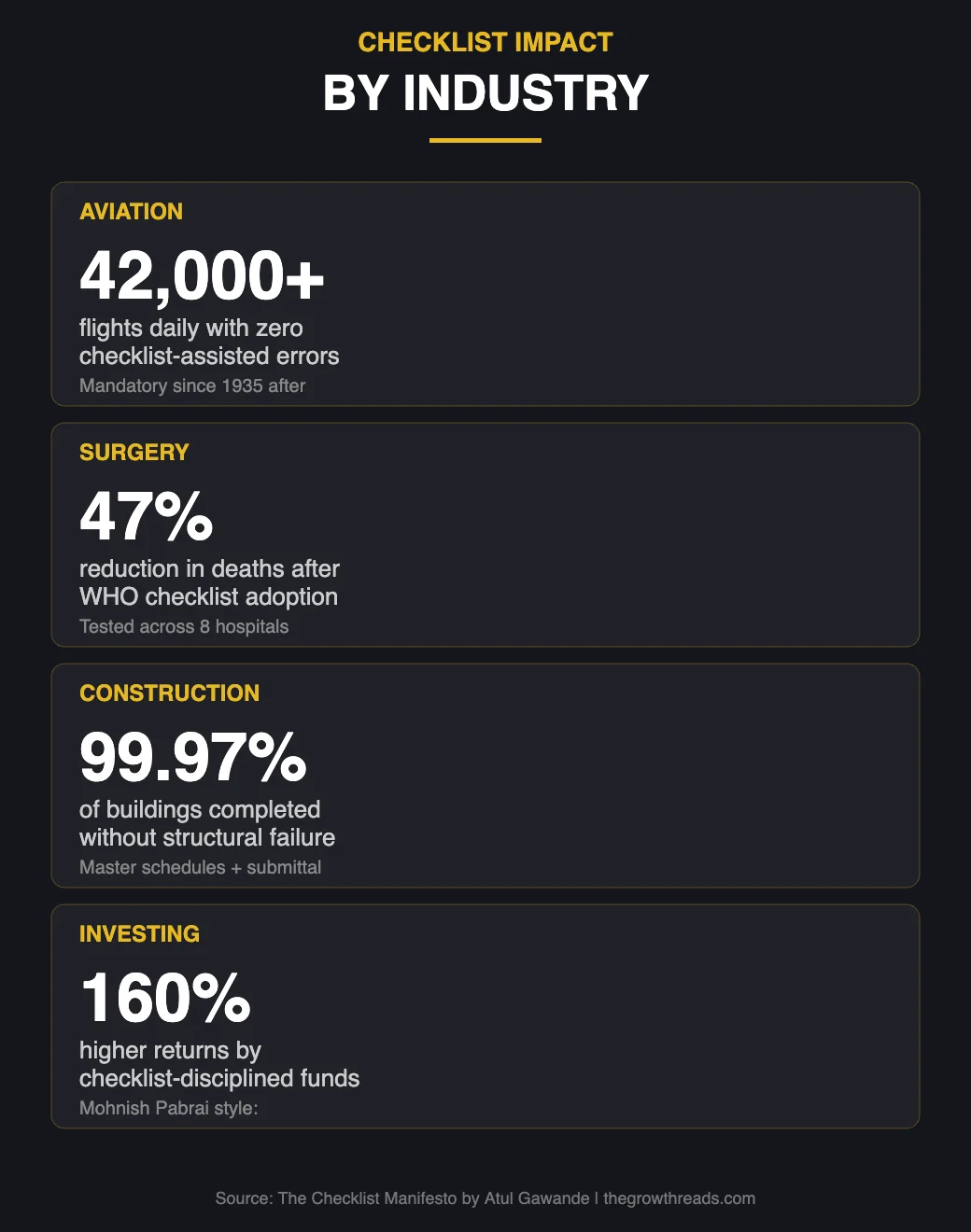
Gawande traces the checklist’s origin to a pivotal moment in aviation history. In 1935, the U.S. Army Air Corps held a flight competition for its next-generation bomber. Boeing’s Model 299 was vastly superior to the competition — and crashed on its demonstration flight, killing the test pilot. The cause: the plane was too complex for any single pilot to manage from memory. Rather than simplifying the plane, pilots created a simple checklist covering the critical steps for takeoff, flight, landing, and taxiing. The result: 1.8 million miles flown without accident.
From this origin, aviation developed a culture of checklists that now governs every aspect of flight. The key design principle: checklists don’t tell expert pilots how to fly. They catch the small, critical steps that even expert pilots might skip under pressure — the “killer items” that, if missed, lead to catastrophe.
Gawande then examines construction, which he calls the “most complex industry on earth.” A modern skyscraper involves sixteen different trades, each with specialized knowledge that the others don’t share. The coordination challenge is staggering, yet construction achieves a 99.97% structural success rate. The secret: two types of checklists. First, detailed task checklists for individual trades. Second, a “master schedule” — a coordination checklist that defines when different teams must communicate, share information, and approve each other’s work before proceeding.
Part 3: The WHO surgical safety checklist
The book’s centerpiece is Gawande’s own story of developing the WHO Surgical Safety Checklist. In 2006, the WHO asked him to lead a campaign to reduce surgical deaths globally. The challenge: surgery happens in wildly different settings — from Harvard hospitals to rural clinics in Tanzania — and any solution had to work across all of them.
Gawande’s team designed a 19-item checklist organized around three pause points: before anesthesia (Sign In), before incision (Time Out), and before the patient leaves the operating room (Sign Out). The items were not complex: confirm the patient’s identity, mark the surgical site, check allergies, ensure antibiotics were given, introduce every team member by name. The last item was key — Gawande discovered that when team members knew each other’s names, they were dramatically more likely to speak up about potential problems.
The results were extraordinary. In a trial across eight hospitals in eight countries (including sites in the U.S., India, Jordan, and Tanzania), the checklist reduced surgical deaths by 47% and complications by 36%. The improvements were consistent across wealthy and poor settings alike. The simplest interventions — confirming the patient’s identity, ensuring antibiotics were administered on time — accounted for a large share of the gains.
Part 4: Making checklists work
The final section addresses the practical challenge of building checklists that actually get used. Gawande’s design rules are precise: 5–9 items maximum, one page, simple exact wording, a clear pause point for when to use it, and a DO-CONFIRM or READ-DO format based on the task. He emphasizes that checklists must be tested in real-world simulations and refined iteratively — no checklist works on its first draft.
The deeper challenge is cultural. Many professionals resist checklists because they perceive them as an insult to their expertise. Gawande addresses this directly: a checklist is not a substitute for skill. It is the tool that makes skill reliable. The best pilots in the world use checklists. The best surgeons use checklists. The issue is not competence — it is the recognition that human memory and attention are fallible, and that a simple piece of paper can catch what our brains miss.
He closes with a broader argument: as the world grows more complex, we face a choice between two approaches. We can rely on individual heroism — smarter, more talented people working harder. Or we can build systems — checklists, protocols, and communication structures — that make ordinary people reliably excellent. Gawande argues that the future belongs to the second approach.
Who is The Checklist Manifesto best for — and who should read something else first?
This book is ideal for anyone who manages complex processes — surgeons, pilots, project managers, engineers, investors, and team leaders. It is especially valuable for people who already consider themselves experts and may be resistant to systematization. The stories make the case persuasively without being preachy.
If you want a broader productivity system beyond checklists, start with Getting Things Done by David Allen. If your challenge is more about focus than process, Deep Work by Cal Newport addresses the attention side. And if you want to build better habits rather than better systems, Atomic Habits by James Clear is the companion read.
Questions to reflect on
- Where in my work do I rely on memory for critical steps that would be better served by a written checklist?
- Which of my recurring mistakes are “errors of ineptitude” — things I know how to do but sometimes forget or skip under pressure?
- Does my team have a “pause point” equivalent — a moment where we stop and confirm everyone is aligned before proceeding?
- Am I resisting systematization because I see it as an insult to my expertise, or am I open to tools that make my expertise more reliable?
- If I built a 5-item checklist for my most high-stakes weekly task, what would the five killer items be?
🔥 Ready to make your expertise reliable?
Learn the checklist design principles used in aviation, surgery, and construction.
How to apply The Checklist Manifesto (7-day plan)
- Day 1 — Identify your failure points: List the 3 recurring tasks where you most often make avoidable mistakes or forget critical steps.
- Day 2 — Choose one task: Pick the highest-stakes task from your list. Write down every step involved, then circle the 5–7 “killer items.”
- Day 3 — Draft your checklist: Create a one-page DO-CONFIRM or READ-DO checklist. Keep language simple and specific. Include a clear pause point.
- Day 4 — Test run: Use the checklist during your next real execution of the task. Note what works and what feels clunky or missing.
- Day 5 — Refine: Based on your test, revise the checklist. Remove anything that didn’t add value. Add anything you missed.
- Day 6 — Add a communication item: Include at least one forced-function step where you must confirm or communicate with someone else before proceeding.
- Day 7 — Commit to consistency: Print the final version or pin it to your workflow tool. Set a reminder to use it every time. Schedule a 30-day review to update it.
Frequently asked questions
Are checklists too simplistic for complex work?
No — that is precisely Gawande’s argument. Checklists are not instruction manuals for beginners. They are safety nets for experts. A pilot with 20,000 hours of flight time still uses a pre-flight checklist because the consequence of missing one step at altitude is catastrophic. The checklist assumes competence and catches the inevitable human lapses that occur under pressure, fatigue, or routine. Simplicity is the feature, not the limitation.
What is the difference between DO-CONFIRM and READ-DO?
A DO-CONFIRM checklist lets you work from memory and experience, then pause at a defined point to confirm nothing was missed. It is best for experienced professionals doing familiar tasks. A READ-DO checklist requires you to read each item and execute it before moving on. It is best for infrequent, high-stakes, or unfamiliar tasks where step-by-step guidance is essential. Most professional checklists are DO-CONFIRM.
How many items should a checklist have?
Gawande recommends 5 to 9 items maximum, and the entire checklist should fit on a single page. The items should target only the “killer items” — the critical steps that are most dangerous to skip and most likely to be forgotten. A checklist that tries to capture every step becomes an instruction manual, which people will stop using. Brevity and relevance are the design priorities.
Did the WHO surgical checklist really reduce deaths by 47%?
Yes. A study published in the New England Journal of Medicine tested the 19-item checklist across eight hospitals in eight countries — ranging from wealthy institutions in the U.S. and Canada to under-resourced facilities in India, Jordan, and Tanzania. Surgical deaths dropped from 1.5% to 0.8% (a 47% reduction) and complications fell from 11% to 7% (a 36% reduction). The results were consistent across all sites regardless of resources.
Can checklists be used outside medicine and aviation?
Absolutely. Gawande shows applications in construction (coordination checklists), finance (investment discipline checklists used by value investors like Mohnish Pabrai), law (contract review checklists), and software engineering (deployment checklists). Any domain where skilled professionals must reliably execute complex, multi-step processes can benefit. The design principles — short, specific, tested, with clear pause points — apply universally.
Why do professionals resist using checklists?
Gawande identifies ego and autonomy as the primary barriers. Many professionals view checklists as an insult to their training and experience — the implication that they need a reminder to do their job. Gawande argues this is a misunderstanding: checklists do not replace expertise, they enhance it by catching the inevitable lapses that all humans experience. The most skilled pilots and surgeons in the world use checklists because they understand that human memory is fallible.
How long does it take to create a good checklist?
Drafting a first version takes about 30 minutes if you know the process well. However, Gawande emphasizes that no checklist is ready after the first draft. You must test it in real-world or simulated conditions, gather feedback from users, refine the wording and sequence, and iterate multiple times. Plan for 3 to 5 revision cycles before the checklist is production-ready. Then schedule regular reviews — Gawande recommends at least quarterly — to keep it current.
Related summaries
- Getting Things Done by David Allen — the full productivity system that complements checklist thinking.
- Atomic Habits by James Clear — build the habits that make checklist discipline automatic.
- The ONE Thing by Gary Keller — focus on the domino items your checklist should target.
- Best Productivity Books — our full curated list of essential productivity reads.
How we analyze books: Every book review at The Growth Reads follows a structured evaluation across five criteria: practical applicability, scientific rigor, writing quality, uniqueness of insight, and lasting impact. We read each book cover to cover, cross-reference key claims with primary research, and test the frameworks in real life before publishing. Read our full methodology.