

★★★★★ (4.6/5) — The most talked-about diagnosis yet of why teen mental health collapsed right when smartphones took over childhood.
Best for: Parents, educators, and anyone who wants the evidence behind the phone-and-teen-anxiety debate, not just a headline.
Reading time: ~7.5 hrs full book (~15 min for this guide)
Difficulty to apply: Moderate — the individual habits are simple, but the real fix is collective, since no one family can opt out alone.
The Anxious Generation in one minute
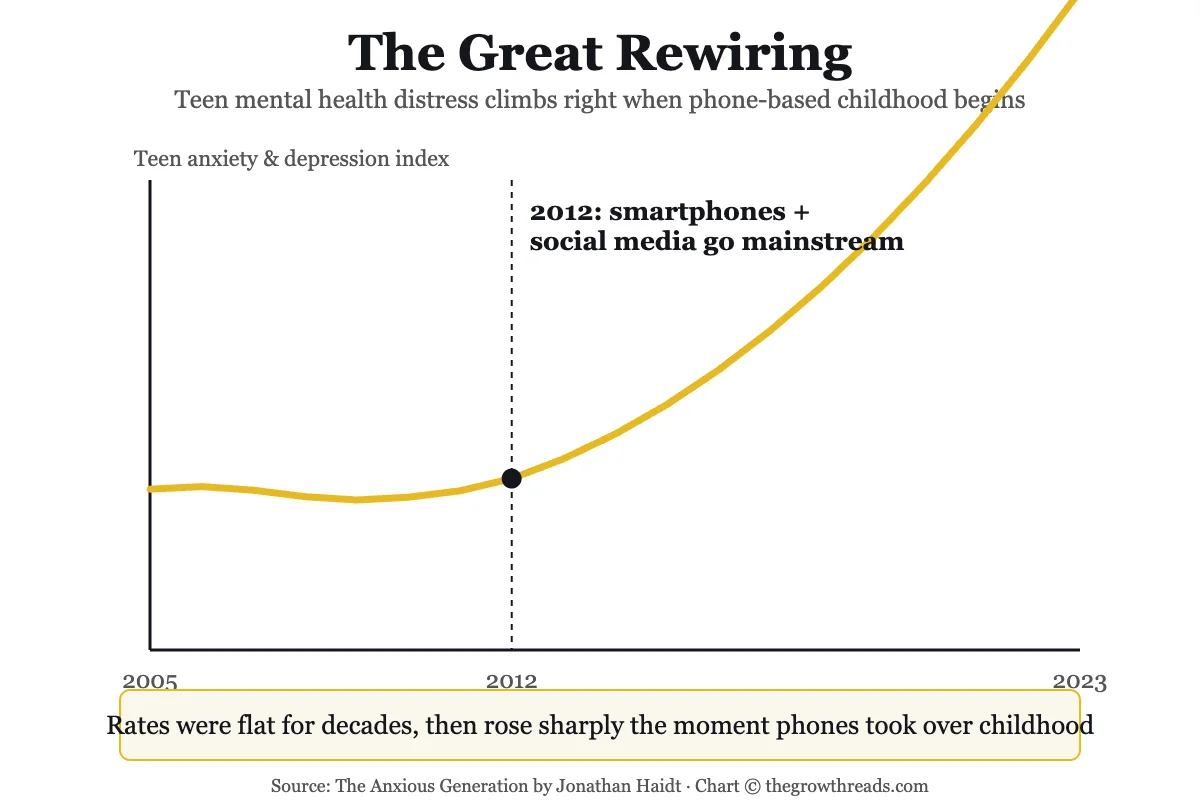
Somewhere around 2012, childhood quietly changed forever — and teen mental health broke along with it. Social psychologist Jonathan Haidt argues that a “Great Rewiring” took place in barely half a decade: front-facing cameras, high-speed mobile internet, and social media platforms arrived together and replaced a play-based childhood with a phone-based one. The timing lines up almost exactly with a sharp, sustained rise in anxiety, depression, self-harm, and loneliness among teenagers across many countries — hitting girls hardest through social comparison, and boys through gaming and withdrawal. Haidt’s case isn’t that phones are simply “bad” — it’s that they created four specific harms (social deprivation, sleep deprivation, attention fragmentation, and addiction) precisely during the developmental window when kids most need real-world risk, unsupervised play, and face-to-face bonding. The second half of the book is a practical playbook for parents, schools, and society to reverse it.
Key takeaways
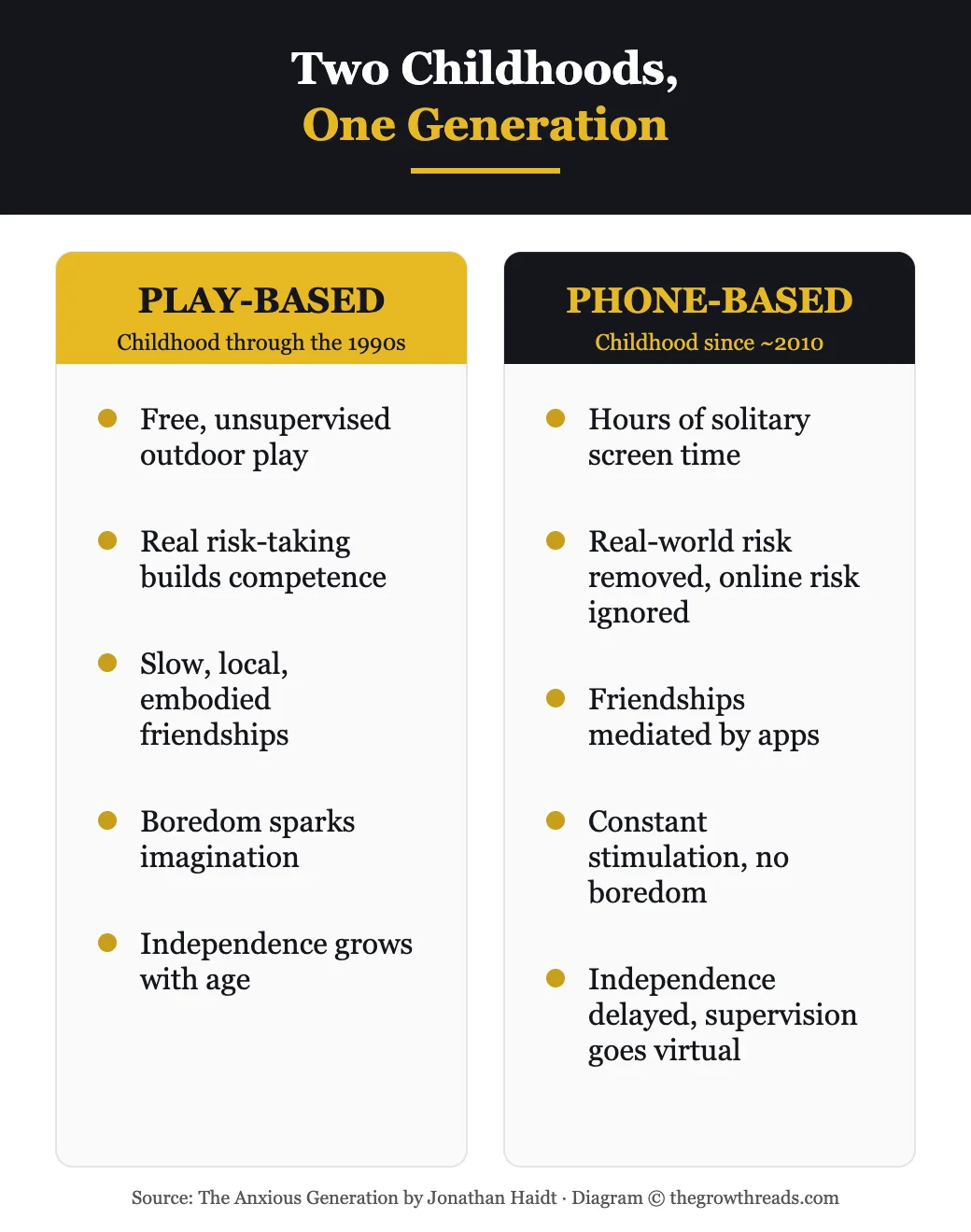
- Two childhoods collided: a play-based childhood was replaced by a phone-based one in roughly one decade, around 2010–2015.
- The Great Rewiring: front-facing cameras, fast mobile internet, and social media arrived together and rewired daily life for an entire generation of kids.
- The timing lines up: teen anxiety, depression, self-harm, and loneliness began rising sharply and simultaneously across many countries around 2012.
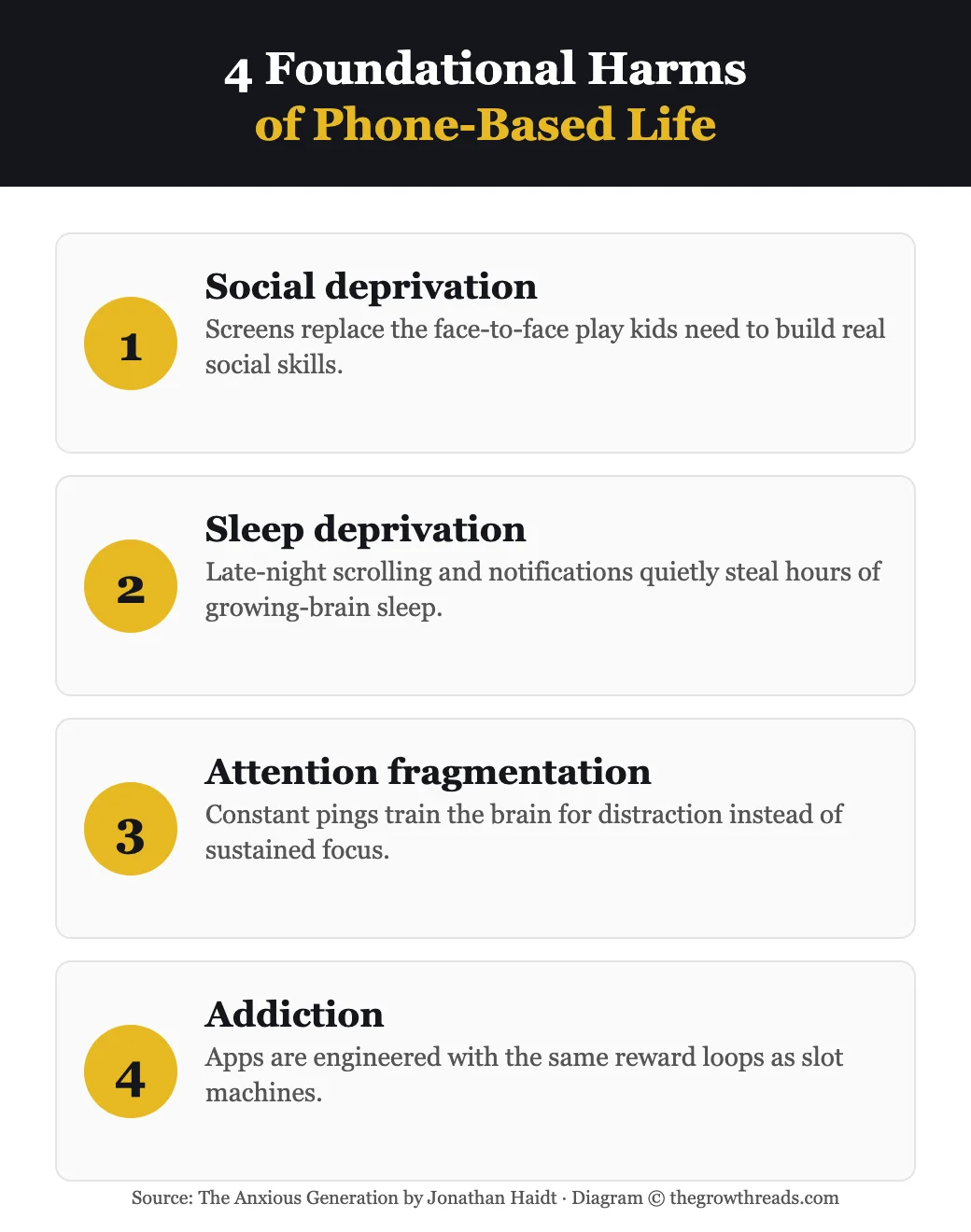
- Four foundational harms: social deprivation, sleep deprivation, attention fragmentation, and addiction — all four compound each other.
- Safety got inverted: real-world risk was removed from childhood (helicopter parenting) at the same time online risk was largely ignored.
- Free play isn’t optional fun: unsupervised play is how children build competence, courage, and real social skills — and it’s been quietly disappearing for decades.
- Gender-specific harm: girls are hit hardest through social comparison and relational aggression; boys are hit through gaming, pornography, and withdrawal.
- This is a collective action problem: no single family can opt out alone — norms have to shift together across parents, schools, and platforms.
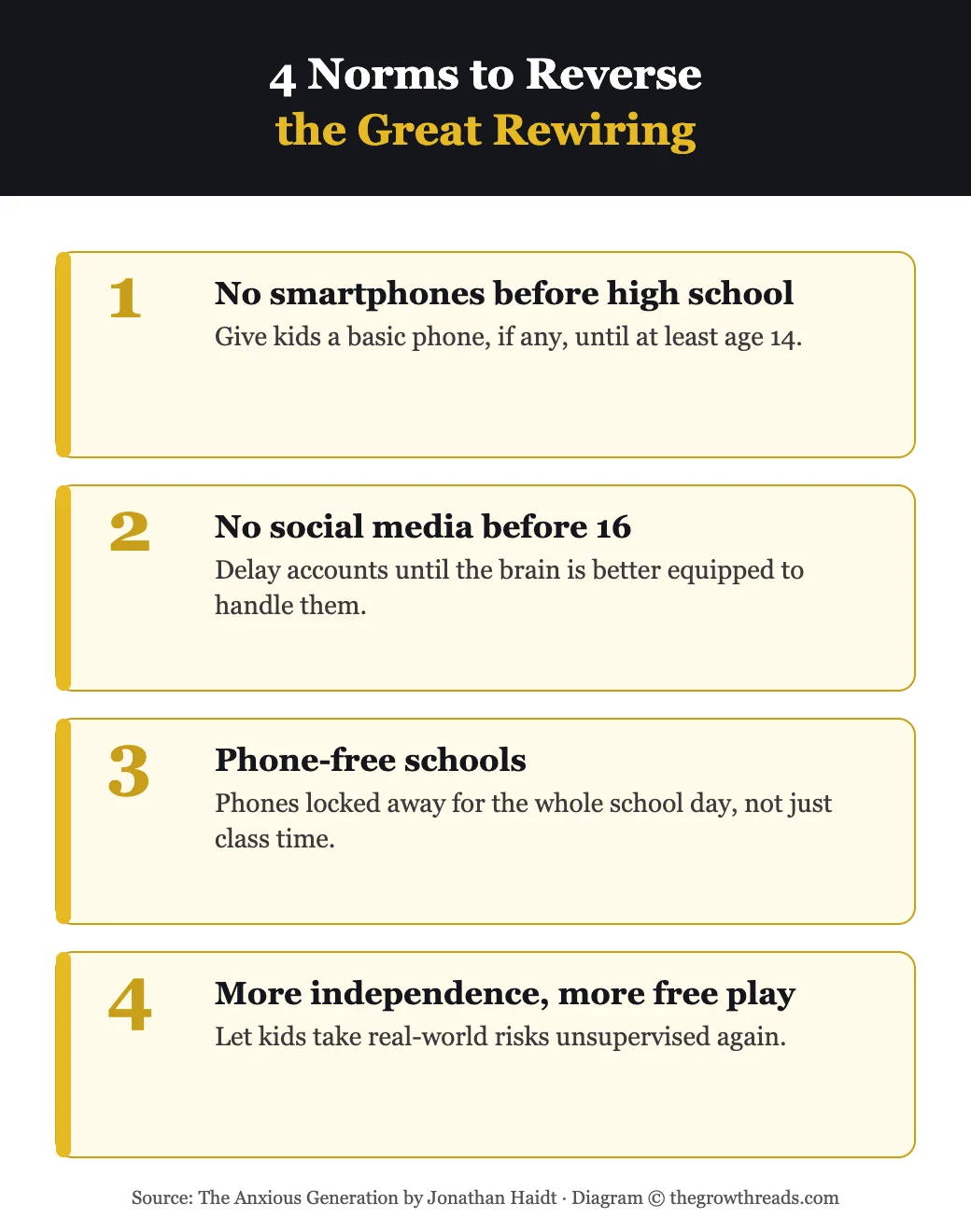
- Four proposed norms: no smartphones before high school, no social media before 16, phone-free schools, and more independence and free play.
- Small changes compound: early schools and communities that adopted even some of these norms report measurable improvements in attention and wellbeing.
What is The Anxious Generation about?
The Anxious Generation argues that replacing a play-based childhood with a phone-based one, roughly between 2010 and 2015, caused the sharp rise in teen anxiety, depression, and self-harm — and lays out four concrete norms parents, schools, and society can adopt to reverse it.
About the author
Jonathan Haidt is a social psychologist and professor of ethical leadership at NYU Stern School of Business. He built his reputation studying moral psychology and political polarization in The Righteous Mind, and co-authored The Coddling of the American Mind with Greg Lukianoff, which first explored how “safetyism” was reshaping young people’s resilience. The Anxious Generation (2024) extends that research into a full account of the phone-based childhood, drawing on a continuously updated public database of studies. Haidt has become one of the most cited voices in the global debate over kids, phones, and mental health, testifying to lawmakers and advising schools on implementation. Explore all Jonathan Haidt book summaries →
Key concepts at a glance
| Concept | What it means | Use it when |
|---|---|---|
| Play-based childhood | Free, unsupervised, risk-taking play as the norm | Understanding what changed before 2010 |
| Phone-based childhood | Childhood mediated by smartphones and social apps | Diagnosing today’s default for kids |
| The Great Rewiring | The rapid 2010–2015 shift from one childhood to the other | Explaining the timing of the mental health surge |
| Social deprivation | Screen time crowding out face-to-face bonding | Assessing a child’s real-world friendships |
| Sleep deprivation | Notifications and late-night use cutting into sleep | Diagnosing mood or focus problems |
| Attention fragmentation | Constant pings training the brain toward distraction | Struggles with focus or schoolwork |
| Addiction | Apps engineered with slot-machine-style reward loops | Compulsive, hard-to-stop phone use |
| Collective action problem | No single family benefits from opting out alone | Planning school- or community-wide change |
Part 1: A surge of suffering
Haidt opens with the data, and it is stark: rates of teen depression, anxiety, self-harm, and loneliness were broadly flat or declining through the 2000s, then began rising sharply and simultaneously across the U.S., U.K., Canada, Australia, and much of Scandinavia starting around 2012. The pattern shows up earliest and most strongly among girls, who report far higher rates of anxiety and depression than boys, while boys show more social withdrawal, gaming dependency, and a retreat from real-world milestones like dating and driving. Haidt is careful to rule out the usual alternative explanations — the 2008 financial crisis predates the surge by years, and academic pressure was rising well before 2012 without a matching mental health spike — before turning to what did change precisely at that moment: smartphone and social media adoption crossed the tipping point into near-universal teen use.
TGR Note: Haidt built the moral-psychology framework behind this argument in his earlier book The Righteous Mind — worth reading if you want the deeper theory of how intuition and identity shape belief, applied here to a generation’s mental health.
Part 2: The decline of the play-based childhood
Before phones even enter the picture, Haidt traces a decades-long retreat from unsupervised, risky, outdoor play — a shift he calls “safetyism.” Starting in the 1980s, fears about crime and stranger danger (statistically much rarer than perceived) led parents to steadily restrict children’s independence: less walking to school alone, less unsupervised outdoor play, less real risk-taking of any kind. The irony, Haidt argues, is that this was exactly backward: real-world risk in childhood is not a hazard to be eliminated but the raw material of resilience — kids learn to assess danger, tolerate frustration, and resolve conflict only by encountering manageable amounts of it directly. By the time phones arrived, an entire generation had already been primed to seek stimulation and social connection indoors, unsupervised, and online — precisely where actual risk turned out to be highest.
Part 3: The rise of the phone-based childhood
This is the core of the book’s diagnosis: four foundational harms that compound each other once a child’s daily life moves onto a phone. Social deprivation replaces embodied, face-to-face friendship with the thinner, more comparison-heavy currency of likes and followers. Sleep deprivation comes from notifications and algorithmic feeds engineered to keep attention past bedtime, at exactly the developmental stage when growing brains need the most sleep. Attention fragmentation trains the brain toward constant task-switching rather than the sustained focus adolescence is supposed to build. And addiction is not a metaphor — Haidt walks through how the same variable-reward mechanics used in slot machines are built directly into infinite scroll and notification design. Puberty, he argues, is a uniquely sensitive rewiring period for the brain, which is exactly why introducing this stack of harms during adolescence — rather than adulthood — did so much damage so quickly.
TGR Note: For a deeper look at attention fragmentation specifically, Stolen Focus by Johann Hari makes a complementary case about why sustained focus has become so hard for people of every age, not just teenagers.
Part 4: What to do about it
Haidt is explicit that individual willpower isn’t the fix — this is a collective action problem, since no parent wants their child to be the only one without a phone or a group chat. His four proposed norms are designed to be adopted together, by enough families and schools at once that no one feels isolated by them: no smartphones before high school (a basic phone is fine), no social media before 16, phone-free schools (phones locked away for the entire day, not just class periods), and far more unsupervised independence and free play restored to daily life. Early adopter schools that went fully phone-free report noticeably better concentration, more lunchtime socializing, and calmer hallways within a single term — small, measurable proof that the norms work faster than most parents expect.
TGR Note: If you want a practical, adult-focused companion to these norms, Digital Minimalism by Cal Newport lays out a concrete process for redesigning your own relationship with your phone — useful for parents trying to model the behavior they want to see.
Who is The Anxious Generation best for — and who should read something else first?
This book is essential for parents, teachers, school administrators, and policymakers who want the evidence behind the phone-and-mental-health debate rather than just the headlines. If your interest is narrower — you mainly want to fix your own relationship with your phone rather than a household or school’s — start with Digital Minimalism or Stolen Focus instead, and come back to this book once you’re ready to think about kids and collective norms specifically.
Questions to reflect on
- What’s one piece of independence or unsupervised play you had as a kid that today’s kids rarely get anymore?
- When did a smartphone or social media account first enter your household, and how did daily life change afterward?
- Which of the four harms — social, sleep, attention, or addiction — shows up most in your own phone use, not just a child’s?
- What would one fully phone-free day look like in your house or workplace this week?
- Which of the four norms could you realistically start today, even before anyone else around you is on board?
🔥 Ready to understand the phone-based childhood?
Grab a copy and start reclaiming real-world childhood today.
How to apply The Anxious Generation (7-day plan)
- Day 1: Check your phone’s built-in screen-time report for yourself and your household as a baseline.
- Day 2: Turn off non-essential notifications on the single most-checked app on your phone.
- Day 3: Create one phone-free zone or time — dinner table, or the first hour after school or work.
- Day 4: Plan one hour of unsupervised free play for a child in your life, or one hour of unstructured solo time for yourself.
- Day 5: Talk to one other parent, teacher, or colleague about setting a shared norm together.
- Day 6: Audit your highest-use app for its worst time-of-day window and cut that window specifically.
- Day 7: Reflect on the week and pick one norm to keep permanently.
Frequently asked questions
Is The Anxious Generation only about teenagers, or does it apply to adults too?
The book’s core evidence and recommendations focus on children and teenagers, since adolescent brains are in a uniquely sensitive developmental window. That said, the four foundational harms — social deprivation, sleep deprivation, attention fragmentation, and addiction — apply to phone use at any age, and many adult readers apply the same diagnostic lens to their own habits.
Does Jonathan Haidt blame phones entirely for the rise in teen mental illness?
No. Haidt is explicit that the decline of play-based childhood and rising “safetyism” set the stage well before smartphones arrived. His argument is that phones and social media were the specific trigger that turned a slow, decades-long shift into a sharp, sudden mental health crisis once they reached near-universal teen adoption around 2012.
Has The Anxious Generation’s central claim been challenged by other researchers?
Yes. Some psychologists argue that correlation between phone adoption and mental health decline doesn’t fully prove causation, and that effect sizes in individual studies are often small. Haidt has responded by maintaining a large, continuously updated public database of studies and argues the weight of evidence across many countries is now substantial, though reasonable researchers still debate exact effect sizes.
What’s the difference between “safetyism” and reasonable safety?
Safetyism, as Haidt uses the term, is treating any conceivable risk as intolerable, even when the real-world odds are extremely low, at the cost of the resilience-building that manageable risk provides. Reasonable safety still protects children from genuine, high-probability dangers — the distinction is refusing to eliminate every small risk of failure, injury, or social friction that childhood actually needs.
What can I actually do if my child’s whole school already has phones?
Haidt’s advice is to start with what’s controllable at home — delaying a personal smartphone or social media account, creating phone-free times — while organizing with other parents to push for a school-wide, phone-free policy. Because this is a collective action problem, coordinated group changes (a grade-level or school-wide agreement) tend to work far better than one family acting alone.
Is social media before 16 really necessary, or is 13 (current typical minimum) fine?
Haidt argues 16 because early-to-mid adolescence is when the brain is most sensitive to social comparison and peer feedback, and most current platforms’ minimum age of 13 was set for legal, not developmental, reasons. He acknowledges 16 is a recommendation based on the available evidence rather than a fixed scientific cutoff, and that the bigger point is delaying as long as reasonably possible.
Should I read the whole book, or is a summary enough?
A summary is a solid way to get the core diagnosis and the four norms quickly. The full book adds substantial supporting data, country-by-country comparisons, and detailed responses to counterarguments, which are worth reading if you plan to advocate for policy changes at a school or in your community.
Related summaries
- The Righteous Mind — Haidt’s earlier work on moral psychology and intuition
- Stolen Focus — why sustained attention has become so hard for everyone
- Digital Minimalism — a practical process for redesigning your own phone habits
- Quiet — understanding temperament and social pressure in a noisy world
- See all our picks on the best psychology books pillar page
How we analyze books: Every TGR summary is built from a full read of the source material, cross-checked against the author’s own interviews and essays, and structured around what’s actually actionable rather than a chapter-by-chapter recap. Read our full methodology.