

★★★★☆ 4.4/5 — A quiet, convicting case that hurry, not busyness, is the real enemy of a healthy inner life.
Best for: Anyone who feels perpetually rushed, distracted, and unable to slow down even when they want to.
Reading time: ~5.5 hrs to read (about 270 minutes)
Difficulty to apply: Moderate — the practices are simple to understand but require real changes to a packed schedule.
The Ruthless Elimination of Hurry in one minute
Hurry isn’t just a scheduling problem — it’s a spiritual and emotional one. That’s the central claim of John Mark Comer’s The Ruthless Elimination of Hurry: that the pace of modern life has become so relentless that it’s quietly eroding people’s capacity for depth, presence, and genuine rest. Drawing on the practices of Jesus and centuries of contemplative tradition, Comer argues that slowing down isn’t a luxury reserved for vacations — it’s a discipline that has to be built deliberately into ordinary weeks, through practices like silence, Sabbath, and simplicity.
Key takeaways
- Hurry is the real enemy, not busyness: you can have a full life without a hurried spirit, and a light schedule while still feeling rushed inside.
- The pace of modern life is not neutral: constant notifications and stimulation actively train the nervous system to expect urgency everywhere.
- Silence and solitude are disciplines, not accidents: quiet time alone has to be scheduled, because it rarely happens on its own.
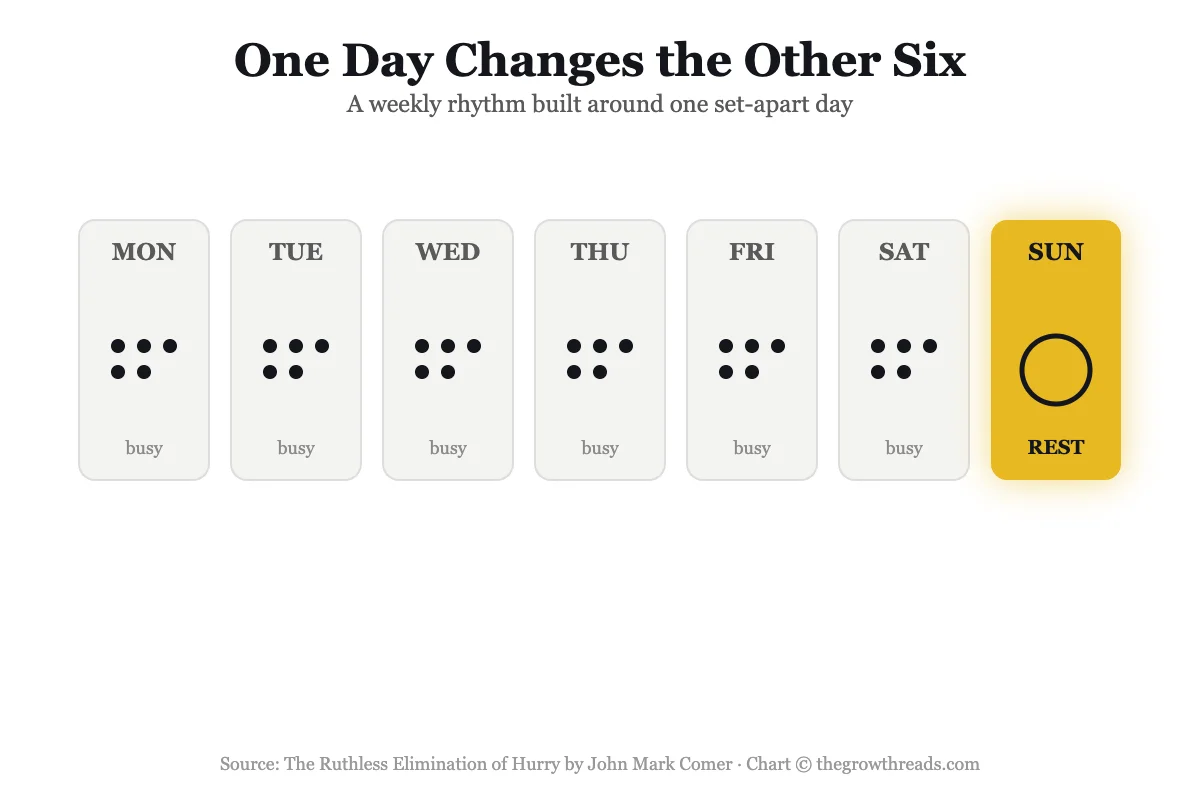
- Sabbath is a weekly reset: one full day set apart from striving is what makes the other six sustainable.
- Simplicity reduces hidden hurry: owning and committing to less means less to manage, maintain, and rush through.
- Irritability and restlessness are symptoms: they’re signals that the pace has outrun your capacity, not just personality quirks.
- Presence is a practice: being fully where you are takes deliberate effort in an environment built to pull your attention elsewhere.
- Community resists hurry better than willpower alone: shared practices and accountability make slowing down more sustainable.
- Small daily shifts compound: starting the day slower or doing one thing at a time adds up more than occasional big resets.
- Rest is not the reward for productivity — it’s the foundation of it: genuine rest is what makes sustained, meaningful work possible.
What is The Ruthless Elimination of Hurry about?
The Ruthless Elimination of Hurry argues that hurry, not busyness, is the real threat to a healthy emotional and spiritual life. John Mark Comer offers four practices — silence and solitude, Sabbath, simplicity, and slowing — for deliberately building margin into a schedule that would otherwise stay perpetually rushed, so that presence and depth become possible again.
About the author
John Mark Comer is a pastor, author, and founder of Practicing the Way, an organization focused on spiritual formation and contemplative practice. He spent over a decade leading a fast-growing church before stepping back from a conventional pastoral role to focus on writing, teaching, and building tools that help people slow down and live with more intention. The Ruthless Elimination of Hurry grew directly out of his own experience with burnout and the process of rebuilding a sustainable, unhurried rhythm of life. That personal history gives the book a practical, tested-in-real-life quality rather than a purely theoretical one — the practices he recommends are ones he has had to rebuild his own schedule around, not just observed in others. Explore all John Mark Comer book summaries →
Key concepts at a glance
| Concept | What it means | Use it when |
|---|---|---|
| Hurry vs. busyness | Busyness is about your schedule; hurry is an inner state of rush that can exist even with a light schedule. | You want to diagnose whether the real problem is your calendar or your pace. |
| Silence and solitude | Deliberate, regular time alone and away from input, to let the nervous system settle. | You notice you’re never truly quiet or alone during a normal week. |
| Sabbath | One full day a week set apart from work and striving, practiced consistently. | Your weeks feel like an unbroken stretch with no real reset point. |
| Simplicity | Owning and committing to less, so there is less to manage and hurry through. | Your possessions or commitments feel like they’re managing you. |
| Slowing | Small daily practices — driving in the slow lane, walking instead of rushing — that retrain a hurried default. | You want a low-effort way to interrupt the automatic rush of a normal day. |
Part 1: Hurry is the enemy, not busyness
Comer opens by drawing a distinction that reframes the whole conversation about overload: busyness is a scheduling fact, but hurry is an inner posture. It’s possible to have a genuinely full life — kids, work, commitments — without a hurried spirit, and it’s just as possible to have a light schedule while still feeling perpetually rushed inside. The goal of the book isn’t to do less, necessarily. It’s to remove the hurry that has crept into how you do everything.
This matters because hurry, left unaddressed, doesn’t just make life feel unpleasant — Comer argues it actively degrades the qualities most people say they want more of: patience, presence, deep relationships, and the capacity to sit with hard things instead of rushing past them. He points to the always-on nature of modern technology as a major accelerant: notifications, infinite feeds, and constant connectivity all train the nervous system to expect the next input immediately, making stillness feel not just difficult but almost unnatural. Removing hurry, in that sense, isn’t just a personal preference — it’s a deliberate act of resistance against an environment engineered to keep you rushing.
TGR Note: This distinction pairs well with Time Anxiety, which looks at the psychological roots of feeling perpetually behind, even when the actual demands on your time haven’t changed. Read together, the two books tackle the same problem from the outside in and the inside out.
Part 2: Four practices against hurry
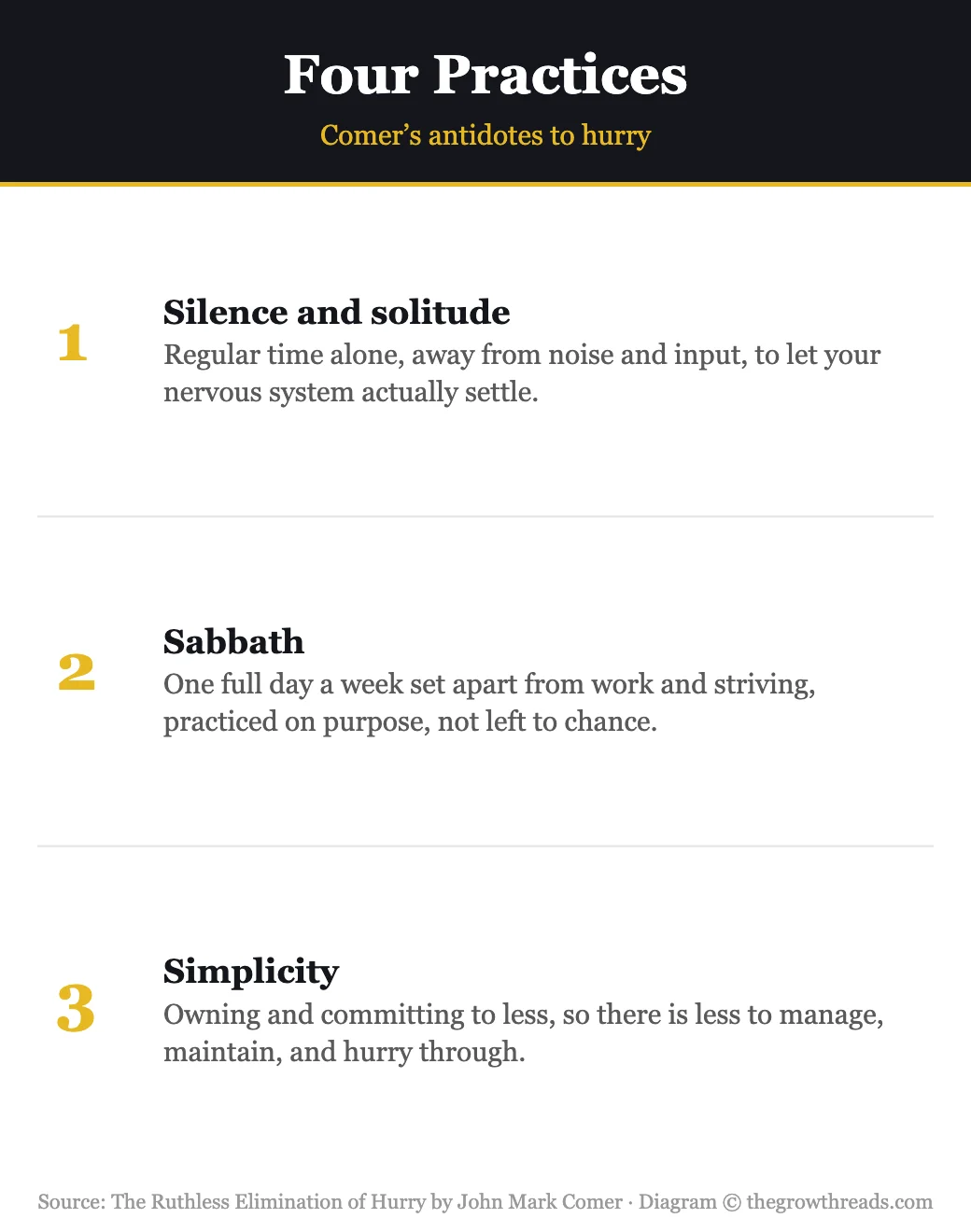
The heart of the book is a set of concrete practices for interrupting hurry rather than just resisting it in the abstract. Silence and solitude create regular space away from noise and input. Sabbath sets apart one full day a week from striving and productivity, practiced deliberately rather than left to chance. Simplicity reduces the hidden hurry that comes from managing too many possessions and commitments. And slowing — small, low-stakes practices like choosing the slower checkout line on purpose — retrains a nervous system that defaults to rush.
Sabbath gets particular attention in the book, and for good reason: Comer treats it not as a nice-to-have but as the practice that makes everything else sustainable. A single day set apart each week, done consistently, changes the texture of the other six — not because it adds more hours, but because it interrupts the assumption that productivity should be constant.
TGR Note: The case for a genuine weekly reset echoes Margin, which makes a similar argument for deliberately building reserve into an overloaded life rather than treating every available hour as fair game for another commitment.
Part 3: How to spot hurry sickness
Because hurry is an inner state rather than a line item on a calendar, it can be hard to notice until it shows up in its symptoms. Comer points to irritability — small interruptions landing like major threats — as an early warning sign. Hypersensitivity to criticism and setbacks is another, since there’s no reserve capacity left to absorb them gracefully. And restlessness, an inability to be present or still even during moments explicitly set aside for rest, is often the clearest signal that the pace has outrun what a person can actually sustain.
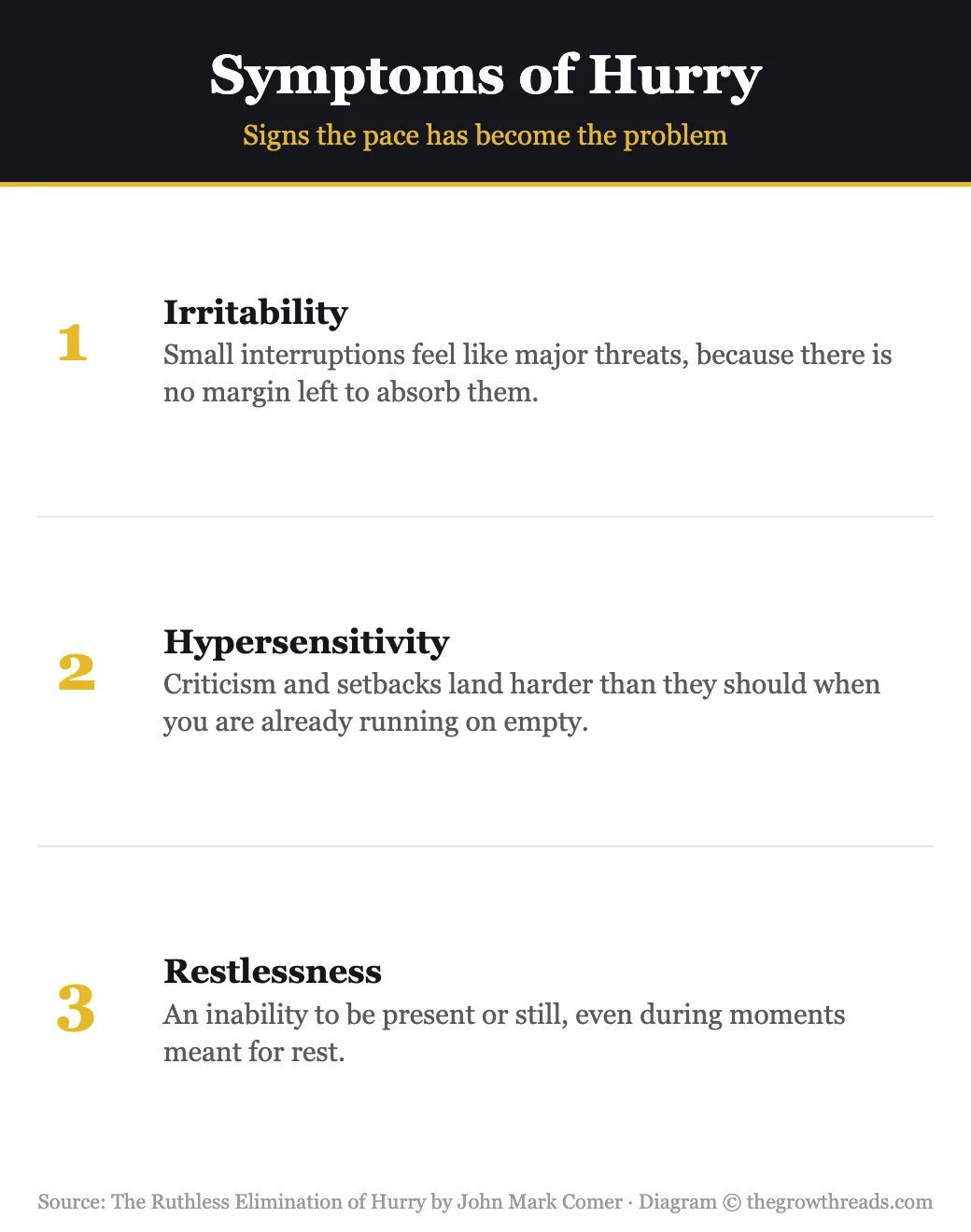
Recognizing these symptoms matters because they’re easy to misattribute — to a difficult week, a demanding season, or just personality. Comer’s argument is that they’re worth treating as data: reliable signals that hurry has become the operating mode, not the exception.
Part 4: Unhurrying an ordinary day
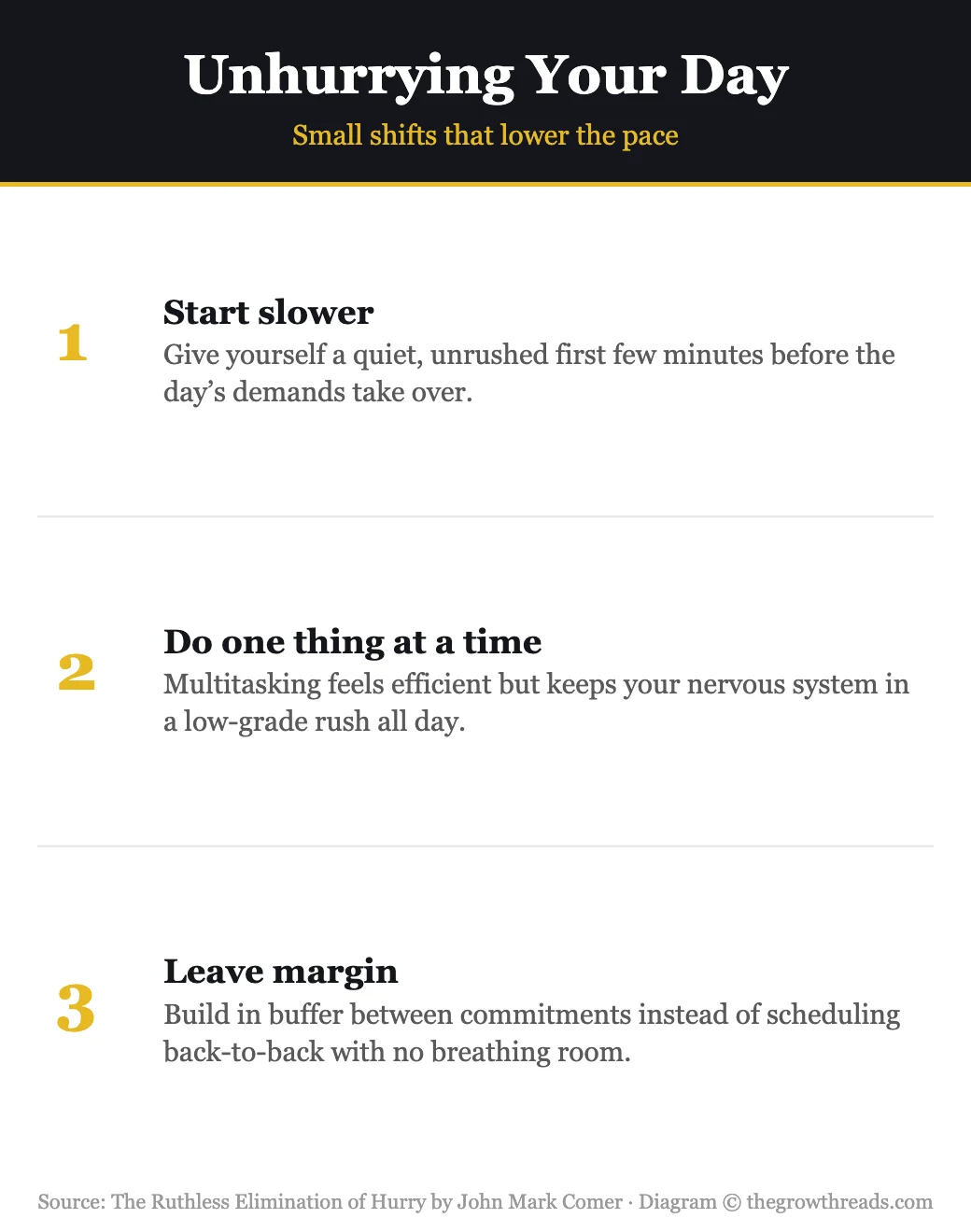
The book’s most immediately usable material is its guidance for lowering the pace of an ordinary day, not just a retreat or vacation. Starting the day with a few unrushed minutes before demands take over sets a different tone than reaching for a phone the moment you wake. Doing one thing at a time, instead of treating multitasking as efficient, keeps the nervous system out of a low-grade rush for hours at a stretch. And leaving margin between commitments — rather than scheduling back-to-back with no buffer — means one delay doesn’t cascade into a day that feels like a sprint from start to finish. None of these shifts require a dramatic life overhaul. Comer’s point is that unhurrying is built moment by moment, choice by choice, far more than it’s achieved through one big change.
TGR Note: This focus on presence over pace connects to Meditations for Mortals, which makes a related case that accepting your limitations — rather than fighting them — is what actually makes a meaningful life possible.
Who is The Ruthless Elimination of Hurry best for — and who should read something else first?
This book is best for anyone who feels perpetually rushed, distracted, or unable to slow down even during moments meant for rest — especially readers open to its contemplative and spiritual framing. If you’re looking for a more secular, psychology-focused take on the same territory, Time Anxiety covers similar ground without the faith-based lens. If your priority is building reserve capacity into an overloaded schedule specifically, Margin is a close, practical complement.
Questions to reflect on
- Is your current struggle closer to too much on your schedule, or a hurried feeling that persists even during quiet moments?
- What would a genuine day of rest look like for you, and what’s currently stopping you from taking one?
- Which of the four practices — silence, Sabbath, simplicity, or slowing — feels most needed in your life right now?
- When did you last notice irritability or restlessness as a signal, rather than just pushing through it?
- What’s one commitment you could simplify or remove to reduce the hidden hurry it creates?
🔥 Ready to slow down?
Grab a copy of The Ruthless Elimination of Hurry and start building an unhurried rhythm.
How to apply The Ruthless Elimination of Hurry (7-day plan)
- Day 1: Notice one moment today when you felt hurried, and ask whether the underlying task actually required that pace.
- Day 2: Schedule 20 minutes of genuine silence and solitude, with no phone or input.
- Day 3: Practice doing one thing at a time for a single task block — no switching, no multitasking.
- Day 4: Identify one commitment or possession you could simplify or remove to reduce hidden hurry.
- Day 5: Start the day with five unrushed minutes before checking your phone or starting work.
- Day 6: Build in deliberate margin between two commitments instead of scheduling them back-to-back.
- Day 7: Take a first attempt at a Sabbath — even a half-day set apart from work and striving.
Frequently asked questions
What is the main idea of The Ruthless Elimination of Hurry?
The main idea is that hurry — an inner state of constant rush — is more damaging than busyness itself, and that it has to be deliberately eliminated through practices like silence, Sabbath, simplicity, and slowing. John Mark Comer argues that a hurried life makes presence, depth, and genuine rest nearly impossible, regardless of how full or light the schedule actually is.
What is the difference between hurry and busyness in the book?
Busyness describes how full your schedule is, while hurry describes an inner posture of constant rush that can exist independent of your actual workload. Comer argues you can be busy without being hurried, and hurried without being especially busy — which is why simply doing less doesn’t automatically solve the deeper problem.
What are the four practices in The Ruthless Elimination of Hurry?
The four practices are silence and solitude, Sabbath, simplicity, and slowing. Silence and solitude create regular space away from noise and input. Sabbath sets apart one day a week from striving. Simplicity reduces what there is to manage and hurry through. Slowing uses small daily choices to retrain a default rush response.
Is The Ruthless Elimination of Hurry a religious book?
Yes, the book draws heavily on the practices of Jesus and the Christian contemplative tradition, and John Mark Comer writes from an explicitly faith-based perspective. Many of its practical insights about pace, presence, and rest are accessible to readers outside that tradition, but the framing throughout is spiritual rather than purely secular.
What are the symptoms of “hurry sickness” described in the book?
Comer highlights irritability, hypersensitivity to criticism or setbacks, and restlessness as common symptoms of a life paced by hurry rather than intention. He frames these not as personality traits but as signals worth taking seriously — evidence that the current pace has outrun what a person can sustainably absorb.
How is Sabbath different from just taking a day off?
Comer distinguishes Sabbath from an ordinary day off by its intentionality and consistency: it’s practiced deliberately and regularly, set apart specifically from striving and productivity, rather than taken opportunistically whenever a schedule happens to be light. The consistency is what makes it function as a genuine reset rather than an occasional break.
Who should read The Ruthless Elimination of Hurry?
It’s best suited to readers who feel perpetually rushed or distracted and are open to a contemplative, faith-informed approach to slowing down. Readers looking for a more secular or purely tactical time-management system may prefer a book with a less spiritual framing, though many of the practical insights still apply broadly.
Related summaries
- Time Anxiety: Ending the Illusion of Urgency
- Margin: Restoring the Reserves Overload Has Stolen
- Meditations for Mortals: Why Your Limitations Are the Point
- See all the best productivity books
How we analyze books: Every TGR summary is built from a close read of the book’s core arguments, cross-checked against the author’s other published work and interviews, and organized around what you can actually do differently this week. Read our full methodology.