

⭐⭐⭐⭐ 4.5/5 — A practical, workbook-style guide to building mental performance through small, repeatable habits.
Best for: Readers who want an interactive, chapter-by-chapter approach to building focus, resilience, and confidence.
Reading time: ~4 hrs to read, 20 min to guide
Difficulty to apply: Low to moderate — each chapter includes written reflection exercises.
A High-Performing Mind in one minute
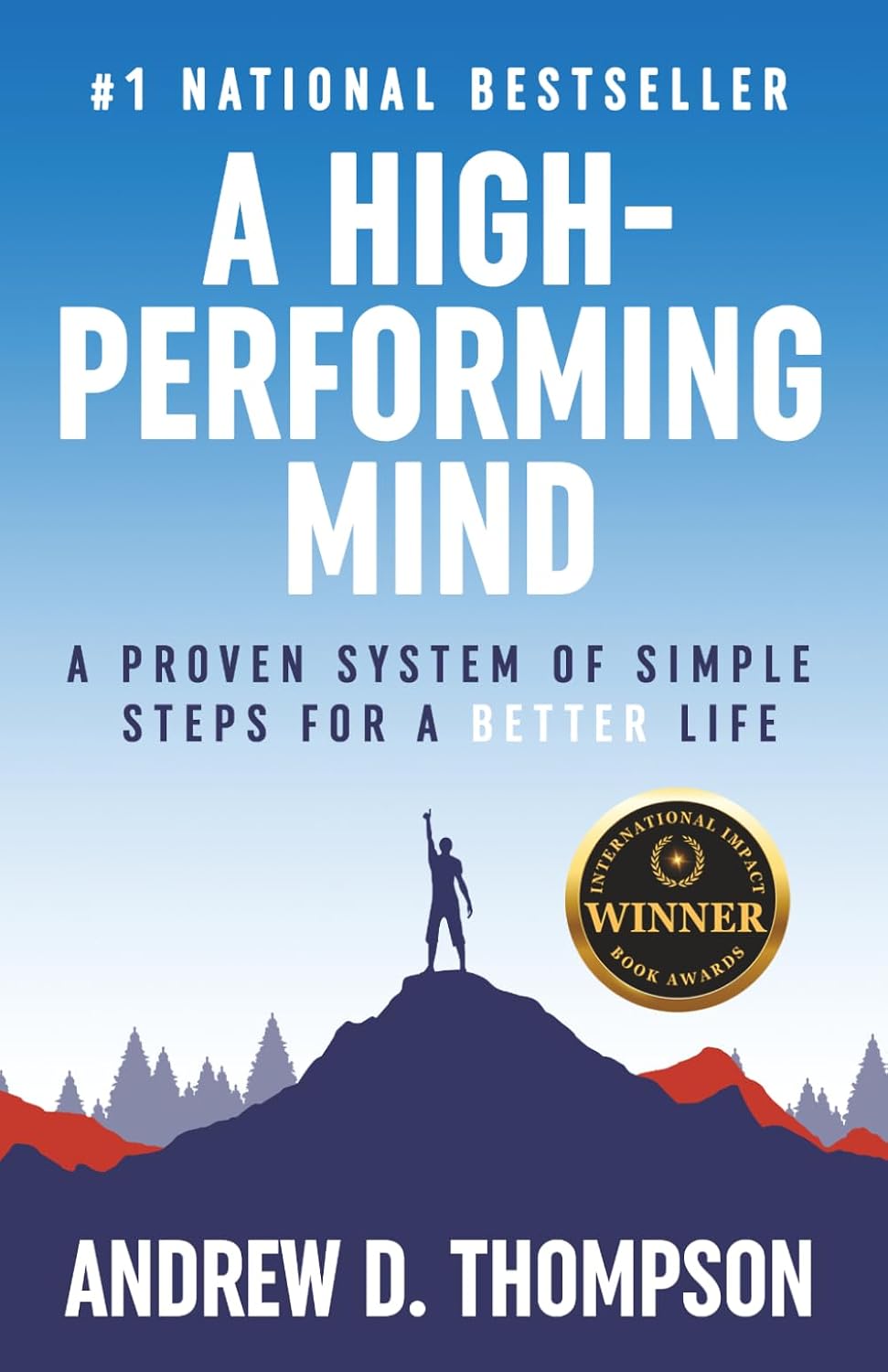
High performance isn’t something you’re born with — it’s a mental skill you can train, one small habit at a time. Andrew D. Thompson built A High-Performing Mind: Strengthen Your Mind and Live Your Best Life around three decades of coaching elite athletes and business executives, combined with his own account of an extended recovery from a serious accident. The book is structured as an interactive workbook: twelve chapters, each isolating a single attribute of high performers, closing with a “key learnings” summary and written reflection questions that turn reading into a personal action plan rather than passive consumption.
Key takeaways
- Performance is learnable: the book frames high performance as a trainable skill rather than a fixed trait some people simply have.
- Mistakes are data, not verdicts: reframing errors as feedback rather than failure keeps momentum after setbacks.
- Fear is a signal to investigate: rather than an obstacle to eliminate outright, fear is treated as information worth examining.
- One idea per chapter: each of the twelve chapters isolates a single attribute instead of covering everything at once.
- Chapters end with reflection: written questions convert each chapter’s idea into a personal, specific action plan.
- Small, repeatable habits beat willpower: the book favors tiny, consistent actions over large, motivation-dependent overhauls.
- Notice distraction early: catching drift quickly makes returning to focus far easier than trying to never lose it.
- Return, don’t restart: getting back to the task matters more than maintaining unbroken focus.
- Clear goals anchor the process: a specific target makes it easier to notice progress and adjust course.
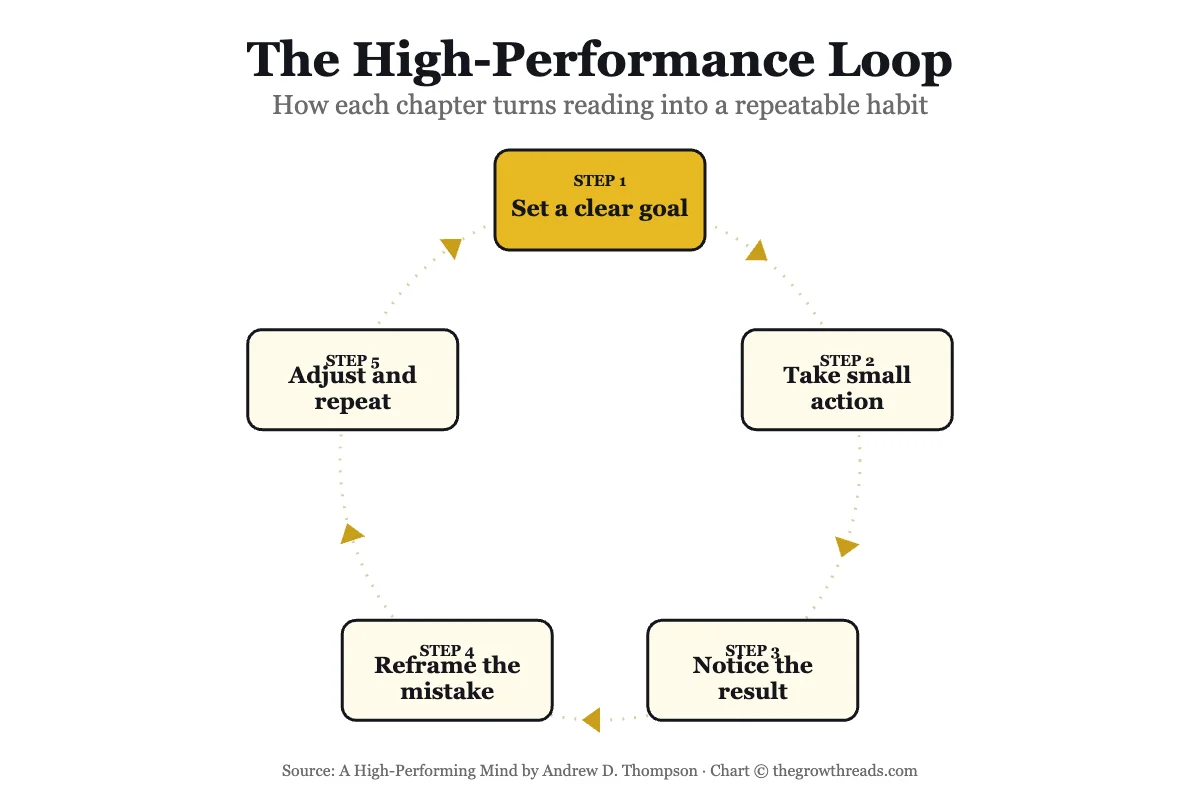
- The process is cyclical: goal, action, result, reframe, and adjustment repeat rather than ending after one pass.
What is A High-Performing Mind about?
A High-Performing Mind is a workbook-style guide arguing that high performance is a trainable mental skill, not an innate trait. Across twelve chapters, each covering a single attribute, the author offers reflection exercises and small, repeatable habits meant to build focus, resilience, and confidence over time rather than through one large overhaul.
About the author
Andrew D. Thompson draws on roughly three decades of experience coaching elite athletes and business executives, and describes the book as also shaped by his own recovery from a serious 2016 accident that reportedly required years of rehabilitation. That personal experience with setback and recovery informs the book’s emphasis on reframing mistakes and adversity as part of the process rather than as derailments from it. This lived-experience framing is part of what distinguishes the book’s tone from more purely academic treatments of resilience — the advice reads as tested against a genuinely difficult personal circumstance rather than derived solely from theory. As a smaller-press release rather than a title from a major publishing house, the book’s reach has been more modest than some of the other titles in this library, but its interactive, workbook-driven format has resonated with readers looking for a structured way to translate reading into personal action. Explore all Andrew D. Thompson book summaries →
Key concepts at a glance
| Concept | What it means | Use it when |
|---|---|---|
| Performance as a skill | High performance can be trained deliberately, not just inherited | You’ve assumed you’re “just not” naturally focused or resilient |
| Mistake reframing | Treating errors as feedback rather than failure | A setback has stalled your momentum on a goal |
| Fear as signal | Investigating what fear is telling you instead of avoiding it outright | Anxiety is stopping you from starting or continuing a task |
| One-chapter, one-attribute structure | Each chapter isolates a single skill rather than covering everything at once | You want to build one habit at a time instead of overhauling everything |
| Key learnings summary | A distilled recap closing every chapter | You want a quick reference to revisit core ideas later |
| Reflective questions | Written prompts that turn reading into a personal action plan | You tend to finish self-help books without applying anything |
| The performance loop | Goal, action, result, reframe, and adjustment repeating in cycles | You want a repeatable structure rather than a one-time push |
Part 1: Performance is trained, not inherited
Thompson’s foundational claim is that high performance — focus, resilience, confidence under pressure — isn’t reserved for people with some innate gift. Drawing on decades spent coaching both elite athletes and business executives, he argues that the attributes separating high performers from everyone else are learnable skills, built through deliberate, repeated practice rather than granted by talent or circumstance. This reframe matters because it changes where a reader’s attention goes: instead of comparing yourself unfavorably to someone who “just has it,” the book directs you toward specific, practicable behaviors you can start building today.
This is a meaningful distinction because the two framings lead to very different next steps. If you believe focus or resilience is something you either have or don’t, there’s little productive action to take beyond hoping for improvement. If instead you believe these are trainable, the natural next step is to identify a specific, small practice and repeat it — which is exactly the shape each of the book’s twelve chapters takes. The framing itself does some of the motivational work before a single technique is even introduced.
This also reframes how a reader might approach comparison with others. If performance is a fixed trait, watching someone else handle pressure calmly or stay consistently focused can feel discouraging — proof of a gap that can’t be closed. If it’s a trained skill, the same observation becomes informative rather than deflating: that person has simply practiced a specific set of behaviors longer, and the gap is closable through the same kind of deliberate repetition, not through waiting for a personality trait to appear.
This argument is given weight by the author’s own account of recovery from a serious accident in 2016 that reportedly required an extended, multi-year rehabilitation. He frames that experience as a direct, lived test of the book’s core ideas — that setbacks, however severe, are navigable through the same mental tools he teaches: clear goal-setting, reframing difficulty as information rather than defeat, and small, consistent forward action even when progress is slow. Whether or not every reader’s circumstances resemble his own, the throughline is consistent: performance under adversity is built the same way performance under normal conditions is — incrementally, through practice.
It’s worth noting that specific details of the author’s recovery, and the exact list of the “twelve attributes” the book builds its chapters around, come primarily from the author’s own account and publisher description rather than independent, third-party verification — as is common for smaller-press titles without the review infrastructure of larger publishing houses. That doesn’t undermine the practical value of the exercises themselves, but it’s a reasonable thing to keep in mind when weighing biographical claims against the book’s actionable content, which stands on its own regardless of how the personal narrative is framed.
What can be verified more directly is the book’s own retail description and its consistent framing across independent reader reviews: a workbook built around twelve attributes, chapter-ending summaries, and written reflection questions. That structural claim is corroborated across multiple sources even where deeper biographical or statistical details aren’t independently confirmable, which is a useful distinction for readers evaluating any book from a smaller press — the format and approach are verifiable even when every personal anecdote isn’t.
Part 2: Reframing mistakes and fear
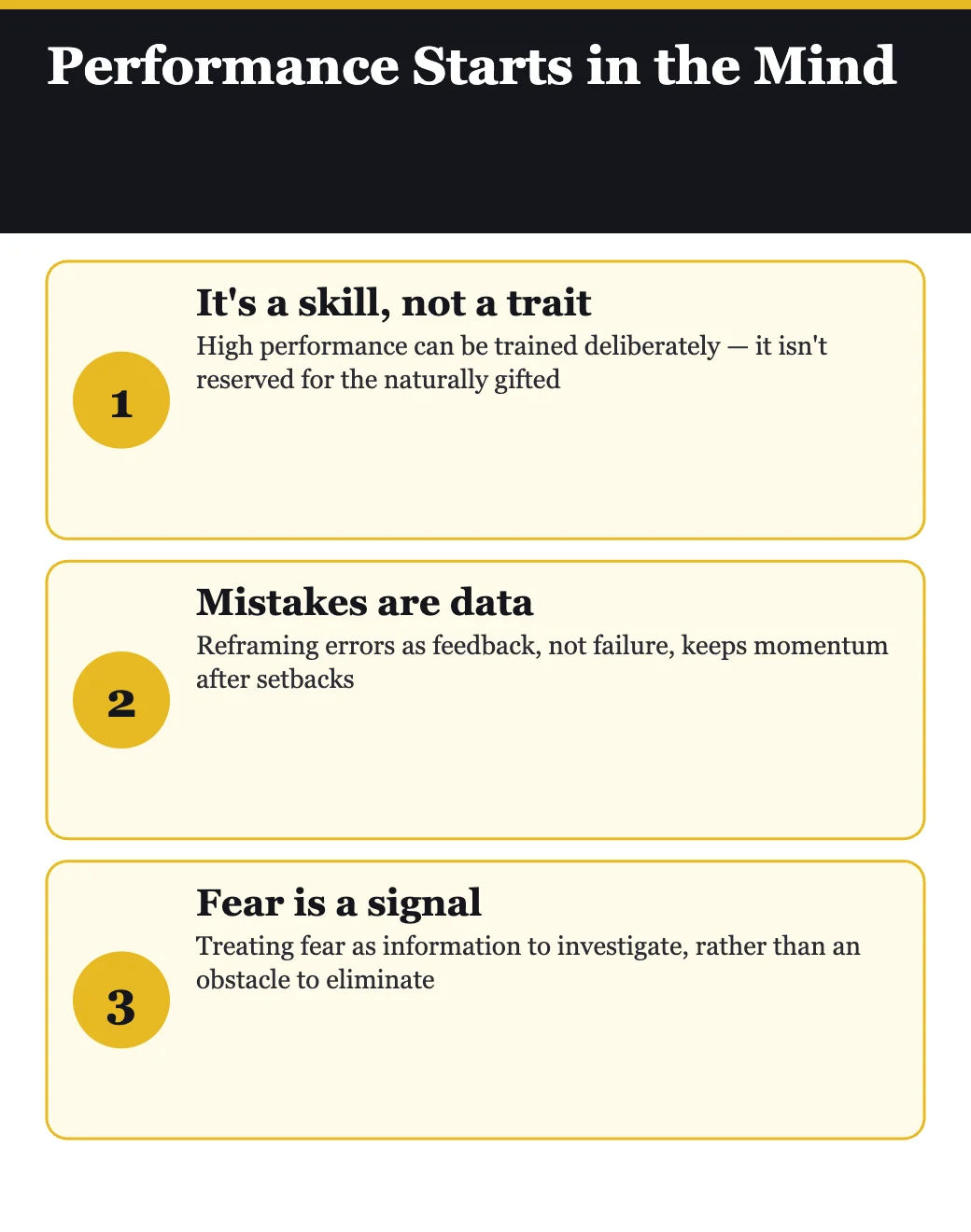
Two of the book’s recurring themes work together closely: how it treats mistakes, and how it treats fear. Rather than framing a mistake as a verdict on ability, Thompson consistently reframes errors as feedback — information about what didn’t work, useful for adjusting the next attempt, rather than proof that the underlying goal is unreachable. This distinction matters more than it might first appear, because how a person interprets a setback largely determines whether they try again or quit. Treating a mistake as data keeps the door open to another attempt; treating it as a verdict tends to close it.
Fear receives a similar treatment. Instead of positioning fear as an obstacle to be eliminated or pushed through by force of will, the book encourages readers to treat it as a signal worth investigating — what, specifically, is the fear pointing toward? Sometimes it flags a genuine risk worth addressing directly; other times it’s simply discomfort with the unfamiliar, which tends to fade with repeated exposure. Either way, examining fear rather than suppressing it gives a reader more useful information than simply trying to override the feeling.
Together, these two reframes — mistakes as feedback, fear as signal — share a common mechanism: they replace an emotionally loaded, all-or-nothing interpretation with a more specific, answerable question. “Did I fail?” is a question with only two demoralizing answers. “What does this tell me, and what should I adjust?” has a productive answer almost every time, regardless of how the attempt actually went. This shift from evaluative to diagnostic thinking is arguably the book’s most transferable single idea, since it applies to nearly any setback a reader might encounter outside the specific examples the book uses.
It’s a habit of language as much as a habit of thought, and Thompson suggests practicing it deliberately in low-stakes situations first — a minor mistake at work, a missed workout, a small miscommunication — before relying on it during genuinely high-pressure setbacks. The diagnostic question becomes easier to reach for automatically under real stress once it’s already a familiar, well-practiced response to smaller, everyday frustrations.
Part 3: Building focus in small, repeatable steps
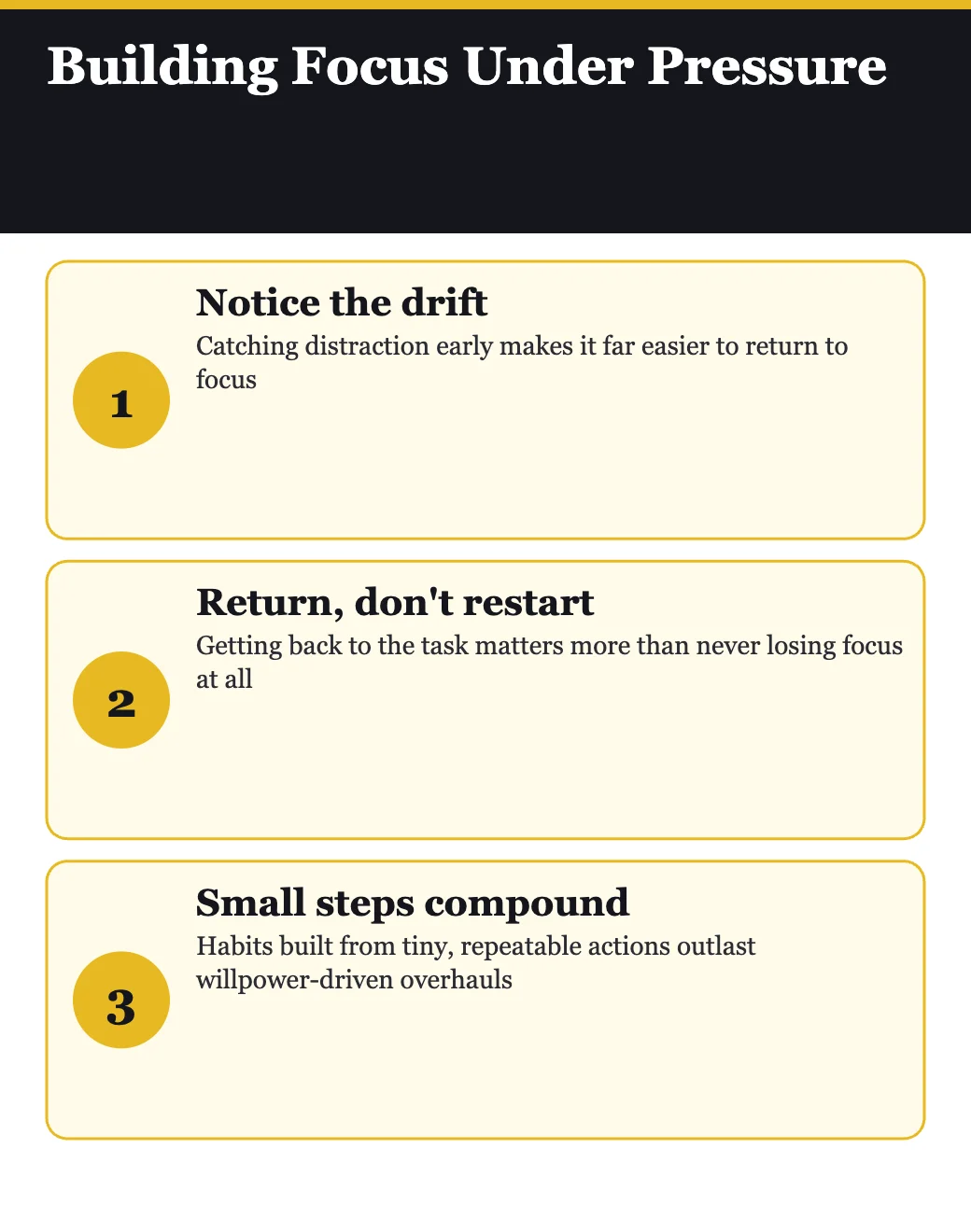
Rather than presenting focus as a matter of raw discipline, the book approaches it as a skill built through noticing and returning — catching distraction early, then redirecting attention back to the task, repeated as many times as needed within a single session. This lowers the bar for what counts as “good focus”: it isn’t never losing attention, it’s noticing quickly when you have and returning without excessive self-criticism about the lapse itself. Readers who’ve judged themselves harshly for a wandering mind may find this reframe more sustainable than treating every distraction as evidence of failure.
This distinction between noticing and never losing focus in the first place also lowers the barrier to starting a focus-building practice at all. A goal of “never get distracted” is both unrealistic and discouraging to attempt, since almost everyone fails at it within minutes. A goal of “notice sooner and return faster” is achievable from the very first practice session, which makes it far easier to actually begin rather than postponing the habit until conditions feel ideal.
The book pairs this with an emphasis on small, repeatable actions over large, motivation-dependent pushes. A habit built from a tiny, easily repeatable unit — a few minutes of focused work, a short reflection exercise — is more likely to survive a low-energy day than a habit that requires a large reserve of willpower to execute. This mirrors a pattern found across much of the habit-formation literature: consistency at a small scale compounds more reliably than sporadic large efforts.
The book also frames focus as context-dependent rather than a single fixed capacity a person either has plenty of or doesn’t. A reader might sustain long, unbroken focus on a hobby they find effortless while struggling to hold five minutes of attention on an unpleasant task — and the book treats this as normal rather than contradictory. The goal isn’t to achieve some universal, unwavering focus across every activity, but to build the specific noticing-and-returning skill that makes focus recoverable in precisely the moments it tends to break down.
Thompson also connects this to the book’s broader emphasis on clear goals: focus is easier to sustain, and easier to notice losing, when there’s a specific target to measure against. A vague intention like “be more productive today” gives the mind nothing concrete to return to after a distraction; a specific goal like “finish this section by 3pm” gives focus something to snap back toward. Several of the book’s twelve chapters build on this same principle from different angles — specificity, in goals, in reflection, and in habits, consistently outperforms vague intention.
Part 4: Turning the book into a personal system
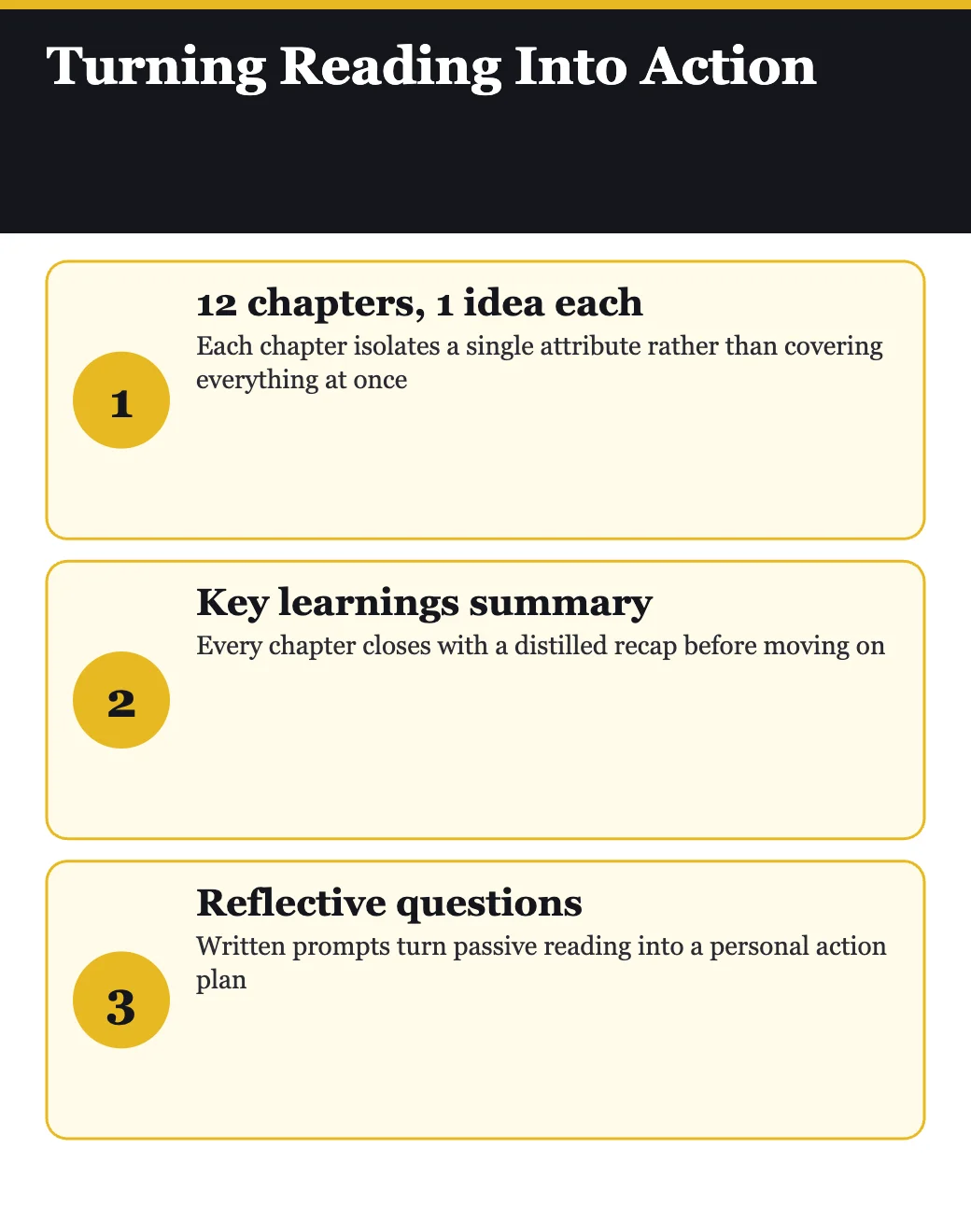
What distinguishes this book from a purely conceptual read is its workbook structure. Each of the twelve chapters isolates one attribute, works through it with explanation and examples, then closes with a “key learnings” summary and a set of written reflection questions with room to respond directly in the book. This design choice matters: reading about a mental skill and actually applying it to your own specific circumstances are different activities, and the reflection questions are what bridge the gap between the two.
Used as intended, the book functions less like a single read-through and more like a slow-built personal action plan — one attribute worked through at a time, with its own written reflection before moving to the next chapter. Readers who skip the reflection exercises and read straight through will still get the conceptual content, but the author’s structure suggests the real value is in the applied, written half of each chapter, not just the explanatory half.
There’s also a practical benefit to spacing the chapters out rather than consuming the book in one sitting. Each attribute takes real practice to internalize, and stacking twelve new concepts back-to-back without pausing to apply any of them risks the same fate as many self-help books: a burst of motivation that fades within days because nothing was actually put into practice. Working through one chapter, completing its reflection, and giving the resulting habit a week or two to take hold before starting the next chapter is a slower approach, but it’s more consistent with how the book frames skill-building throughout — incremental, not immediate.
Who is A High-Performing Mind best for — and who should read something else first?
This book is best for readers who want a structured, interactive approach to building mental performance — one that asks for written reflection rather than passive reading — and who respond well to breaking a big goal into twelve smaller, sequential attributes. It’s a good fit for readers recovering from a setback who want a framework for reframing difficulty as workable rather than final. Readers looking for a broader treatment of habit formation specifically, rather than mental performance more generally, might pair this with Million Dollar Habits. Readers whose primary challenge is sustained daily routines rather than mindset might prefer How to Manage Your Home Without Losing Your Mind.
Questions to reflect on
- Which single attribute from this book’s list feels most relevant to where you’re stuck right now?
- Think of a recent mistake — how would treating it purely as feedback, rather than failure, change what you do next?
- What is a fear you’ve been avoiding rather than investigating? What might it actually be signaling?
- Where do you tend to judge yourself harshly for losing focus, rather than simply noticing and returning to the task?
- What’s one small, repeatable action you could commit to this week, sized so it survives even a low-energy day?
🔥 Ready to train your mind like a skill?
Get A High-Performing Mind and work through twelve attributes with built-in reflection exercises.
How to apply A High-Performing Mind (7-day plan)
- Day 1: Pick one attribute from the book that feels most relevant right now and read just that chapter.
- Day 2: Complete the chapter’s reflection questions in writing, even briefly — don’t skip this step.
- Day 3: Identify one recent mistake and rewrite it in your own words as feedback rather than failure.
- Day 4: Name one fear you’ve been avoiding and write down what it might actually be signaling.
- Day 5: Practice noticing distraction during one focused work session — count how many times you catch and return, without judgment.
- Day 6: Set one small, specific goal for the week and define what “small action” toward it looks like today.
- Day 7: Review the week using the loop: what was the result, what would you reframe, and what will you adjust next week?
Frequently asked questions
What is the core idea of A High-Performing Mind?
The book argues that high performance — focus, resilience, confidence under pressure — is a learnable skill rather than an innate trait. Drawing on the author’s experience coaching elite athletes and executives, it presents twelve chapters, each isolating one attribute of high performers, paired with reflection exercises meant to turn each idea into a personal action plan.
How is this book structured?
It’s built as a workbook: twelve chapters, each covering a single attribute, closing with a “key learnings” summary and written reflection questions. The structure is designed to be worked through slowly, one attribute at a time, rather than read straight through in one sitting, since the applied reflection is presented as central to the book’s value.
Is this a research-backed book or based on personal experience?
Available information indicates the book is grounded primarily in the author’s coaching experience and personal account of recovering from a serious accident, rather than citations to academic research. Readers looking for a book built more explicitly around cited psychological studies may want to treat this as a practical, experience-based guide rather than an academic one.
What does the book mean by treating mistakes as “feedback”?
Rather than treating an error as a verdict on ability, the book frames mistakes as information about what didn’t work, useful for adjusting the next attempt. This reframing is meant to keep readers moving forward after a setback instead of interpreting the mistake as proof a goal is unreachable.
Who is Andrew D. Thompson?
Andrew D. Thompson has spent roughly three decades coaching elite athletes and business executives, and describes his 2016 recovery from a serious accident as a personal test of the book’s core ideas around resilience and reframing adversity. The book is independently or small-press published rather than released by a major publishing house.
Do I need to complete the reflection exercises to benefit from the book?
The conceptual content is accessible through reading alone, but the book’s design suggests the written reflection questions are what convert each chapter’s idea into something personally applicable. Skipping them likely means absorbing the concepts without the specific, individualized action plan the exercises are meant to produce.
Who is A High-Performing Mind best for?
It’s best suited to readers who want a structured, interactive approach to mental performance and are willing to complete written reflection exercises rather than read passively. It’s a good fit for anyone navigating a setback who wants a framework for treating difficulty as workable rather than final.
Related summaries
Explore more productivity and mindset guides: Million Dollar Habits · How to Manage Your Home Without Losing Your Mind · Gentle · see the full Time Management hub for more.
How we analyze books: we read the source material, cross-reference author interviews and published summaries, and build original diagrams and 7-day application plans so every TGR guide adds value beyond the book itself. Read our full methodology.