

TGR Verdict: ★★★★☆ 4.1/5
A clear-eyed case that the real work of finding lasting love happens inside yourself first — understanding your history, patterns, and readiness before you go looking for the right partner.
Loving Bravely in one minute
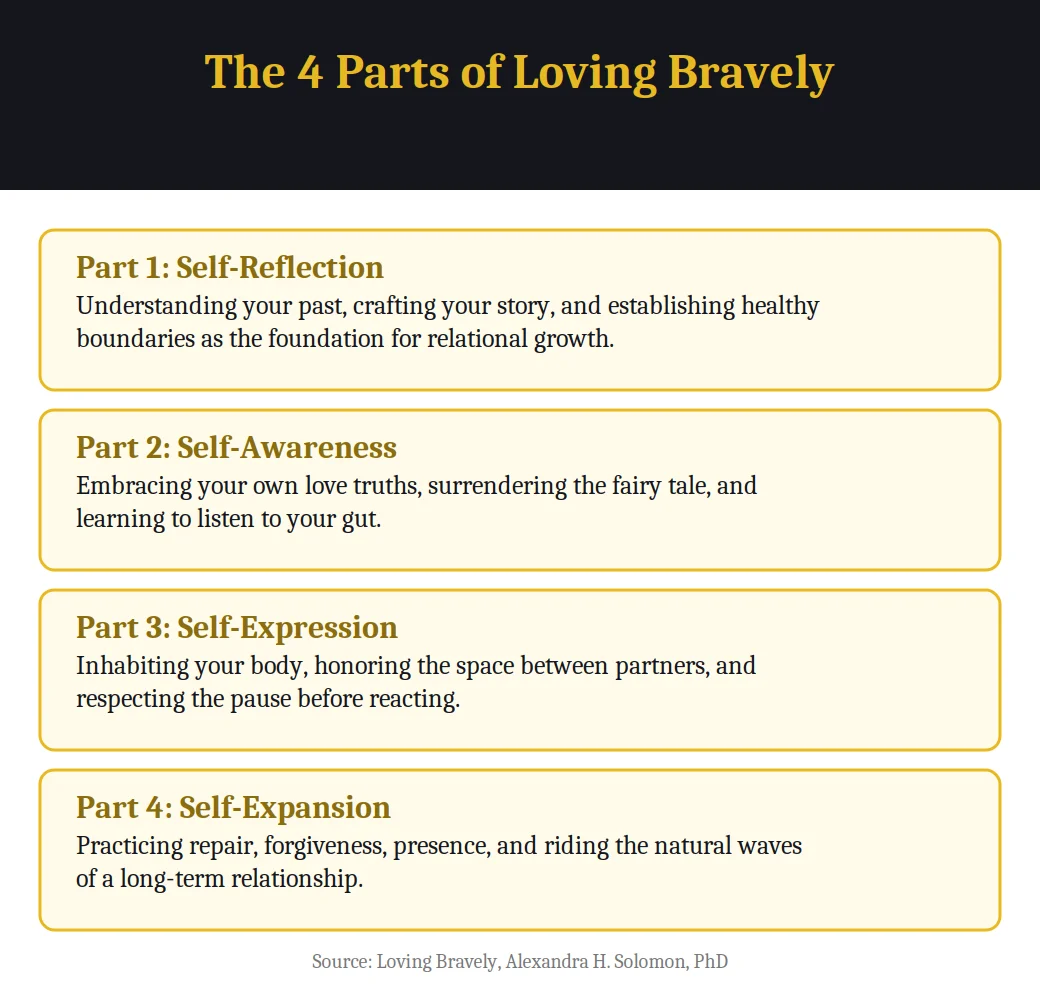
Alexandra H. Solomon, a couples therapist and Northwestern professor known for her popular “relationships 101” course, argues that most people approach love backwards — searching for the right partner before doing the internal work of understanding their own patterns. Loving Bravely is structured as 20 lessons across four parts (Self-Reflection, Self-Awareness, Self-Expression, and Self-Expansion), building the case that “relational self-awareness” — knowing your own history, triggers, and blind spots — is what actually determines whether a relationship will thrive. Rather than offering dating tactics, the book asks readers to examine their family-of-origin scripts, surrender the fairy-tale idea that a partner will complete them, and build the internal skills (boundaries, self-soothing, honest communication) that make real intimacy possible.
Key takeaways
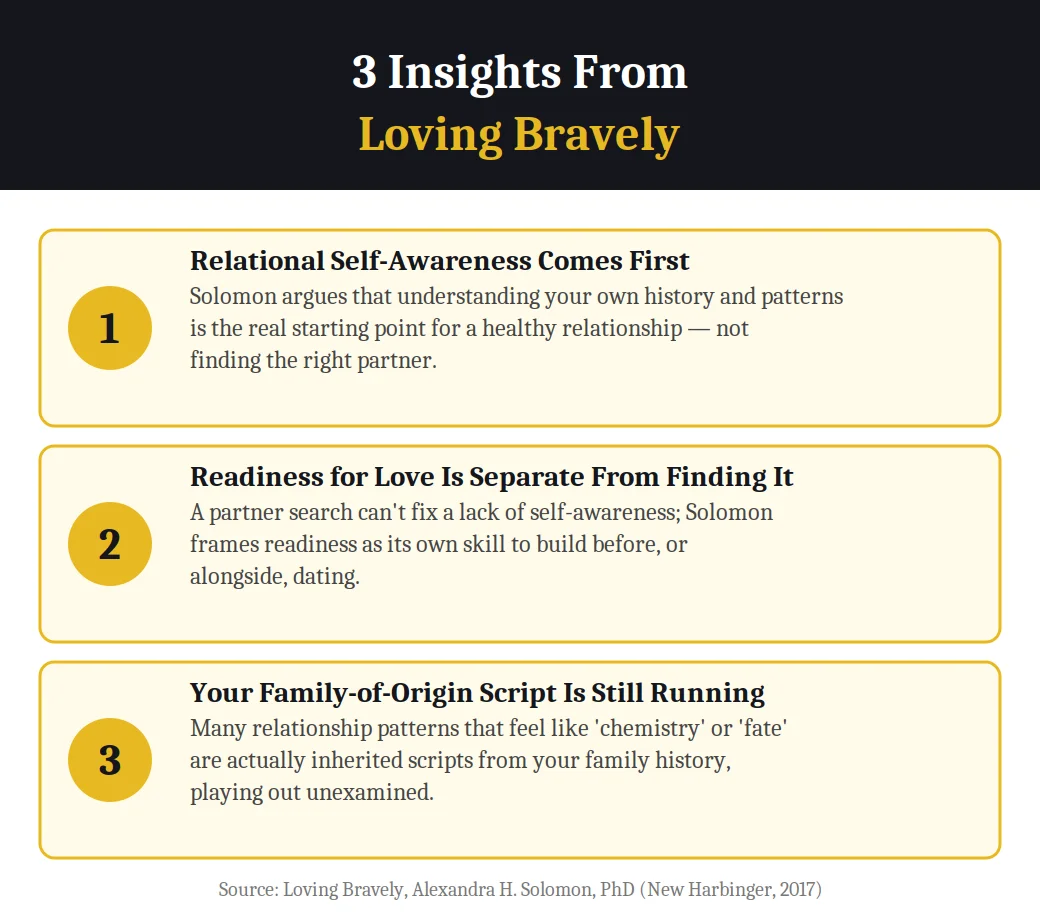
- Relational self-awareness — understanding your own history and patterns — is the real starting point for a healthy relationship, not finding the right partner.
- Readiness for love is a separate skill from finding love; a partner search can’t fix a lack of self-awareness.
- Many relationship patterns that feel like “chemistry” or “fate” are actually inherited scripts from your family-of-origin, playing out unexamined.
- Surrendering the fairy tale means giving up the idea that a partner will complete you, in favor of two whole people choosing each other.
- “The space between” two partners — healthy boundaries and separateness — is what makes real intimacy possible, rather than fusion or codependency.
- Listening to your gut and respecting the pause before reacting are learnable skills, not just personality traits.
- Repair, forgiveness, and presence are ongoing practices, not one-time achievements, once a relationship is underway.
- Relationships move through natural cycles of closeness and distance; lasting love means learning to “ride the waves” rather than panicking at every dip.
- Many people enter relationships full of hope, only to be disappointed by the realization that their partner is a flawed human being with their own history and needs — a disappointment Solomon treats as the real starting point of mature love, not evidence of a mistake.
What is Loving Bravely about?
Loving Bravely is Alexandra Solomon’s foundational relationship book, built around her signature concept of “relational self-awareness”: the idea that understanding your own history, patterns, and emotional triggers has to come before, or alongside, any search for a partner. The book is organized into 20 lessons across four parts — Self-Reflection, Self-Awareness, Self-Expression, and Self-Expansion — moving readers from excavating their family-of-origin patterns, to building conscious insight into their own “love truths,” to practicing the boundaries and communication skills that let real intimacy happen, to sustaining a mature long-term partnership through repair, forgiveness, and the natural ebb and flow of closeness over time.
About the author
Alexandra H. Solomon, PhD, is a licensed clinical psychologist and couples therapist who teaches at Northwestern University, where her undergraduate course on relationships has become widely known (informally nicknamed “Marriage 101”). She hosts the podcast Reimagining Love and has extended the ideas in Loving Bravely into two additional books: Taking Sexy Back (2020), which applies the same self-awareness lens to sexuality and desire, and Love Every Day. Explore all Alexandra H. Solomon, PhD book summaries →
Key concepts at a glance
| Concept | What it means |
|---|---|
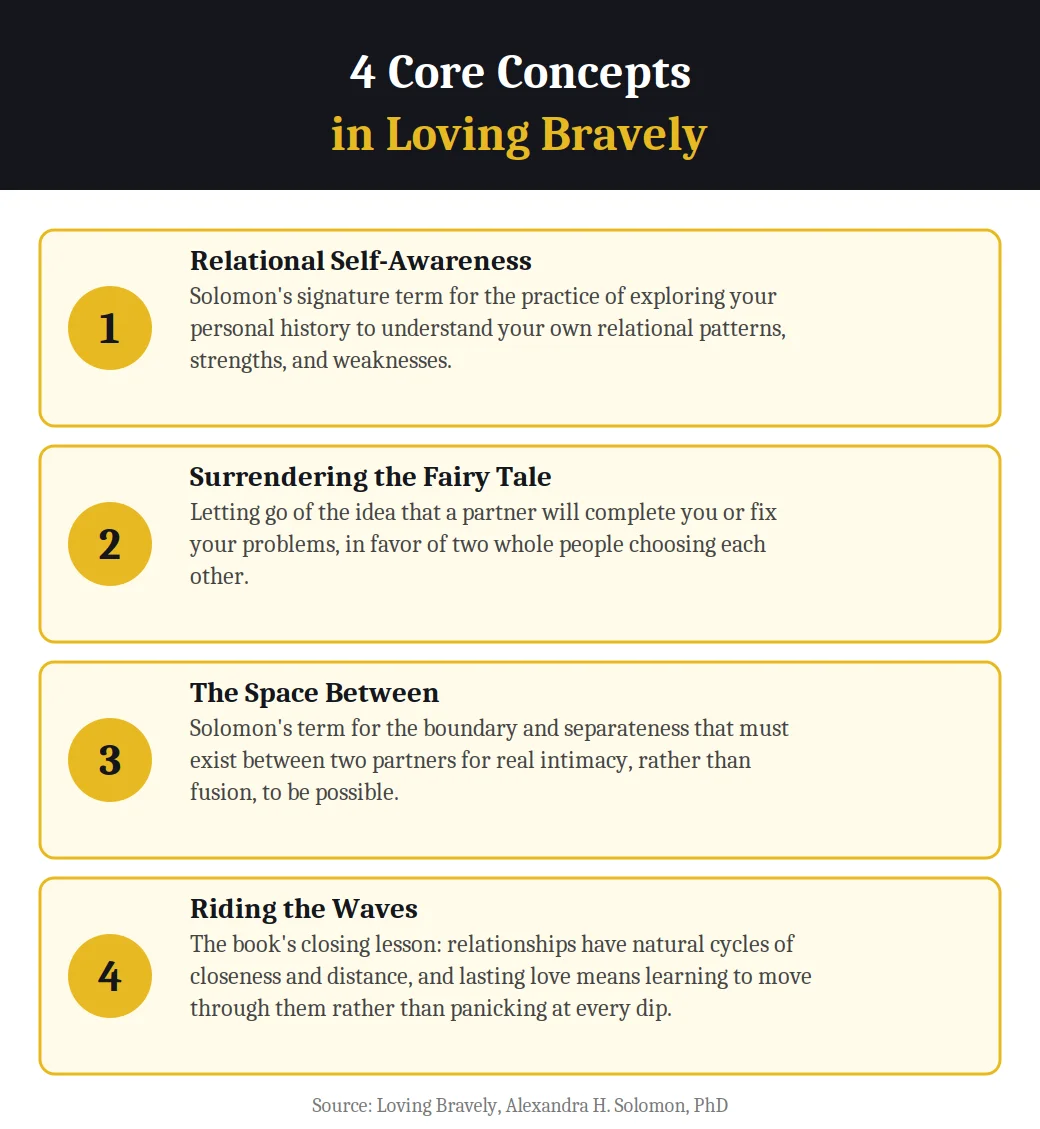
| Relational Self-Awareness | Exploring your personal history to understand your own relational patterns, strengths, and weaknesses before or alongside a partner search. |
| Surrendering the Fairy Tale | Letting go of the idea that a partner will complete you, in favor of two whole people choosing each other. |
| The Space Between | The boundary and separateness that must exist between two partners for real intimacy, rather than fusion, to be possible. |
| Readiness for Love | A distinct skill from finding love — built through self-work rather than through a partner search alone. |
| Riding the Waves | Learning to move through the natural cycles of closeness and distance in a long-term relationship rather than panicking at every dip. |
Part 1: Self-reflection and the scripts you inherited
The book’s first part asks readers to understand their past before trying to change their future — lessons like “Understand Your Past” and “Craft Your Story” push readers to trace how their family history shaped their expectations of love, long before they consciously chose a partner. Solomon argues that patterns which feel like chemistry, fate, or “just how relationships go” are frequently inherited scripts running unexamined in the background. This part closes with “Establish Healthy Boundaries,” treating boundary-setting as a foundational relational skill rather than an advanced one.
TGR Note: This idea that unexamined family-of-origin patterns quietly run our adult relationships connects directly to David Schnarch’s concept of differentiation in our Passionate Marriage summary, which frames maintaining your own identity within a relationship as the real engine of intimacy.
Part 2: Surrendering the fairy tale
In the book’s second part, Solomon directly confronts the “soulmate” narrative — the belief that a partner should instinctively understand you and complete what feels missing. Lessons like “Surrender the Fairy Tale” and “Keep the Soul in Soulmate” argue that this fantasy sets couples up for disappointment, since real partners are, in her words, flawed human beings with their own history and needs. The alternative she proposes isn’t cynicism about love, but a more grounded model: two whole, self-aware people choosing each other, rather than one incomplete person hoping to be finished by another.
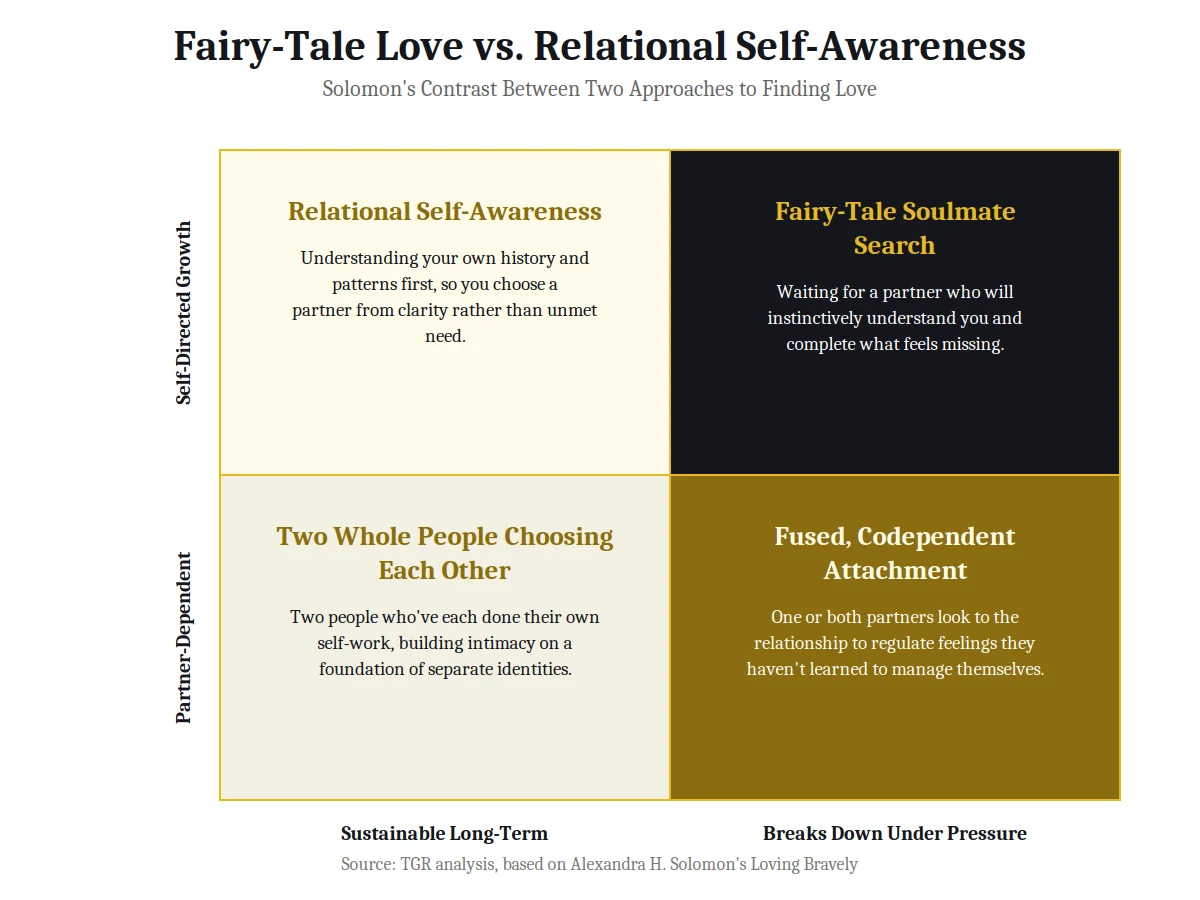
TGR Note: This distinction between two whole people choosing each other and one person looking to a relationship to complete them echoes Alain de Botton’s critique of “Romanticism” in our The Course of Love summary, which argues the soulmate ideology sets couples up to see normal friction as failure.
Part 3: Self-expression and the space between
The book’s third part turns to how self-awareness gets expressed in real relational moments: inhabiting your body, honoring “the space between” you and a partner, and respecting the pause before reacting to conflict. Solomon frames boundaries and separateness not as barriers to intimacy but as its precondition — without a clear sense of where you end and your partner begins, closeness collapses into fusion or codependency rather than genuine connection.
Who is Loving Bravely best for?
This book is best for readers who are single or dating and want to understand their own relational patterns before searching for a partner, as well as readers already in a relationship who suspect old family-of-origin scripts are still shaping how they handle conflict or closeness. It’s especially useful for anyone who keeps ending up in similar relationship dynamics and wants to understand why, rather than just changing partners.
It pairs well with our Passionate Marriage summary for readers interested in how personal differentiation shapes intimacy, or our The Course of Love summary for a philosophical take on why the soulmate myth causes so much relationship disappointment.
Questions to reflect on
- What relationship patterns from your family of origin do you notice repeating in your own romantic life?
- Are you searching for a partner to complete you, or are you working on becoming a whole person who can choose a partner from clarity?
- Do you have a clear sense of “the space between” you and your partner, or does closeness tend to feel like fusion?
- How do you typically respond during the natural distant phases of a relationship — do you panic, withdraw, or ride the wave?
- What would it look like to pause before reacting the next time a relational conflict triggers you?
How to apply Loving Bravely (7-day plan)
- Day 1: Write down one relationship pattern from your family of origin that you notice repeating in your own romantic life.
- Day 2: Identify one “fairy tale” expectation you hold about what a partner should provide, and question where it came from.
- Day 3: Practice naming one boundary clearly in a current relationship, romantic or otherwise.
- Day 4: Notice a moment of relational friction and practice pausing before reacting.
- Day 5: Reflect on whether you tend to fuse with a partner’s moods or maintain your own separate sense of self.
- Day 6: If you’re in a relationship, practice a small act of repair — a genuine apology or acknowledgment of impact.
- Day 7: Reflect on a recent “distant” phase in a relationship and consider whether you rode the wave or panicked.
Frequently asked questions
What is “relational self-awareness” in Loving Bravely?
Relational self-awareness is Alexandra Solomon’s signature concept for the practice of exploring your personal history to understand your own relational patterns, strengths, and weaknesses — treated as the real foundation for a healthy relationship, more so than finding the right partner.
How is Loving Bravely structured?
The book is organized into 20 lessons across four parts: Self-Reflection, Self-Awareness, Self-Expression, and Self-Expansion, moving from understanding your past to sustaining a mature long-term relationship.
What does “surrendering the fairy tale” mean?
It means letting go of the belief that a partner will instinctively understand you and complete what feels missing, in favor of a model where two whole, self-aware people choose each other.
Is Loving Bravely aimed at single people or couples?
Both — it’s written for readers who are single or dating and want to understand their patterns before searching for a partner, as well as readers already in a relationship who want to understand recurring dynamics.
Who is Alexandra Solomon?
Alexandra H. Solomon, PhD, is a licensed clinical psychologist, couples therapist, and Northwestern University professor known for her popular relationships course, informally nicknamed “Marriage 101,” and for hosting the podcast Reimagining Love.
What is “the space between” in Loving Bravely?
It’s Solomon’s term for the boundary and separateness that must exist between two partners for real intimacy, rather than fusion or codependency, to be possible.
What other books has Alexandra Solomon written?
She followed Loving Bravely (2017) with Taking Sexy Back (2020), which applies the same self-awareness lens to sexuality and desire, and a more recent title, Love Every Day.
Related summaries
If you found Loving Bravely valuable, read our Passionate Marriage summary for more on differentiation and intimacy, or explore our full list of best relationship books.
Our methodology: TGR book summaries are researched using the original text, publisher materials, author interviews, and critical reception, then structured to give you the core arguments, practical applications, and an honest verdict on who the book is best for.