

★★★★☆ 4.4/5
One-liner: Love is not a mystery or a fairy tale — it is a biological imperative with a science we can understand and a skill we can learn.
Best for: Anyone who wants to understand the science of love and attachment — couples seeking deeper connection, individuals exploring their relationship patterns, and therapists working with couples.
Reading time: ~6 hours (368 pages)
Difficulty to apply: Moderate — understanding attachment is immediate, but changing deeply ingrained patterns takes sustained practice.
Love Sense in One Minute
We are wired from birth to bond — and the quality of our bonds determines the quality of our lives. Dr. Sue Johnson, the creator of Emotionally Focused Therapy (EFT) and one of the world’s leading researchers on romantic attachment, presents the revolutionary science of love. Drawing on decades of clinical research and neuroscience, Johnson argues that love is not a mystery, not an irrational emotion, and not a cultural invention — it is a biological survival mechanism built into the human brain. Our need for emotional connection is as fundamental as our need for food and shelter. The book reveals the three key questions that drive all attachment behavior — Are you there for me? Can I reach you? Do you value me? — and shows how understanding and answering these questions transforms relationships from conflict and disconnection into secure, lasting bonds.
Key Takeaways
- Love is a biological imperative: Emotional bonding is wired into the human brain as a survival mechanism. The need for secure attachment is not weakness — it is biology.
- Three questions define every bond: Are you accessible? Are you responsive? Are you engaged? These A.R.E. questions drive all attachment behavior in romantic relationships.
- Attachment styles shape adult love: The patterns we develop in childhood — secure, anxious, avoidant, or fearful — predict how we connect in adult romantic relationships.
- Emotional responsiveness is the key: Being emotionally available, tuned in, and responsive to your partner’s needs is more important than any specific relationship technique.
- Conflict is usually about attachment: Most relationship fights are not really about money, chores, or parenting — they are protests against perceived disconnection from the attachment bond.
- Insecure attachment can change: Attachment patterns are not fixed. Through new experiences of emotional responsiveness — in therapy or in a secure relationship — insecure patterns can become secure.
- Isolation is the enemy of health: Loneliness and social isolation are as damaging to health as smoking fifteen cigarettes per day. Secure bonds are literally life-extending.
- Love is a skill, not just a feeling: The ability to create and maintain secure emotional bonds can be learned, practiced, and strengthened throughout life.
What Is Love Sense About?
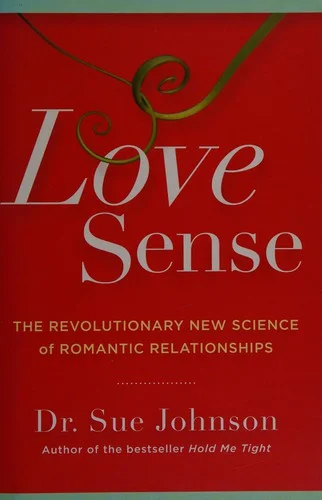
Love Sense presents the science of romantic attachment — revealing that love is a biological survival mechanism, not a mystery. Dr. Sue Johnson explains how the A.R.E. framework (Accessibility, Responsiveness, Engagement) drives all bonding behavior and how understanding attachment science transforms relationships from conflict into secure connection.
About the Author
Dr. Sue Johnson is a clinical psychologist, distinguished research professor at Alliant International University, and the primary developer of Emotionally Focused Therapy (EFT), the most empirically validated approach to couples therapy. Her research has demonstrated that EFT produces lasting improvements in relationship satisfaction for over seventy percent of distressed couples, with results maintained years after therapy ends. Johnson has trained thousands of therapists worldwide and has been recognized by the American Psychological Association for her contributions to the field. She is also the author of Hold Me Tight, a practical companion volume for couples. Explore all Sue Johnson book summaries →
Key Concepts at a Glance
| Concept | What It Means | Use It When |
|---|---|---|
| Attachment Bond | The deep emotional connection between partners that provides safety and security | You want to understand what makes relationships feel secure or insecure |
| A.R.E. | Accessibility, Responsiveness, Engagement — the three dimensions of secure bonding | You want a framework for evaluating and improving your relationship |
| Attachment Styles | Patterns of relating — secure, anxious, avoidant, fearful — shaped by early experience | You want to understand your own relationship patterns and your partner’s |
| Protest Behavior | Actions driven by attachment anxiety — clinging, withdrawing, or escalating conflict | You want to understand the real meaning behind conflict and emotional reactions |
| Emotional Responsiveness | Being available, attuned, and reactive to your partner’s emotional needs | You want the single most important skill for building a secure relationship |
Part 1: The Science of Bonding
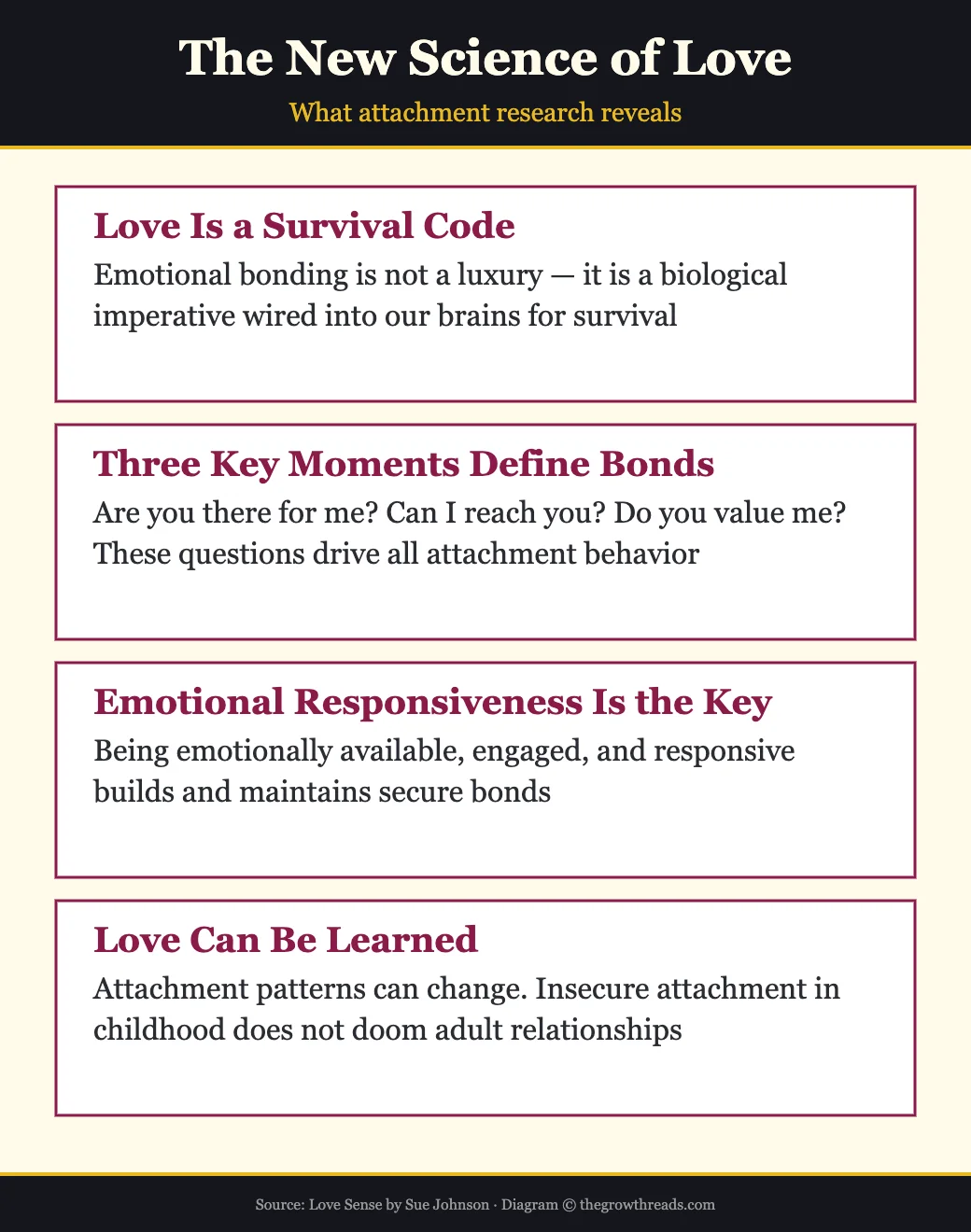
Johnson opens with a radical reframing of love. For centuries, Western culture has treated romantic love as either an irrational passion or a practical arrangement — something that happens to you rather than something you do. Modern attachment science tells a completely different story. Love is a survival code built into the mammalian brain. Infants who do not bond with a caregiver fail to thrive and can literally die. Adults who lack secure emotional connections suffer dramatically higher rates of depression, anxiety, heart disease, and early death.
The neuroscience is compelling: brain imaging studies show that when people in secure relationships hold their partner’s hand during a stressful experience, their brain’s threat response literally calms down. The partner’s presence functions as a biological regulator — reducing cortisol, lowering blood pressure, and dampening the amygdala’s fear response. This is not metaphorical. Secure attachment is a physiological buffer against stress, illness, and the wear of daily life.
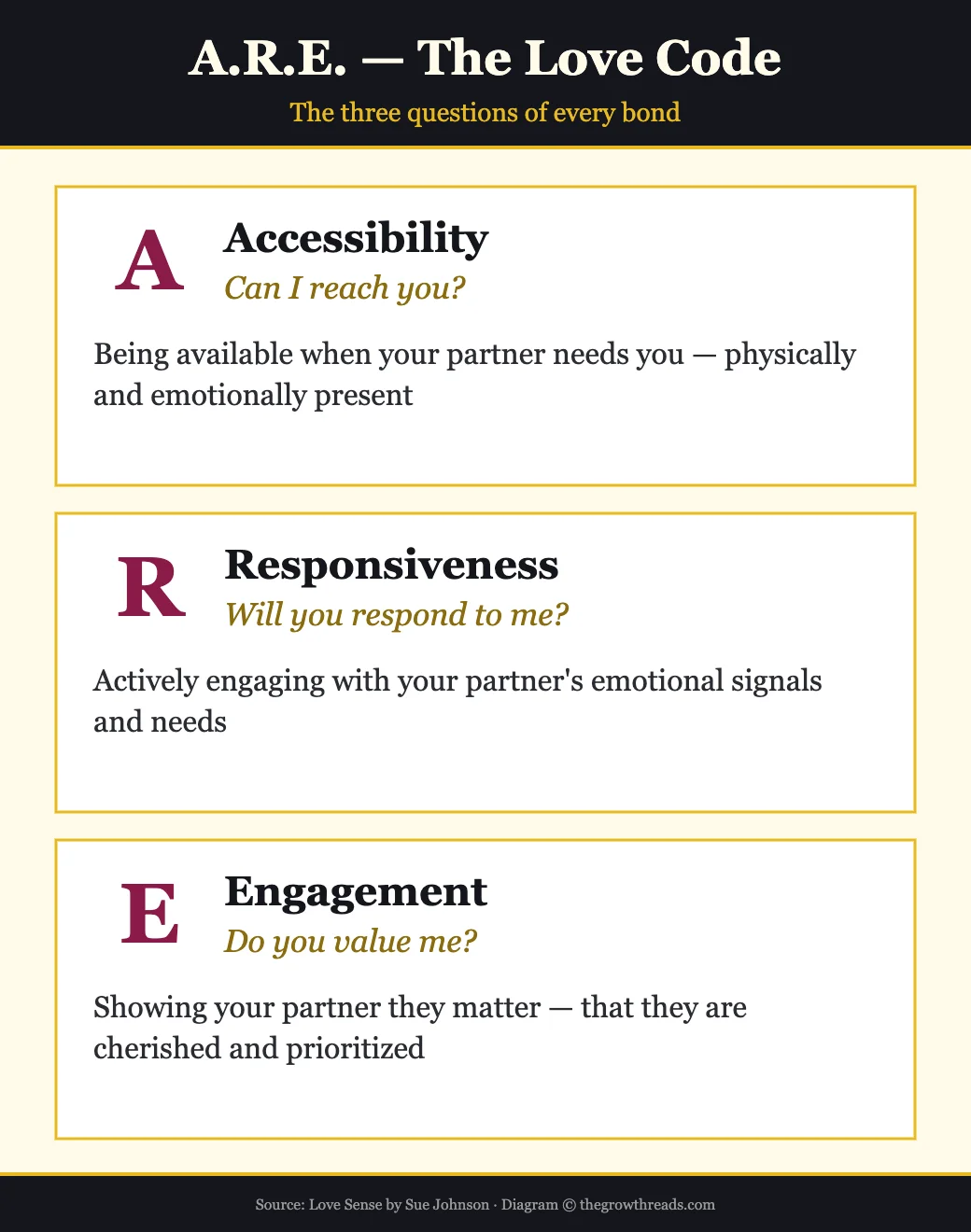
Johnson introduces the three questions that define every attachment bond: Are you accessible to me? (Can I reach you when I need you?) Are you responsive to me? (Will you respond when I call?) Are you engaged with me? (Do you value me and our connection?) These A.R.E. questions, Johnson argues, are playing beneath the surface of every interaction between romantic partners, whether they know it or not.
Part 2: How Attachment Shapes Adult Love
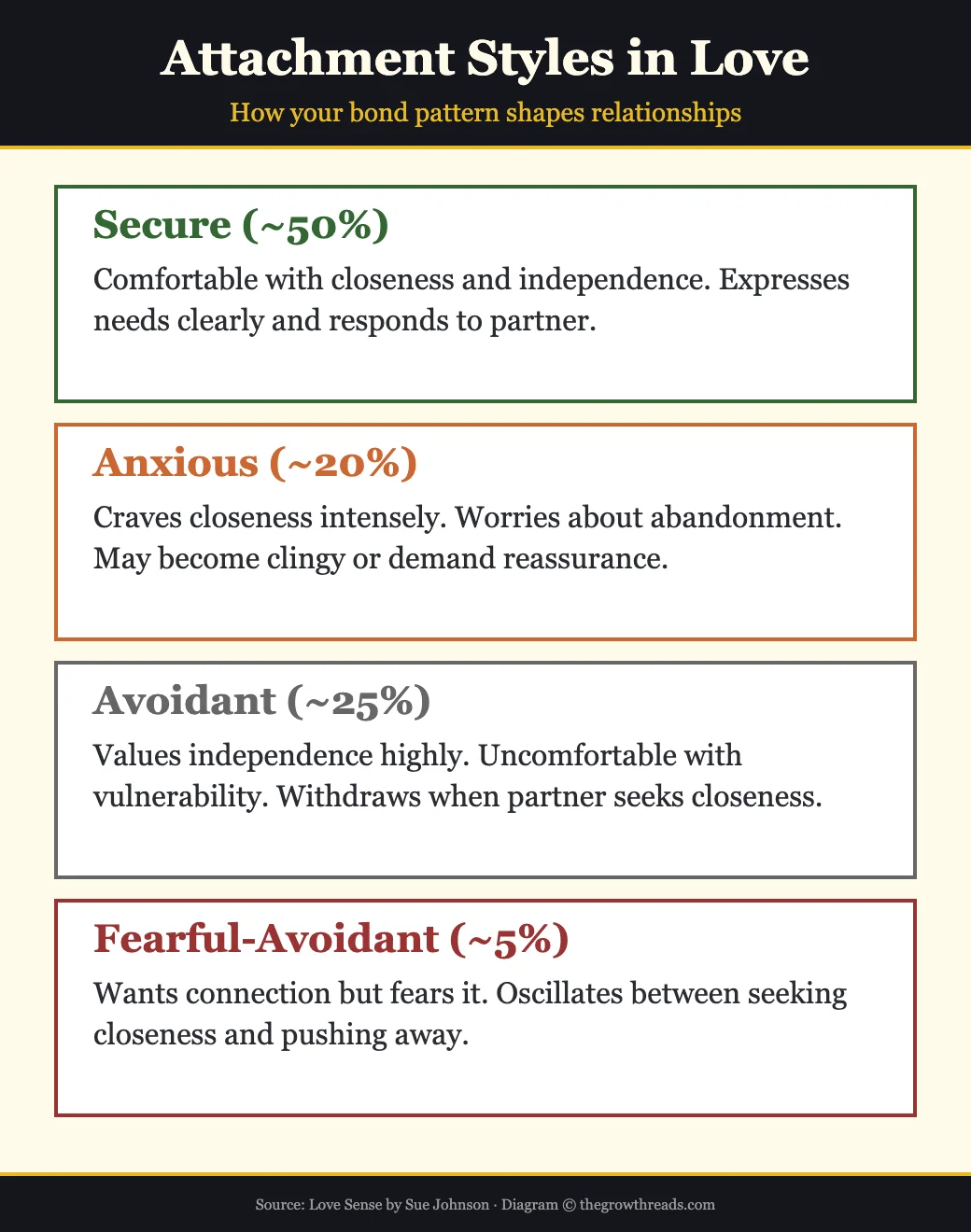
The middle section connects childhood attachment research to adult romantic relationships. Johnson draws on John Bowlby’s pioneering work and Mary Ainsworth’s Strange Situation experiments to show that the patterns of relating we develop as infants carry directly into our adult love lives. Roughly fifty percent of adults are securely attached — comfortable with both closeness and independence, able to express needs clearly and respond to a partner’s needs. About twenty percent are anxiously attached — craving closeness intensely, worrying about abandonment, and sometimes becoming demanding or clingy when they feel the bond is threatened. Approximately twenty-five percent are avoidantly attached — valuing independence highly, uncomfortable with vulnerability, and tending to withdraw when a partner seeks emotional closeness. A smaller group, roughly five percent, are fearful-avoidant — wanting connection but fearing it, oscillating between approach and withdrawal.
Johnson explains that most relationship conflict is actually attachment protest — behavior driven by the fear that the bond is not secure. When an anxiously attached person escalates a fight, they are not trying to be difficult — they are desperately trying to get a response from a partner who feels emotionally unavailable. When an avoidant partner withdraws, they are not being cold — they are managing the overwhelming vulnerability that closeness triggers. Understanding these patterns transforms how couples see their conflicts: it is not you versus me, it is both of us trying to manage our attachment needs in the only way we know how.
Part 3: Building and Repairing Bonds
The final section is where Johnson’s clinical expertise shines. She shows that attachment patterns are not destiny — they can change through new experiences of emotional responsiveness. In her research on Emotionally Focused Therapy, over seventy percent of distressed couples move from insecurity to security, with improvements maintained years after therapy ends. The mechanism is straightforward: when partners learn to be emotionally accessible, responsive, and engaged with each other — to answer the A.R.E. questions with a consistent “yes” — the attachment bond strengthens, conflict decreases, and both partners’ emotional and physical health improves.
Johnson outlines the key moves for building secure bonds: turning toward your partner’s emotional bids rather than away, naming your attachment needs directly rather than expressing them through protest behavior, responding to your partner’s vulnerability with comfort rather than criticism, and creating rituals of connection that reinforce the bond daily. She emphasizes that this is not about being perfect — it is about being present. A “good enough” response to a partner’s emotional reach is vastly better than a sophisticated response that comes too late.
The book closes with the broader implications of attachment science for society. Johnson argues that understanding love as a biological need rather than a luxury reframes everything from mental health policy to education to public health. If secure bonds are as essential to health as exercise and nutrition, then investing in relationship quality — through therapy access, relationship education, and social connection programs — is not indulgent but medically and economically essential.
Who Is Love Sense Best For — and Who Should Read Something Else First?
Love Sense is ideal for anyone who wants to understand the deep science of love and attachment — whether you are in a relationship, recovering from one, or preparing for one. It provides the theoretical foundation that makes practical relationship advice genuinely understandable.
If you want a more hands-on guide for couples, Johnson’s own Hold Me Tight translates this science into seven practical conversations. If you are single and want to understand attachment in dating, Attached is more immediately applicable.
Questions to Reflect On
- Which attachment style best describes your pattern in relationships — and how does it affect your behavior during conflict?
- When you need emotional support from your partner, do you reach toward them or pull away — and what drives that choice?
- How would your partner answer the A.R.E. questions about you — are you accessible, responsive, and engaged?
- What is one thing you could do this week to turn more consistently toward your partner’s emotional bids?
- If love is a biological need and not a luxury, how does that change how you prioritize your relationships?
🔥 Ready to Understand the Science of Love?
Discover why love is a biological imperative and how the A.R.E. framework can transform your relationships.
How to Apply Love Sense (7-Day Plan)
- Day 1 — Identify your attachment style: Read the descriptions of the four styles and honestly identify which pattern best describes your behavior in relationships. Notice it without judgment.
- Day 2 — Track emotional bids: Throughout the day, notice when your partner makes a bid for emotional connection — a question, a touch, a look. Count how many you turn toward versus away from.
- Day 3 — Ask the A.R.E. questions: Reflect privately on each question: Am I accessible to my partner? Do I respond when they reach for me? Do I show them they are valued? Rate each honestly.
- Day 4 — Name one need directly: Instead of expressing an attachment need through criticism or withdrawal, state it directly: “I need to feel close to you right now” or “I need to know you are here for me.”
- Day 5 — Respond to vulnerability: When your partner expresses a need or shows vulnerability today, respond with comfort rather than advice, solutions, or dismissal.
- Day 6 — Create a connection ritual: Establish one small daily practice — a two-minute conversation at bedtime, a hug when you arrive home, a text during the day — that reinforces the bond.
- Day 7 — Share what you have learned: Tell your partner about the A.R.E. framework and ask them how they would answer the three questions about your relationship. Listen without defending.
Frequently Asked Questions
What is the A.R.E. framework?
A.R.E. stands for Accessibility, Responsiveness, and Engagement — the three dimensions that define a secure attachment bond. Accessibility means your partner can reach you when they need you. Responsiveness means you actively engage with their emotional signals. Engagement means you show them they are valued and cherished. When all three are consistently present, the bond is secure; when any is missing, attachment anxiety activates.
Can attachment styles change?
Yes. Johnson’s research demonstrates that attachment patterns are not fixed for life. Through new experiences of emotional responsiveness — whether in therapy, in a secure relationship, or through deliberate practice — insecure attachment patterns can become secure. Emotionally Focused Therapy has a seventy percent success rate in helping distressed couples move from insecurity to security, with results lasting years after therapy ends.
How is Love Sense different from Hold Me Tight?
Love Sense provides the scientific foundation — the neuroscience, evolutionary biology, and research behind attachment theory. Hold Me Tight translates that science into seven practical conversations that couples can have to strengthen their bond. Love Sense is the theory book; Hold Me Tight is the practice book. Reading Love Sense first deepens your understanding; reading Hold Me Tight first gives you immediate tools.
Is this book only for couples?
No. While the primary focus is romantic attachment, the science applies to all close relationships. Singles benefit from understanding their attachment style before entering new relationships. Parents can use attachment insights to build secure bonds with children. Therapists, counselors, and anyone interested in human connection will find the research valuable. The book is about the fundamental human need for bonding, not exclusively about romance.
What is Emotionally Focused Therapy?
Emotionally Focused Therapy (EFT) is a structured approach to couples therapy developed by Sue Johnson based on attachment science. It helps partners identify the negative interaction patterns driven by attachment insecurity, access the underlying emotions and needs, and create new patterns of emotional responsiveness. EFT is the most empirically validated approach to couples therapy, with over twenty-five years of research demonstrating its effectiveness across diverse populations and relationship issues.
Why does Johnson say love is not a mystery?
Johnson argues that attachment science has decoded the mechanisms of love — it is a biological survival system with predictable patterns, identifiable needs, and learnable skills. The mystery narrative serves romantic mythology but actually harms relationships by suggesting that love is either magical (and therefore uncontrollable) or irrational (and therefore untrustworthy). Understanding love as a science empowers people to build and repair bonds deliberately rather than hoping for the best.
How does loneliness affect health?
Johnson cites extensive research showing that loneliness and social isolation are as damaging to physical health as smoking fifteen cigarettes per day. Isolation increases cortisol, inflammation, blood pressure, and the risk of heart disease, stroke, and dementia. Conversely, secure emotional bonds function as biological stress buffers — literally reducing the brain’s threat response and improving immune function. Love is not just emotionally important; it is medically essential.
Related Summaries
- Hold Me Tight by Sue Johnson — the practical companion for couples.
- Attached by Amir Levine — attachment styles applied to modern dating.
- The Seven Principles for Making Marriage Work by John Gottman — research-based relationship strategies.
- Best Relationship Books — our complete guide to books on love and connection.