

★★★★☆ 3.8/5
One-liner: A structured productivity system for identifying your highest-value work and systematically eliminating everything else.
Best for: Overwhelmed professionals and entrepreneurs who need a clear framework for prioritizing ruthlessly and protecting their most productive hours.
Reading time: ~4 hours (224 pages)
Difficulty to apply: Low to moderate — the frameworks are clear and immediately actionable.
Free to Focus in One Minute
Most productivity advice tells you how to do more — Free to Focus tells you how to do the right things. Michael Hyatt presents a three-step framework — Stop, Cut, Act — that helps you identify which tasks belong in your “Desire Zone” (high passion and high proficiency), then systematically eliminate, delegate, or automate everything else. The book is built around the idea that productivity is not about efficiency with all tasks but about effectiveness with the tasks that matter most. By designing an Ideal Week, using the Freedom Compass to sort your activities, and building rituals around deep work, you create a system that consistently directs your energy toward your highest-value contributions.
Key Takeaways
- Productivity starts with stopping: Before you can do your best work, you must pause to formulate your goals, filter your tasks, and decide what actually deserves your time and energy.
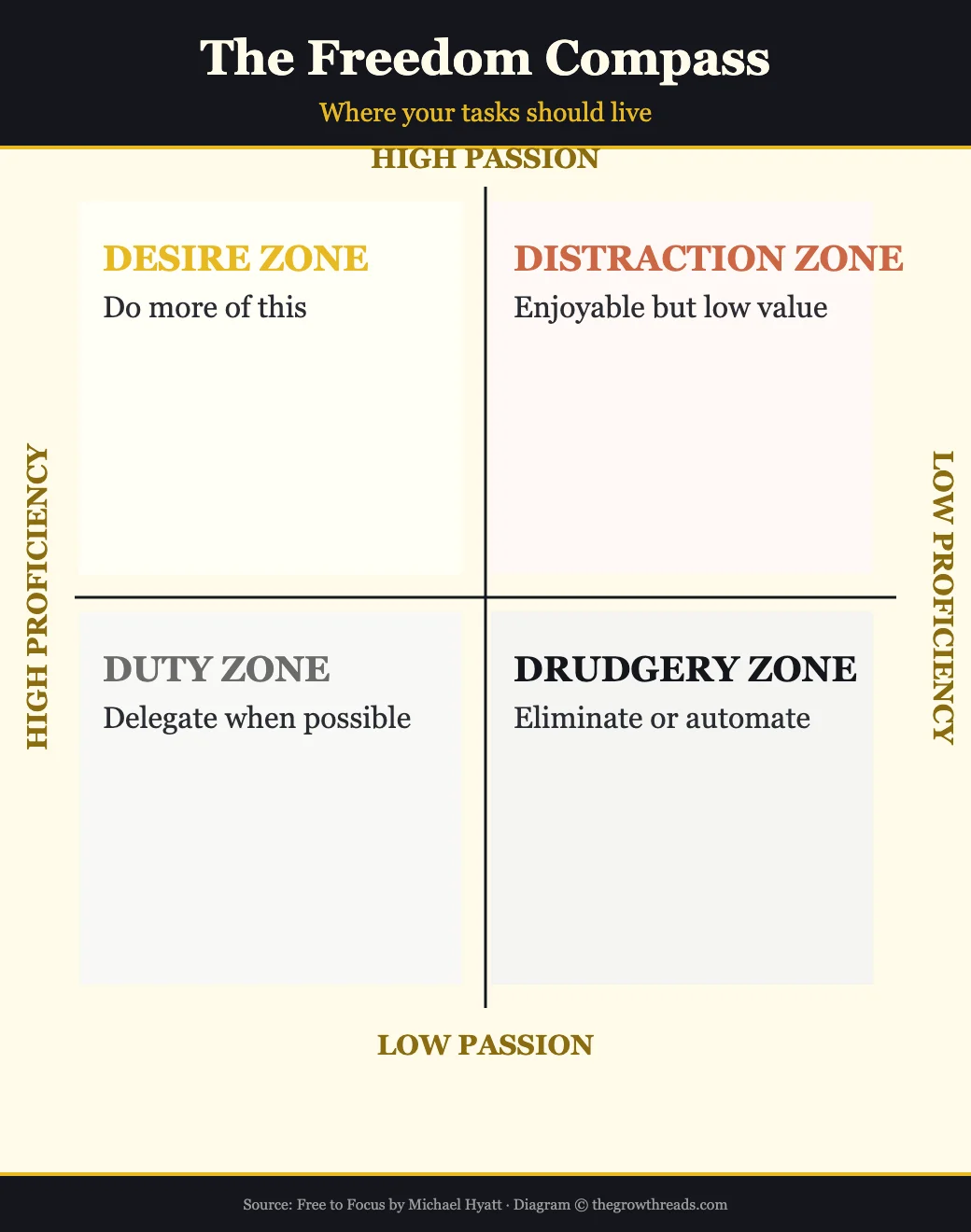
- The Freedom Compass sorts your work: Every task falls into one of four zones — Desire, Duty, Distraction, or Drudgery — based on your passion and proficiency. Your goal is to spend most of your time in the Desire Zone.
- Elimination beats optimization: The biggest productivity gains come not from doing tasks faster but from removing tasks that should not be done at all.
- Delegation is a multiplier: Tasks in your Duty Zone — things you are good at but do not enjoy — should be delegated to free your time for higher-value work.
- Automation handles the routine: Repetitive tasks in your Drudgery Zone can be automated with technology, templates, or systems, removing them permanently.
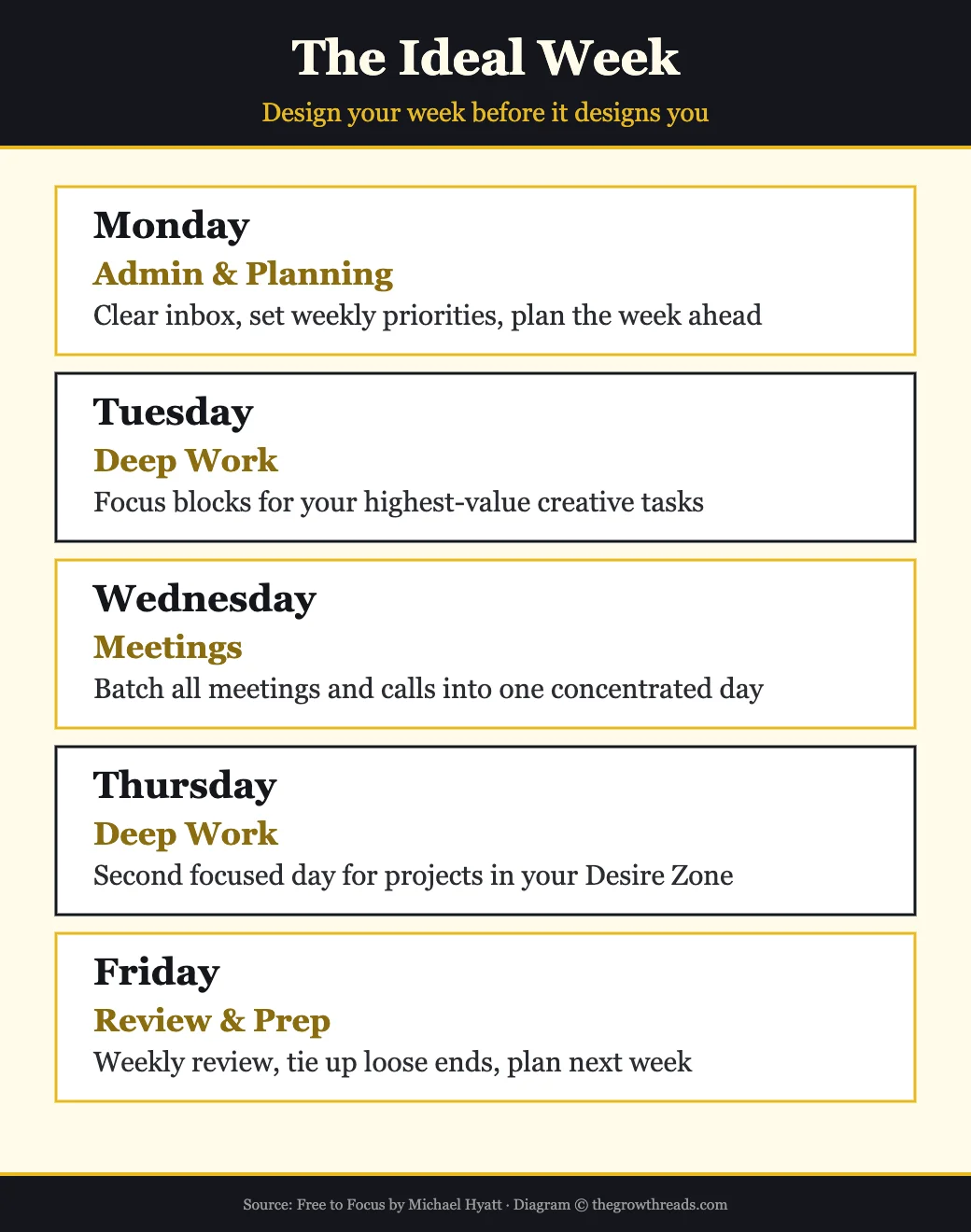
- The Ideal Week is a design tool: Theming your days — deep work on Tuesdays and Thursdays, meetings on Wednesdays — prevents context-switching and protects focus time.
- Rituals reduce decision fatigue: Morning startup rituals and evening shutdown rituals create reliable transitions into and out of deep work without willpower.
- Saying no is a skill: Every yes to a low-value activity is an implicit no to your Desire Zone work. Learning to decline gracefully is essential.
- Mega-batching saves energy: Grouping similar tasks into single blocks — all calls on one day, all writing in one session — dramatically reduces the cognitive cost of switching.
- Rejuvenation is part of the system: Hyatt emphasizes that rest, sleep, and vacations are not rewards for productivity — they are prerequisites for it.
What Is Free to Focus About?
Free to Focus is a productivity system built on three steps — Stop, Cut, Act — that helps professionals identify their highest-value work, eliminate low-value tasks through delegation and automation, and structure their weeks around focused execution in their areas of greatest passion and skill.
About the Author
Michael Hyatt is the former CEO of Thomas Nelson Publishers, one of the largest publishing companies in the United States, and the founder of Full Focus, a productivity and leadership development company. After leading a major corporate turnaround, Hyatt transitioned into coaching and writing, drawing on decades of executive experience to develop practical frameworks for achievement without burnout. He is the author of several bestselling books including Your Best Year Ever and The Vision Driven Leader, and his Full Focus Planner has sold millions of copies worldwide. Explore all Michael Hyatt book summaries →
Key Concepts at a Glance
| Concept | What It Means | Use It When |
|---|---|---|
| Freedom Compass | A 2×2 grid sorting tasks by passion and proficiency into four zones | You need to decide which tasks to keep, delegate, or eliminate |
| Desire Zone | Work you love and are skilled at — your highest-value contribution | You want to identify what you should spend most of your time doing |
| Stop-Cut-Act | Three phases: formulate goals, eliminate non-essentials, execute focused work | You feel overwhelmed and need a structured approach to regain control |
| Ideal Week | A weekly template with themed days and protected time blocks | Your calendar is reactive and you want to design it proactively |
| Mega-Batching | Grouping similar tasks into concentrated blocks to reduce switching costs | You spend too much time bouncing between different types of work |
| Ritual Stacking | Morning and evening routines that automate transitions into and out of work | You struggle with getting started or shutting down at the end of the day |
| Rejuvenation | Deliberate rest, sleep, and time off as core productivity inputs | You are burning out or your performance is declining despite long hours |
Part 1: Stop — Formulate Your Priorities
Hyatt opens with a counterintuitive first step: before you can become more productive, you have to stop. Most people are running so fast that they never pause to ask whether they are running in the right direction. The Stop phase is about formulating — getting clear on your goals, values, and the specific outcomes you want to achieve.
The central tool here is the Freedom Compass, a two-by-two matrix that plots every activity in your life along two dimensions: passion (how much you enjoy it) and proficiency (how good you are at it). This creates four zones. The Desire Zone contains work you love and excel at — this is where your greatest contributions come from. The Duty Zone contains tasks you are skilled at but find draining. The Distraction Zone holds enjoyable activities that do not leverage your strengths. The Drudgery Zone is work you neither enjoy nor do well — it should be eliminated entirely.
Hyatt emphasizes that most professionals spend only a fraction of their time in the Desire Zone, even though it is where they create the most value. The goal of the entire system is to progressively migrate your time toward this quadrant.
Part 2: Cut — Eliminate the Non-Essential
The second step is where the real gains happen. Hyatt argues that elimination — not optimization — is the most powerful productivity lever available. Most people try to do everything more efficiently. Free to Focus says the better approach is to stop doing things that do not belong in your Desire Zone.
For tasks in the Drudgery Zone, elimination is straightforward: stop doing them. Many recurring tasks exist only because they have always been done, not because they add value. For tasks in the Duty Zone, the strategy is delegation. Hyatt provides a practical delegation framework: define the desired outcome, give the person authority to make decisions, set check-in points, and resist the urge to micromanage. For the Distraction Zone, you must learn to say no — gracefully but firmly — to activities that are enjoyable but unproductive.
Automation handles the routine work that remains. Hyatt recommends identifying every task you do more than twice and asking whether it can be handled by software, a template, or a standard operating procedure. Email filters, scheduling tools, text expanders, and project management templates can eliminate hours of recurring Drudgery Zone work each week.
Part 3: Act — Execute with Focus
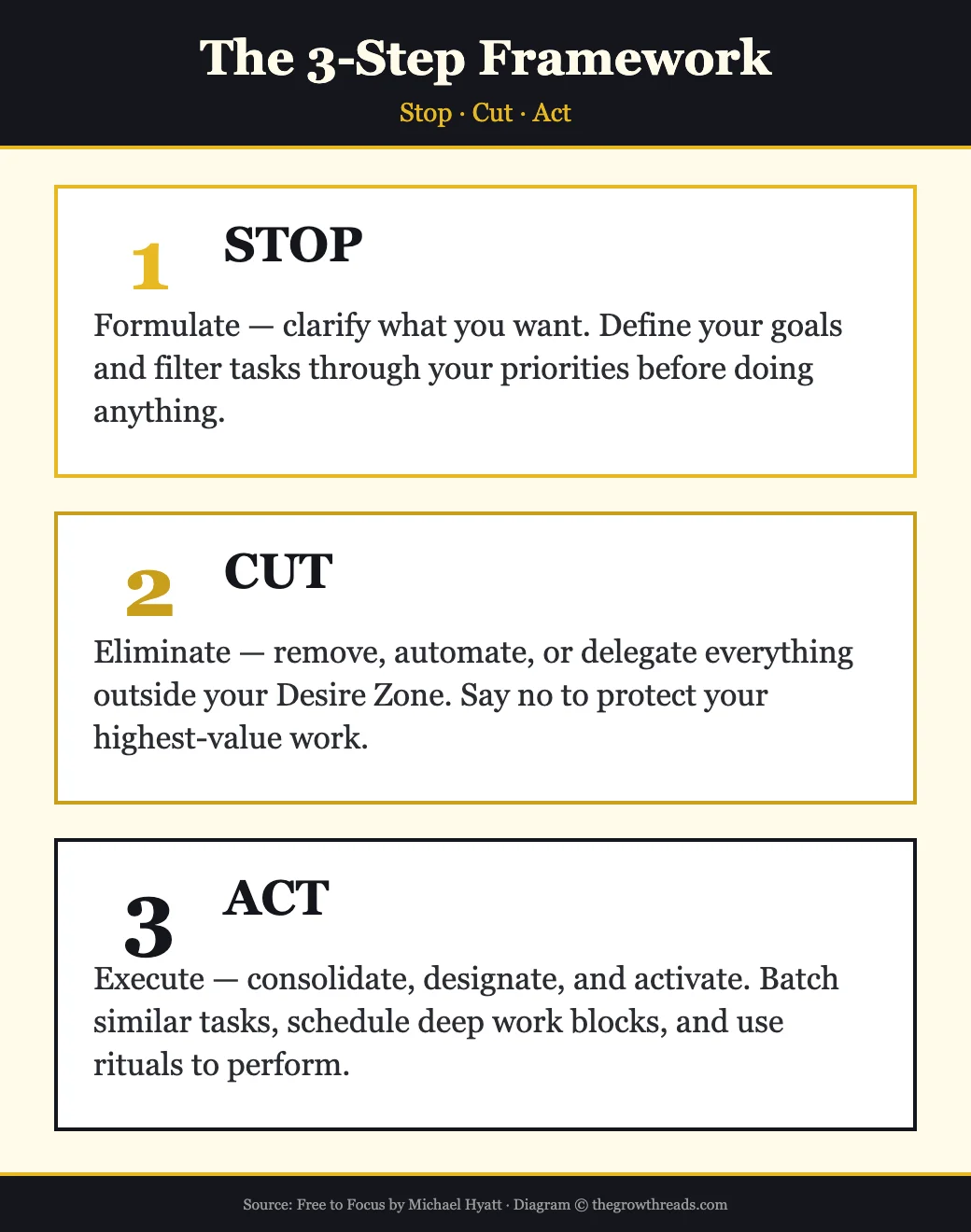
With your priorities clear and your non-essentials removed, the Act phase is about executing your Desire Zone work with maximum focus and energy. Hyatt introduces three sub-steps: Consolidate, Designate, and Activate.
Consolidate means batching similar tasks together. Rather than checking email throughout the day, process it in two or three defined windows. Rather than taking calls whenever they come, batch them into a single afternoon. This mega-batching approach dramatically reduces the cognitive switching penalty that fragments most people’s days.
Designate means scheduling your work using an Ideal Week template. Hyatt recommends theming your days so that each day has a primary focus — deep creative work, meetings, administrative tasks, or strategic thinking. This creates predictable rhythms that reduce decision fatigue and protect your most productive hours for your most important work.
Activate means building rituals — morning startup sequences, workday startup rituals, workday shutdown routines, and evening wind-down habits — that automate the transitions into and out of focused work. These rituals replace willpower with habit, making it easier to start deep work and easier to stop at a healthy time.
Who Is Free to Focus Best For — and Who Should Read Something Else First?
Free to Focus is ideal for overwhelmed professionals who know they are busy but suspect they are not productive. The system works especially well for managers, entrepreneurs, and knowledge workers who have some control over their schedules and the ability to delegate. It is also excellent for anyone who has read a dozen productivity books but never found a unifying framework to tie the tactics together.
If you are looking for deep scientific research on focus and distraction, start with Deep Work instead — Hyatt is more practical than theoretical. If your challenge is not prioritization but motivation, Drive by Daniel Pink addresses that root cause more directly.
Questions to Reflect On
- What percentage of your current workweek is spent in your Desire Zone — and what would it take to double that?
- Which three recurring tasks could you eliminate tomorrow without any meaningful consequence?
- If you could delegate one Duty Zone task this week, which would free the most time for high-value work?
- How does your actual week compare to your ideal week — and where are the biggest gaps?
- What ritual could you build to make starting deep work effortless each morning?
🔥 Ready to Focus on What Actually Matters?
Learn the three-step system that helps you achieve more by doing less — and never feel overwhelmed again.
How to Apply Free to Focus (7-Day Plan)
- Day 1 — Map your Freedom Compass: List every recurring task from the past week and sort each into Desire, Duty, Distraction, or Drudgery based on your passion and proficiency.
- Day 2 — Eliminate three tasks: Identify three Drudgery Zone tasks and stop doing them today. If they are truly unnecessary, no one will notice.
- Day 3 — Delegate one task: Pick one Duty Zone task and hand it off. Define the desired outcome, give authority, and set a check-in point.
- Day 4 — Automate one workflow: Find one repetitive task and set up an automation — an email filter, a template, or a scheduling tool.
- Day 5 — Design your Ideal Week: Create a weekly template with themed days. Block your Desire Zone work into your highest-energy time slots.
- Day 6 — Build your morning ritual: Design a 15-minute startup sequence that transitions you into deep work — same time, same steps, every day.
- Day 7 — Review and adjust: Compare your actual week to your Ideal Week. Identify the biggest gap and make one specific change for next week.
Frequently Asked Questions
What is the Freedom Compass in Free to Focus?
The Freedom Compass is a two-by-two matrix that sorts every task by two dimensions: passion (how much you enjoy it) and proficiency (how skilled you are at it). This creates four zones: Desire (high passion, high proficiency — your best work), Duty (high proficiency, low passion — delegate), Distraction (high passion, low proficiency — say no), and Drudgery (low both — eliminate). The goal is to systematically increase the time you spend in the Desire Zone.
How is Free to Focus different from other productivity books?
Most productivity books teach you how to do more tasks efficiently. Free to Focus teaches you how to identify which tasks deserve your time and eliminate the rest. Its three-step framework — Stop, Cut, Act — is a complete operating system rather than a collection of tips. The book is more practical and less theoretical than works like Deep Work, making it especially useful for people who want a step-by-step implementation guide they can start using immediately.
Can I use the Free to Focus system if I work for someone else?
Yes, though some adaptation is needed. Even in a structured corporate role, you typically have more control over your schedule than you think. You can batch meetings, protect morning focus time, create email processing windows, and negotiate task delegation with your manager. The Ideal Week template works within existing constraints — it helps you optimize the flexibility you already have rather than requiring total schedule freedom.
What is mega-batching?
Mega-batching means grouping similar tasks into large, concentrated blocks rather than scattering them throughout the week. Instead of checking email every thirty minutes, you process it twice a day. Instead of taking calls whenever they come, you schedule them all on Wednesday. This approach dramatically reduces the cognitive cost of context-switching, which research shows can consume up to forty percent of productive time in a fragmented schedule.
How do morning and evening rituals help productivity?
Rituals replace willpower with habit. A morning startup ritual — the same sequence of steps at the same time each day — creates an automatic on-ramp into deep work without requiring motivation or decision-making. An evening shutdown ritual signals to your brain that work is done, enabling psychological detachment. Hyatt recommends keeping rituals short (fifteen to thirty minutes) and consistent. Over time, the ritual itself triggers the focused state you need.
Does Free to Focus address rest and recovery?
Yes. Hyatt treats rejuvenation as the foundation of the entire system, not an afterthought. He argues that sleep, exercise, hobbies, and vacations are inputs to productivity, not rewards for it. The book includes practical guidance on protecting rest time, designing restorative evenings, and planning vacations that genuinely recharge rather than exhaust. This emphasis on sustainability distinguishes Free to Focus from hustle-culture productivity systems.
What is the Ideal Week in Free to Focus?
The Ideal Week is a recurring weekly template where you assign a primary theme to each day — for example, deep creative work on Tuesdays and Thursdays, meetings on Wednesdays, administrative tasks on Mondays, and review on Fridays. By pre-deciding how each day will be used, you eliminate daily scheduling decisions and protect your most productive hours for your most important work. It is a design tool, not a rigid schedule — real weeks rarely match perfectly, but the template provides a target to return to.
Related Summaries
- Deep Work by Cal Newport — the deep research on why focused work matters and how to protect it.
- Essentialism by Greg McKeown — the philosophy of doing less, better.
- Rest by Alex Soojung-Kim Pang — why strategic rest is the secret to sustained high performance.
- Best Productivity Books — our complete guide to the top books on getting more done.