
Money
Freakonomics Summary and Review
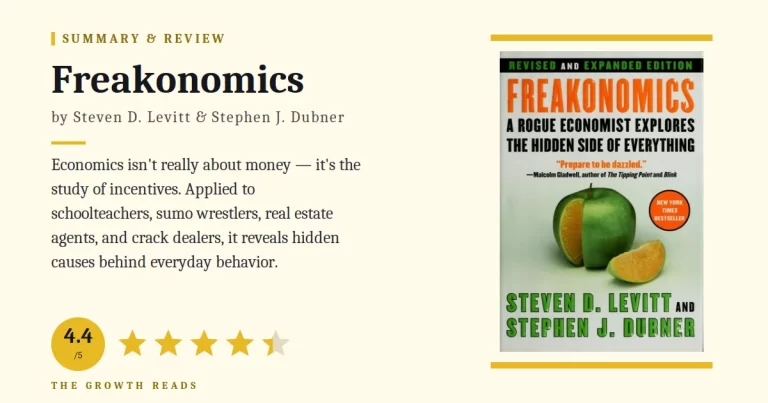
★★★★☆ 4.4/5 — A data-driven case that economics is really the study of incentives and hidden causality, applied to schoolteachers, sumo wrestlers,…
Read Summary →"The economist and the journalist who turned incentive analysis into a publishing phenomenon."
Steven D. Levitt is the William B. Ogden Distinguished Service Professor of Economics at the University of Chicago and winner of the John Bates Clark Medal, awarded to the top American economist under 40. His research applies rigorous data analysis to unconventional questions in crime, cheating, and everyday incentives. Stephen J. Dubner is a journalist and author who profiled Levitt for The New York Times Magazine in 2003, an article that led directly to Freakonomics. Together they wrote several sequels, including SuperFreakonomics, Think Like a Freak, and When to Rob a Bank, and co-host the long-running Freakonomics Radio podcast.
Our in-depth summaries and reviews of his work
★★★★☆ 4.4/5 — A data-driven case that economics is really the study of incentives and hidden causality, applied to schoolteachers, sumo wrestlers,…
Read Summary →In "Freakonomics," Levitt and Dubner apply rigorous data analysis to unconventional questions — cheating teachers, real estate agents, gang finances, baby names — to show that economic, social, and moral incentives explain behavior conventional wisdom gets wrong.
"Morality represents how we would like the world to work, and economics represents how it actually does work."— Freakonomics
Start with our most popular summary of their work.
Read the Summary★★★★☆ 4.4/5 — A data-driven case that economics is really the study of incentives and hidden causality, applied to schoolteachers, sumo wrestlers, and crack dealers instead of markets. Best for: readers who enjoy having conventional wisdom overturned by data, not…