

★★★★ 4.3/5 — a demanding, wide-ranging blend of psychology, myth, and stern life advice built around one theme: take responsibility. Meandering but often profound.
Best for: anyone feeling adrift who wants a serious, meaning-focused case for personal responsibility · Reading time: ~10 hours (this guide: 17 min) · Difficulty to apply: Moderate — the rules are simple; the philosophy behind them is deep
12 Rules for Life in one minute
Life is suffering, order and chaos are always in tension, and the antidote is to take responsibility and pursue meaning rather than mere happiness. Clinical psychologist Jordan Peterson frames his twelve rules as practical guidance for standing up straight — literally and metaphorically — in a difficult world. Drawing on psychology, mythology, religious stories, and evolutionary biology, he argues that the deepest human task is to voluntarily shoulder the burden of your own life, put your own house in order before blaming the world, tell the truth, and orient yourself toward what is meaningful even when it is hard. The rules range from the concrete (“stand up straight with your shoulders back”) to the philosophical (“pursue what is meaningful, not what is expedient”), and each is really a doorway into a long, digressive meditation. It is not a quick self-help checklist; it is a serious, occasionally overwhelming argument that a responsible, honest, meaning-directed life is the best defense against the chaos of existence.
Key takeaways
- Take responsibility: the core of the whole book — voluntarily shoulder the burden of your own life instead of blaming circumstances.
- Order and chaos must be balanced: stand with one foot in the security of the known and one in the possibility of the unknown.
- Stand up straight (Rule 1): posture and confidence feed back on themselves, biologically and socially — carry yourself like you matter.
- Treat yourself like someone you’re responsible for helping (Rule 2): care for yourself as diligently as you would for a loved one.
- Compare yourself to who you were yesterday (Rule 4): not to someone else today — measure progress against your own past.
- Set your house in order before you criticize the world (Rule 6): fix what you can control in your own life first.
- Pursue meaning, not expedience (Rule 7): sacrifice short-term ease for a worthy long-term aim.
- Tell the truth, or at least don’t lie (Rule 8): honesty is the foundation of a stable self and a stable world.
- Assume the person you’re listening to knows something you don’t (Rule 9): listen to genuinely learn.
- Notice the good amid suffering (Rule 12): pause to appreciate small joys — “pet a cat” — because life is hard and beauty is fleeting.
What is 12 Rules for Life about?
12 Rules for Life is a self-development book by psychologist Jordan Peterson, subtitled “An Antidote to Chaos.” Through twelve rules drawn from psychology, mythology, and religion, it argues that meaning and stability come from taking personal responsibility, balancing order and chaos, telling the truth, and orienting your life toward what is meaningful rather than what is merely easy.
About the author
Jordan B. Peterson is a Canadian clinical psychologist and a former professor at the University of Toronto, known for his earlier academic work Maps of Meaning, which explored the psychological function of myth and belief. He rose to wide public prominence in the late 2010s through lectures and online videos, becoming one of the most discussed — and most polarizing — public intellectuals of his era. Published in 2018, 12 Rules for Life distilled his lectures and clinical experience into a bestseller that sold millions of copies worldwide. Peterson writes as a therapist and a scholar of mythology at once, weaving clinical anecdotes together with readings of ancient stories, and his central preoccupation throughout is the individual’s responsibility to confront suffering and create meaning. Readers’ reactions to him vary enormously, but the book’s core self-help message — grow up, tell the truth, take responsibility — has resonated far beyond any political line. Explore all Jordan B. Peterson book summaries →
Key concepts at a glance
| Concept | What it means | Use it when |
|---|---|---|
| Responsibility | Voluntarily bearing your own burden | You’re blaming your circumstances |
| Order vs chaos | Balance the known and the unknown | Life feels rigid or overwhelming |
| Compare to yesterday | Measure against your own past | You’re stuck in comparison |
| House in order | Fix your own life first | You want to change the world |
| Meaning over expedience | Sacrifice ease for worth | Facing a hard-but-right choice |
| Tell the truth | Honesty as a way of being | You’re tempted to lie |
Part 1: Order and chaos — the fundamental duality
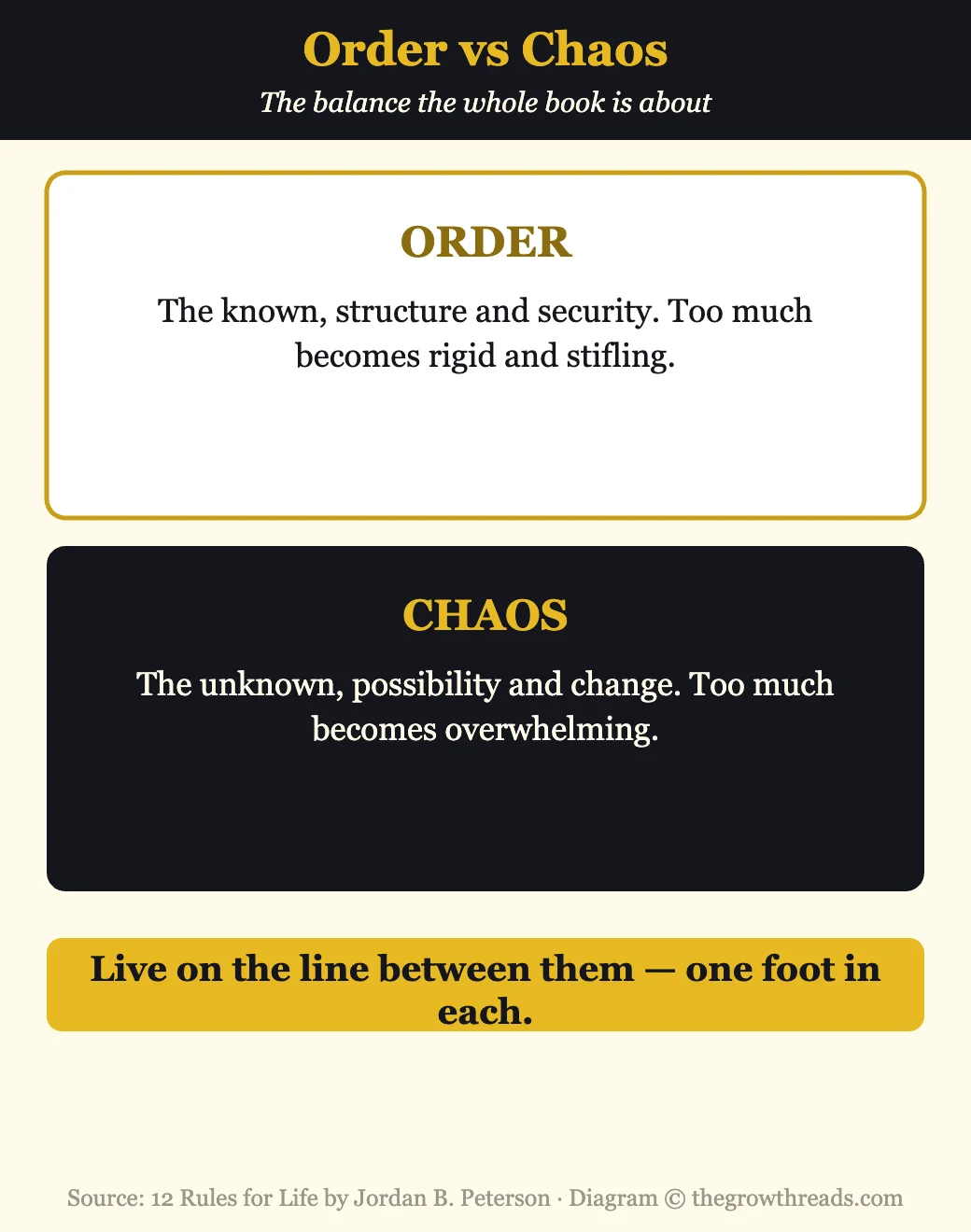
Peterson organizes his worldview around an ancient duality: order and chaos. Order is the domain of the known — structure, tradition, security, the world working as expected. Chaos is the domain of the unknown — possibility, novelty, disorder, everything that can surprise or overwhelm us. Neither is wholly good: too much order becomes rigid, tyrannical, and stifling, while too much chaos becomes anxious and destabilizing. The ideal, he argues, is to stand with one foot in each — at the border between them, where you are stable enough to function but open enough to grow. Much of the book is about how to keep your footing on that line.
His famous first rule — stand up straight with your shoulders back — grounds this in biology through the now-notorious example of lobsters, which have dominance hierarchies and serotonin systems strikingly analogous to our own. A defeated lobster slumps; a victorious one stands tall, and its posture and neurochemistry reinforce its status. Peterson’s point is that posture is not merely physical: how you carry yourself signals confidence to others and feeds back on your own psychology, so adopting a bold, upright stance can begin a positive spiral. It is a small, concrete act that embodies the larger theme — voluntarily confronting the world rather than cowering before it.
Part 2: Take responsibility for yourself
If there is one idea beneath all twelve rules, it is responsibility. Rule 2 — treat yourself like someone you are responsible for helping — grew from Peterson’s clinical observation that many people care for their pets or children far more diligently than for themselves, skipping their own medication or neglecting their own needs. He urges you to become your own advocate, to figure out what is genuinely good for you and pursue it as faithfully as you would for someone you love. This is not indulgence; it is the discipline of taking your own life seriously.
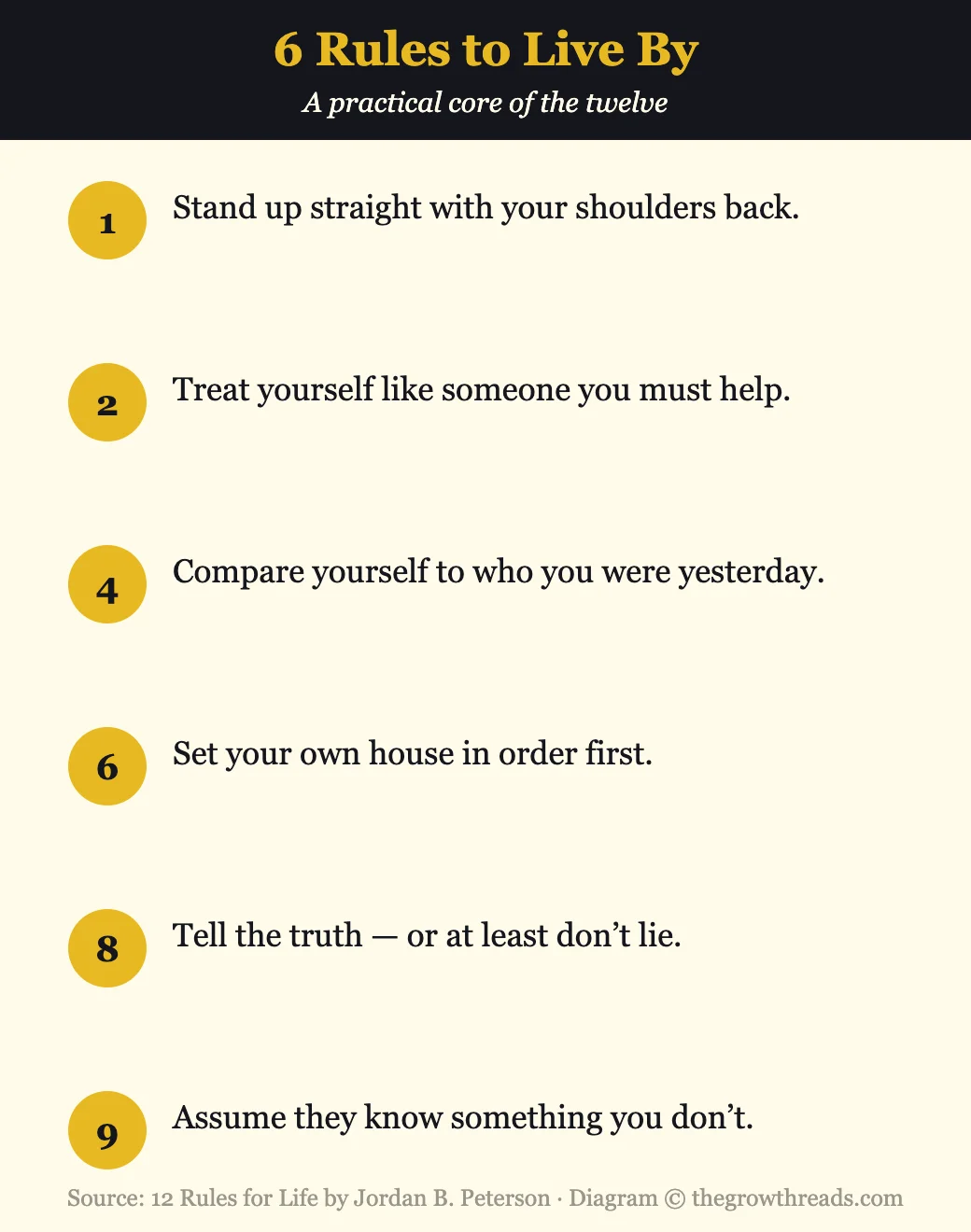
Several rules extend this. Rule 4 — compare yourself to who you were yesterday, not to who someone else is today — redirects the corrosive habit of comparison toward personal progress, echoing the compounding logic of small daily improvement. Rule 3 counsels befriending people who want the best for you, since the company you keep shapes who you become. And Rule 6 — set your house in perfect order before you criticize the world — is perhaps his signature demand: before you blame society, your parents, or the cosmos for your suffering, ask whether you have done everything within your own power to put your own life right. It is a bracing call to focus your energy where you actually have control, and to earn the standing to critique by first fixing what is yours to fix.
TGR Note: Peterson’s insistence on radical responsibility is the philosophical sibling of David Goggins’s Can’t Hurt Me and Mark Manson’s The Subtle Art of Not Giving a F*ck — all three argue that owning your response, not blaming your circumstances, is the doorway to a meaningful life. And “compare yourself to who you were yesterday” is simply Atomic Habits‘ 1%-better principle in moral clothing.
Part 3: Meaning over expedience, and truth
At the philosophical center of the book sits Rule 7: pursue what is meaningful, not what is expedient. Expedience is the easy, impulsive, short-term path — doing whatever is convenient or pleasurable right now. Meaning, by contrast, requires sacrifice: giving up immediate gratification in service of a worthy future goal.
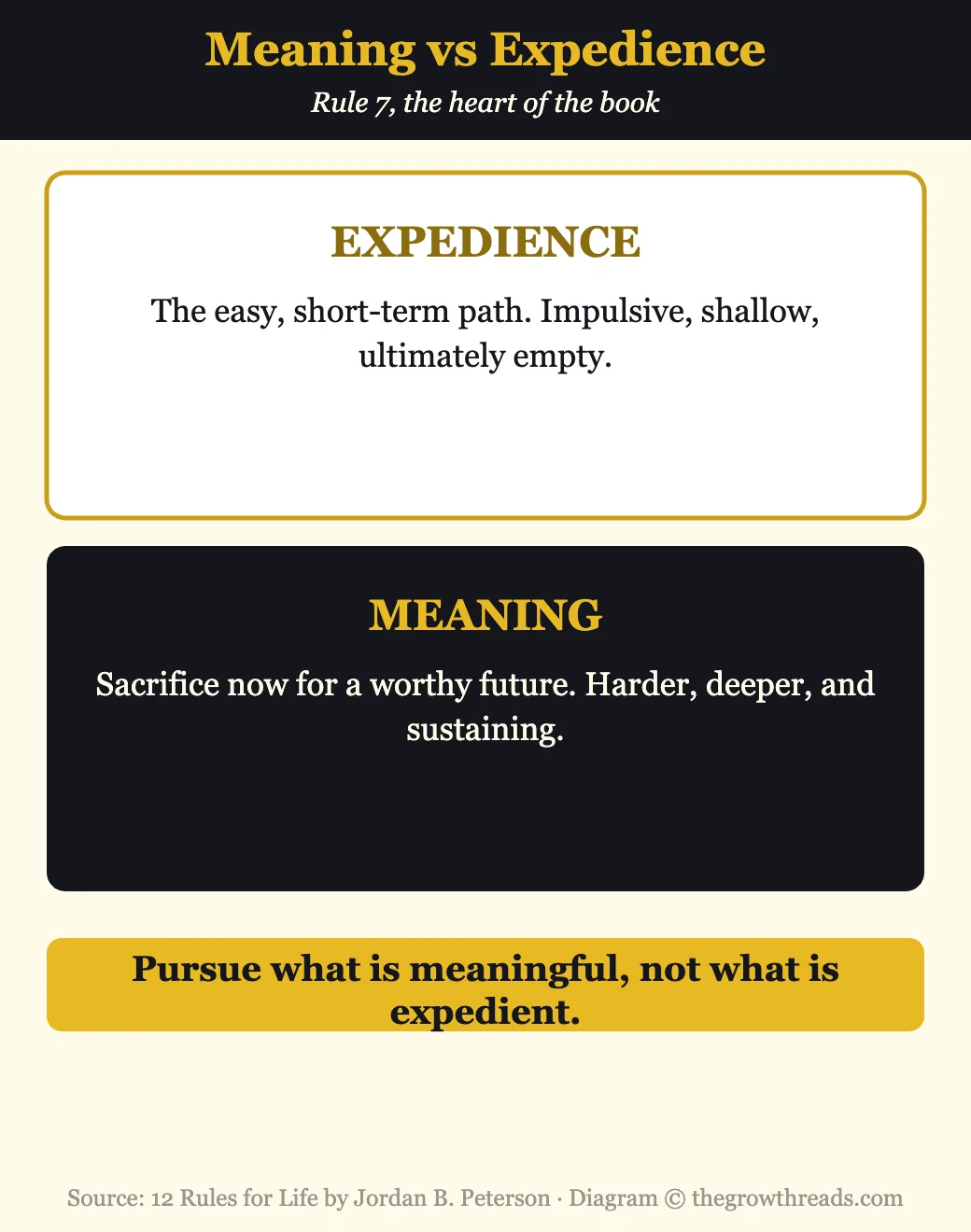
Peterson draws on the ancient idea of sacrifice — the recognition that giving something up now can secure something better later — and argues that a life oriented toward meaning is both more bearable and more noble than one oriented toward happiness or comfort. Suffering is inevitable, he says, so the question is not how to avoid it but how to live in a way that makes it worth enduring; meaning is what makes the suffering bearable. Closely tied to this is Rule 8: tell the truth, or at least don’t lie. Peterson treats honesty as almost sacred, arguing that lies — even small, convenient ones — corrupt your perception of reality and slowly destabilize your character and your relationships. Living truthfully, aligning your words and actions with what you genuinely believe, is how you build a self and a world you can actually trust. Truth is the foundation on which a meaningful life is constructed.
Part 4: Humility, precision, and the small good things
The remaining rules temper the book’s sternness with humility and grace. Rule 9 — assume the person you are listening to might know something you don’t — is a plea for genuine, open listening as a path to learning, since conversation is a tool for thinking, not just for winning. Rule 10 — be precise in your speech — argues that vaguely defined problems remain monstrous and unsolvable, and that naming things clearly is how you make chaos manageable. Rules 5 and 11 turn to raising children with a mix of boundaries and freedom: don’t let your children do things that make you dislike them, but also don’t needlessly interfere with them when they are testing themselves — his memorable image is not to bother children when they are skateboarding, because risk-taking is how competence and courage grow.
The book closes on its gentlest and most human note, Rule 12: pet a cat when you encounter one on the street. Behind the whimsy is a serious point about how to endure a hard life. When suffering is acute and the future looks bleak, Peterson counsels shrinking your time horizon and deliberately noticing the small, fleeting good things — a moment of beauty, a friendly animal, a brief reprieve — because these tiny pockets of grace are what carry us through. It is a fitting end to a book that never denies how difficult existence is, but insists that responsibility, truth, meaning, and an eye for small joys are enough to stand up straight against the chaos. The style is undeniably meandering, dense with mythological and biblical digression, and readers will differ on the author himself, but the practical spine — grow up, tell the truth, take responsibility, pursue meaning — is coherent and, for many readers, genuinely steadying.
Who is 12 Rules for Life best for — and who should read something else first?
This book is ideal for readers who feel adrift and want a serious, substantial case for responsibility and meaning, and who enjoy philosophy, psychology, and mythology woven together. It rewards patient, reflective reading. It is not for you if you want concise, practical tips — the rules are surrounded by long, wandering essays — or if you are put off by its religious and mythological framing, or by the polarizing public persona of its author. If you want the same core message of responsibility in a lighter, funnier form, start with The Subtle Art of Not Giving a F*ck; for a gentler, more structured route to freedom, try The Courage to Be Disliked.
Questions to reflect on
- Where in your life do you have too much order — or too much chaos — and what would balance look like?
- Are you caring for yourself as diligently as you would for someone you love?
- What part of your own “house” is out of order that you’ve been blaming on the world?
- Where are you choosing expedience over meaning — the easy path over the worthy one?
- What small, convenient lie could you stop telling to live more truthfully?
🔥 Ready to stand up straight against the chaos?
This guide is the map — Peterson’s stories and digressions are what give the rules their depth.
How to apply 12 Rules for Life (7-day plan)
- Day 1 — Stand up straight. Consciously fix your posture today and notice how it changes your confidence (Rule 1).
- Day 2 — Care for yourself. Do one thing for your own good that you’ve been neglecting (Rule 2).
- Day 3 — Compare to yesterday. Pick one area and measure progress against your own past self, not others (Rule 4).
- Day 4 — Set your house in order. Fix one thing in your own life you can control before criticizing anything else (Rule 6).
- Day 5 — Choose meaning. Make one decision for its long-term worth rather than short-term ease (Rule 7).
- Day 6 — Tell the truth. Catch and drop one small, convenient lie (Rule 8).
- Day 7 — Notice a small good. Pause to appreciate one fleeting, beautiful thing amid the day (Rule 12).
Frequently asked questions
Is 12 Rules for Life worth reading?
Yes, for readers who want a serious, substantial book about responsibility and meaning rather than quick tips. Its core message — take responsibility, tell the truth, pursue meaning, put your own house in order — is coherent and, for many, genuinely steadying, and Peterson’s blend of psychology, mythology, and clinical experience is thought-provoking. The caveats are real: it is long, meandering, and heavy with religious and mythological digression, and the author is a polarizing figure. If you can engage with its depth and set aside the surrounding controversy, there is a lot of value in it.
What are the 12 rules in 12 Rules for Life?
They are: 1) Stand up straight with your shoulders back; 2) Treat yourself like someone you are responsible for helping; 3) Befriend people who want the best for you; 4) Compare yourself to who you were yesterday, not to someone else today; 5) Do not let your children do anything that makes you dislike them; 6) Set your house in perfect order before you criticize the world; 7) Pursue what is meaningful, not what is expedient; 8) Tell the truth, or at least don’t lie; 9) Assume the person you are listening to might know something you don’t; 10) Be precise in your speech; 11) Do not bother children when they are skateboarding; and 12) Pet a cat when you encounter one on the street.
What is the main message of 12 Rules for Life?
That taking personal responsibility is the antidote to life’s inevitable chaos and suffering. Peterson argues you should voluntarily shoulder the burden of your own life, put your own house in order before blaming the world, tell the truth, and orient yourself toward meaning rather than short-term ease. Underlying it is the idea that life is difficult and often unfair, but a responsible, honest, meaning-directed life is what makes that difficulty bearable and even noble.
Why does 12 Rules for Life talk about lobsters?
The lobster appears in Rule 1 as an illustration of how ancient and biological dominance hierarchies are. Lobsters have social hierarchies governed by serotonin — the same neurochemical involved in human mood and status — and a lobster that wins fights stands tall while a loser slumps. Peterson uses this to argue that posture and confidence are deeply wired and self-reinforcing, so standing up straight is not trivial advice but a way of signaling and generating confidence. The example became famous partly because of how far back in evolution these hierarchies reach.
Is 12 Rules for Life political?
The book itself is primarily a work of psychology and self-help focused on individual responsibility and meaning, not a political manifesto. However, its author is a highly polarizing public figure whose commentary on cultural and political topics has made him controversial, and some readers come to the book with strong preexisting opinions about him. It is possible to read the twelve rules purely as personal-development advice — many people do — while setting aside the broader debates surrounding Peterson. The practical core is not partisan.
How long does it take to read 12 Rules for Life?
The book is around 400 pages and quite dense, with long digressions, so most readers take about ten hours or more, often spread out because the essays reward slow reading. Our summary above captures the twelve rules and their central themes in roughly 17 minutes, which is a good way to grasp the practical advice before deciding whether to engage with the full, wandering text.
Is 12 Rules for Life good for beginners to self-help?
It is accessible in its advice but demanding in its delivery. The rules themselves are clear and useful, but they are embedded in long, philosophical, sometimes difficult essays that assume patience and an interest in psychology and mythology. Beginners who want fast, practical guidance may find it heavy going and might prefer a lighter book first. Those who enjoy depth and don’t mind digression, however, can find it one of the more substantial entries in the genre.
Related summaries
- The Subtle Art of Not Giving a F*ck Summary — responsibility and meaning, told with humor.
- The Courage to Be Disliked Summary — a gentler route to freedom and ownership.
- Can’t Hurt Me Summary — radical accountability at its most intense.
- Atomic Habits Summary — “compare to yesterday” as a daily system.
- Browse all our best psychology books.
How we analyze books: We work from the full book — reconstructing its core arguments in our own words, adding commentary that connects it to related research and other books in our library, and pressure-testing the advice against how it plays out in real life. We never reproduce the text; we synthesize it. Read our full methodology.
Disclosure: The Growth Reads is reader-supported. When you buy through links on our site we may earn an affiliate commission at no extra cost to you. We only recommend books we believe are worth your time, and our summaries and opinions are written independently.