

★★★★☆ 4.2/5 — a journalist’s case, backed by history and research, that our guilt about rest is a relatively recent invention, and it’s making us sicker and less productive.
Best for: chronically busy people who suspect their packed schedule isn’t actually making them happier or more effective · Reading time: ~6 hrs (this guide: ~14 min) · Difficulty to apply: Easy — starts with noticing, not overhauling
Do Nothing in one minute
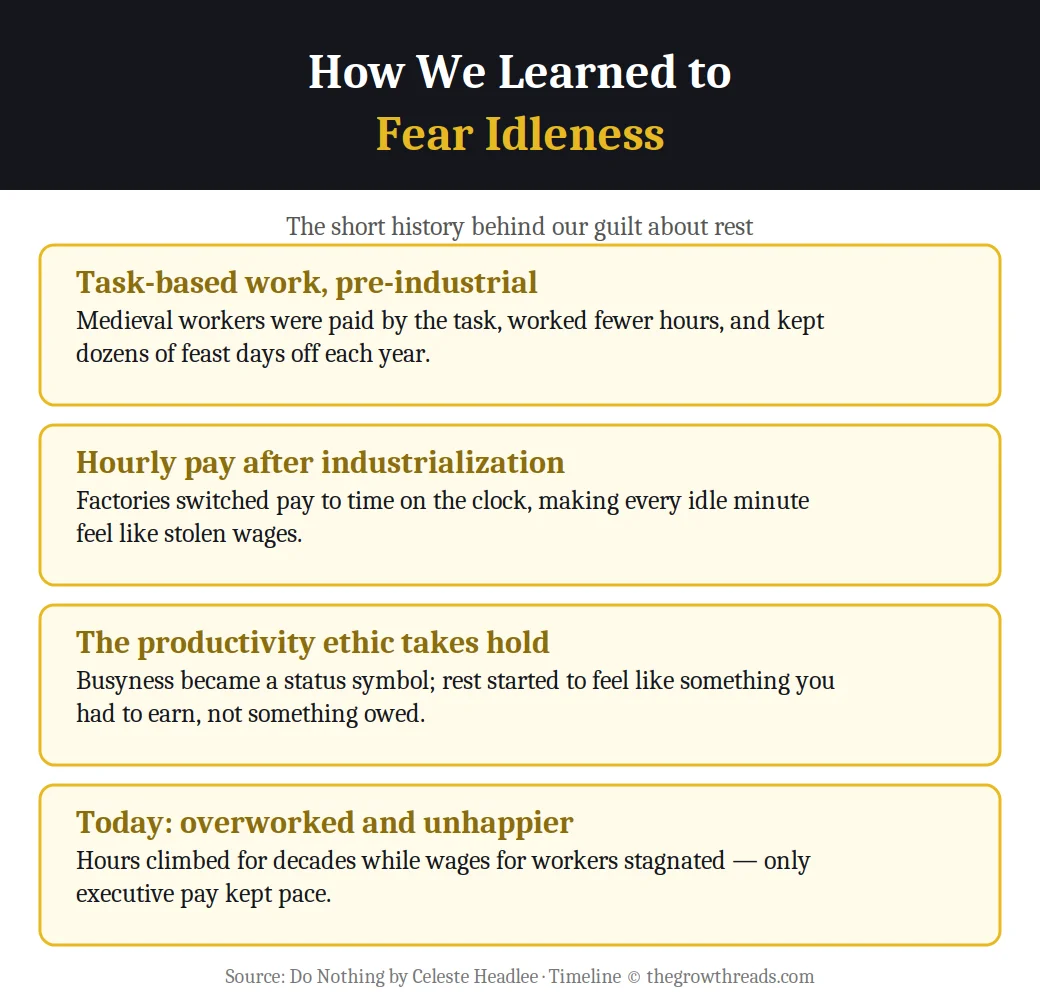
We are working more than at almost any point in modern history, and getting sadder, sicker, and less productive for it. Celeste Headlee, a longtime NPR journalist, traces how idleness came to feel shameful: pre-industrial workers were paid by the task and kept dozens of feast days off each year, but the shift to hourly wages made every unproductive minute feel like money left on the table. That mindset, she argues, has only intensified — busyness became a status symbol, rest became something to earn rather than something owed, and the result is a culture that’s more anxious, more isolated, and, by many measures, no more effective at work than it was decades ago. Her fix isn’t a productivity hack; it’s a case for treating leisure, connection, and idle time as requirements, not luxuries to be scheduled in if anything is left over.
Key takeaways
- Our fear of idleness is historically recent: pre-industrial workers were paid by the task, worked fewer hours than today’s average, and kept far more days off — the guilt about rest is a product of hourly wage work, not a human default.
- Busyness became a status symbol: constant activity started signaling importance and virtue, making rest feel like something that has to be justified or earned.
- Wages stagnated even as hours didn’t: workers haven’t seen proportional gains from decades of increased output — the clearest financial winners have been executives, not employees.
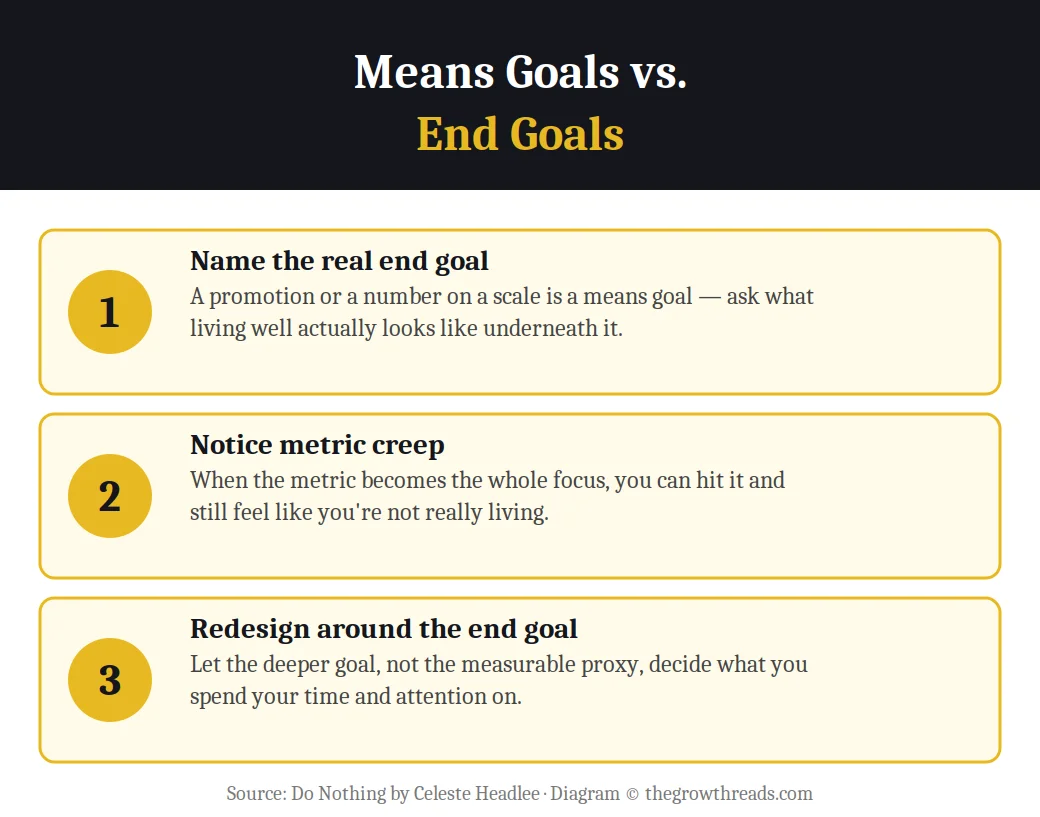
- Means goals get mistaken for end goals: a promotion or a number on a scale is a proxy, not the actual point — chasing the metric can leave the underlying goal of living well untouched.
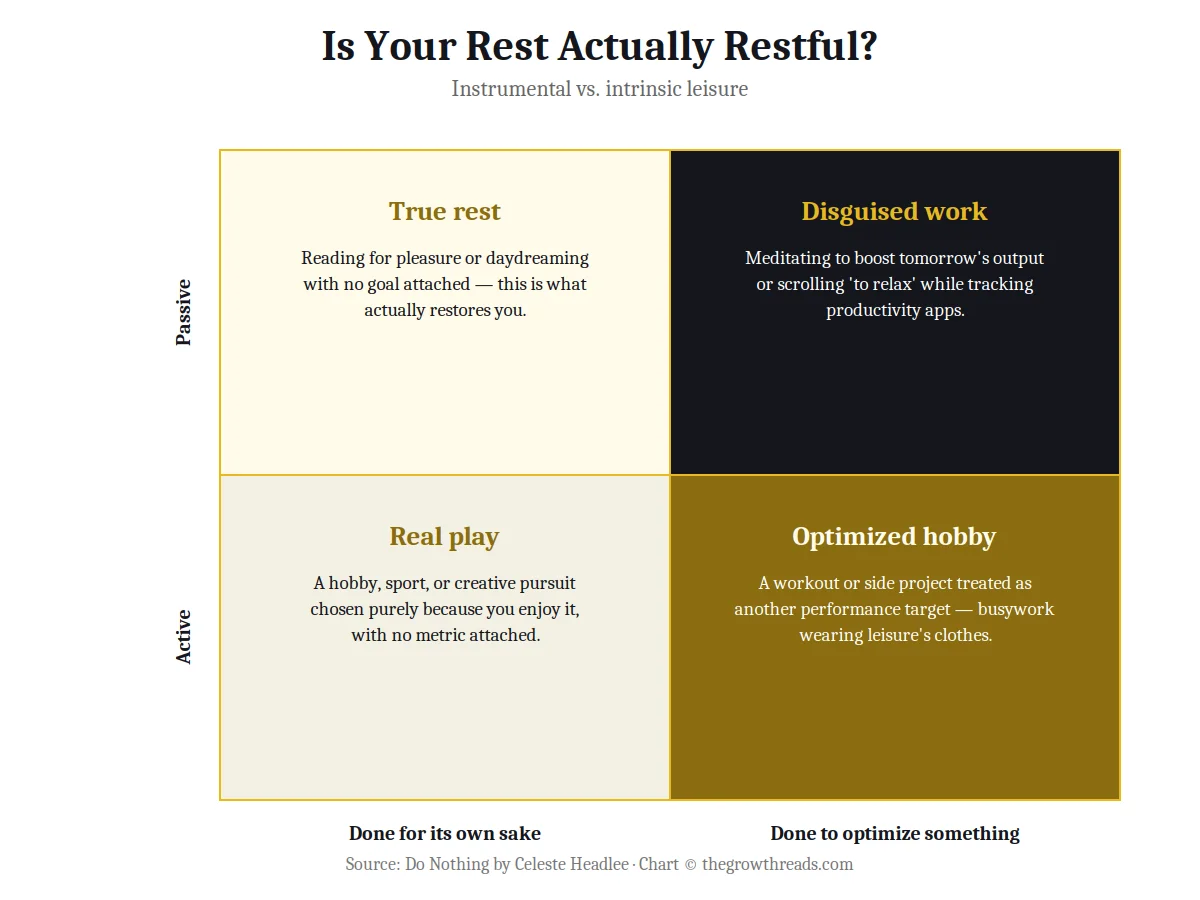
- Not all rest is actually restful: leisure optimized for a future payoff, like meditating specifically to boost tomorrow’s output, functions as disguised work rather than real recovery.
- Time perception is usually wrong: most people significantly misjudge where their hours actually go, and a simple time log corrects this more reliably than intuition.
- Distant comparisons fuel unhappiness: measuring your life against curated online highlight reels drives unhealthy competition rather than useful motivation.
- Diverse collaboration outperforms lone experts: across industries, merging an expert’s judgment with input from less-experienced people consistently produces better conclusions than the expert working alone.
- Face-to-face connection and small kindnesses matter more than they’re given credit for: both reliably improve wellbeing more than most people’s default leisure choices, like passive screen time.
What is Do Nothing about?
Do Nothing is Celeste Headlee’s argument that modern culture’s obsession with efficiency and constant productivity is making people worse off, not better — sadder, sicker, more isolated, and, despite all the extra hours, not meaningfully more effective. Drawing on history, sociology, and her own reporting, Headlee traces how work came to dominate identity and self-worth, then lays out specific, practical ways to reclaim genuine leisure, face-to-face connection, and unstructured time as necessities rather than indulgences.
About the author
Celeste Headlee is a journalist and radio host with two decades in public radio, having anchored NPR programs including Tell Me More, Talk of the Nation, Here and Now, and 1A, and co-hosted the national morning news program The Takeaway. Her TEDx talk, “10 Ways to Have a Better Conversation,” has been viewed more than 34 million times and ranks among the platform’s most-watched talks since 2009. Do Nothing grew out of her long-running interest in overwork and burnout as a journalist, and she is also the author of We Need to Talk, Speaking of Race, and You’re Cute When You’re Mad. Explore all Celeste Headlee book summaries →
Key concepts at a glance
| Concept | What it means | Use it when |
|---|---|---|
| The history of hourly pay | The shift from task-based to hourly wages after industrialization made idle time feel like lost money | You want to understand where your guilt about resting actually comes from |
| Means goals vs. end goals | A measurable proxy (a promotion, a number) mistaken for the real underlying goal of living well | You’ve hit a target and still don’t feel like anything actually changed |
| Instrumental vs. intrinsic leisure | Rest done to optimize something later versus rest done purely for its own sake | Your “relaxation” still feels like another item on a performance checklist |
| Time perception | Most people’s intuitive sense of where their hours go is inaccurate | You feel like you have no time but can’t say specifically where it’s going |
| Distant comparison | Measuring your life against curated, distant examples rather than realistic local ones | Social media or others’ highlight reels are leaving you dissatisfied |
| Diverse collaboration | Merging expert judgment with input from less-experienced people improves outcomes | A decision is resting entirely on one expert’s solo judgment |
Part 1: How we learned to fear idleness
Headlee opens with a historical reframe that runs against most assumptions about pre-industrial life: task-based workers before industrialization often worked fewer hours than today’s average employee and kept far more days off, including dozens of feast days scattered through the year. Time itself wasn’t yet a unit of value — you were paid for finishing a task, not for the hours spent doing it, which meant idle time carried no particular moral weight.
That changed with industrialization, when factories shifted payment from completed tasks to hours logged on the clock. Once time itself became billable, every idle minute started to feel like money left unearned. Headlee traces how this shift, compounded over generations, produced a culture where busyness signals virtue and importance, and rest has to be justified rather than simply taken — even though wages for most workers haven’t kept pace with the extra hours, while executive compensation has grown substantially.
TGR Note: This historical account pairs well with Four Thousand Weeks‘s argument that clock time itself, not just how we fill it, reshaped how humans relate to their own mortality and daily choices.
Part 2: Means goals, end goals, and telling real rest from disguised work
One of Headlee’s more practical distinctions is between means goals and end goals. A promotion, a number on a scale, or a specific income target is a means goal — a measurable proxy for something else. The end goal underneath it is usually something less quantifiable, like feeling secure, respected, or genuinely satisfied with how you’re spending your life. The trouble, she argues, is that means goals are easy to optimize for directly, so people chase the metric and quietly lose track of whether the actual end goal is being served at all.
The same logic extends to leisure itself. Headlee distinguishes rest that’s genuinely restorative from what she treats as disguised work — meditating specifically to boost tomorrow’s output, or scrolling social media “to relax” while a productivity app quietly tracks the time. If leisure is being optimized for a future payoff, it isn’t really leisure; it’s still work, just wearing a more comfortable outfit.
TGR Note: The means-versus-end distinction is a close cousin of the “P-Squared” idea in Great at Work — both books argue that hitting a visible metric isn’t the same as actually achieving the deeper thing the metric was supposed to represent.
Part 3: Correcting time perception and cutting distant comparisons
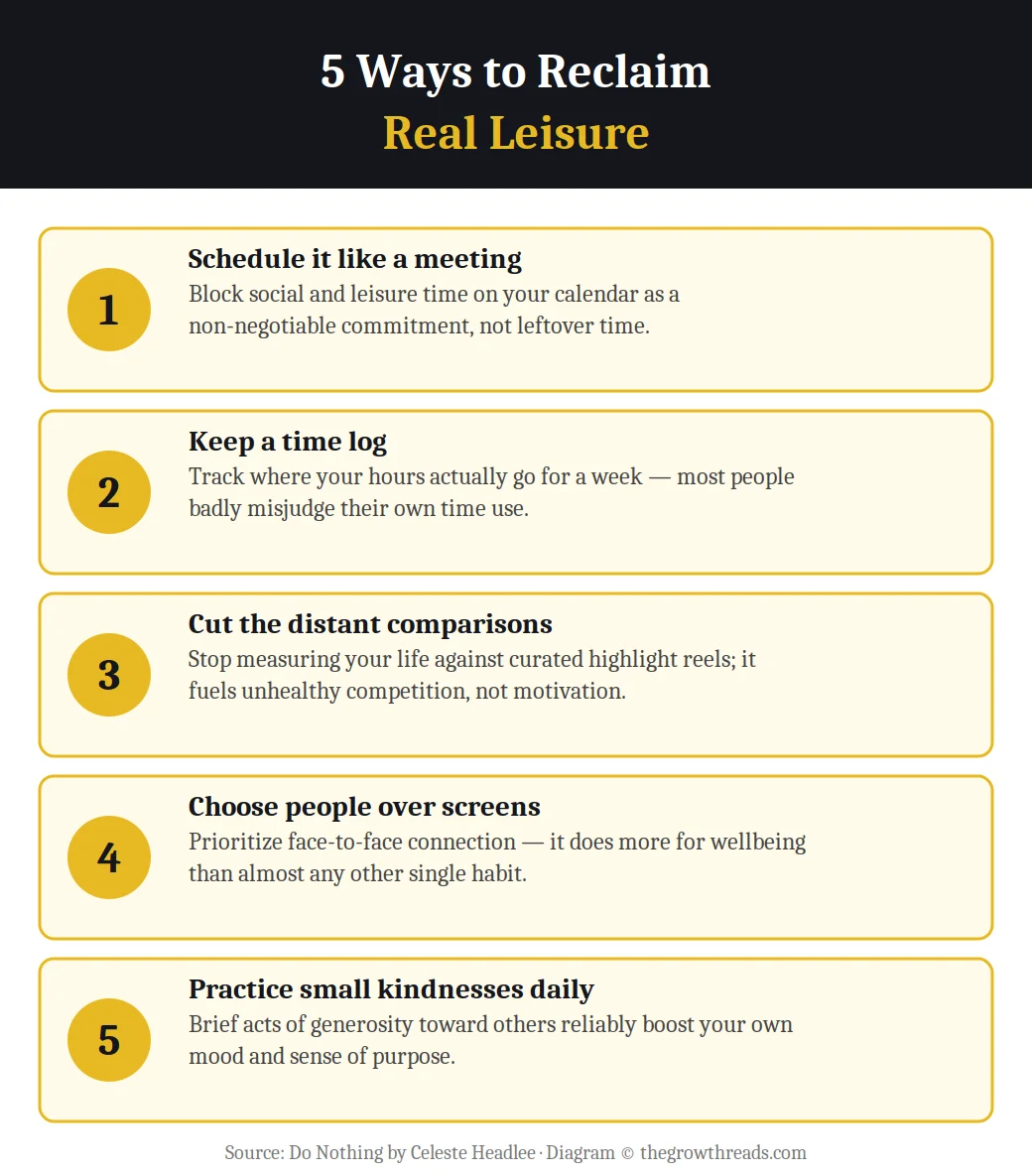
Headlee’s research consistently found that people misjudge their own time use — believing they’re busier, or have less free time, than an honest log of their actual hours would show. A simple time-tracking exercise, done for even a week, tends to correct this more reliably than intuition or memory, and often reveals more genuinely free time than people assumed they had, echoing findings from other time-use researchers.
She also singles out distant comparison as a specific driver of dissatisfaction: measuring your career, body, or lifestyle against a curated, often unrepresentative online highlight reel produces a kind of comparison that has no natural ceiling and rarely resolves into anything constructive. Headlee recommends replacing distant comparisons with more local, realistic ones, and notes that even small acts of kindness toward others reliably do more for mood and sense of purpose than most people’s default choice of passive screen time.
TGR Note: The time-log correction echoes the same core finding in 168 Hours — both authors found that a detailed log routinely contradicts people’s gut sense of how busy or free their week actually is.
Part 4: Reclaiming leisure and connection on purpose
Headlee’s practical recommendations treat leisure and connection as things to schedule deliberately, not as whatever’s left after work is done. Blocking social and leisure time on a calendar the same way you’d block a meeting, prioritizing face-to-face contact over more passive, screen-based alternatives, and practicing small daily acts of kindness are all presented as concrete, low-effort interventions rather than a wholesale lifestyle overhaul.
She also draws on research showing that decisions benefit from diverse input more than most people assume: across industries, merging even a highly experienced expert’s judgment with contributions from less-knowledgeable collaborators tends to produce better outcomes than the expert deciding alone. The throughline across all of these recommendations is the same: connection, unstructured time, and input from others aren’t distractions from getting things done — they’re part of what makes a life, and often the work itself, actually go well.
Who is Do Nothing best for — and who should read something else first?
This book is best for people who feel chronically busy and suspect, without quite being able to prove it, that the busyness isn’t actually making their life or work better. It particularly rewards readers who appreciate historical and sociological context rather than a straight self-help format.
If you want the philosophical case for finitude and radical prioritization rather than the history of overwork specifically, Four Thousand Weeks covers related ground from a different angle. If your focus is squarely on evaluating and cutting commitments rather than reclaiming leisure broadly, Essentialism gives a more systematic framework for that specific decision. And if the root of your overwork is really about attention and distraction rather than hours themselves, Hyperfocus addresses that more targeted problem.
Questions to reflect on
- Where did your own guilt about resting come from — do you actually believe idle time is wasted, or have you just absorbed that from your environment?
- Think of a current means goal you’re chasing — what’s the actual end goal underneath it, and is the means goal still serving it?
- Is your typical “relaxation” actually restful, or is it quietly optimized for some future payoff?
- If you tracked your actual hours for a week, do you expect the log would match your gut sense of how busy you are?
- What’s one distant comparison you could replace with a more local, realistic one this week?
🔥 Ready to stop earning your rest?
This guide covers the core argument — the book gives you the full history, research, and Headlee’s complete set of practical recommendations.
How to apply Do Nothing (7-day plan)
- Day 1: Start a simple time log, noting roughly what you did each hour, without judging or adjusting your behavior yet.
- Day 2: Identify one means goal you’re chasing and write down the actual end goal it’s supposed to serve.
- Day 3: Schedule one block of genuinely unstructured leisure time this week, and put it on your calendar like a meeting.
- Day 4: Review yesterday’s “relaxation” — was it truly restful, or quietly optimized for some future payoff?
- Day 5: Replace one screen-based leisure habit with a face-to-face interaction, even a short one.
- Day 6: Practice one small, unprompted act of kindness toward someone else.
- Day 7: Review your week’s time log and compare it honestly to how busy you assumed you were.
Frequently asked questions
What is the main idea of Do Nothing?
Do Nothing argues that modern culture’s obsession with constant productivity and efficiency is making people sadder, sicker, and more isolated without making them meaningfully more effective. Celeste Headlee traces the history of how idleness came to feel shameful and makes the case for treating leisure, rest, and connection as requirements rather than optional luxuries.
Why did people used to work less than we do now?
Before industrialization, many workers were paid by the completed task rather than by the hour, which meant idle time carried no particular financial cost. Headlee cites historical accounts showing pre-industrial workers often had fewer work hours and far more days off than the modern average.
What are means goals versus end goals in Do Nothing?
A means goal is a measurable proxy, like a promotion or a specific number, while an end goal is the deeper, less quantifiable thing it’s supposed to represent, like feeling secure or living well. Headlee warns that chasing the means goal directly can leave the actual end goal unaddressed.
What does the book mean by “disguised work” leisure?
Disguised work refers to leisure activities optimized for a future payoff, like meditating specifically to be more productive tomorrow. Headlee argues this isn’t genuine rest, since it’s still oriented around performance rather than being done for its own sake.
Does the book say working hard is bad?
No, Headlee’s argument isn’t against effort or ambition, but against treating constant busyness as inherently virtuous and rest as something that has to be earned. Her case is that unstructured time, connection, and genuine leisure are necessary inputs to a good and, often, more effective life.
What does Do Nothing say about comparing yourself to others?
Headlee identifies distant comparison — measuring your life against curated, often unrepresentative examples, especially online — as a specific driver of dissatisfaction. She recommends replacing distant comparisons with more local, realistic ones.
Is Do Nothing based on research or personal opinion?
The book draws on historical records, sociological research, and Headlee’s own journalism on overwork and burnout, rather than relying primarily on personal anecdote. She cites specific findings on time perception, collaboration, and the effects of comparison throughout.
Related summaries
If Do Nothing resonated, these dig further into related territory: Four Thousand Weeks on mortality and radical prioritization, Essentialism on systematically cutting non-essential commitments, and 168 Hours on correcting your own time perception with a real log. For more, see our best productivity books pillar page.
How we analyze books: We work from the full book — reconstructing its core arguments in our own words, adding commentary that connects it to related research and other books in our library, and pressure-testing the advice in a practical 7-day plan. Ratings weigh usefulness, readability, and evidence quality. Read our full methodology.