

★★★★★ 4.7/5 — A blunt, practical playbook for trading money for time, then reinvesting that time into the handful of things that actually grow your business.
Best for: Founders, coaches, and solo operators who are busy every hour but not actually growing
Reading time: ~6–7 hours to read the book · ~18 minutes for this guide
Difficulty to apply: Moderate — the ideas are simple, but delegating well takes real practice
Buy Back Your Time in one minute
You will never out-earn the ceiling of your own calendar. Dan Martell’s central claim in Buy Back Your Time is that most entrepreneurs stay stuck not because they lack ambition, but because they keep doing work that pays them far less than their time is actually worth. The fix isn’t a new productivity app or a better morning routine — it’s a mindset reversal: stop spending time to save money, and start spending money to buy back time.
Martell, a serial SaaS founder and startup coach who has invested in and advised hundreds of companies, built the book around a simple loop: calculate what your hour is worth, delegate anything that costs less than that, and reinvest the freed-up hours into the small number of high-leverage activities that actually move your business (and your life) forward. The rest of the book is a practical toolkit — the DRIP Matrix for auditing your task list, the Replacement Ladder for handing work off cleanly, and the Camcorder Method for documenting how you work without ever opening a blank document.
Key takeaways
- Time, not money, is the real constraint on growth: you can always make more money, but you can never make more hours — so protect them like the scarce resource they are.
- Calculate your Buyback Rate: divide your desired annual income by the hours you actually want to work in a year — that number is the line under which everything gets delegated.
- Buying back time is an investment, not an expense: paying someone $20/hour to do a task frees you to do $200/hour work — the math only looks scary before you run it.
- Sort tasks with the DRIP Matrix: every task on your plate is a Drain, Replaceable, Investment, or Production activity — and only Production deserves your full attention.
- Delegation fails when it’s abdication: handing someone a task with zero training or documentation isn’t delegating, it’s setting them up to fail — and you up for disappointment.
- Use the Camcorder Method to document work fast: record yourself doing a task while narrating your thinking, and you’ve built 80% of a training document in the time it takes to do the task once.
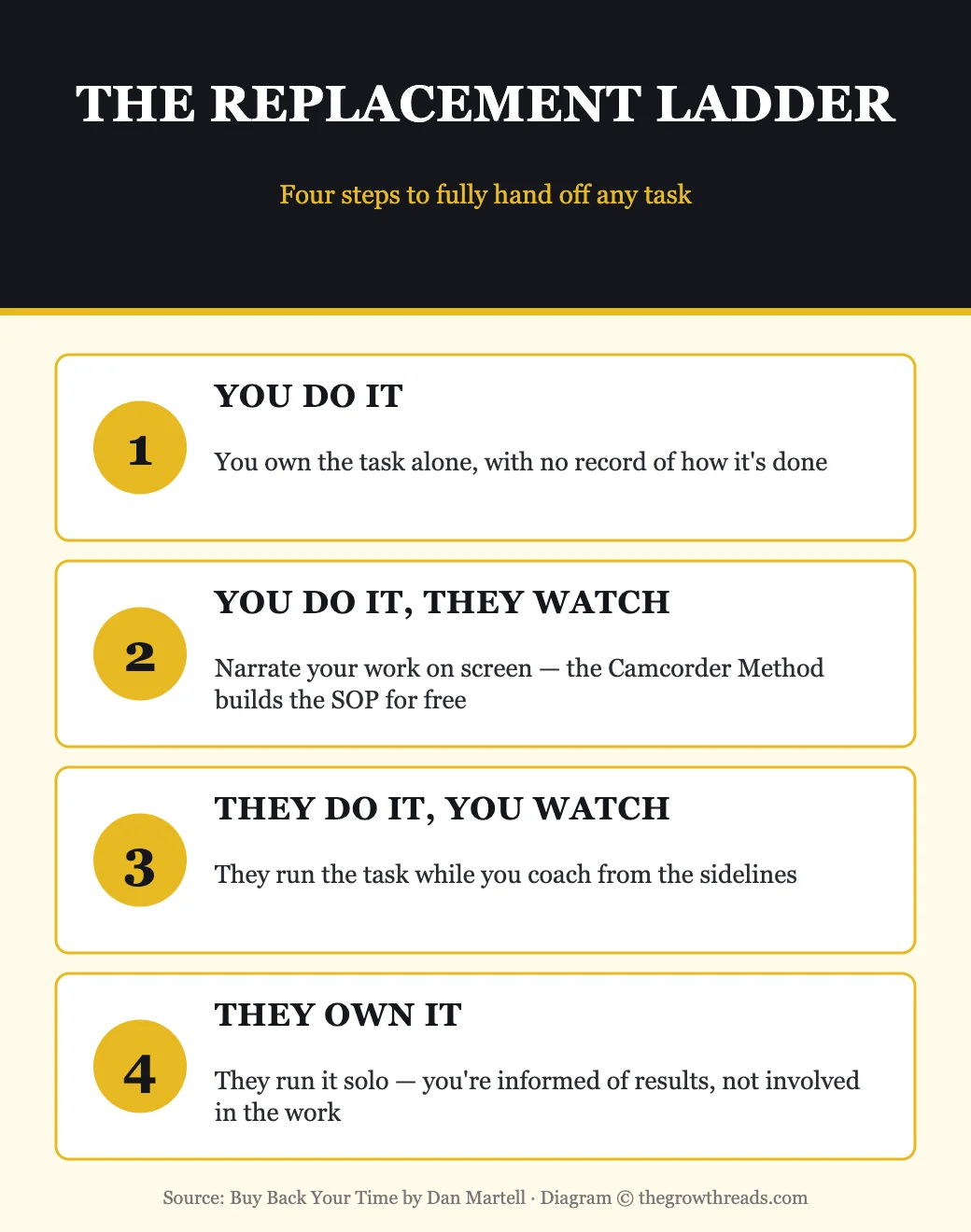
- Climb the Replacement Ladder gradually: go from doing a task alone, to doing it while someone watches, to watching while they do it, to fully handing it off — skipping rungs is why most delegation attempts collapse.
- Your first hire should buy back your lowest-value hours: an executive assistant or equivalent almost always pays for itself faster than a “growth” hire, because it frees the founder to do growth work personally.
- Freed time is only valuable if you reinvest it on purpose: without a 10x vision guiding how you spend newly bought-back hours, they quietly get eaten by email and busywork again.
- The goal isn’t to work less for its own sake: it’s to work only on what only you can do, so the business (and your life outside it) can grow past what your two hands can build alone.
What is Buy Back Your Time about?
Buy Back Your Time by Dan Martell teaches entrepreneurs to stop trading hours for money and start spending money to reclaim hours. Using the Buyback Rate, the DRIP Matrix, and the Replacement Ladder, it shows how to delegate low-value work, document it fast with the Camcorder Method, and reinvest freed time into the few high-leverage activities that scale a business without burning out its founder.
About the author
Dan Martell is a Canadian serial entrepreneur, angel investor, and startup coach best known for founding and exiting three technology companies within a decade, including Clarity.fm and Spheric Technologies. In 2012 he was named Canada’s top angel investor after backing more than 50 startups, among them Intercom, Udemy, and Unbounce. He went on to found SaaS Academy, one of the largest coaching programs for software-as-a-service founders in the world, where he has personally coached hundreds of CEOs on scaling past six and seven figures without losing their lives to their businesses. Buy Back Your Time, published in 2023, distills two decades of that operating experience — plus his own early struggles with burnout — into a single repeatable framework. Explore all Dan Martell book summaries →
Key concepts at a glance
| Concept | What it means | Use it when |
|---|---|---|
| Buyback Rate | Your target hourly value: desired annual income ÷ hours you want to work per year | Deciding whether a task is worth doing yourself or delegating |
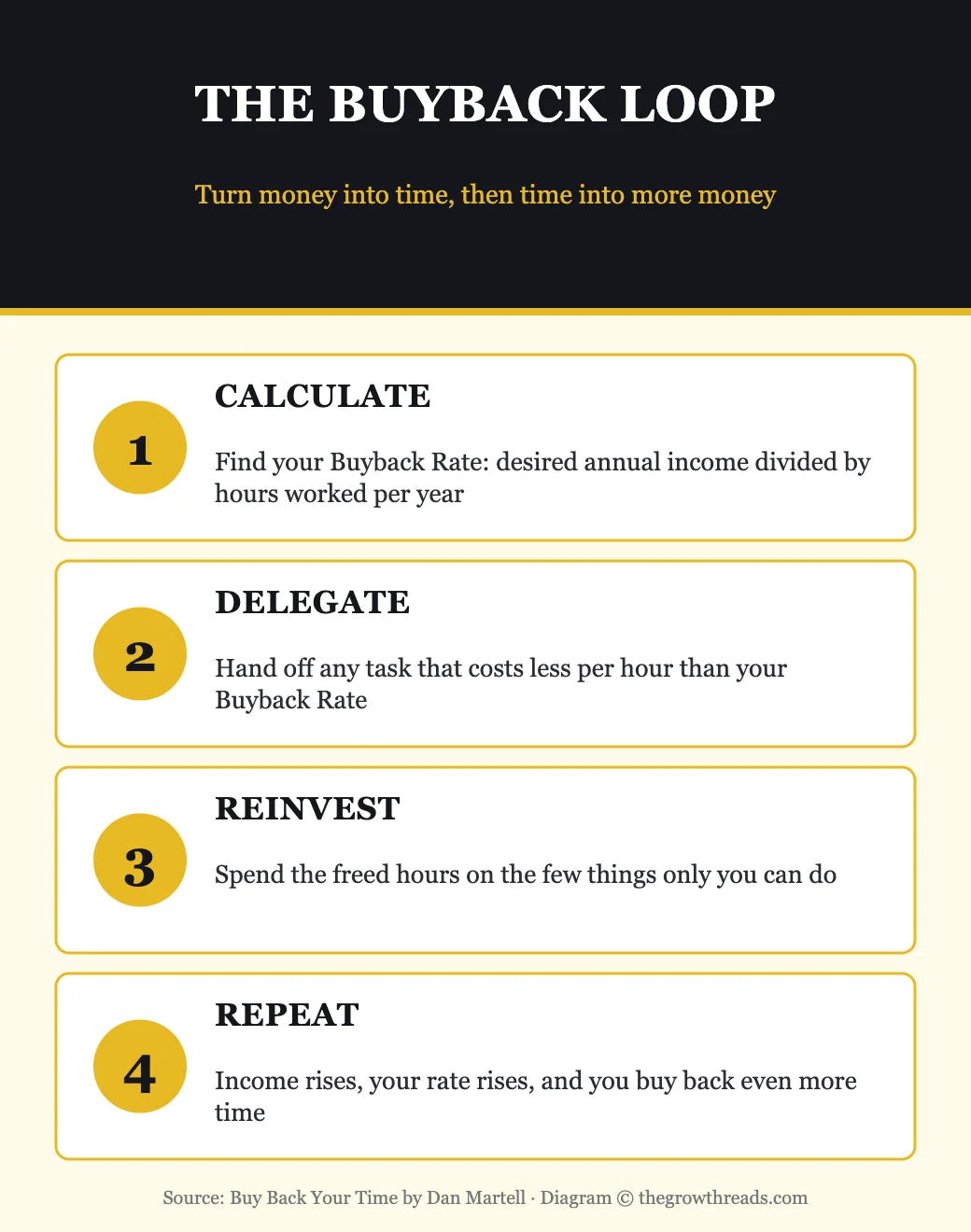
| Buyback Loop | Calculate → delegate → reinvest → repeat, so freed time keeps compounding | Building a habit of continuously buying back more time |
| DRIP Matrix | Sorts tasks into Drain, Replaceable, Investment, and Production | Auditing a week or a calendar to see where your hours actually go |
| Replacement Ladder | Four stages for fully handing off a task: do it, do-it-while-watched, watch-while-done, fully owned | Delegating a task without it silently boomeranging back to you |
| Camcorder Method | Recording yourself doing a task while narrating it, instead of writing a manual from scratch | Turning tribal knowledge into a training asset in minutes, not hours |
| 10x Vision | A concrete picture of the business and life you’re building toward | Deciding what freed-up hours should actually be spent on |
| Energy Audit | Tracking which tasks drain you versus which ones energize you, independent of skill | Prioritizing what to delegate first when everything feels urgent |
| Delegation vs. abdication | Delegation includes training and follow-up; abdication just dumps the task and hopes | Diagnosing why a previous attempt to hand off work failed |
Part 1: The Buyback Principle — spend money to make time
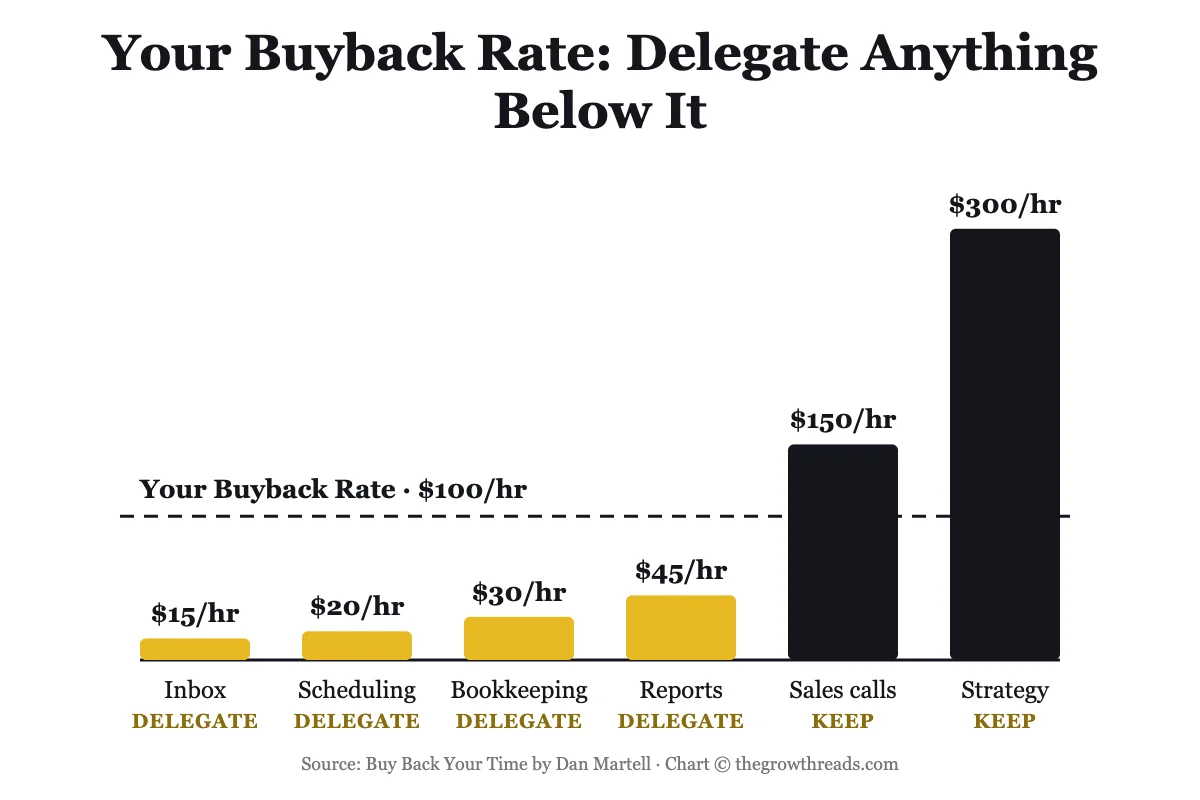
Martell opens with a confession familiar to almost every founder: he built his first company by working himself into the ground, answering every email, taking every support call, and treating his own exhaustion as a badge of honor. The turning point came from a simple realization — his time had a dollar value whether he tracked it or not, and every hour spent on a $15-an-hour task was an hour stolen from the $500-an-hour work only he could do.
That realization becomes the Buyback Rate: take the annual income you actually want, divide it by the hours you actually want to work in a year, and you get a number. Anything you could pay someone else to do for less than that number is, mathematically, costing you money every time you do it yourself — even though no invoice ever shows up to prove it. Martell is direct that most founders underestimate this gap badly, because the cost of doing a low-value task themselves is invisible, while the cost of hiring someone to do it is a very visible number on a bank statement.
The mechanism that turns this insight into a habit is what the book calls the Buyback Loop: calculate your rate, delegate anything below it, reinvest the freed hours into higher-value work, and watch your rate — and your business — rise as a result. It’s a flywheel, not a one-time fix, which is why Martell frames buying back time as a continuous practice rather than a single spring-cleaning of your calendar.
TGR Note: The Buyback Rate is really a specific, numbers-driven version of the “what’s my highest-value use of time” question that runs through Essentialism and The 4-Hour Workweek. What Martell adds is a hard formula instead of a feeling — which makes it much easier to catch yourself mid-task and ask whether you should even be the one doing it.
Part 2: The DRIP Matrix — auditing where your time actually goes
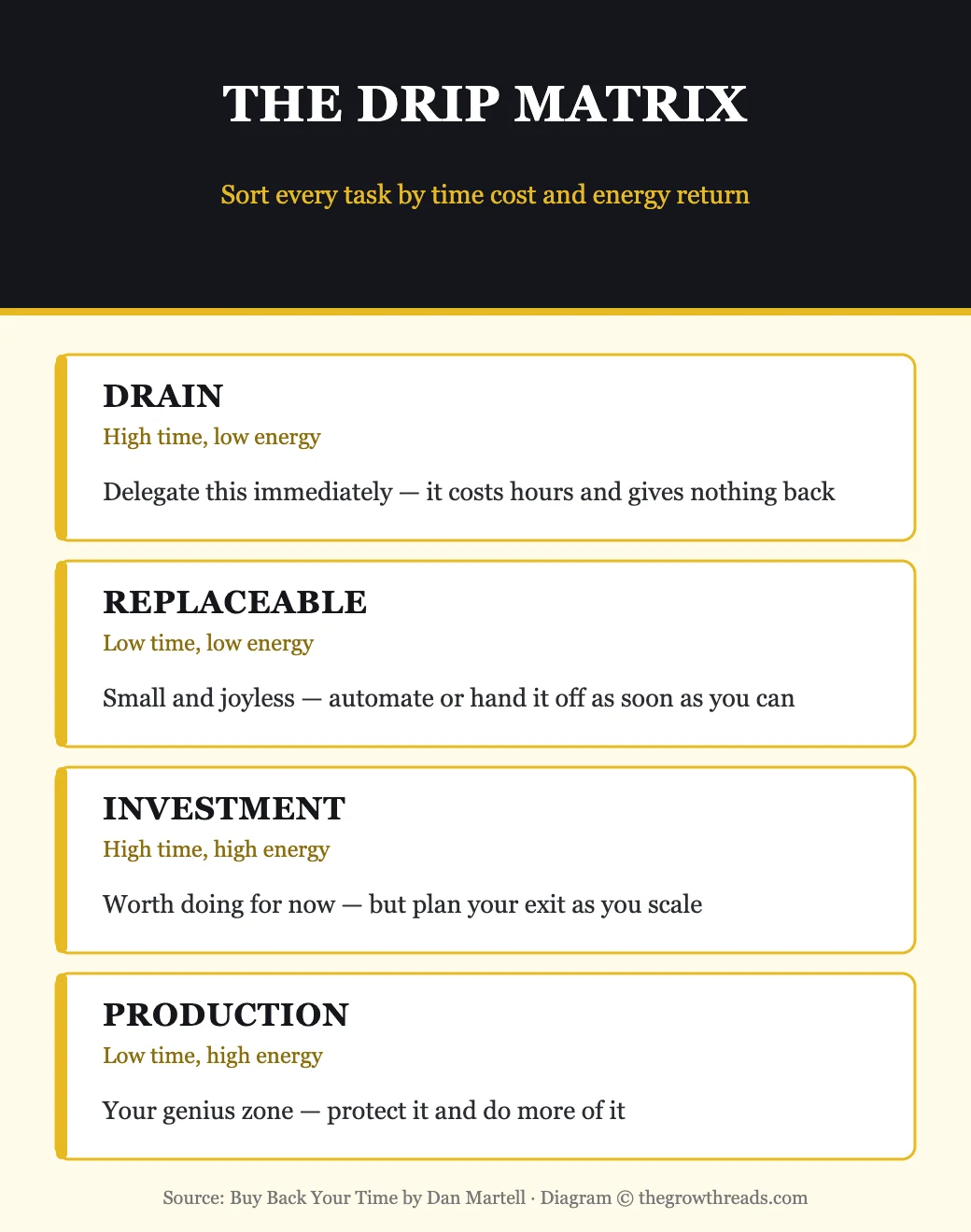
Once the Buyback Rate gives you a number, the DRIP Matrix gives you a map. Martell has readers track a representative week of tasks and sort each one along two dimensions: how much time it takes, and how much energy it gives back (independent of how good you are at it). The result is four buckets. Drain tasks cost a lot of time and give nothing back — these are the first things to delegate, no exceptions. Replaceable tasks are small and joyless, easy to overlook because no single instance seems worth automating, but they add up fast. Investment tasks take real time but genuinely build a skill or asset you’ll need later, so they’re worth doing personally for now, with a planned exit date. Production tasks are the ones that generate energy and results at the same time — this is a founder’s “zone of genius,” and the entire point of buying back time elsewhere is to protect more hours for this bucket.
Martell is careful to note that the matrix isn’t about being good or bad at a task — plenty of Drain tasks are things a founder is perfectly competent at, they just don’t return enough value to justify the founder’s specific hour. This distinction — competence versus leverage — is what separates the DRIP Matrix from a simple to-do list triage, and it’s the part readers most often say reframes how they look at their calendar.
TGR Note: The DRIP Matrix plays a similar role to the task-auditing exercises in The E-Myth Revisited — both push owners to see their business as a system of separable tasks rather than one undifferentiated blob of “work.” Reading them together makes the case for documentation (Part 3, below) even stronger: Michael Gerber’s systems-thinking plus Martell’s DRIP audit gives you both the “why” and the “which tasks first.”
Part 3: The Replacement Ladder — delegating without it boomeranging back
Most delegation fails not because the delegator picked the wrong task, but because they skipped straight from “I do this” to “you do this now” with no documentation and no ramp-up — what Martell calls abdication rather than delegation. The Replacement Ladder is his fix: four rungs that move a task off your plate gradually enough that quality doesn’t collapse in the handoff. First, you do the task alone, with no one watching. Second, you do it while someone shadows you and takes notes. Third, they do it while you watch and correct in real time. Fourth, they own it completely, and you’re informed of outcomes rather than involved in the work itself.
The rung most founders skip is the second one — and it’s the rung the Camcorder Method exists to make painless. Instead of writing a step-by-step manual from memory (which almost never gets finished), you simply record your screen and narrate your thinking while doing the task once, normally. That recording becomes rung two automatically: a new hire can watch it as many times as needed, and a rough written SOP can be built from the transcript afterward instead of from a blank page. Martell argues this single habit — recording instead of writing — is responsible for more successful delegations in his coaching practice than any other single tactic in the book.
He’s also candid that the ladder takes longer than it feels like it should, especially for founders used to just doing things themselves because it’s “faster this one time.” The math only works if you count the twentieth time, not the first — the first handoff is nearly always slower than doing it yourself, and that’s the investment, not the failure.
TGR Note: The Camcorder Method is a lightweight, founder-friendly cousin of the “systemize everything” instinct in The Checklist Manifesto. Where Atul Gawande makes the case for checklists in high-stakes fields like surgery and aviation, Martell applies the same instinct to ordinary business tasks — proof that the underlying principle (write it down once, reuse it forever) scales down just as well as it scales up.
Part 4: Buying back your life, not just your business
The final section pulls the lens back from tactics to purpose. Buying back time is pointless, Martell argues, if the hours you free up quietly get swallowed by more email, more meetings, or more scrolling. That’s why he insists on pairing every buyback with a 10x vision — a specific, almost uncomfortably concrete picture of what your business and your life look like at ten times their current scale. Without that picture, freed time defaults back to whatever already fills your day.
He also reframes the entire project as being about more than revenue. The same Buyback Rate math that tells you to delegate a $20-an-hour task applies just as well outside work — cleaning, errands, and admin at home cost real hours that could go toward health, family, or rest. Several of the founders profiled in the book describe buying back time at the office only to discover the real payoff was dinner with their kids or finally training for the race they’d postponed for years. Martell’s closing argument is that the goal was never to work less for its own sake; it’s to make sure the hours you do have go toward the small number of things — in business and in life — that only you can do.
TGR Note: This closing argument lands in almost the same place as Four Thousand Weeks, which makes the philosophical case that time is finite and unowned no matter how productive you get. Martell arrives at a similar conclusion from the opposite direction — through spreadsheets and delegation rather than mortality and philosophy — which makes the two books an unusually good pair for anyone who wants both the “why” and the “how.”
Who is Buy Back Your Time best for — and who should read something else first?
This book is written for people who already have some revenue coming in and are personally the bottleneck in their own business: solo consultants and coaches billing by the hour, agency owners still doing the client work themselves, and early-stage founders who haven’t hired past a skeleton crew. If that’s you, the Buyback Rate and DRIP Matrix will likely reorganize your calendar within a week of reading.
If you don’t yet run a business and just want better personal time management, start with The 4-Hour Workweek or Getting Things Done — Martell’s framework assumes you have money coming in to spend on buying back hours, which isn’t always true before that point. And if you’ve already systemized your business and delegation isn’t the bottleneck, The E-Myth Revisited or Essentialism will push you further on strategy and focus rather than repeating ground this book already covers well.
Questions to reflect on
- What’s my Buyback Rate today, and which three tasks on my calendar fall clearly below it?
- Which DRIP quadrant holds most of my actual hours this week — and does that match where I think my time goes?
- What’s stopping me from recording a five-minute Camcorder Method video of my most-repeated task this week?
- If I had ten more free hours every week starting today, what would I genuinely spend them on?
- What does my 10x vision actually look like in concrete detail — and does my current calendar move toward it or away from it?
🔥 Ready to buy back your first hour?
Grab a copy and start running the Buyback Rate on your own calendar this week.
How to apply Buy Back Your Time (7-day plan)
- Day 1 — Calculate your Buyback Rate. Pick the annual income you want and the hours you actually want to work, and divide.
- Day 2 — Track every task for one full day and tag each one with a DRIP quadrant: Drain, Replaceable, Investment, or Production.
- Day 3 — Pick one Drain task and record yourself doing it, narrating your thinking out loud (the Camcorder Method).
- Day 4 — Turn that recording into a one-page SOP — just the steps, in order, nothing fancy.
- Day 5 — Decide who could own this task: an existing team member, a part-time hire, or a virtual assistant.
- Day 6 — Hand it off at rung two of the Replacement Ladder: have them shadow you doing it once more before they try it solo.
- Day 7 — Block the freed hour on your calendar for one activity that moves you toward your 10x vision — and protect it like a client meeting.
Frequently asked questions
What is the Buyback Rate and how do I calculate it?
Your Buyback Rate is the dollar value of one hour of your time, calculated by dividing the annual income you want to earn by the number of hours you actually want to work in a year. If you want to earn $200,000 while working 2,000 hours a year, your Buyback Rate is $100 an hour. Any task you could pay someone else to do for less than that — bookkeeping, scheduling, basic admin — is technically costing you money every time you do it yourself instead of delegating it, even though that cost never shows up as a line item on a bill.
Is Buy Back Your Time only for business owners?
The examples and math are built around founders and small business owners, since Martell’s coaching practice is entirely SaaS entrepreneurs. That said, the Buyback Rate and DRIP Matrix apply just as cleanly to freelancers, consultants, and even employees with side income or household budgets — anyone who has some money to spend and some low-value tasks eating their hours can use the same framework, just at a smaller scale.
What is the DRIP Matrix?
The DRIP Matrix sorts every task on your plate into one of four buckets based on how much time it takes and how much energy it gives back: Drain (high time, no energy — delegate immediately), Replaceable (low time, low energy — automate or hand off when convenient), Investment (high time, high energy — worth doing for now, but plan an exit), and Production (low time, high energy — your zone of genius, protect it). The goal is to spend as much of your week as possible in Production and as little as possible in Drain.
What is the Camcorder Method?
The Camcorder Method is Martell’s shortcut for documenting a task without ever sitting down to write a manual. You simply record your screen (or yourself) while doing the task once, narrating your reasoning as you go — “I’m checking this field because…”, “I always do X before Y because…” — and that recording becomes the training material a new hire or delegate can watch before taking the task on themselves. A rough written SOP can be built afterward from the transcript, but the recording alone is usually enough to get someone started.
How much does it cost to start delegating if I’m not making much money yet?
Martell’s advice is to start small rather than waiting until you can afford a full-time hire. A few hours a week from a part-time virtual assistant, priced well below your Buyback Rate, is usually enough to test the process on one or two Drain tasks. The point isn’t to hire a large team overnight — it’s to prove to yourself that delegated tasks still get done well, then gradually expand as the freed-up hours generate more revenue to reinvest.
Is the advice in Buy Back Your Time backed by research, or just Dan Martell’s experience?
The book is grounded primarily in Martell’s own experience building and exiting three companies and coaching hundreds of SaaS founders through SaaS Academy, rather than in academic studies. The frameworks are practical rather than empirical, and some of the specific numbers and case studies come from his coaching clients. The underlying logic — that delegation frees high-value time — is broadly consistent with standard business and economics thinking about comparative advantage and opportunity cost, even where the specific frameworks are Martell’s own invention.
How is Buy Back Your Time different from The E-Myth Revisited or The 4-Hour Workweek?
The E-Myth Revisited focuses on building systems so a business can run without its owner being present for every task — it’s about the business as a franchise-like machine. The 4-Hour Workweek focuses on personal lifestyle design and outsourcing to reclaim time for travel and side projects. Buy Back Your Time sits between the two: it gives you a concrete formula (the Buyback Rate) for deciding what to delegate and a specific method (the Replacement Ladder and Camcorder Method) for doing it well, making it more actionable day-to-day than either of the other two, though less philosophically ambitious than Four Thousand Weeks on the question of what time is ultimately for.
Related summaries
- The E-Myth Revisited Summary & Review
- Essentialism Summary & Review
- The 4-Hour Workweek Summary & Review
- Four Thousand Weeks Summary & Review
- Best Productivity Books
How we analyze books: Every TGR summary is built from a full read of the source material, cross-checked against the author’s public talks and interviews where relevant, and structured around frameworks readers can actually apply — not just remember. Read our full methodology.