

★★★★★ 4.5/5 — A sharp, insider’s map of the US-China AI race, grounded by a deeply personal turn near the end.
Best for: Anyone who wants to understand how AI is actually being deployed and by whom · Reading time: ~8 hrs to read, ~23 min for this guide · Difficulty to apply: Moderate — mostly about updating your mental model of where AI’s real advantages come from
AI Superpowers in one minute
Kai-Fu Lee has run AI labs at Apple, Microsoft, and Google, and led Google China before becoming one of China’s most prominent venture capitalists. That vantage point lets him make an argument few Western AI books can: the next decade of AI won’t be won by whoever publishes the most breakthrough research, but by whoever implements existing AI most aggressively.
He calls this the shift from the “age of discovery” to the “age of implementation,” and argues it favors China’s data abundance, entrepreneurial intensity, and government backing just as much as it favors Silicon Valley’s research edge. The book’s second half turns personal: Lee’s own cancer diagnosis reshaped his thinking about what AI can’t replace, and what job displacement will actually demand of us as a society.
Key takeaways
- Four waves of AI: internet AI, business AI, perception AI, and autonomous AI are each rolling out at a different pace, not arriving all at once.
- The age of implementation has begun: Lee argues execution now matters more than new research breakthroughs for who benefits from AI.
- China’s edge is real: data abundance, entrepreneurial hustle, government support, and deep engineering talent all favor rapid AI deployment.
- Data is the new oil, but messier: huge, real-world, imperfect datasets often beat smaller, cleaner ones for training useful AI.
- Job displacement will be uneven: some fields shift slowly, others could be disrupted within a decade, depending on how routine and asocial the work is.
- Not all “safe” jobs are equally safe: creativity and social connection both matter, and jobs need real strength in at least one to resist automation.
- Universal basic income isn’t enough on its own: Lee proposes a “social investment stipend” that pays people specifically for care work, community building, and education.
- His cancer diagnosis reframed his priorities: Lee describes rediscovering the value of love and human connection in ways that reshaped his view of what a post-AI economy should optimize for.
- Competition isn’t zero-sum by necessity: Lee argues US-China AI competition could still produce shared global benefit if managed thoughtfully.
- The stakes are civilizational, not just economic: how societies handle this transition will shape inequality, purpose, and wellbeing for generations.
What is AI Superpowers about?
AI Superpowers is Kai-Fu Lee’s argument that the next decade of artificial intelligence will be defined by implementation, not discovery, and that this shift favors China’s data, hustle, and government support as much as it favors Silicon Valley’s research talent. The book combines geopolitical analysis of the US-China AI race with a personal, human meditation on what job displacement demands of society and what technology can never replace.
About the author
Kai-Fu Lee holds a PhD in computer science from Carnegie Mellon and has led AI research and product teams at Apple, Microsoft, and Google, including serving as president of Google China. He later founded Sinovation Ventures, one of China’s leading technology venture capital firms, giving him a rare dual vantage point inside both American and Chinese AI development. Explore all Kai-Fu Lee book summaries →
While writing this book, Lee was diagnosed with stage IV lymphoma, an experience he weaves into the book’s final chapters. That diagnosis reshaped his perspective on what truly matters in an AI-driven future, adding an unusually personal dimension to what is otherwise a geopolitical and economic analysis.
| Concept | What it means | Use it when |
|---|---|---|
| Four waves of AI | Internet, business, perception, and autonomous AI, each maturing on its own timeline | Explaining where a specific AI application actually sits in the adoption curve |
| Age of implementation | The idea that deploying existing AI well now matters more than new breakthroughs | Evaluating whether a country or company’s AI strategy is realistic |
| Data abundance | Large, messy, real-world datasets that often train more useful models than small clean ones | Assessing why a data-rich market might out-innovate a research-rich one |
| Job safety matrix | Mapping jobs by how creative and social they are to estimate automation risk | Discussing which careers face near-term disruption |
| Social investment stipend | Lee’s proposal to pay people for care work, teaching, and community building | Debating policy responses to AI-driven job displacement |
Part 1: The four waves of AI
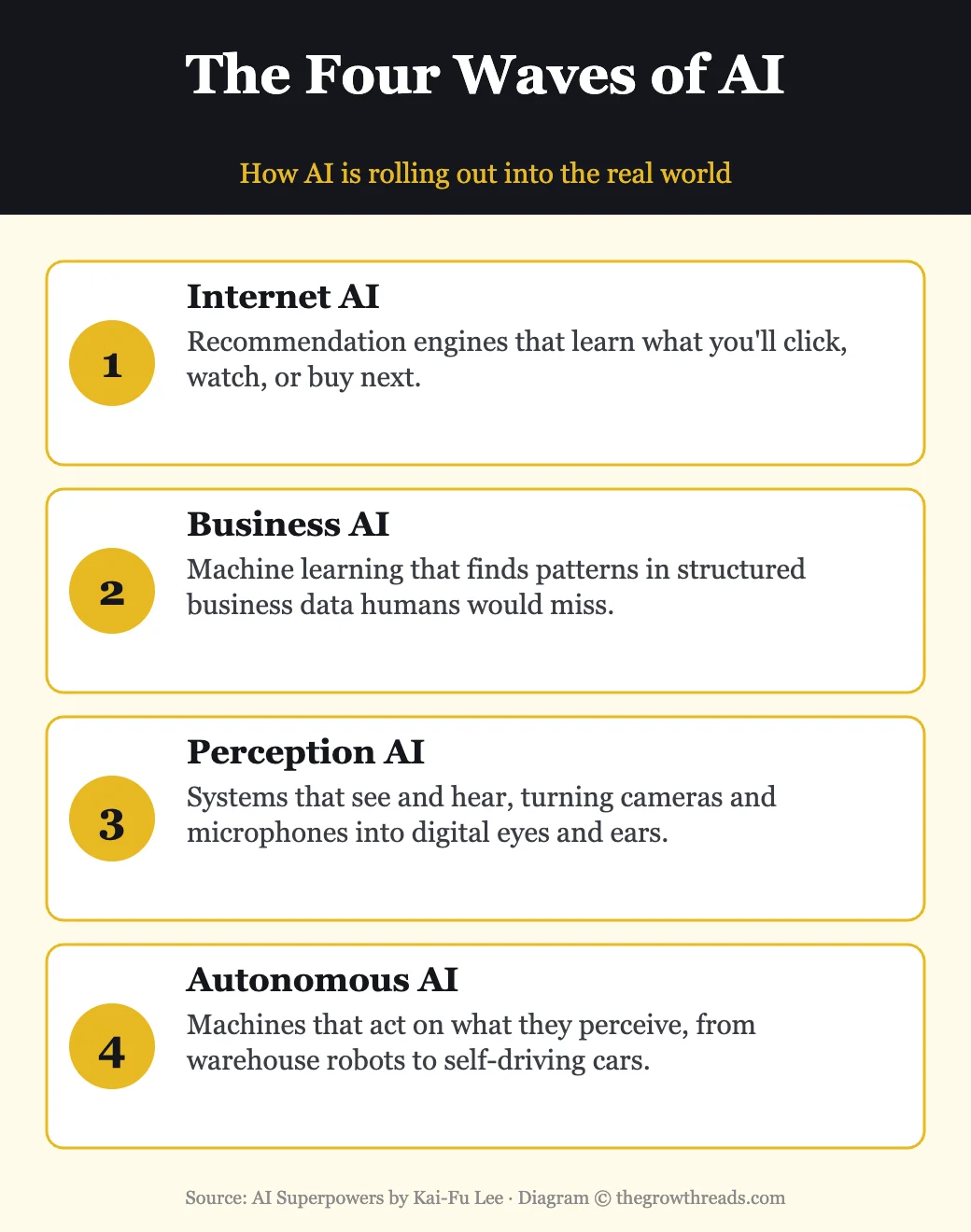
Lee organizes the current AI boom into four overlapping waves, each with its own maturity level. Internet AI is the furthest along: recommendation systems that quietly shape what you watch, read, and buy based on your behavior. Business AI takes structured company data — sales records, insurance claims, medical histories — and finds patterns humans would take years to spot, or never spot at all.
Perception AI turns raw sensory input, cameras and microphones, into structured data machines can act on, powering everything from facial recognition to voice assistants. Autonomous AI, the least mature wave, closes the loop by letting machines act on what they perceive: warehouse robots, delivery drones, and eventually self-driving vehicles. Lee’s point is that these waves arrive at different speeds in different industries, so “AI’s impact” isn’t one single moment but a staggered rollout.
TGR Note: Lee’s four waves map neatly onto the “general-purpose” trait Suleyman describes in our Coming Wave summary — each wave is really the same underlying technology finding a new domain to touch, which is exactly the kind of omni-use spread Suleyman argues is so hard to contain.
Part 2: Why China is catching up fast
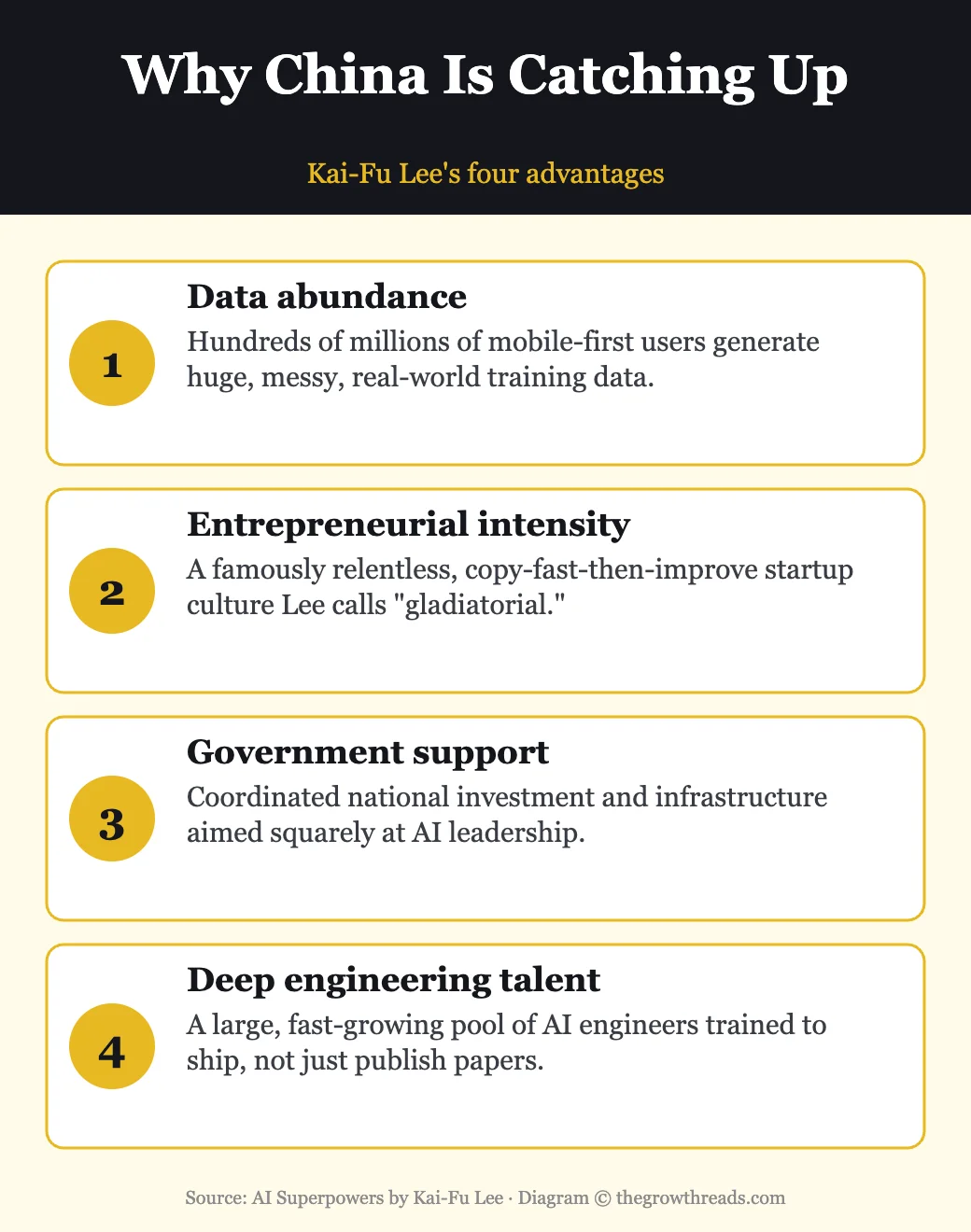
Lee’s central geopolitical argument is that four factors favor China’s AI deployment specifically: an enormous, mobile-first user base generating messy but abundant real-world data; an entrepreneurial culture he describes as gladiatorial, where startups copy fast, iterate faster, and fight brutally for market share; coordinated government backing that treats AI as a national priority; and a deep, rapidly growing bench of engineers trained to ship products rather than just publish papers.
None of this means Silicon Valley loses its research edge, Lee is careful to note. It means the era where research breakthroughs alone determined AI leadership is ending, replaced by an era where deployment speed and data scale matter just as much, if not more.
Part 3: Which jobs are actually at risk
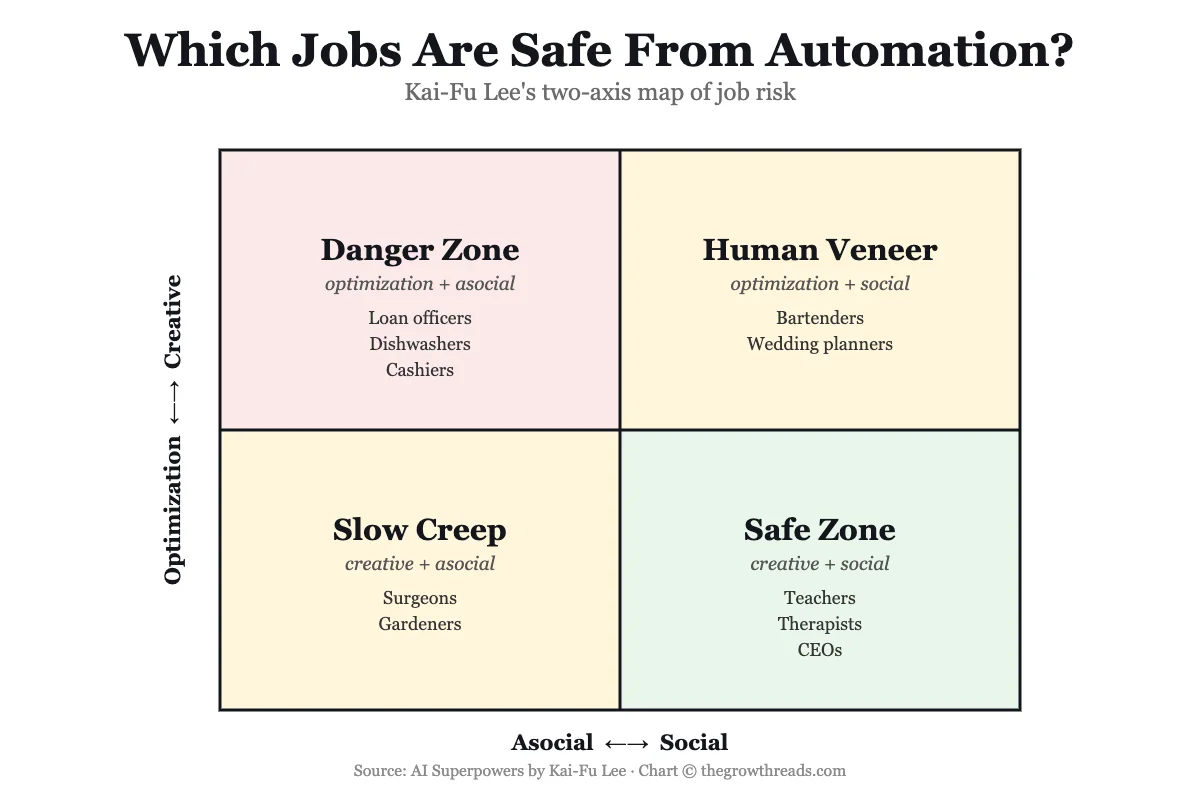
Rather than a single doom prediction, Lee offers a two-axis framework for thinking about job risk: how creative versus optimization-based the work is, and how social versus asocial it is. Jobs low on both creativity and social interaction — think routine data entry or basic food prep — sit squarely in what he calls the danger zone. Jobs strong on either axis have real staying power, and jobs strong on both, like teaching or therapy, look genuinely safe for the foreseeable future.
This framework matters because it replaces vague anxiety with something you can actually apply to your own career, or your kids’ choices. It also explains why some seemingly “skilled” jobs are more exposed than people assume, while some seemingly “simple” jobs, ones requiring real human warmth or unstructured dexterity, are safer than headlines suggest.
TGR Note: This job-risk framework pairs well with the alignment discussion in our Life 3.0 summary. Tegmark asks whether AI will adopt goals compatible with ours; Lee asks a more immediate version of the same question — whose economic goals get served as the technology scales, and how we make sure it isn’t only capital.
Part 4: What AI can’t replace, and what to do about it
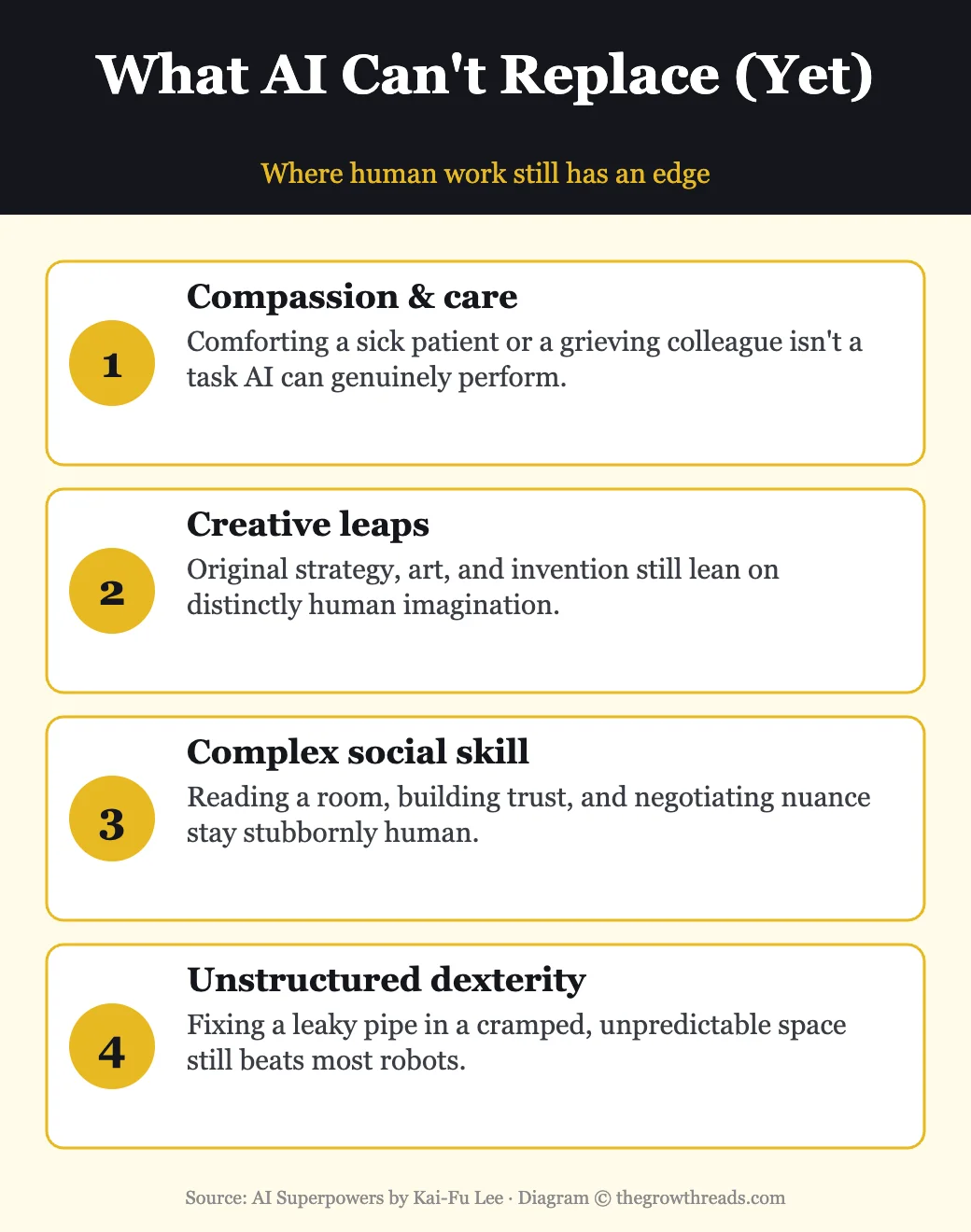
Lee is refreshingly specific about the boundary of AI’s reach: genuine compassion, creative leaps, complex social navigation, and dexterity in unpredictable physical environments all remain stubbornly human. He argues policy should actively invest in these areas rather than treating them as consolation prizes for people displaced by automation.
His concrete proposal is a “social investment stipend”: not just a check for doing nothing, but direct payment for care work, community organizing, and education, treating those activities as economically valuable rather than incidental. The book’s final chapters, written after his cancer diagnosis, argue this isn’t just smart policy but a more honest accounting of what actually makes life meaningful, a theme he says the diagnosis forced him to confront personally.
TGR Note: Lee’s personal turn toward compassion and connection after his diagnosis is a useful counterweight to purely geopolitical AI books. It’s worth reading alongside the containment and alignment frameworks elsewhere in this series as a reminder that the goal was never AI dominance for its own sake, but a better outcome for the humans living through it.
Who is AI Superpowers best for — and who should read something else first?
This book is best for readers who want to understand the geopolitical and economic reality of AI deployment, not just its technical possibilities, and who appreciate an author writing from direct experience inside both the American and Chinese tech industries.
If you’re more interested in the long-term philosophical stakes of superintelligence than near-term job and geopolitical questions, our Life 3.0 summary is the better starting point. If you want a hands-on guide to using today’s AI tools rather than analyzing the industry around them, start with our Co-Intelligence summary instead.
Questions to reflect on
- Where does your own job fall on Lee’s creativity-versus-social matrix, and does that match how secure you actually feel in it?
- Do you think data abundance or research talent matters more for who leads the next decade of AI?
- What would a “social investment stipend” look like if your community actually implemented one?
- Has your view of AI competition between countries changed after reading this — more zero-sum, or more shared-benefit?
- What is one distinctly human skill you could invest more in developing, regardless of how AI progresses?
🔥 Ready to see who’s actually winning the AI race?
Get the insider’s view from someone who has led AI labs on both sides of it.
How to apply AI Superpowers (7-day plan)
- Day 1: Map your own job onto the creativity-versus-social matrix and identify which quadrant it lands in.
- Day 2: Research one AI product built in China and one built in Silicon Valley, and compare their approach to data and deployment.
- Day 3: List which of the four AI waves — internet, business, perception, autonomous — already touches your daily work.
- Day 4: Identify one skill from the “what AI can’t replace” list you could deliberately strengthen this year.
- Day 5: Discuss with a colleague or friend whether a social investment stipend makes sense for your community.
- Day 6: Read one news story about AI policy in a country other than your own, and note what surprises you.
- Day 7: Write down one concrete way you’ll invest in a distinctly human strength over the next year.
Frequently asked questions
What are the four waves of AI in AI Superpowers?
Kai-Fu Lee identifies four waves that make up the current AI boom, each maturing at its own pace. Internet AI powers recommendation systems that predict what you’ll click or buy. Business AI finds patterns in structured company data like sales or medical records. Perception AI turns cameras and microphones into structured, usable data through computer vision and speech recognition. Autonomous AI closes the loop by letting machines act on what they perceive, from warehouse robots to self-driving cars. Lee argues these waves roll out unevenly across industries rather than arriving all at once.
Why does Kai-Fu Lee think China is catching up in AI?
Lee points to four converging advantages: a massive, mobile-first user base that generates abundant real-world data; an intensely competitive, fast-iterating entrepreneurial culture he calls gladiatorial; coordinated government investment treating AI as a strategic national priority; and a large, rapidly growing pool of engineers focused on shipping products rather than only publishing research. He argues that as AI shifts from an “age of discovery” to an “age of implementation,” these deployment-focused advantages matter as much as pure research talent.
Which jobs does AI Superpowers say are safest from automation?
Lee maps jobs along two axes: how creative versus optimization-based the work is, and how social versus asocial it is. Jobs strong on both axes, like teaching, therapy, and leadership roles requiring genuine human connection, are the safest. Jobs weak on both, like routine data entry, sit in what he calls the danger zone. Jobs strong on just one axis, such as surgery (creative but less social) or bartending (social but less creative), fall somewhere in between and face a slower, more gradual risk of disruption.
What is a social investment stipend?
It’s Kai-Fu Lee’s proposed policy response to AI-driven job displacement, distinct from a simple universal basic income. Rather than an unconditional check, the stipend would specifically pay people for socially valuable but often uncompensated work, such as caregiving, community organizing, and education. Lee argues this both cushions economic disruption and treats human connection and care work as economically legitimate, rather than framing displaced workers as passive recipients of charity.
How does Kai-Fu Lee’s cancer diagnosis relate to the book?
Lee was diagnosed with stage IV lymphoma while writing AI Superpowers, and the experience reshaped the book’s final chapters. He describes it as prompting a deep reconsideration of what actually matters in a life increasingly organized around productivity and optimization, concluding that love and human connection deserve far more weight than his earlier career had assumed. This personal turn gives the book’s policy proposals, like the social investment stipend, an unusually sincere emotional grounding.
Is AI Superpowers about the US-China AI competition specifically?
Yes, that competition is the book’s central geopolitical frame, but Lee treats it as more nuanced than a simple race with one winner. He argues both countries have genuine, different advantages, and that thoughtful cooperation could produce shared global benefit rather than a purely zero-sum outcome. The book is as much about understanding how AI actually gets deployed in each ecosystem as it is about declaring a winner.
Is AI Superpowers still accurate since it was published in 2018?
The core frameworks — the four waves, the age of implementation, and the job-risk matrix — remain widely cited and useful. Some specific company examples and competitive details have naturally shifted as both the US and Chinese AI industries have evolved rapidly since publication, particularly with the rise of generative AI. Readers should treat the big-picture frameworks as durable while checking current news for the latest competitive specifics.
Related summaries
- Life 3.0 Summary & Review — the long-term stakes of superintelligence, mapped across twelve futures
- The Coming Wave Summary & Review — the practical containment case for AI and biotech risk
- Browse all Technology book summaries
How we analyze books: we read the full text, cross-check key claims against the author’s public interviews and other research, and build practical application plans rather than just summarizing chapters. Read our full methodology.