

★★★★★ 4.6/5 — A clear-eyed insider’s map of the biggest technology shift of our lifetime, and what we can still do about it.
Best for: Anyone who wants to understand AI and biotech risk without the hype or the doom · Reading time: ~9 hrs to read, ~24 min for this guide · Difficulty to apply: Moderate — mostly about sharpening how you think and vote, not a habit tracker
The Coming Wave in one minute
We are living through the opening chapter of the most consequential technological wave in human history, and Mustafa Suleyman has a front-row seat. As a co-founder of DeepMind and later Inflection AI, and now CEO of Microsoft AI, Suleyman has spent his career building the very systems he warns about in this book.
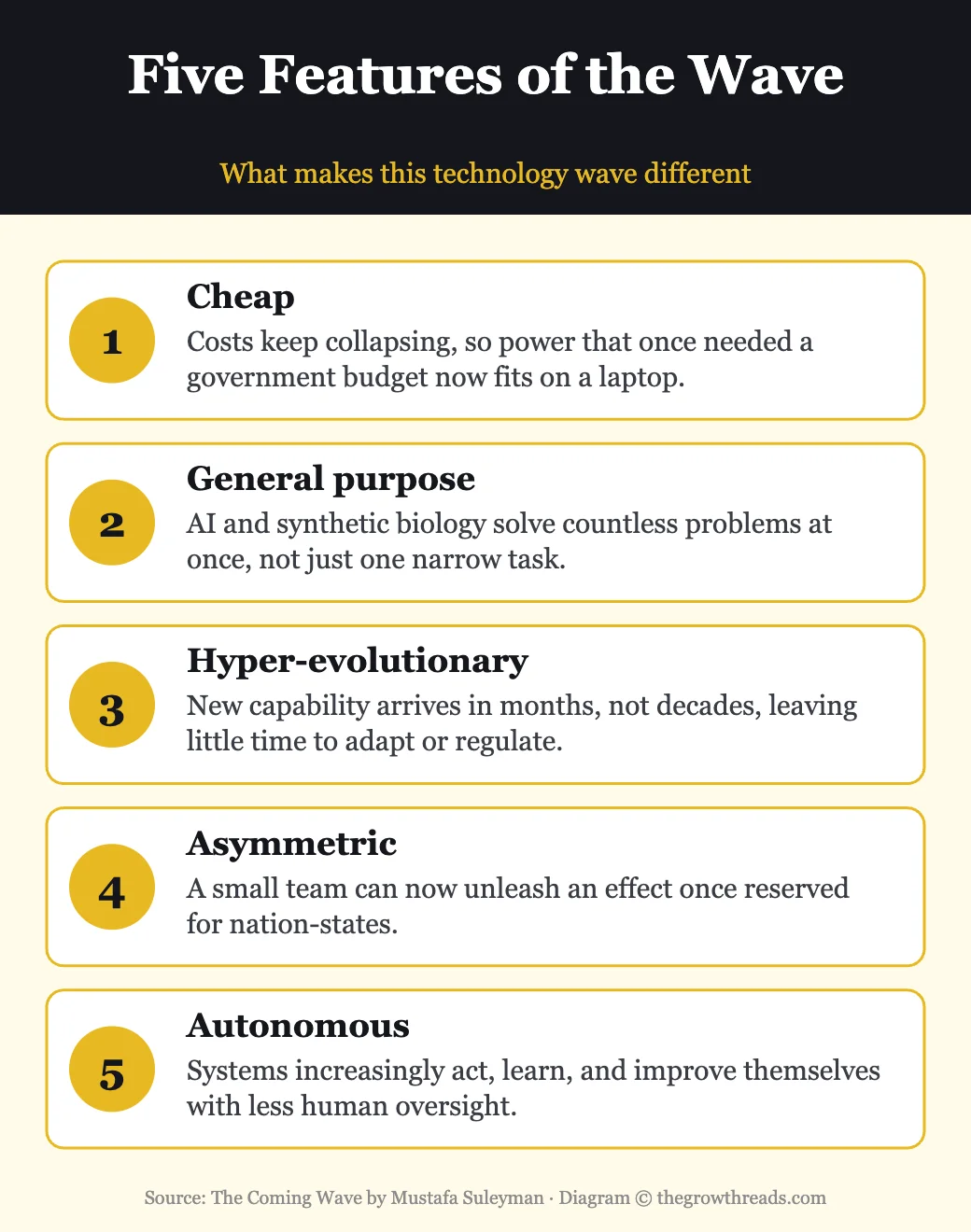
His argument is simple but unsettling: AI and synthetic biology share five traits that make them impossible to fully control — they are cheap, general-purpose, fast-evolving, asymmetric in their power, and increasingly autonomous. Trying to ban or freeze them will fail, the way every past attempt to freeze a useful technology has failed.
The real question isn’t whether this wave arrives. It’s whether we can contain the worst of it while keeping the best — through smarter safety engineering, real corporate accountability, and international cooperation built for speed rather than committee meetings.
Key takeaways
- The wave has five features: it’s cheap, general-purpose, hyper-evolutionary, asymmetric, and increasingly autonomous — and each one makes it harder to control than any technology before it.
- Containment, not prohibition, is the goal: Suleyman explicitly rejects both blind optimism and calls to halt AI development — neither is realistic or achievable.
- The nuclear playbook doesn’t transfer: nuclear weapons stayed contained because they needed rare materials and huge state budgets; AI models run on commodity hardware and open research.
- Power is decentralizing fast: capabilities that once required a nation-state’s resources now sit in the hands of small teams, companies, and eventually individuals.
- Choke points still matter: advanced chips, cloud compute, and specialized lab equipment remain genuine bottlenecks worth watching closely.
- Nation-states face a narrow corridor: too little oversight risks catastrophe; too much risks a surveillance state that’s its own kind of disaster.
- Companies can’t self-regulate their way out: voluntary pledges help, but Suleyman argues for real audits, red-teaming, and external accountability.
- Speed beats bureaucracy: traditional treaty-making moves far slower than the technology it’s meant to govern, so new, faster coalitions are needed.
- Individuals aren’t powerless: how citizens vote, which products they use, and which norms they demand from employers all shape the containment effort.
- This is a multi-decade project: containment isn’t a single policy win, it’s an ongoing discipline society will need to practice for the rest of this century.
What is The Coming Wave about?
The Coming Wave is Mustafa Suleyman’s argument that AI and synthetic biology form a single technological wave that is cheap, general-purpose, fast-evolving, and increasingly autonomous — and therefore impossible to stop outright. The book lays out why containment, not prohibition, is the only realistic path, and what governments, companies, and citizens can each do to keep that wave from overwhelming us.
About the author
Mustafa Suleyman co-founded DeepMind in 2010, one of the defining AI research labs of the last two decades, later acquired by Google. After leading AI policy work at Google, he co-founded Inflection AI in 2022 and built the Pi personal AI, before joining Microsoft in 2024 as CEO of Microsoft AI. Few people alive have built more of the technology this book is warning about. Explore all Mustafa Suleyman book summaries →
He wrote The Coming Wave with Michael Bhaskar, a writer, publisher, and co-founder of the Content Is Infrastructure consultancy, whose earlier books explored curation and creativity in the digital age. Their combined perspective — one an AI builder, the other a technology historian — gives the book both technical grounding and long-view perspective.
Key concepts at a glance
| Concept | What it means | Use it when |
|---|---|---|
| The coming wave | AI and synthetic biology arriving together as one broad, fast-moving technological shift | Framing any conversation about “AI risk” more broadly |
| Omni-use technology | Tools general enough to serve medicine, war, art, and everything between | Explaining why AI regulation is harder than past tech regulation |
| Hyper-evolution | Capability improving in months rather than the decades older technologies took | Planning any multi-year AI strategy or policy |
| The containment problem | The challenge of limiting a technology’s worst uses without banning its best ones | Debating whether to restrict or regulate a new AI capability |
| Choke points | Chips, cloud compute, and lab supplies — the few genuine bottlenecks left | Evaluating whether a proposed safeguard can actually work |
| The narrow corridor | The balance between too little oversight (chaos) and too much (authoritarian control) | Assessing a country’s or company’s AI governance approach |
| Coalitions of the willing | Fast-moving alliances of companies, states, and researchers built for speed | Looking for realistic models of AI cooperation beyond slow treaties |
Part 1: Why this wave is different
Suleyman opens by placing today’s AI and biotech boom in a long line of transformative technologies — fire, writing, gunpowder, electricity, the internet. Every one of them proliferated, despite attempts to control it, because useful tools eventually spread to anyone who can afford them.
What makes the current wave unusual is the combination of five traits arriving together: it’s cheap enough for almost anyone to access, general-purpose enough to touch nearly every industry, evolving faster than any regulator can track, capable of giving a small group outsized power, and increasingly able to act with less human input at every step. No past technology combined all five at once.
TGR Note: This same idea of a small edge compounding into outsized power echoes the frameworks in our Co-Intelligence summary, where Ethan Mollick describes AI’s “jagged frontier” — huge advantage in some tasks, none in others. Suleyman’s asymmetry point explains why that jaggedness matters at a societal scale, not just a personal one.
Part 2: The containment problem
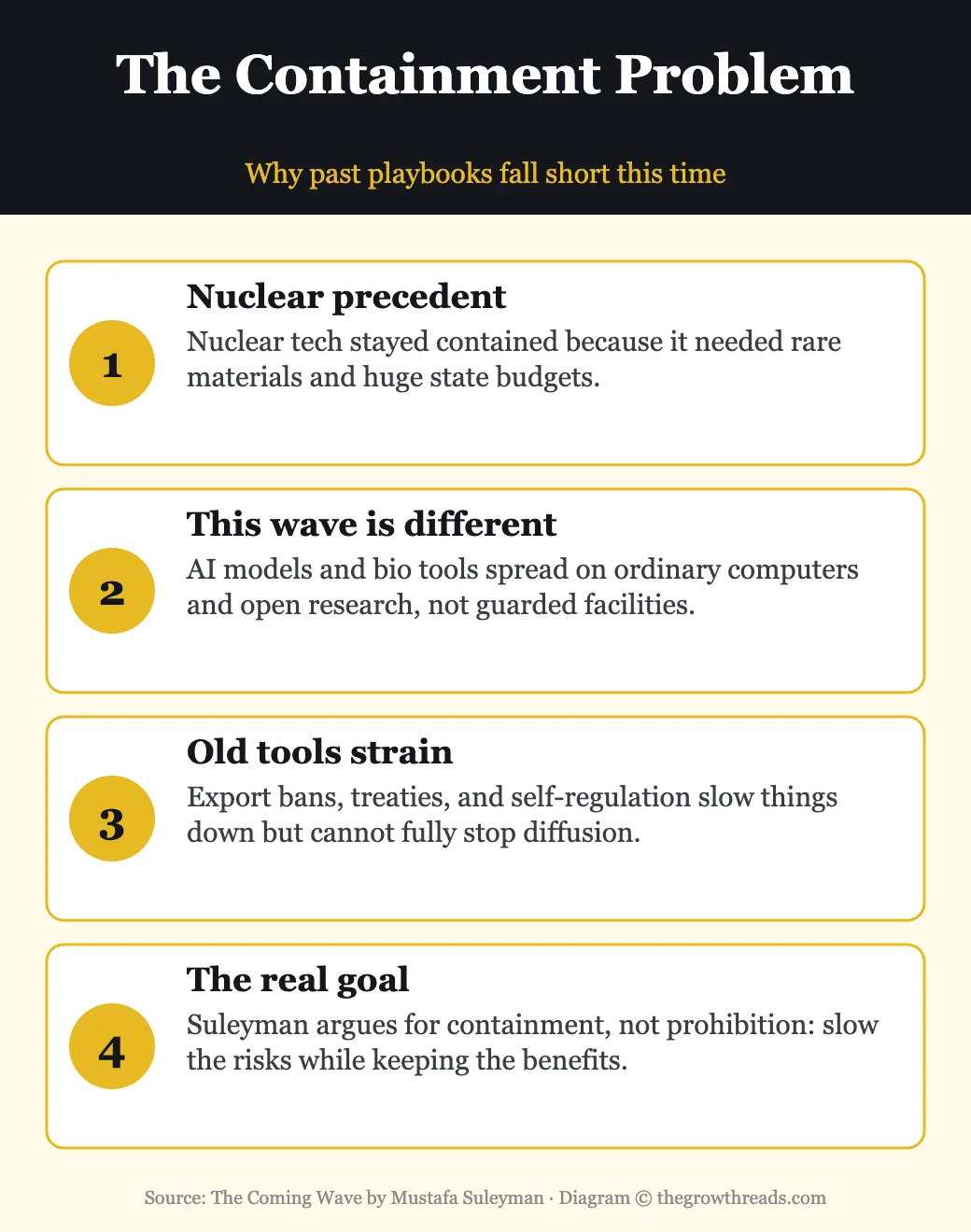
The book’s central argument is that we’ve solved this kind of problem before, but never quite like this. Nuclear weapons stayed contained for eighty years because building one requires rare materials, immense infrastructure, and a state-sized budget — natural choke points that make control possible.
AI and synthetic biology don’t have that luxury. A capable model can be trained with commodity chips and published research; a gene-editing kit can be ordered online. Suleyman is blunt that traditional tools — export controls, international treaties, voluntary self-regulation — will slow diffusion but cannot stop it. The goal has to shift from prevention to containment: shaping how the wave unfolds rather than pretending it can be stopped.
Part 3: The narrow corridor between chaos and control
If containment fails on the loose side, the risk is catastrophe — runaway systems, weaponized biology, or destabilized economies. But Suleyman is equally worried about the opposite failure: governments using the same surveillance and AI tools to lock in permanent, unaccountable control over their citizens.
He calls this the narrow corridor nation-states must walk: enough oversight to catch genuine threats, but not so much that containment itself becomes the disaster. This is why the book resists simple political labeling — it’s not a call for less government or more government, but for smarter, faster, more accountable government.
TGR Note: This tension between control and freedom shows up constantly in books about power and institutions. Our Innovator’s Dilemma summary covers a related dynamic at the company level — how the incentives that make an organization successful can also make it unable to respond to disruption, a smaller-scale version of the corridor Suleyman describes for entire states.
Part 4: Building containment in practice
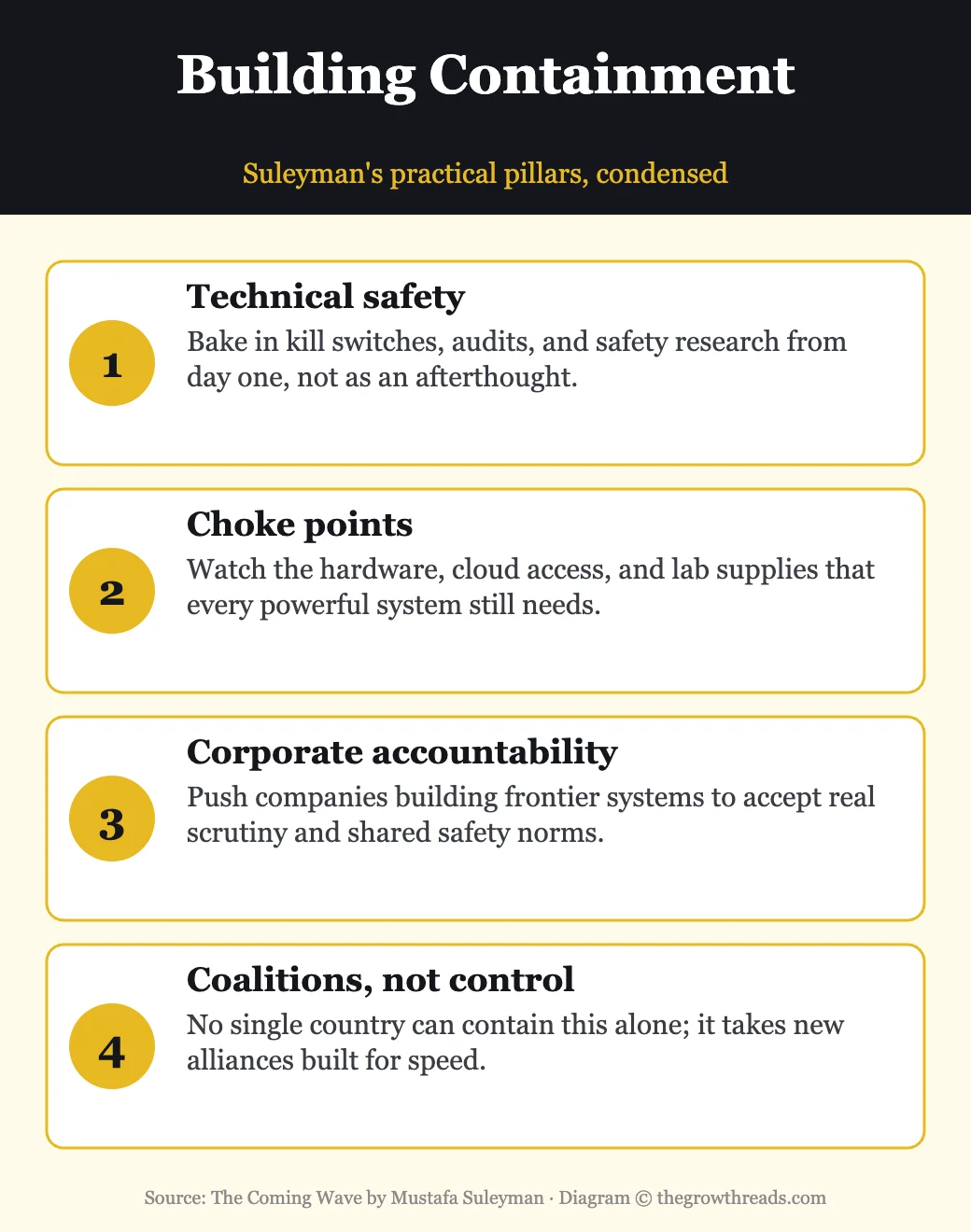
The most practical section of the book lays out where containment can actually take hold. Technical safety research — interpretability, red-teaming, built-in shutoffs — needs far more investment relative to capability research than it currently gets. Choke points like advanced chip manufacturing and frontier cloud compute remain genuine levers, at least for now, because so few facilities on Earth can produce them.
Suleyman also pushes hard on corporate accountability: the companies building frontier AI, his own included, should face real external audits rather than self-graded safety reports. And because no single country can contain a global technology alone, he argues for new, faster coalitions — modeled less on the UN Security Council and more on how central banks coordinate during a crisis.
TGR Note: Suleyman wrote much of this before generative AI’s public explosion accelerated even faster than he predicted — a reminder that hyper-evolution isn’t a metaphor. Later research on model auditing and safety evaluation has moved in the direction he calls for, though the accountability gap he describes is, if anything, wider today.
Who is The Coming Wave best for — and who should read something else first?
This book is best for people who want a serious, insider-level view of AI and biotech risk without wading into academic papers or partisan doom content. It’s especially useful for founders, policymakers, managers, and anyone who has to explain “why does AI risk matter” to a skeptical colleague.
If you want a more hands-on, personal guide to actually working with today’s AI tools day to day, start with our Co-Intelligence summary instead. If your interest is more about how disruptive technology reshapes companies and markets rather than society and governance, our Innovator’s Dilemma summary is the better entry point.
Questions to reflect on
- Which of the five features — cheap, general-purpose, hyper-evolutionary, asymmetric, autonomous — feels most present in the AI tools you already use at work?
- Where do you sit in Suleyman’s narrow corridor: do you worry more about too little oversight of AI, or too much control by governments and companies?
- What choke points exist in your own industry that could slow down a risky use of a new technology?
- If your company built a powerful AI system tomorrow, what accountability would you want in place before it shipped?
- What’s one small way you could push for more transparency from a company or tool you already use?
🔥 Ready to understand the wave that’s reshaping everything?
Get the full picture straight from someone who helped build it.
How to apply The Coming Wave (7-day plan)
- Day 1: List every AI tool you personally use in a normal week, and note which of the five wave features (cheap, general-purpose, fast-evolving, asymmetric, autonomous) applies to each.
- Day 2: Read up on one choke point — advanced chip manufacturing is a good start — and note who actually controls it today.
- Day 3: Look up your employer’s or industry’s AI policy, if one exists, and compare it against the accountability ideas in Part 4.
- Day 4: Pick one AI product you use regularly and read its safety or model card, if it publishes one.
- Day 5: Talk with a colleague or friend about where they sit in the narrow corridor — more worried about too little oversight, or too much.
- Day 6: Identify one place in your own work where autonomous AI decision-making is quietly increasing, and decide whether that needs more human checkpoints.
- Day 7: Write down one concrete way you’ll advocate for containment — a vote, a workplace policy suggestion, or simply a more informed conversation.
Frequently asked questions
What is the main argument of The Coming Wave?
Mustafa Suleyman argues that AI and synthetic biology form a single technological wave that is cheap, general-purpose, fast-evolving, asymmetric in its power, and increasingly autonomous. Because of these traits, the wave cannot be stopped through bans or prohibition. Instead, Suleyman argues for “containment” — a mix of technical safety work, corporate accountability, smarter and faster regulation, and new international coalitions designed to limit the worst outcomes while preserving the wave’s benefits. The book treats this as an urgent, multi-decade project rather than a problem with a single fix.
Who should read The Coming Wave?
The book is aimed at general readers who want a serious, non-academic understanding of AI and biotech risk, along with founders, managers, and policymakers who need a working mental model for these issues. It doesn’t assume a technical background, though some familiarity with current AI news helps. Readers looking for step-by-step personal productivity advice or a purely optimistic take on AI’s future may find the tone more sobering than they expect, though it stops well short of doom-mongering.
Is Mustafa Suleyman against AI development?
No. Suleyman has spent his career building AI systems, from DeepMind to Inflection AI to Microsoft AI, and the book is not an argument to stop or slow AI research. He explicitly rejects both blind techno-optimism and calls for a moratorium on AI development, arguing both are unrealistic. His position is that the wave is coming regardless, so the productive question is how to contain its risks while capturing its benefits, not whether to allow it to happen at all.
What does “containment” mean in The Coming Wave?
Containment is Suleyman’s term for managing a powerful technology’s risks without banning the technology itself, similar in spirit to how nuclear containment worked for decades, but adapted for tools that are far cheaper and harder to restrict. In practice, he describes it as a combination of technical safety research, choke points like chip manufacturing and cloud compute, corporate accountability through real external audits, and new, faster international coalitions built specifically to keep pace with the technology’s evolution.
How is The Coming Wave different from other AI books?
Unlike many AI books written by outside observers, journalists, or academics, The Coming Wave comes from someone who has built frontier AI systems firsthand as a co-founder of DeepMind and Inflection AI. That insider vantage point gives the book unusual specificity about how these systems actually get built and deployed. It also pairs AI with synthetic biology as part of one combined wave, a broader framing than most AI-only books attempt, co-written with technology writer Michael Bhaskar.
Does the book cover synthetic biology in depth?
Yes, though AI receives more overall attention. Suleyman treats synthetic biology as the wave’s other core pillar, pointing to falling gene-sequencing and gene-editing costs as evidence that biotechnology is following a similar cheap-and-fast-evolving trajectory to AI. The two technologies compound each other’s risks and opportunities, which is part of why he frames them as a single wave rather than two separate stories, rather than treating biotech as a brief afterthought.
Has anything in The Coming Wave already changed since it was published?
The book was published in 2023, and generative AI capability has moved quickly since then, with newer reasoning-focused models and agentic systems arriving faster than many expected. Some of the specific examples have dated, but the core framework — five defining features and the containment argument — has held up well and, if anything, looks more urgent given how much faster capability has advanced than most predictions, including some in the book itself.
Related summaries
- Co-Intelligence Summary & Review — a hands-on guide to working with today’s AI tools
- The Innovator’s Dilemma Summary & Review — why disruptive technology topples even well-run companies
- Browse all Technology book summaries
How we analyze books: we read the full text, cross-check key claims against the author’s public interviews and other research, and build practical application plans rather than just summarizing chapters. Read our full methodology.