

★★★★☆ 4.4/5 — A clear, practical field guide to working with AI, not a hype book or a doom book.
Best for: Knowledge workers, managers, and leaders who want concrete habits for using AI well, without needing a technical background.
Reading time: ~15 minutes for this summary · ~6 hours for the full book
Difficulty to apply: Easy to moderate — most of it starts with opening a chat window today
Co-Intelligence in one minute
AI is already good enough to change how you work today — the real skill is learning where it helps, where it doesn’t, and how to stay in charge either way. Ethan Mollick, a Wharton professor who has spent years testing AI tools in public, argues that most people are using AI far below its actual capability, not because they’re careless, but because nobody has handed them a usable mental model. Co-Intelligence gives you one: four simple rules for working with AI, two working styles for dividing the labor, and an honest look at where these systems reliably fail. It’s not a book about the future of AI. It’s a book about Tuesday afternoon.
Key takeaways
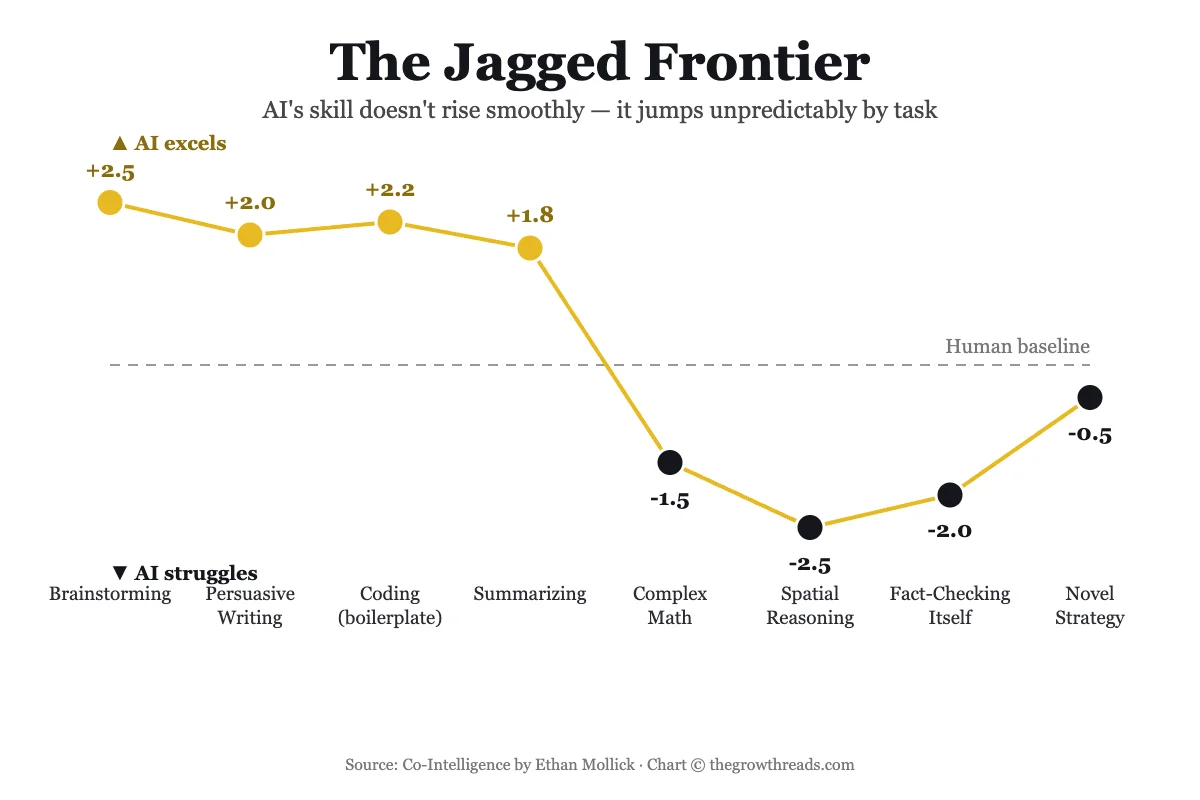
- AI ability is jagged, not smooth: it can outperform experts on some tasks and fail badly on others that look just as hard — the only way to know which is to test it.
- Rule 1 — Always invite AI to the table: try it on a task before assuming it can’t help; most people underuse AI rather than overuse it.
- Rule 2 — Be the human in the loop: AI can draft, suggest, and accelerate, but judgment, ethics, and final accountability stay with you.
- Rule 3 — Treat AI like a person, for now: giving it a role, context, and feedback — the way you’d brief a new hire — produces sharply better output.
- Rule 4 — Assume this is the worst AI you’ll ever use: capability is compounding quickly, so habits built now only get more valuable.
- Centaur mode splits work into separate human and AI parts; Cyborg mode blends the two so tightly the seams disappear — pick based on the task.
- AI works best as a thinking partner, not a replacement for expertise or an oracle to defer to blindly.
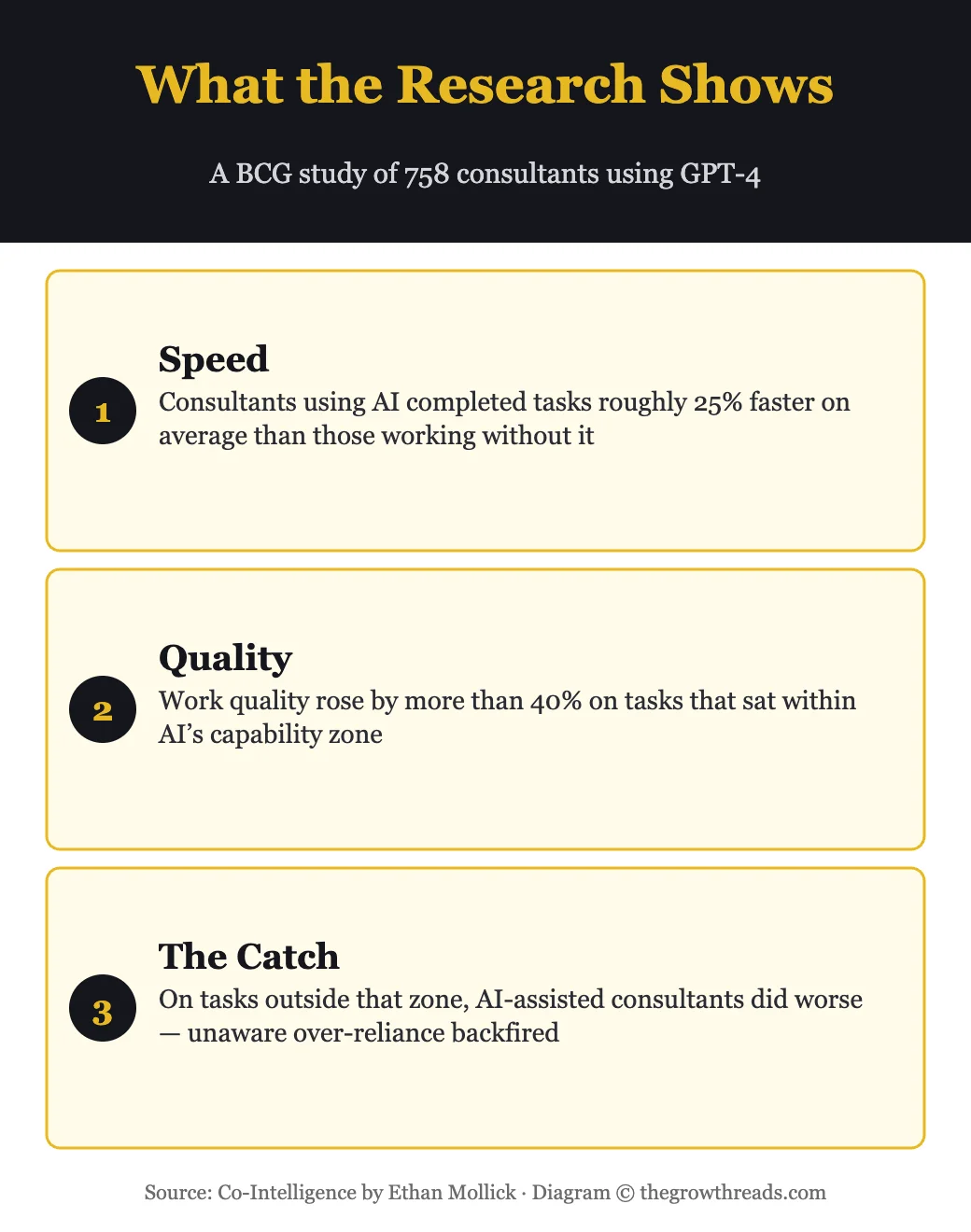
- Controlled studies back this up: consultants using AI on in-frontier tasks worked faster and produced measurably better work.
- The same studies found a catch: on tasks outside AI’s actual strengths, AI-assisted work quietly got worse — confidence outran competence.
- The people who benefit most experiment constantly rather than waiting for AI to become obviously trustworthy before trying it.
What is Co-Intelligence about?
Co-Intelligence is Wharton professor Ethan Mollick’s practical guide to working with AI day to day. Rather than forecasting the future or explaining the technology under the hood, it offers a simple framework — four rules and two working styles — for using tools like ChatGPT well right now, while staying clear-eyed about their real limits.
About the author
Ethan Mollick is a professor at the Wharton School at the University of Pennsylvania, where he studies entrepreneurship, innovation, and how people learn to use new technology. He co-directs Wharton’s Generative AI Labs and became one of the most followed voices on practical AI use through his newsletter, One Useful Thing, and a habit of testing AI tools in public — on his own coursework, business plans, and everyday tasks — rather than just theorizing about them. That hands-on approach shapes Co-Intelligence’s tone: it reads like notes from someone who actually uses the tools, not a futurist speculating from a distance. Mollick got early research access to GPT-4 before its public release, and has spent the years since studying how AI is reshaping work, teaching, and creative practice, publishing both academic research and accessible writing on the subject. Explore all Ethan Mollick book summaries →
Key concepts at a glance
| Concept | What it means | Use it when |
|---|---|---|
| Jagged Frontier | AI is unpredictably good or bad at different tasks | Before trusting AI on a new type of task — test it first |
| Centaur mode | You and AI split the task into separate, clearly owned parts | Complex, multi-step work where you want clear control |
| Cyborg mode | You and AI blend output so tightly the seams disappear | Fast, iterative work like brainstorming or line editing |
| Four Rules | Invite it in, stay human-in-the-loop, treat it like a person, assume it’s the worst you’ll use | As a general operating framework for any AI use |
| Hallucination | AI can state wrong information with total confidence | Always verify facts, numbers, and citations before using them |
| Homework apocalypse | AI can now complete most standard school assignments | Rethinking how learning is taught and assessed |
| Persona prompting | Assigning AI a role or expertise sharpens its output | Whenever you want sharper, more specific responses |
Part 1: Meet Your Co-Intelligence
Mollick opens with a simple but disorienting observation: large language models already outperform most people on a surprising range of tasks — writing, brainstorming, summarizing, even certain kinds of analysis — while remaining unreliable at things that seem, on the surface, much simpler. He calls this uneven capability the “jagged frontier.” Unlike earlier software, which was reliably good or reliably bad at a fixed set of tasks, AI’s abilities don’t map onto human intuitions about difficulty. It might nail a complex strategy memo and then miscount the words in a sentence. The only way to find the edge of that frontier for a given task, Mollick argues, is to actually test it — repeatedly, with real work, not toy examples. This matters because most people’s mental model of AI is either too generous, treating it as a reliable expert, or too dismissive, writing it off after one bad answer. Both miss the actual shape of the tool. Mollick draws on his own experiments — using AI to help write academic papers, redesign his courses, and run mock negotiations with MBA students — to show what exploring that frontier looks like in practice: fast, iterative, and a little undignified, since it means being wrong about AI’s limits fairly often before you learn where they actually sit.
Part 2: The Four Rules
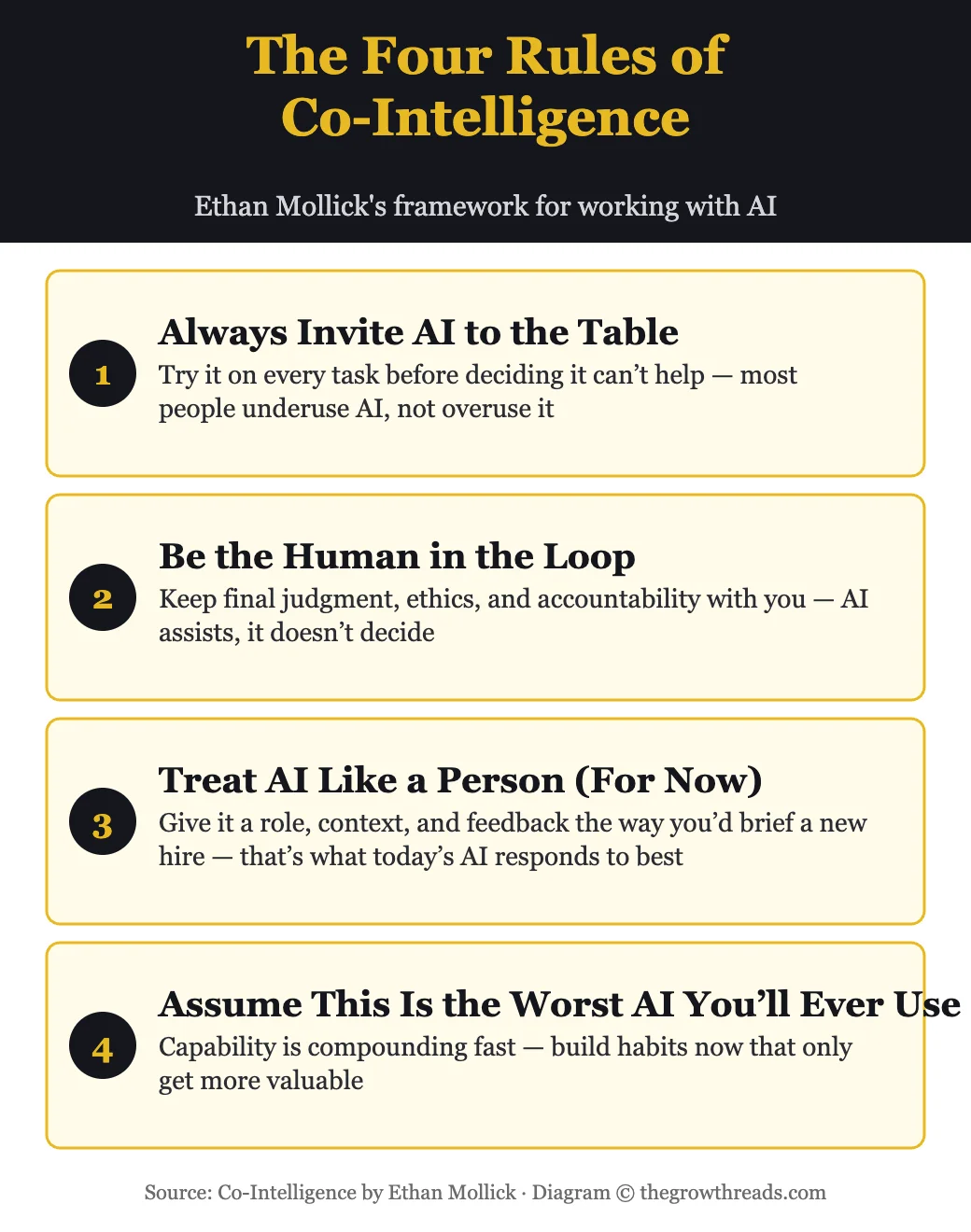
The four rules are less a checklist than a stance. The first, always invite AI to the table, pushes back against a habit Mollick sees constantly: people deciding in advance that AI can’t help with their specific, specialized work, without ever testing that assumption. He suggests treating every new task as an open question rather than a foregone conclusion. The second rule, be the human in the loop, is a guardrail against the opposite failure — outsourcing judgment along with the labor. AI can draft a performance review, but the decision about what’s true and fair in it is still yours. The third rule, treat AI like a person, for now, is more practical than philosophical: today’s models respond noticeably better to the kind of context, role, and feedback you’d give a new employee than to terse, robotic commands. Mollick isn’t arguing AI is conscious; he’s arguing that persona-based prompting is, empirically, what gets better results out of current systems. The fourth rule, assume this is the worst AI you’ll ever use, is a reminder about trajectory rather than a claim about any one model. Capability has moved fast enough, generation over generation, that skills built around today’s limitations will likely transfer forward even as the tools improve, while habits built around dismissing AI entirely will not.
TGR Note: Rule three overlaps with an idea from Atomic Habits: specificity changes outcomes. James Clear argues vague goals produce vague results; Mollick’s version is that vague prompts produce vague AI output. Treating a request to AI as seriously as a delegation to a real colleague — with context, constraints, and a clear ask — is the fastest way to raise the quality of what comes back.
Part 3: Two Ways to Work Together: Centaur and Cyborg
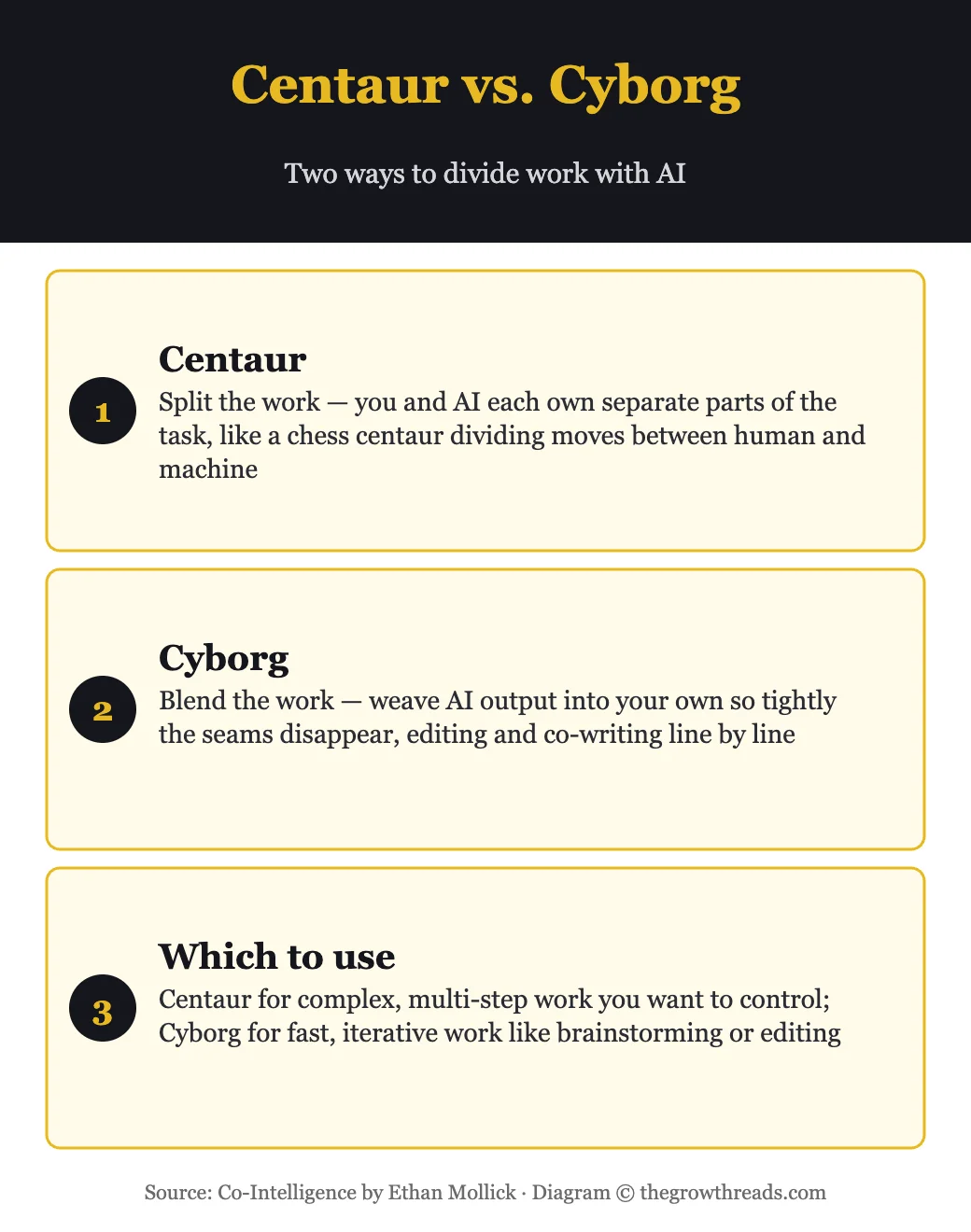
Mollick borrows the term “centaur” from chess, where human-AI teams once outperformed either humans or AI alone by dividing labor along clear lines — the human handling strategy, the engine handling tactics. In a centaur workflow, you and the AI each own separate, well-defined parts of a task: maybe you outline an argument and AI drafts supporting research, or you handle a client relationship while AI handles first-pass data analysis. The division is clean, which makes it easier to check the AI’s work and stay accountable for your part. The alternative, which Mollick calls “cyborg” work, is far more blended: you and the AI trade sentences, edits, and ideas back and forth so quickly that it’s hard to say afterward who wrote what. This suits fast, iterative work — brainstorming, editing a rough draft, exploring an idea from multiple angles — where the goal is momentum rather than a clean division of labor. Neither mode is superior; they suit different kinds of work. The practical guidance is to notice, task by task, whether you want a clear seam between your contribution and the AI’s, or a fully merged process, and to pick deliberately rather than falling into whichever mode is most habitual.
TGR Note: The centaur/cyborg distinction is a close cousin of the deep-work-versus-shallow-work split many productivity books draw — see Peak Performance for a related take on matching your mode of work to the task at hand rather than defaulting to one style for everything.
Part 4: The Real Risks: Hallucination, Homogenization, and the Homework Apocalypse
Mollick doesn’t soften the downsides. The most immediate is hallucination: AI systems generate false information — invented citations, wrong statistics, confidently misremembered facts — with exactly the same fluent tone they use for correct information, which makes errors hard to catch without independent verification. He treats this as a lasting feature of current models rather than a bug that will simply get patched away, and argues the discipline of checking AI output has to become as automatic as checking a source. A second risk is homogenization: because millions of people are prompting similar models in similar ways, AI-assisted work risks converging toward a flattened sameness — competent, polished, and a little generic — unless users deliberately push for distinctiveness. The third, and the one Mollick spends the most time on, is what he calls the “homework apocalypse”: AI can now complete most standard school assignments competently enough that traditional take-home work no longer reliably measures what a student has actually learned. He extends this beyond classrooms to any organization that evaluates people by the output they produce rather than the judgment behind it — a distinction AI is quietly making harder to verify. None of this leads Mollick to caution against using AI; it leads him to argue for using it more deliberately, with verification built in as a habit rather than an afterthought.
TGR Note: The verification habit Mollick describes pairs well with the reflective questioning in Turning Pro — both books argue that the discipline separating amateurs from professionals is less about talent and more about the checks you run on your own work before calling it finished.
Who is Co-Intelligence best for — and who should read something else first?
This book is best for people who already use AI occasionally and want a sharper, more deliberate approach — managers, consultants, writers, educators, and knowledge workers of almost any kind who want concrete habits rather than either hype or dismissal. It assumes no technical background and stays almost entirely away from how the models work internally. If you’re looking for a hands-on technical guide to prompting or building with AI, this isn’t that book; it’s closer to a field guide for daily use. If you’ve never used a chatbot at all, you’ll get more from Co-Intelligence after spending a week experimenting first, so the examples land against real experience. Readers who want a broader look at building better habits before adding AI into the mix might start with Atomic Habits, since several of Mollick’s rules are really habit-formation advice aimed at a new kind of tool.
Questions to reflect on
- Which task on your plate this week have you never actually tried handing to AI — and what’s the worst that happens if you test it?
- Are you currently working with AI in centaur mode, cyborg mode, or no clear mode at all?
- What’s one piece of AI output you accepted recently without independently verifying it?
- If today’s AI is “the worst you’ll ever use,” what habit would be worth building now, even if it feels premature?
- Where in your work might AI-assisted output be quietly converging toward sameness rather than standing out?
🔥 Ready to get better at working with AI?
Co-Intelligence gives you a framework you can start using in your next chat window.
How to apply Co-Intelligence (7-day plan)
- Day 1: Pick one task you’ve assumed AI can’t help with, and actually try it — save the output even if it’s bad.
- Day 2: Rewrite one AI prompt as a briefing you’d give a new hire: role, context, constraints, and what “good” looks like.
- Day 3: Run one task in centaur mode — split the work into a part you own and a part AI owns — and compare it to your usual approach.
- Day 4: Run one task in cyborg mode — trade drafts back and forth in one continuous session — on something like brainstorming or editing.
- Day 5: Deliberately try to catch AI in a hallucination: ask it for a specific statistic or citation, then verify it independently.
- Day 6: Notice one piece of AI-assisted work that feels generic, and push it toward something more distinctive — a stronger opinion, a sharper example.
- Day 7: Write down your own version of the four rules, adjusted for your actual job, and keep it somewhere you’ll see it.
Frequently asked questions
What is the main idea of Co-Intelligence?
The main idea is that AI is already capable enough to meaningfully improve everyday work, but only if people learn to use it deliberately. Ethan Mollick offers four rules — invite AI in, stay the human in the loop, treat it like a person for now, and assume it will only get better — plus two working styles, centaur and cyborg, for dividing labor with AI. The book focuses on practical habits rather than technical explanation or long-range forecasting.
Is Co-Intelligence good for beginners with no AI experience?
Yes, with one caveat: the book assumes almost no technical background, but its examples land better once you’ve spent some time actually using a chatbot. Complete beginners will get more out of it by spending a week experimenting with a free AI tool first, then returning to Mollick’s framework to make sense of what they noticed. It’s written for a general audience, not developers.
What does Ethan Mollick mean by the “jagged frontier”?
The jagged frontier describes how AI’s abilities don’t map onto human intuitions about task difficulty. A model might handle a complex writing task well and then fail at something that looks much simpler, like precise counting or strict logical consistency. Mollick argues the only reliable way to find that frontier for your own work is to test AI directly on real tasks, rather than assuming its limits in advance.
What’s the difference between centaur and cyborg ways of working with AI?
Centaur work divides a task into separate, clearly owned parts — you handle one piece, AI handles another — which keeps the division easy to check. Cyborg work blends human and AI contributions so tightly that it’s hard to tell afterward who produced what, which suits fast, iterative tasks like brainstorming or editing. Mollick recommends choosing deliberately based on the task rather than defaulting to one style.
Does Co-Intelligence cover the risks of AI, or just the benefits?
Both. Mollick spends real time on hallucination, homogenization — AI-assisted work converging toward sameness — and what he calls the “homework apocalypse,” AI’s ability to complete standard assignments well enough to undermine how schools and workplaces measure competence. He treats these as reasons to use AI more deliberately, with verification built in, not reasons to avoid it.
How is Co-Intelligence different from other AI books?
Most AI books either forecast the technology’s future or explain how the models work technically. Co-Intelligence does neither; it’s a practical, present-tense guide to using AI tools well right now, written by someone who tests them constantly rather than theorizing from a distance. That hands-on, example-driven approach is closer to a field guide than a work of futurism or a technical manual.
Is Co-Intelligence still relevant given how fast AI changes?
Largely yes, because the book’s core advice — test rather than assume, keep a human in the loop, verify outputs, and expect rapid improvement — is built to age well precisely because it doesn’t depend on any single model’s specific capabilities. Mollick’s fourth rule, assuming today’s AI is the worst you’ll ever use, is itself a hedge against obsolescence: the habits matter more than the snapshot of technology that inspired them.
Related summaries
If you found Co-Intelligence useful, these summaries pair well with it: Atomic Habits for building the habits that make new tools stick, Peak Performance for matching your mode of work to the task at hand, and Turning Pro for the verification discipline that separates careful work from careless work. For more on thinking clearly about new technology, visit the Technology hub.
How we analyze books: every summary on The Growth Reads is built from a close, structured read of the source material — key arguments, supporting evidence, and practical applications — cross-checked against the author’s other published writing where relevant. We rate books on lasting impact, evidence quality, practical application, writing quality, and external consensus. Read our full methodology.