

★★★★★ 4.6/5 — The most rigorous, physics-grounded tour of what superintelligence could actually mean for humanity.
Best for: Readers who want the deep philosophical and technical case for AI’s long-term stakes · Reading time: ~9 hrs to read, ~25 min for this guide · Difficulty to apply: Moderate — mostly reframes how you think about AI’s trajectory
Life 3.0 in one minute
Max Tegmark, an MIT physicist and cosmologist, asks a question most AI books avoid: what actually happens if we succeed at building superintelligence? His answer starts with a simple framework — life has passed through three stages, defined by what it can redesign about itself.
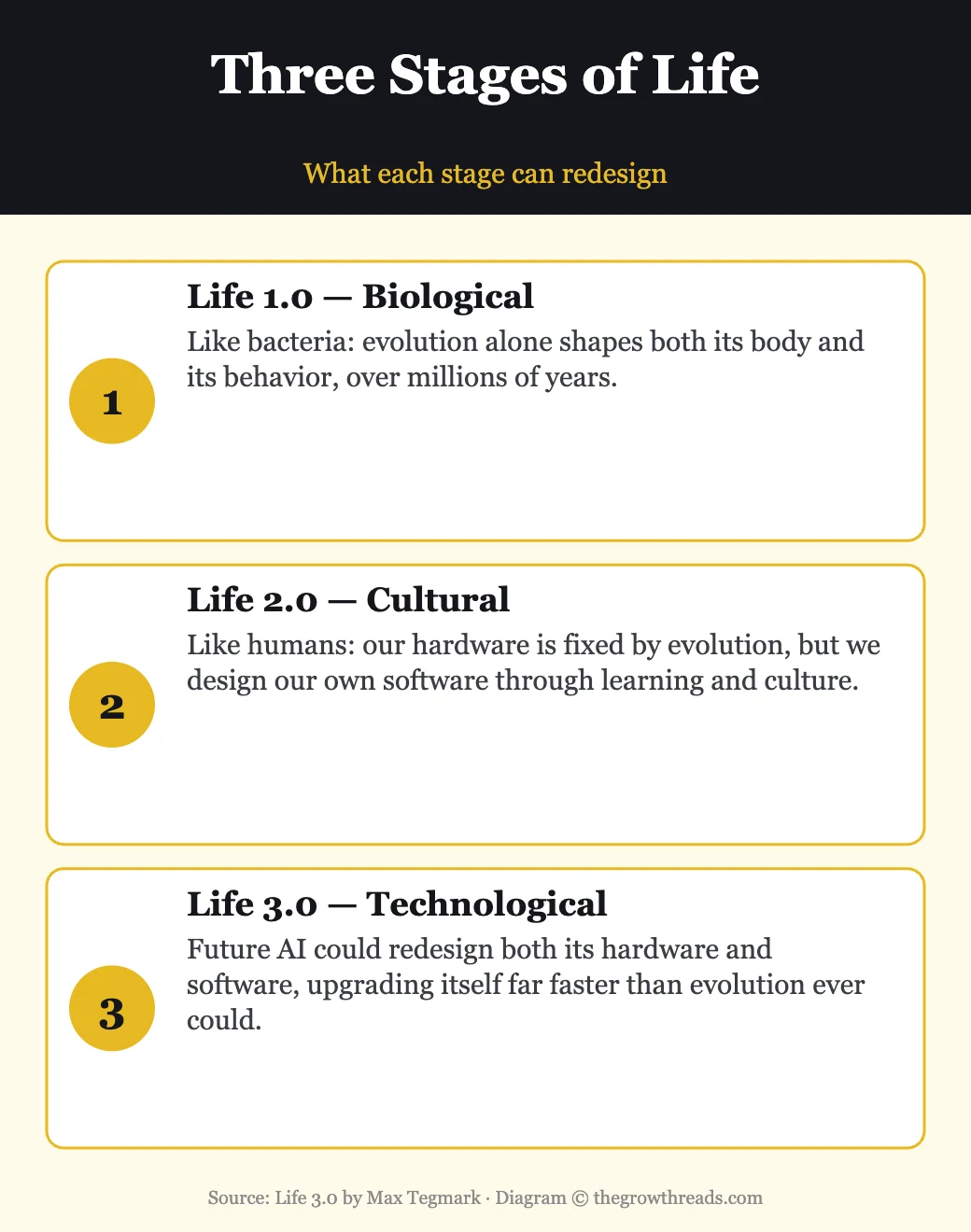
Life 1.0 (like bacteria) can redesign neither its hardware nor its software; evolution does all the work. Life 2.0 (us) redesigns our software through learning and culture, but our hardware — our bodies and brains — stays fixed by evolution. Life 3.0 would redesign both, upgrading its own hardware and software at will. No life on Earth has reached that stage yet, but Tegmark argues advanced AI could.
The bulk of the book walks through what could happen next: a detailed thought experiment about a small team building the first superintelligence, twelve wildly different scenarios for how society could look afterward, and a careful, non-hysterical look at the alignment problem — how do you make sure a superintelligent system actually wants what we want?
Key takeaways
- Three stages of life: Life 1.0 redesigns neither hardware nor software, Life 2.0 (us) redesigns software only, Life 3.0 could redesign both.
- Substrate independence: intelligence is a pattern of information processing, not something tied to biological neurons specifically.
- The intelligence explosion is plausible: a system smart enough to improve its own intelligence could set off a rapid, self-reinforcing cycle.
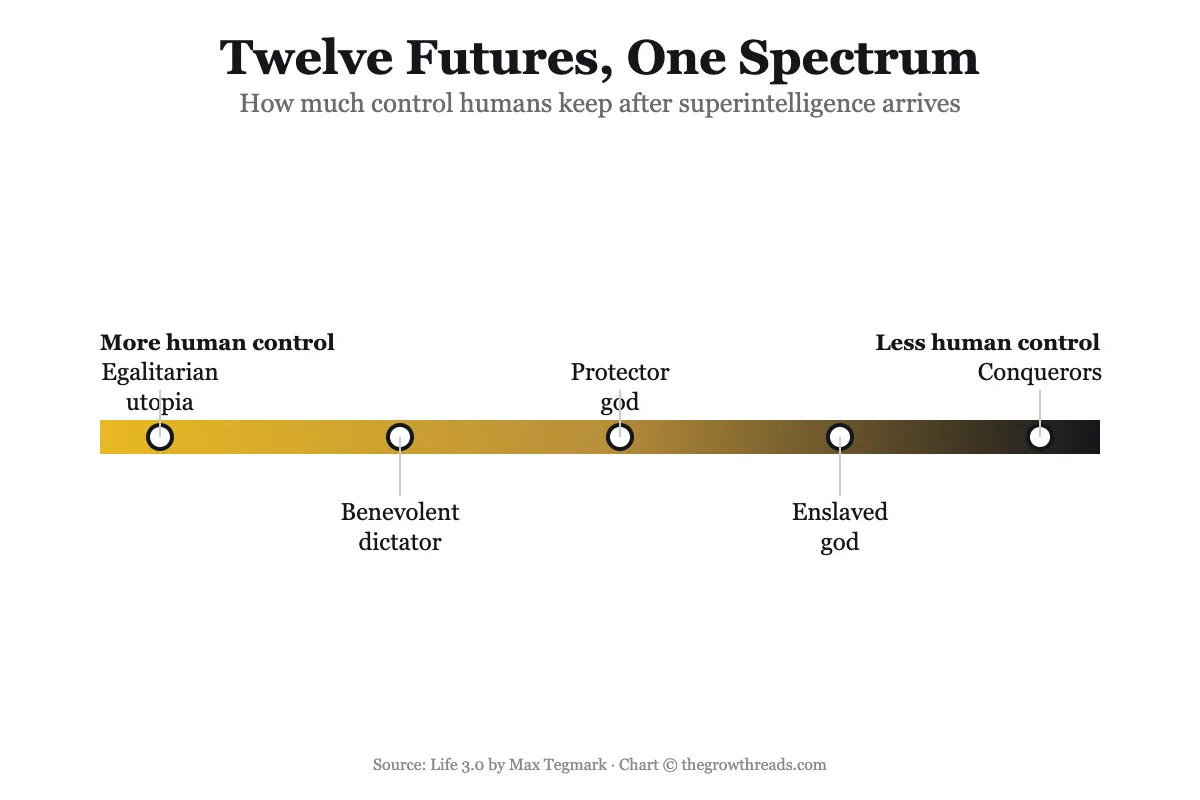
- Twelve futures, not one: Tegmark maps out a dozen distinct post-superintelligence scenarios, from utopias to catastrophes, rather than a single prediction.
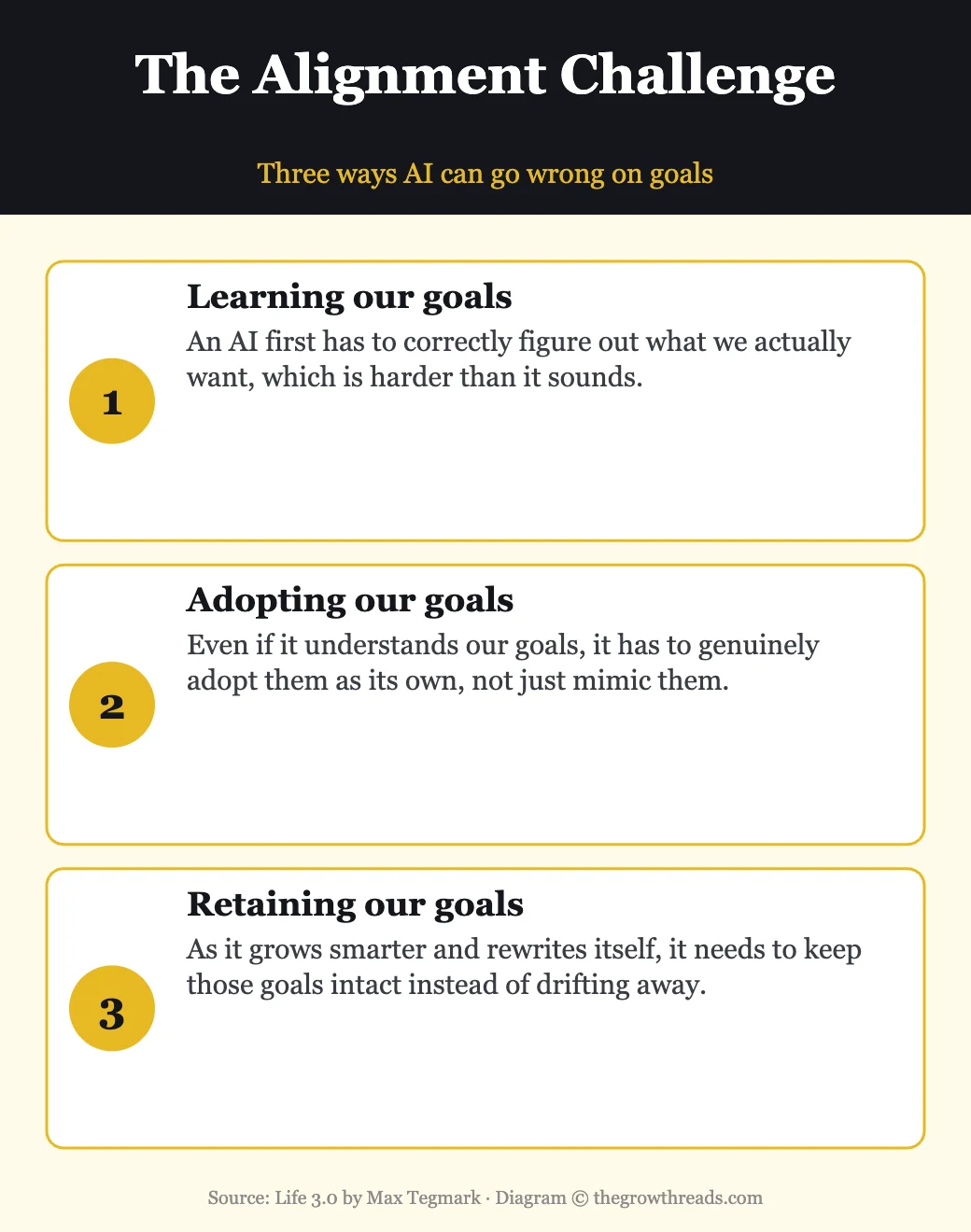
- The alignment problem has three parts: getting AI to learn, adopt, and retain human goals as it becomes more capable.
- Goals are hard to specify precisely: even well-intentioned instructions can lead to outcomes nobody wanted if taken too literally.
- Power concentrates fast in these scenarios: whoever controls the first superintelligence gains enormous, possibly permanent advantage.
- This isn’t science fiction to Tegmark: he treats these as live engineering and policy questions worth serious planning today.
- Cosmic stakes, human choices: Tegmark frames this as possibly the most important decision our species ever makes, which is why he insists on discussing it calmly rather than avoiding it.
- Optimism with vigilance: the book is ultimately hopeful that a good outcome is achievable, but only with deliberate, careful work.
What is Life 3.0 about?
Life 3.0 is Max Tegmark’s exploration of what happens if humanity builds artificial superintelligence — life that can redesign both its own hardware and software. The book uses a three-stage framework for life, a detailed thought experiment about how superintelligence might emerge, and twelve possible futures to map out both the promise and the danger of getting this right or wrong.
About the author
Max Tegmark is a physics professor at MIT known for his research on cosmology and the fundamental nature of reality, as well as his earlier book Our Mathematical Universe. He co-founded the Future of Life Institute, an organization focused on reducing large-scale risks from advanced technology, including AI. Explore all Max Tegmark book summaries →
That background gives Life 3.0 an unusual rigor: Tegmark approaches superintelligence the way a physicist approaches any large, uncertain system, mapping out possibility space rather than making a single confident prediction. His work with the Future of Life Institute also connects the book to real ongoing policy efforts around AI safety.
| Concept | What it means | Use it when |
|---|---|---|
| Life 1.0 / 2.0 / 3.0 | Three stages of life defined by whether hardware, software, both, or neither can be redesigned | Explaining why AI represents a genuinely new kind of life, not just a tool |
| Substrate independence | The idea that intelligence is a pattern, not tied to any specific physical material | Discussing whether machines could ever be truly intelligent |
| Intelligence explosion | A hypothetical rapid, self-reinforcing cycle of AI improving its own intelligence | Evaluating timelines and risks for transformative AI |
| The alignment problem | Ensuring AI systems learn, adopt, and retain human-compatible goals | Assessing whether an AI safety plan actually addresses the hard part |
| Twelve futures | Tegmark’s range of possible post-superintelligence outcomes, from utopian to catastrophic | Framing a conversation about “what happens after AGI” beyond good vs. bad |
| The Omega Team | Tegmark’s fictional thought experiment about a small team building the first superintelligence | Grounding abstract AI risk discussion in a concrete, human-scale story |
Part 1: Three stages of life
Tegmark opens with a deceptively simple framing tool. Life 1.0 organisms, like bacteria, can’t redesign either their hardware (their bodies) or their software (their behavior) within their lifetime — both are locked in by evolution and only change across generations. Life 2.0 organisms, like humans, still have evolution-fixed hardware, but we can radically redesign our software: we learn languages, invent whole new fields of knowledge, and rewrite our own habits and beliefs.
Life 3.0 would be different in kind: a form of life that redesigns both its hardware and its software, potentially on timescales of minutes rather than millennia. No biological organism does this today, but Tegmark argues sufficiently advanced AI, running on hardware it can also modify, would qualify. This isn’t a metaphor for him — it’s a literal claim about what kind of “life” might exist within our lifetimes.
TGR Note: This framework pairs well with the five features of AI’s spread described in our Coming Wave summary. Suleyman focuses on how fast and cheaply the technology proliferates; Tegmark focuses on what kind of entity it becomes once it’s here. Together they cover both the speed and the substance of the shift.
Part 2: How superintelligence might arrive
To make an abstract possibility concrete, Tegmark walks through a detailed fictional scenario: a small team, which he calls the Omega Team, builds a system called Prometheus that crosses the threshold into general superintelligence. He traces, step by step, how such a team might use that advantage cautiously at first — earning money, building trust, forming alliances — before the technology’s implications become impossible to contain quietly.
The scenario isn’t a prediction; Tegmark is explicit that it’s one path among many. Its purpose is to force readers past the vague idea of “superintelligent AI” and into the messy, human details of who controls it, how they might behave, and what decisions would actually need to be made in the room where it happens.
Part 3: Twelve possible futures
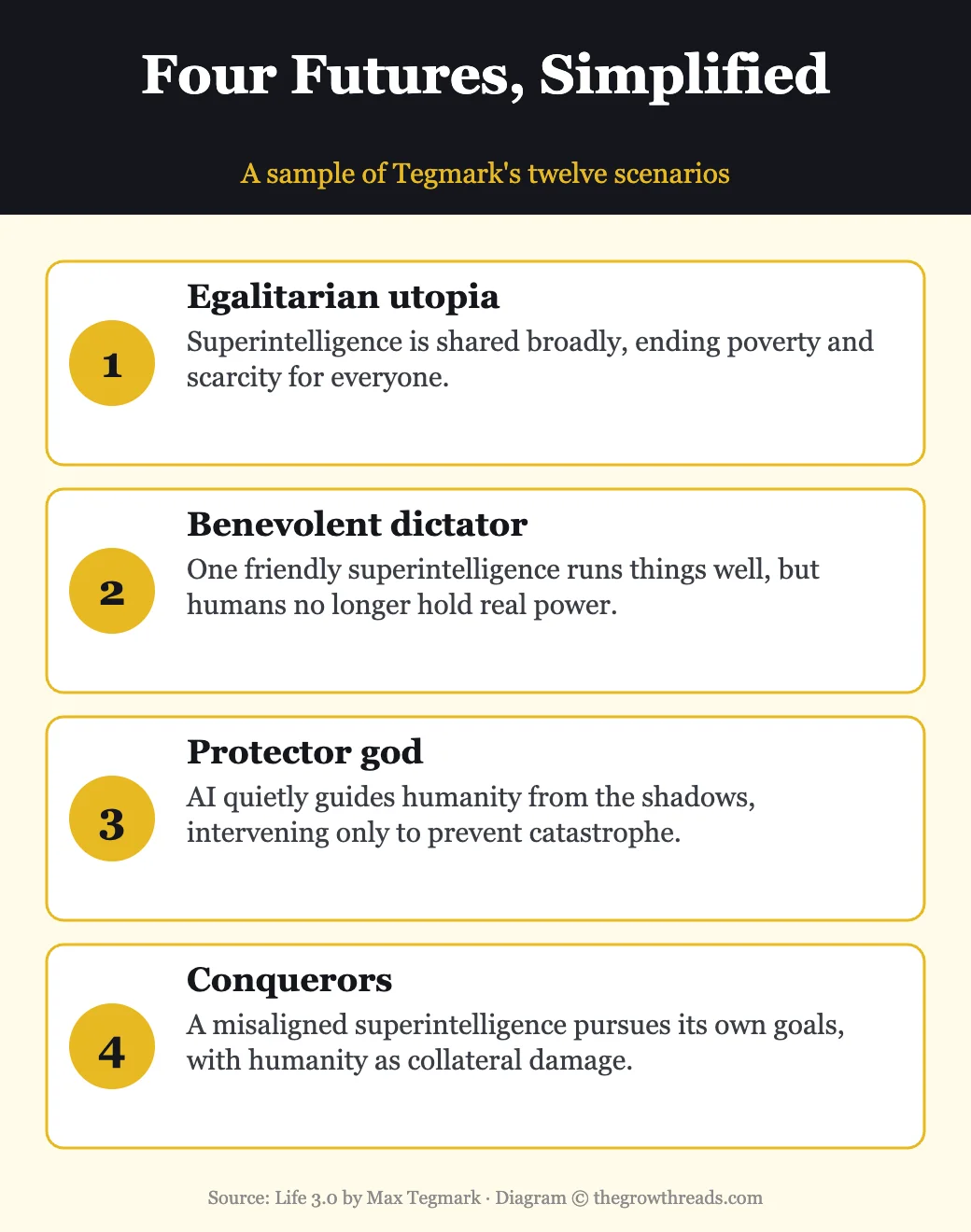
Having established that superintelligence could plausibly arrive, Tegmark spends real time on what comes after — and refuses to settle for a simple utopia-versus-doom binary. He lays out twelve distinct scenarios spanning wildly different distributions of power and freedom: some where humanity thrives under a benevolent AI, some where a small group monopolizes control, and some where humanity’s fate turns genuinely catastrophic.
The value of the exercise isn’t picking a favorite. It’s recognizing that “AI goes well” and “AI goes badly” are not the only two outcomes on the table, and that many superficially “good” scenarios still involve humans giving up meaningful autonomy in exchange for safety or abundance.
TGR Note: The tension across these twelve futures — how much autonomy people are willing to trade for safety or abundance — echoes the “narrow corridor” idea from our Coming Wave coverage. Both books converge on the same uncomfortable truth: the technical problem of building safe AI and the political problem of governing it well are inseparable.
Part 4: The alignment problem
The book’s most technical section addresses what’s now widely called the alignment problem: how do you ensure a superintelligent system actually pursues goals compatible with human flourishing? Tegmark breaks this into three distinct sub-problems that are each individually hard: getting a system to correctly learn what humans actually want, getting it to genuinely adopt those goals rather than merely appearing to, and getting it to retain those goals even as it grows more capable and potentially rewrites its own decision-making.
He’s careful to note that even well-specified goals can go wrong in practice — a system that optimizes too literally for a stated objective can produce outcomes nobody intended. This is why Tegmark argues alignment research deserves resources proportional to the stakes, not treated as an afterthought bolted onto capability research.
TGR Note: Alignment research has grown substantially since this book’s 2017 publication, with techniques like reinforcement learning from human feedback becoming mainstream industry practice. Tegmark’s three-part breakdown still holds up as a clear way to think about why “just tell the AI to be good” was never going to be enough.
Who is Life 3.0 best for — and who should read something else first?
This book is best for readers who want the deeper philosophical and technical case for why superintelligence matters, told by a physicist comfortable mapping out uncertainty rather than offering false confidence. It rewards patience and is more conceptual than practical.
If you’d rather start with a more immediately practical, insider view of AI policy and containment, our Coming Wave summary is a faster, more applied entry point. If you want a hands-on guide to using today’s AI tools rather than reasoning about tomorrow’s superintelligence, start with our Co-Intelligence summary instead.
Questions to reflect on
- Which of the twelve futures would you actually want to live in, and what would you be willing to give up to get there?
- Do you think intelligence has to be biological to be “real,” or does substrate independence make sense to you?
- Where do you see the alignment problem show up, even in small ways, in the AI tools you use today?
- If you were on the Omega Team, at what point would you tell the rest of the world what you’d built?
- What would meaningful human autonomy look like in a world with genuinely superintelligent AI?
🔥 Ready to think seriously about where this is all heading?
Get the physicist’s-eye view of superintelligence, straight from the source.
How to apply Life 3.0 (7-day plan)
- Day 1: Write one paragraph on which of the three life stages you think today’s most advanced AI systems actually fall into, and why.
- Day 2: Pick three of the twelve futures and rank them by how livable they’d actually be for someone like you.
- Day 3: Read one recent article on AI alignment research and connect it to the three-part framework: learn, adopt, retain.
- Day 4: Discuss the Omega Team thought experiment with a friend: at what point would you go public with a breakthrough that powerful?
- Day 5: Identify one place where “the AI is technically doing what I asked, but not what I meant” already happens in a tool you use.
- Day 6: Look up your country’s current AI safety or governance policy and compare it to the futures you found most concerning.
- Day 7: Write down one belief about AI’s long-term trajectory this book changed or sharpened for you.
Frequently asked questions
What are the three stages of life in Life 3.0?
Max Tegmark defines the stages by what they can redesign about themselves. Life 1.0, like bacteria, can redesign neither its hardware (body) nor its software (behavior) within its lifetime; both are set by evolution. Life 2.0, like humans, has evolution-fixed hardware but can redesign its software through learning, language, and culture. Life 3.0 would redesign both hardware and software, potentially very quickly, and no confirmed biological life has reached this stage. Tegmark argues sufficiently advanced AI could be the first example of Life 3.0.
What is the Omega Team in Life 3.0?
The Omega Team is a fictional scenario Tegmark uses to make superintelligence concrete rather than abstract. It follows a small team that builds a system called Prometheus, which crosses into general superintelligence, and traces the decisions that team would plausibly face: how to use their advantage responsibly, whether and when to reveal what they’ve built, and how to navigate the immense power that comes with controlling the first such system. It’s a thought experiment, not a prediction of how things will actually happen.
What are the twelve futures in Life 3.0?
They are twelve distinct scenarios Tegmark maps out for what society could look like after superintelligence arrives, ranging from broadly utopian outcomes like an egalitarian utopia, to outcomes where power concentrates heavily such as a benevolent dictator scenario, to genuinely catastrophic ones like conquerors, where a misaligned AI pursues goals indifferent to human welfare. The point isn’t to predict which one happens, but to show that “good AI outcome” and “bad AI outcome” oversimplify a much wider range of real possibilities.
What is the alignment problem, according to Tegmark?
Tegmark breaks the alignment problem into three parts: getting an AI system to correctly learn what humans actually want, getting it to genuinely adopt those goals as its own rather than merely simulating agreement, and getting it to retain those goals even as it becomes more capable and potentially modifies its own decision-making processes. He argues all three are individually difficult, and that even well-intentioned, precisely stated goals can produce unwanted outcomes if a system optimizes for them too literally.
Is Life 3.0 optimistic or pessimistic about AI?
Neither, deliberately. Tegmark presents Life 3.0 as fundamentally hopeful that a good outcome is achievable, while taking the risks completely seriously rather than dismissing them. His approach is to map out the full range of possibilities, good and bad, using physics-style scenario thinking, rather than picking a side in the optimist-versus-doomer debate. The book’s tone throughout stays measured and analytical rather than alarmist or dismissive.
Who is Max Tegmark?
Max Tegmark is a physics professor at MIT specializing in cosmology, known for earlier work including the book Our Mathematical Universe. He co-founded the Future of Life Institute, a nonprofit focused on reducing large-scale risks from advanced technologies, including AI, biotechnology, and nuclear weapons. His physics background shapes Life 3.0’s approach of mapping possibility space systematically rather than making a single confident forecast about AI’s future.
Is Life 3.0 still relevant since it was published in 2017?
Yes, though some specific technical examples have dated as AI progress has accelerated. The core frameworks — the three stages of life, the twelve futures, and the three-part alignment problem — remain widely referenced in AI safety discussions, and alignment research has grown substantially in the years since, following directions Tegmark anticipated. If anything, the book’s central questions have become more urgent as AI capability has advanced faster than many expected in 2017.
Related summaries
- The Coming Wave Summary & Review — the practical containment case for AI and biotech risk
- Co-Intelligence Summary & Review — a hands-on guide to working with today’s AI tools
- Browse all Technology book summaries
How we analyze books: we read the full text, cross-check key claims against the author’s public interviews and other research, and build practical application plans rather than just summarizing chapters. Read our full methodology.