

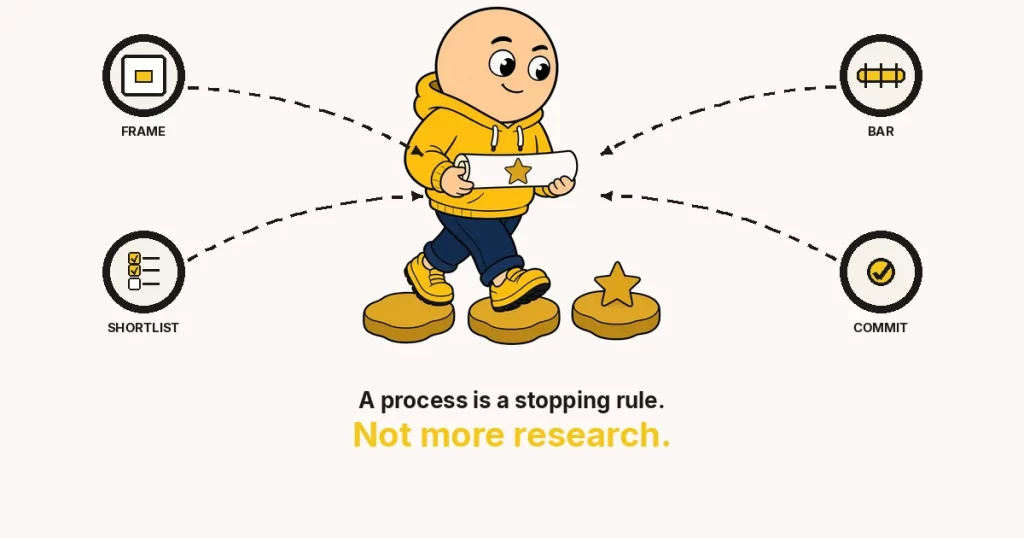
A decision-making process is a named sequence with a stopping rule: frame the call, set a good-enough bar, compare a short list, then commit and review. It is not more research or a freeze. The textbook cascade fails when options sprawl; satisficing and working backwards start from an end-state instead of every option.
Key takeaways
- Herbert Simon (1955) showed that real decision makers satisfice: they search until an option clears an aspiration level, rather than computing a global best.
- Iyengar and Lepper (2000) found people more often bought jam — and later liked the choice more — from six flavours than from twenty-four.
- Scheibehenne, Greifeneder and Todd (2010) found a mean choice-overload effect near zero across 50 experiments, so more options are not automatically worse.
- Iyengar, Wells and Schwartz (2006) found maximizers won about 20% higher starting salaries and still liked the jobs less than satisficers.
- Gigerenzer and Goldstein (1996) showed a one-reason “Take The Best” rule matching or beating multiple regression on inference speed and accuracy in simulation.
What the decision-making process actually is
A decision-making process is a sequence that is allowed to end. You name the call, write a bar for “good enough” before you look, compare a short list, commit, and put a date on the review. The sequence is the mechanism. Diligence without a stop is not a process — it is research that has taken the job.
Most school and workplace posters still sell one cascade: identify the problem, gather information, generate alternatives, weigh them, choose, act, review. That ladder is a useful map of what a complete analysis would contain. It is a poor description of how people actually decide under limited time, limited knowledge, and a list that can grow forever. Herbert Simon’s 1955 paper in the Quarterly Journal of Economics is the clean break. Global optimisation assumes a complete set of alternatives, a stable preference order, and the computational capacity to rank them. Real decision makers, Simon wrote, search until they find an option that meets an aspiration level — they satisfice — because the environment they work in does not supply Laplacean completeness.
That is the useful definition for this page. A process is not a personality. It is not a talent some people have. It is a stopping rule plus a short list, written before the options start multiplying. The rest of The Growth Reads productivity hub is full of tools that only work once that rule exists: ranking, time boxes, even a nightly six. Without it, every method becomes another way to keep looking.
How is a process different from analysis paralysis?
Analysis paralysis is what a cascade looks like after the stopping rule has been dropped. You can already name a leading option, and you still will not commit, because one more comparison still feels cheaper than being wrong. That stall has its own page — analysis paralysis is the parent of this cluster — and a sister page, decision paralysis, covers the freeze at the point of picking. This article is the sequence that is supposed to sit underneath both: what you run instead of an endless compare.
Gut feeling is not a process either, though experts sometimes look as if they are guessing. Gary Klein, Roberta Calderwood and Anne Clinton-Cirocco’s 1986 fireground study found experienced commanders rarely generated a bake-off of options. They recognised a pattern, retrieved a workable first move, and mentally simulated whether it would hold. That is a process with a different starting point — pattern match, then check — not a vibe. If you do not have the years of pattern stock those commanders had, borrowing their speed without their simulation is how “trust your gut” becomes a coin flip with better branding.
Why the textbook cascade stalls
The cascade stalls because it starts from options, and options do not cap themselves. Identify-gather-weigh-choose sounds orderly until the gather step has no “enough.” Each new tab is locally rational. The bill is a list that never becomes a call.
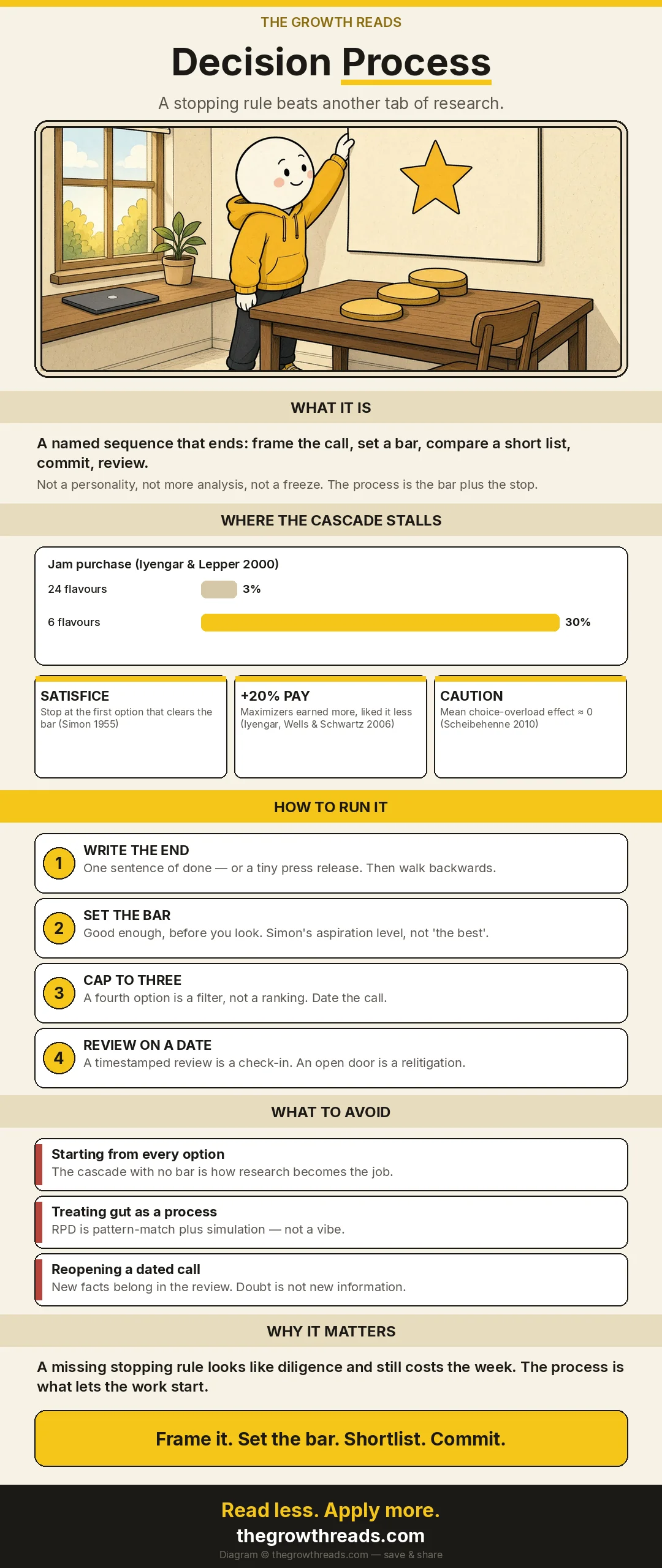
Sheena Iyengar and Mark Lepper’s 2000 jam study is the famous picture of that stall, and it is worth quoting at the size they actually ran. Shoppers who saw 24 flavours were less likely to buy than shoppers who saw six (roughly 3% versus 30%), and people who chose from the larger set later reported less satisfaction with what they picked. Limited arrays of chocolates and of essay topics produced the same direction: fewer options, more follow-through, better-rated work. The mechanism is not “choice is bad.” It is that a large, similar set with unclear preferences turns comparison into the task.
Two later papers keep that finding honest. Benjamin Scheibehenne, Rainer Greifeneder and Peter Todd’s 2010 meta-analysis of 50 experiments (63 conditions, N = 5,036) found a mean choice-overload effect of virtually zero, with a lot of variance between studies. Alexander Chernev, Ulf Böckenholt and Joseph Goodman’s 2015 meta-analysis of 99 observations (N = 7,202) then showed the effect is real when four moderators are high: choice-set complexity, decision-task difficulty, preference uncertainty, and an effort-minimising goal. In plain language: more options hurt when the set is hard, you do not know what you want, and you are trying to spend less effort, not more. That is exactly the situation the textbook cascade creates if you skip the bar.
The four places a process actually fails
- No frame. “I need to decide” is not a call. A frame is one sentence: what is being chosen, by when, and what “done” looks like. Without it, gathering has nowhere to aim. A brain dump can empty the head; it cannot replace the sentence.
- No bar. If you have not written what good-enough is, every option can be beaten by a hypothetical better one. Simon’s aspiration level is the missing line on most stalled cascades.
- An uncapped list. Three candidates is a comparison. A dozen is a hobby. Iyengar and Lepper’s limited array is the empirical picture; Chernev’s moderators tell you when that picture shows up at work.
- No commit date. An open decision is a loop. A dated review is a check-in. Relitigating on doubt, with no new information, is how a call un-decides — the same reopen that second-guessing feeds after the pick.
Why a missing process costs more than a slow one
A slow process with a bar still produces a call. A missing process produces a week that looks busy and a decision that is still open on Friday. The honest cost is not one dramatic number. It is a stack of smaller, documented ones.
Iyengar, Rachael Wells and Barry Schwartz followed graduating students through a job search in 2006. Students who scored high on maximising — hunting the best option rather than a good-enough one — secured starting salaries about 20% higher than satisficers. They also reported lower satisfaction with the jobs they got, and more negative affect during the search, mediated by heavier use of external information and fixation on realised and unrealised options. Objectively better, subjectively worse. That is the bill a cascade without a bar can present even when the “win” looks good on paper.
There is a second, more fashionable cost that this page will not treat as settled. Kathleen Vohs, Roy Baumeister and colleagues argued in 2008 that making many choices impairs later self-control — less stamina, less persistence, more procrastination — as if deciding spent the same limited resource as resisting. That finding sits inside the ego-depletion model, which a 23-lab registered replication (Hagger et al., 2016; N = 2,141) could not recover at a meaningful size (d = 0.04, confidence interval crossing zero). So: do not build a process around “you ran out of willpower.” Build it around the thing that still replicates — unbounded comparison, unclear preferences, and no stop.
Two honest caveats. Iyengar and Lepper’s jam study is one field experiment in one store, not a law of assortments; Scheibehenne’s mean of near-zero is the reminder. And Vohs et al. 2008 should not be cited as proof that deciding depletes a fuel tank. The replication record on that model is the counter-case this page is required to name.
What you can say without theatre: a missing stopping rule keeps the compare step alive. Alive compare is unpaid work. It also collides with how to prioritise tasks and with SMART goals — both of those tools assume a call has already been framed. Ranking a fog is not prioritisation. Writing a SMART sentence for a job you have not chosen is paperwork.
Four processes compared
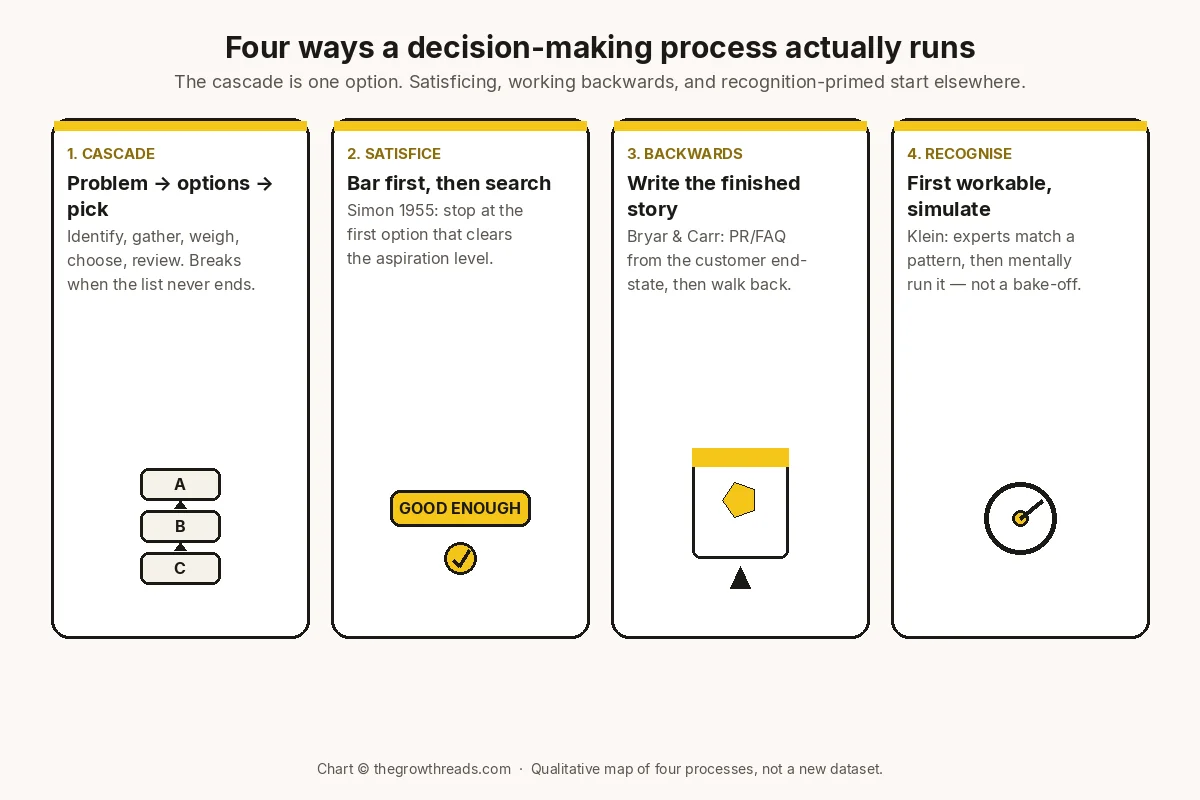
There is no single correct decision-making process. There are a handful of processes with different starting points, and the stall is almost always using the cascade on a call that needed a bar, an end-state, or a pattern match.
| Process | Starts from | Stopping rule | Best for |
|---|---|---|---|
| Textbook cascade | The problem statement, then a growing option set | Often missing — “when I have enough information” | High-stakes calls with time, a clear preference, and a list that can actually be closed |
| Satisficing (Simon, 1955) | An aspiration level written first | First option that clears the bar | Everyday reversible calls, hiring screens, tool choice, anything that can sprawl |
| Working backwards (Bryar & Carr) | The finished customer story — a one-page press release, then FAQ | Does the story still compel, after the hard questions? | Product, project, and “what should we build” bets, before anyone opens a ticket |
| Recognition-primed (Klein, Calderwood & Clinton-Cirocco, 1986) | A pattern match from experience | First workable move that survives a mental simulation | Time pressure plus real expertise. Not a beginner shortcut. |
Gigerenzer and Goldstein’s 1996 “Take The Best” simulations sit next to satisficing as a warning against the cascade’s hidden assumption. Their one-reason algorithm — search cues in order of validity, stop at the first cue that discriminates, ignore the rest — matched or outperformed multiple regression on speed and accuracy in the environments they tested. That is an existence proof, not a life rule: you do not have to integrate everything to decide well. You do have to know which cue you are betting on, and when you will stop looking up more of them.
Working backwards is the process this row’s down-link actually teaches. Colin Bryar and Bill Carr describe Amazon’s PR/FAQ: write the press release as if the thing already shipped, keep it under a page, then answer the hard customer and internal questions, and only then walk back to what you would have to build. The forcing function is the finished story. If the press release is dull, you do not “gather more.” You rewrite the end-state or you kill the idea. That is a stopping rule wearing a customer’s sentence. Read the TGR summary of Working Backwards for the full PR/FAQ shape; this page only needs the starting-point swap.
How to run a decision-making process without drowning in it
Write the end, write the bar, cap the list, date the commit. None of those is a numbered HowTo on this page, because a play-slot article does not ship a step ladder. They are four checks you can run in one sitting on an ordinary reversible call.
Write the end first. One sentence of “done,” or — if the call is a product or a project — a tiny press release. Who is this for, what changes for them, why would they switch. Bryar and Carr’s tool scaled to Amazon’s catalogue; the home version is a paragraph. If you cannot write the paragraph, you do not have a process problem. You have a frame problem. Park the fog on paper with a brain dump, then come back and write the sentence.
Write the bar before you look. Simon’s aspiration level is a line, not a vibe: “good enough is a tool we can try for two weeks, under $X, that talks to the existing stack.” Looking first and then inventing the bar is how every option becomes a special case. The ABCDE method and the 1-3-5 rule both assume you already know what “A” means. The bar is that meaning.
Cap the list at three, and treat a fourth as a filter, not a ranking. Iyengar and Lepper’s limited array is the picture; Chernev’s moderators tell you why a bloated, similar set with unclear preferences is the dangerous one. Three candidates you can actually compare. A long list is a search that has not finished. Time-box the search the way a time audit time-boxes a week — a window, not an identity.
Commit in writing, with a review date. A timestamped call plus a date to look at new information is a process. An open tab is a loop. If the door is two-way — most tool choices, most drafts, most trial hires — the cost of a good-enough pick plus a review is lower than the cost of another week of compare. Parkinson’s Law will fill whatever window you leave unmarked; work expands to fill the time is the sister fact, not a different topic.
Common mistakes
- Starting from every option. The cascade with no bar is how research becomes the job. Write the end-state first.
- Calling a vibe a process. Klein’s commanders simulated the first workable move. “I just feel it” without a check is not recognition-primed decision making.
- Using maximising language on a reversible call. “The best” is expensive. Iyengar, Wells and Schwartz’s maximisers paid for it in mood even when the salary went up.
- Treating more research as progress. Scheibehenne’s near-zero mean is the warning against assuming that a bigger set will save you. Chernev’s moderators tell you when the bigger set will stall you.
- Reopening a dated call because of doubt. New facts belong in the review. Doubt is not new information. That is the second-guessing loop, not a new process.
- Borrowing a ranking method before you have a call. Ivy Lee, ABCDE, 1-3-5, SMART — all of them rank something. Fog does not rank. Frame it first. The Ivy Lee method is a nightly cap of six, not a substitute for choosing what the six are about.
- Confusing a starting freeze with a deciding freeze. Task paralysis is shrinking the first action on work you have already chosen. This page is the sequence for choosing. Do not treat them as the same stall.
When a different process is required
Satisficing is the default for reversible, everyday calls. It is the wrong process for a one-way door you cannot undo, and it is the wrong process for a domain where you have no patterns to recognise.
Jeff Bezos’s two-way / one-way door distinction (the one analysis-paralysis already uses as a classify-the-door check) is the practical split. Two-way doors — a trial tool, a draft headline, a two-week experiment — should run Simon’s bar and a short list. One-way doors — a signature you cannot unwind, a public commitment, a hire you cannot cheaply reverse — earn more cascade, more written FAQ, and a slower commit. Working backwards is useful on both, because a dull press release is a cheap way to discover you do not want the door at all.
Recognition-primed decision making is not a beginner upgrade. Klein’s fireground commanders had years of incidents stocked as patterns. If you do not have that stock, the honest process is a written bar and a short list, not a faster gut. Group decisions add a second failure mode — the loudest preference winning before anyone wrote the bar. Put the sentence on paper before the meeting, the way a PR/FAQ goes out before the debate.
This is a work-and-habits page. A freeze that is not about options, a bar, or a missing review date — a freeze that shows up across contexts, with sleep, mood, or health changing underneath it — is outside what a decision-making process can fix. Seek the right kind of help for that. Do not turn this article into a diagnosis.
The evidence behind this
| Study | Design and size | Finding | What this page used it for |
|---|---|---|---|
| Simon (1955) | Theoretical model; QJE 69(1) | Real choosers search until an aspiration level is met (satisficing), not until a global best is computed | Definition of a stopping rule |
| Iyengar & Lepper (2000) | Field + lab experiments; jam, chocolates, essays | Limited arrays (6) produced more purchases / better-rated work than extensive arrays (24–30) | Why an uncapped list stalls follow-through |
| Scheibehenne, Greifeneder & Todd (2010) | Meta-analysis, 50 experiments, 63 conditions, N = 5,036 | Mean choice-overload effect near zero, with high between-study variance | Counter-case: more options are not automatically worse |
| Chernev, Böckenholt & Goodman (2015) | Meta-analysis, 99 observations, N = 7,202 | Overload is reliable when complexity, difficulty, preference uncertainty, and effort-minimising goals are high | When a bloated cascade actually hurts |
| Iyengar, Wells & Schwartz (2006) | Longitudinal; graduating students on a maximising scale | Maximisers: ~20% higher starting pay, lower satisfaction, more negative affect | Cost of hunting “the best” on a real search |
| Gigerenzer & Goldstein (1996) | Computer simulations of Take The Best vs multiple regression | One-reason stopping matched or beat integrating models on speed and accuracy in tested environments | You do not have to integrate every cue |
| Klein, Calderwood & Clinton-Cirocco (1986) | Critical-incident interviews with fireground commanders | Experts usually generated one workable option and simulated it, not a multi-option bake-off | Recognition-primed process; not a beginner gut |
| Vohs et al. (2008), with Hagger et al. (2016) | Lab + field choice tasks; later 23-lab RRR, N = 2,141 | 2008: choosing impaired later self-control. 2016: d = 0.04, CI crossed zero | Named counter-case: do not treat deciding as a fuel tank |
Frequently asked questions
What is the decision-making process?
A decision-making process is a named sequence that is allowed to end. You frame the call in one sentence, write a good-enough bar before you look, compare a short list, commit in writing, and put a date on the review. Herbert Simon called the everyday version satisficing: search until an option clears an aspiration level, then stop. The textbook cascade — identify, gather, weigh, choose — is one process among several. It fails when the gather step has no “enough.” Diligence without a stop is research that has taken the job, not a process.
How many steps are in a decision-making process?
There is no sacred number. Posters often list five or seven cascade steps, which is a map of a complete analysis, not a law. The version that survives contact with a real week is four checks: frame, bar, shortlist, commit-and-review. Satisficing can be two moves — write the bar, take the first option that clears it. Working backwards starts with a one-page press release and an FAQ, then walks back to what you would build. Count the stops, not the headings. A seven-step poster with no stopping rule is still an open loop.
What is the difference between a decision-making process and analysis paralysis?
A process ends. Analysis paralysis is a cascade that dropped its stopping rule: you can already name a leading option, and you still will not commit because one more comparison feels cheaper than being wrong. Decision paralysis is the freeze at the pick itself. This page is the sequence underneath both. Write the bar and cap the list before you keep gathering. If the door is two-way, a good-enough call plus a review date beats another week of tabs. If the door is one-way, slow down — that is a different process, not more of the same stall.
What is satisficing in a decision-making process?
Satisficing is Herbert Simon’s 1955 alternative to global optimisation. You set an aspiration level first — a written bar for good enough — then search until an option clears it, and you stop. You do not compute the best of all possible worlds, because the set of alternatives is not complete and neither is your ability to rank it. Iyengar, Wells and Schwartz later showed the cost of the opposite habit: maximisers won higher starting salaries and still liked the jobs less. Satisficing is the default for reversible everyday calls. It is the wrong tool for a one-way door you cannot undo.
What is working backwards as a decision-making process?
Working backwards, as Colin Bryar and Bill Carr describe it at Amazon, starts from the finished customer story. You write a one-page press release as if the thing already shipped, then an FAQ that answers the hard customer and internal questions, and only then walk back to what you would have to build. If the press release is dull, you rewrite the end-state or you kill the idea — you do not “gather more.” That swap is the process: the stopping rule is a sentence the customer would care about, not a longer option list. It is useful on product and project bets before anyone opens a ticket.
Is gut feeling a decision-making process?
Not by itself. Gary Klein, Roberta Calderwood and Anne Clinton-Cirocco found experienced fireground commanders rarely ran a bake-off of options. They recognised a pattern, retrieved a first workable move, and mentally simulated whether it would hold. That is recognition-primed decision making: pattern match, then check. It requires a stock of patterns built over years. If you do not have that stock, borrowing their speed without their simulation is a coin flip. Write a bar and a short list instead. Gut is not a process until there is a check you can name.
Why do I freeze when I have to decide?
On this page, a freeze is usually a missing stopping rule: no frame, no bar, an uncapped list, or no commit date. Iyengar and Lepper’s larger arrays reduced follow-through; Chernev, Böckenholt and Goodman showed overload is reliable when the set is hard and preferences are unclear. That is a work-and-habits mechanism, not a diagnosis. If the stall is “I already chose and I cannot start,” that is task paralysis — shrink the first action. If it is “I will not pick,” write the bar and cap the list. A freeze that is not about options sits outside what a process can fix.
Does more research make a better decision?
Sometimes, when the door is one-way, the preference is clear, and the extra fact could actually change the call. Often, no. Scheibehenne, Greifeneder and Todd found a mean choice-overload effect near zero across 50 experiments — more options are not automatically worse, and they are not automatically better. Chernev’s later meta-analysis found extra options hurt when complexity, difficulty, preference uncertainty, and effort-minimising goals are high. More research is a better decision only when you already wrote what would change your mind. Otherwise it is the cascade without a stop.
Sources
- Simon, H. A. (1955). A behavioral model of rational choice. The Quarterly Journal of Economics, 69(1), 99–118. https://doi.org/10.2307/1884852
- Iyengar, S. S., & Lepper, M. R. (2000). When choice is demotivating: Can one desire too much of a good thing? Journal of Personality and Social Psychology, 79(6), 995–1006. https://doi.org/10.1037/0022-3514.79.6.995
- Scheibehenne, B., Greifeneder, R., & Todd, P. M. (2010). Can there ever be too many options? A meta-analytic review of choice overload. Journal of Consumer Research, 37(3), 409–425. https://doi.org/10.1086/651235
- Chernev, A., Böckenholt, U., & Goodman, J. (2015). Choice overload: A conceptual review and meta-analysis. Journal of Consumer Psychology, 25(2), 333–358. https://doi.org/10.1016/j.jcps.2014.08.002
- Iyengar, S. S., Wells, R. E., & Schwartz, B. (2006). Doing better but feeling worse: Looking for the “best” job undermines satisfaction. Psychological Science, 17(2), 143–150. https://doi.org/10.1111/j.1467-9280.2006.01677.x
- Gigerenzer, G., & Goldstein, D. G. (1996). Reasoning the fast and frugal way: Models of bounded rationality. Psychological Review, 103(4), 650–669. https://doi.org/10.1037/0033-295X.103.4.650
- Klein, G. A., Calderwood, R., & Clinton-Cirocco, A. (1986). Rapid decision making on the fire ground. Proceedings of the Human Factors Society Annual Meeting, 30(6), 576–580. https://doi.org/10.1177/154193128603000616
- Vohs, K. D., Baumeister, R. F., Schmeichel, B. J., Twenge, J. M., Nelson, N. M., & Tice, D. M. (2008). Making choices impairs subsequent self-control: A limited-resource account of decision making, self-regulation, and active initiative. Journal of Personality and Social Psychology, 94(5), 883–898. https://doi.org/10.1037/0022-3514.94.5.883 — with the counter-case in Hagger, M. S., et al. (2016). A multilab preregistered replication of the ego-depletion effect. Perspectives on Psychological Science, 11(4), 546–573. https://doi.org/10.1177/1745691616652873
Related reading on The Growth Reads
Books. Working Backwards is the unused review for this row — start from the finished customer story, then walk back. That is the process this page borrowed for product and project bets.
Articles. Up to the cluster parent analysis paralysis. Across to decision paralysis when the stall is the pick, not the sequence. Brain dump empties the head before you write the frame. How to stop second-guessing yourself is the after-the-call sister. SMART goals and how to prioritise tasks assume a call already exists.
Hub. All of this sits under productivity on The Growth Reads.
How this article was researched
The argument is built from eight peer-reviewed sources with years, designs, and DOIs, plus one book whose TGR review was unused in the live article graph at the 10 September 2026 crawl: Bryar and Carr’s Working Backwards. Choice-overload is presented with both the famous jam result and the two meta-analyses that condition it. Ego-depletion is named and then limited by the 2016 registered replication. This is a work-and-habits page: no diagnosis and no symptom list. Klein’s fireground work is treated as an expert process, not a beginner shortcut.
Method: read the primary papers and meta-analyses cited above, checked each DOI before naming a finding, and refused to treat contested models as settled. Limits: no new experiment; jam-study follow-through rates are from one field setting; Take The Best results are simulations, not a field trial of your Tuesday.