

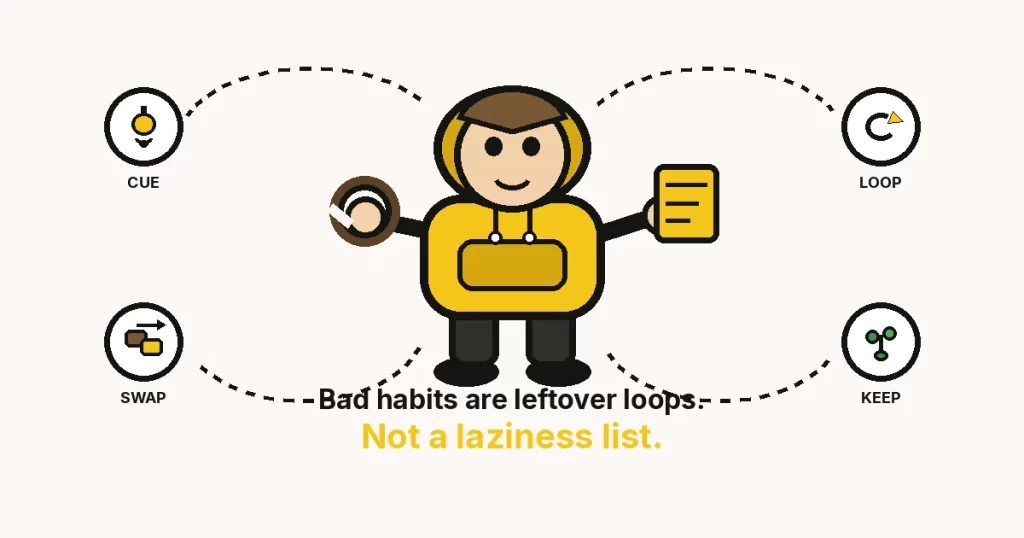
Bad habits examples are leftover loops: a cue that still starts an old action after the goal has changed, not a laziness list. The phone-first unlock, the after-meeting scroll, and inbox-as-morning are the same mechanism — a stable context running last week’s response. Replace the slot; do not give a grit speech.
Key takeaways
- A leftover loop is a learned link between a context and a response; it keeps running when that context returns even after the current goal has moved (Wood & Neal, 2007).
- Old actions travel when the room stays the same and loosen when the cue set breaks — transfer students kept campus habits only when the supporting context travelled with them (Wood, Tam & Witt, 2005).
- A stale reward is not enough: people with a strong popcorn habit still ate stale popcorn in a cinema-like room, and stopped in a meeting room (Neal, Wood, Wu & Kurlander, 2011).
- Catching the start of the old action and substituting a planned other one reduced unwanted habit performance; a general willpower instruction did not do the same job (Quinn, Pascoe, Wood & Neal, 2010).
- What replaces the loop is a smaller action in the same slot — the size constraint in Kondo and Sonenshein’s Joy at Work is the leftover object on the desk, which is also a leftover cue, not a character verdict.
What bad habits actually are
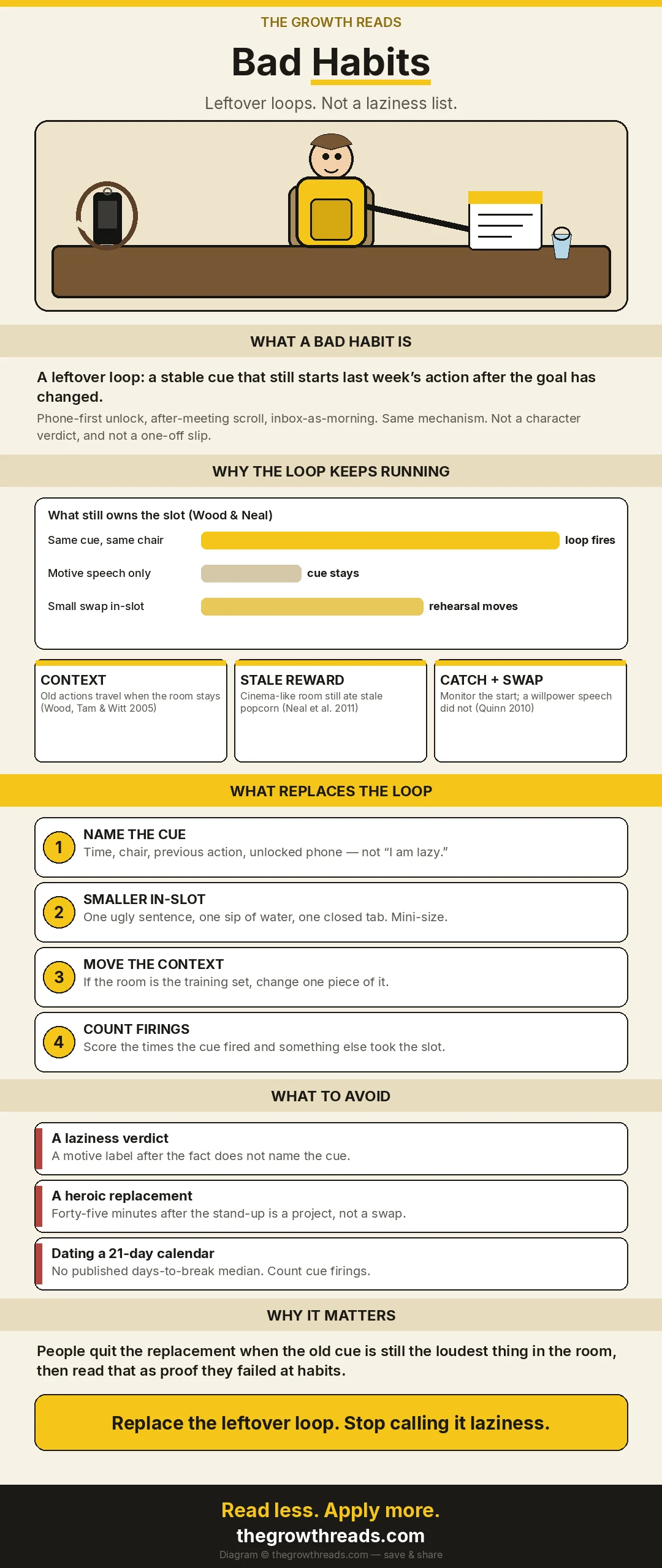
A bad habit, on this page, is a leftover loop: a stable cue that still starts last week’s action after the goal has changed. The everyday search for “bad habits examples” wants a list. The useful version of that list is not a moral catalogue. It is a set of leftover contexts — the unlocked phone on the nightstand, the chair that faces the same three tabs, the walk back from the stand-up that already has a scroll attached.
Wendy Wood and David Neal’s 2007 review is the definition this article uses. Habits are learned associations between a context and a response. They keep running when that context returns, even when a person’s current goal has moved. That is why “I don’t even want this” and the action can sit in the same minute. The goal voted. The cue still fired.
That is also why this page sits under Habits, next to the cluster’s live parent keystone habits — the one habit that pulls others with it — rather than under a health silo or a motivation silo. The sister question on this site is what consistency actually is: the same small action, again, in a stable slot. A leftover loop is that mechanism pointed at last week’s file. The work is to occupy the filename.
The named examples below are work-and-desk loops. They are not a diagnosis, not a personality test, and not a treatment list. They are the leftover loops people on the productivity library keep calling laziness after the fact.
Are leftover loops the same as laziness?
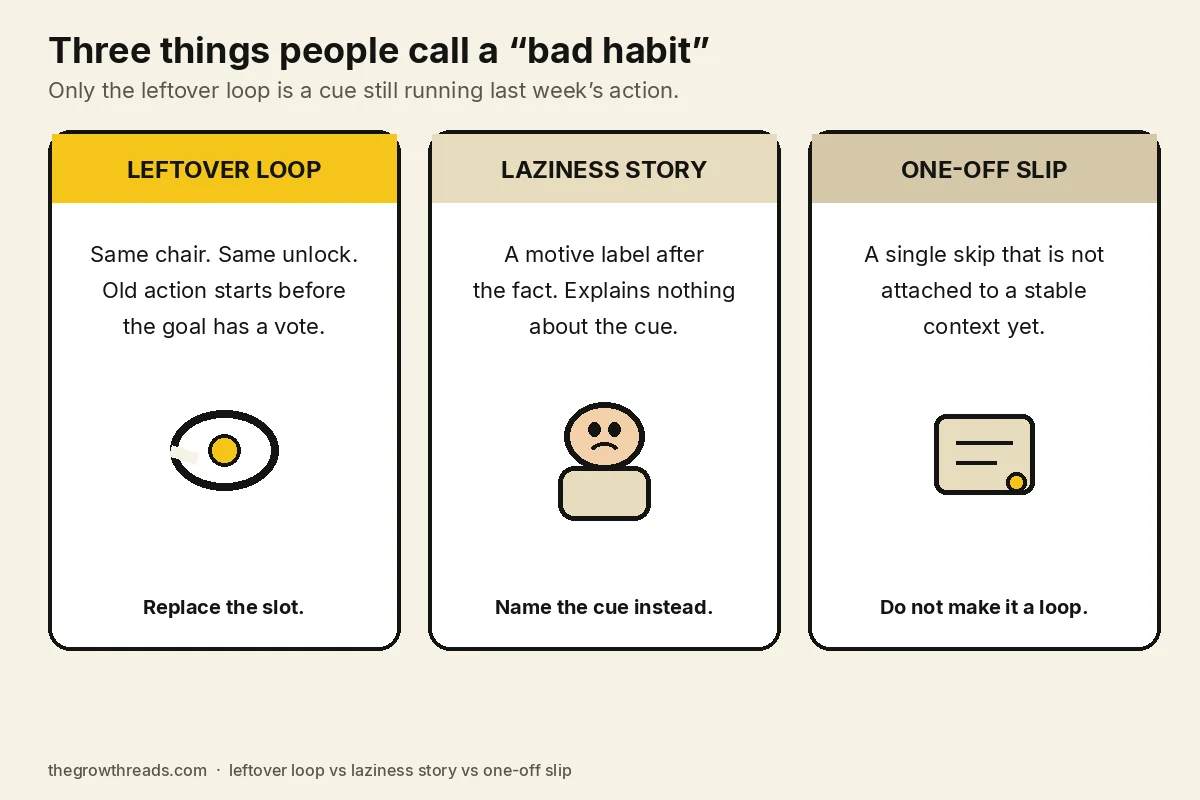
No — laziness is a motive story told after the action; a leftover loop is a cue that still fired. The popular word “lazy” explains nothing about the 8:01 unlock, the after-meeting scroll, or the inbox that opens before the kettle. Those are trained responses to a room that still looks like the training set. Calling them laziness is how a leftover loop hides.
This is a different split from live burnout vs laziness, which is motivation versus depletion at work. That page asks whether the tank is empty. This page asks whether last week’s cue is still the loudest thing in the room. Do not paste a depletion story onto a leftover loop, and do not paste a leftover-loop story onto an empty tank. They are neighbours. They are not the same file.
A one-off slip is a third thing. One Sunday inbox binge that has no chair, no time, and no preceding action attached yet is not a leftover loop. Repeat it in the same chair at the same hour and it starts to become one. Benjamin Gardner’s 2015 paper is the guardrail: habit is the process that generates automaticity. Frequency alone is not the definition. A thing you did twice is not a leftover loop. A thing the room still starts for you is.
Why leftover loops keep running
Leftover loops keep running because the cue is still present — the chair, the time, the unlocked phone — not because a person “chose lazy” again. Ask “why am I like this” first and the room answers with a character verdict. Ask “what started it” first and the room answers with a time, a place, a preceding action, or a device already in the hand.
Wood, Leona Tam and Melissa Witt tested that attachment in 2005 with students who transferred universities. When the new campus kept the same supporting context, old habits travelled. When the context broke, the old automatic responses loosened — even when intentions had not changed as much as the room had. The discontinuity was in the cue, not in a Sunday-night speech.
A later cinema study made the same point from the other direction. David Neal, Wendy Wood, Mengju Wu and David Kurlander sat people in front of popcorn that was deliberately stale. In a cinema-like context, people with a strong popcorn habit still ate. In a meeting-room context, the stale taste was enough to stop them. The reward was bad in both rooms. The habit only ignored that fact when the old cue was still present. “I don’t even like this app” is stale popcorn in the cinema seat.
The four leftover-loop triggers
A leftover loop at a desk is almost always one of four cues: a time, a place, a preceding action, or a device already in the hand.
| Leftover loop (example) | Cue that still fires | What it is not | Smaller swap in the same slot |
|---|---|---|---|
| Phone-first unlock | Alarm + phone already in the hand. The first context of the day is the lock screen. | A laziness verdict about mornings. Not a sleep-clinic finding. | Phone charges in another room. First action is water, then light. The live morning-routine page is this cue, not a 5 a.m. identity. |
| Inbox-as-morning | Chair + laptop lid + yesterday’s mail client still in the dock. | A personality that “loves email.” The dock is the cue. | Open the one document that is today’s output. Mail at a named later window. |
| After-meeting scroll | Stand-up ends, walk back, unlocked phone. The meeting is the preceding action. | A reward you “earned.” The walk is the filename. | On the walk back, open the doc and write one ugly sentence. Habit stacking is the same glue pointed forward. |
| Just-check after every send | Each small finish (send, save, close a ticket) is a cue for a new tab. | Curiosity. It is a leftover “break” that was trained onto completion. | Write the next physical action on paper, then close the tab. The written if-then on implementation intentions belongs here. |
| Reward-before-work | The task file is open and a video is already playing “for one minute.” | A rest you planned. The video is the first action in the slot. | One sentence in the file, then the video if it is still wanted. Size from Guise’s Mini Habits. |
| One-more-email close | Clock says done; the inbox still owns the last twenty minutes. | Diligence. It is a leftover end-of-day cue, the inverse of inbox-as-morning. | A written shutdown line: where you stopped + the first action tomorrow. Then the lid closes. |
| Desk leftovers | Last week’s piles, last week’s tabs, last week’s mug still in the work zone. | Mess as a character flaw. The objects are leftover cues. | Clear the work square. That is the Joy at Work move: leftover objects keep leftover actions available. |
Jeffrey Quinn, Anthony Pascoe, Wendy Wood and David Neal (2010) had people monitor the beginning of an unwanted response and implement a planned other action. Vigilant monitoring reduced the old performance. A general “use more willpower” instruction did not do the same job. The substitute has to be ready at the first half-second. A grit speech written on Sunday is not present at 3:40 on Tuesday.
Bas Verplanken and Sheina Orbell’s 2003 Self-Report Habit Index is the other honest tool on this page. It asks whether a behaviour starts automatically, is hard not to do, and belongs to a sense of “this is just what I do.” That is a leftover-loop check. It is not a laziness scale, and it is not a clinical instrument. If the action does not start without a debate, it is not yet a leftover loop — it is still a decision, which is a different page.
Why leftover loops cost more than they feel like
A leftover loop costs the replacement — people spend the freshest minutes on last week’s file, then read the empty output as proof they are lazy. The tax is not dramatic. It is twelve minutes after the stand-up, eighteen minutes of inbox-as-morning, a first half-hour given to the lock screen. None of those minutes feel like a crisis. Together they are how a day loses its only unclaimed slot.
The quieter cost is the story that follows. Once the leftover loop has run, the motive-label arrives: lazy, undisciplined, “bad at habits.” That label does not name the cue. It also does not install a substitute. It rehearses a personality that then becomes the excuse for leaving the chair, the time, and the unlocked phone exactly where they were. Wood and Neal’s interface paper is again the mechanism: the goal changed; the context did not. The character story is extra, and it is expensive.
A fake calendar multiplies the tax. The 21-day slogan and the 66-day paste job are formation numbers pointed at the wrong object — the live how long does it take to break a habit page is that clock, not this list. On this page the cost is simpler: people quit the small swap on day eight because the old cue is still louder, then treat that as evidence they cannot replace anything. Lally, van Jaarsveld, Potts and Wardle (2010) measured a median of 66 days for a new everyday action to reach 95% of that person’s automaticity plateau, range 18 to 254. That is the honest clock for the replacement, not a deadline for deleting the old file, and not a reason to call day nine a character failure.
Two honest limits. Wood, Tam and Witt is a field study of students who already decided to move campus — strong on context, not a proof that rearranging one mug will do the same work. Neal’s popcorn study is a lab / cinema-like contrast, not a workplace trial of Slack. Neither paper measures “laziness,” and this page will not invent a laziness score. The usable claim is narrower: leftover loops are cue-bound, and a motive label does not move the cue.
Gretchen Rubin’s Better Than Before is the practical translation that is not a study: people fail habits they copied from someone else’s tendency. An abstainer’s “never unlock in bed” is not an obliger’s “text me when the lid closes.” The leftover loop is still the cue. The replacement has to fit the person who will be in that chair tomorrow. Copying a public morning and calling the miss laziness is how the loop survives another week.
Common mistakes
The usual failure is writing a motive speech while leaving the cue, the chair, and the unlocked phone exactly where they were.
- Publishing a laziness verdict. “I am lazy” is a summary after the action. It does not name the 8:01 unlock. Link the disappointment to the cue, not to the person.
- A heroic replacement that cannot start. “After the stand-up I will write for forty-five minutes” is a project. “After the stand-up I will open the doc and write one ugly sentence” is a Mini Habit in the same slot. Why consistency is important is the same point from the other side.
- Removing the reward and leaving the cue. Stale popcorn still went down in the cinema-like room. “I don’t even enjoy this app” is not a context change.
- Stacking the new action on the cue you are trying to kill. If the leftover loop is “phone already in hand,” do not attach the replacement to the phone. Attach it to the kettle, the chair, the walk back. The live reading-habit page uses a physical book in a fixed chair for that reason.
- Calling a one-off slip a leftover loop. One skip that has no stable context is not yet a habit. Treating it as one is how a slip gets a chair and a time.
- Pasting a 21-day challenge on a leftover loop. Maltz never ran that trial. Count the times the cue fired and a different action took the slot.
- Confusing leftover loops with an empty tank. If the week is depletion, not a cue, the neighbour page is burnout vs laziness — motivation versus depletion — not a longer examples list. Do not treat this URL as a health page.
- Leaving last week’s objects in the work square. A desk that still holds last week’s piles is a context that still fires last week’s actions. Joy at Work’s tidy is a cue change, not a personality reboot. How to build discipline is staying put after the cue has been named; it is not a grit speech aimed at a messy desk.
When it is more than a leftover loop
A workplace default that still starts in the same chair is a habit question; a pattern that takes over sleep, money, or safety is a different conversation and this page is not that conversation. The leftover-loop frame is for ordinary defaults: the 8:01 unlock, the after-meeting scroll, the inbox that opens before the kettle. It is not a diagnosis, not a treatment list, and not a stand-in for help with compulsive use, substance loops, or anything that is harming health or relationships.
If the same cue is firing and a two-minute swap is available, this page applies. If the thing you want to stop is bigger than a slot on a workday, stop asking this URL for a laziness test. The honest next step is a qualified person, not a tighter streak and not a longer examples list.
The evidence behind this
The usable evidence is a context-response definition, two context-disruption findings, one substitution finding, and a formation curve for the replacement — not a laziness score.
| Study | Design and size | Finding | What we used it for |
|---|---|---|---|
| Wood & Neal (2007) | Theoretical review of habit as a context–response association | Habits interface with goals; they keep running when the context returns even if the current goal has changed | Definition of a leftover loop — not a motive label |
| Wood, Tam & Witt (2005) | University students transferring campus; field measures of habits vs intentions in stable vs changed contexts | Habits persisted when supporting context travelled; loosened when the context broke | Why the chair and the unlock matter more than a Sunday speech |
| Neal, Wood, Wu & Kurlander (2011) | Lab / cinema-like vs meeting-room eating of stale popcorn; split by habit strength | Strong habits ate stale popcorn in the cinema-like room; the same stale reward stopped them in the other room | Why “I don’t even enjoy it” fails if the cue stays |
| Quinn, Pascoe, Wood & Neal (2010) | Lab tasks; vigilant monitoring plus a planned substitute vs a willpower instruction | Catch-and-swap reduced unwanted habit performance; the general willpower instruction did not match that effect | The replacement has to be ready at the start of the old action |
| Lally, van Jaarsveld, Potts & Wardle (2010) | 96 adults; daily self-report automaticity on a self-chosen new behaviour; up to 84 days | Median 66 days to 95% of plateau; range 18–254; one missed day did not reset the curve | The honest clock for the replacement, not a laziness deadline |
| Verplanken & Orbell (2003) | Scale development for the Self-Report Habit Index | Habit as automaticity, lack of awareness, and identity — not as “I do this a lot” | Keeps this page from calling every repeat a leftover loop |
| Gardner (2015) | Conceptual paper: habit as a process generating automaticity | Habit is the process; automaticity is the outcome | The one-off slip is not yet a leftover loop |
| Gardner, Lally & Wardle (2012) | Practice paper translating habit-formation evidence | Small, cue-tied actions judged by automaticity, not by heroic streaks | The same-slot replacement rule in plain language |
| Verplanken & Wood (2006) | Review of discontinuity interventions in consumer habits | Context change opens a window; the window is temporary | A move or new commute is a chance, not a personality reset |
Frequently asked questions
What are bad habits examples at work?
The useful bad habits examples at a desk are leftover loops: phone-first unlock, inbox-as-morning, the after-meeting scroll, a “just check” after every send, reward-before-work, and the one-more-email close. Each one is a stable cue still starting last week’s action. They are not a laziness list and not a personality test. Name the cue — time, chair, preceding action, or unlocked phone — then put a smaller action in the same slot.
Are leftover loops the same as laziness?
No. Laziness is a motive story told after the action. A leftover loop is a context–response link that still fires when the room looks the same, even after the goal has moved (Wood and Neal, 2007). The 8:01 unlock does not become a character trait because someone is tired of it. If the tank is empty rather than the cue leftover, that is the burnout-versus-laziness question — motivation versus depletion — and a different page. This URL does not score laziness.
How do you replace a leftover loop?
Occupy the same slot with a smaller action, and catch the start of the old one so the substitute can run (Quinn, Pascoe, Wood and Neal, 2010). After the stand-up, open the doc and write one ugly sentence. After the alarm, water then light, with the phone in another room. A forty-five-minute vow in the same chair is a project, not a swap. Count the times the cue fired and something else took the slot. There is no published days-to-break median.
Is checking your phone a bad habit?
Checking a phone is a leftover loop when a stable cue still starts it — waking, a meeting ending, a send, a kettle click — and the check runs before the current goal has a vote. A single look that has no chair and no time attached is a slip, not yet a loop. The phone is often the device already in the hand, which is why charging it in another room is a context change and “use more willpower at 8:01” is not. Enjoyment is not the test; stale popcorn still got eaten in the cinema-like room.
Why do leftover loops come back after a weekend?
Because the weekend removed the cue set, and Monday put it back. Wood, Tam and Witt’s transfer students kept old habits when the supporting context travelled with them. Two days off is a short discontinuity. The office chair, the 3:40 slump, and the unlocked phone are the original training set. Install the smaller action on the first Monday the cue returns. Do not wait for the weekend feeling to last, and do not read the first leftover scroll as proof the person is lazy.
Do you need 21 days to replace a leftover loop?
No. The 21-day line is Maxwell Maltz’s 1960 self-image anecdote, not a habit trial. The 66-day figure is Lally and colleagues’ median for forming a new automatic action, range 18 to 254 days, not a deadline for deleting an old cue. The replacement can start on the next firing. Automaticity of that replacement, if you want a clock, follows the formation evidence — with a wide range — and missing a day did not reset Lally’s curves to zero.
What is the difference between a leftover loop and burnout?
A leftover loop is last week’s cue still running. Burnout, on the neighbour page, is motivation versus depletion at work — an empty tank, not a leftover filename. This article does not diagnose burnout, does not list clinical symptoms, and does not treat either state. If the week feels like an empty tank, do not add a longer bad-habits list. If the tank is fine and the 8:01 unlock still owns the morning, name the cue and occupy the slot.
Can you break a leftover loop without a replacement?
You can suppress it for a while. The cinema-popcorn finding is the warning: when the old context is still present, the response can run even after the reward has gone stale (Neal, Wood, Wu and Kurlander, 2011). Extinction without a substitute leaves the filename empty. An empty slot is how the old file gets opened again. A smaller action in the same slot is the boring version that occupies the filename. A willpower speech without a substitute did not match catch-and-swap in Quinn’s lab tasks.
Sources
- Wood, W., & Neal, D. T. (2007). A new look at habits and the habit-goal interface. Psychological Review, 114(4), 843–863. doi:10.1037/0033-295X.114.4.843
- Wood, W., Tam, L., & Witt, M. G. (2005). Changing circumstances, disrupting habits. Journal of Personality and Social Psychology, 88(6), 918–933. doi:10.1037/0022-3514.88.6.918
- Neal, D. T., Wood, W., Wu, M., & Kurlander, D. (2011). The pull of the past: When do habits persist despite conflict with motives? Personality and Social Psychology Bulletin, 37(11), 1428–1437. doi:10.1177/0146167211419863
- Quinn, J. M., Pascoe, A., Wood, W., & Neal, D. T. (2010). Can’t control yourself? Monitor those bad habits. Personality and Social Psychology Bulletin, 36(4), 499–511. doi:10.1177/0146167209360665
- Lally, P., van Jaarsveld, C. H. M., Potts, H. W. W., & Wardle, J. (2010). How are habits formed: Modelling habit formation in the real world. European Journal of Social Psychology, 40(6), 998–1009. doi:10.1002/ejsp.674
- Verplanken, B., & Orbell, S. (2003). Reflections on past behavior: A self-report index of habit strength. Journal of Applied Social Psychology, 33(6), 1313–1330. doi:10.1111/j.1559-1816.2003.tb01951.x
- Gardner, B. (2015). A review and analysis of the use of ‘habit’ in understanding, predicting and influencing health-related behaviour. Health Psychology Review, 9(3), 277–295. doi:10.1080/17437199.2013.876238
- Gardner, B., Lally, P., & Wardle, J. (2012). Making health habitual: The psychology of ‘habit-formation’ and general practice. British Journal of General Practice, 62(605), 664–666. doi:10.3399/bjgp12X659466
- Verplanken, B., & Wood, W. (2006). Interventions to break and create consumer habits. Journal of Public Policy & Marketing, 25(1), 90–103. doi:10.1509/jppm.25.1.90
Related reading on The Growth Reads
The books this page draws on
- Joy at Work summary — leftover objects on a desk are leftover cues, not a character verdict
- Mini Habits summary — the size constraint: a two-minute action in the same slot beats a vow that never starts
- Better Than Before summary — Gretchen Rubin on knowing your habit tendency before you copy someone else’s streak
Related articles
- Keystone habits — the one habit that pulls others with it (this cluster’s parent)
- What consistency actually is — the sister: the same small action, again
- How long does it take to break a habit — the clock for an old cue, not a laziness deadline
- How to stack habits — attaching the next action to a cue you never skip
- Implementation intentions — the written if-then that makes the substitute ready at the start
- Burnout vs laziness — the neighbour split: motivation versus depletion, not leftover loops
Go deeper
How this article was researched
The Growth Reads editorial team writes from primary sources: the books themselves and the peer-reviewed literature behind the claims. Every study cited above was read in the original publication or its published abstract, and every figure is quoted with its design, sample and effect so you can judge its weight rather than take ours. Where a finding is correlational, self-report, a lab contrast, or a field study of people who already changed context, we say so in the body rather than in a footnote. This page does not invent a laziness score, because none of the cited papers measured one.
This article is a work-and-habits page. It is leftover loops versus a laziness label — not a burnout health page, not medical advice, not a diagnosis, and not a treatment plan. A pattern that is harming sleep, money, safety, or relationships is outside this URL.
How we work: every article on The Growth Reads is built from the books in our library plus the research they rest on, and is reviewed and date-stamped when the evidence changes. Read our full methodology.