

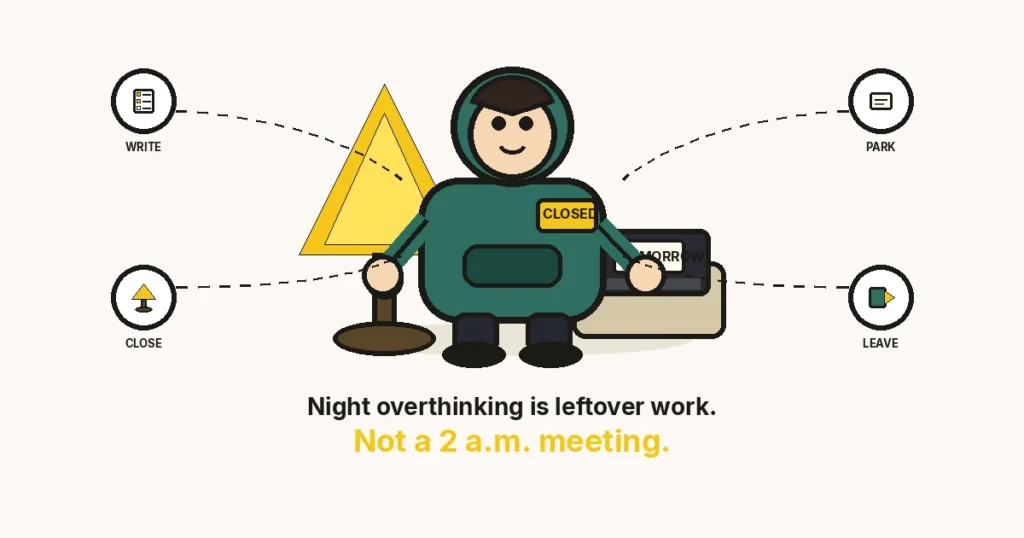
To stop overthinking at night, close the day’s leftover decisions before the lights go out — do not keep working the same unsigned choice in bed. Night overthinking is unfinished work wearing pyjamas, not a new personality. Write the next physical step, shut the laptop, and leave the call until morning.
Key takeaways
- Michael Scullin and colleagues (2018) had 57 young adults write for five minutes at bedtime: a specific to-do list for tomorrow shortened sleep-onset latency compared with writing a list of completed activities, and more specific tasks predicted a faster close.
- Christine Syrek, Oliver Weigelt, Corinna Peifer and Conny Antoni (2017) found unfinished tasks at the end of the week predicted worse weekend sleep through rumination — leftover Friday work does not stay in Friday.
- E. J. Masicampo and Roy Baumeister (2011) showed that a specific plan for an unfinished goal reduced the intrusive pull of that goal, even though the goal was still literally unfinished.
- Sabine Sonnentag and Charlotte Fritz (2007) treat psychological detachment — mentally leaving work — as a recovery experience, not a mood and not a diagnosis.
- Jason Fried and David Heinemeier Hansson’s Rework is blunt about the evening: stop treating the night as extra meeting time. Planning is guessing; a 2 a.m. replay is a meeting nobody booked.
What night overthinking actually is
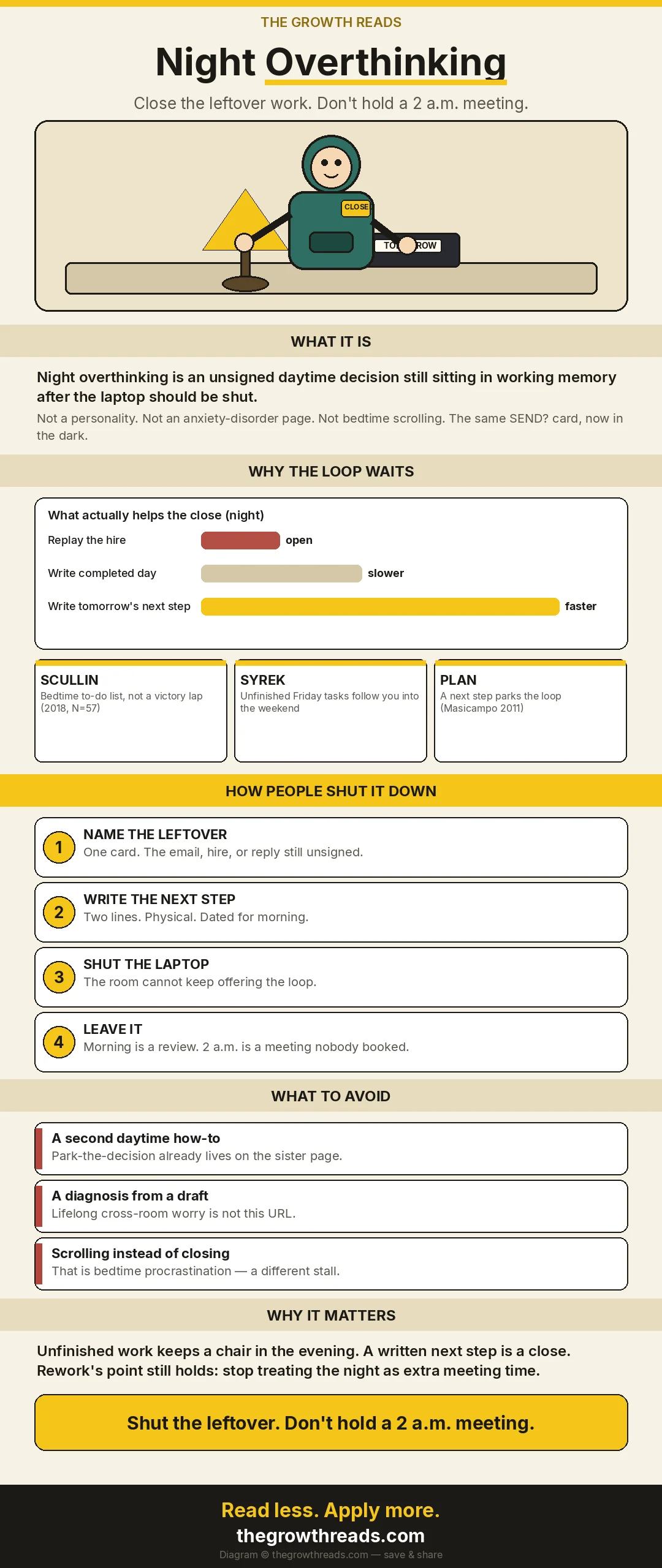
Night overthinking is an unsigned daytime decision still sitting in working memory after the laptop should be shut. The search phrase “how to stop overthinking at night” mixes three different objects. One object is daytime parking: name the open choice, set a good-enough bar, write a next action, leave. One object is a night leftover: the same email, hire, or reply keeps replaying after the day has already ended. One object is a clinical story about worry that has been short across years and rooms. This page owns the second. It will not diagnose the third, and it will not become a second daytime how-to.
That is why this article hangs off the Decisions parent analysis paralysis. Analysis paralysis is the stall before the stamp. Night overthinking is what the stall does after office hours: you can already name the leading option, and the record still skips in the dark. The parent page is the stopping-rule system. This page is the shutdown page — how the leftover waits until the lights go out, which neighbours are different objects, and which “fixes” are aimed at the wrong loop.
The method sister is already live. How to stop overthinking parks the decision during the day. This URL does not repeat that ladder. Play slots drop the HowTo step list on purpose. If you came here because the phrase in the search box was “how to stop overthinking at night,” stay. The night close is a different keyword from the daytime park. The why-page is different again: why do I overthink everything names the leftover loop. This page names the hour it prefers.
Jason Fried and David Heinemeier Hansson’s Rework is this row’s unused review for a reason. The book’s evening argument is the shutdown wearing a different hat. Work does not have to expand into the night. Planning is guessing. A 2 a.m. replay of an unsigned hire is a meeting nobody put on the calendar. That is a work-design problem, not a personality, and it is why this down-link sits on a night page instead of a second park-the-decision guide.
What night overthinking is not
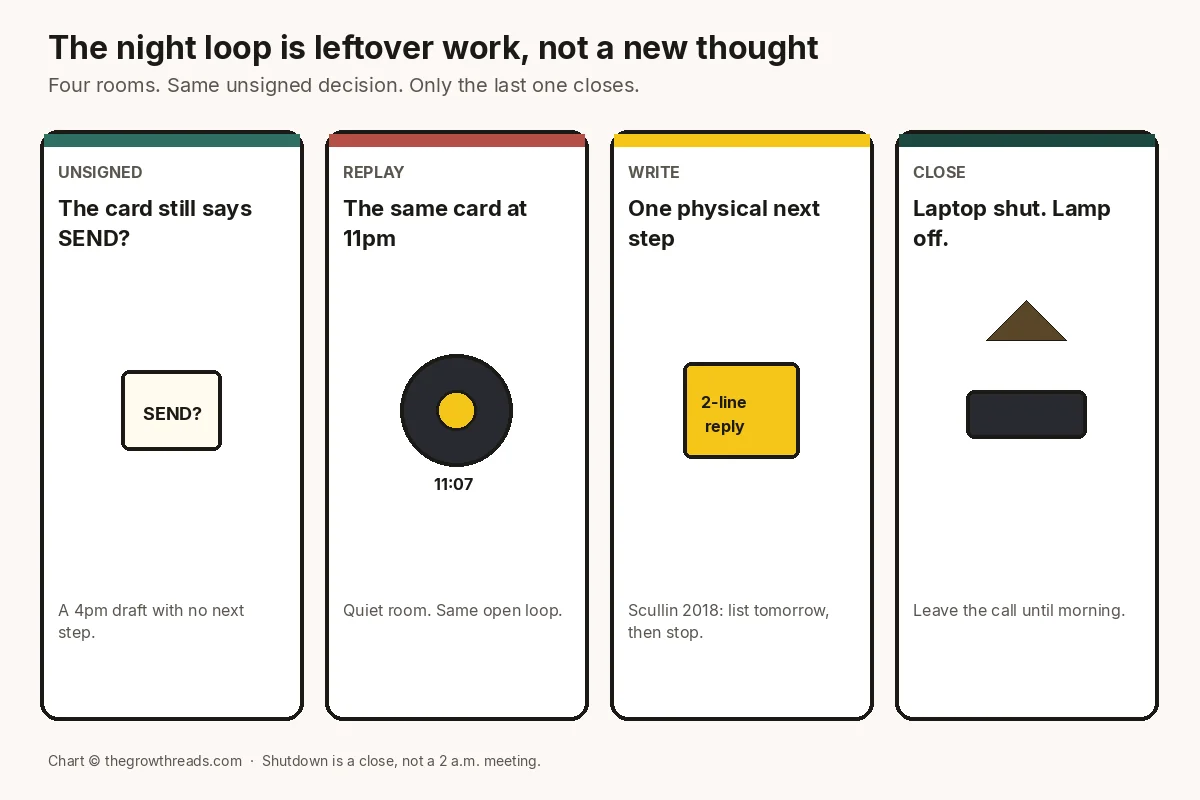
The opposite of night overthinking is not a reckless stamp at 11pm. One careful pass with a written bar before dinner is thinking. The night leftover is what happens after that line was available and you kept the card in your pocket. You can think carefully at 4pm and still replay the same email at 11. The first is a pass. The second is a skip in the groove after the office closed.
It is also not bedtime procrastination. Bedtime procrastination is the stall that keeps you on the sofa with a phone after you meant to stop. Night overthinking can happen with the phone face-down. The object is the unsigned decision, not the scroll. Same evening. Different job. If the card already says “sent Tuesday,” you want how to stop second-guessing yourself. If the card still says “SEND?” and the lamp is still on, you are here.
And it is not an anxiety-disorder page. Lifelong, cross-context, impairing worry is a clinical conversation. A draft that has been open since 10 a.m. is not. This queue’s medical guard is blunt: no diagnosis, no symptom list, no “overthinking disorder.” If the only room you cannot leave a choice in is the one with twelve similar tabs and no written bar, start with the bar. We will say that again in the limits note, because the SERP around this keyword keeps offering a diagnosis the keyword does not earn.
Why the loop waits until the lights go out
The loop waits until the lights go out because the day finally stops offering new inputs, and the unsigned goal is still holding a chair. Bluma Zeigarnik’s 1927 observation — unfinished tasks stay more available than finished ones — is the oldest version of that chair. Masicampo and Baumeister (2011) made it useful for a work page. Across experiments, people who had an unfulfilled goal showed the usual intrusive pull. People who then made a specific plan for when, where, and how they would finish the goal showed less of that pull, even though the goal was still literally unfinished. The plan parked the loop. Completion was not required. A next physical action was. That is the mechanism, stated as a finding, not as a numbered method. The daytime sister already owns the parking steps.
Night is when the chair gets louder, not because the decision got harder at 10:40, but because the competing noise dropped. Meetings end. Slack goes quiet. The unsigned hire is still there. Syrek, Weigelt, Peifer and Antoni (2017) measured the weekly version of the same chair: unfinished tasks at the end of the week predicted rumination, and rumination predicted worse sleep on the weekend. Leftover Friday work does not stay in Friday. It follows you into Saturday morning. A Tuesday night replay of a 4pm draft is the daily-sized version of that weekend finding.
Sonnentag and Fritz (2007) named the skill the evening is asking for: psychological detachment — mentally leaving work. Detachment is a recovery experience, one of four they measured (the others are relaxation, mastery, and control). It is not a personality. It is not a diagnosis. It is the difference between “the card is closed until 9am” and “the card is still in my hand in the dark.” Brandon Smit (2016) then tied detachment to unfinished goals: people who left more work unresolved found it harder to leave the work mentally. The night loop is not a new thought arriving at 11. It is the afternoon thought the close never dated.
The four evening triggers
- The unsigned next step. The decision has no dated physical action, so working memory keeps it in the rotation (Masicampo and Baumeister, 2011). A written “send the two-line reply at 9:15” parks more of the loop than another hour of rereading the thread under the lamp.
- The quiet room. The day was full of competing inputs. Night removes them. The leftover is what remains. That is why the same hire feels louder at 11 than it did at 3, when three other fires were burning.
- The victory-lap list. Scullin, Krueger, Ballard, Pruett and Bliwise (2018) compared two bedtime writes. Listing tomorrow’s unfinished tasks shortened the time it took to fall asleep compared with listing what you already finished. A recap of the day keeps the work in the room. A specific next-step list is a close.
- The extra meeting. Fried and Hansson’s evening argument in Rework: stop treating the night as more office. A 2 a.m. replay of an unsigned choice is a meeting with no agenda and no end time. Planning is guessing. The guess does not get cheaper after midnight.
Querstret and Cropley (2012) add a workplace-sized weather report. In a survey of 719 working adults, affective rumination about work — the emotional replaying, not the calm problem-solve — tracked with poorer sleep quality and more work-related fatigue. That is a correlation, not a randomised trial of “stop thinking.” Johanna Wendsche and Andrea Lohmann-Haislah’s 2017 meta-analysis then put detachment on a larger map: more detachment tracks with better sleep and less exhaustion. The unsigned card is what blocks it.
Sleep debt and a day that started in fragments will also keep a loop spinning. Those are real. They are not the default story for a Tuesday that only falls apart when twelve similar tabs share a screen and no bar has been written. Start with the unsigned decision. If the replay is the same in a quiet room, across years, that is a different conversation — and not one this page is allowed to finish. A later how-to on how to fix your sleep schedule owns the wake-and-sleep anchors. This page owns the leftover card, not the clock.
Why it costs more than it feels like
A night leftover feels like diligence because it is still “working on it”; the bill is a slower close, a worse next morning, and an extra meeting nobody booked. Scullin priced the close. People who wrote tomorrow’s tasks at bedtime fell asleep faster than people who wrote a completed-activity list. The more specifically they listed the unfinished items, the faster the onset. A victory lap of what you already did is not a shutdown. A dated next step is. That is a lab sleep-onset finding in young adults, not a promise that a sticky note cures a year of short nights. It is still the cheapest evidence that the write you do at 10:40 is not a neutral act.
Syrek priced the weekend. Unfinished Friday tasks predicted rumination, and rumination predicted worse weekend sleep. The cost is not only Tuesday at 11. It is Saturday still carrying Tuesday. That is why decision paralysis and this page sit in the same family: the freeze at commit during the day becomes a replay after dark if the freeze never dated a next step. The decision-making process is a stopping rule. A night leftover is a process with the last box left blank, then taken to bed.
Wilson and Schooler (1991) priced the pick itself. Extra verbal analysis can scramble a preference that was already good enough. A third pass at 11:20 is not automatically more accuracy. It can be less. That paper is a lab preference effect, not a proof that every extra hour on a real hire is harmful. What it supports is narrower and still useful: extra passes after a bar are not free, and they do not get cheaper because the lamp is still on.
Two honest caveats. Scullin’s bedtime-writing study is a small, young-adult, one-night lab protocol — not a clinical insomnia trial, and not a reason to treat this page as sleep medicine. Syrek’s weekend finding is a diary association, not a randomised “finish every Friday task” experiment. What both support is still useful: leftover work keeps a chair, and a specific next step is a closer close than a recap.
Put together, the honest cost of night overthinking is not “you have a disorder.” It is a slower close (2018), a weekend that still carries Friday (2017), an unfinished-goal chair (2011), a detachment gap (2007, 2016, 2017), and — when you keep listing reasons after the bar — a preference tax you already paid once at 4pm (1991). That is enough to take seriously. It is not enough to pathologise a Tuesday. The productivity hub is where this sits: work design, not a seventh silo, and not a clinic.
Night overthinking vs nearby ideas
Most phrases that sit next to “how to stop overthinking at night” on a search page are different objects, and treating them as synonyms is how the wrong page gets written. The table is a boundary map, not a diagnostic of types-and-cures. Play pages do not run that ladder. They name the neighbours so this URL stays on its own keyword.
| Phrase | What people think it is | What it actually is | Wrong fix |
|---|---|---|---|
| Night overthinking | A personality that cannot switch off | An unsigned daytime decision still in working memory after dark | A new notes app; a diagnosis from a draft |
| How to stop overthinking | This page, with the lights on | The daytime sister: park the decision, then leave | Turning this night URL into a second how-to ladder |
| Why do I overthink everything | The same leftover, with a why | The recognition page for the unsigned loop — any hour | Repeating the why instead of dating a next step |
| Bedtime procrastination | The same evening stall | Staying on the sofa after you meant to stop — a scroll, not a hire | Treating a leftover email as a phone problem |
| Anxiety | What every night leftover “probably is” | A clinical pattern across years and rooms — not this page | Self-diagnosis from an unsigned email |
The parent analysis paralysis keeps the stopping rule. The sister how to stop overthinking keeps the daytime parking steps. The why-page keeps the leftover-loop recognition. Bedtime procrastination keeps the scroll. A sleep-schedule page keeps the wake time. This play slot refuses to become any of those. Night close first. The other URLs can inherit the leftover without this one growing a step ladder or a symptom list.
How people actually shut it down
People stop overthinking at night by closing the leftover before the lamp goes off, not by holding a better meeting with the same unsigned card. There is no numbered ladder here, because this is a play-slot page and the mechanism is a handful of closes you can run the same evening. Use them in any order. The only rule is not to skip the write and jump to a 2 a.m. replay.
Name the one leftover. One card. The email, hire, or reply that is still unsigned. If three things are looping, pick the loudest. A night that tries to close a whole week is a second workday. Syrek’s weekend finding is about unfinished tasks as a pile. The cheapest close is one dated card, not a new system.
Write the next physical step, then stop. Masicampo and Baumeister’s plan is the mechanism: when, where, and how, even if the goal is still unfinished. Scullin’s bedtime list is the hour: tomorrow’s tasks, written specifically, then the pen goes down. “Think about the hire” is a mood. “Open the two-line reply at 9:15 and send if it still clears the bar” is a close. A recap of what you already finished is the condition that took longer to fall asleep.
Shut the laptop and kill the lamp. The room cannot keep offering the loop if the loop’s furniture is closed. That is Rework’s evening argument in furniture form. Distance is cheaper than a grit speech at 23:10. A muted laptop on the duvet is still a cue. A closed laptop in another room is the version the night can actually use.
Leave the call until morning. Morning is a review. 2 a.m. is a meeting nobody booked. If a new fact arrives at 9:15, you can change the call. Replaying the same facts in the dark is how a close un-decides. Fried and Hansson’s line still holds: planning is guessing. The guess does not get cheaper after midnight. If the leftover is a starting problem rather than a closing problem, you are on a different page — and the daytime park already exists.
All of this sits inside the broader productivity library for a reason. Night overthinking is one child of Decisions, not a seventh silo and not a sleep clinic. If the phone is the object, you want the bedtime-procrastination page. If the clock is the object, you want the sleep-schedule page. If the card is the object, stay here.
Common mistakes
- Treating one more research pass at 11pm as neutral. Wilson and Schooler (1991) are the unwelcome paper: extra verbal analysis can worsen a preference that was already good enough. A third hour is a decision, not a default.
- Writing a victory lap instead of a next step. Scullin’s completed-activity list was the slower condition. “Look how much I did” keeps the work in the room. “Send the two-line reply at 9:15” is a close.
- Calling a leftover loop a disorder. Lifelong, cross-context, impairing worry is a clinician’s job. An unsigned hire is a decisions problem. Do not let a night-keyword do medical work.
- Turning this page into the daytime how-to. The parking steps live on how to stop overthinking. This play slot does not own that ladder. Night close first.
- Confusing the leftover with the scroll. If the object is the phone on the sofa, you want bedtime procrastination. Treating a leftover email as a screen-time problem misses the unsigned card.
- Confusing the leftover with the after-stamp wobble. If the card is already dated, you want how to stop second-guessing yourself. Reopening a dated call as “research” is how a close un-decides.
- Using the night as extra meeting time. Rework’s down-link is the whole job: stop treating the evening as more office. Planning is guessing. A 2 a.m. replay is a meeting with no end time.
The evidence behind this
The useful studies on night overthinking measure unfinished goals, bedtime writing, weekend leftover work, and detachment — not a disorder, and not a single “overthinking score” you can buy a supplement for. What follows is the working set for this page, with design and limit in the same row as the finding.
| Study | Design and size | Finding | What we used it for |
|---|---|---|---|
| Scullin, Krueger, Ballard, Pruett & Bliwise (2018) | Lab; 57 young adults; 5-minute bedtime write; polysomnography | To-do list for tomorrow shortened sleep-onset vs completed-activity list; more specific tasks, faster onset | Write the next step, not a victory lap; not a clinical insomnia trial |
| Syrek, Weigelt, Peifer & Antoni (2017) | Diary; employees across a work week into the weekend | Unfinished end-of-week tasks predicted rumination, which predicted worse weekend sleep | Leftover Friday work does not stay in Friday |
| Masicampo & Baumeister (2011) | Experiments on unfulfilled goals and specific plans | A when/where/how plan reduced intrusive pull even though the goal was still unfinished | A next physical step parks the loop; completion is not required |
| Sonnentag & Fritz (2007) | Scale development; Recovery Experience Questionnaire | Psychological detachment is one of four recovery experiences | Mentally leaving work is a skill, not a mood and not a diagnosis |
| Smit (2016) | Field study of unfinished goals and detachment | More unresolved work, harder mental leave | The night loop is the afternoon card the close never dated |
| Querstret & Cropley (2012) | Survey; 719 working adults | Affective work rumination tracked with poorer sleep quality and more fatigue | The 11pm replay is not free diligence; correlational, not causal |
| Wendsche & Lohmann-Haislah (2017) | Meta-analysis of detachment from work | More detachment tracks with better sleep and less exhaustion | Detachment is the evening skill the leftover card blocks |
| Wilson & Schooler (1991) | Lab preference studies (jam / course evaluations) | Extra verbal analysis can worsen a preference that was already good enough | A third pass at 11:20 is not automatically more accuracy |
Frequently asked questions
How do I stop overthinking at night tonight?
Name the one leftover, write the next physical step for morning, shut the laptop, and leave the call. Scullin’s 57-person bedtime study is the hour: a specific to-do list for tomorrow shortened sleep-onset compared with a recap of what you already finished. Masicampo and Baumeister’s plan is the mechanism: when, where, and how, even if the goal is still unfinished. This is not a six-step ladder and not a diagnosis. If three cards are looping, close the loudest. A night that tries to finish a whole week is a second workday.
Why does overthinking get worse at night?
The day finally stops offering new inputs, and the unsigned goal is still holding a chair. Zeigarnik’s old observation is that unfinished work stays more available than finished work. Night removes the competing noise, so the leftover is what remains. Syrek’s weekend diary is the weekly version: unfinished Friday tasks predicted rumination, and rumination predicted worse sleep. The hire did not get harder at 10:40. The room got quieter. That is a work-memory problem, not a personality, and not a reason to start a 2 a.m. meeting with the same facts.
Is night overthinking the same as anxiety?
No. Lifelong, cross-context, impairing worry is a clinical conversation this article will not have, treat, or symptom-list. An unsigned email from 4pm is a decisions problem. They can sit in the same evening. They are not one page. If the replay is the same in a quiet room, across years and rooms, that is a conversation for a qualified professional. The work version here stays on the card: write the next step, shut the laptop, leave the call until morning. That help is real and limited.
Should I write a journal or a to-do list before bed?
Scullin’s comparison is specific. Writing tomorrow’s unfinished tasks shortened sleep-onset. Writing a list of completed activities took longer. A victory lap keeps the work in the room. A dated next step is a close. This is not a journal-therapy page and not a morning-pages rewrite. Two or three physical next actions, then the pen goes down. If you write for twenty minutes and reopen the hire, you documented the meeting instead of ending it.
How is this different from how to stop overthinking?
The daytime sister parks the decision: name the open choice, set a good-enough bar, write a next action, leave. This page is the hour after that park should already have happened. Play slots drop the HowTo ladder on purpose. If you need the six-step system, that URL already exists. If you need the why, the leftover-loop page already exists. If the lamp is still on and the card still says SEND?, you are on the night close. Do not turn this URL into a second park-the-decision guide.
Is this the same as bedtime procrastination?
No. Bedtime procrastination is staying on the sofa with a phone after you meant to stop. Night overthinking can happen with the phone face-down. The object is the unsigned decision, not the scroll. They can stack — a leftover hire plus a feed — but the fix is aimed at different furniture. Close the card, then see whether the phone is a second problem. Treating a leftover email as a screen-time problem misses the unsigned next step.
Does finishing every task before bed stop the loop?
No, and the evidence does not ask you to. Masicampo and Baumeister’s plan reduced the intrusive pull while the goal was still unfinished. Scullin’s faster condition was a list of tomorrow’s tasks, not a cleared desk. Completion is lovely when it is cheap. It is a bad night policy when it turns 10:40 into a second shift. Write the next physical step. Date it. Leave it. Friday’s pile can wait for a Friday close, which is Syrek’s finding, not a dare to finish the year at 23:10.
When is night overthinking more than a leftover decision?
When the replay is the same in a quiet room, across years, and it is impairing life beyond an unsigned draft. That is a clinical conversation. This page will not finish it, list symptoms, or offer a label. A later sleep-schedule article owns the wake-and-sleep anchors. The daytime overthinking page owns the park. The why-page owns the leftover loop. What remains here is narrow: one card, one next step, a closed laptop. If that is not the object, you are on a different URL — or in a different kind of appointment.
Related reading on The Growth Reads
The book this page draws on
- Rework by Jason Fried and David Heinemeier Hansson — stop treating the night as extra meeting time; planning is guessing
Related articles
- Analysis paralysis — the Decisions parent: the stall before the stamp
- How to stop overthinking — the daytime sister: park the decision, then leave
- Why do I overthink everything — the leftover-loop recognition page
- Bedtime procrastination — the scroll after you meant to stop
- How to stop second-guessing yourself — the after-stamp wobble
- Decision paralysis — the freeze at commit
- How to fix your sleep schedule — wake-and-sleep anchors, not this leftover card
Go deeper
How this article was researched
The Growth Reads editorial team writes from primary sources: the books themselves, the authors’ published essays, and the peer-reviewed literature behind the claims. Every study cited above was checked against the original publication or its published abstract, and every figure is quoted with its design, sample and effect so you can judge its weight. Where a finding is a synthesis rather than a single trial, or where later work limits the headline (small lab sleep-onset samples, diary associations), we say so in the body rather than in a footnote.
This is a productivity article about work and habits. It is not a clinical page, not a diagnosis, and not advice about mental health treatment or sleep medicine.
How we work: every article on The Growth Reads is built from the books in our library plus the research they rest on, and is reviewed and date-stamped when the evidence changes. Read our full methodology.
Sources
- Scullin, M. K., Krueger, M. L., Ballard, H. K., Pruett, J., & Bliwise, D. L. (2018). The effects of bedtime writing on difficulty falling asleep: A polysomnographic study comparing to-do lists and completed activity lists. Journal of Experimental Psychology: General, 147(1), 139–146. doi:10.1037/xge0000374
- Syrek, C. J., Weigelt, O., Peifer, C., & Antoni, C. H. (2017). Zeigarnik’s sleepless nights: How unfinished tasks at the end of the week impair employee sleep on the weekend through rumination. Journal of Occupational Health Psychology, 22(2), 225–238. doi:10.1037/ocp0000031
- Masicampo, E. J., & Baumeister, R. F. (2011). Consider it done! Plan making can eliminate the cognitive effects of unfulfilled goals. Journal of Personality and Social Psychology, 101(4), 667–683. doi:10.1037/a0024192
- Sonnentag, S., & Fritz, C. (2007). The Recovery Experience Questionnaire: Development and validation of a measure for assessing recuperation and unwinding from work. Journal of Occupational Health Psychology, 12(3), 204–221. doi:10.1037/1076-8998.12.3.204
- Smit, B. W. (2016). Successfully leaving work at work: The self-regulatory underpinnings of psychological detachment. Journal of Occupational and Organizational Psychology, 89(2), 393–414. doi:10.1111/joop.12137
- Querstret, D., & Cropley, M. (2012). Exploring the relationship between work-related rumination, sleep quality, and work-related fatigue. Journal of Occupational Health Psychology, 17(3), 341–353. doi:10.1037/a0028552
- Wendsche, J., & Lohmann-Haislah, A. (2017). A meta-analysis on antecedents and outcomes of detachment from work. Frontiers in Psychology, 7, 2072. doi:10.3389/fpsyg.2016.02072
- Wilson, T. D., & Schooler, J. W. (1991). Thinking too much: Introspection can reduce the quality of preferences and decisions. Journal of Personality and Social Psychology, 60(2), 181–192. doi:10.1037/0022-3514.60.2.181