

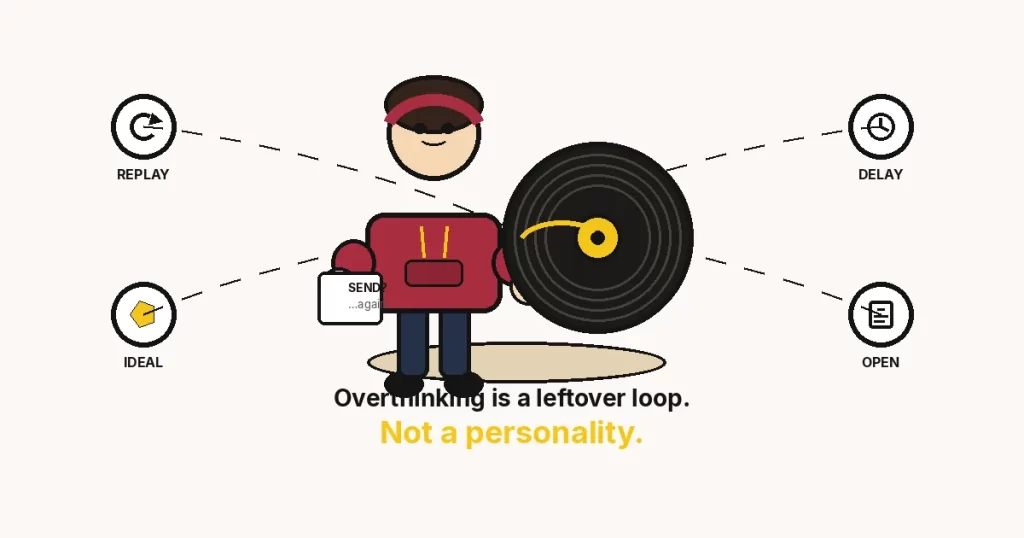
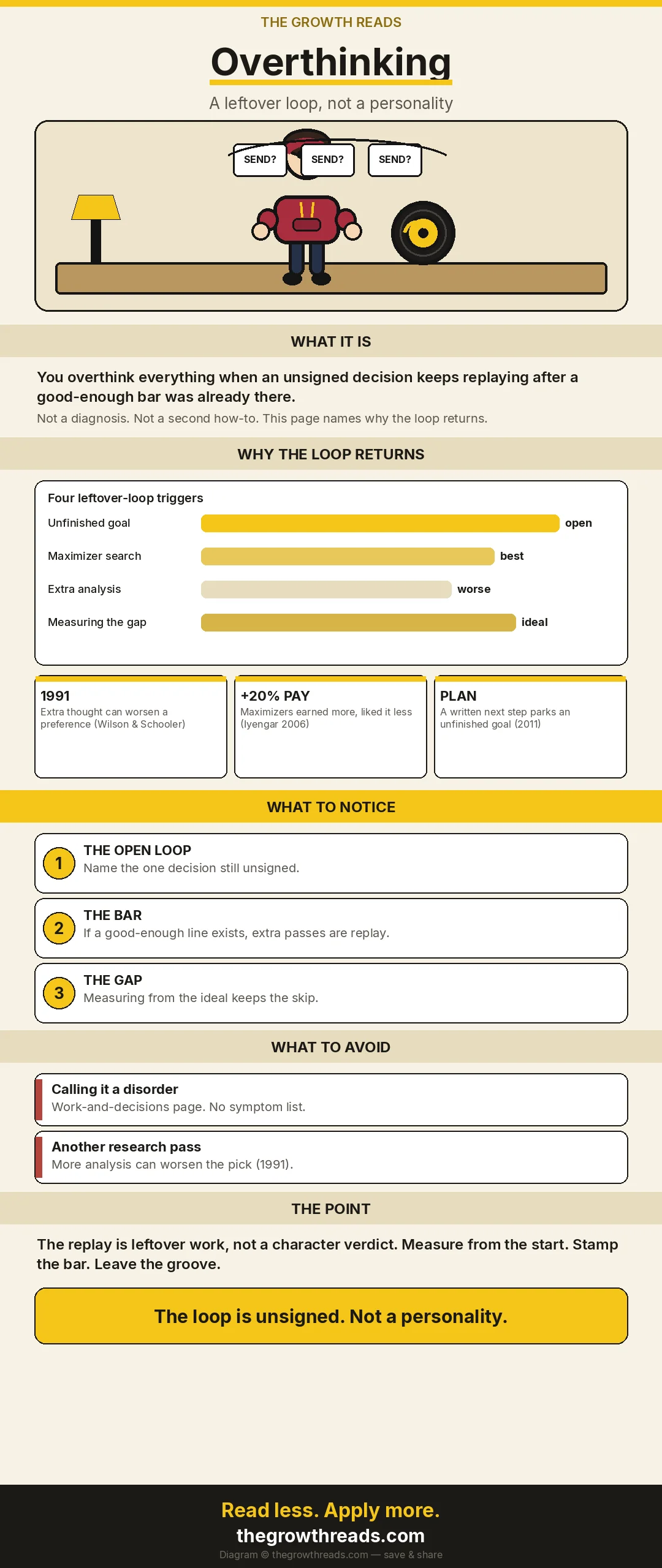
You overthink everything because an unsigned decision keeps a leftover loop open, not because you have a personality defect. Extra analysis after a good-enough bar can worsen the choice (Wilson and Schooler, 1991). This page names why the replay returns. The method URL parks it.
Key takeaways
- Timothy Wilson and Jonathan Schooler (1991) found that people who analysed a preference in extra verbal detail later made worse choices than people who picked with less introspection — more thought is not automatically more accuracy.
- Barry Schwartz and colleagues (2002) showed that maximizers — people who keep searching for the best possible option — report more regret and less satisfaction than satisficers who stop at good enough.
- Sheena Iyengar, Rachael Wells and Schwartz (2006) found college-senior maximizers accepted jobs with about 20% higher starting pay and then liked those jobs less — a better number on paper, a worse feeling after the stamp.
- E. J. Masicampo and Roy Baumeister (2011) showed that making a specific plan for an unfinished goal reduced the intrusive pull of that goal; an unsigned next step is what keeps the record skipping.
- Dan Sullivan and Dr. Benjamin Hardy’s The Gap and the Gain names the measuring error underneath the replay: comparing the present to an ideal (the gap) keeps the loop open; measuring backward from the start (the gain) lets the decision close.
What overthinking everything actually is
Overthinking everything is a leftover decision loop: the same choice keeps replaying after a good-enough bar was already available, and the extra passes do not add a new fact. The everyday complaint (“why do I overthink everything?”) mixes three different objects. One object is careful thinking: one or two deliberate passes while the facts are still moving. One object is a leftover loop: the same email, hire, or purchase keeps returning after you could already name the leading option. One object is a clinical story about anxiety that has been short across years and rooms. This page owns the second. It will not diagnose the third, and it will not become a second how-to.
That is why this article hangs off the Decisions parent analysis paralysis. Analysis paralysis is the stall before the stamp — you will not pick because you keep comparing. Overthinking everything is what the stall feels like from the inside after the comparing has already run: you can name the leading option, and the record still skips. The parent page is the stopping-rule system. This page is the recognition page — why the replay returns, which neighbours are different objects, and which “fixes” are aimed at the wrong loop.
The method sister is already live. How to stop overthinking parks the decision: name the open choice, set a good-enough bar, write a next physical action, leave. This URL does not repeat that ladder. Play slots drop the HowTo step list on purpose. If you came here for a six-step system, that page already exists. If you came here because the phrase in the search box was “why do I overthink everything,” stay. The why is a different keyword from the how.
The mechanism that keeps showing up in the decision literature is unflattering: an unfinished goal occupies working memory, extra verbal analysis can scramble a preference that was already good enough, and measuring from an ideal that never arrives guarantees another pass. None of those require a personality defect. They require an unsigned next step, a maximizer search, or a gap you keep scoring against. That is an ordinary Tuesday on the productivity hub, not a character verdict.
What overthinking everything is not
The opposite of overthinking everything is not a reckless stamp. One careful pass with a written bar is not a leftover loop. Herbert Simon’s satisficing — stop at the first option that clears a pre-set line — is thinking. The leftover loop is what happens after that line was available and you kept walking past it. You can think carefully on Monday and still overthink the same email on Thursday. The first is a pass. The second is a skip in the groove.
It is also not the after-stamp wobble. How to stop second-guessing yourself is the replay that starts once the decision is already dated. This page is the replay that starts because the decision was never dated. Same family. Different clock. If the card already says “sent Tuesday,” you are on the second-guess page. If the card still says “SEND?” in pencil, you are here.
And it is not an anxiety-disorder page. Lifelong, cross-context, impairing worry is a clinical conversation. A draft that has been open since 10 a.m. is not. This queue’s medical guard is blunt: no diagnosis, no symptom list, no “overthinking disorder.” If the only room you cannot leave a choice in is the one with twelve similar tabs and no written bar, start with the bar. We will say that again in the limits note, because the SERP around this keyword keeps offering a diagnosis the keyword does not earn.
Dan Sullivan and Dr. Benjamin Hardy’s The Gap and the Gain is this row’s unused review for a reason. The book’s measuring error is the why wearing a different hat. The gap is the distance between now and an ideal that keeps moving. The gain is the distance between now and where you started. People who live in the gap keep the record skipping, because the ideal never arrives and so the decision never qualifies as “done.” That is a measuring problem, not a personality, and it is why this down-link sits on a why-page instead of a how-to.
Why the leftover loop returns
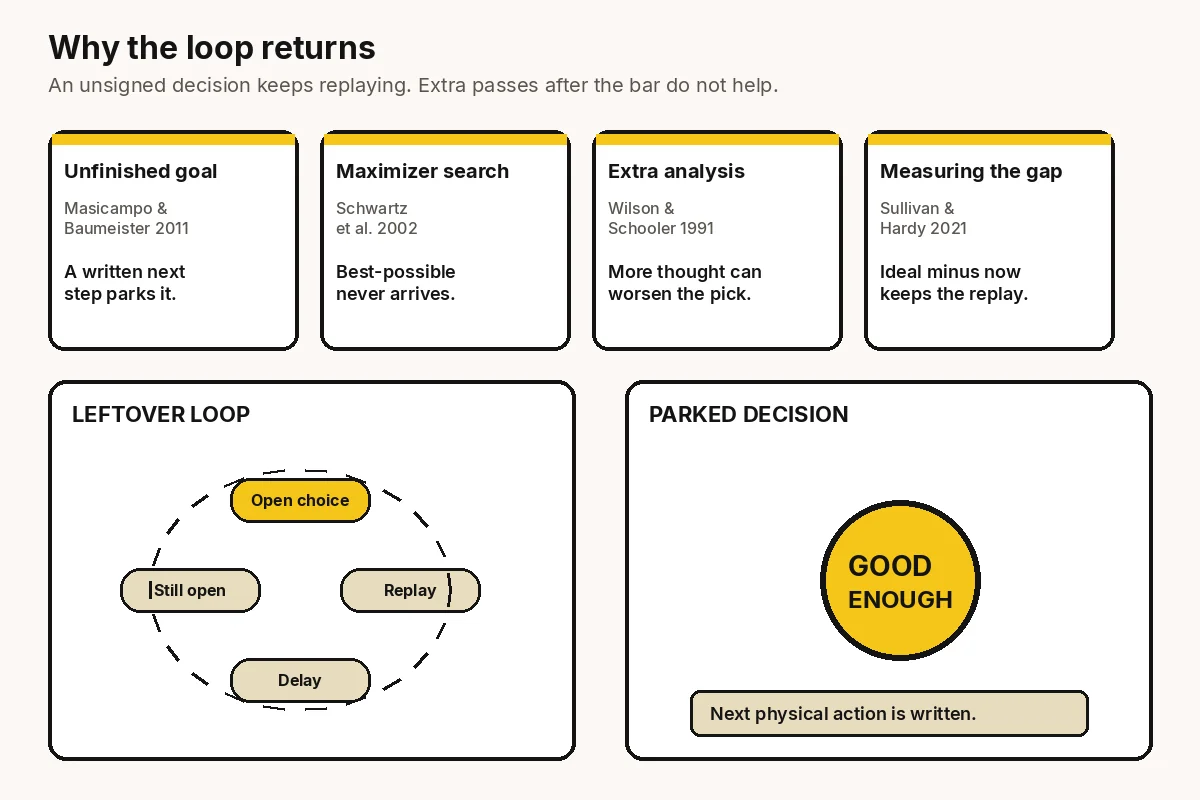
The leftover loop returns because an unfinished goal keeps a chair in working memory, a maximizer search has no stop, extra analysis can scramble a preference, and measuring from an ideal guarantees another pass. None of those require a diagnosis. They require an unsigned next step, a “best possible” rule, a verbal dump of reasons, or a scoreboard that only looks forward. That is an ordinary afternoon in a decisions cluster, not a character verdict.
Bluma Zeigarnik’s 1927 observation — unfinished tasks stay more available than finished ones — is the oldest version of this chair. Masicampo and Baumeister (2011) made it useful for a work page. Across experiments, people who had an unfulfilled goal showed the usual intrusive pull. People who then made a specific plan for when, where, and how they would finish the goal showed less of that pull, even though the goal was still literally unfinished. The plan parked the loop. Completion was not required. A next physical action was. That is the mechanism, stated as a finding, not as a numbered method. The method URL already owns the parking steps.
Schwartz, Ward, Monterosso, Lyubomirsky, White and Lehman (2002) then named the search that refuses to park. They distinguished maximizers — people who keep looking for the best option — from satisficers, who stop at the first option that clears a line. Maximizers in their samples reported more regret, more upward social comparison, and less happiness and life satisfaction. The search itself is the loop. If the rule is “best possible,” the record cannot skip to the end, because “best” is not a stamp you can date. It is a horizon.
Wilson and Schooler (1991) added the part that feels like research and behaves like damage. In their jam and course-evaluation studies, people who were asked to analyse why they liked an option later made choices that lined up worse with expert ratings, and worse with their own later satisfaction, than people who chose with less introspection. Extra verbal analysis disrupted a preference that was already good enough. The third pass did not refine the pick. It scrambled it. That is the most unwelcome finding on this page, and the reason “one more research hour” is not a neutral act.
The four leftover-loop triggers
- The unfinished goal. The decision has no dated next step, so working memory keeps it in the rotation (Masicampo and Baumeister, 2011). A written “send the two-line reply at 4 p.m.” parks more of the loop than another hour of rereading the thread.
- The maximizer search. The rule is “best possible,” so no option ever qualifies (Schwartz et al., 2002). Satisficing is not sloppiness. It is a stop that the search does not otherwise contain.
- The extra analysis. You keep listing reasons after the bar was already visible. Wilson and Schooler (1991) are the warning: more introspection can worsen the pick you already had.
- The gap scoreboard. You measure the choice against an ideal that keeps moving (Sullivan and Hardy). The gain — how far this is from the start — is the scoreboard that lets a decision close. The gap is the scoreboard that never will.
Choice overload can feed the same loop. Iyengar and Lepper (2000) found that shoppers facing 24 jams were far less likely to buy than shoppers facing 6 (about 3% versus about 30%). More similar options, less closing. Scheibehenne, Greifeneder and Todd’s 2010 meta-analysis later put a hard limit on that story: the mean choice-overload effect across studies was near zero (d = 0.02). Chernev, Böckenholt and Goodman (2015) then mapped when overload does show up — hard tasks, complex options, unclear preferences. We keep both. A 24-flavour shelf can stall a close. It does not stall every close. If your preferences are clear and the options are simple, more choice is not automatically the villain. If they are not, the shelf is doing maximizer work for you.
Sleep debt and a day that started in fragments will also keep a loop spinning. Those are real. They are not the default story for a Tuesday that only falls apart when twelve similar tabs share a screen and no bar has been written. Start with the unsigned decision. If the replay is the same in a quiet room, across years, that is a different conversation — and not one this page is allowed to finish.
Why it costs more than it feels like
A leftover loop feels like diligence because it is still “working on it”; the bill is a worse pick, a worse feeling after a better number, and an afternoon spent in the gap. Wilson and Schooler priced the pick. Extra analysis moved people off the preference that later proved better. The cost is not only time. It is accuracy you already had and then talked yourself out of.
Iyengar, Wells and Schwartz (2006) priced the feeling. They followed college seniors through the job search. Maximizers landed positions with starting salaries about 20% higher than satisficers — and then reported less satisfaction with those jobs, plus more negative affect during the search. Doing better on the metric and feeling worse after the stamp is the leftover loop’s favourite costume. The extra passes look like they paid off. The person who made them is less glad they did. That is not a reason to hunt badly on purpose. It is a reason not to treat “I kept looking” as proof the looking helped the life attached to the number.
Schwartz’s maximizer samples add a slower bill: more regret, more social comparison, less satisfaction as a background weather. The study is correlational on the personality side — it compared people who already differed on a maximization scale — so it cannot prove that a single Tuesday of extra passes causes a less happy month. That limit matters. It is still a warning against treating “I just want the best option” as a free search. The people who already live that rule are the ones who report enjoying the result less.
Sullivan and Hardy’s measuring error is the quietest cost, and the one that shows up as “nothing I pick is ever the one.” If the scoreboard is the gap, every closed decision is instantly a loss against an ideal that did not happen. The gain — this reply is two lines further than the blank — is the only scoreboard on which a decision can finish. That is why the decision-making process keeps showing up as a neighbour: a process is a stopping rule. A leftover loop is a process with the last box left blank. Decision paralysis is the freeze at commit. This page is the replay that pretends commit is still research.
Two honest caveats. Scheibehenne, Greifeneder and Todd (2010) found the average choice-overload effect is near zero, so “too many options” is not a universal law — it is a conditional stall (Chernev, Böckenholt and Goodman, 2015). Wilson and Schooler’s introspection effect is a lab preference effect, not a proof that every extra hour on a real hire is harmful. What both support is narrower and still useful: extra passes after a bar are not free, and “best possible” is a rule that often costs the feeling the extra search was supposed to buy.
Put together, the honest cost of overthinking everything is not “you have a disorder.” It is a preference tax (1991), a satisfaction tax that can sit on a better number (2006), regret weather that travels with maximizer rules (2002), an unfinished-goal chair (2011), and — when the shelf is actually overloaded — a stall that more similar options make worse (2000, with the 2010 and 2015 limits). That is enough to take seriously. It is not enough to pathologise a Tuesday.
Nearby ideas that are not this leftover loop
Most phrases that sit next to “why do I overthink everything” on a search page are different objects, and treating them as synonyms is how the wrong page gets written. The table is a boundary map, not a diagnostic of types-and-cures. Play pages do not run that ladder. They name the neighbours so this URL stays on its own keyword.
| Phrase | What people think it is | What it actually is | Wrong fix |
|---|---|---|---|
| Overthinking everything | A personality that cannot stop thinking | A leftover loop on an unsigned decision | A new notes app; a diagnosis from a draft |
| Analysis paralysis | The same thing as the leftover loop | The stall before the stamp — the parent page | More comparison after the leading option is named |
| How to stop overthinking | This page, with steps | The method sister: park the decision, then leave | Turning this why-URL into a second how-to |
| Second-guessing | The same replay | The after-stamp wobble — a different clock | Reopening a dated decision as if it were still research |
| Anxiety | What every leftover loop “probably is” | A clinical pattern across years and rooms — not this page | Self-diagnosis from an unsigned email |
The parent analysis paralysis keeps the stopping rule. The sister how to stop overthinking keeps the parking steps. A later play row in this queue will own “how to stop overthinking at night” as a shutdown-routine URL. This page refuses to become either method early. Causes and boundaries first. The method URLs can inherit them without this one growing a step ladder.
Common mistakes
- Treating one more research pass as neutral. Wilson and Schooler (1991) are the unwelcome paper: extra verbal analysis can worsen a preference that was already good enough. A third hour is a decision, not a default.
- Using “best possible” as the only rule. Schwartz’s maximizers got more regret and less satisfaction. Satisficing is a stop. “Best” is a horizon. Horizons do not date.
- Calling a leftover loop a disorder. Lifelong, cross-context, impairing worry is a clinician’s job. An unsigned hire is a decisions problem. Do not let a why-keyword do medical work.
- Measuring the choice from the ideal. Sullivan and Hardy’s gap never closes. The gain — how far this is from the blank — is the only scoreboard on which a stamp can land. That is the down-link’s whole job.
- Turning this page into the how-to. The parking steps live on how to stop overthinking. This play slot does not own that ladder. Recognition first.
- Confusing the leftover loop with the after-stamp wobble. If the card is already dated, you want how to stop second-guessing yourself. Reopening a dated call as “research” is how a close un-decides.
- Blaming the shelf for every stall. Iyengar and Lepper’s jam result is real and conditional. Scheibehenne’s meta-analysis is the limit. Too many options stall some closes. They do not explain an unsigned two-option email.
The evidence behind this
The useful studies on overthinking everything measure leftover goals, maximizer search, extra analysis, and the conditions under which more options stall a close — not a disorder, and not a single “overthinking score” you can buy a supplement for. What follows is the working set for this page, with design and limit in the same row as the finding.
| Study | Design and size | Finding | What we used it for |
|---|---|---|---|
| Wilson & Schooler (1991) | Lab preference studies (jams; course evaluations) comparing introspective analysis vs less verbal thought | People who analysed why they liked an option later chose worse against expert ratings and their own later satisfaction | Why extra passes after a bar are not free research |
| Iyengar & Lepper (2000) | Field experiment, jam display: 24 vs 6 options | About 3% bought from 24 flavours vs about 30% from 6 | When a crowded shelf feeds the leftover loop |
| Schwartz, Ward, Monterosso, Lyubomirsky, White & Lehman (2002) | Scale studies distinguishing maximizers from satisficers | Maximizers reported more regret and less satisfaction and happiness | Why “best possible” is a search with no stamp |
| Iyengar, Wells & Schwartz (2006) | College seniors in a job search; maximization score vs outcomes | Maximizers accepted jobs with ~20% higher starting pay and then liked those jobs less | The better-number, worse-feeling costume |
| Scheibehenne, Greifeneder & Todd (2010) | Meta-analysis of choice-overload experiments | Mean effect size near zero (d = 0.02) | The honest limit: more options do not always stall |
| Masicampo & Baumeister (2011) | Experiments on unfulfilled goals with and without a specific plan | A plan for when/where/how reduced the intrusive pull of the unfinished goal | Why an unsigned next step keeps the record skipping |
| Chernev, Böckenholt & Goodman (2015) | Conceptual review and meta-analysis of choice overload | Overload shows up when the task is hard, options are complex, and preferences are unclear | When the jam result applies, and when it does not |
| Watkins (2008) | Psychological Bulletin review of repetitive thought | Some repetitive thought is constructive (concrete, problem-focused); some is unconstructive (abstract, unmoored from a next step) | Why this page can name a leftover loop without calling every replay a disorder |
Watkins (2008) is the honest boundary review. Repetitive thought is not one object. Concrete, next-step thinking can help a decision. Abstract, unmoored replay is the leftover loop this URL owns. We keep the review so we do not pretend every extra minute is the 1991 damage case — or that every extra minute is useful. The tell is whether a new fact arrived, or whether the same unsigned card came back around.
Frequently asked questions
Why do I overthink everything?
You overthink everything when an unsigned decision keeps a leftover loop open. An unfinished goal holds a chair in working memory (Masicampo and Baumeister, 2011). A “best possible” rule has no stamp (Schwartz et al., 2002). Extra verbal analysis can worsen a preference that was already good enough (Wilson and Schooler, 1991). Measuring from an ideal keeps the gap open (Sullivan and Hardy). That is a work-and-decisions story. It is not a personality defect, and it is not a diagnosis. Name the one choice still unsigned. The method sister parks it. This page only names why it returned.
Is overthinking a personality trait?
Not on the evidence this page uses. Schwartz’s maximization scale describes a search rule some people use more often, not a fixed soul. You can satisficed a hire on Monday and maximize a two-line email on Thursday. Wilson and Schooler’s effect is a state — extra analysis in that sitting — not a trait you are stuck with. Treat “I overthink everything” as a report about unsigned loops this week, not as an identity. If the same replay shows up in every room, across years, and it gets in the way of life, that is a different conversation with a clinician. A leftover draft is not that conversation.
Is overthinking the same as anxiety?
No. Anxiety that is lifelong, cross-context, and impairing is a clinical pattern. A leftover loop on an unsigned decision is a decisions problem: no dated next step, a maximizer rule, extra analysis after the bar, or a gap scoreboard. This page will not list symptoms, will not score you, and will not use the phrase “overthinking disorder.” The SERP offers that read. We do not take it. If the replay is the same in a quiet room, after sleep, across years, talk to a clinician. If the replay is a hire with twelve similar tabs and no written bar, start with the bar.
Is overthinking the same as analysis paralysis?
They sit in the same family and they are not the same clock. Analysis paralysis is the stall before the stamp — you will not pick because you keep comparing. That is the parent page. Overthinking everything is the leftover loop after the comparing has already run: you can name the leading option, and the record still skips. The fix on the parent is a stopping rule. The fix on the method sister is a parked next action. This page only names why the skip returns. Do not buy a comparison spreadsheet for a loop that already has a leading option.
Does thinking more lead to better decisions?
Sometimes, and then it doesn’t. One careful pass while the facts are still moving is thinking. Extra verbal analysis after a good-enough bar can worsen the pick (Wilson and Schooler, 1991). Maximizers in Iyengar, Wells and Schwartz (2006) landed better-paid jobs and then liked them less. More thought is not a monotonic upgrade. The tell is whether a new fact arrived. If the third hour produced the same three options and a worse feeling, you are in the leftover loop, not in research. Park that loop on the method URL. Do not keep paying for a pass you already bought.
What is the difference between overthinking and second-guessing?
Overthinking everything is the replay before the stamp — the card still says SEND? in pencil. Second-guessing is the replay after the stamp — the card already says sent Tuesday, and you keep reopening it. Same family. Different clock. The after-stamp page is how to stop second-guessing yourself. Reopening a dated decision as if it were still research is how a close un-decides. If you cannot find a date on the card, you are here. If you can, you are there. Do not run both pages as if they were one keyword.
How do I stop overthinking without a six-step system on this page?
You don’t, on this URL — and that is the point. This play slot is the why page. The parking steps live on how to stop overthinking: name the one open decision, set a good-enough bar, write a next physical action, leave. Masicampo and Baumeister (2011) are why that last line works as a finding: a specific plan reduced the pull of an unfinished goal without requiring the goal to be finished. Use the sister for the how. Use The Gap and the Gain review if the scoreboard is the ideal. Stay here if you only needed the name of the loop.
Why do I overthink small decisions more than big ones?
Small decisions often have no written bar and too many similar options — the exact conditions Chernev, Böckenholt and Goodman (2015) flagged for choice overload, and the exact setup for a maximizer search with nothing at stake except the feeling of having picked “wrong.” A hire at least announces itself as a one-way door. A two-line email does not, so it never gets a stamp and never leaves working memory (Masicampo and Baumeister, 2011). The leftover loop loves cheap choices. Give the cheap choice a one-sentence bar. If it still loops in every room, across years, that is no longer a two-line email problem.
Sources
- Wilson, T. D., & Schooler, J. W. (1991). Thinking too much: Introspection can reduce the quality of preferences and decisions. Journal of Personality and Social Psychology, 60(2), 181–192. https://doi.org/10.1037/0022-3514.60.2.181
- Iyengar, S. S., & Lepper, M. R. (2000). When choice is demotivating: Can one desire too much of a good thing? Journal of Personality and Social Psychology, 79(6), 995–1006. https://doi.org/10.1037/0022-3514.79.6.995
- Schwartz, B., Ward, A., Monterosso, J., Lyubomirsky, S., White, K., & Lehman, D. R. (2002). Maximizing versus satisficing: Happiness is a matter of choice. Journal of Personality and Social Psychology, 83(5), 1178–1197. https://doi.org/10.1037/0022-3514.83.5.1178
- Iyengar, S. S., Wells, R. E., & Schwartz, B. (2006). Doing better but feeling worse: Looking for the best job undermines satisfaction. Psychological Science, 17(2), 143–150. https://doi.org/10.1111/j.1467-9280.2006.01684.x
- Scheibehenne, B., Greifeneder, R., & Todd, P. M. (2010). Can there ever be too many options? A meta-analytic review of choice overload. Journal of Consumer Research, 37(3), 409–425. https://doi.org/10.1086/651235
- Masicampo, E. J., & Baumeister, R. F. (2011). Consider it done! Plan making can eliminate the cognitive effects of unfulfilled goals. Journal of Personality and Social Psychology, 101(4), 667–683. https://doi.org/10.1037/a0024192
- Chernev, A., Böckenholt, U., & Goodman, J. (2015). Choice overload: A conceptual review and meta-analysis. Journal of Consumer Psychology, 25(2), 333–358. https://doi.org/10.1016/j.jcps.2014.08.002
- Watkins, E. R. (2008). Constructive and unconstructive repetitive thought. Psychological Bulletin, 134(2), 163–206. https://doi.org/10.1037/0033-2909.134.2.163
- Sullivan, D., & Hardy, B. (2021). The Gap and the Gain: The High Achievers’ Guide to Happiness, Confidence, and Success. Hay House. Growth Reads review: the-gap-and-the-gain-summary.
Related reading on The Growth Reads
The books behind this
- The Gap and the Gain summary — Sullivan and Hardy’s measuring error: the gap keeps the loop open; the gain lets a decision close. This row’s unused down-link.
Related articles
- Analysis paralysis — the Decisions parent: the stall before the stamp
- How to stop overthinking — the sister: park the decision, then leave
- How to stop second-guessing yourself — the after-stamp replay
- The decision-making process — a stopping rule, not more research
- Decision paralysis — the freeze at commit
- What causes perfectionism — the delay rule next door
Go deeper
How this article was researched
The Growth Reads editorial team read the primary papers behind the leftover-loop claim — Wilson and Schooler (1991); Iyengar and Lepper (2000); Schwartz and colleagues (2002); Iyengar, Wells and Schwartz (2006); Scheibehenne, Greifeneder and Todd (2010); Masicampo and Baumeister (2011); Chernev, Böckenholt and Goodman (2015); and Watkins (2008) — plus Sullivan and Hardy’s The Gap and the Gain as the named unused review. Numbers in the takeaways and the evidence table come from those papers, not from listicles. This is a why-and-boundaries page, not a second how-to and not a clinical article.
Limits. Scheibehenne’s mean choice-overload effect is near zero; Chernev maps the conditions where it appears. Schwartz’s maximizer findings are largely correlational. Wilson and Schooler is a lab preference effect, not a field trial of every hire. Watkins reviews repetitive thought as a mixed family, not as a disorder. We state those limits in the body. We did not invent percentages. We did not diagnose anxiety. We did not treat “overthinking” as a book title, and we did not name books that do not have a Growth Reads review except as already-live sister articles.
Method: primary papers and one named unused review. Last checked 14 September 2026. Play slot — no HowTo schema.