

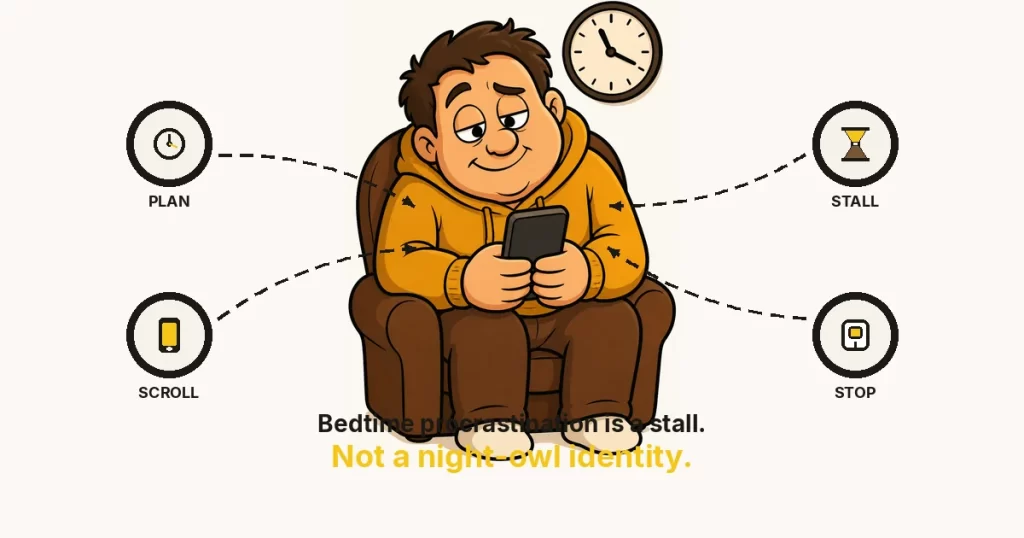
Bedtime procrastination is going to bed later than you intended, even though nothing is stopping you. A bedtime was named, then traded for one more episode or scroll. It is not a night-owl identity and not a diagnosis. Shrink the first shutdown step instead of renegotiating the clock.
Key takeaways
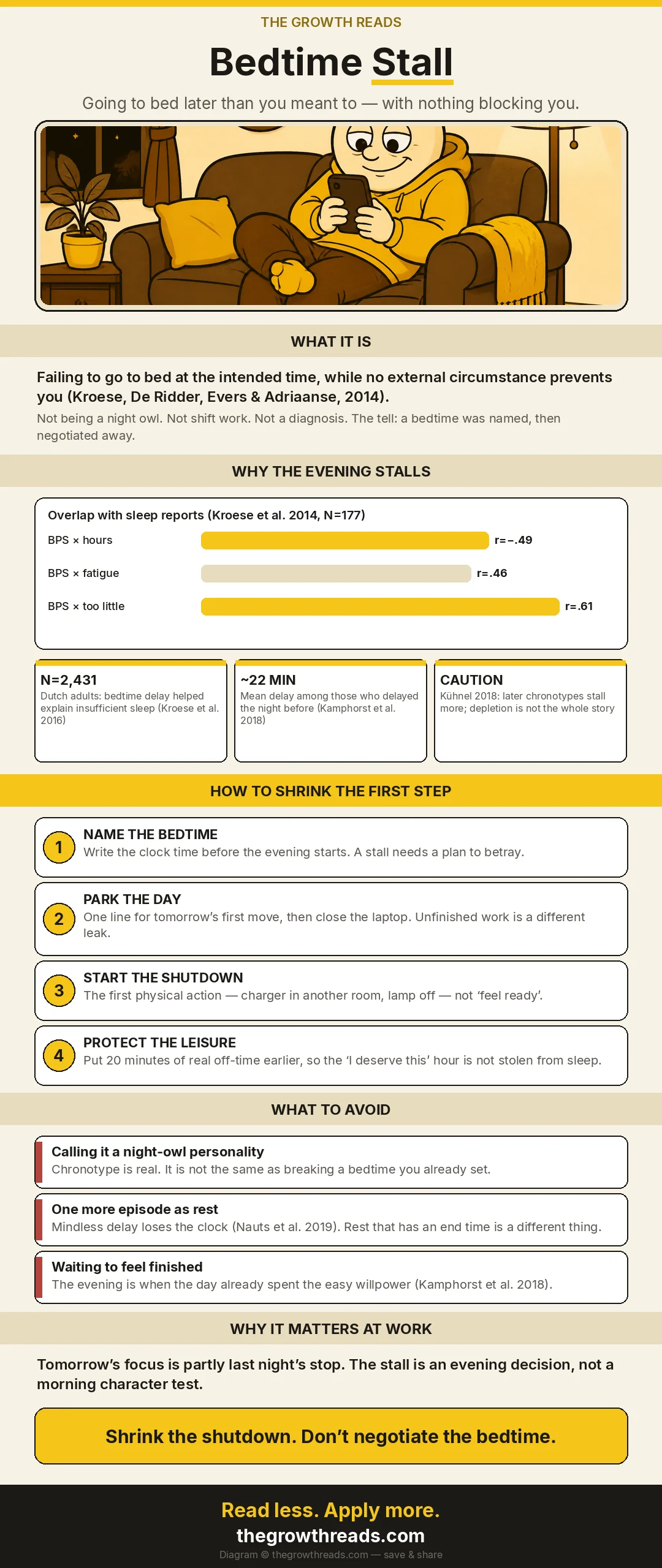
- Bedtime procrastination is failing to go to bed at the intended time while no external circumstance prevents it, and in a community sample it tracked insufficient sleep above and beyond general self-regulation (Kroese, De Ridder, Evers & Adriaanse, 2014).
- In a representative Dutch sample of 2,431 adults, bedtime delay helped explain the link between weaker self-regulation and reports of insufficient sleep — the evening stall was not just a personality label (Kroese, Evers, Adriaanse & de Ridder, 2016).
- People describe three evening stalls that look similar from the sofa: deliberate delay (“I deserve this”), mindless delay (losing the clock), and strategic delay that may not be procrastination at all (Nauts, Kamphorst, Stut, De Ridder & Anderson, 2019).
- A later chronotype predicts more work-day bedtime delay even after trait self-control is accounted for, so “owl” and “stall” are not the same mechanism (Kühnel, Syrek & Dreher, 2018).
- Days with more resisted temptations correlated with more bedtime delay (Spearman’s r = 0.21, N = 218), which is a small-to-moderate association, not proof that willpower is the whole story (Kamphorst, Nauts, de Ridder & Anderson, 2018).
What bedtime procrastination actually is
Bedtime procrastination is going to bed later than you intended, without an external reason that made the original bedtime impossible. Floor Kroese, Denise de Ridder, Catharine Evers and Marieke Adriaanse introduced the construct in 2014 with that test: the delay is voluntary, the intention existed, and the usual excuses — a night shift, a sick child, a diagnosed sleep disorder they screened out of the sample — are not what is running the clock.
That is the same shape as what “procrastinate” actually means in the work-and-habits sense: a delay of an intended action despite expecting to be worse off for it (Steel, 2007). The intended action here is not “become a morning person.” It is a specific shutdown you already named — lights out at eleven — and then failed to start.
Two boundary cases matter immediately. First, going to bed is not the same as falling asleep. Kroese’s team restricted the construct to getting into bed, because intending to sleep cannot always be enacted. This page follows that line. Second, “revenge bedtime procrastination” is a popular label for the deliberate variety — staying up to reclaim leisure after a day that felt owned by other people. It is a useful nickname for one motive. It is not a separate medical category, and it is not this article’s keyword.
How it differs from being a night owl
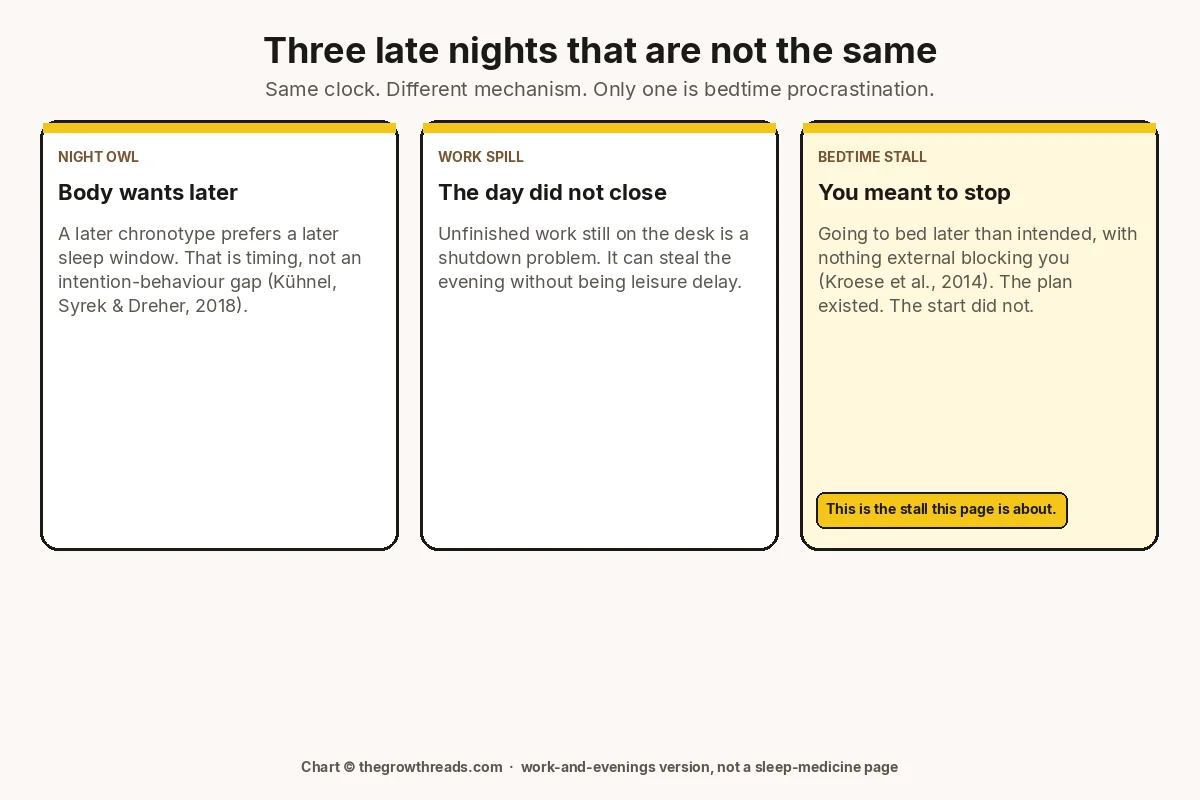
A night owl has a later preferred sleep window; bedtime procrastination is a broken plan inside whatever window you actually set. Jana Kühnel, Christine Syrek and Anne Dreher tracked 108 employees across five work days (399 matched evening-to-next-day reports) and found later chronotypes reported more bedtime procrastination on work days — a pattern that could not be reduced to trait self-control. For late chronotypes the stall also eased as the week went on, which is what you would expect if social jetlag, not a character defect, was part of Monday night.
That finding is the counter-case this page has to carry. If every late night were “low willpower,” earlier types and later types with the same self-control score would stall the same amount. They did not. Chronotype is real. It still does not license renaming a broken 11 p.m. plan as an identity.
What causes the evening stall
The evening stall happens because the first shutdown step is effortful at the exact moment the rest of the day has already spent the easy decisions. Procrastination research has said for years that delay is self-regulatory failure, not laziness — Steel’s 2007 review put impulsiveness, task delay, and low conscientiousness at the centre of the pattern. Bedtime is a special case of that pattern: the decision is trapped at the end of the day, when the next action is “stop doing something pleasant” rather than “start something aversive.”
Kroese’s 2014 community sample (N = 177, after dropping night-shift workers and people treated for sleep disorders) found bedtime procrastination correlated with general procrastination at r = 0.60 — overlapping, not identical — and with a composite self-regulation score at r = −0.52. The bedtime-specific scale predicted hours of sleep, daytime fatigue, and feeling under-slept much more tightly than the general procrastination scale did. In the final regressions, adding bedtime procrastination still improved the models after demographics and self-regulation were already in. That is the claim that this is a domain, not a mood.
Two later papers pull in opposite directions, and both should stay on the page. Bart Kamphorst, Sanne Nauts, Denise de Ridder and Joel Anderson (2018) asked 218 people how many desires they had tried to resist that day. More resist-attempts went with higher bedtime-procrastination scores (Spearman’s r = 0.21) and with a longer delay the night before (r = 0.17). Among people who delayed at all, the mean delay was about 22 minutes. That is a small-to-moderate link, retrospective, and not a randomised test of “depletion.” Treat it as a hint that a taxing day makes the sofa stickier — not as a law that tired people cannot turn in.
Kühnel’s diary study then found the opposite of the simple depletion story at the day level: on evenings when employees reported fewer self-regulatory resources just before bed, they reported less bedtime procrastination, not more. The authors’ reading is that bedtime delay on work nights is often a mismatch between the body’s clock and the office clock, not a tank of willpower hitting empty. Both papers can be true in different layers: a hard day can make leisure harder to stop, and a late chronotype can make an early lights-out plan unrealistic. The work move is to notice which one you actually have tonight.
That is also why this page sits under how to overcome procrastination rather than under a sleep clinic. The parent problem is an intention–behaviour gap. The evening is just where it shows up when the intended behaviour is “stop.”
The three stalls people describe
Interviews with frequent bedtime delayers split into deliberate delay, mindless delay, and a “strategic” wait that may not be procrastination. Nauts, Kamphorst, Wim Stut, de Ridder and Anderson (2019) sat with 17 people who delayed often but were not in shift work and did not report a diagnosed sleep disorder. The sample is small and qualitative — it cannot give you percentages for the general population — but the three themes are the most honest map we have of what the stall feels like from inside it.
- Deliberate delay. “I deserve some time for myself.” The day felt owned by other people, so the night is seized back. This is the motive the internet nicknamed revenge bedtime procrastination. Ali Abdaal’s Feel-Good Productivity is useful here for a different reason than hustle books: if the only joy in the day is stolen after 11 p.m., the stall is a scheduling problem as much as a character problem. Put a real, bounded off-block earlier and the “deserve this” argument has less to eat.
- Mindless delay. The clock disappears inside a show, a feed, a game. Exelmans and Van den Bulck (2021), interviewing 821 adults, found that weaker self-control linked to more bedtime procrastination partly through deficient control over television — not merely through how many hours were watched. Habitual viewing, interestingly, pointed the other way: a stable viewing habit was associated with less bedtime delay. Volume is not the mechanism. Ending is.
- Strategic delay. “I’ll sleep faster if I wait until I’m exhausted.” Nauts’s team flagged this as a possible mislabel: if you are delaying bedtime because you do not believe you can fall asleep yet, the problem may not be procrastination. This page does not diagnose that, list symptoms, or treat it. It just refuses to pretend every late night is the same stall.
Why it costs more than it feels like
One more episode feels free because it is short; the bill shows up as shorter sleep, more next-day fatigue, and a thinner morning. In Kroese’s 2014 sample, almost 30% reported sleeping six hours or less on week nights, and bedtime procrastination correlated r = 0.61 with days of feeling under-slept and r = 0.46 with daytime fatigue. Those are self-reports, not actigraphy, and the design cannot prove the stall caused the short night — tired people may also stall more. The 2016 paper (N = 2,431) still found bedtime procrastination sitting on the path between self-regulation and insufficient sleep in a representative adult sample. A BPS research digest of that paper reported 17.5% of respondents felt they generally did not get enough sleep, and more than half felt under-slept at least two nights a week. We cite those descriptives as the authors’ own sample picture, not as a universal rate.
The work cost is easier to feel than to cite from a single trial. Short sleep the night before is one of the boring ways focus gets worse the next morning: more residue, more checking, less patience for the first hard task. That is why this stall belongs in a productivity cluster rather than a wellness magazine. You are not failing a sleep exam. You are borrowing tomorrow’s attention to pay for tonight’s unstructured leisure.
Romana Kadzikowska-Wrzosek (2018) surveyed 304 people and found bedtime procrastination ran with fewer hours of sleep and more daily fatigue, and that eveningness partly carried the path from low self-regulation skills to the stall. Again: correlational, not causal. The practical read is still useful. If you are a later type, a 10:30 p.m. lights-out plan copied from a lark is a plan you will “procrastinate” because the body has not arrived yet. Move the plan, or protect a later window — do not moralise the miss.
What the evidence does not show. None of these studies prove that “trying harder at 11:07 p.m.” is the fix. Kroese 2014 is cross-sectional. Kamphorst 2018 is a modest rank correlation. Kühnel 2018 actively contradicts a simple depletion story at the day level. If a page promised that one willpower trick ends bedtime procrastination, it would be selling a mechanism the papers do not contain.
Four late nights that are not the same
Most “I went to bed late” stories collapse four different evenings into one confession. Separating them is the whole diagnostic job of this page — and it is a comparison, not a types-and-fix ladder. The fix, when there is one, is in the next section, and it only applies to the stall.
| Evening | What you intended | What actually happens | What it is |
|---|---|---|---|
| Bedtime stall | Lights out at a named time | Still on the sofa, knowing you meant to stop | Bedtime procrastination (Kroese et al., 2014) |
| Night owl | A later sleep window that matches the body | Later bedtime, without a broken earlier plan | Chronotype (Kühnel, Syrek & Dreher, 2018) |
| Work spill | The day would close | Inbox, slides, or a half-finished task still open | A shutdown miss — see evening routine |
| Strategic wait | Bed, but “I will not sleep yet” | Delaying because sleep itself feels unavailable | May not be procrastination (Nauts et al., 2019). Outside this page. |
Work spill is the sister that steals evenings without looking like leisure. If the laptop is still open, you do not have a scrolling problem yet — you have an unfinished-day problem. Park the next action, then shut the machine. Leisure delay that starts after the machine is closed is the stall this article is actually about.
How to shrink the first shutdown step
Treat the bedtime as a two-minute start, not a personality renovation: name the time, park tomorrow, begin the shutdown with one physical action, and put a real leisure block earlier so the night is not the only joy in the day. This is play-slot guidance, not a numbered HowTo. The research does not hand us a validated five-step protocol for bedtime delay. What it does hand us is a mechanism — an intention–behaviour gap at the end of the day — and a family of tools that already work on that gap in other domains.
Name the bedtime before the evening starts. A stall needs a plan to betray. “Whenever I get tired” is not a plan; it is an invitation to the next episode. Write a clock time. If you are a later chronotype, write a later clock time you can actually meet on work nights rather than a lark’s bedtime you will only perform guilt about. Kühnel’s data is the permission to be honest here.
Park the day in one line. Unfinished work is a different leak from leisure delay, and it keeps the brain on the task (the same residue problem we cover in focus work). One sentence — “tomorrow, open the deck at the pricing slide” — then close the laptop. That is the evening-routine move, borrowed, not reinvented. If the day never ends, the stall never gets a chance to be about rest. It stays about spill.
Start the shutdown with a physical first action, not a feeling. The two-minute rule is the right grain: plug the phone in another room, stand up, switch the lamp. Kroese’s 2014 discussion already pointed at implementation intentions as a candidate because they do not ask for a fresh burst of willpower at 11 p.m. We use them the same way on implementation intentions for daytime tasks: “When the episode ends, I plug the phone in the kitchen.” Gollwitzer’s if–then format is the tool. It is not magic, and it has not been trialled as the official bedtime-procrastination cure. It is simply the cheapest way to make the first step smaller than “become disciplined.”
Protect leisure earlier so you are not stealing it from sleep. Deliberate delayers in Nauts’s interviews were not chasing work. They were chasing a piece of the day that had felt like theirs. Feel-Good Productivity is the down-link for that motive: energy and enjoyment are design problems, not moral ones. Jake Knapp and John Zeratsky’s Make Time is the sister tactic — a highlight that is allowed to happen while you are still allowed to be awake. Alex Soojung-Kim Pang’s Rest makes the same point from the other side: rest that has a start and a stop is a skill. Rest that is only whatever is left after 11:40 is how mindless delay wins.
Screens are often the vehicle, not the whole disease. If the stall is a feed that does not end, the overlap with how to reduce screen time is real — deficient control over the session, not the mere presence of a television, was Exelmans and Van den Bulck’s mediator. Put the phone to bed first. Then you can find out whether you still wanted “one more episode,” or you only wanted a device in your hand.
Common mistakes
- Relabelling a broken plan as a night-owl identity. Chronotype is real (Kühnel et al., 2018). Using it to excuse a bedtime you already set is a different move.
- Using “one more episode” as rest. Mindless delay is rest that lost the clock (Nauts et al., 2019). Rest with an end time is the version that actually returns you to tomorrow.
- Leaving the day open so the evening never starts. Work spill is not leisure. Close the laptop, then notice whether the stall remains.
- Waiting to feel ready to stop. Readiness at 11 p.m. is a feeling the feed is designed to postpone. Start the shutdown with an action.
- Copying a 5 a.m. identity instead of a shutdown. This page is not a morning-routine article. If mornings are the actual problem, start with how to build a morning routine — after you have a night that ends.
- Treating a repeating stall as a character verdict. A loop can be chronic procrastination in the work-and-habits sense: delay as the default, not a medical label. Change the first step, then see what is left.
- Stacking sleep-hygiene advice onto a procrastination problem. Cool rooms and dark blinds help sleep once you are in bed. They do not start the walk to the bed. Wrong layer.
If the pattern is the full procrastination cycle — stall, soothe, squeeze, repeat — the evening is one lap, not a separate personality. Shrink that lap the same way you would shrink a daytime one: smaller first action, earlier reward, less negotiation.
The evidence behind this
Every figure above traces to a specific paper. Here is the short version of what each one actually found — and what it does not prove.
| Study | Design & size | What it found | Used here for |
|---|---|---|---|
| Kroese, De Ridder, Evers & Adriaanse (2014), Frontiers in Psychology | Online community survey, N = 177 after exclusions | 9-item bedtime procrastination scale; r = 0.60 with general procrastination; predicted sleep hours, fatigue, and insufficient sleep beyond self-regulation | The definition, and the claim that this is a domain of delay |
| Kroese, Evers, Adriaanse & de Ridder (2016), Journal of Health Psychology | Representative Dutch adults, N = 2,431, plus a sleep diary | Bedtime procrastination mediated the self-regulation → insufficient-sleep path | Prevalence in a general-population sample; still correlational |
| Nauts, Kamphorst, Stut, De Ridder & Anderson (2019), Behavioral Sleep Medicine | Qualitative interviews, N = 17 frequent delayers | Three themes: deliberate, mindless, and strategic delay | The varieties — not population rates. Strategic delay may not be procrastination |
| Kamphorst, Nauts, de Ridder & Anderson (2018), Frontiers in Psychology | Retrospective survey, N = 218 | Resisted desires that day correlated with BPS (r = 0.21) and delay minutes (r = 0.17); mean delay ~22 minutes among those who delayed | The “taxing day” hint. Small-to-moderate, not causal |
| Kühnel, Syrek & Dreher (2018), Frontiers in Psychology | Daily diary, 108 employees, 399 day-pairs | Later chronotypes delayed more on work days; day-level low resources predicted less delay, not more | The counter-case against a pure depletion story |
| Exelmans & Van den Bulck (2021), Communication Research | Face-to-face interviews, N = 821 adults | Self-control → bedtime procrastination path ran through deficient TV self-regulation; viewing volume was not a mediator | Why “just watch less” under-solves ending the session |
| Kadzikowska-Wrzosek (2018), Personality and Individual Differences | Survey, N = 304 | Bedtime procrastination linked to less sleep and more fatigue; eveningness partly mediated low self-regulation → stall | Chronotype as a carrier, not a moral |
| Steel (2007), Psychological Bulletin | Meta-analysis, 691 correlations | Procrastination as self-regulatory failure; strong predictors include impulsiveness, delay, conscientiousness | The parent definition this stall inherits |
Frequently asked questions
What is bedtime procrastination?
Bedtime procrastination is going to bed later than you intended even though nothing external is preventing you from turning in. Kroese, De Ridder, Evers and Adriaanse defined it that way in 2014 and showed it tracked shorter sleep, more fatigue, and more days of feeling under-slept beyond a general self-regulation score. The tell is a named bedtime you then negotiate away — not a later body clock, and not a night you did not control.
Is bedtime procrastination the same as being a night owl?
No. A night owl prefers a later sleep window. Bedtime procrastination is failing a bedtime you already set, inside whatever window you chose. Kühnel, Syrek and Dreher’s 2018 diary study found later chronotypes reported more work-day delay even after trait self-control was accounted for, so biology can make an early plan unrealistic. The honest move is to set a bedtime your clock can meet, then keep it — not to relabel a broken 10:30 plan as an identity.
Is revenge bedtime procrastination a different problem?
It is a popular name for one motive, not a separate diagnosis. Nauts and colleagues’ interviews called this deliberate delay: staying up because the day felt owned by other people and the night is the first block that feels like yours. The mechanism is still an intention–behaviour gap. The practical difference is where you put leisure — earlier, on purpose — so the only joy in the day is not stolen from sleep.
Does a hard day make bedtime procrastination worse?
Sometimes, and the effect is modest. Kamphorst, Nauts, de Ridder and Anderson (2018) found that people who had resisted more desires during the day reported more bedtime delay that night (Spearman’s r = 0.21). Kühnel’s diary study found the opposite at the evening level: fewer self-regulatory resources just before bed went with less delay, not more. Read a taxing day as a risk factor for sticking to the sofa, not as proof you are depleted past the point of walking to bed.
How do I stop bedtime procrastination tonight?
Do not renovate your personality at 11:07 p.m. Write the bedtime before the evening starts, park tomorrow in one sentence, then start the shutdown with a physical first step — charger in another room, laptop closed, standing up. Implementation intentions (“when the episode ends, I plug the phone in the kitchen”) are the format borrowed from Gollwitzer, not a trialled bedtime protocol. If leisure is the real hunger, put twenty minutes of it earlier so “I deserve this” is not the only remaining argument.
Is scrolling at night the same as bedtime procrastination?
Scrolling is often the vehicle. The stall is the missing stop. Exelmans and Van den Bulck (2021) found that deficient control over television — trouble ending the session — sat on the path from low self-control to bedtime delay, while sheer viewing volume did not. A feed with no ending will eat any bedtime you have not protected with a first action. Put the phone to bed, then see whether you still wanted the show.
What if I go to bed and still cannot sleep?
That is outside this article. Kroese’s team defined bedtime procrastination as delaying getting into bed, not as failing to fall asleep once you are there, because intending to sleep cannot always be enacted. Nauts’s “strategic delay” — waiting until exhaustion because you do not believe sleep will come yet — may not be procrastination. This page does not diagnose, treat, or list clinical signs. If the problem starts after you are already in bed, it is a different problem.
Why does bedtime procrastination hurt work the next day?
Because tomorrow’s attention is partly last night’s stop. Kroese’s samples linked the stall to shorter sleep and more daytime fatigue; those are self-reports, not proof of a single causal arrow. The practical cost is still obvious in knowledge work: a thinner morning, more checking, less patience for the first hard task. Treat the evening stall as a productivity leak with a clock time attached, not as a wellness hobby you will get to later.
Related reading on The Growth Reads
The books this stall sits next to
- Feel-Good Productivity summary — why the “I deserve this” hour shows up, and how to design enjoyment earlier than 11 p.m.
- Make Time summary — a highlight that is allowed to happen while you are still allowed to be awake
- Rest summary — rest with a start and a stop, not whatever is left after the feed
Related articles
- How to overcome procrastination — the parent system this evening stall belongs to
- What procrastination actually means — the intention–behaviour definition this page inherits
- The procrastination cycle — stall, soothe, squeeze, repeat, including at night
- Evening routine — closing the workday so leisure delay is not work spill in disguise
- How to reduce screen time — ending the session, not just shortening it
- Chronic procrastination — when delay is the default rather than one late night
Go deeper
How this article was researched
The Growth Reads editorial team writes from primary sources: the books themselves and the peer-reviewed literature behind the claims. Every study cited above was checked against the original publication or its published abstract, and every figure is quoted with its design, sample and effect so you can judge its weight rather than take ours. Where a finding is correlational rather than causal, qualitative rather than counted, or actively contradicted by a later diary study, we say so in the body.
This article is the work-and-evenings version of bedtime procrastination. It is not medical advice, not a sleep-disorder guide, and not a diagnosis page. Difficulty that starts after you are already in bed sits outside this article.
How we work: every article on The Growth Reads is built from the books in our library plus the research they rest on, and is reviewed and date-stamped when the evidence changes. Read our full methodology.
Sources
- Kroese, F. M., De Ridder, D. T. D., Evers, C., & Adriaanse, M. A. (2014). Bedtime procrastination: introducing a new area of procrastination. Frontiers in Psychology, 5, 611. doi:10.3389/fpsyg.2014.00611
- Kroese, F. M., Evers, C., Adriaanse, M. A., & de Ridder, D. T. D. (2016). Bedtime procrastination: A self-regulation perspective on sleep insufficiency in the general population. Journal of Health Psychology, 21(5), 853–862. doi:10.1177/1359105314540014
- Nauts, S., Kamphorst, B. A., Stut, W., De Ridder, D. T. D., & Anderson, J. H. (2019). The explanations people give for going to bed late: A qualitative study of the varieties of bedtime procrastination. Behavioral Sleep Medicine, 17(6), 753–762. doi:10.1080/15402002.2018.1491850
- Kamphorst, B. A., Nauts, S., de Ridder, D. T. D., & Anderson, J. H. (2018). Too depleted to turn in: The relevance of end-of-the-day resource depletion for reducing bedtime procrastination. Frontiers in Psychology, 9, 252. doi:10.3389/fpsyg.2018.00252
- Kühnel, J., Syrek, C. J., & Dreher, A. (2018). Why don’t you go to bed on time? A daily diary study on the relationships between chronotype, self-control resources and the phenomenon of bedtime procrastination. Frontiers in Psychology, 9, 77. doi:10.3389/fpsyg.2018.00077
- Exelmans, L., & Van den Bulck, J. (2021). “Glued to the tube”: The interplay between self-control, evening television viewing, and bedtime procrastination. Communication Research, 48(4), 594–616. doi:10.1177/0093650216686877
- Kadzikowska-Wrzosek, R. (2018). Self-regulation and bedtime procrastination: The role of self-regulation skills and chronotype. Personality and Individual Differences, 128, 10–15. doi:10.1016/j.paid.2018.02.015
- Steel, P. (2007). The nature of procrastination: A meta-analytic and theoretical review of quintessential self-regulatory failure. Psychological Bulletin, 133(1), 65–94. doi:10.1037/0033-2909.133.1.65