

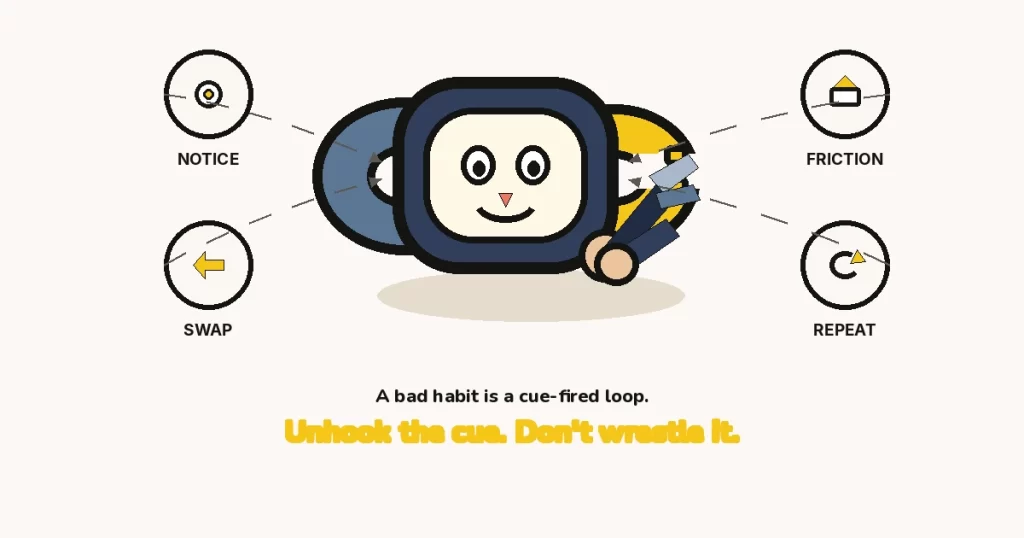
How to break bad habits is to unhook the cue that fires them, swap in a same-place replacement, and watch the old loop when it starts. Wood, Tam and Guerrero Witt (2005) found habits survive a life change only when the context stays the same. Edit the loop, not the person.
Key takeaways
- Wood, Tam and Guerrero Witt (2005) found students’ exercising, newspaper and TV habits survived a university transfer only when the performance context stayed the same — a new intention was not enough on its own.
- Neal, Wood, Wu and Kurlander (2011) found habitual cinema-goers ate similar amounts of stale and fresh popcorn, but only in the cinema, and only when they could eat with the usual hand.
- Quinn, Pascoe, Wood and Neal (2010) found strong unwanted habits were controlled most effectively by vigilant monitoring — watching for the slip in the moment — not by a generic pep talk.
- Adriaanse, Gollwitzer, de Ridder, de Wit and Kroese (2011) showed a replacement if-then can overrule a habitual response; a later 2011 paper found “I will not” wording can keep the old action accessible.
- Lally, van Jaarsveld, Potts and Wardle (2010) found missing one day did not wreck automaticity; the sister page owns the 18–254 day clock. This page owns the unhook.
What breaking a bad habit actually is (and what it isn’t)
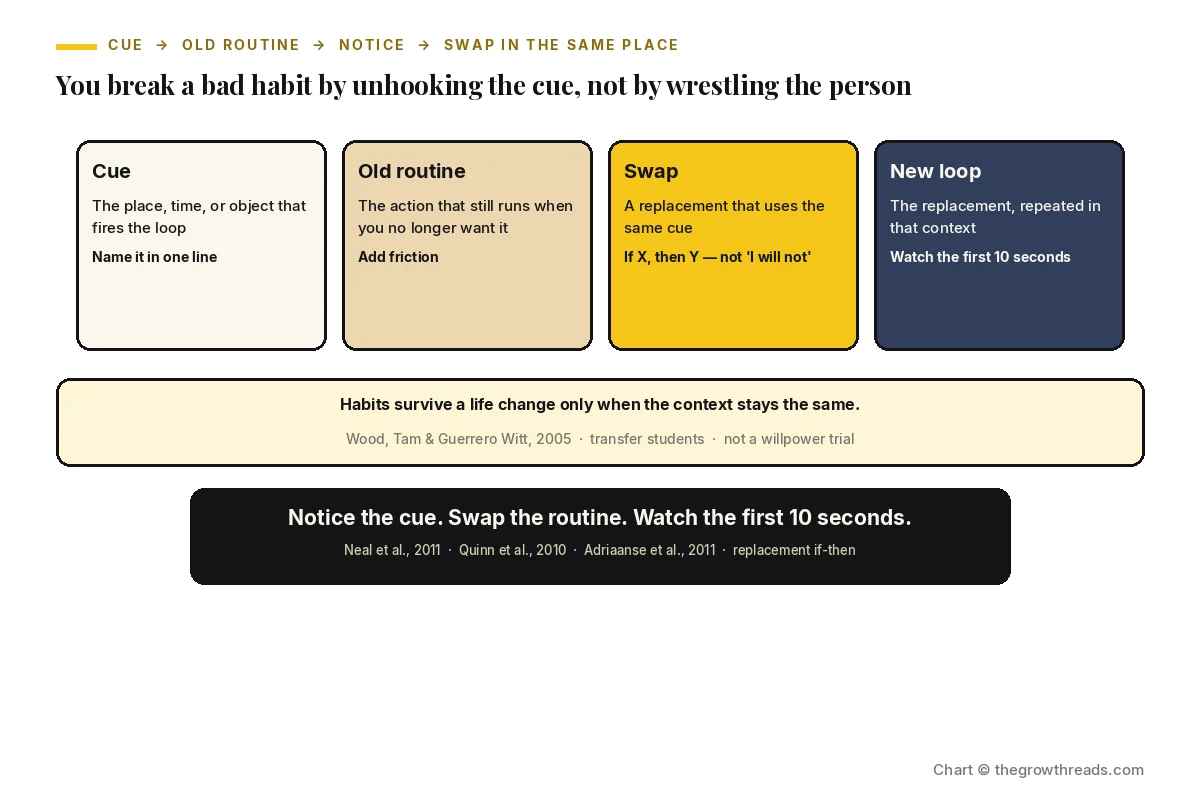
How to break bad habits, on this page, is a work-and-life method: name the cue that fires the loop, add friction to the old routine, write a replacement you can do in the same place, and watch the first ten seconds when the cue shows up. It is not a personality transplant. It is not a 21-day slogan. It is not addiction treatment or a quiz. Wood, Tam and Guerrero Witt (2005) already showed the lever is the context that cues the action. The sister page, how long does it take to break a habit, owns the clock. This page owns the unhook.
That job is narrower than “try harder.” A bad habit here is an action that still runs when you no longer want it, because the place, time or object still fires it. Phone on the desk. Snooze because the phone is the alarm. Snack because the meeting ended. The catalogue sits on bad habits: examples, and what replaces them. The parent, keystone habits, is the one habit that pulls others with it. This URL is the method for taking one unwanted loop apart.
How is this different from the clock, the catalogue, or stacking?
This page unhooks an existing loop; how long does it take to break a habit owns how long a new automaticity curve takes; bad habits examples names the loops; habit stacking attaches a new action to a cue you already do. Four jobs. Four pages. Stacking borrows a cue to add something. This page unhooks a cue to stop something, then puts a replacement in the same slot. If the missing piece is a scorecard of what you are actually repeating, that is which habits to track. This page ends when the old action is no longer the automatic move in that room.
Why the old loop still wins
The old loop still wins because the context keeps firing it, the action can run even when you no longer like it, and a vague “I will not” plan leaves the old response sitting in memory. Wood, Tam and Guerrero Witt (2005) is the first motor: when students transferred university, exercising, newspaper reading and TV watching survived only when aspects of the performance context did not change. A new intention did not, by itself, explain the disruption. Change the room, or the loop stays.
The second motor is that a strong habit can ignore the fact that you do not want it today. Neal, Wood, Wu and Kurlander (2011) gave cinema-goers fresh or week-old popcorn. People with a strong cinema-popcorn habit ate similar amounts either way — but only in the cinema, and in a second study only when they could eat with their dominant hand. Weak-habit eaters tracked liking and hunger. That is a field experiment in one food context, not a law about every vice. It is still why this page does not start with “just want it less.”
The third motor is the plan you write. Adriaanse, Gollwitzer, de Ridder, de Wit and Kroese (2011) found a counter-habitual if-then that names a replacement can strip the old response of its cognitive head start. A separate 2011 paper by Adriaanse, van Oosten, de Ridder, de Wit and Evers found that plans worded as “I will not” can ironically keep the unwanted action accessible. If the stall is a missing new habit rather than an old one, that is already on habit stacking.
The four triggers, in the order you can actually pull them
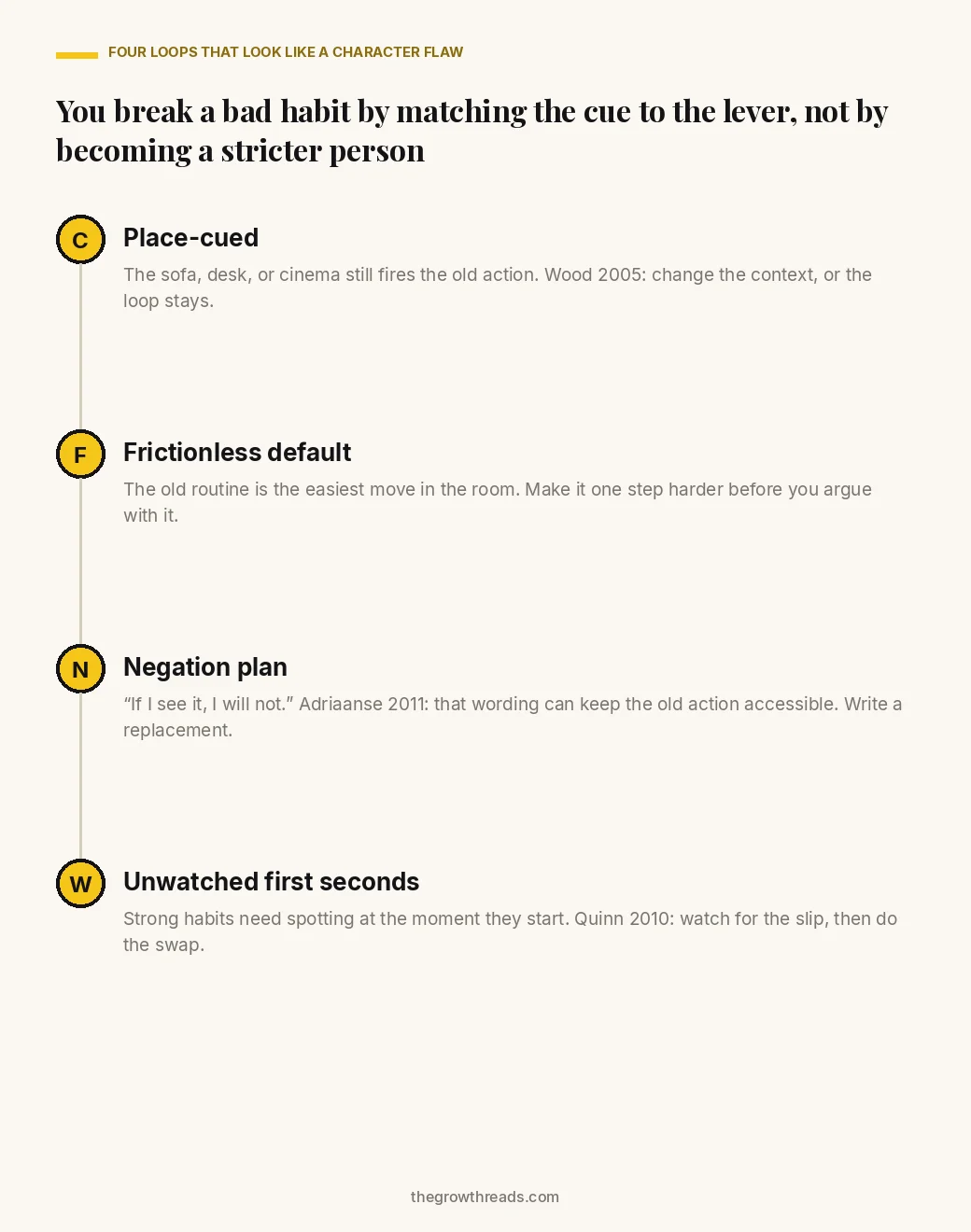
- Place-cued. The sofa, desk, or cinema still fires the old action. Wood 2005. Step 1 names that place. Step 2 changes one piece of it.
- Frictionless default. The old routine is still the easiest move in the room. Verplanken and Wood (2006) call that an upstream problem: disrupt the cue before the action runs. Step 2 is one extra step, not a speech.
- Negation plan. “If I see it, I will not.” Adriaanse 2011 on ironic wording. Step 3 writes a replacement that uses the same cue.
- Unwatched first seconds. The loop has already started before you notice. Quinn, Pascoe, Wood and Neal (2010) found vigilant monitoring — thinking “don’t do it,” watching for the slip — was the diary strategy that actually controlled strong habits. Step 5 is that watch, then the swap from Step 4. Napoleon Hill’s Outwitting the Devil is the book for the failure mode he called drifting: going along without deciding.
Why the loop costs more than it feels like
The loop feels like a small repeat, and it is often a context that keeps spending attention, time, and the next hour’s start without a new decision. Neal et al. (2011) is why the bill is not “I still like this.” Habitual cinema-goers ate the stale popcorn anyway, in the room that cued it. Quinn et al. (2010) is why a pep talk after the fact is usually late: strong habits were controlled in the moment of firing, not by a later story about willpower. A week of “I meant to stop” can be the same cue, firing, unpaid.
Verplanken and Wood (2006) is the invoice in policy language: interventions that only change beliefs and intentions are a poor match for behaviours people have repeated into habits. They split downstream-plus (information at a moment when the context is already changing) from upstream (disrupt the cue before the action). This page is the personal version of that split. It is a review paper, not a trial of this sequence. Treat it as the map, not a guarantee. If the object is the phone, phone distraction is the cousin page. This page is only the loop you can name in one room.
The honest limit: there is no randomised trial of this exact six-step sequence. Wood 2005 is transfer students, not your kitchen. Neal 2011 is popcorn in a cinema. Quinn’s diaries are self-report of strategies, then a lab follow-up. Webb, Sheeran and Luszczynska (2009) found if-then plans reduced smoking among people with weak or moderate habits, not among those with the strongest ones — so a strong loop needs context change too, and this is not a cessation page. Related reading on productivity systems and summaries helps because no single cue owns every loop.
The four loops — and the fix for each
Most “just stop” speeches fail because they pull the wrong lever. Match the loop to the trigger that is winning, then pull that one.
| Pattern | What it looks like | The trigger that is winning | The fix that works |
|---|---|---|---|
| Place-cued | The action starts when you sit down, open the laptop, or walk into the usual room | Stable context — Wood, Tam & Guerrero Witt (2005) | Name the cue (Step 1). Change one piece of that place (Step 2) |
| Frictionless default | The old move is still the path of least resistance; the new one needs a hunt | Cue still in reach — Verplanken & Wood (2006) upstream | One extra step on the old routine before you argue with it (Step 2) |
| Negation plan | “If I see snacks / the phone / the snooze, I will not” | Old action kept accessible — Adriaanse, van Oosten et al. (2011) | Write a replacement that uses the same cue (Step 3), then if-then it (Step 4) |
| Unwatched first seconds | You notice the loop after it has already started, then call it a character flaw | No monitoring at fire time — Quinn et al. (2010) | Watch the first ten seconds (Step 5), then do the swap. Repeat (Step 6) |
How to break bad habits: the 6-step system
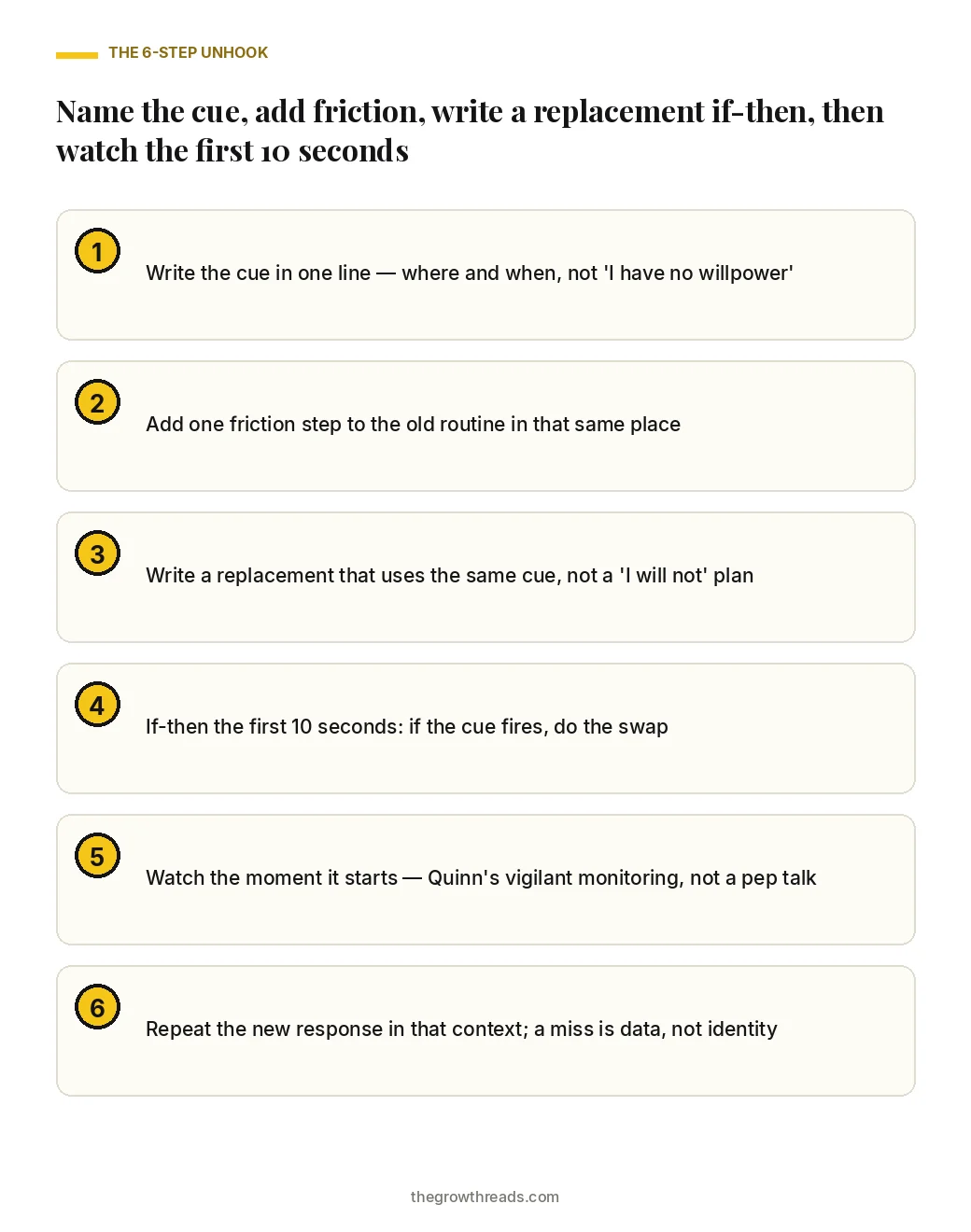
Break a bad habit by naming the cue, adding friction to the old routine, writing a same-place replacement, if-thening the first ten seconds, watching the moment it starts, and repeating the new response in that context — treating a miss as data. Do not start by becoming a stricter person. Do not wait for a week with no other work. Do not mash this with habit stacking’s add-a-cue, or with how long it takes as if a calendar number were the method. Those pages still apply when you are attaching a new action, or asking how long automaticity takes. This sequence is for when the old loop is still the automatic move in that room.
Step 1 — Write the cue in one line — not “I have no willpower”
On paper, write the cue a stranger could score: “phone on the desk at 16:00,” “sofa after dinner,” “laptop opens to the same tab,” not “I am weak.” If the sentence still sounds like a verdict on you, you have not named the cue. Wood, Tam and Guerrero Witt (2005) is the test: what in the performance context is still the same? The catalogue page, bad habits examples, is the longer list. This step is one line, dated, next to the room. If the stall is a missing keystone rather than an old loop, stop and use keystone habits instead of collecting another insight. One sentence. Then friction.
Step 2 — Add one friction step to the old routine in that same place
Leave the cue named. Make the old action one step harder in that room: charger in another room, snack off the desk, alarm across the floor, tab that does not auto-open. Verplanken and Wood (2006) is why this is upstream: disrupt the environmental factor that automatically cues performance, rather than giving yourself another lecture after it has fired. Quinn et al. (2010) is the honest limit: in their diaries, stimulus control helped temptations more than strong habits, which still needed monitoring. So friction is not the whole system. It is the cheap first edit. If you cannot name one extra step, you are still arguing with the person. Sit on Step 2 until the extra step is boring and physical.
Step 3 — Write a replacement that uses the same cue, not a “I will not” plan
Write what you will do instead when that cue fires: kettle on, two-minute walk, a paper notebook, the next line of the actual file. Adriaanse, Gollwitzer, de Ridder, de Wit and Kroese (2011) is why the replacement is the point: the if-then can strip the old means of its head start in the horse race. Adriaanse, van Oosten, de Ridder, de Wit and Evers (2011) is why you do not write “I will not eat / scroll / snooze.” That wording can keep the old action sitting in memory. This step is only the substitute that can occupy the same slot. Implementation intentions is the longer method page for the if-then form; this step is the content of the plan.
Step 4 — If-then the first 10 seconds: if the cue fires, do the swap
Write the plan as If I sit on the sofa after dinner, then I put the kettle on, not “I will do better this week.” That is the Adriaanse 2011 replacement form, sitting on top of Gollwitzer’s if-then. Webb, Sheeran and Luszczynska (2009) is why this is not magic on a very strong loop: their if-then helped weaker and moderate smoking habits, not the strongest ones. Combine it with Step 2’s context edit. A time audit is how you see where the cue actually lives. The first ten seconds are the whole step.
Step 5 — Watch the moment it starts — Quinn’s monitoring, not a pep talk
When the cue fires, notice it on purpose. Quinn, Pascoe, Wood and Neal (2010) found that for strong habits, the diary strategy that worked was vigilant monitoring: thinking “don’t do it,” watching carefully for slipups. Their follow-up experiment suggested that helps by heightening inhibitory control in the moment, not by erasing the habit memory. So this step is attention at fire time, then the swap from Step 4. It is not a speech at 23:00. Hill’s Outwitting the Devil is the name for the opposite: drifting. If accountability is the missing piece, how to take accountability is the scorecard.
Step 6 — Repeat the new response in that context; a miss is data, not identity
Do the replacement in that same place until it is the easier move. Lally, van Jaarsveld, Potts and Wardle (2010) is why a miss is not a restart: missing one opportunity did not materially affect the automaticity curve, and the time to 95% of asymptote ranged from 18 to 254 days with a median of 66 among those with a good model fit. The sister page, how long does it take to break a habit, owns that clock. This step only says: same cue, same replacement, again. Consistency is the cousin page when the question is repeating at all. Write the miss on the line for the next time. Do not found a new identity from one slip.
What to do when you slip
When the old loop has already run, do not restart from a blank personality: name the cue that just fired, do the replacement once now if the context is still there, and keep tomorrow’s if-then as written. A new vow at 23:00 is how drifting gets a second vote. You are allowed to be annoyed. You are not required to found a new system.
If you have not named the cue at all, do Step 1 tonight and skip the poetry. If the stall is a ritual you cannot choose to skip, that is the next section, not a kettle. This page’s job that evening is only: the cue on paper, the replacement once, and the same if-then in the morning.
Common mistakes
- Calling the loop a character flaw. Wood (2005) put the lever in the context. Name the cue, not the verdict.
- Waiting 21 days as if the number were the method. Lally et al. (2010) is a curve with a wide range. The sister page owns the clock. This page owns the unhook.
- Writing “I will not.” Adriaanse, van Oosten et al. (2011) is why that wording can keep the old action accessible. Write a replacement.
- Relying on if-then alone on a very strong loop. Webb, Sheeran and Luszczynska (2009) saw weaker effects when the habit was strongest. Add Step 2’s friction.
- Mashing this with stacking. Habit stacking adds a new action to a cue you already do. This page unhooks an unwanted one.
- Using research as the work. If more comparison would not change the next ten seconds, that is how to stop overthinking. Park it. Then swap.
When it is more than a habit
A six-step unhook will not fix a loop you cannot choose to skip, a substance you cannot drop by moving a charger, or a night that is standing in for a conversation about the job — those are different problems, and this page is the wrong tool for them. If you cannot drop a ritual even when you want to, that is outside a productivity how-to. We will not list signs, name a disorder, or walk a clinical scale. Webb’s smoking finding is cited only as a habit-strength moderator, not as a cessation plan. Talk to a clinician rather than adding an eighth step.
The evidence behind this system
The studies below are the context, popcorn, monitoring, if-then, and automaticity literature that makes a named cue plus a replacement a reasonable unhook. None of them is a trial of this exact six-step sequence.
| Study | Design & size | Finding | What we used it for |
|---|---|---|---|
| Wood, Tam & Guerrero Witt (2005), Journal of Personality and Social Psychology | Transfer-student field study; exercising, newspaper, TV habits across a university move | Habits survived the transfer only when aspects of the performance context stayed the same; intention change alone did not explain disruption | Step 1’s cue, Step 2’s context edit; not a willpower trial |
| Neal, Wood, Wu & Kurlander (2011), Personality and Social Psychology Bulletin | Two cinema field experiments; fresh vs 7-day-old popcorn; dominant vs non-dominant hand | Strong-habit eaters ate similar amounts of stale and fresh popcorn, only in the cinema and only with the usual hand | Why “just want it less” fails; correlational liking is not the lever |
| Quinn, Pascoe, Wood & Neal (2010), Personality and Social Psychology Bulletin | Two episode-sampling diary studies plus a lab experiment on inhibitory control | Vigilant monitoring controlled strong habits; stimulus control helped temptations more than strong habits | Step 5’s watch; honest limit that hiding the cue is not enough alone |
| Adriaanse, Gollwitzer, de Ridder, de Wit & Kroese (2011), Personality and Social Psychology Bulletin | Three experiments on accessibility of habitual vs alternative means | A replacement if-then removed the habitual means’ cognitive advantage; the alternative did not instantly become automatic | Steps 3–4: swap, then if-then; still need a strong goal to actually depart |
| Adriaanse, van Oosten, de Ridder, de Wit & Evers (2011), Personality and Social Psychology Bulletin | Experiments on implementation intentions that negate an unhealthy habit | “I will not” plans can ironically keep the unwanted action accessible | The honest wording warning: write a replacement, not a negation |
| Verplanken & Wood (2006), Journal of Public Policy & Marketing | Framework paper on habit-change interventions (not a new experiment) | Intention-only (downstream) interventions are a poor match for strong habits; upstream and downstream-plus target the cue | Step 2’s friction as an upstream edit; map, not a trial of this sequence |
| Webb, Sheeran & Luszczynska (2009), British Journal of Social Psychology | Lab task-switch experiment plus a smoking field test of if-then plans | If-then effects were smaller when the antagonistic habit was strong; smoking dropped for weak/moderate, not strongest, habits | Step 4’s limit; combine with context change; not a cessation how-to |
| Lally, van Jaarsveld, Potts & Wardle (2010), European Journal of Social Psychology | 96 volunteers, 82 with enough data; automaticity curves over 84 days | Median 66 days to 95% of asymptote among good model fits (range 18–254); missing one day did not wreck the process | Step 6; the sister page owns the clock. Self-report automaticity, not a break-habit RCT |
Frequently asked questions
How do you break a bad habit this week?
Write the cue in one line a stranger could score: the sofa at 21:30, the phone on the desk, the usual tab. Add one friction step in that same place. Write a replacement that uses that cue, as an if-then, not “I will not.” Watch the first ten seconds when the cue fires, then do the swap. Repeat it in that context. Wood, Tam and Guerrero Witt found habits survive a life change only when the context stays. A pep talk is not a system. An unhooked cue is. Do it in one room this week, not as a new personality.
Is breaking a bad habit the same as stacking a new one?
No. Habit stacking attaches a new action to a cue you already perform. This page unhooks an unwanted action that the same kind of cue is already firing. You can need both in one month. You should not mash them into one “just start” speech. If you are adding a two-minute start onto coffee, use the stacking page. If you are stopping the scroll that coffee currently fires, stay here, write the replacement, and watch the first ten seconds. The test is whether the old move is still automatic in that room. A new stack that leaves the old loop in place is a second habit, not an unhook.
Why does wanting to stop not break the loop?
Because the cue can fire the action even when you no longer like it. Neal, Wood, Wu and Kurlander found habitual cinema-goers ate similar amounts of stale and fresh popcorn, but only in the cinema, and only when they could eat with the usual hand. Wood, Tam and Guerrero Witt found transfer-student habits survived when the performance context stayed the same. A new intention did not, by itself, do the work. That is correlational plus field, not a trial of your kitchen. It is still why this how-to names the room before it names the person. Wanting to stop is the goal. The cue is the lever.
Should I write “I will not” as my plan?
No. Write a replacement that uses the same cue. Adriaanse, Gollwitzer, de Ridder, de Wit and Kroese found a counter-habitual if-then can strip the old means of its cognitive head start. A separate 2011 paper by Adriaanse, van Oosten, de Ridder, de Wit and Evers found that plans worded as not doing the old action can ironically keep that action accessible. So: if I sit on the sofa, then I put the kettle on. Not “I will not scroll.” Implementation intentions is the longer method page for the form. This page is the content of the plan. A negation is not a swap.
How long until the old habit is gone?
There is no honest single number, and this page does not own the clock. Lally, van Jaarsveld, Potts and Wardle found the time to 95% of automaticity ranged from 18 to 254 days, with a median of 66 among those with a good model fit, and missing one day did not wreck the process. That study tracked forming a new daily action, not deleting an old one. The sister page on how long it takes to break a habit is where that curve lives. This page’s job is the unhook you can run tonight. A 21-day slogan is not a finding.
What if the habit is very strong and if-then did nothing last time?
Then treat that as Webb, Sheeran and Luszczynska’s finding, not as a personal failure: if-then effects were smaller when the antagonistic habit was strong, and in their smoking field test the plan helped weak and moderate habits, not the strongest. Combine Step 4 with Step 2’s friction and Step 5’s watch. Change one piece of the room. Watch the first ten seconds. This is not a cessation how-to, and it is not a promise that a sentence on paper will overpower a loop that has had years of the same context.
Is this addiction treatment, or a clinical scale?
No. This is a productivity how-to for everyday work-and-life loops: the phone, the snooze, the desk snack, the tab. It is not a diagnosis, not a symptom list, and not a clinical scale. Webb’s smoking study is cited only as a habit-strength moderator. If you cannot choose to skip a ritual even when you want to, this page is the wrong tool — talk to a clinician rather than adding an eighth step. We will not list signs. A charger in another room is the work version. A scale you found at 1 a.m. is not a system, and it is not ours to interpret.
Will this six-step system break the habit for good?
No, and the evidence does not say it will. The studies on this page map context change, a cinema popcorn field experiment, diary monitoring, replacement if-thens, a wording warning, and an automaticity curve for new daily actions. They are not a trial of this sequence. Verplanken and Wood is a framework paper. Lally is self-report automaticity for forming, not a deletion RCT. An unhook is a bout. Next week needs the same cue line, or a new one if the room changed. Use it for the next loop. Do not use it as a promise you will never slip, and do not use it as a medical protocol.
Related reading on The Growth Reads
The book behind the unhook
- Outwitting the Devil summary & review — Napoleon Hill on drifting, the unnamed rhythm of going along; the book cousin of an unwatched cue, not a clinical manual
Related articles
- Keystone habits
- Habit stacking
- How long does it take to break a habit
- Bad habits: examples, and what replaces them
- Which habits to track
- What is consistency
- Implementation intentions
- How to take accountability
Go deeper
How this article was researched
The Growth Reads editorial team writes from primary sources: the books, and the peer-reviewed literature behind the claims. Every study cited above was read in the original publication or its published abstract, and every figure is quoted with its design, sample and effect so you can judge its weight. Where a finding is limited — a transfer-student field study, a popcorn experiment, a diary of strategies, a framework paper, or a six-step habit with no trial of its own — we say so.
How we work: every article on The Growth Reads is built from the books in our library plus the research they rest on, and is reviewed and date-stamped when the evidence changes. Read our full methodology.
Sources
- Wood, W., Tam, L., & Guerrero Witt, M. (2005). Changing circumstances, disrupting habits. Journal of Personality and Social Psychology, 88(6), 918–933. doi:10.1037/0022-3514.88.6.918
- Neal, D. T., Wood, W., Wu, M., & Kurlander, D. (2011). The pull of the past: When do habits persist despite conflict with motives? Personality and Social Psychology Bulletin, 37(11), 1428–1437. doi:10.1177/0146167211419863
- Quinn, J. M., Pascoe, A., Wood, W., & Neal, D. T. (2010). Can’t control yourself? Monitor those bad habits. Personality and Social Psychology Bulletin, 36(4), 499–511. doi:10.1177/0146167209360665
- Adriaanse, M. A., Gollwitzer, P. M., De Ridder, D. T. D., de Wit, J. B. F., & Kroese, F. M. (2011). Breaking habits with implementation intentions: A test of underlying processes. Personality and Social Psychology Bulletin, 37(4), 502–513. doi:10.1177/0146167211399102
- Adriaanse, M. A., van Oosten, J. M. F., de Ridder, D. T. D., de Wit, J. B. F., & Evers, C. (2011). Planning what not to eat: Ironic effects of implementation intentions negating unhealthy habits. Personality and Social Psychology Bulletin, 37(1), 69–81. doi:10.1177/0146167210390523
- Verplanken, B., & Wood, W. (2006). Interventions to break and create consumer habits. Journal of Public Policy & Marketing, 25(1), 90–103. doi:10.1509/jppm.25.1.90
- Webb, T. L., Sheeran, P., & Luszczynska, A. (2009). Planning to break unwanted habits: Habit strength moderates implementation intention effects on behaviour change. British Journal of Social Psychology, 48(3), 507–523. doi:10.1348/014466608X370591
- Lally, P., van Jaarsveld, C. H. M., Potts, H. W. W., & Wardle, J. (2010). How are habits formed: Modelling habit formation in the real world. European Journal of Social Psychology, 40(6), 998–1009. doi:10.1002/ejsp.674