

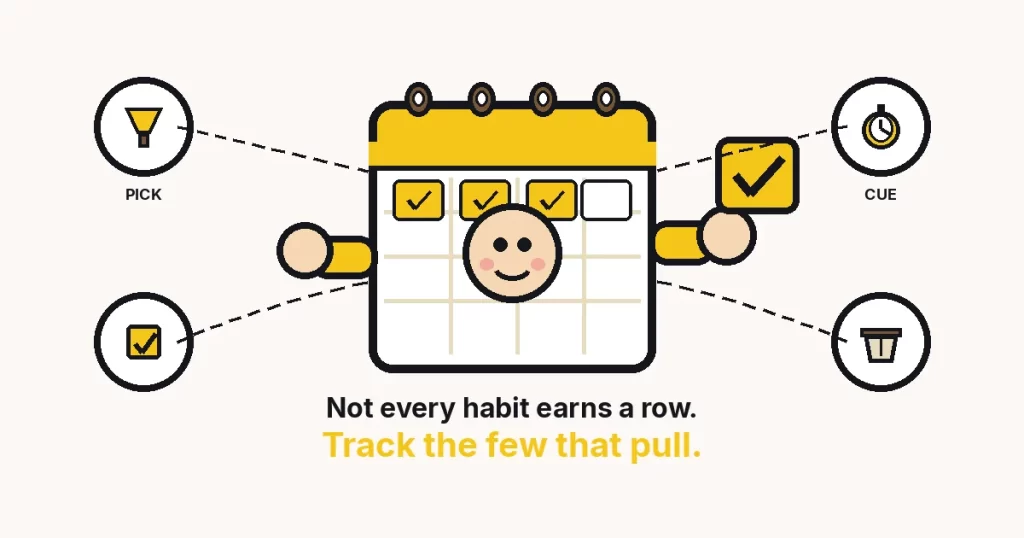
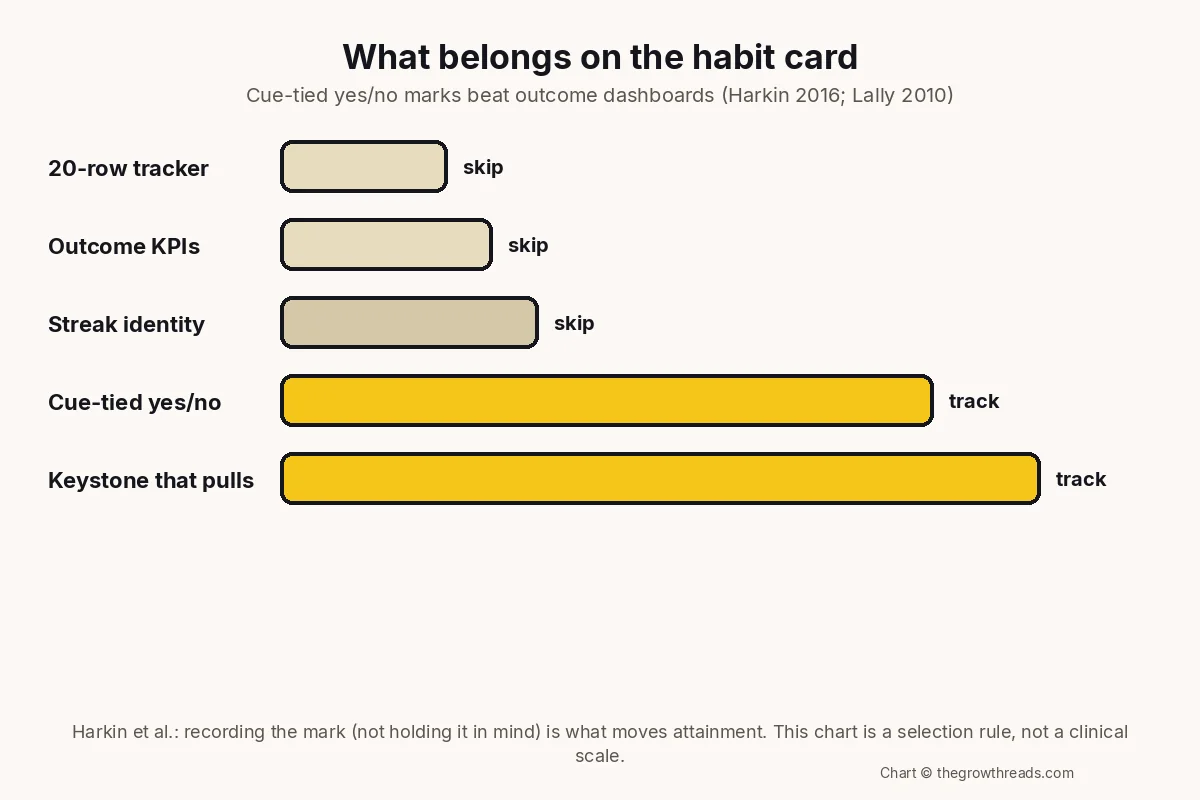
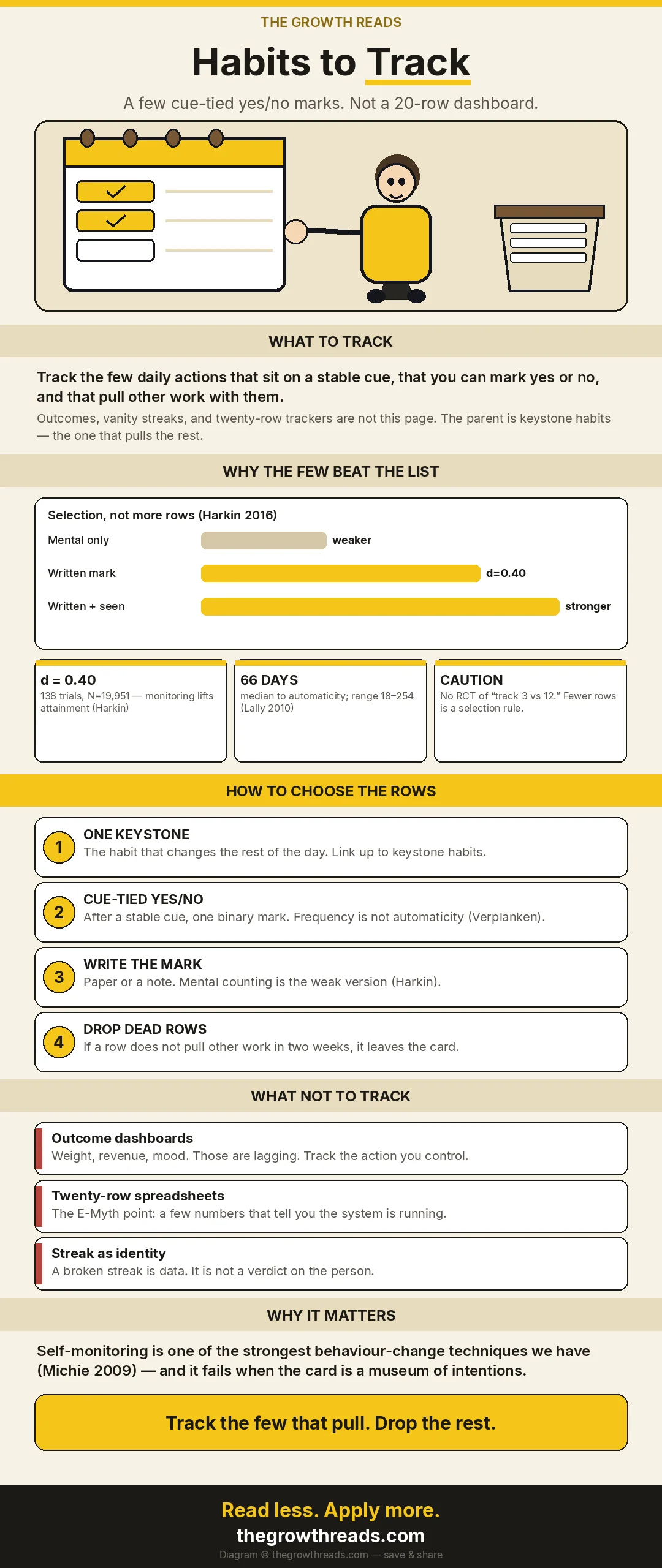
The habits to track are the few daily actions that sit on a stable cue, that you can mark yes or no, and that pull other work with them. Outcomes and twenty-row dashboards do not belong on the card. Write the mark down. Drop any row that does not change the rest of the day.
Key takeaways
- Progress-monitoring interventions raised goal attainment by d = 0.40 across 138 randomised studies (N = 19,951), with larger effects when the mark was physically recorded and when it was reported (Harkin et al., 2016).
- New daily actions reached 95% of modelled automaticity in a median of 66 days (range 18–254) in Lally, van Jaarsveld, Potts and Wardle’s 2010 sample; missing one opportunity did not materially derail the curve.
- Habit strength is not the same as how often you ticked a box: Verplanken and Orbell’s 2003 Self-Report Habit Index treats automaticity, history of repetition, and identity as a construct, not a frequency count.
- In Michie, Abraham, Whittington, McAteer and Gupta’s 2009 meta-regression of 122 physical-activity and healthy-eating evaluations, self-monitoring explained the most between-study heterogeneity and worked better with other control-theory techniques (pooled d = 0.42 versus 0.26).
- Between a third and a half of the everyday behaviours in Wood, Quinn and Kashy’s 2002 diary studies were classified as habits because they ran almost daily in the same location — which is why a cue-tied action earns a row and a floating intention does not.
What habits to track actually are
The habits to track are the few daily actions that sit on a stable cue, that you can mark yes or no before the day closes, and that pull other useful work with them. That sentence is the whole method. Everything else on a typical “50 habits to track” list is either an outcome you do not control today, a project pretending to be a tick, or a cosmetic streak.
This URL hangs off live keystone habits, the Habits cluster page later Habits articles link up to. A keystone is the one habit that changes the rest of the day. This page is the selection rule for the rest of the card: which supporting actions deserve ink, and which ones are clutter. Do not mint a second habits parent. The sister in this cluster is how to stack habits — once a row has earned its place, stacking is how you glue it to a cue you already never skip. The named unused review is Michael Gerber’s The E-Myth Revisited: work on the system, watch a handful of numbers that tell you the system is running, and stop collecting busywork that looks like management. The book stays on the review. This URL is the method. The productivity library sits at the productivity hub.
Tracking is not the habit. Tracking is a second, smaller action: noticing whether the first action happened and writing that down. Benjamin Harkin, Thomas Webb, Betty Chang, Andrew Prestwich, Mark Conner, Ian Kellar, Yael Benn and Paschal Sheeran quantified that second action in 2016 in Psychological Bulletin. Across 138 randomised studies and 19,951 people, interventions designed to increase progress monitoring did increase monitoring (d = 1.98) and, more importantly, raised later goal attainment (d = 0.40). The effect on attainment was larger when the information was physically recorded rather than held in mind, and larger when it was reported or made public. A card you actually mark is the recorded version. A vibe that “I think I wrote this week” is the weak version.
How is this different from tracking productivity, or from the habit loop?
How to track productivity is about whether the day’s output moved; the habit loop is the cue–routine–reward mechanism; this page is only which actions earn a row on the card. Mixing those three is how a useful yes/no mark turns into a second job.
How to track productivity asks whether a named output moved. Words shipped, tickets closed, a draft that did not exist this morning. Those are lagging and leading work metrics. They are not habits. A habit is the repeated action that makes those outputs more likely — open the draft after the kettle, put the phone in another room, write the six tasks tonight. If you put revenue on a habit card, you have smuggled an outcome into a yes/no square that cannot honestly be a yes/no.
The cue–routine–reward loop is a different object again. This page will use “stable cue” as a filter — Wood, Quinn and Kashy’s 2002 diaries classified a behaviour as habitual when it ran almost daily in the same location — but it does not own the loop as a model. That mechanism is a later Habits child. Here the job is narrower: given a life full of possible ticks, which few deserve ink.
Why tracking the wrong rows fails
A bloated card fails because monitoring only helps when you actually monitor the behaviour that matters, and a twenty-row museum is how people stop monitoring anything. Control theory — the family Harkin et al. sat their meta-analysis in — says you compare a current state to a standard and adjust. If the standard is “did I open the draft after coffee,” the comparison is cheap. If the standard is “did I live like a high-performer today,” there is nothing to mark, so the card becomes a mood.
Susan Michie, Charles Abraham, Craig Whittington, John McAteer and Sunjai Gupta’s 2009 meta-regression in Health Psychology is the behaviour-change version of the same point. They coded 122 evaluations of physical-activity and healthy-eating interventions (N = 44,747) into 26 techniques. The technique “self-monitoring” explained the most between-study heterogeneity (13%). Interventions that combined self-monitoring with at least one other control-theory technique — goal setting, feedback, reviewing goals, or a contextualised action plan — pooled at d = 0.42, against d = 0.26 for the rest. Two honest limits: this is diet and activity, not knowledge work, and a meta-regression of coded techniques is not a trial of a three-row versus twenty-row habit app. What it does support is the claim that writing the behaviour down is one of the strongest cheap moves we have, and that it works as part of a small self-regulation set, not as a hobby of collecting rows.
Phillippa Lally, Cornelia van Jaarsveld, Henry Potts and Jane Wardle (2010) then tell you what a useful row looks like in time. Ninety-six people picked one eating, drinking, or activity behaviour, tied it to a daily cue (“after breakfast”), and rated automaticity for 12 weeks. For the 39 people whose automaticity curve fitted well, the median time to 95% of the modelled plateau was 66 days, ranging from 18 to 254. Simpler actions moved faster. Missing a single day did not materially knock the curve off. The implication for the card is rude and useful: you are watching a slow automaticity curve on a few cue-tied actions, not running a 21-day challenge on a list of fifteen.
Two honest caveats. Harkin et al. mixed health, academic, and other goals; they did not randomise “track three work habits versus twelve.” Lally et al. used volunteers performing self-chosen daily health actions, not writers or operators. Use both papers as a mechanism — record a few cue-tied actions for long enough — not as a certificate that your specific three rows will plateau on day 66.
The four filters that earn a row
A row earns its place if it pulls other work, sits on a cue you already have, can be marked yes or no today, and would be missed if you dropped it. Fail any filter and the row is clutter, a project, or an outcome in costume.
| Candidate | Pulls other work? | Stable cue? | Yes/no today? | On the card? |
|---|---|---|---|---|
| Open the draft after the kettle | Yes — starts the deep block | Kettle, same counter | Yes | Track. Then stack it |
| Phone in another room for the first block | Yes — protects attention | Sit-down time | Yes | Track. Cousin: how to focus better |
| Read ten pages after lunch | Sometimes — only if reading is the keystone | Lunch, same chair | Yes | Track if it pulls; else sample via how to start a reading habit |
| Ship 2,000 words this month | It is the outcome | None | No — not a daily yes/no | Skip. That belongs on how to track productivity |
| Feel focused / be disciplined | A mood | None | No | Skip. Not a behaviour |
| A 20-item morning from the internet | No — it is a museum | Vague | You will not mark 20 | Skip. See how to build a morning routine |
Filter one is the keystone test, which is why this page links up rather than inventing a new parent. If the action does not change what happens next, it is decoration. Filter two is context. Wendy Wood, Jeffrey Quinn and Deborah Kashy’s 2002 diary studies in Journal of Personality and Social Psychology classified 35% (Study 1) to 43% (Study 2) of listed behaviours as habits because they were performed just about every day in the same location. Thoughts during those stretches often did not even match the action — the cue was doing the work. A row with no location and no preceding action has nothing to fire it. Filter three is binary. If you need a paragraph, a score out of ten, or a spreadsheet column, you have a project or an outcome. Filter four is the drop test. After two weeks, if skipping the row changed nothing about the rest of the day, it was never a keystone and never a support. Gerber’s franchise logic in The E-Myth Revisited is the same move: keep the few numbers that tell you the prototype is running, and stop drowning in measurements that only prove you are busy.
What “cue-tied yes/no” actually means
Write the action as “After X, in Y, I did Z” — then mark whether Z happened, not whether you felt like a person who does Z. That sentence is an implementation intention with a tick attached. The site already owns the planning half on implementation intentions. This page owns the tick. “Write more” fails every filter. “After I put the kettle on, at the counter, I opened the draft” passes three of them, and passes the fourth if opening the draft actually starts the work.
Bas Verplanken and Sheina Orbell’s 2003 Self-Report Habit Index exists because researchers kept using “I do this often” as if frequency were habit. The index asks about automaticity (“I do it without thinking”), history of repetition, and whether the action expresses identity. Gardner, Abraham, Lally and de Bruijn later showed you can keep the automaticity items and drop frequency and identity without losing the useful signal. For the card, that means a filled streak is not proof the action is a habit. It is proof you marked a box. When the kettle starts the draft without a debate, the row can retire. Until then, the mark is scaffolding.
Why a bloated habit card costs more than it feels like
Extra rows feel free because they are only squares, but each square is an open loop you now have to close, judge, and emotionally survive when it goes blank. The cost is not the two seconds of ticking. The cost is twelve unfinished standards sitting in working memory every evening.
A card with twenty intentions is a to-do list wearing a halo. You will not mark twenty. You will mark none, or you will mark the easy cosmetic ones — water, steps, a gratitude line — and leave the keystone blank. That pattern trains the card to reward the rows that never needed a card. It also turns a miss into a character judgement. Lally et al. (2010) is blunt here: one miss did not wreck automaticity. A moralised streak does. People quit the useful action because the necklace broke, which is the opposite of what a record is for.
There is a second, quieter cost. Tracking can become the work. Gerber’s warning about working in the business instead of on it maps cleanly: a founder who lives inside twelve dashboards is not running a prototype, and a person who lives inside a habit app is not running a morning. Consistency is showing up on the action. Why consistency is important is why the showing-up compounds. Neither page asks you to maintain a museum. The hub at the productivity library is full of methods that fail the same way when they become collections rather than a few moves you can name aloud.
How to choose which habits to track
Pick one keystone, attach at most two supports to cues you already have, write a binary mark, and drop any row that does not pull after two weeks. This is a selection pass, not a numbered how-to product. There is no HowTo schema on this page because the slot is a spoke.
Name the keystone first, using the parent test on keystone habits: if this action happens, which other useful actions get easier? For a lot of knowledge work that is “open the important file after a cue you never skip,” not “be a writer.” If you do not have a cue, do not add a row yet. Use habit stacking to park the action behind something that already happens — kettle, commute, closing the laptop. The two-minute rule is how you shrink a bloated action until it can be a yes/no. “Write the book” is not a habit. “Open the draft” is.
Write the mark where you will see it at the cue, not in an app you open at midnight. Harkin et al. (2016) is why recording beats mental counting, and why a mark other people can see — a partner, a wall calendar, a Friday review — is the stronger version of the same move. You do not need a social-media streak. You need a recorded comparison to a standard. PARA and a second brain can hold notes about the work. They are the wrong place to hide the three ticks. Those ticks want to live next to the kettle, not inside a knowledge base.
Review on a Friday, not in a spiral of shame each missed morning. Keep, stack, or drop. If you are still “learning the skill,” that is how to learn new skills, not a forever row. If you are asking how long until the action feels automatic, that duration question lives on how long it takes to break a habit — a sister duration page, not this selection page. This URL stays on which rows deserve ink.
Common mistakes that fill the card with junk
- Putting outcomes on a habit card. Weight, revenue, “feel focused.” Those are lags. Track the action that makes them more likely, or move the number to how to track productivity.
- Copying a twenty-habit list. If you cannot name each row’s cue out loud, it is a wishlist. A morning routine is a short sequence, not a catalogue.
- Treating a streak as identity. Lally et al. (2010): one miss did not wreck the curve. A broken necklace is not a personality.
- Counting in your head. Harkin et al. (2016): physically recorded monitoring is the stronger form. A thought is not a mark.
- Never dropping a row. The E-Myth move is to keep the few numbers that mean the system is running. A row that survives two weeks without pulling anything is a souvenir.
- Confusing a filled box with automaticity. Verplanken and Orbell (2003) built an index so researchers would stop using frequency as habit. You can tick for months and still be deciding every time.
- Hiding the ticks in a knowledge system. A second brain stores notes. The mark wants to live on the cue.
When it is more than a tracker
A habit card is for repeated actions you control. It is not a mood diary, a symptom log, or a substitute for help when starting work is broken across every context. This is a productivity selection page. It does not diagnose, and it does not treat. If the stall is “I cannot begin anything, anywhere, for weeks,” that is not a missing row. That is a different problem, and a clinician is the right next step — not a prettier template. Sleep, pain, and mood belong with people qualified to handle them. The card can still hold “open the file after coffee” while that other work happens. It cannot hold “fix my life.”
The evidence behind this
The literature supports recording a few cue-tied actions. It does not support a twenty-row dashboard, a 21-day myth, or treating ticks as automaticity.
| Study | Design and size | Finding we used | Limit |
|---|---|---|---|
| Harkin et al., 2016 | Meta-analysis, 138 randomised studies, N = 19,951 | Progress-monitoring interventions raised monitoring (d = 1.98) and goal attainment (d = 0.40); stronger when recorded and when public | Mixed domains; not a trial of three versus twelve work habits |
| Michie et al., 2009 | Meta-regression, 122 evaluations, N = 44,747 | Self-monitoring explained the most heterogeneity; with other control-theory techniques, d = 0.42 vs 0.26 | Physical activity and healthy eating, not knowledge work |
| Lally et al., 2010 | 96 volunteers, 12 weeks, one daily cued action | Median 66 days to 95% of automaticity plateau (range 18–254); one miss did not materially derail | Self-chosen health actions; 39 good-fitting curves |
| Wood, Quinn & Kashy, 2002 | Two hourly diary studies | 35–43% of listed behaviours were almost-daily in the same location; thoughts often did not match habitual action | Mostly students; classification by frequency and location, not a lab manipulation |
| Verplanken & Orbell, 2003 | Four studies developing the SRHI | Habit strength is automaticity plus history, not a frequency count | Self-report index, not an intervention |
| Gardner, Abraham, Lally & de Bruijn, 2012 | Content validity plus secondary and primary analyses of SRHI data | The automaticity items (SRBAI) carry the useful signal without frequency/identity items | Mostly energy-balance behaviours |
| Locke & Latham, 2002 | 35-year review of goal-setting theory | Specific goals plus feedback beat vague standards — a mark needs a clear action | Workplace goals more than daily habits |
| Gerber, 2001 (E-Myth Revisited) | Practice book, not a trial | Watch a few numbers that mean the system is running | A franchise metaphor, not a behaviour-change experiment |
Frequently asked questions
What habits should I track?
Track the few daily actions that sit on a stable cue, that you can mark yes or no, and that pull other work with them. A keystone that changes the rest of the day earns a row. A cue-tied start — after the kettle, open the draft — earns a row. Revenue, mood, and a twenty-item list copied from the internet do not. Write the mark down. Harkin et al. (2016) found progress monitoring lifts goal attainment when the information is physically recorded. Drop any row that does not change the rest of the day after two honest weeks.
How many habits should I track?
Three is a working lid for a card you will actually mark. One keystone plus one or two supporting actions is plenty. There is no randomised trial of three versus twelve rows, so treat the cap as a selection rule, not a law. Michie, Abraham, Whittington, McAteer and Gupta (2009) found self-monitoring helped when it sat with other self-regulation techniques — not when the list became the hobby. If a row needs a paragraph of explanation, it is a project. Split it or drop it. The E-Myth point is the same: a few numbers that tell you the system is running.
Should I track streaks?
A streak can be a record of repetition. It should not be an identity. Lally, van Jaarsveld, Potts and Wardle (2010) found that missing one opportunity did not materially derail habit formation in their sample. A broken streak is data. Treating it as a verdict is how people quit the useful action because the cosmetic chain snapped. If the streak is the only reason the row exists, drop the row. Mark yes or no against the cue. Then look at the week, not the necklace of days.
Is tracking the same as a habit?
No. A habit is an action that has become automatic in a stable context. Tracking is a separate action: noticing whether the first action happened and writing that down. Verplanken and Orbell (2003) built the Self-Report Habit Index precisely because frequency is not habit strength. You can tick a box for sixty days and still need a full decision each morning. You can also stop tracking a behaviour that has actually become automatic. The card is a scaffold. It is not the brickwork. When the action fires from the cue without a debate, the row can leave.
Should I track outcomes or actions?
Track the action you control today. Outcomes — weight, revenue, a mood score, words published this quarter — lag, mix luck with behaviour, and turn the card into a verdict. How to track productivity owns output metrics. This URL owns which habits earn a row. Harkin et al. (2016) studied progress monitoring as a self-regulation move between a goal and later attainment. The useful mark is still “did the cue-tied action happen,” not “did the distant number move.” If an outcome is the only thing on the card, you are watching a lagging indicator and calling it a habit.
Do I need an app to track habits?
No. Harkin et al. (2016) found larger effects when progress was physically recorded and when it was reported. A paper card, a note, or a shared check-in all count as recorded. An app is one way to record. It is not the mechanism. A dashboard you do not open is mental counting with extra steps. If the app becomes a twenty-row museum, it is working against the selection rule. Start with three lines on paper after the same cue. Move to software only if the paper is actually filling up and you still want a record.
What if I miss a day?
Mark the miss and take the next cue. Lally et al. (2010) reported that a single missed opportunity did not materially affect the automaticity curve in their 96-person, 12-week sample. Automaticity still took a median of 66 days, with a range from 18 to 254, so one blank square is not a reset to day one. Do not run a punishment workout to “earn the streak back.” That turns the card into a moral scoreboard. The next mark is the same yes/no against the same cue. If misses cluster, the cue is wrong or the action is too big — not the person.
What should I read after this page?
Start with keystone habits, the Habits parent this selection rule hangs off, if you still need the one action that pulls others. Read how to stack habits if the chosen rows have no cue to sit on. The E-Myth Revisited is the named book for watching a few numbers that mean the system is running. How to track productivity is the cousin for outputs rather than habits. Consistency and why consistency is important cover showing up without turning the card into a shrine. None of those replace writing three rows tonight and dropping a dead one on Friday.
Sources
- Harkin, B., Webb, T. L., Chang, B. P. I., Prestwich, A., Conner, M., Kellar, I., Benn, Y., & Sheeran, P. (2016). Does monitoring goal progress promote goal attainment? A meta-analysis of the experimental evidence. Psychological Bulletin, 142(2), 198–229. https://doi.org/10.1037/bul0000025
- Michie, S., Abraham, C., Whittington, C., McAteer, J., & Gupta, S. (2009). Effective techniques in healthy eating and physical activity interventions: A meta-regression. Health Psychology, 28(6), 690–701. https://doi.org/10.1037/a0016136
- Lally, P., van Jaarsveld, C. H. M., Potts, H. W. W., & Wardle, J. (2010). How are habits formed: Modelling habit formation in the real world. European Journal of Social Psychology, 40(6), 998–1009. https://doi.org/10.1002/ejsp.674
- Wood, W., Quinn, J. M., & Kashy, D. A. (2002). Habits in everyday life: Thought, emotion, and action. Journal of Personality and Social Psychology, 83(6), 1281–1297. https://doi.org/10.1037/0022-3514.83.6.1281
- Verplanken, B., & Orbell, S. (2003). Reflections on past behavior: A self-report index of habit strength. Journal of Applied Social Psychology, 33(6), 1313–1330. https://doi.org/10.1111/j.1559-1816.2003.tb01951.x
- Gardner, B., Abraham, C., Lally, P., & de Bruijn, G.-J. (2012). Towards parsimony in habit measurement: Testing the convergent and predictive validity of an automaticity subscale of the Self-Report Habit Index. International Journal of Behavioral Nutrition and Physical Activity, 9, 102. https://doi.org/10.1186/1479-5868-9-102
- Locke, E. A., & Latham, G. P. (2002). Building a practically useful theory of goal setting and task motivation: A 35-year odyssey. American Psychologist, 57(9), 705–717. https://doi.org/10.1037/0003-066X.57.9.705
- Gerber, M. E. (2001). The E-Myth Revisited: Why most small businesses don’t work and what to do about it. Harper Business. TGR review: The E-Myth Revisited summary.
Related reading on The Growth Reads
The books this method draws on
- The E-Myth Revisited summary & review — the named unused review; a few numbers that mean the system is running
Related articles
- Keystone habits — the Habits parent; the one action that pulls others
- How to stack habits — the sister; glue a chosen row to a cue you already never skip
- How to track productivity — outputs, not habits
- What is consistency — showing up on the action
- Why consistency is important — why the showing-up compounds
- How to start a reading habit — a concrete cue-tied candidate
- How long does it take to break a habit — duration, not selection
- Implementation intentions — the plan half of “after X, I did Z”
Go deeper
How this article was researched
The Growth Reads editorial team writes from primary sources: the books themselves, the authors’ published essays, and the peer-reviewed literature behind the claims. Every study cited above was read in the original publication or its published abstract, and every figure is quoted with its design and limit so you can judge its weight rather than take ours. Where a finding is a mixed-domain meta-analysis of progress monitoring, a diet-and-activity meta-regression, a volunteer automaticity curve, a student diary, a self-report habit index, or a franchise book rather than a randomised test of a three-row work tracker, we say so in the body rather than in a footnote.
This page is a productivity method, not a book review of any single title, and not medical or clinical advice. Mood, sleep, and symptom tracking are not this URL. Persistent inability to start work across contexts belongs with a clinician, not with a prettier habit card. Habits-cluster articles on this site link up to live keystone habits; this URL is a Habits child and does not mint a new habits parent.
How we work: every article on The Growth Reads is built from the books in our library plus the research they rest on, and is reviewed and date-stamped when the evidence changes. Read our full methodology.