

★★★★½ 4.5/5 — Don’t resign on a bad Tuesday. Redesign the job you already have, then decide.
Best for: people with a current role they could change — founders, operators, and knowledge workers who keep planning an exit instead of a prototype.
Reading time: ~7 hours (guide: 45 min).
Difficulty to apply: Medium — the reframes fit on a card; the experiments need a real week and one honest conversation.
Designing Your Work Life in one minute
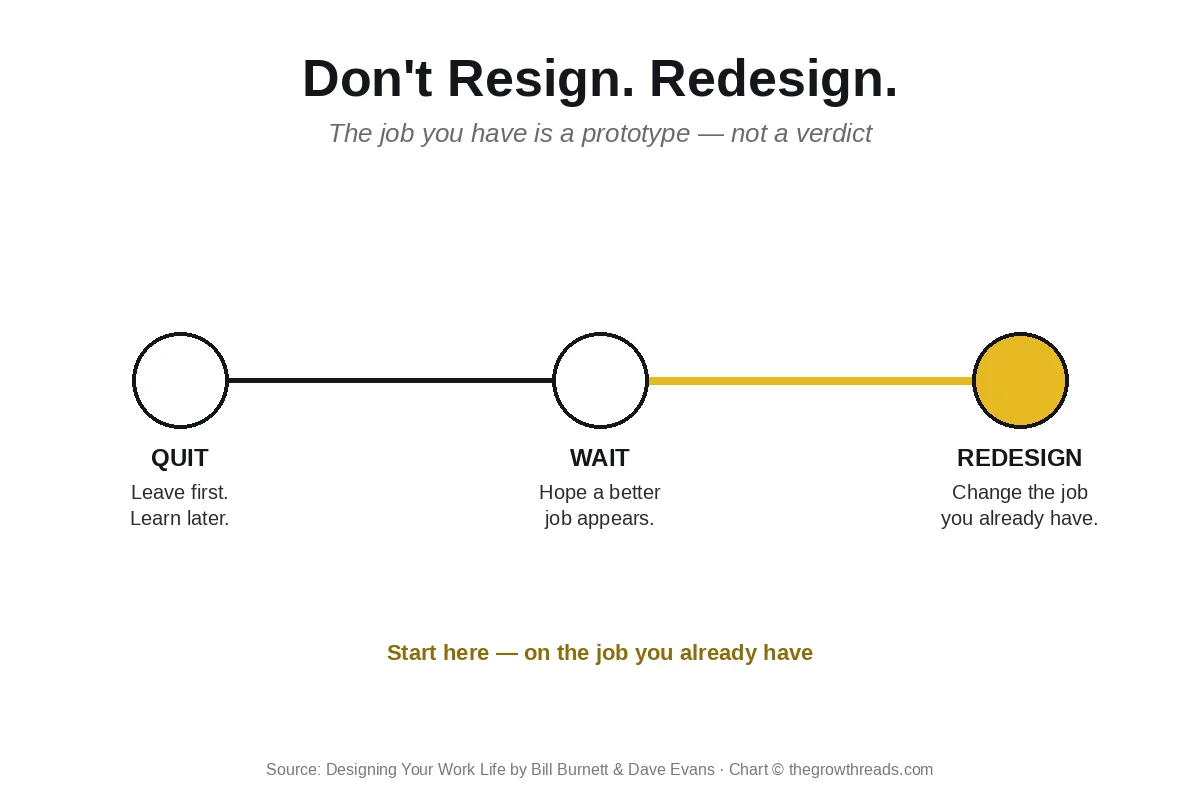
You do not have to quit to change your work. You have to stop treating the current job as a finished object. Bill Burnett and Dave Evans’s Designing Your Work Life (Knopf, 2020) is the office-hours sequel to Designing Your Life. Same Stanford studio habits. Different canvas: the forty-plus hours you already spend doing something for money.
The engine is a reframe most career books skip. “Are we there yet?” is a child’s question and a grown-up trap. Wherever you are is good enough for now — not forever, for the next prototype. Money and meaning are not a fork in the road. The four moves — reframe, remodel, relocate, reinvent — run in that order so you do not spend social capital you never used.
Key takeaways
- Good enough for now: A job can be a prototype you are in, not a verdict you must escape this week.
- Money and meaning: Designing for both beats choosing a side and resenting the other.
- Find the real problem: Mood is data. It is not the brief. Gravity problems stay constraints.
- Log energy, not vibes: A Good Time Journal on workdays shows what to keep and what to cut.
- Reframe before you resign: Change the why of the job you have, then the tasks, then the seat.
- Remodel, then relocate: Trade hours toward work you do well; a sideways seat is cheaper than a new logo.
- Reinvent you last: Skills and story come after you have used the job as a studio. If you do leave, leave the door on its hinges.
- Map influence: Work is already political. Name who can say yes, then make one small ask.
What is Designing Your Work Life about?
Designing Your Work Life applies design thinking to the job you already have. Burnett and Evans replace “I need a new job” with four redesign moves, an energy journal, and small tests — so you can make the role livable, or leave it on purpose.
About the author
Bill Burnett is a product designer and executive director of the Design Program at Stanford. After years at Apple he turned studio practice — many sketches, cheap tests, critique — into a course ordinary people could run on a weeknight. Dave Evans helped ship Apple’s first mouse, was an early employee at Electronic Arts, and later taught that same course with Burnett. Their 2016 Knopf book Designing Your Life argued that you do not find a passion; you prototype a life. This 2020 sequel aims the same tools at the place most readers spend more waking hours than anywhere else: work. They write as designers who have had bosses, not as career coaches selling a leap. Explore all Bill Burnett book summaries →
Key concepts at a glance
| Concept | What it means | Use it when |
|---|---|---|
| Good enough for now | The current job is a workable prototype, not a forever sentence. | You are living in “I’ll be happy when.” |
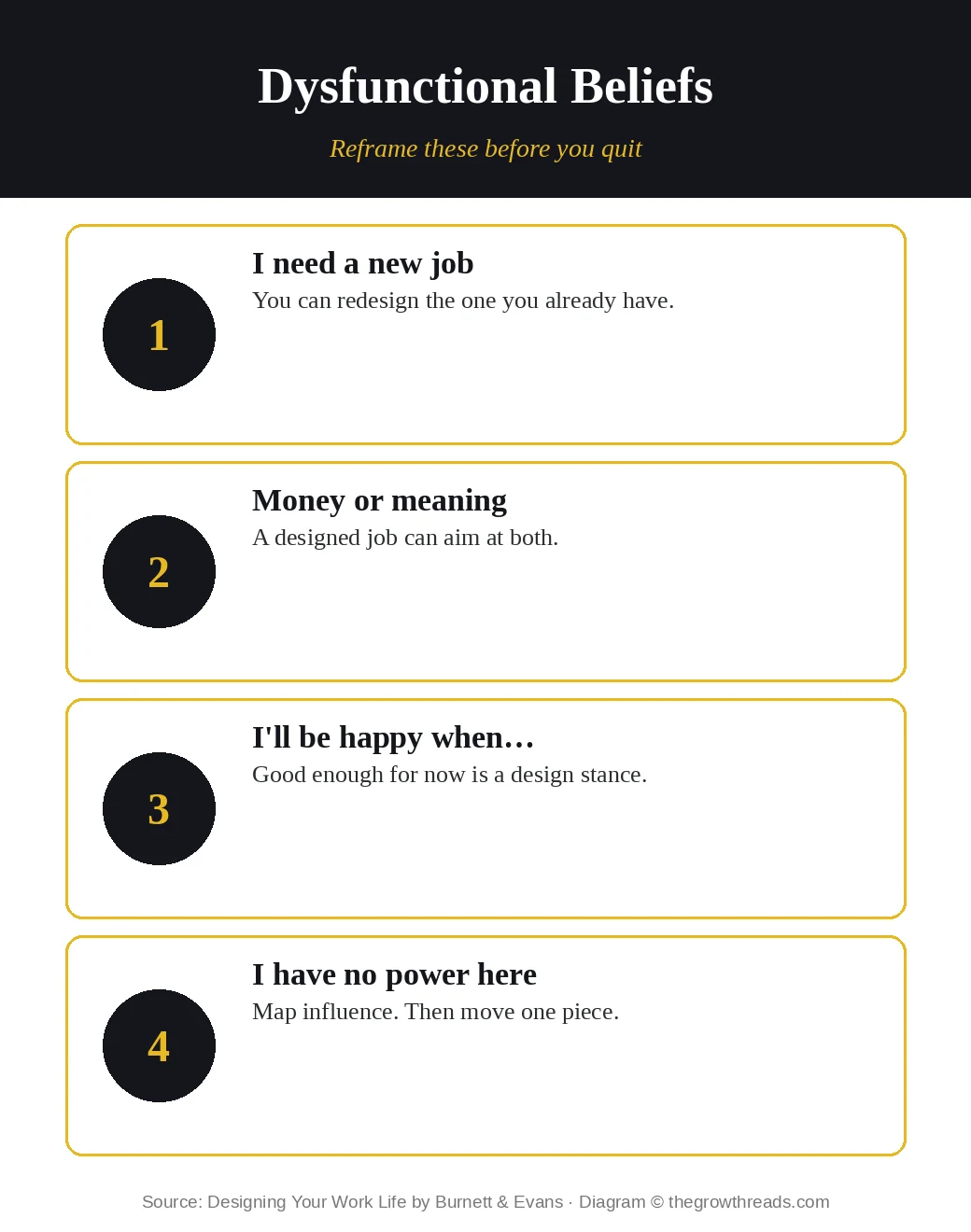
| Dysfunctional belief | A rule that feels true and blocks design (“I have to choose money or meaning”). | You keep repeating a reason you cannot move. |
| Gravity problem | A fact you cannot change. Stop solving it; design around it. | You are straining at a constraint that will not blink. |
| Good Time Journal | A log of energy and engagement on actual work blocks. | You cannot say what to keep in the role. |
| Reframe / re-enlist | Change the why of the job so you can stand the work. | The tasks are fine; the story is dead. |
| Remodel | Change the what: tasks, hours, collaborators. | You can name work that drains you and work that does not. |
| Relocate | Change the where inside the same organization. | The company still fits; the seat does not. |
| Reinvent | Change your skills and story — the 2.0 version of you. | The other three moves have been tried, or the role truly cannot hold you. |
Part 1: You’re already there — “good enough for now”
Burnett and Evans open with a car-seat question. Children ask “Are we there yet?” because the trip has a clock. Adults import that question into careers. The next title, the next raise — each arrival resets the hunger. Psychologists call the treadmill hedonic. The authors call the person on it a non-life-designer: someone who wants more without asking what the more is for.
The reframe is not “this job is perfect.” It is “this job is good enough for now.” That phrase buys you a studio. You cannot prototype a role you have already declared dead, and you cannot design from a fantasy office that does not exist yet. The current calendar is the only lab that will have you this week.
Money versus meaning is the other trap. Plenty of smart people pick a lane, then punish themselves for the one they did not pick. A designed job can aim at both — not by pretending invoices are poetry, but by asking for more useful blocks without setting fire to the ones that pay rent. If you have never written a Workview, you will keep treating every trade-off as a moral failure.
Overwhelm gets the same treatment. Some of the pile is yours. Some is a gravity problem: a boss, a market, a body. Designers do not repeal gravity. They stop putting it on the to-do list. The rest is a problem you have not named — which means you are solving the mood instead of the brief.
TGR Note: If this sequel is your first contact with Burnett and Evans, the passion reframe still lives in Designing Your Life — you do not hunt a calling, you prototype interest. This book assumes that argument and spends its pages on the job you already clock into. Pair them if you are choosing a life; start here if you are choosing a Tuesday.
Part 2: Name the real problem, not the mood
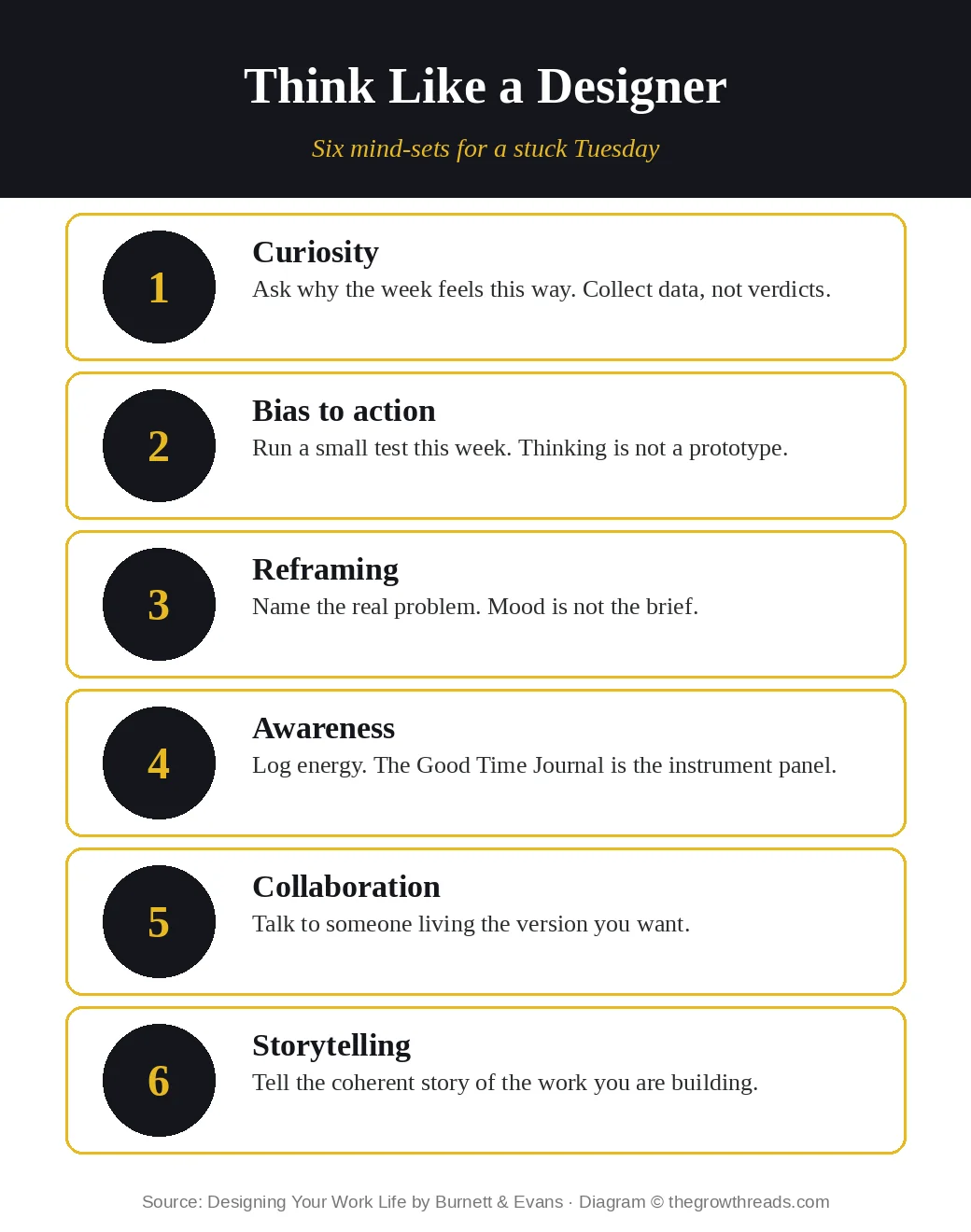
Design thinking here is not a workshop poster. Curiosity: ask why this week feels this way before you write a resignation. Bias to action: a conversation and a two-hour test beat another night of rumination. Reframing: the problem you walked in with is often the wrong one. Awareness: you need an instrument panel. Radical collaboration: someone is already living a version of the work you want. Storytelling: humans hire stories as much as skills.
The instrument panel is the Good Time Journal aimed at work. For a few days you log blocks: what, who, energy after. You are not grading the company. You are collecting evidence for a remodel. Most people who say “I hate my job” hate three repeating tasks, one meeting, and a story about what the job means. Those are different designs.
Grit here is not a poster. Staying is not always grit; leaving is not always grit. Grit is continuing a design you chose after the first awkward prototype. The ARC of a career is ongoing agency — you keep authoring the next version — not a ladder you either climb or fall off.
Power and politics get a chapter because pretending work is a meritocracy is how nice people stay stuck. You already live in a power relationship. Mapping who can say yes to a task swap is not cynicism. A small, specific ask to that person is a prototype. A vague complaint is not.
TGR Note: Cal Newport’s So Good They Can’t Ignore You is the right companion if the journal shows you lack rare skills. Redesign will not invent career capital. Deep Work (summary) is the companion if the journal shows you never get an uninterrupted block. Fix the attention, then remodel the role.
Part 3: Don’t resign. Redesign the job you have
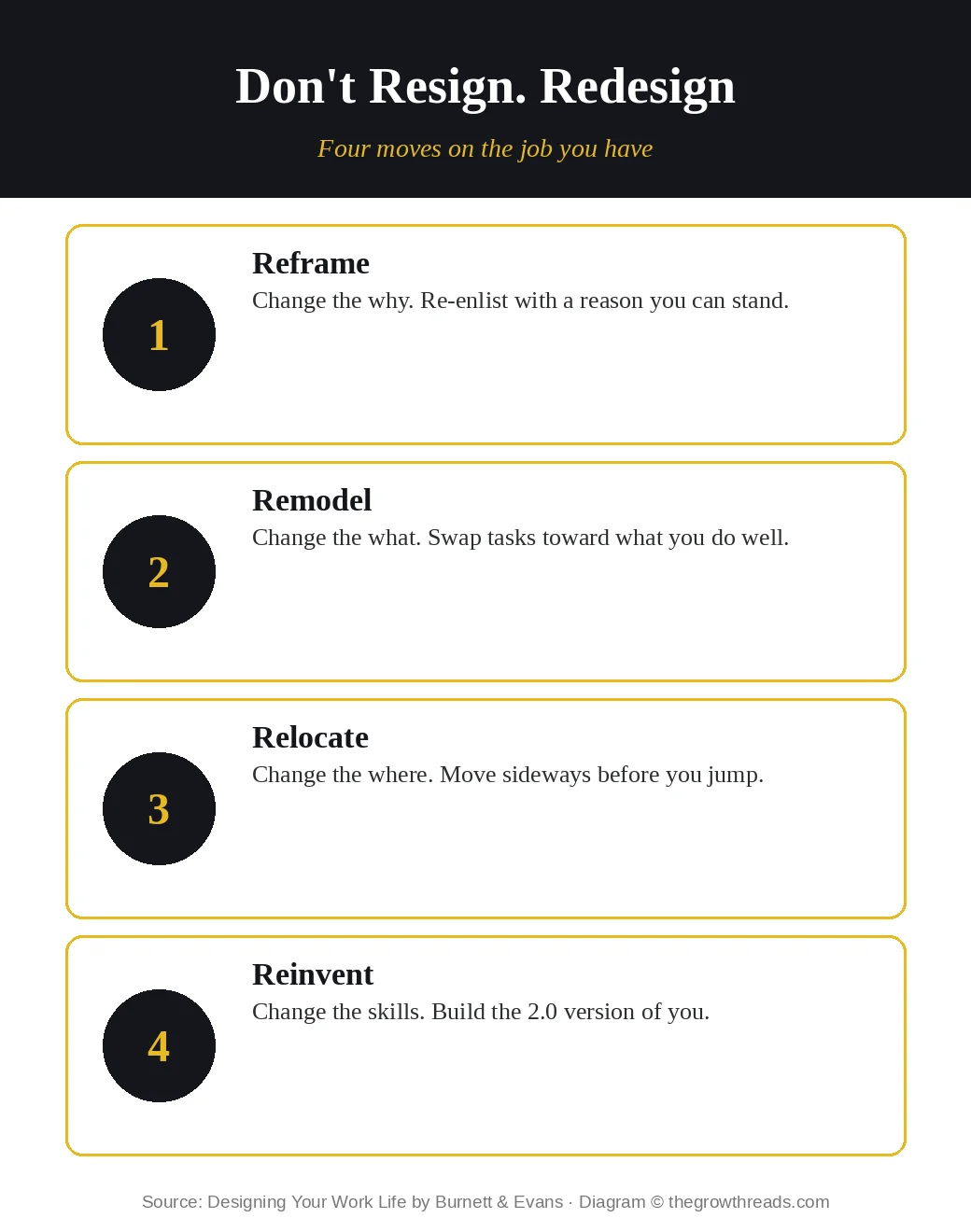
This is the signature chapter and the reason the book exists. Most career advice skips from misery to a posting. Burnett and Evans insert four moves you can run without a recruiter.
Reframe and re-enlist. Change the why. The tasks can stay; the story cannot. A job that used to be “I am building the product” can become “I am funding school,” or “I am learning a market I will use later.” That is not fake gratitude. It is a reason you can stand while you remodel. If you cannot say a why out loud, that is data for a later move — not a silent year.
Remodel. Change the what. Trade a draining meeting for a block you do well. Ask to drop a report nobody reads. Managers who want you effective will often say yes to a specific swap and no to “I need a new career.” Specific is kind.
Relocate. Change the where without changing the employer. A lateral seat or a six-month internal project keeps the social capital and still gives you a prototype. People skip this because it feels less dramatic than a leap. Dramatic is not a design criterion.
Reinvent. Change you — skills, story, sometimes market. This is the expensive move. It belongs last because you cannot undo it in a week. Do it when the other three have been tried in good faith, or when the building cannot hold the work you need to do.
The order is the contribution. Quit-first people reverse it and take the same belief into a new logo. Redesign-first people spend the social capital they already paid for.
TGR Note: If the journal says the job cannot be remodeled — the market died, the values clash, the harm is real — switch tools. What Color Is Your Parachute is still the structured search. The Progress Principle is the inner-work-life science underneath a remodel: protect small wins on meaningful work, not more recognition theater.
Part 4: Leave well, or stay as the designer
Quitting is allowed. It is just not the first prototype. When you do leave, tell the truth without a scorched-earth memo, hand off the work, and give people a story they can repeat about you. The next user of your reputation is a future hiring manager.
Moving on is a design problem of its own. You are not hunting a soulmate company. You are prototyping a next role with conversations and a Workview you can actually say. Ask what Tuesdays are made of. Do not ask whether they are passionate. Passion is still a lagging indicator.
Self-employment is the fantasy exit for people who have not remodeled. Being your own boss does not cancel gravity; it changes which bills have your name on them. If the journal shows you love the craft and hate the org, a small paid prototype is a real design. If it shows you hate the craft, a logo on the door will not save you.
The last move is permission to be happy at work without a cinematic arrival. Happiness here is not a mood the company owes you. It is what happens when the hours, the people, and the story are close enough that you can stand them — and you keep authoring the next version. You are the designer of the next cheap test, not the CEO of the universe.
Who is Designing Your Work Life best for — and who should read something else first?
Best for: people who still have a job, some goodwill, and a Tuesday they could change — operators, teachers, managers, and independents who keep writing a fantasy resignation instead of asking for a task swap.
Read something else first if: you do not yet have a Workview or you are choosing among whole lives — start with Designing Your Life. If the journal would show you lack skill, read So Good They Can’t Ignore You before you remodel a role you cannot yet perform. If you have already decided to leave and need a search process, What Color Is Your Parachute will move you faster. If the workplace is unsafe, unpaid, or actively harmful, this is not a journal assignment. Leave with help. Design later.
A location-independent fantasy will bounce.
Questions to reflect on
- What is the dysfunctional belief you keep repeating about this job — in one sentence?
- Which three blocks from last week gave you energy, and which three took it?
- What is a gravity problem you have been treating like a to-do?
- Who at work can actually say yes to a small remodel, and what would you ask them this week?
- If you re-enlisted for 90 days with a new why, what would that why be?
🔥 Ready to redesign the job you already have?
Run one reframe and one small remodel this week before you spend another night on a fantasy resignation.
How to apply Designing Your Work Life (7-day plan)
- Day 1 — Write the belief. One sentence: the rule that says you cannot move. Next to it, write a designer reframe you could test. Do not quit on paper tonight.
- Day 2 — Start the journal. Log three work blocks: what, who, energy after. No grading the company. Just evidence.
- Day 3 — Sort gravity from design. Circle what you cannot change. Put it off the to-do list. Circle one thing you could remodel this month.
- Day 4 — Re-enlist in a paragraph. Write a why you can stand for 90 days. Read it once. If you cannot write it, that is data for Day 7, not a reason to skip Days 5–6.
- Day 5 — One conversation. Ask someone who has a piece of the role you want what their Tuesday is made of. Fifteen minutes. Notes after.
- Day 6 — One small remodel. A task swap, a dropped report, a two-hour block protected. Ask the person who can say yes. Specific, one week, reversible.
- Day 7 — Decide the next move. Reframe, remodel, relocate, or — only if the others are closed — plan a clean leave. Put the next prototype on next week’s calendar.
Frequently asked questions
What is Designing Your Work Life about?
It is Bill Burnett and Dave Evans’s field guide for people who already have a job and still feel stuck in it. The 2020 Knopf sequel to Designing Your Life applies design thinking to the hours you already spend at work: name dysfunctional beliefs, keep a Good Time Journal, treat gravity problems as constraints, then reframe, remodel, relocate, or reinvent before you resign. Read it when the instinct is to quit on a bad Tuesday and you have not yet prototyped a better version of the role you hold.
Who are Bill Burnett and Dave Evans?
Bill Burnett is a product designer and the executive director of Stanford’s Design Program. Dave Evans helped ship Apple’s first mouse, was an early Electronic Arts hire, and later taught at Stanford. Together they built the Designing Your Life course and the 2016 Knopf book of the same name. Designing Your Work Life (2020) is the work-hours companion: same studio habits — curiosity, cheap tests, many sketches — aimed at the job you already have rather than a five-year odyssey plan on a blank page.
Do I need to read Designing Your Life first?
You can start here if the problem is this job, this week. Designing Your Life is the better first book if you do not yet have a Workview, you are choosing among whole lives, or you want Odyssey Plans and prototype conversations before you touch the org chart. This sequel assumes you already know that passion is a lagging indicator. It spends its pages on reframes, influence maps, and four redesign moves you can run without leaving the building. If both feel relevant, read Life first, then this.
What are the four redesign moves?
Reframe and re-enlist: change the why of the job so you can stand the work while you still do it. Remodel: change the what — trade tasks, hours, and collaborators toward what you do well. Relocate: change the where inside the same organization before you jump companies. Reinvent: change you — skills, story, and the 2.0 version of the role. The order is the point. Most people reverse it and reinvent by quitting. Burnett and Evans want a small prototype on the current calendar first.
Is this only for people who hate their jobs?
No. The book is as useful for a decent job that has gone flat as it is for a miserable one. “Good enough for now” is a design stance, not a pep talk. You log energy, find the real problem, and run a test. People who are in harm’s way, unpaid, or in a workplace that will not let them move a single task should not wait on a journal. For everyone else, the bias is: redesign before you resign, and if you do leave, leave in a way that keeps the next door open.
How long does it take to apply Designing Your Work Life?
You can run the core loop in a week: three days of a Good Time Journal, one page of dysfunctional beliefs, one conversation, and one small remodel. The 292-page book itself is a weekend or about seven hours. The 7-day plan in this summary is the smallest complete pass. Career ARC — ongoing agency, not a one-off workshop — is the longer practice. Expect the first prototype to be awkward. That awkwardness is the point of a prototype, not a reason to quit the experiment.
Designing Your Work Life vs What Color Is Your Parachute?
Parachute is still the classic for people who are hunting a new role and need a structured search. Designing Your Work Life is for people who might not need a search yet — they need a redesigned Tuesday. Burnett and Evans borrow the designer’s bias to action; Bolles maps the wider world of work. If you have already decided to leave, Parachute (and So Good They Can’t Ignore You for the skill question) will do more. If you have not decided, start here so you do not throw away social capital you have not used.
Related summaries
- Designing Your Life Summary & Review
- So Good They Can’t Ignore You Summary & Review
- What Color Is Your Parachute Summary & Review
- Creative Confidence Summary & Review
- Best Productivity Books
How we analyze books: every book on The Growth Reads is read cover to cover, summarized in thousands of words of original analysis, and rated against our five-criteria rubric (lasting impact, evidence quality, practical application, writing & originality, external consensus). Read our full methodology.