

★★★★½ 4.5/5 — the job-hunt manual that still starts in the right place: you, not the posting.
Best for: career changers, laid-off professionals, and anyone spraying résumés at ads that never write back
Reading time: ~7 hours (352 pages) · this guide ~12 min
Difficulty to apply: Medium — the Flower inventory is a weekend, not a commute
What Color Is Your Parachute in one minute
Do not hunt jobs. Design the work, then hunt the people who can hire you for it. Richard N. Bolles wrote What Color Is Your Parachute? as a career handbook that refuses to begin with job boards. You inventory favorite skills, knowledge, people, place, conditions, and purpose — the Flower Exercise — until you can name the work you want to offer. Then you research organizations that need that offer and ask for short informational conversations, not a vacancy. Posted ads, Bolles argued for fifty years, fill only a slice of real hires. The designed search fills more. If you take one move from this What Color Is Your Parachute summary, write seven short stories of work you were proud of, extract the skills, and list ten organizations that use those skills — before you touch another job board.
Key takeaways
- You first: A posting is a late clue. Name the work you want to offer before you hunt a title.
- The Flower is the product: Skills, knowledge, people, place, conditions, money, and purpose on one page. Vague hope is not a target.
- Skills hide in stories: Seven proud moments beat a personality quiz. Verbs you actually used are the inventory.
- Most jobs are unposted: Boards show a fraction of hires. The rest move through people who already have a problem.
- Hunt people, not ads: Research organizations. Ask for twenty minutes of advice. Do not open with “any openings?”
- Informational chats are practice: You learn the work, collect names, and stay a visitor — not a desperate applicant.
- The interview is mutual: They test proof. You test fit. Salary comes after they want you.
- A thank-you is part of the hunt: Same-day note, one useful follow-up, two names if they offer them.
What is What Color Is Your Parachute about?
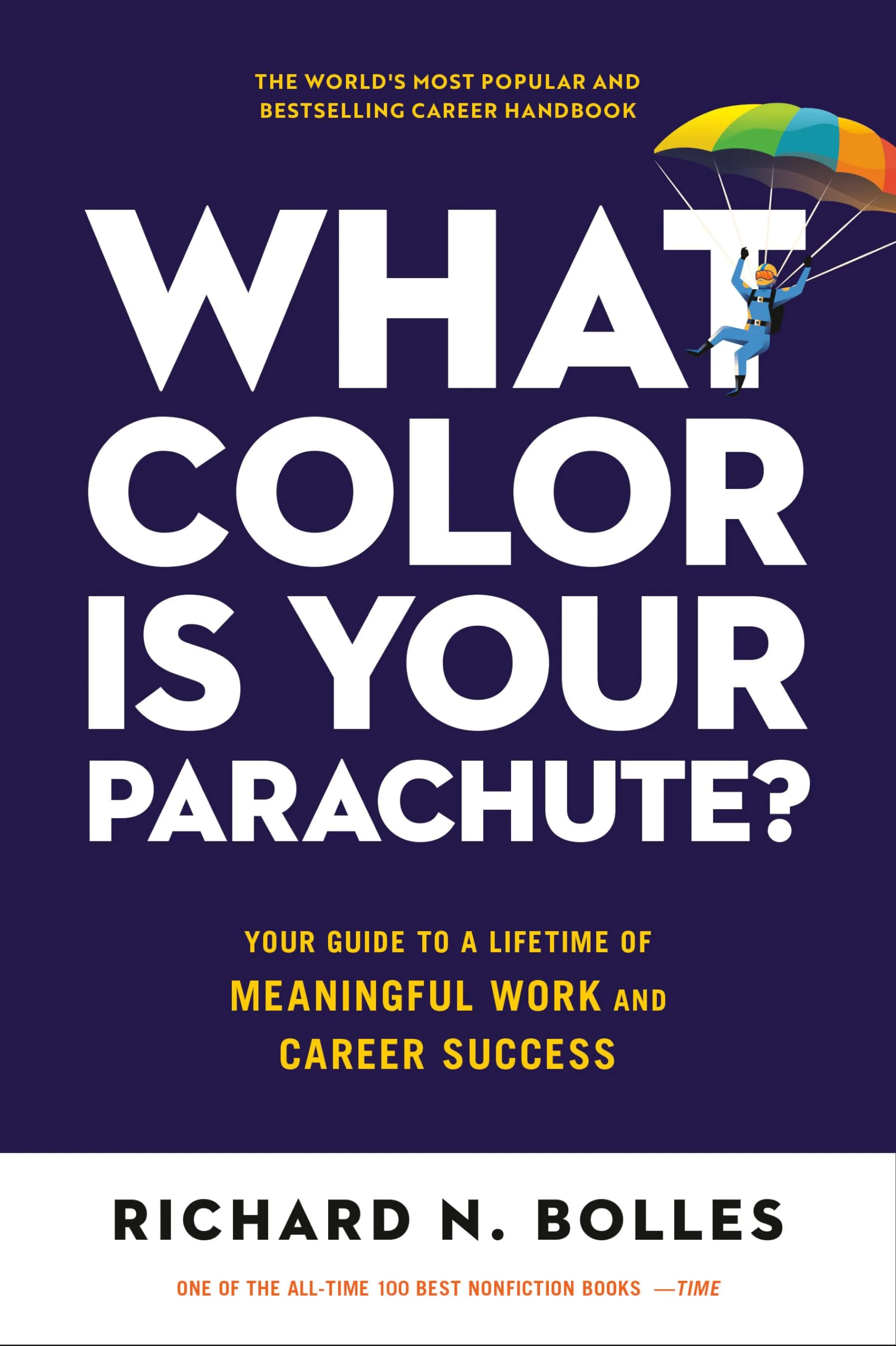
What Color Is Your Parachute? is Richard N. Bolles’s career handbook: a self-inventory (the Flower Exercise) plus a designed search of the hidden job market — informational conversations with people who can hire — instead of spraying résumés at posted ads.
About the author
Richard Nelson Bolles (1927–2017) was an Episcopal priest who lost a church job in the late 1960s and turned that shock into the most widely used career manual in English. He trained in physics at MIT, theology at Harvard, and spent decades teaching job-hunters that a résumé is a tool, not a strategy. First published in 1970, What Color Is Your Parachute? has been revised almost yearly; the 2022 Ten Speed Press edition was updated with Katharine Brooks after his death. Time listed it among the century’s best nonfiction. He wrote as a pastor-counselor, not a labor economist: worksheets, interviews, and encouragement. The method survived because it is operational. You leave with a page about yourself and a list of humans to talk to, not a pep talk about “passion.” Explore all Richard N. Bolles book summaries →
Key concepts at a glance
| Concept | What it means | Use it when |
|---|---|---|
| Flower Exercise | One-page inventory of skills, knowledge, people, place, conditions, money, purpose | You can describe jobs you hate more clearly than work you want |
| Favorite skills | Verbs from proud stories, ranked — not adjectives from a quiz | Your résumé lists duties, not what you actually do well |
| Hidden job market | Roles filled before or without a public posting | Boards are silent and you assume there is “nothing” |
| Informational interview | A short advice chat with someone doing the work | You are guessing at a field from listings alone |
| PIE | Proximity, informational chats, then employment talks | You skip to “hire me” and freeze the room |
| Mutual interview | They test proof; you test whether the room is livable | You treat every conversation as a plea |
| Salary last | Money after they want you, with a researched range | You name a number before they are sold |
| Parachute path | Designed search: inventory → orgs → people → offer | Résumé spray has become your only move |
Part 1: Stop hunting jobs — start with the person doing the hunt
Bolles opens with a mind-game, not a website. A layoff, a dull Tuesday, or a title that stopped fitting all feel like a hunt for openings. He says the first problem is identity. You are not your last job description. You are a set of skills you enjoy using, with people you can stand, in a place and on terms you can live with. Until that is named, every posting is a random dart. The book’s title is the question: what kind of landing are you actually trying to make?
He is kind about fear and blunt about tactics. Mass applications soothe panic and produce silence. Silence then looks like evidence that you are unhireable. The loop is the trap. The alternative is slower in week one and faster in week six: a written picture of the work you want to offer. That picture is not a vision board. It is verbs, subjects, and constraints. “I want a meaningful role in tech” is not a picture. “I diagnose messy processes with skeptical operators, in a mid-size company, hybrid, in this city, for this pay band” is a picture a human can react to.
The 2022 edition still spends pages on attitude because the hunt wrecks it. You will be ignored. Bolles’s advice is practical: keep a small daily practice that is not the hunt, and treat each conversation as data. Mood is a passenger. Method is the driver.
TGR Note: If you want a design-school grandchild of this inventory, pair it with Designing Your Life — prototypes instead of one perfect flower. If the stall is a duty list with no strengths language, StrengthsFinder 2.0 is a faster first pass. Do not take a second book as a delay. Seven stories this week beat a new personality model.
Part 2: The Flower Exercise — a product, not a journal
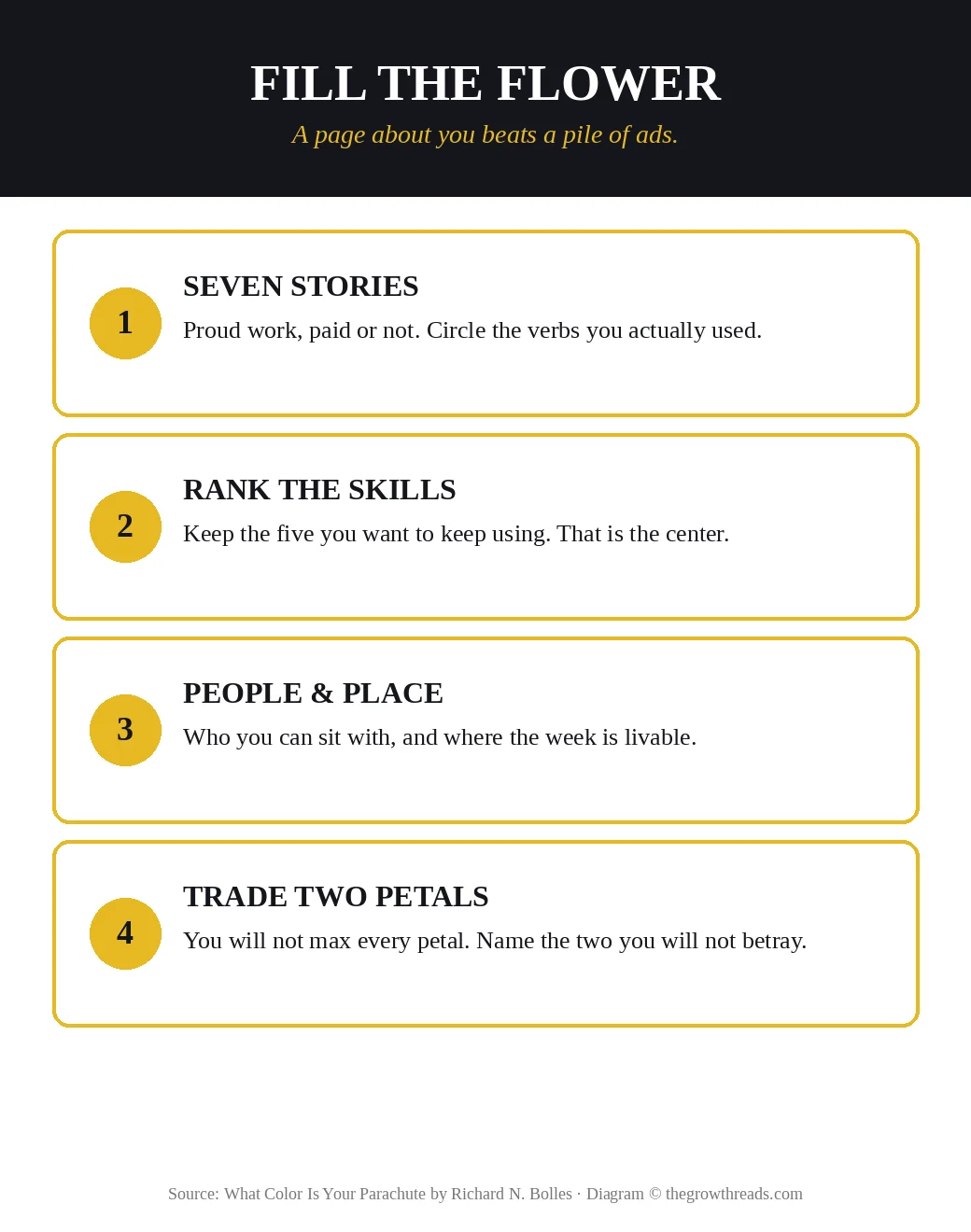
The Flower is Bolles’s signature worksheet. Petals typically cover favorite transferable skills, fields of knowledge, kinds of people, geography or place, working conditions, salary and level, and purpose or values. You do not fill them with wishes. You fill them with evidence. He wants seven stories of times you were proud of something you did — paid or unpaid — written in enough detail that you can circle the verbs. Those verbs are skills. Rank the ones you want to keep using. That ranking is the center of the flower.
Knowledge petals are the subjects you already have, not the degree you wish you had started. People petals are the personalities and problems you can sit with for a year. Place is not a vibe: city or remote, commute, travel. Conditions are noise, team size, pace, indoor/outdoor. Money is a researched band, not a fantasy. Purpose is the outcome you want your hours to serve, written in one sentence you could say out loud without cringing. When the petals conflict, Bolles says you choose. A flower with every petal maxed is a stall. Trade. Name the two petals you will not betray this decade.
The output is one page you can show a trusted person. If they cannot repeat your offer back to you, the flower is still fog. This is why the book is long: the worksheets are the product. Skipping them and jumping to “how to network” is how people turn informational interviews into rambling coffee. You need a sentence: here is the work I do, here is who it helps, here is the kind of room I do it in. That sentence is what you are testing in the wild, not your worth.
TGR Note: Cal Newport’s So Good They Can’t Ignore You pushes career capital — rare skills the market already pays. Use the Flower to pick the field, then Newport to get dangerously good inside it. Drucker’s Managing Oneself is the shorter strengths companion if a 352-page workbook feels heavy. Inventory, then skill. Not the other way around this month.
Part 3: The hidden market — hunt organizations, then ask for advice
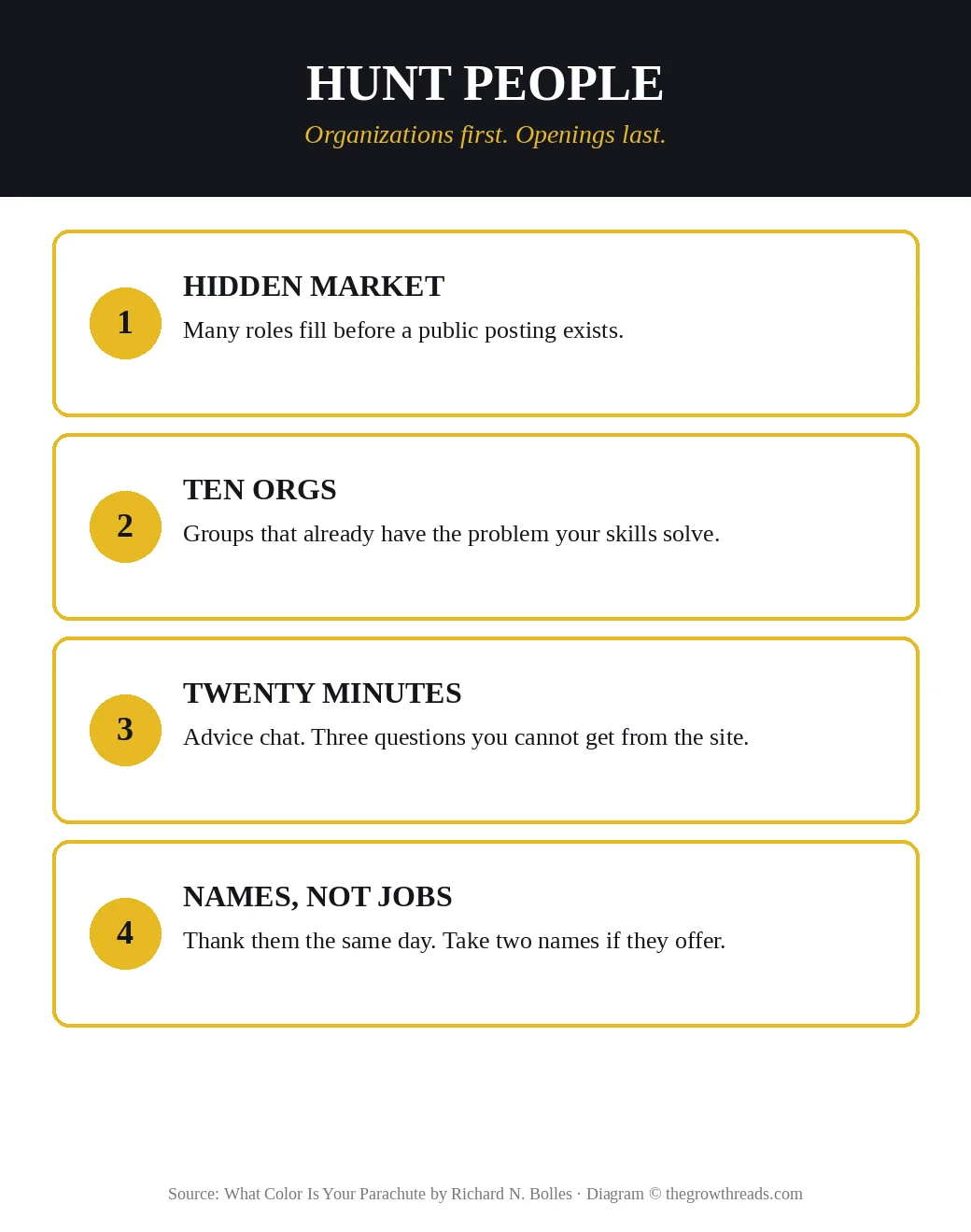
Once the flower exists, Bolles turns the search around. Do not begin with “jobs.” Begin with organizations that have the problem your skills solve. Read what they ship. Note who runs the work. Then ask for a short informational conversation with someone doing the job, not HR’s inbox. The rule he repeats: you are there to learn, not to beg. Twenty minutes. Three questions you could not answer from the website. A thank-you the same day. If they offer names, take two. If they offer a job, that is a bonus, not the ask.
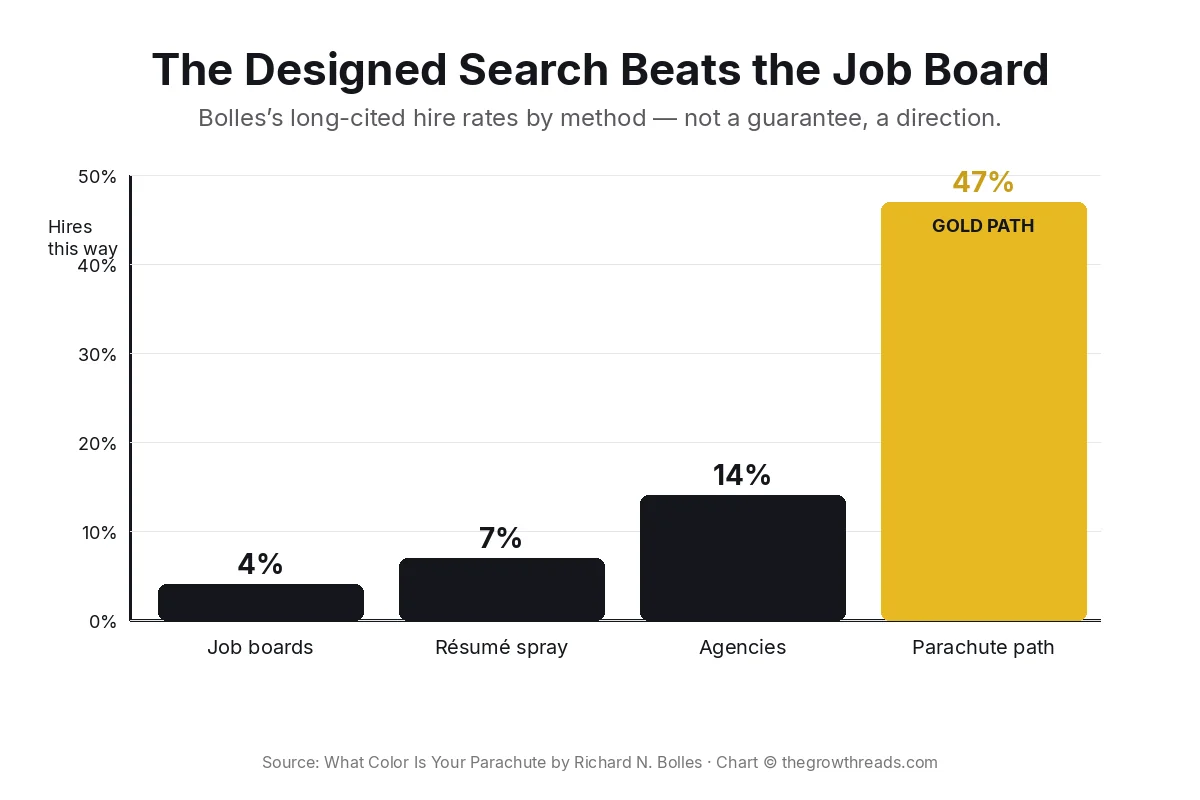
He cites, across editions, a blunt comparison of methods: answering ads and spraying résumés land a small share of hires; agencies a larger slice; approaching people through a designed search a much larger one. The numbers move by year and study. The direction does not. Public postings are a convenience for employers who already know the role. Many roles are shaped around a person who showed up with a clear offer. That is the parachute path in the chart after the takeaways: job boards and résumé spray are thin bars. The designed search is the tall gold one.
Informational interviews fail when they are secret job pleas. They also fail when you have no flower and ask “so what do you do all day?” like a tourist. Prepare. Lead with a one-sentence offer. Ask how they got in, what the work rewards, what a strong hire looks like in the first six months, and who else you should learn from. Stop on time. You are practicing being a colleague, not performing hunger. The next conversation is easier because you now speak the field’s nouns.
TGR Note: If you are testing an idea rather than landing a role, The Mom Test is the conversation craft: ask about their life, not your pitch. For a stalled career inside a company you already have, What Got You Here Won’t Get You There may be the better first book. Use Parachute when the next room is still unnamed.
Part 4: Interviews, offers, and work that still fits after you land
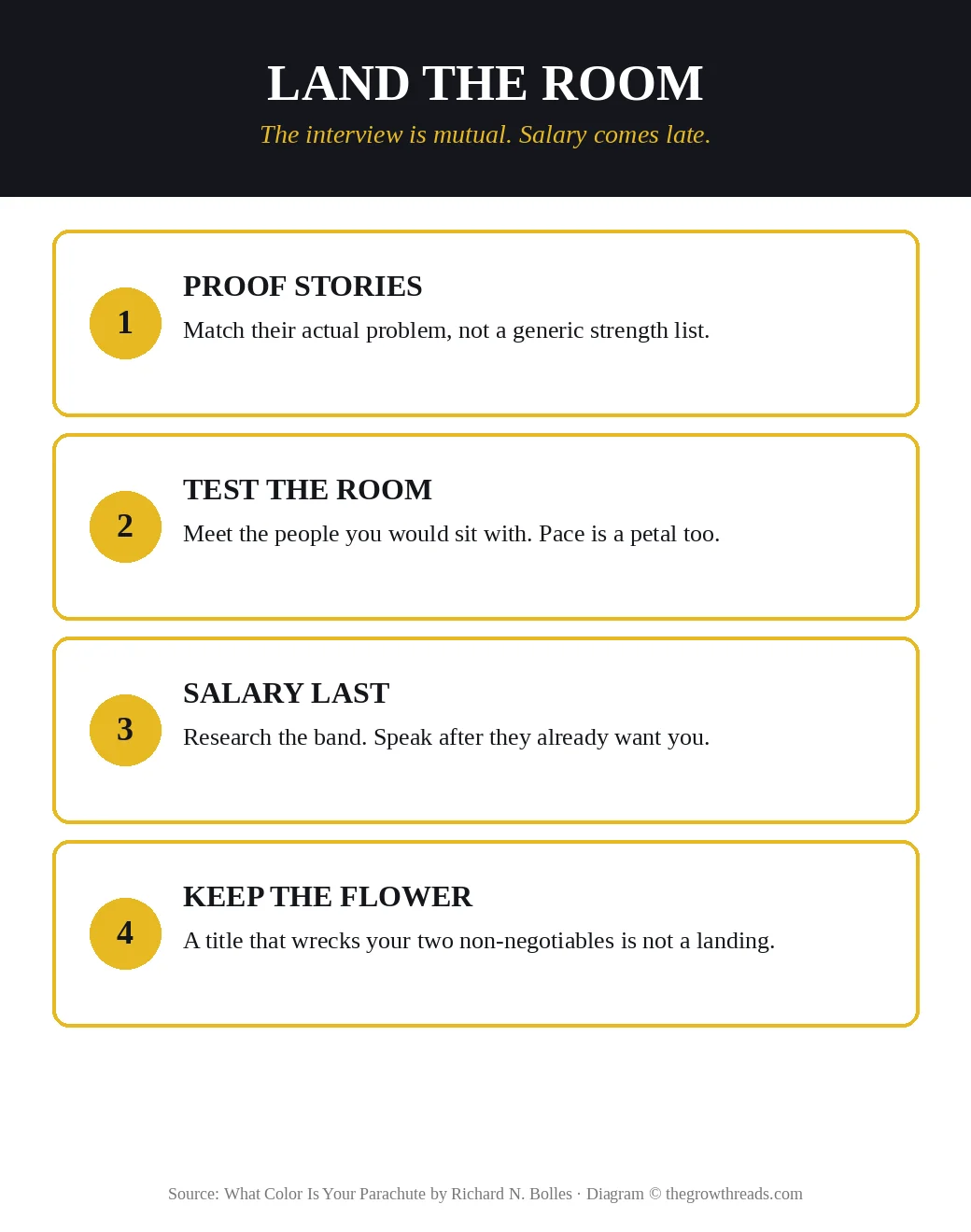
When an employment conversation finally happens, Bolles wants it mutual. They need proof you can do the work. You need proof the room will not wreck the petals you refused to betray. Prepare stories that match their actual problems. Ask to meet the people you would sit with. A title and a salary with a toxic pace is a failed landing. He is not anti-ambition. He is anti-self-erasure. The interview is where the flower gets tested against a real building.
Salary comes late. Research the band. Let them want you. Then negotiate with a number you can defend, plus the conditions petal — remote days, title, scope — so money is not the only lever. After you land, the book’s later chapters treat self-employment and later-life change as the same method: a customer (or a mission) plus an offer. Retirement is not an identity delete. It is another flower, often with a different money petal and the same skills.
The failure mode is collecting editions and never filling a petal. Parachute is a workbook that looks like a book. Do the stories. Rank the verbs. List ten organizations. Ask for one twenty-minute chat. That sequence is the whole argument. Everything else is commentary so you do not bolt back to the job board when the first email is ignored.
Who is What Color Is Your Parachute best for — and who should read something else first?
Best for career changers, people between roles, and anyone whose only tactic is a résumé spray. Also good if you are employed and quietly done with the title, and need a legal, ethical way to explore the next room. Not first if you still need a tiny daily action that feels safe — start with Mini Habits or Tiny Habits. Not first if the problem is deep work inside a job you already want — Deep Work. Not first if you want a two-hour strengths snapshot rather than a flower — StrengthsFinder 2.0. Parachute is the designed-search handbook after you are willing to write about yourself for a weekend.
Questions to reflect on
- Which seven moments of work (paid or not) still make you proud — and what verbs did you actually use?
- If you could keep only two petals of the flower this decade, which two?
- Which ten organizations already have the problem those skills solve?
- Who could give you twenty minutes of advice this month without being asked for a job?
- What would make a landing a failure even with a good title and pay?
🔥 Ready to stop spraying résumés?
Get What Color Is Your Parachute?, then use the 7-day plan to fill a flower and ask for one real conversation.
How to apply What Color Is Your Parachute (7-day plan)
- Day 1 — Seven stories. Write seven short proud-work stories. Circle the verbs. Those are candidate skills.
- Day 2 — Rank the verbs. Pick your top five transferable skills. That ranking is the center of the flower.
- Day 3 — Three more petals. Knowledge, people, and place. Be specific enough that a friend could repeat them.
- Day 4 — Conditions, money, purpose. One sentence each. Mark the two petals you will not betray.
- Day 5 — Ten organizations. Not ten job ads. Ten groups that already have the problem you solve. No applications today.
- Day 6 — One ask. Request a twenty-minute informational chat. Script: one-sentence offer, three questions, stop on time.
- Day 7 — Close the loop. Same-day thank-you. If they offer names, take two. Do not spray résumés this week. Repeat the chat habit next week.
Frequently asked questions
What is What Color Is Your Parachute about in one paragraph?
What Color Is Your Parachute? is Richard N. Bolles’s career handbook, first published in 1970. You inventory yourself with the Flower Exercise, then hunt organizations and people who need that offer instead of spraying résumés at job boards. Informational conversations come before employment talks. Interviews are mutual. Salary comes after they want you. This summary turns the method into seven stories, one page, ten organizations, and one twenty-minute ask this week.
Is What Color Is Your Parachute still worth reading in 2026?
Yes, if your hunt is stuck on boards and silence. The web changed the tools. It did not kill the hidden market or the need for a clear offer. Newer books are tighter on prototypes (Designing Your Life) or career capital (So Good They Can’t Ignore You). Bolles is still the plainest workbook for a self-inventory plus a people-first search. Use the 2022 text, fill the flower, and talk to humans. The 7-day plan is the 2026 use case.
What is the Flower Exercise?
The Flower Exercise is Bolles’s one-page self-inventory. Petals cover favorite skills (verbs from proud stories), fields of knowledge, kinds of people, place, working conditions, salary and level, and purpose. You rank what you want to keep using and you choose when petals conflict. The page is the product: a sentence about the work you offer that another person can repeat. Without it, networking is wandering. With it, a twenty-minute informational chat has a point. Day 1 through Day 4 of the plan in this summary are the flower, nothing else.
What is an informational interview in this book?
A short advice conversation with someone who already does the work or hires for it. You are not asking for a job. You ask how they got in, what the work rewards, what a strong hire looks like, and who else to learn from. Twenty minutes. Same-day thank-you. Names if offered. Bolles treats this as the engine of the hidden market: you learn the field’s nouns, you become a known person, and sometimes a role appears around you. It fails when it is a secret plea or when you have no flower and no questions.
How is this different from Designing Your Life?
Parachute is a career-search workbook: inventory, then hunt people. Designing Your Life is a design-thinking kit: many prototypes, odyssey plans, try stuff. Burnett and Evans are downstream of Bolles’s instinct that you should not marry the first posting. If you need a job-hunt method with worksheets aimed at landing, start here. If you need permission to run small experiments before you name a field, start with Designing Your Life. Many readers do the flower, then prototype one petal with a conversation rather than a resignation.
Who should read something else first?
If even a weekend of writing about yourself feels like an accusation, start with Mini Habits or Tiny Habits and come back when a small daily action already feels safe. If you already love the job and cannot concentrate, read Deep Work. If you want a ninety-minute strengths snapshot, StrengthsFinder 2.0 is lighter. What Color Is Your Parachute is for the person who will fill a page and ask a human for twenty minutes, not for someone hunting a slogan. The method only works if the flower leaves the notebook.
How do I apply What Color Is Your Parachute this week?
Do not reread every chapter. Write seven proud-work stories and circle the verbs. Rank five skills. Fill knowledge, people, place, conditions, money, and purpose. Name the two petals you will not betray. List ten organizations that already have the problem — not ten ads. Ask one person for a twenty-minute informational chat. Thank them the same day. That sequence is the book. The 7-day plan in this What Color Is Your Parachute summary is that sequence with a name for each day. Résumé spray waits until the flower can steer it.
Related summaries
- Designing Your Life by Bill Burnett & Dave Evans
- So Good They Can’t Ignore You by Cal Newport
- Managing Oneself by Peter Drucker
- StrengthsFinder 2.0 by Tom Rath
- Best productivity books
How we analyze books: every book on The Growth Reads is read cover to cover, summarized in thousands of words of original analysis, and rated against our five-criteria rubric (lasting impact, evidence quality, practical application, writing & originality, external consensus). Read our full methodology.