

★★★★½ 4.5/5 — IDEO’s field guide for people who froze at “I’m not the creative one” and still have work that needs a new idea.
Best for: professionals who can execute a plan but stall when the work asks for a sketch, a prototype, or a first ugly version.
Reading time: ~5 hours (304 pages) · this guide ~14 min
Difficulty to apply: Easy to start — twenty minutes and a cheap prototype. Hard to keep honest when looking unfinished still feels like a character flaw.
Creative Confidence in one minute
Creativity is not a personality type. It is a muscle you train with small, slightly embarrassing tries. Tom Kelley and David Kelley wrote this Crown Business book (2013) after decades at IDEO and Stanford’s d.school watching capable people freeze. The freeze is not a talent shortage. It is fear of judgment wearing a costume labeled “I’m just not creative.” Creative confidence, in their definition, is the belief that you can come up with a new idea and the courage to try it in the world. The engine is Albert Bandura’s guided mastery: shrink the next step until success is likely, use a human spotter, bank the evidence, then raise the grain. If you only remember one sentence, remember this: stop waiting to feel like a creative person. Run a twenty-minute experiment before noon, then look at the evidence.
Key takeaways
- The spectator story is optional: “I’m not a creative type” is a freeze response, not a diagnosis.
- Confidence follows evidence: Bandura’s guided mastery — tiny wins with a spotter — beats pep talks.
- Heart, hand, and mind: care about a human, make something, then think. Do not start in the slide deck.
- Empathy before ideas: watch someone struggle. Your cleverness is not the brief.
- Quantity unlocks quality: ten rough options beat one precious concept you are afraid to touch.
- A prototype is a question: a sketch, a cardboard mock, a scripted conversation — not a launch.
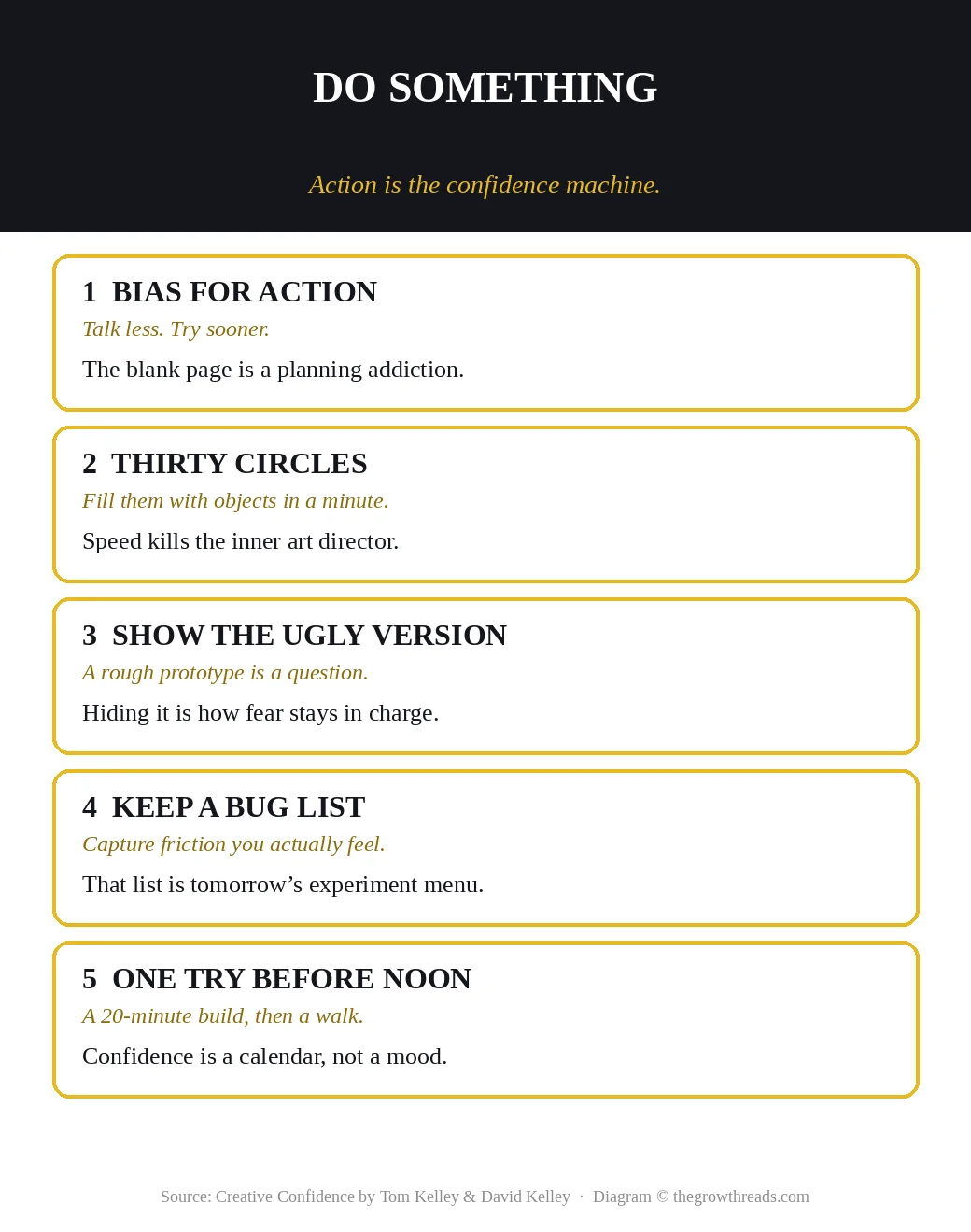
- Bias for action: talking about the work is how fear stays in charge. Show the ugly version.
- Keep a bug list: friction you actually feel is tomorrow’s experiment menu.
- Culture is designed: teams get braver when unfinished work is allowed in the room on purpose.
- Passion is often a lagging indicator: stretch into the work, then notice what starts to pull.
What is Creative Confidence about?
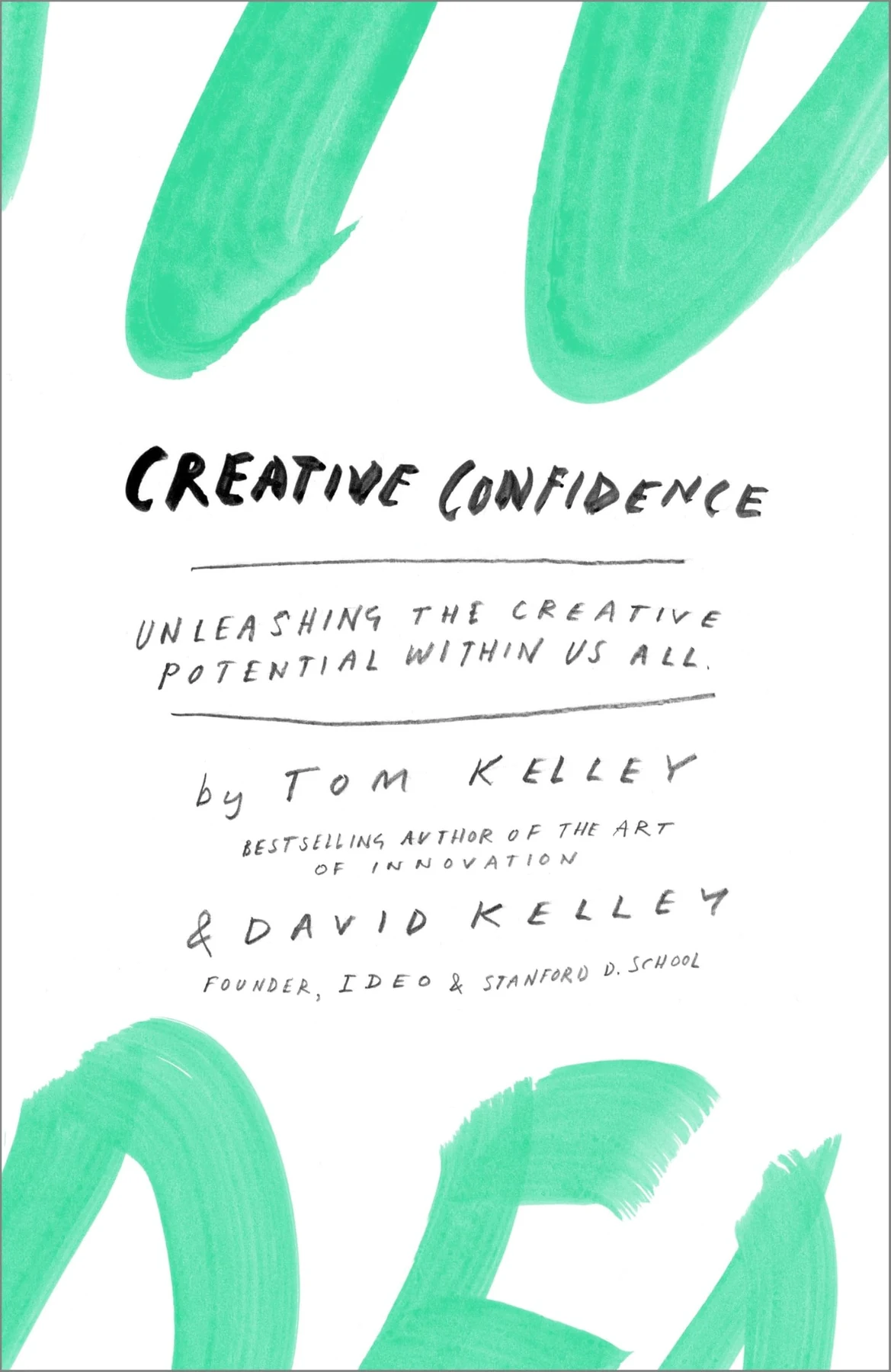
Creative Confidence is a practical manual for recovering the maker you were before school and work taught you to sit still. The Kelley brothers mix IDEO stories, d.school drills, and Bandura’s psychology into a loop: face the fear, run a tiny experiment, learn from a real person, and put unfinished work where it can teach you.
About the author
David Kelley co-founded IDEO, helped design the first commercial mouse, and built Stanford’s Hasso Plattner Institute of Design — the d.school — so engineering and business students would stop treating creativity as someone else’s job. After a cancer diagnosis he gave a widely watched TED talk arguing that creative confidence is recoverably human, not a gift for a few. Tom Kelley, his brother, spent years as IDEO’s general manager and wrote The Art of Innovation and The Ten Faces of Innovation, translating studio habits into language managers can actually use. Together they wrote Creative Confidence so the people who already run meetings, ship decks, and hit dates could steal the studio’s real advantage: a bias for cheap, human-centered tries instead of a personality they never got issued. Explore all David Kelley book summaries →
Key concepts at a glance
| Concept | What it means | Use it when |
|---|---|---|
| Creative confidence | The belief you can generate a new idea and the courage to try it in the world. | You stall at the first sketch, email, or prototype. |
| Guided mastery | Bandura’s method: shrink the step, add a spotter, bank a win, then raise difficulty. | Pep talks have not moved the work. |
| Heart, hand, mind | Start with care for a person, make something, then analyze — not the reverse. | You live in decks and never touch a prototype. |
| Empathy fieldwork | Watch a real user struggle before you invent. | The team is solving a problem nobody has. |
| Thirty circles | A one-minute drill: fill circles with objects to kill the inner art director. | The blank page has become a planning meeting. |
| Prototype as question | A cheap artifact you can show, not a polished launch. | You are still “getting it ready” in private. |
| Bug list | A running capture of friction you actually feel. | You want experiments but cannot name one. |
| Do-something mindset | Action as the confidence machine — try, then talk. | The calendar is full of discussion and empty of tries. |
Part 1: From fear to flourishing — creativity is a belief you practice
The opening is a permission slip with teeth. The Kelleys refuse the split between “creative people” and everyone else. Children draw without a committee. Then school, a harsh critique, a manager who wanted the safe option, and the story sets: I am an operator, an analyst, a finisher — not a maker. That story is efficient. It also quietly vetoes the work that would change the next year. Creative confidence, as they use it, is not a mood and not a job title. It is a belief about agency: I can have a new idea, and I can put a version of it in front of a human this week.
They borrow a three-part body. Heart is caring enough about a person’s struggle to stay with it. Hand is making — cardboard, a script, a landing page, a role-play. Mind is the analysis that belongs after you have something to look at. Most professional rooms reverse the order. They start in mind (strategy), skip hand (too messy), and treat heart as a slide called “user.” The result is elegant stall. The MRI story they tell — Doug Dietz at GE, children terrified of a scanner until the machine became an adventure — is not a TED ornament. It is heart and hand arriving before a bigger budget. Dietz did not wait to feel like a designer. He watched kids, then built a cheap story around the existing hardware. The book wants that sequence on your Tuesday, not only in a famous case.
TGR Note: If your stall is a whole life, not a product, start with our Designing Your Life summary — Burnett and Evans taught in the same Stanford design world and treat a stuck career as a prototype. For the five-day team version of this loop, Sprint is Jake Knapp’s calendar. Creative Confidence is the inner permission those books assume you already have.
Part 2: Flip and Dare — guided mastery beats the inner critic
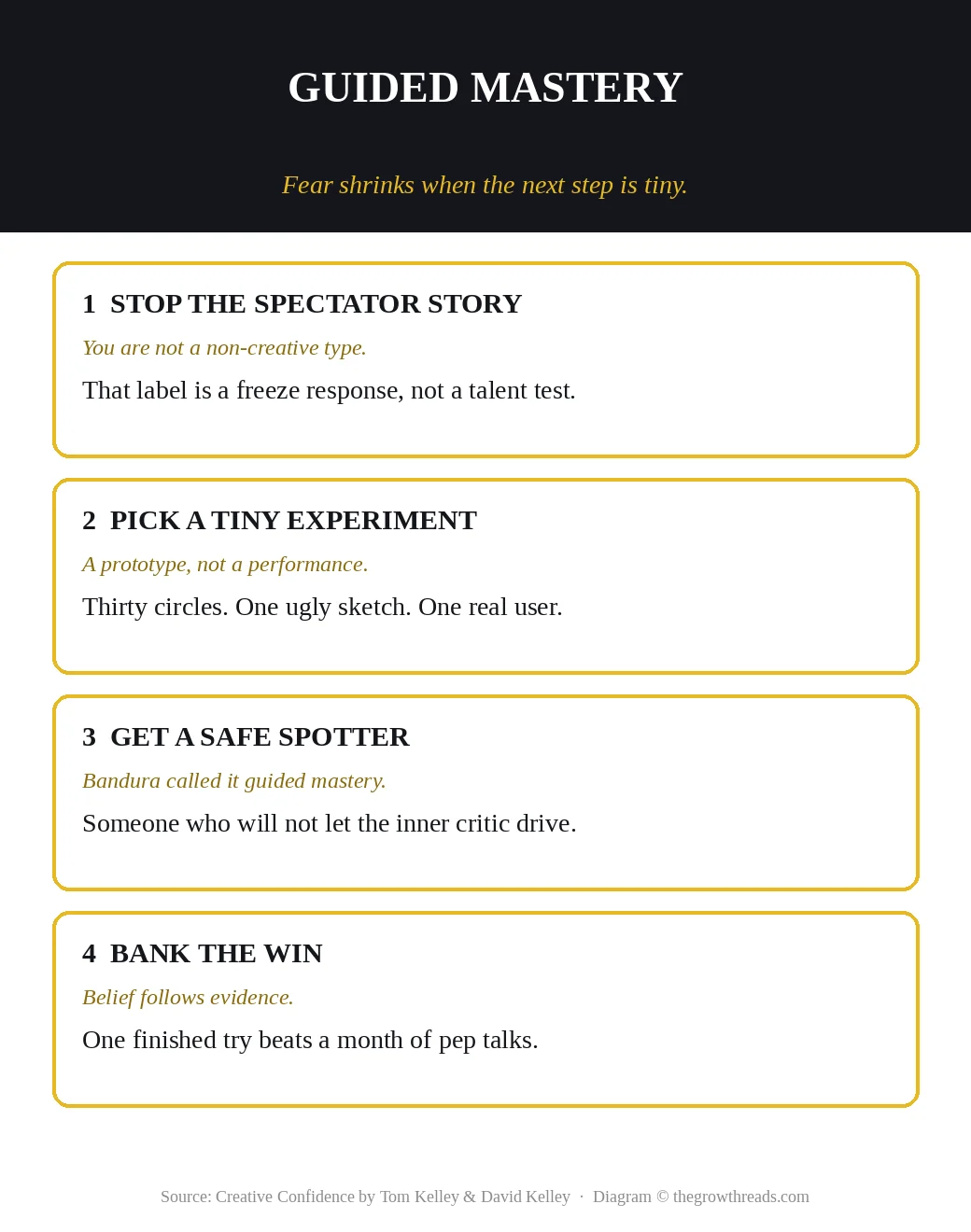
The middle of the book is where most creativity writing goes misty and the Kelleys stay clinical. They reach for Albert Bandura. People do not leap from terror to fluency because a poster told them to believe. They take a step that is almost sure to work, with someone watching who will not let the inner critic drive, and the nervous system updates. That is guided mastery. The Flip is the story change: from “I can’t” to “I can try a smaller version.” The Dare is the first public-ish try — a sketch in a meeting, a prototype on a table, a question asked of a customer instead of guessed in a conference room.
Fear of judgment is the real antagonist, not a shortage of ideas. The inner art director wants the first mark to be good. The d.school’s thirty-circles drill is rude on purpose: sixty seconds, fill the circles with objects, quantity over prettiness. Speed starves the critic. So does a spotter. A colleague who will look at the ugly version with you is not a luxury. It is the method. If you do not have a d.school coach, fake the loop: a twenty-minute build, a photo, one honest sentence from a person who will not soothe you. The Kelley argument is that courage is downstream of designed success, not a personality you wait to be issued. Desk translation: do not “brainstorm the campaign.” Draw three bad headlines on paper, show them to one colleague before lunch, and write what you learned in one line. That is Flip and Dare without a studio.
TGR Note: If the critic in the room is Resistance with a capital R, The War of Art names it; this book hands you a smaller door through it. The Practice is Seth Godin’s cousin — ship the work as a habit. Steal Like an Artist is the permission to copy a form while you find your own. Stack them. Do not binge them.
Part 3: Spark and Leap — empathy, then a prototype
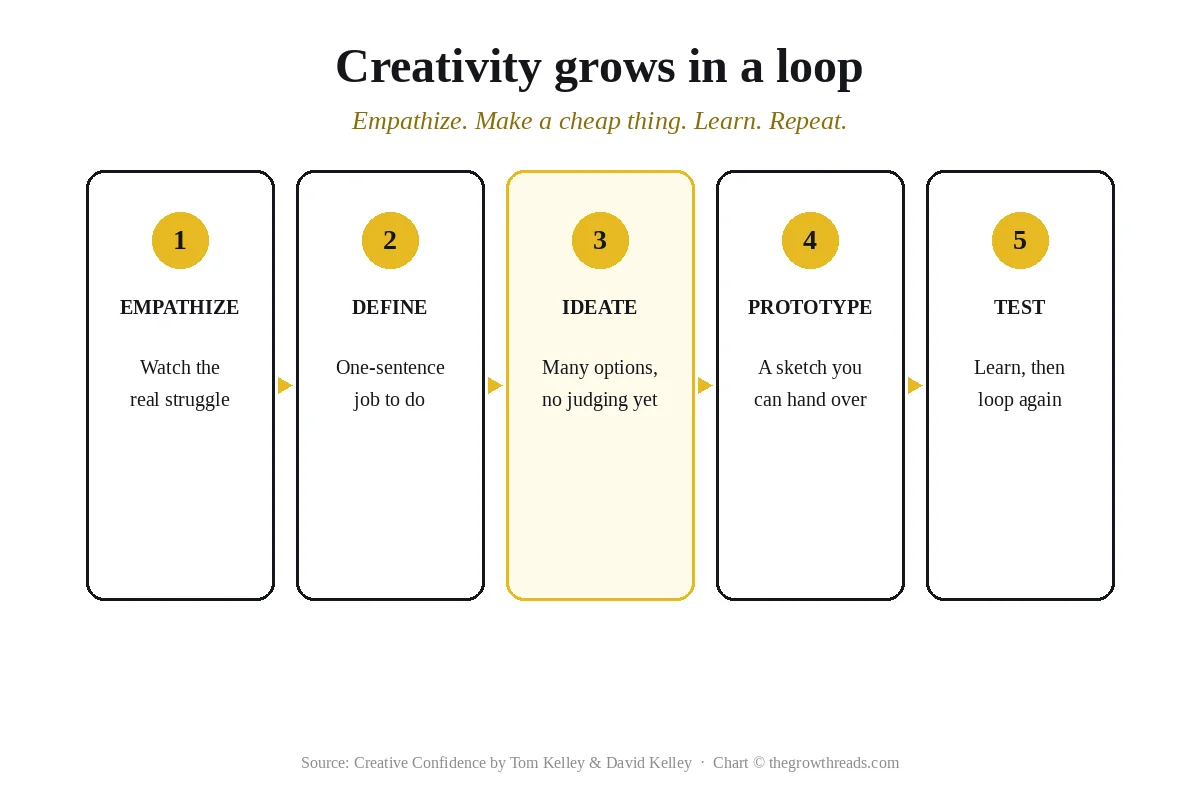
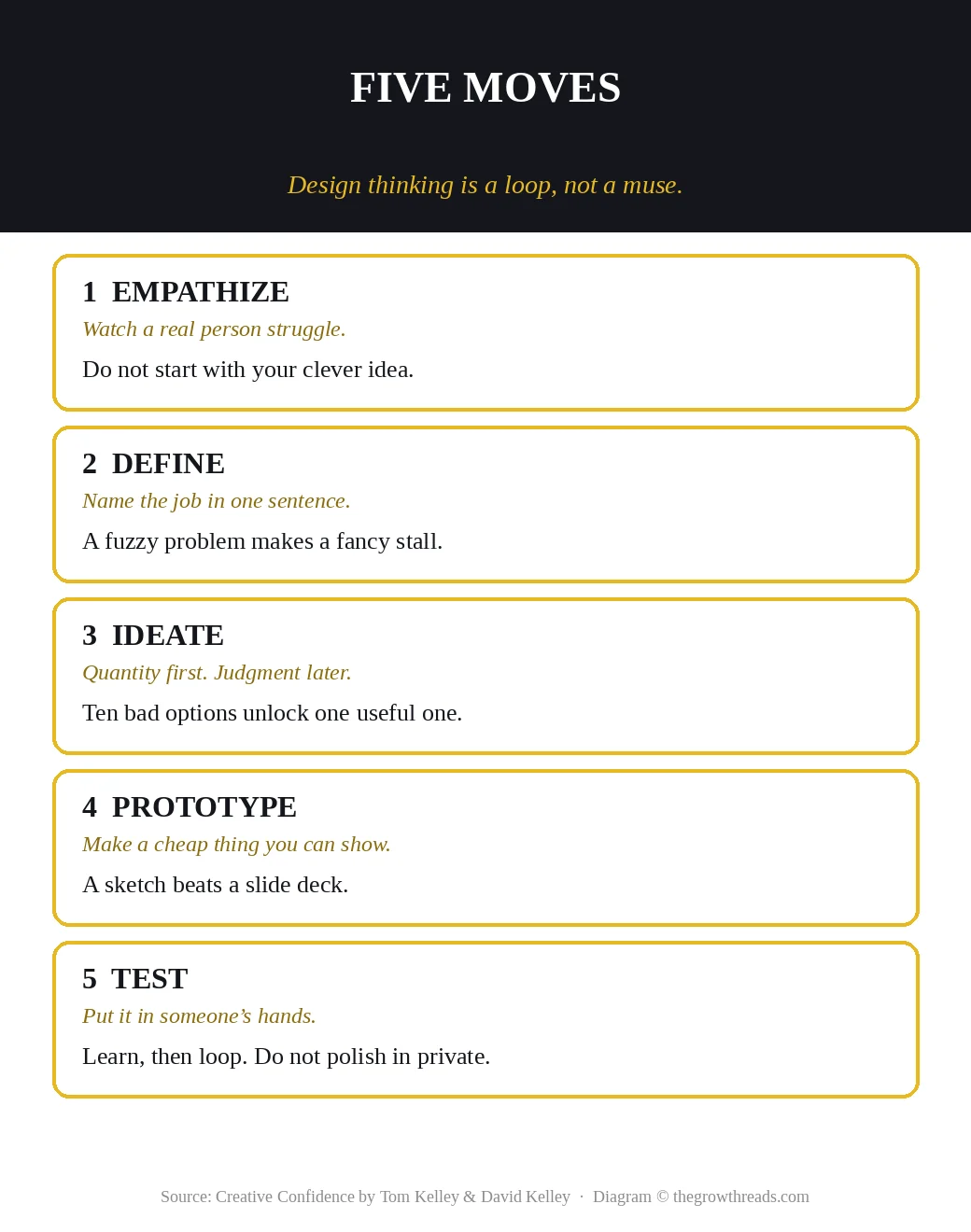
Spark is how insights actually arrive: not from staring at a whiteboard of your own cleverness, but from watching a person in the wild. Empathy here is fieldwork, not a values poster. Sit with the nurse, the new hire, the customer who silently abandons the form. Ask what they are trying to do in one sentence. Define that job before you ideate. Then ideate like a studio: many options, judgment later. The Leap is the prototype — cardboard, a scripted conversation, a fake door on a website, a role-play of the support call. A prototype is a question you can hand someone. If it cannot be shown, it is still a plan, and plans are where fear hides with better fonts.
The Kelleys keep returning to cheap. Expensive prototypes demand they be right. Cheap ones are allowed to be wrong in public, which is the only way they teach. Test means put the thing in someone’s hands and watch, not survey them into a fog. Then loop. Design thinking as they teach it is not a five-box religion. It is a refusal to polish in private. The bug list is the poor person’s insight engine: write down friction you actually feel. That list is tomorrow’s experiment menu.
TGR Note: Linchpin is Godin’s case that the work that matters is art; Creative Confidence is the how for people who believed that lecture and still cannot start. Big Magic is the permission to make without a guarantee. The Creative Act is the studio monk. Use Kelley when you need a loop you can run before lunch, not a cosmology.
Part 4: Seek, Team, Move — put it on the calendar
The last movement is what happens after the first brave afternoon. Seek is stretch: try the adjacent job, the side project, the conversation with someone already living a version of the work. Passion, they argue, is often a lagging indicator. You grow into it by doing, the way Designing Your Life treats interest as something that shows up after a life is in motion. Team is culture as a designed object. Creative confidence dies in rooms where unfinished work is punished and only the polished option may appear. It grows where a manager asks to see the cardboard, where a bug list is a standing agenda, where looking unfinished for twenty minutes is a professional move rather than a character flaw.
Move is the calendar. A bias for action that never gets a block is a poster. The Kelleys want companies — and people — to stop talking as if talk were progress. One try before noon. A weekly prototype hour. A bug list reviewed like a backlog, not a diary. Translate. Empathy is a thirty-minute shadow. The prototype is three paper screens. The spotter is a colleague who will be honest. The streak is four short sessions on next week’s calendar, protected like a lesson.
Who is Creative Confidence best for — and who should read something else first?
Read this if you already ship work, you already believe new ideas matter, and you still freeze when the next step is a sketch, a prototype, or a conversation with a real user. It is especially sharp for managers, product people, and operators who have been typed as “the finisher” and would like the maker back. It is a good companion if you liked Sprint or Designing Your Life and want the inner mechanics those books assume.
Read something else first if you cannot get into the chair at all — go to Atomic Habits or Mini Habits. If your stall is Resistance rather than a missing loop, start with The War of Art. If you need a five-day team process this month, start with Sprint. If the problem is a whole life, not a product, start with Designing Your Life. The Kelleys will not build your calendar. They will tell you which twenty minutes on that calendar actually grow creative confidence.
Questions to reflect on
- Where, specifically, did you learn the story that you are “not a creative type” — and who benefits if you keep it?
- What is the smallest prototype you could show a real person by Friday?
- Who is your spotter — and if you do not have one, who could look at an ugly version without soothing you?
- Of last week’s hours, how many were empathy or making versus talking about making?
- If you treated the next 30 days as guided mastery, what would you stop waiting to feel?
🔥 Ready to stop waiting to feel creative?
Pick one stuck problem. Watch a person, then ship a twenty-minute prototype before noon.
How to apply Creative Confidence (7-day plan)
- Day 1 — Name one stuck problem. Write the human who lives with it. If you cannot name them, you do not have a brief yet.
- Day 2 — Spend 30 minutes watching or interviewing that person. Write the job in one sentence.
- Day 3 — Run thirty circles or ten ugly options on paper. Circle one you could prototype in twenty minutes.
- Day 4 — Build the cheap prototype. Cardboard, a script, three screens. Do not polish. Set a 20-minute cap.
- Day 5 — Show it to a real person. Watch. Write the miss and the fix in a notebook. That is the test.
- Day 6 — Recruit a spotter. Show them the next tiny step. Guided mastery needs a human, not a mood.
- Day 7 — Block four short “try” sessions for next week. Protect them like lessons, not leftover calendar.
Frequently asked questions
What is Creative Confidence about in one paragraph?
Creative Confidence is Tom and David Kelley’s field guide for recovering the maker in people who were typed as operators. They argue that creativity is a trainable belief: you can have a new idea and you can try it. The method is guided mastery plus design thinking — empathize with a real person, define the job, generate many options, prototype something cheap, test it, and loop. It is a studio manual for desks, not a memoir about IDEO’s greatest hits. Read it as a drawer of experiments, not a personality transplant.
Who wrote Creative Confidence, Tom or David Kelley?
Both. David Kelley co-founded IDEO and Stanford’s d.school and is the more public face of design thinking in education. Tom Kelley, his brother, ran IDEO as general manager and wrote The Art of Innovation. Creative Confidence (Crown Business, 2013) is the book they wrote together so people outside the studio could steal the real advantage: a bias for small, human-centered tries. You do not need their earlier books first. You need one experiment on the calendar this week.
What is guided mastery in this book?
Guided mastery is Albert Bandura’s method for building belief with evidence. You shrink the next step until success is likely, you add a human who will not let the inner critic drive, you complete the step, and the nervous system updates. Then you raise the grain. The Kelleys use it to explain why pep talks fail and why a twenty-minute prototype with a colleague watching works. A desk version is three ugly headlines shown to one person before lunch, not a weekend personality retreat. Courage follows the designed win.
Is this the same as design thinking or Sprint?
Same family, different layer. Design thinking is the loop: empathize, define, ideate, prototype, test. Sprint is Knapp’s five-day team calendar for that loop. Creative Confidence is the inner permission and the psychology — why capable people freeze, and how guided mastery and a do-something bias get them moving again. You can run Sprint with a team that still personally believes they are “not creative.” This book is for that belief. Use Sprint when you have five days and a squad. Use Kelley when the blocker is you, a sketch, and a Tuesday morning.
Can I use this if I am not a designer?
Yes. That is the point of the book. The stories come from IDEO and the d.school because those rooms already treat making as a craft. The drills translate. Empathy is watching a colleague fight a form. A prototype is a script for a difficult conversation, a paper mock of a dashboard, a two-line email test. Thirty circles is a warm-up, not an art class. The Kelleys wrote for managers, engineers, teachers, and operators who were typed as non-creative. The studio is optional. The loop is not.
How is this different from The War of Art, The Practice, or Steal Like an Artist?
Pressfield names Resistance. Godin, in The Practice, wants you to ship as a professional habit. Kleon gives you permission to steal a form while you find a voice. The Kelleys give you a human-centered loop and a psychology of tiny wins. Use Pressfield when you know what to make and will not start. Use Godin when the identity is the work. Use Kleon when you need to copy without shame. Use Creative Confidence when the missing piece is a user, a prototype, and a spotter. They nest. None of them replace a try you can show.
Should I read Designing Your Life or Atomic Habits instead?
Read Atomic Habits if the problem is showing up at all. Read Designing Your Life if the problem is a whole career you have been treating as a calling you must hunt. Read Creative Confidence if you already sit down and still freeze when the work asks for a new idea in public. They nest. Clear gets you in the chair. Burnett and Evans get you to prototype a life. The Kelleys tell you how the next twenty-minute studio hour should feel. None of them replace a human who will look at the ugly version with you.
Related summaries
- Designing Your Life — Stanford d.school tools for a stuck career, from Kelley’s colleagues.
- Sprint — Knapp’s five-day team calendar for the same design loop.
- Steal Like an Artist — permission to copy a form while you practice making.
- The Practice — Godin on shipping creative work as a habit, not a mood.
- Best productivity books — the full Productivity pillar.
How we analyze books: every book on The Growth Reads is read cover to cover, summarized in thousands of words of original analysis, and rated against our five-criteria rubric (lasting impact, evidence quality, practical application, writing & originality, external consensus). Read our full methodology.