

★★★★⅗ 4.6/5 — Ask until they name the need, then show you can meet it.
Best for: Founders and sellers who already have a real offer and still lose the room by pitching features too soon.
Reading time: ~4 hrs (guide: 14 min)
Difficulty to apply: Easy to cut three situation questions this week; hard to wait for an explicit need before you demo.
SPIN Selling in one minute
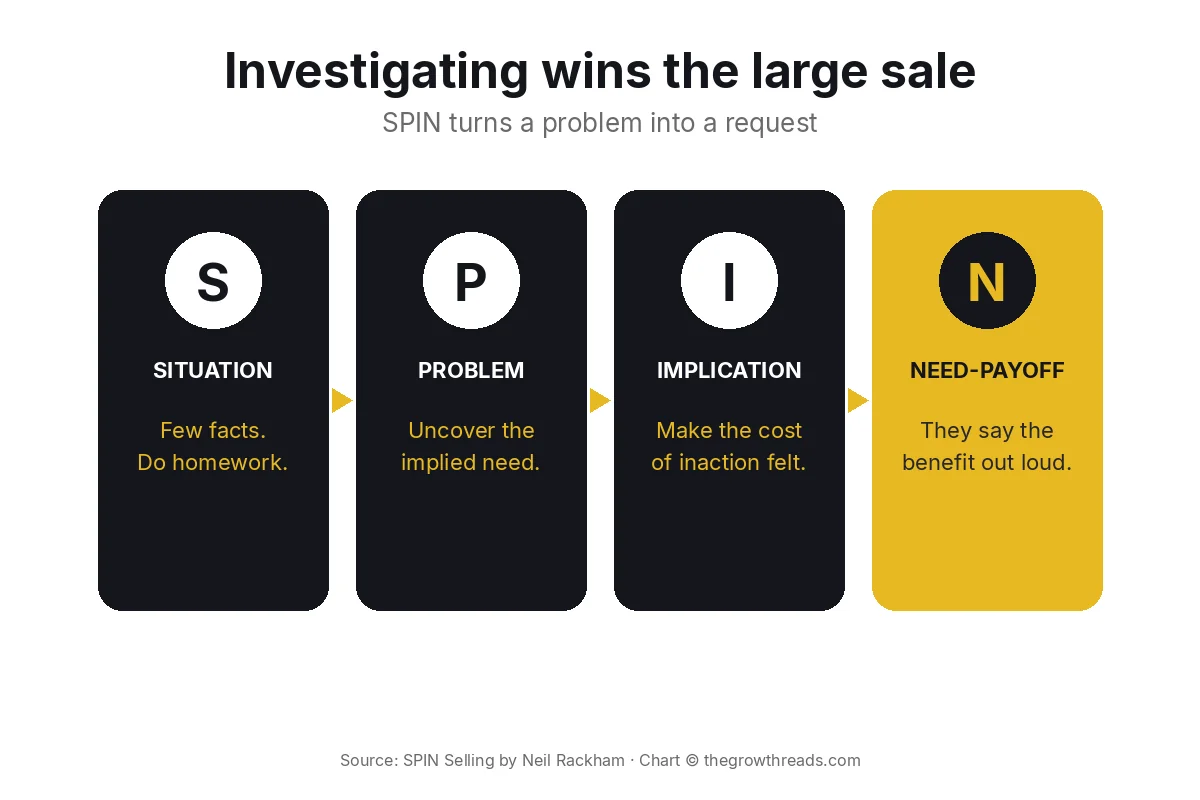
In a large sale, the close is not the skill — investigating is. Neil Rackham’s SPIN Selling (McGraw-Hill, 1988) is the field report from 35,000 observed calls: traditional closes and feature dumps work when the deal is small and the call is one. They backfire when the buy takes months, several people, and a real risk to the person who signs. If you take one move from this SPIN Selling summary, stop pitching. Ask a problem, then an implication, and wait until they say they want a change.
Key takeaways
- Large is not small: What wins a one-call order can lose a six-month deal.
- Investigating predicts the win: Questions that grow need matter more than a clever close.
- SPIN is an order: Situation, Problem, Implication, Need-payoff. Skip the middle two and you are still dumping.
- Few situation questions: Do not ask what a public page already answers.
- Implied needs are not enough: “We have a problem” does not predict a large-sale win. “We need a solution” does.
- Implication does the heavy lifting: Make the cost of inaction felt before you demo.
- Need-payoff lets them sell themselves: They describe the value of a fix.
- Features are weak early: Facts before an explicit need create objections.
- Want an Advance, not a Continuation: A dated next step with skin, not “let’s talk again.”
- Prevent objections: If you investigated, fewer surprises show up at the end.
What is SPIN Selling about?
SPIN Selling is Neil Rackham’s research-backed method for complex sales: use Situation, Problem, Implication, and Need-payoff questions to turn a buyer’s dissatisfaction into an explicit request, then demonstrate capability and win a realistic next commitment — without hard closes or a feature dump.
About the author
Neil Rackham is a British researcher and consultant who treated selling as something you could observe, count, and improve. With Huthwaite he recorded tens of thousands of sales calls, then wrote the result so a working rep could use it on Tuesday. SPIN Selling (1988) is the flagship; later books stay in the same family — consultative selling as a practiced skill, not a personality type. He has taught as a visiting professor at Portsmouth, Cranfield, and Sheffield. The credential is the dataset, not a stage persona. Explore all Neil Rackham book summaries →
Key concepts at a glance
| Concept | What it means | Use it when |
|---|---|---|
| Large vs small sale | Multi-call, multi-person, real risk — not a one-visit order | Your closer tricks stop working |
| Investigating | The call stage that uncovers and develops need | You talk product before they feel a gap |
| Situation questions | Background facts. Overuse bores and loses | You are interrogating instead of preparing |
| Problem questions | Find implied needs — trouble, gaps, dissatisfaction | The call is pleasant and empty |
| Implication questions | Enlarge the cost of leaving the problem alone | They admit a snag and stay unmoved |
| Need-payoff questions | They state the value of a solution | You are listing benefits they did not ask for |
| Implied vs explicit need | A problem vs a request. Only the second predicts a large win | You demo at the first complaint |
| Features / Advantages / Benefits | Facts; how a feature helps; how you meet a stated need | You lead with the spec sheet |
| Advance | A next step that actually moves the decision | Every call ends in “let’s reconnect” |
Part 1 — Why closing dies in a large sale
Rackham’s opening fight is with a myth that still sells training: the good seller is a closer. That story fits a small sale — one visit, one person, a signature before lunch. In major sales his researchers watched the opposite. The more classic closing techniques showed up, the worse the call tended to go. Pressure arrived before value. The “always be closing” line, imported from a smaller game, trained people to snatch at a commitment the other side was not ready to give.
A large sale is a chain of calls with several stakeholders and a real cost of being wrong. The skill that predicted success was not a clever close at minute fifty. It was investigating: questions that found a problem, grew it, and got the buyer to want a fix. Preliminaries, capability, and commitment still matter. They sit on top of need. Without it, your demo is a brochure with a pulse.
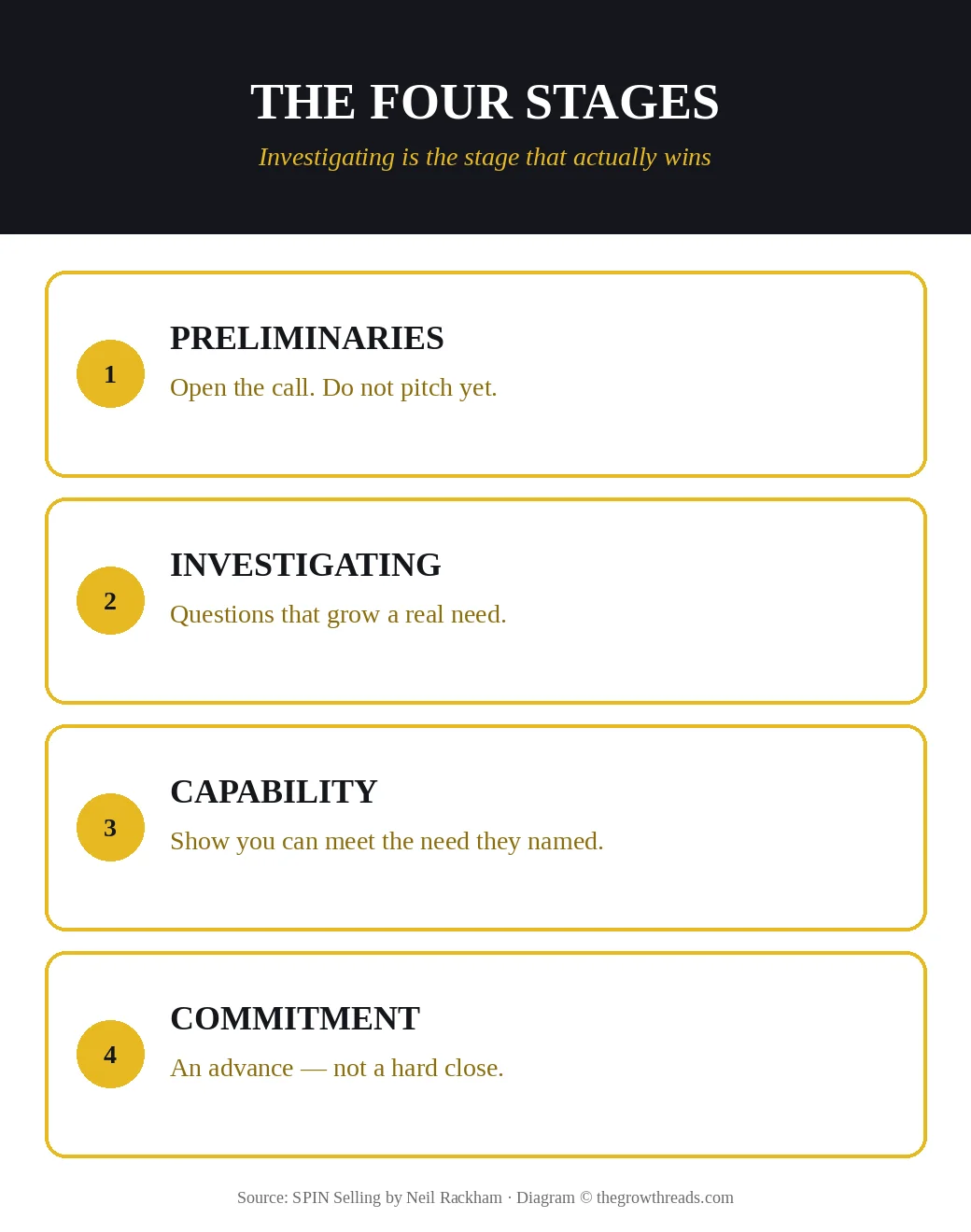
Take one live deal that is not a one-call order. Write the last call as four boxes: open, questions, pitch, ask. If “pitch” is fat and “questions” is three situation facts, you are running a small-sale script on a large-sale problem. Cut the close list. Put one extra investigating question on the card instead.
TGR Note: Pitch Anything is Klaff on the first five minutes of status — frame, prize, a decision while the hook is warm. Use it when the room already treats you as the petitioner. Use Rackham when the deal is a chain of calls and you keep losing by talking product. To Sell Is Human is Pink on everyday moving: attunement, buoyancy, clarity. Stack them. Do not use a close from a one-call world to skip the investigating Rackham measured.
Part 2 — The SPIN questions
SPIN is four kinds of question, in an order that matches how a buyer changes their mind. Situation questions collect facts. Necessary, and poisonous in bulk — in larger sales they correlated with poorer calls when they crowded out the rest. Do the homework. Ask only the facts you cannot get elsewhere, and only enough to set up a problem.
Problem questions hunt implied needs: where it is hard, what breaks. The buyer does not have to want your product yet. They have to admit a gap. Implication questions make the cost of inaction felt — delay, risk, a number on a goal they already own. Average sellers hear a problem and jump to a demo. Strong sellers stay until the gap is expensive. Need-payoff flips the light: they describe the value of a fix. You have not yet read the spec sheet at them.
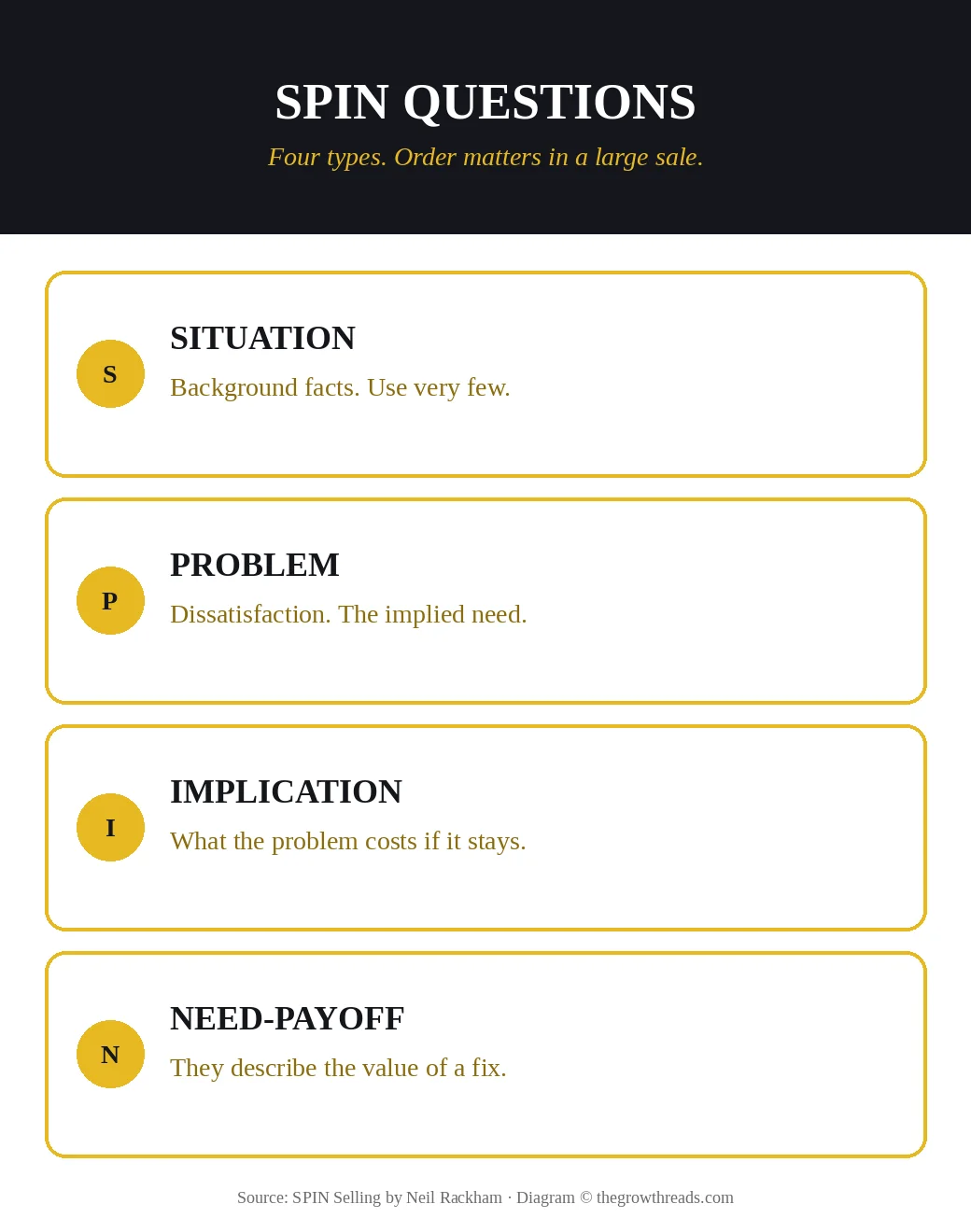
Write four questions for one real meeting, labeled S, P, I, N. Cap situation at two. Draft two problem questions you could not answer from their website, two implication questions that hit money or a goal, and one need-payoff you will ask only after they have felt the cost. If you cannot write the implication without naming your product, you are still pitching.
TGR Note: The Mom Test is the opposite-looking job with the same respect for truth: ask about their life, not your idea. Use Fitzpatrick when you are still discovering whether a problem exists. Use Rackham when you are in an active sale and the problem is on the table but has not become a request. Talk Like TED is how an idea travels in eighteen minutes. Use Gallo for a room that is an audience. Use SPIN for a room that has to buy.
Part 3 — Implied needs, explicit needs, and benefits
Rackham splits needs because the split predicts the outcome. An implied need is a problem: the reporting is slow, the handoff drops. It is real, and in a large sale it is not enough. An explicit need is a want: we need a way to close in two days. Implied needs did not line up with wins in major sales. Explicit needs did. SPIN is the conversion — problem finds the gap, implication grows it, need-payoff invites the explicit sentence. Then a benefit has somewhere to land.
Features are facts about the product. Weak, and often negative early in large sales: they invite “so what” and price pushback. Advantages show how a feature could help even if they have not asked. Benefits, here, are narrower than the brochure word: you show how you meet an explicit need they already stated. If they have not said they want it, you cannot give a benefit yet. A demo at the first complaint creates objections because you solved a need that was still implied.
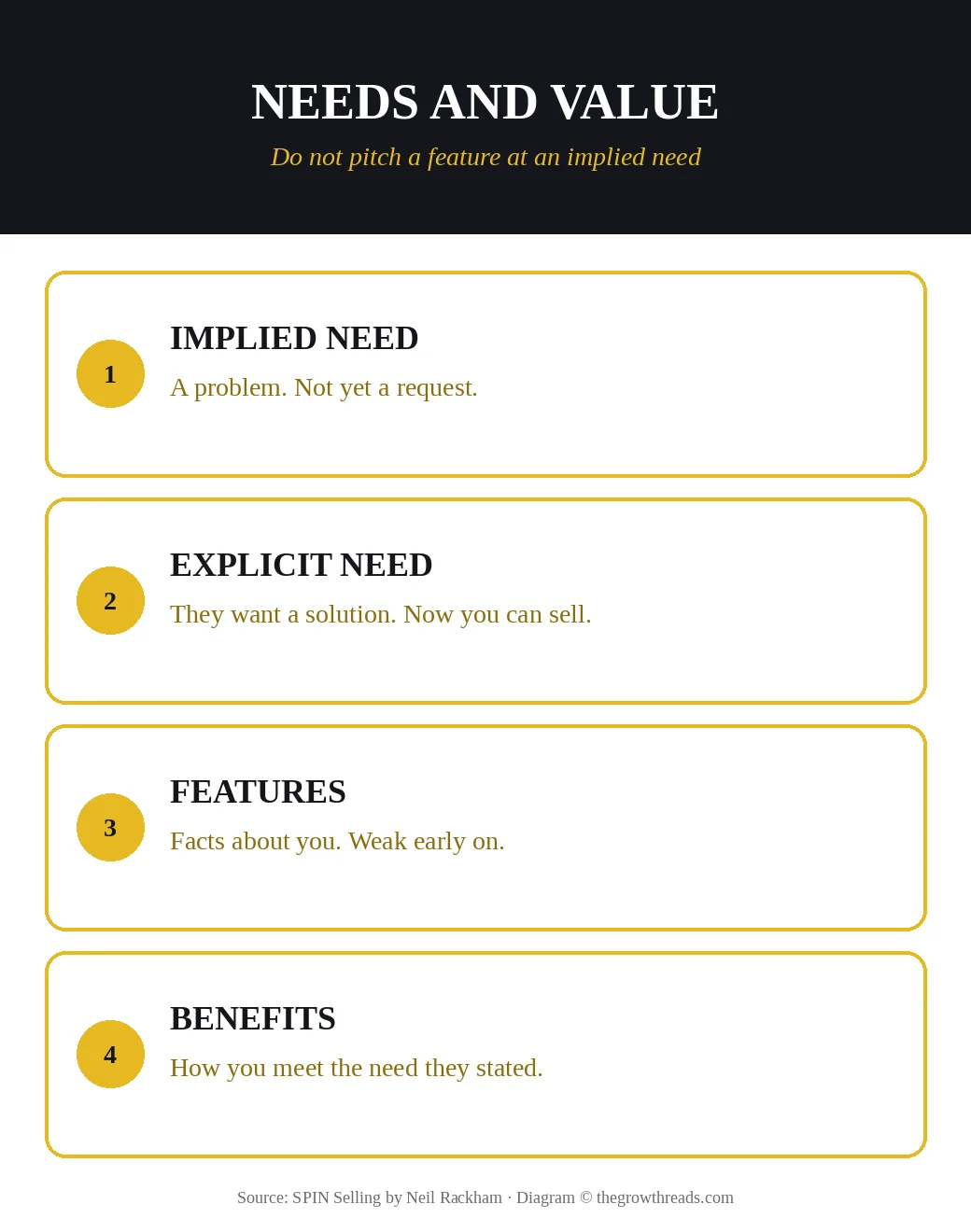
Highlight every time you described your product on the last call. Mark whether an explicit need existed in the minute before. If the highlight lands on a complaint, you sold early. Next call, earn “we need…” before you show the screen. If you cannot get that sentence, you have an investigating problem, not a pitch problem.
TGR Note: Building a StoryBrand makes the customer the hero of the narrative. Rackham makes the customer the author of the need. Those two live together: they are the hero, and they still have to say what they want. Made to Stick is the Heath brothers on an idea that survives without you. Use it when the story has to travel to a stakeholder who is not in the call. Use SPIN when you are still in the call and the need has not been spoken.
Part 4 — Stages, advances, and a realistic next step
Almost every call moves through four stages: preliminaries, investigating, demonstrating capability, obtaining commitment. In a large sale, investigating carries the result. Keep preliminaries short with senior people. Show capability against needs that already exist, not a tour of every module. Successful sellers checked remaining concerns, summarized the benefits the buyer had named, and proposed the highest realistic next step that person could actually give.
Name the ending honestly. An Advance moves the decision — a meeting with the economic buyer, a trial with success criteria. A Continuation is activity without movement: another chat, “let’s stay in touch.” Continuations feel like work. They are how six-month deals die of politeness. Traditional closes, used as a habit, push people there because the need was never built. Prevent objections by investigating until the need is explicit. Handling them later is downstream of that miss.
Put the four stages on a card for one live call. Script a two-sentence open, the SPIN questions, the one capability you will show only if an explicit need appears, and the Advance you will ask for. If you leave with a Continuation, log it as a Continuation, not a win.
TGR Note: The Go-Giver is Burg and Mann on giving more value than you take. Rackham is not asking you to become extractive. He is asking you not to fund a maybe with a feature tour. Contagious is Berger on why an idea spreads after you leave. SPIN is why they ask for the next step before you leave. If you need both a decision path and a story that travels to the committee, read them as a pair, not a fight.
Who is SPIN Selling best for — and who should read something else first?
Best for people who sell something that takes more than one conversation and currently lose by pitching early — especially if “send more information” is the default ending.
If you do not yet know whether anyone has the problem, start with The Mom Test. If the bottleneck is the first five minutes of status, start with Pitch Anything. For a keynote, Talk Like TED or Building a StoryBrand. For everyday asks, To Sell Is Human. Come here when a complex buyer has not yet said they want a change.
Questions to reflect on
- In your last important call, did you get an explicit need — or only a complaint?
- How many situation questions could you have answered before you walked in?
- Where did you demo before the cost of inaction was felt?
- Was the ending an Advance, a Continuation, or a close you forced too soon?
- What one implication question will you ask in the next meeting?
🔥 Ready to stop pitching so soon?
Ask one implication question, wait for the explicit need, then propose a real advance.
How to apply SPIN Selling (7-day plan)
- Day 1 — Sort the deal. Pick one live opportunity that is not a one-call order. Write why it is large: people, risk, more than one meeting.
- Day 2 — Cut situation. List the fact questions you usually ask. Delete any you could answer from their site or last email. Keep two.
- Day 3 — Two problem questions. Write two that hunt a gap, not a compliment. Practice them out loud once.
- Day 4 — One implication. Connect a known snag to money, time, or a goal they already own. One sentence. No product name.
- Day 5 — Need-payoff, then stop. Draft the question that lets them describe the value of a fix. Do not answer it for them.
- Day 6 — Live call. Run S-P-I-N. Do not demo until you hear an explicit need. If you do not hear it, do not force the tour.
- Day 7 — Ask for an Advance. Check concerns, summarize benefits they named, propose the highest realistic next step. Log Continuation as Continuation.
Frequently asked questions
What is SPIN Selling about?
SPIN Selling is Neil Rackham’s 1988 field book from 35,000 observed sales calls. In a large, multi-call deal, classic closes and feature dumps fail. Success comes from investigating: Situation, Problem, Implication, and Need-payoff questions that grow a vague dissatisfaction into an explicit request. You then show capability against that named need and ask for a realistic advance — not a hard close. If you take one move from this SPIN Selling summary, stop pitching features at a problem they have not yet felt. Ask until they say they want a change.
What does SPIN stand for?
SPIN is four question types in order. Situation gathers a few facts — do the homework so you do not interrogate. Problem uncovers implied needs: trouble, dissatisfaction, a gap. Implication enlarges the cost of leaving that gap alone; this is the question set that separates strong people in large sales. Need-payoff is positive and solution-centered: they describe the value of a fix, which turns an implied need into an explicit one. Use the sequence on a real call this week. Memorizing the letters without asking an implication question is a poster, not the method.
What is the difference between implied and explicit needs?
An implied need is a problem: “Our reporting is slow.” It is dissatisfaction without a request. An explicit need is a want: “We need a way to close the books in two days.” Rackham’s research found implied needs do not predict a win in a large sale; explicit needs do. SPIN is the bridge. Problem questions find the implied need. Implication questions make the cost vivid. Need-payoff questions get the buyer to state the value of a solution. Pitch features only after that sentence exists. If you demo at the first complaint, you are selling too early.
Do closing techniques work in SPIN Selling?
In small, one-call sales, a close can help. In large sales, Rackham found traditional closing techniques were ineffective or harmful — they create pressure before value is built. The job at the end of a call is not a signature every time. It is an Advance: a concrete next step that moves the decision, with skin. A Continuation (“let’s talk again”) is polite stall. Check remaining concerns, summarize the benefits they named, then propose the highest realistic commitment. Prevent objections by investigating first. Do not collect another twenty closes from a listicle and run them on a six-month deal.
Who should read SPIN Selling?
Sellers, founders, and anyone who has to win a multi-meeting yes — a budget, a pilot, a renewal — and currently dies by pitching too soon. Useful if you prepare a strong deck and still hear “send more information.” Skip it as a first book if you do not yet know whether the problem is real; start with The Mom Test. If the room is a keynote, Talk Like TED will serve the stage. Come here when a complex buyer has not yet said they want a change.
How is SPIN Selling different from Pitch Anything or The Mom Test?
The Mom Test is discovery: do not pitch until you have heard their life. Pitch Anything is status in a live room: frame, prize, a decision this meeting. SPIN Selling is the investigating spine of a large sale: grow a problem into an explicit need, then show capability. Use Fitzpatrick when you are still guessing. Use Klaff when the first five minutes are a status fight. Use Rackham when the deal takes several calls and feature-dumping is how you currently lose. They stack. They are not the same job.
Is SPIN Selling still relevant?
The calls Rackham recorded were analog. The pattern is not. Complex buys still have multiple stakeholders, delayed decisions, and buyers who will not move on a feature list. Situation questions still bore people when you could have looked it up. Implication questions still do the work that a demo cannot. Need-payoff still beats you listing benefits they did not ask for. Treat the 1988 examples as period film, not as a reason to skip the method. Run one implication question this week. If the room leans in, the book is current. If they glaze, you asked another situation question and called it SPIN.
Related summaries
- Pitch Anything — own the frame in the first five minutes
- The Mom Test — hear their life before you pitch
- To Sell Is Human — move others by serving, every day
- Talk Like TED — make the idea travel in eighteen minutes
- More on the best productivity books pillar
How we analyze books: we read for application, not for a takedown — then we add a plan you can run this week. Read our full methodology.